Page 641 of 1273
EMISSION CONTROL SYSTEMS -Evaporative Emission Control System17-21EC1510
6EM137
EVAPORATIVE EMlS$lON
PURGE SOLENOID
INSPECTIONM17lBFD
NOTE
When disconnecting the vacuum hose, make an identification
mark on it so that it can be reconnected to the original posi-
tion.
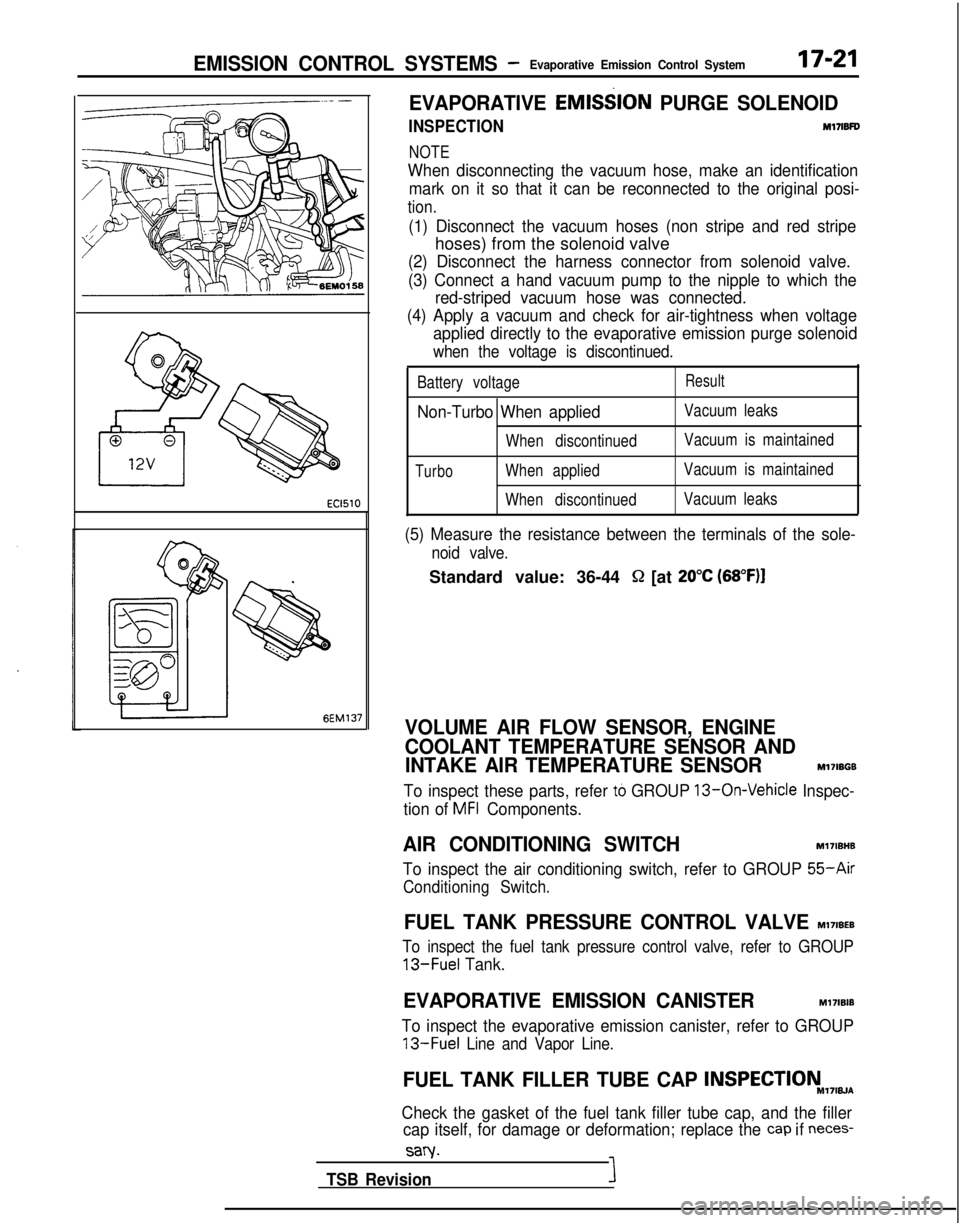
(1) Disconnect the vacuum hoses (non stripe and red stripe
hoses) from the solenoid valve
(2) Disconnect the harness connector from solenoid valve.
(3) Connect a hand vacuum pump to the nipple to which the red-striped vacuum hose was connected.
(4) Apply a vacuum and check for air-tightness when voltage applied directly to the evaporative emission purge solenoid
when the voltage is discontinued.
Battery voltageResult
Non-Turbo When appliedVacuum leaks
When discontinued Vacuum is maintained
TurboWhen appliedVacuum is maintained
When discontinued Vacuum leaks
(5) Measure the resistance between the terminals of the sole-
noid valve.
Standard value: 36-44 Q [at 20°C (68”F)l
VOLUME AIR FLOW SENSOR, ENGINE
COOLANT TEMPERATURE SENSOR AND
INTAKE AIR TEMPERATURE SENSOR
M17IBGB
To inspect these parts, refer to GROUP 13-On-Vehicle Inspec-
tion of
MFI Components.
AIR CONDITIONING SWITCH Ml7IBHB
To inspect the air conditioning switch, refer to GROUP
55-Air
Conditioning Switch.
FUEL TANK PRESSURE CONTROL VALVE MI’IIBEB
To inspect the fuel tank pressure control valve, refer to GROUP
13-Fuel
Tank.
EVAPORATIVE EMISSION CANISTERM17lBlB
To inspect the evaporative emission canister, refer to GROUP
13-Fuel Line and Vapor Line.
FUEL TANK FILLER TUBE CAP INSPECTIONM,7,w~
Check the gasket of the fuel tank filler tube cap, and the filler
cap itself, for damage or deformation; replace the
cap if neces-
sary.
TSB RevisionI
Page 645 of 1273
EMISSION CONTROL SYSTEMS -Exhaust Gas Recirculation (EGR) System17-25
1
.
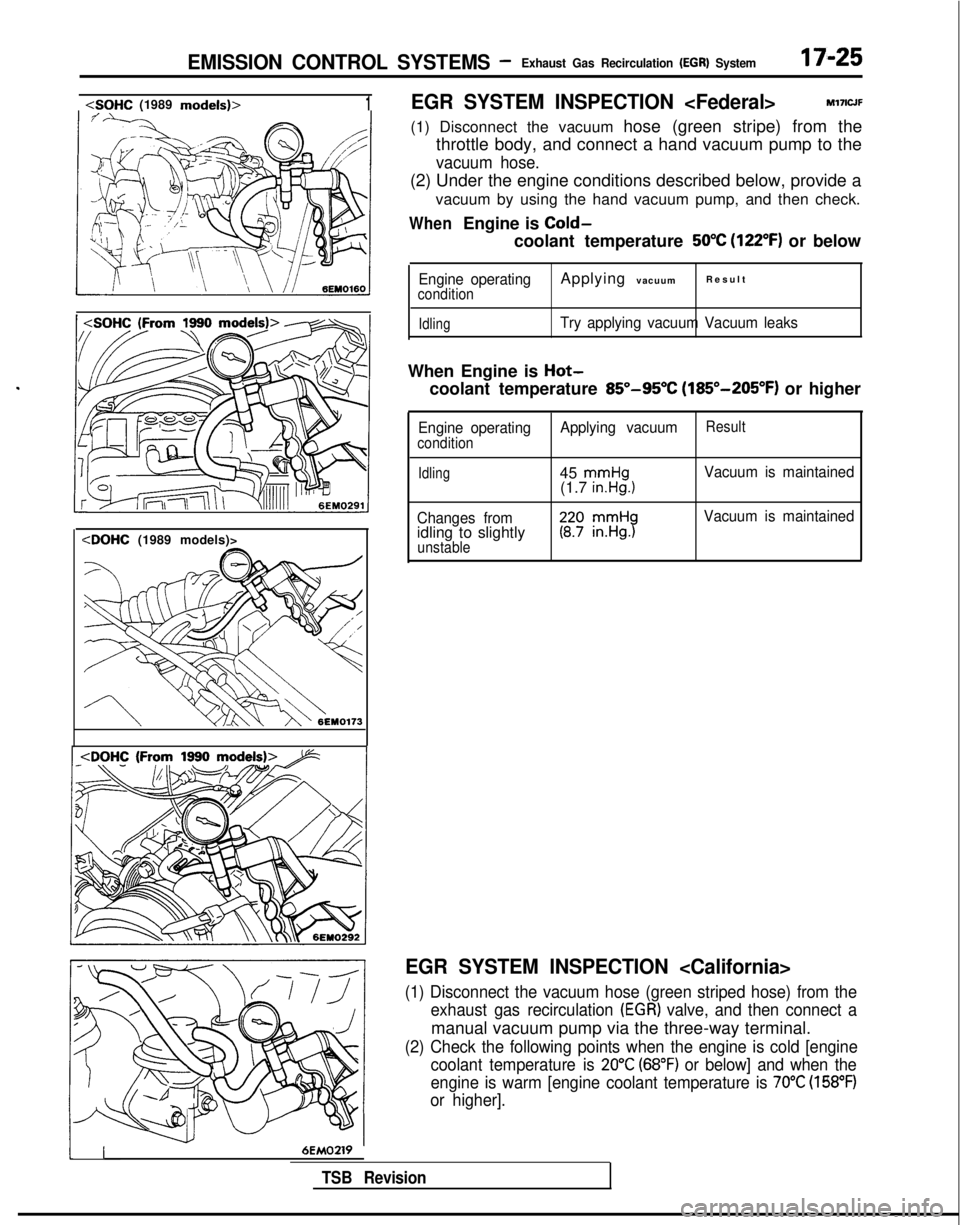
EGR SYSTEM INSPECTION Ml7ICJF
(1) Disconnect the vacuum hose (green stripe) from the throttle body, and connect a hand vacuum pump to the
vacuum hose.
(2) Under the engine conditions described below, provide a
vacuum by using the hand vacuum pump, and then check.
WhenEngine is Cold-
coolant temperature 50°C (122°F) or below
Engine operatingconditionApplying vacuumResul
t
IdlingTry applying vacuum Vacuum leaks
When Engine is Hot-
coolant temperature 85”-95°C (185”-205°F) or higher
Engine operatingconditionApplying vacuumResult
Idling45 mmHg(1.7 in.Hg.1Vacuum is maintained
Changes from
idling to slightlyunstable
Vacuum is maintained
EGR SYSTEM INSPECTION
(1) Disconnect the vacuum hose (green striped hose) from the exhaust gas recirculation
(EGR) valve, and then connect a
manual vacuum pump via the three-way terminal.
(2) Check the following points when the engine is cold [enginecoolant temperature is
20°C (68°F) or below] and when the
engine is warm [engine coolant temperature is
70°C (158°F)
or higher].
116EMOZW
TSB Revision
Page 646 of 1273
17-26EMISSION CONTROL SYSTEMS- Exhaust Gas Recirculation (EGR) System
~
I6EM0224 1
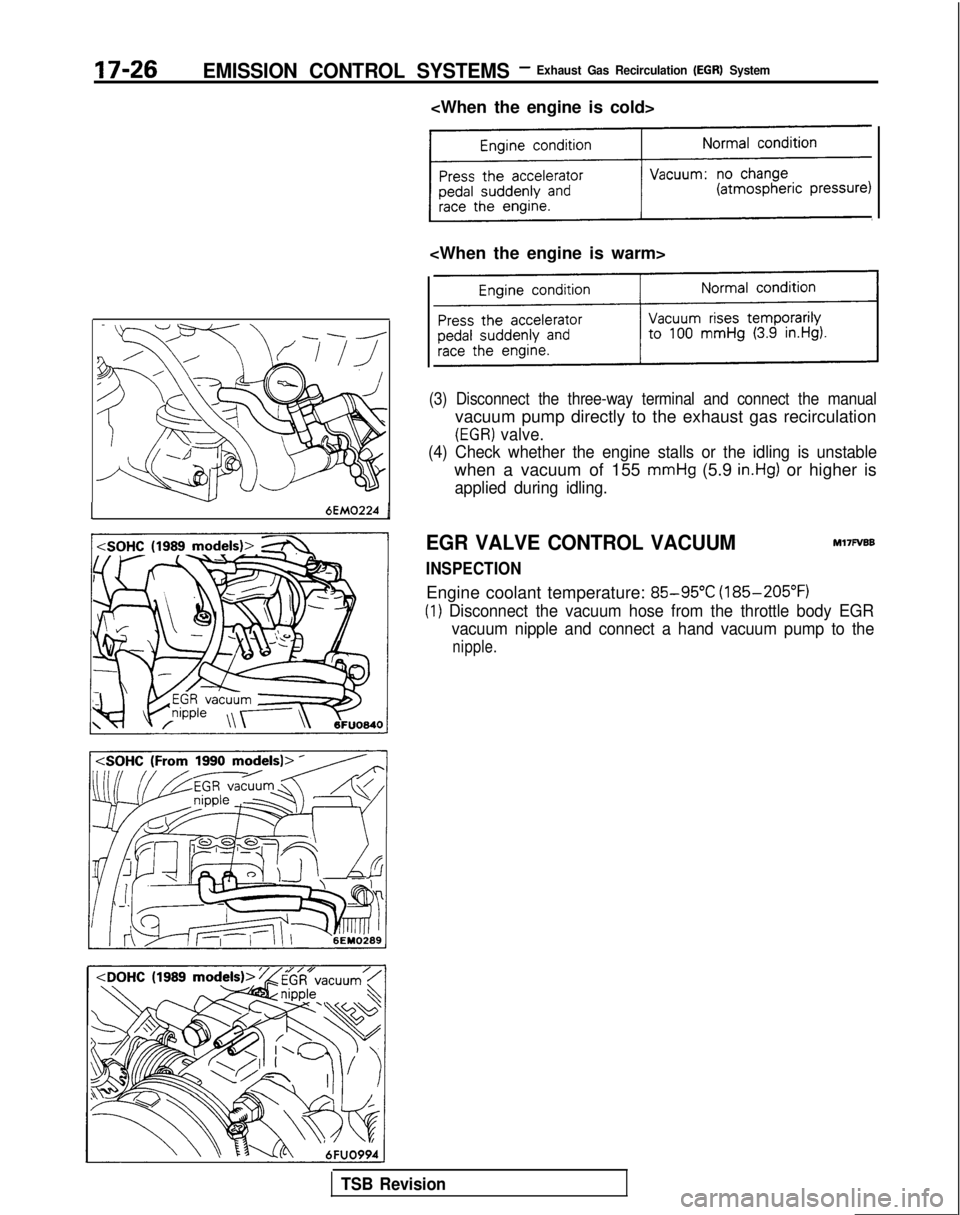
(3) Disconnect the three-way terminal and connect the manual
vacuum pump directly to the exhaust gas recirculation
(EGR) valve.
(4) Check whether the engine stalls or the idling is unstable
when a vacuum of 155 mmHg (5.9 in.Hg) or higher is
applied during idling.
EGR VALVE CONTROL VACUUM
INSPECTION M17WBB
Engine coolant temperature: 85-95°C
(185-205°F)
(1) Disconnect the vacuum hose from the throttle body EGR
vacuum nipple and connect a hand vacuum pump to the
nipple.
TSB Revision
Page 647 of 1273
![MITSUBISHI GALANT 1989 Service Repair Manual EMISSION CONTROL SYSTEMS -Exhaust Gas Recirculation (EGR) System1 T-27
1 <DOHC (From 1990 models)>/]
LEngine speed (rpm)
lFU446
4zJ -6EM159
(2) Start the engine and check to see that, after raising th](/manual-img/19/57312/w960_57312-646.png "MITSUBISHI GALANT 1989 Service Repair Manual EMISSION CONTROL SYSTEMS -Exhaust Gas Recirculation (EGR) System1 T-27
1 <DOHC (From 1990 models)>/]
LEngine speed (rpm)
lFU446
4zJ -6EM159
(2) Start the engine and check to see that, after raising th")
EMISSION CONTROL SYSTEMS -Exhaust Gas Recirculation (EGR) System1 T-27
1 /]
LEngine speed (rpm)
lFU446
4zJ -6EM159
(2) Start the engine and check to see that, after raising the
engine speed by racing the engine, vacuum raises prop-
ortionately with the rise in engine speed.
NOTE
if there is a problem with the change in vacuum, it is
possible that the throttle body port may be clogged and
require cleaning.
EGR VALVE
INSPECTION MI’IICKF
(1) Remove the EGR valve and check it for sticking, deposit of
carbon, etc.
If such condition exists, clean with adequate solvent to en-
sure tight valve seat contact.
(2) Connect a hand vacuum pump to the EGR valve.
(3) Apply a vacuum of 500 mmHg (19.6 in.Hg.) and check air
tightness.
(4)Blow in air from one passage of the EGR to check condition
as follows.
INSTALLATION
(1) Install a new gasket and EGR valve, tighten bolts to
specified torque.
Specified tightening torque: 17-26 Nm (12-19 ft.lbs.1
THERMAL VACUUM VALVE Y~JICNG
INSPECTION
(1)Disconnect the vacuum hoses from the thermal vacuum
valve, and connect a hand vacuum pump to nipple of the
thermal vacuum valve.
(2) Apply a vacuum and check the air passage through the
thermal vacuum valve.
Page 649 of 1273
I6EM0187
EMISSION CONTROL SYSTEMSExhaust Gas Recirculation (EGR) System/- Catalytic Converter/Air-fuel Ratio Control (MPI) System17-29
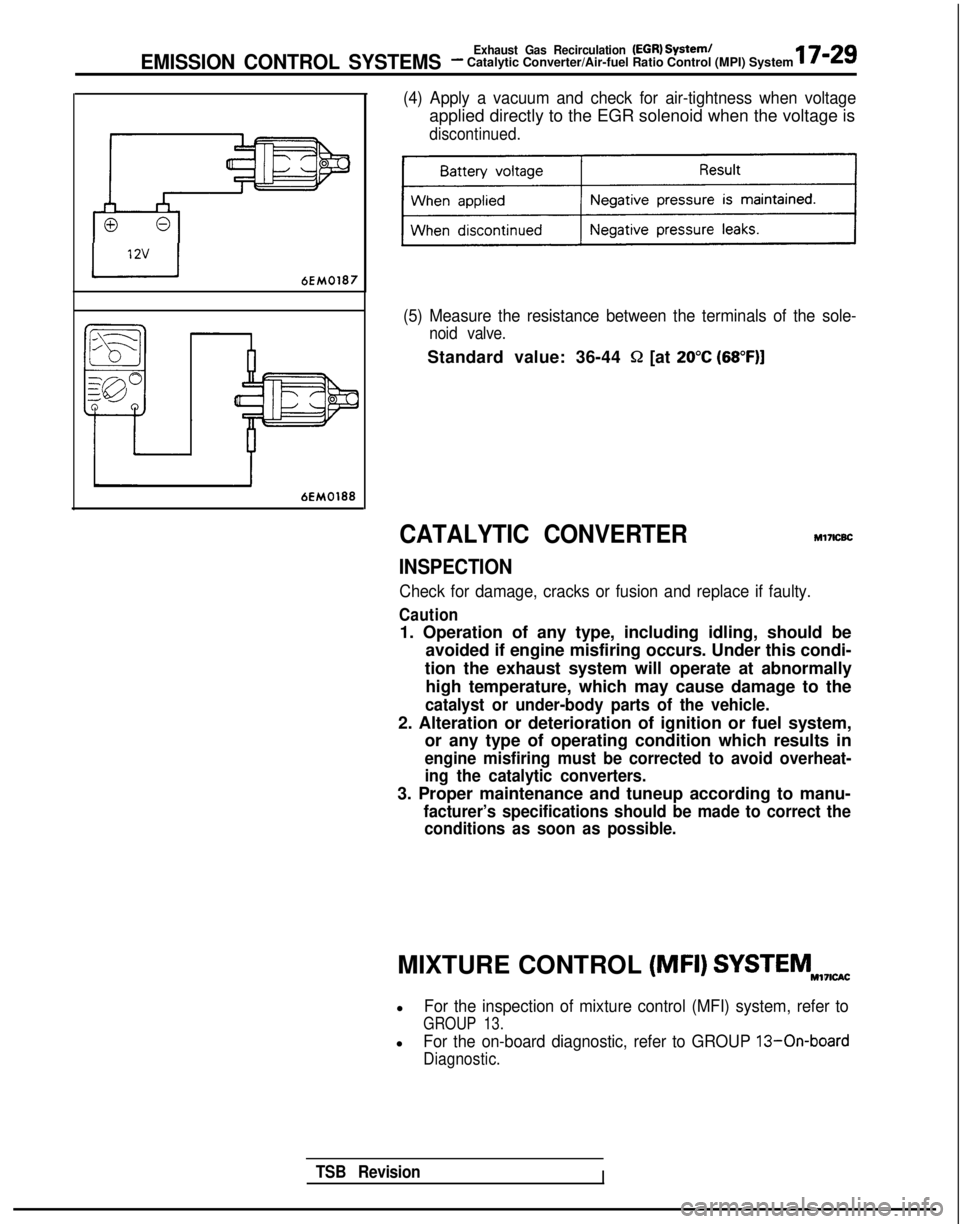
(4) Apply a vacuum and check for air-tightness when voltage
applied directly to the EGR solenoid when the voltage is
discontinued.
(5) Measure the resistance between the terminals of the sole-
noid valve.
Standard value: 36-44 Q [at 20°C (68”F)]
CATALYTIC CONVERTERMl7lcBc
INSPECTION
Check for damage, cracks or fusion and replace if faulty.
Caution
1. Operation of any type, including idling, should be
avoided if engine misfiring occurs. Under this condi-
tion the exhaust system will operate at abnormally high temperature, which may cause damage to the
catalyst or under-body parts of the vehicle.
2. Alteration or deterioration of ignition or fuel system, or any type of operating condition which results in
engine misfiring must be corrected to avoid overheat-
ing the catalytic converters.
3. Proper maintenance and tuneup according to manu-
facturer’s specifications should be made to correct theconditions as soon as possible.
TSB RevisionI
MIXTURE CONTROL (MFI) SYSTEMNI,I,w
lFor the inspection of mixture control (MFI) system, refer to
GROUP 13.
lFor the on-board diagnostic, refer to GROUP 13-On-board
Diagnostic.
Page 674 of 1273
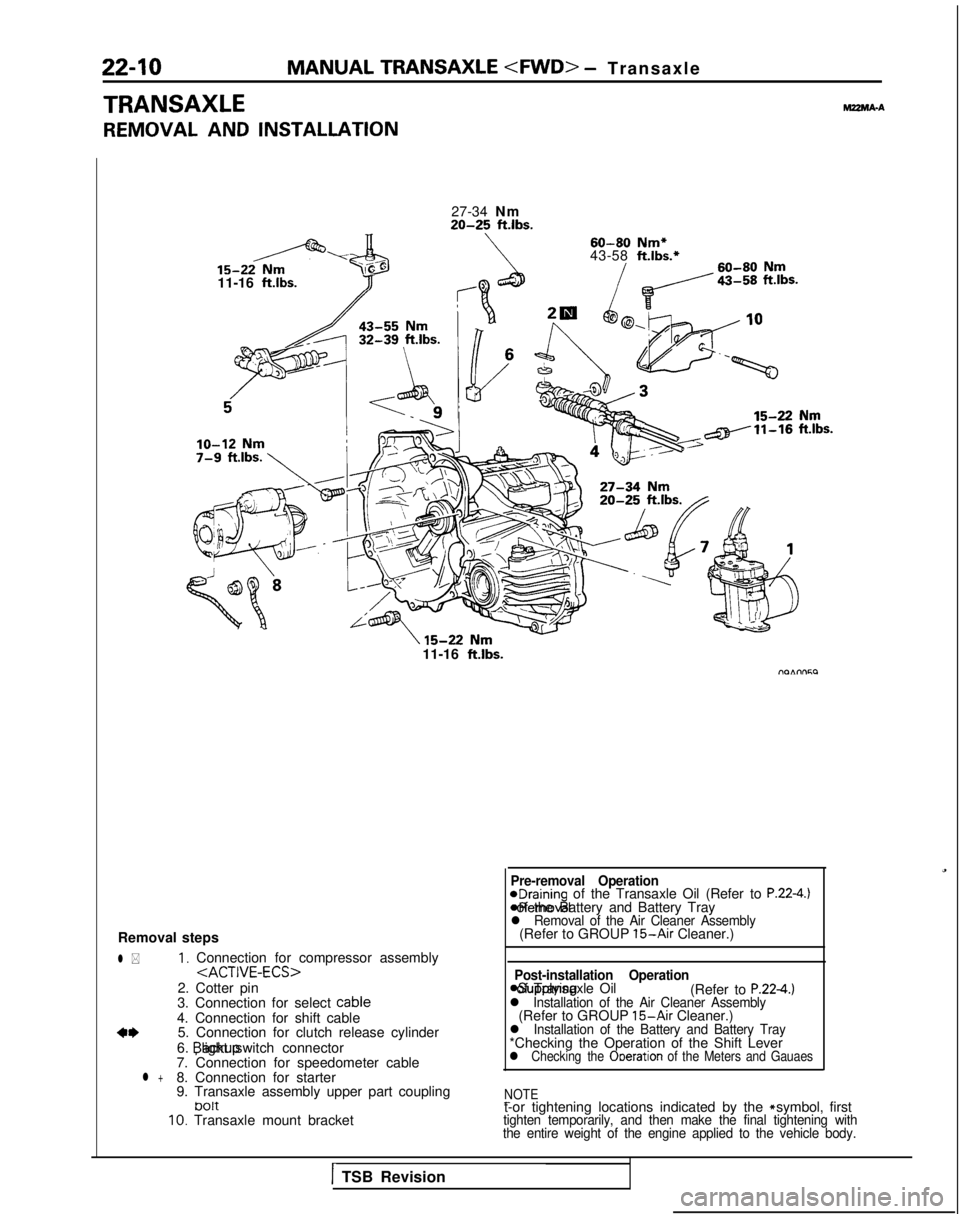
22-10MANUAL TRANSAXLE - Transaxl
e
TRANSAXLE
REMOVAL AND INSTALLATION
MZMA-A
27-34 Nm20-25 ft.lbs.
60-80
Nm*
43-58 ft.lbs.*
11-16
ft.lbs.71
11-16 ftlbs.
Removal steps
l *1, Connection for compressor assembly
2. Cotter pin
3. Connection for select cable
4. Connection for shift cable
a*5. Connection for clutch release cylinder
6. backup light switch connector
7. Connection for speedometer cable
l +8. Connection for starter
9. Transaxle assembly upper part coupling
tJ01t10. Transaxle mount bracket
Pre-removal Operation@Draining of the Transaxle Oil (Refer to P.22-4.) *Removal of the Battery and Battery Tray
l Removal of the Air Cleaner Assembly(Refer to GROUP 15-Air Cleaner.)
Post-installation Operation
asupplying of Transaxle Oil
(Refer to P.224.)l Installation of the Air Cleaner Assembly(Refer to GROUP 15-Air Cleaner.)l Installation of the Battery and Battery Tray*Checking the Operation of the Shift Leverl Checking the Ooeration of the Meters and Gauaes
NOTE
-t-or tightening locations indicated by the * symbol, firsttighten temporarily, and then make the final tightening with
the entire weight of the engine applied to the vehicle body.
1TSB Revision
Page 684 of 1273
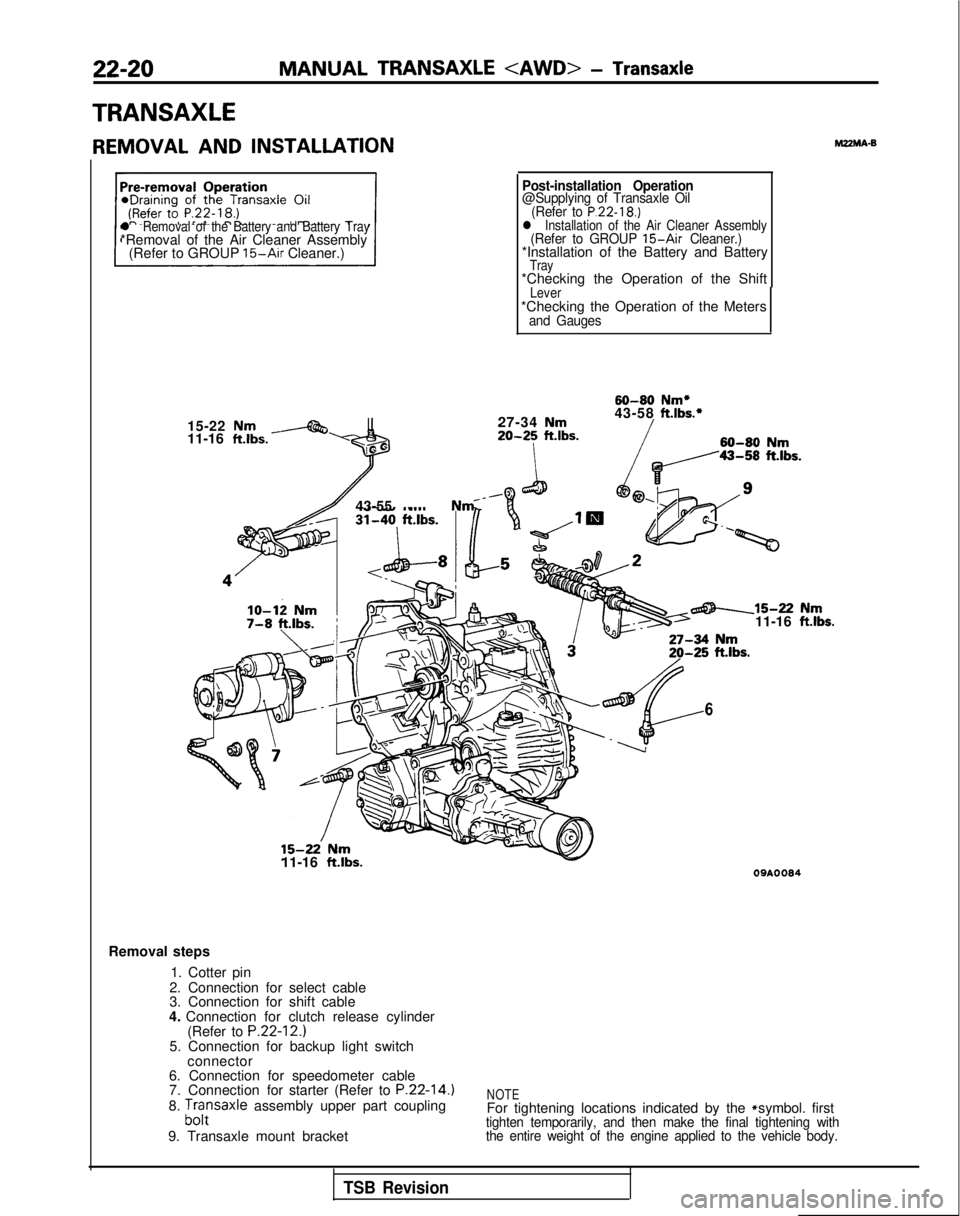
22-20MANUAL TRANSAXLE - Transaxle
TRANSAXLE
REMOVAL AND INSTALLATIONMZMA-B
l Removal of the Battery and Battery Tray*Removal of the Air Cleaner Assembly
(Refer to GROUP 15-Air Cleaner.)
15-22
Nm11-16 ft.lbs.-
lo-12 Nm7-8 ft.lbs.;
Post-installation Operation@Supplying of Transaxle Oil (Refer to P.22-18.)l Installation of the Air Cleaner Assembly(Refer to GROUP 15-Air Cleaner.)*Installation of the Battery and BatteryTray*Checking the Operation of the ShiftLever*Checking the Operation of the Metersand Gauges
60-80
Nm*
27-34
Nm43-58ft.lbs.*
20-25ft.lbs.60-80Nm
43-55 Nm _
15-22’ Nm11-16 ft.lbs.
6
-15-22 Nm11-16 ftlbs.
09AOOS4
Removal steps
1. Cotter pin
2. Connection for select cable
3. Connection for shift cable
4. Connection for clutch release cylinder (Refer to
P.22-12.)5. Connection for backup light switchconnector
6. Connection for speedometer cable
7. Connection for starter (Refer to
P.22-14.)8. ;,,:saxle assembly upper part coupling
9. Transaxle mount bracketNOTEFor tightening locations indicated by the * symbol. firsttighten temporarily, and then make the final tightening with
the entire weight of the engine applied to the vehicle body.
TSB Revision
Page 726 of 1273
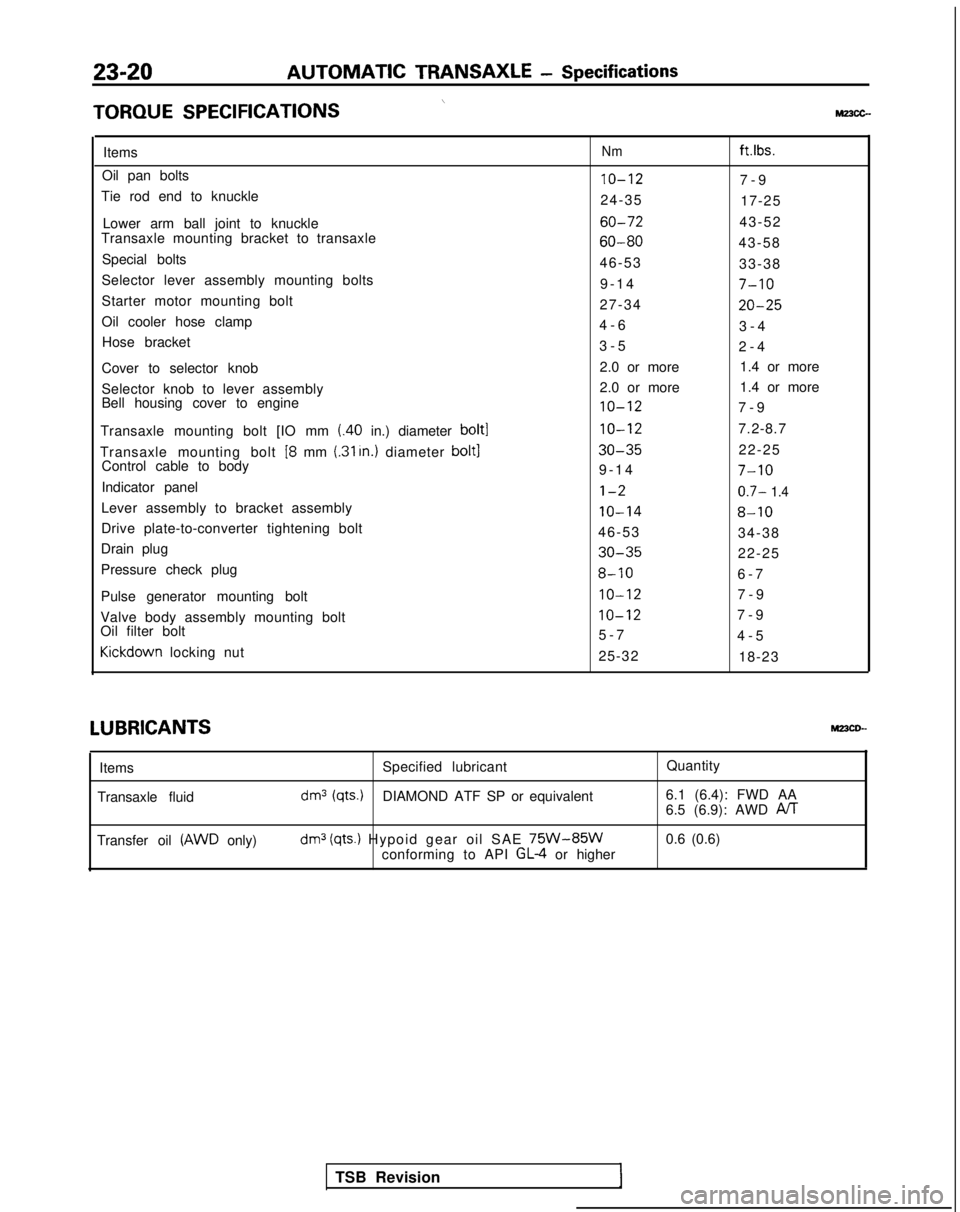
23-20AUTOMATIC TRANSAXLE
- Specifications
\TORQUE
SPECIFICATIONSMz3cc-
ItemsNmft.lbs.
Oil pan bolts10-127-
9
Tie rod end to knuckle 24-3517-25
Lower arm ball joint to knuckle
60-7243-52
Transaxle mounting bracket to transaxle
60-8043-58
Special bolts 46-5333-38
Selector lever assembly mounting bolts 9-1
4
7-10
Starter motor mounting bolt
27-3420-25
Oil cooler hose clamp4-
6
3-4
Hose bracket 3-52-4
Cover to selector knob 2.0 or more
1.4 or more
Selector knob to lever assembly 2.0 or more
1.4 or more
Bell housing cover to engine
10-127-
9
Transaxle mounting bolt [IO mm
(.40 in.) diameter bolt110-127.2-8.7
Transaxle mounting bolt
[8 mm (.31 In.) diameter bolt130-3522-25
Control cable to body 9-1
4
7-10
Indicator panell-20.7- 1.4
Lever assembly to bracket assembly10-148-10
Drive plate-to-converter tightening bolt
46-5334-38
Drain plug
30-3522-25
Pressure check plug
8-106-
7
Pulse generator mounting bolt
IO-127-
9
Valve body assembly mounting bolt
IO-127-
9
Oil filter bolt 5-74-5Kickdown
locking nut
25-3218-23LUBRICANTS
MPCD--
Items
Transaxle fluid Specified lubricant
Quantity
dm3 (qts.)DIAMOND ATF SP or equivalent6.1 (6.4): FWD AA
6.5 (6.9): AWD PJT
Transfer oil (AWD only)dm3 (qts.) Hypoid gear oil SAE 75W-85Wconforming to API GL-4 or higher0.6 (0.6)
TSB Revision