1989 MITSUBISHI GALANT check engine
[x] Cancel search: check enginePage 728 of 1273
23-22 AUTOMATIC
TRANSAXLE
- Troubleshooting
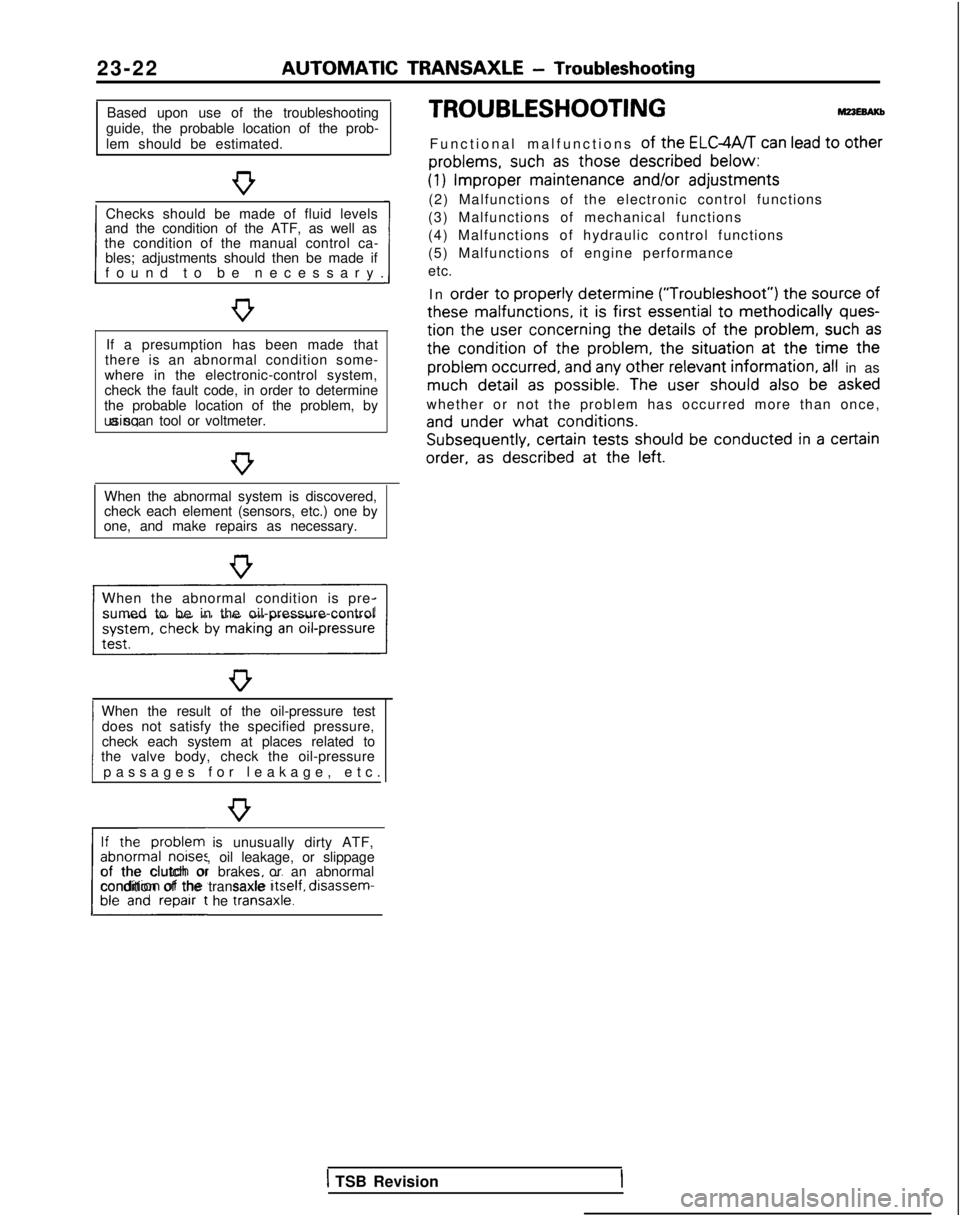
Based upon use of the troubleshooting
guide, the probable location of the prob-
lem should be estimated.
Checks should be made of fluid levels
and the condition of the ATF, as well as
1 found to be necessary
.
the condition of the manual control ca-
bles; adjustments should then be made if
If a presumption has been made that
there is an abnormal condition some-
where in the electronic-control system,
check the fault code, in order to determine
the probable location of the problem, by using a scan tool or voltmeter.
When the abnormal system is discovered,
check each element (sensors, etc.) one by
one, and make repairs as necessary.
When the abnormal condition is pre- sumed to be in the oil-pressure-control
When the result of the oil-pressure test does not satisfy the specified pressure,
1 passages for leakage, etc
.
check each system at places related to
the valve body, check the oil-pressure
If the problem is unusually dirty ATF,
abnormal noises, oil leakage, or slippage
L##t he traniaxle.1
of the clutch or brakes or an abnormal
condition of the transaxle Itself,
disassem-
TROUBLESHOOTING
Functional malfunctions of the ELGWT can lead to other
problems,
such
as those described
below:
(1) Improper
maintenance
and/or
adjustments
(2) Malfunctions of the electronic control functions
(3) Malfunctions of mechanical functions
(4) Malfunctions of hydraulic control functions
(5) Malfunctions of engine performance
etc.
In order
to properly
determine (“Troubleshoot”)
the
source
of
these
malfunctions,
it is first essential
to methodically ques-
tion
the
user
concerning
the details
of the problem,
such as
the
condition of
the
problem,
the
situation at
the
time the
problem
occurred,
and any other relevant
information, all in as much detail
as possible.
The user
should
also be asked
whether or not the problem has occurred more than once,
and under
what conditions. Subsequently,
certain
tests should
be conducted in a certain
order,
as described
at
the
left.
1 TSB Revision
Page 740 of 1273
23-34AUTOMATIC TRANSAXLE - Troubleshooting
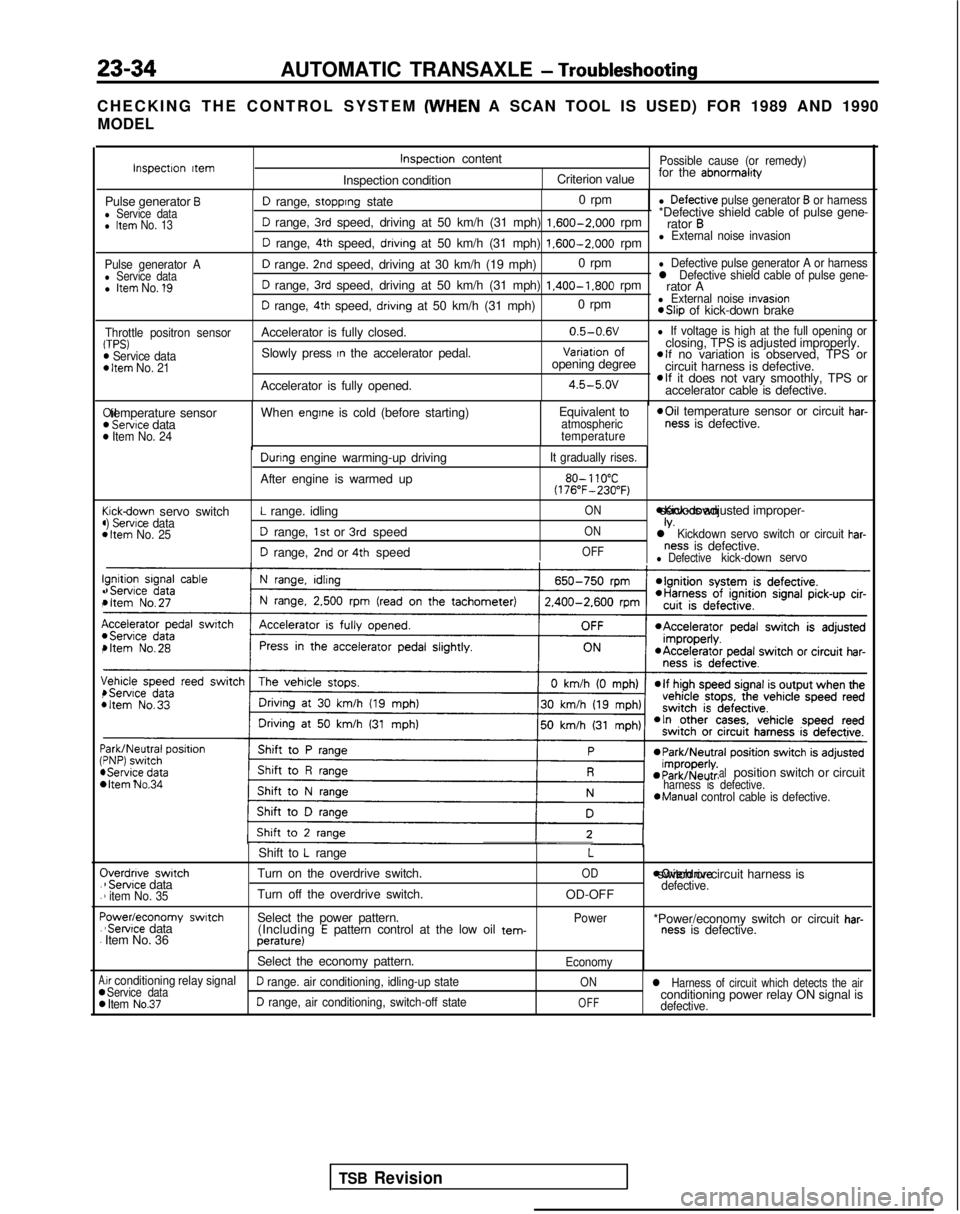
CHECKING THE CONTROL SYSTEM (WHEN
A SCAN TOOL IS USED) FOR 1989 AND 1990
MODEL
Pulse generator Al Service datal Item No. 1’9
Throttle positron sensorTPS)m Service dataD Item No. 21
I!(
(44
c44
I!.,
I(,
\,4
:44 C
.
.
F.
.
A00
D range, stopprng state 0 rpml Defectrve pulse generator B or harness
D range, 3rd speed, driving at 50 km/h (31 mph) 1.600-2.000
rpm*Defective shield cable of pulse gene-
rator B
D range, 4th speed, drivrng at 50 km/h (31 mph) 1.600-2.000
rpml External noise invasion
D range. 2nd speed, driving at 30 km/h (19 mph) 0 rpml Defective pulse generator A or harness
D range, 3rd speed, driving at 50 km/h (31 mph) 1.400-1.800
rpml Defective shield cable of pulse gene-rator A
D range, 4th speed, drivrng at 50 km/h (31 mph) 0 rpml External noise Invasion *Slip
of kick-down brake
Accelerator is fully closed. 0.5-0.6V
l If voltage is high at the full opening or
Slowly press In the accelerator pedal.Variatron of
closing, TPS is adjusted improperly.
opening degreeelf no variation is observed, TPS or
circuit harness is defective.
Accelerator is fully opened.
4.5-5.ovelf it does not vary smoothly, TPS or
accelerator cable is defective. Xl temperature sensor
) Servtce data) Item No. 24
When engtne is cold (before starting)
Equivalent toatmospheric
temperature *Oil
temperature sensor or circuit har-ness is defective.
cickdown servo switch) Servrce data1 Item No. 25
Durrng engine warming-up driving
After engine is warmed up
L range. idling
D range, 1st or 3rd speed
D range, 2nd or 4th speed
It gradually rises.
80- 110°C(176”F-230°F)
ON *Kick-down servo IS adjusted improper-
ONIV.l Kickdown servo switch or circuit har-
OFFness is defective.l Defectivekick-down
servo
bItem No.34 alposition switch or circuitharness is defective.*Manual
control cable is defective.
Iverdnve switch1 Servrce data1 item No. 35
‘owedeconomy swatch‘Servrce data
Item No. 36 Shift to
L range
Turn on the overdrive switch.
Turn off the overdrive switch.
Select the power pattern. (Including
E pattern control at the low oil tem-perature)
L
OD
OD-OFF
Power moverdrive switch or circuit harness is
defective.
*Power/economy switch or circuit har-ness is defective.
Select the economy pattern.
Economy
.ir conditioning relay signalService dataD range. air conditioning, idling-up stateONl Harness of circuit which detects the air
Item No.37D range, air conditioning, switch-off stateOFFconditioning power relay ON signal isdefective.
Inspectron ttemInspectron content
Inspection conditionPossible cause (or remedy)
Criterion value for the abnormalrty
Pulse generator Bl Service datal Item No. 13
TSB Revision
Page 741 of 1273
AUTOMATIC TRANSAXLE - Troubleshooting23-35
l TPS system isdefective.
ilpressure
is improper.verter clutch (TCC) solenoid
B Service datam Item No.49
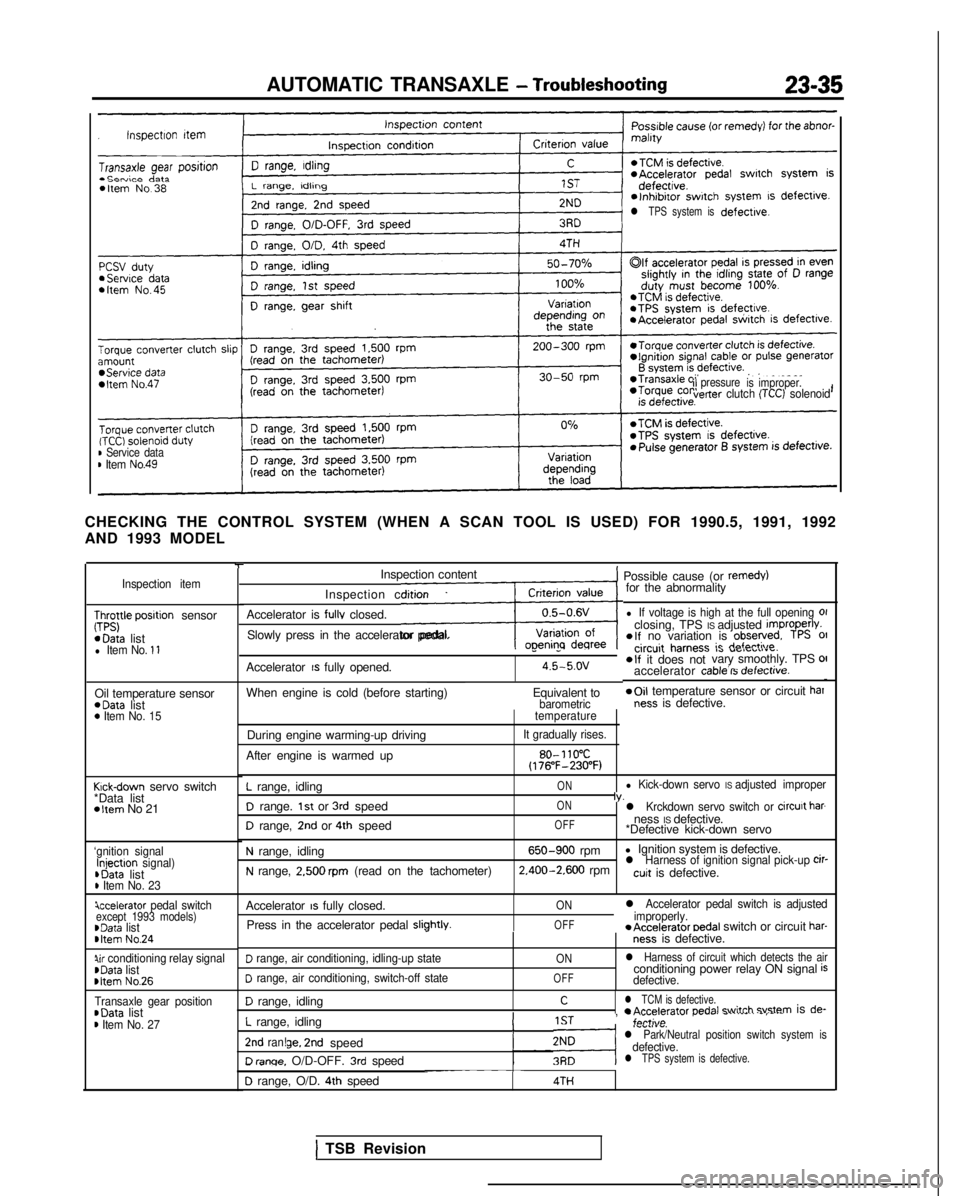
CHECKING THE CONTROL SYSTEM (WHEN A SCAN TOOL IS USED) FOR 1990.5, 199\
1, 1992
AND 1993 MODEL
Inspection item
;;;yle posrtion sensor *Data
list
l Item No. 11
Oil temperature sensor *Data
list
0 Item No. 15
Krck-down servo switch
*Data list
*Item No 21
‘gnition signalInjectron signal) ,Data
list
D Item No. 23
iccelerator pedal switchexcept 1993 models)~Data listbItem No.24
Qr conditioning relay signalrData list rltem
No.26
Transaxle gear position~Data listm Item No. 27
-rInspection content
Inspection condition
Accelerator is
fullv closed.
LSlowly press in the accelerator pedal.
1 Possible cause (or remedy)for the abnormality
l If voltage is high at the full opening 01closing, TPS IS adjusted improperlv.elf no variation is observed. TPS 01
Accelerator IS fully opened.
--circuit harness ic r(afndi
O,a “ClrULIIu.
4.5-5.ov*If it does not vary smoothly. TPS OII- .-d-L__.:__accelerator cable IS oerectrve.
When engine is cold (before starting)
Equivalent to*Oil temperature sensor or circuit barbarometricness is defective.
During engine warming-up driving
After engine is warmed uptemperature
It gradually rises.
80- 110°C(176”F-230°F)
L range, idling
D range. 1st or 3rd speed
D range, 2nd or 4th speed
ON
ON
OFFl Kick-down servo IS adjusted improperIv.l Krckdown servo switch or circurt barness IS defective.
*Defective kick-down servo
N range, idling
N range, 2.500 rpm (read on the tachometer)
650-900 rpm l Ignition system is defective. 2.400-2.600
rpml Harness of ignition signal pick-up cir-cuit is defective.
Accelerator
IS fully closed.
Press in the accelerator pedal
sliphtlv.I
ON
OFF
l Accelerator pedal switch is adjusted
improperly. *Accelerator
oedal switch or circuit har-ness is defective.
D range, air conditioning, idling-up state
D range, air conditioning, switch-off state
ON
OFF
l Harness of circuit which detects the airconditioning power relay ON signal isdefective.
D range, idling
L range, idling
Cl TCM is defective.r A~d~r~tnr nednl +witch svstem is de-
!IST, -;,,tl;;..- r..--. -.-.--..
-,---,.,.,.,.v.l Park/Neutral position switch system isdefective.2nd ran!ge. 2nd speed
D renqe. O/D-OFF. 3rd speedl TPS system is defective.-~~~~~D range, O/D. 4th speed4TH
1 TSB Revision
Page 751 of 1273
AlJTCMVlATlC TRANSAXLE - Troubleshooting23-45
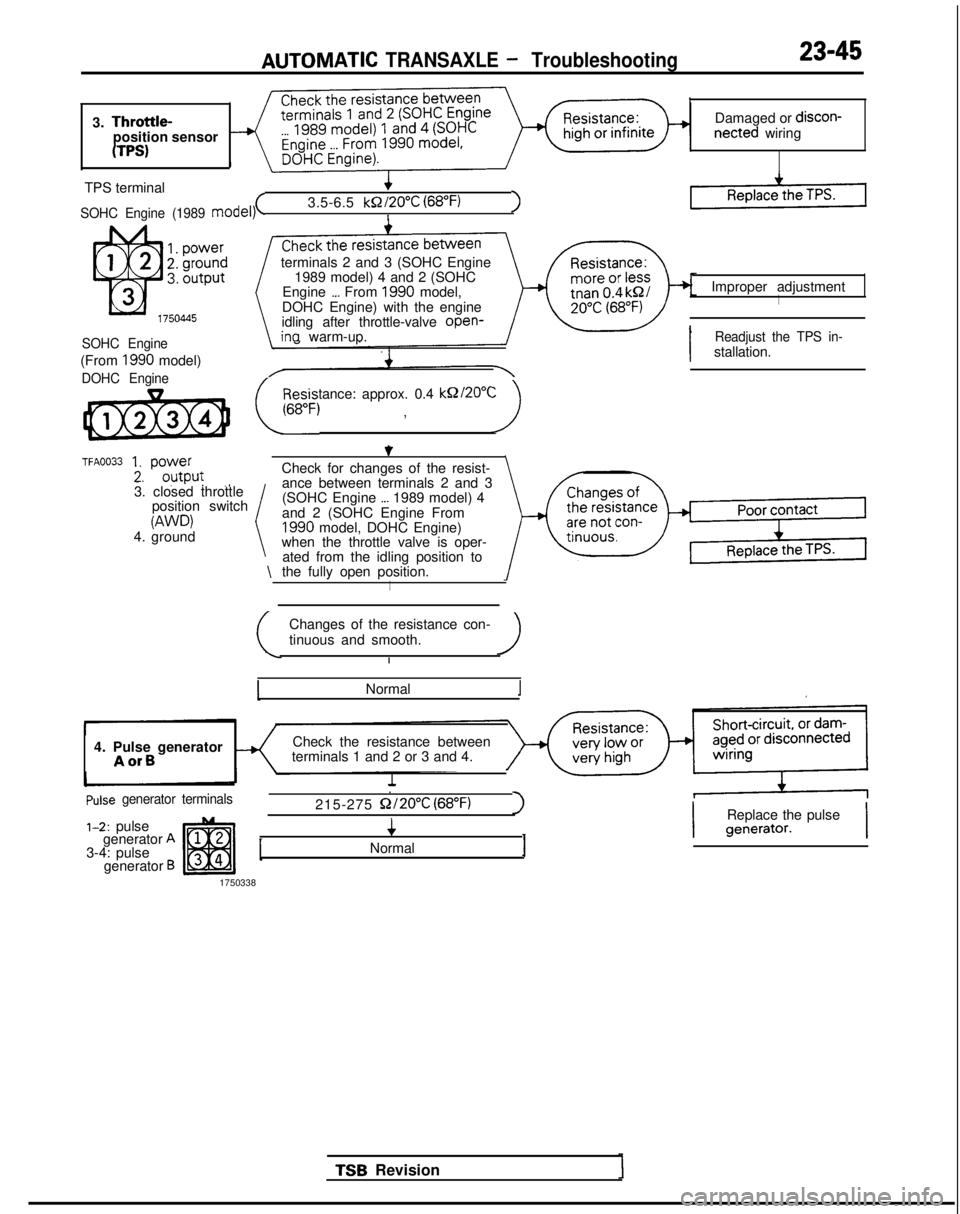
3. Throttle-position sensor
UPS)
Damaged or discon-netted wiring
TPS terminal
SOHC Engine (1989 model)(3.5-6.5 kQ/20”C
(68°F)1I
SOHC Engine
(From 1990 model)
DOHC Engine
TFA0033 1. power
2. outpur.,
terminals 2 and 3 (SOHC Engine
1989 model) 4 and 2 (SOHC
Engine
_._ From 1990 model,
DOHC Engine) with the engine
idling after throttle-valve open-
ina warm-up.
Resistance: approx. 0.4
kQZ20”C
(,6,, , )
3. closed throttle position switch
W’D)4. ground \
Check for changes of the resist-
ance between terminals 2 and 3
(SOHC Engine
,._ 1989 model) 4
and 2 (SOHC Engine From
1990 model, DOHC Engine)
when the throttle valve is oper-
ated from the idling position to
the fully open position.
I
Changes of the resistance con-
tinuous and smooth.
Normal
4. Pulse generator
AorB
Check the resistance between
terminals 1 and 2 or 3 and 4.
Pulse generator terminals.
215-275
Q/20% (68°F)I
1-2: pulse
generator A3-4: pulse
generator B
4
Normal1
1750338 Improper adjustment
I
I
Readjust the TPS in-stallation.
TSB Revision
I
Replace the pulsegenerator.I
Page 752 of 1273
23-46AUTOMATIC TRANSAXLE - Troubleshootincl
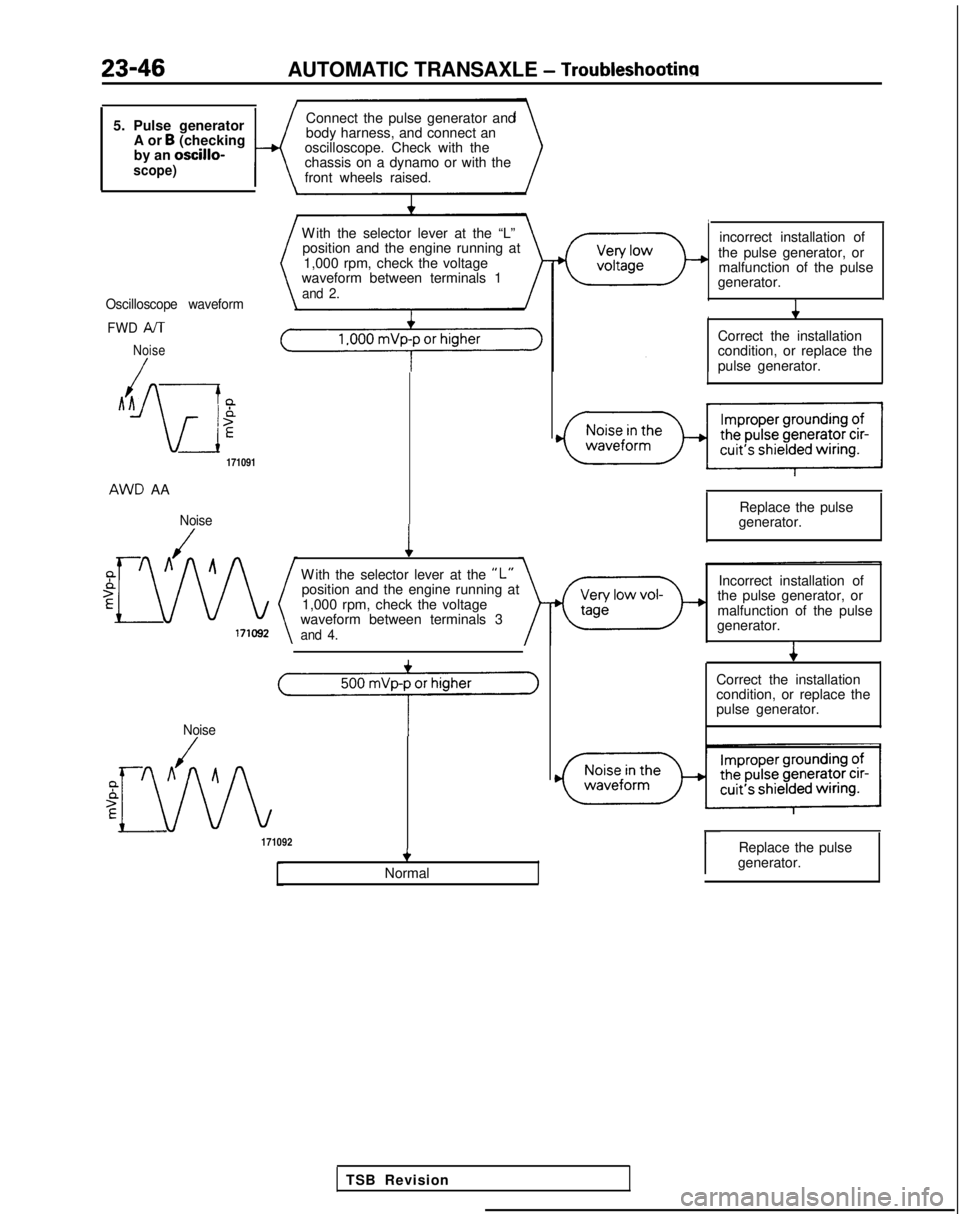
5. Pulse generatorA or B (checking
by an oscillo-
scope)K
Connect the pulse generator and
body harness, and connect an
oscilloscope. Check with the
chassis on a dynamo or with the
front wheels raised.
Oscilloscope waveform
FWD
/VT
Noise
/Ah --L
Ar
IP
-iE
171091 AWD
AA
Noise
W
ith the selector lever at the “L”
position and the engine running at
1,000 rpm, check the voltage
waveform between terminals 1
and 2.
1
W
ith the selector lever at the
“L”position and the engine running at
1,000 rpm, check the voltage
waveform between terminals 3
and 4.
Noise
A
(6
171092+
Normal incorrect installation of
the pulse generator, or malfunction of the pulse
generator. 4
Correct the installation
condition, or replace the
pulse generator.
Replace the pulse
generator.
Incorrect installation of
the pulse generator, or
malfunction of the pulse
generator. 4
Correct the installation
condition, or replace the
pulse generator.r
Replace the pulse
generator.
TSB Revision
Page 758 of 1273
23-52AUTOMATIC TRANSAXLE - Troubleshooting
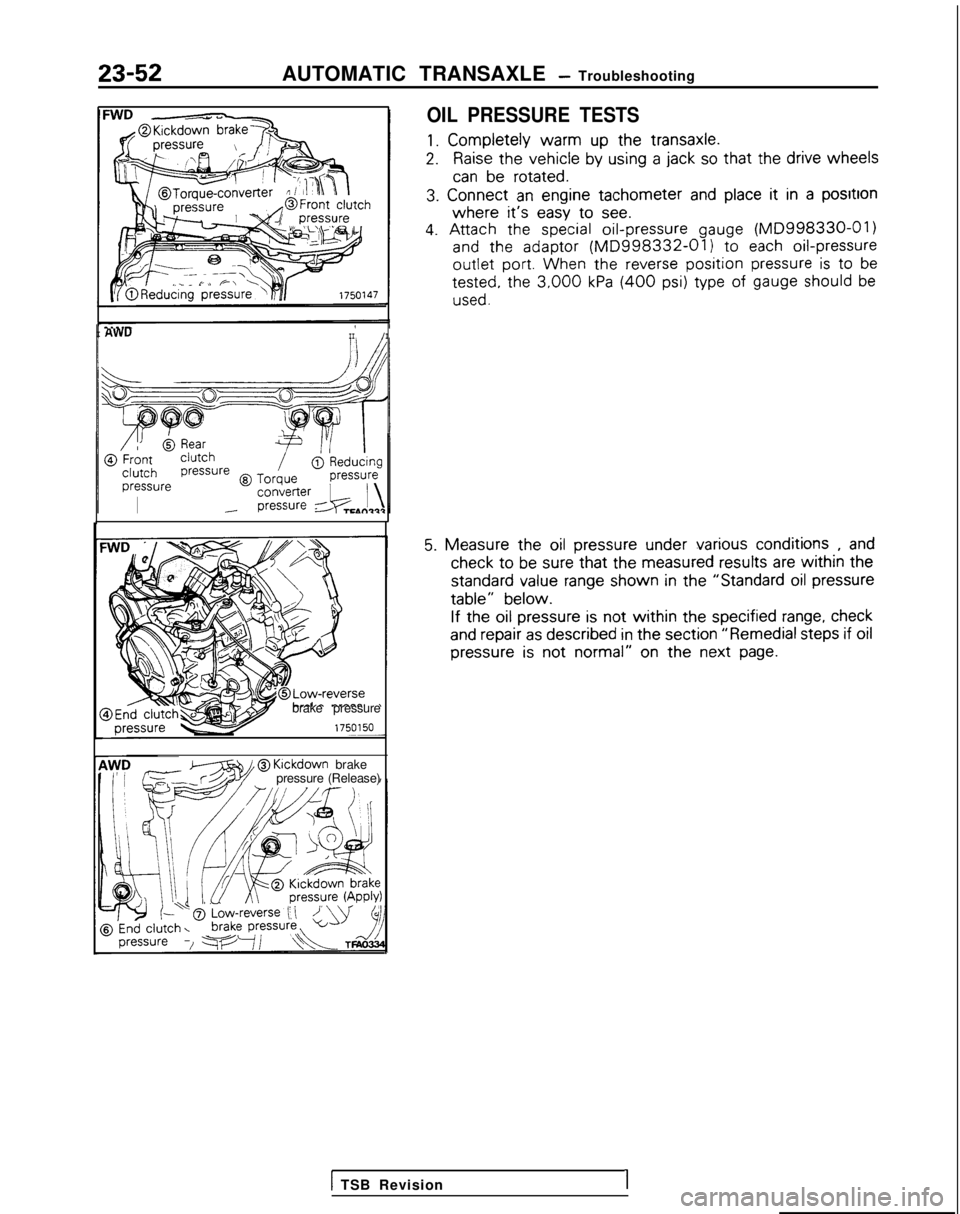
OIL PRESSURE TESTS
1. Completely
warm
up the
transaxle.
2.Raise the
vehicle
by
using
a jack so that the
drive
wheels
can be
rotated.
3.
Connect
an engine
tachometer
and place it
in a positron
where it’s easy
to
see.
4. Attach
the
special oil-pressure
gauge (MD998330-01)
and
the
adaptor
(MD998332-01) to
each oil-pressure
outlet
port. When
the
reverse position pressure is to
be tested,
the
3,000 kPa (400 psi) type
of gauge should be
used.
I AWUII/I
brake pressure
zT?ziw@
Klckdown
brake
pressure (Release)
5. Measure
the
oil pressure
under
various
conditions
, and check
to be sure that the
measured
results
are within the
standard
value
range shown
in the
“Standard
oil pressure
table”
below.
If the
oil pressure
is not
within the
specified
range, check
and repair
as described
in the
section
“Remedial
steps
if oil
pressure
is not
normal”
on the next
page.
1 TSB Revision1
Page 765 of 1273
AUTOMATIC TRANSAXLE - Troubleshooting23-59
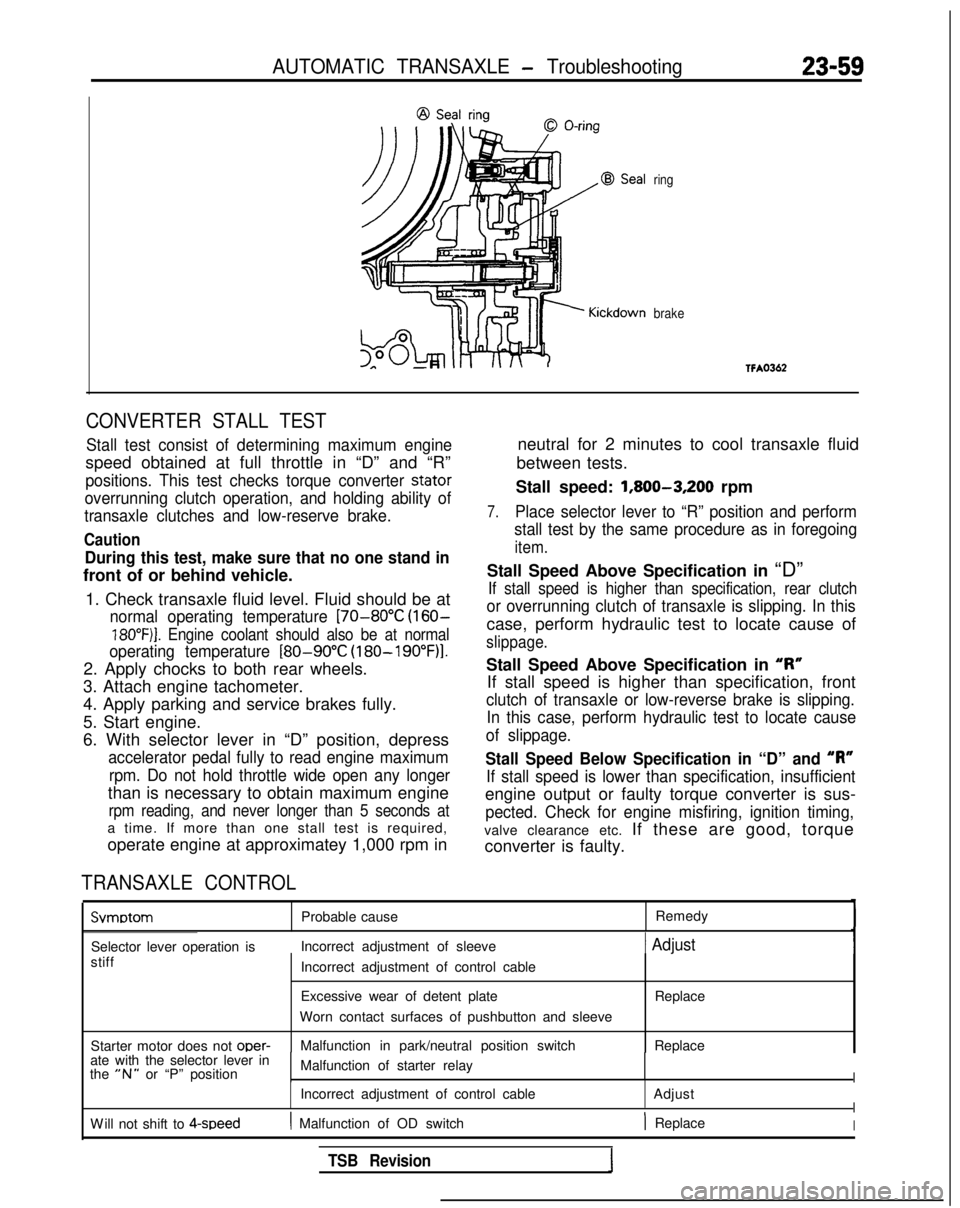
ring
brake
CONVERTER STALL TEST
Stall test consist of determining maximum engine
speed obtained at full throttle in “D” and “R”
positions. This test checks torque converter stator
overrunning clutch operation, and holding ability of
transaxle clutches and low-reserve brake.
Caution
During this test, make sure that no one stand in
front of or behind vehicle.
1. Check transaxle fluid level. Fluid should be at
normal operating temperature [70-80°C (160-
18O”F)j. Engine coolant should also be at normal
operating temperature
[80-90°C (180-19O”F)l.
2. Apply chocks to both rear wheels.
3. Attach engine tachometer.
4. Apply parking and service brakes fully.
5. Start engine.
6. With selector lever in “D” position, depress
accelerator pedal fully to read engine maximum
rpm. Do not hold throttle wide open any longer
than is necessary to obtain maximum engine
rpm reading, and never longer than 5 seconds at
a time. If more than one stall test is required,
operate engine at approximatey 1,000 rpm in
TRANSAXLE CONTROL
neutral for 2 minutes to cool transaxle fluid
between tests.
Stall speed: 1,800-3,200
rpm
7.Place selector lever to “R” position and perform
stall test by the same procedure as in foregoing
item.
Stall Speed Above Specification in “D”
If stall speed is higher than specification, rear clutch
or overrunning clutch of transaxle is slipping. In this
case, perform hydraulic test to locate cause of
slippage.
Stall Speed Above Specification in “I?”
If stall speed is higher than specification, front
clutch of transaxle or low-reverse brake is slipping. In this case, perform hydraulic test to locate cause
of slippage.
Stall Speed Below Specification in “D” and “R”
If stall speed is lower than specification, insufficient
engine output or faulty torque converter is sus-
pected. Check for engine misfiring, ignition timing,
valve clearance etc. If these are good, torque
converter is faulty. Svmotom
Probable cause
Remedy
Selector lever operation is Incorrect adjustment of sleeve
1 Adjust
stiff
Starter motor does not oper-
Incorrect adjustment of control cable
Excessive wear of detent plate
Worn contact surfaces of pushbutton and sleeve
Malfunction in park/neutral position switch Replace
Replace
ate with the selector lever in
the
“N” or “P” position Malfunction of starter relayI
Incorrect adjustment of control cable
AdjustI
W
ill not shift to 4-speed
( Malfunction of OD switch) ReplaceI
TSB Revision
Page 789 of 1273
AUTOMATIC TRANSAXLE - Service Adjustment Procedures23-83
I:
I’
4989 models>
09A0140
6% Button pressed (while brakepedal is depressed)
c Button not pressed
0 Button pressed
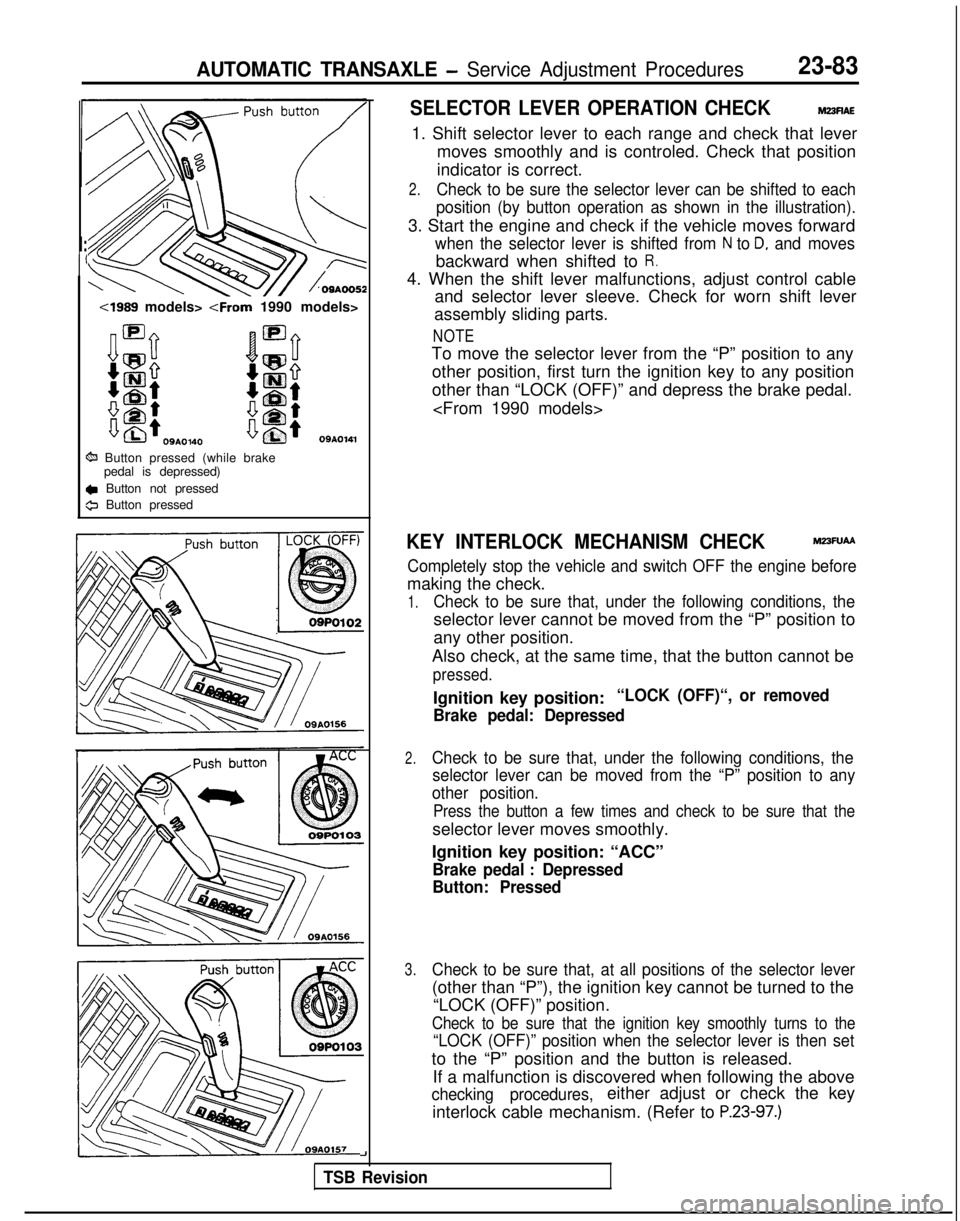
SELECTOR LEVER OPERATION CHECKM23flAE
1. Shift selector lever to each range and check that lever
moves smoothly and is controled. Check that position
indicator is correct.
2.Check to be sure the selector lever can be shifted to each
position (by button operation as shown in the illustration).
3. Start the engine and check if the vehicle moves forward
when the selector lever is shifted from N to D, and moves
backward when shifted to R.
4. When the shift lever malfunctions, adjust control cable and selector lever sleeve. Check for worn shift lever
assembly sliding parts.
NOTE
To move the selector lever from the “P” position to any
other position, first turn the ignition key to any position
other than “LOCK (OFF)” and depress the brake pedal.
KEY INTERLOCK MECHANISM CHECKM23FUAA
Completely stop the vehicle and switch OFF the engine before
making the check.
1.Check to be sure that, under the following conditions, the
selector lever cannot be moved from the “P” position to
any other position.
Also check, at the same time, that the button cannot be
pressed.
Ignition key position:“LOCK (OFF)“, or removed
Brake pedal: Depressed
2.Check to be sure that, under the following conditions, the selector lever can be moved from the “P” position to any
other position.
Press the button a few times and check to be sure that the
selector lever moves smoothly.
Ignition key position: “ACC”
Brake pedal : Depressed
Button: Pressed
3.Check to be sure that, at all positions of the selector lever
(other than “P”), the ignition key cannot be turned to the
“LOCK (OFF)” position.
Check to be sure that the ignition key smoothly turns to the
“LOCK (OFF)” position when the selector lever is then set
to the “P” position and the button is released.
If a malfunction is discovered when following the above
checking procedures,either adjust or check the key
interlock cable mechanism. (Refer to
P.23-97.)
-I
TSB Revision