1989 MITSUBISHI GALANT check engine
[x] Cancel search: check enginePage 1161 of 1273
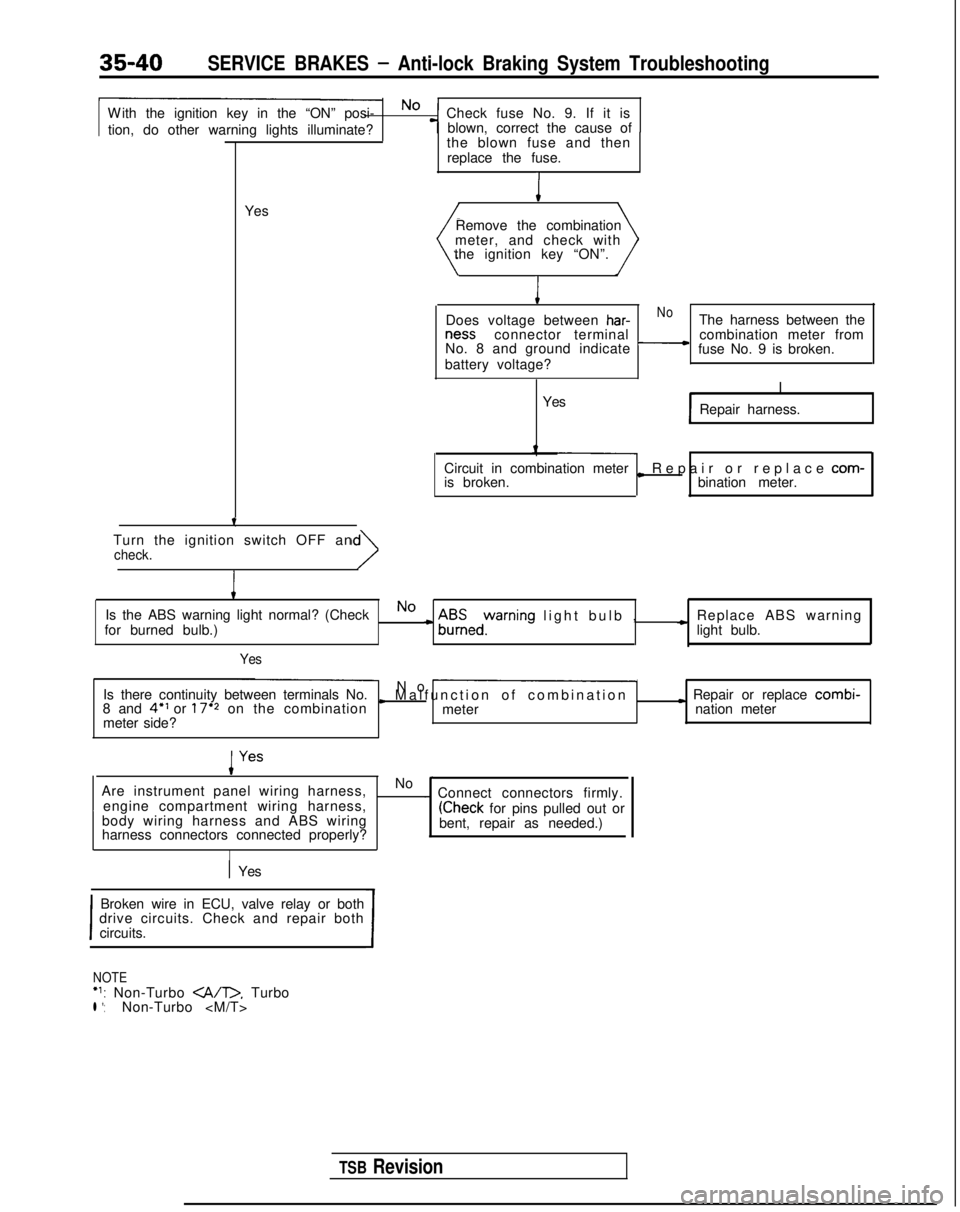
SERVICE BRAKES - Anti-lock Braking System Troubleshooting
W
ith the ignition key in the “ON” posi- No
Check fuse No. 9. If it is
tion, do other warning lights illuminate? blown, correct the cause of
-T-
Yesthe blown fuse and then
replace the fuse.I
Remove the combination
meter, and check with
the ignition key “ON”.
I
Does voltage between har-NoThe harness between the ness
connector terminal
No. 8 and ground indicate
-combination meter from
fuse No. 9 is broken.
battery voltage?
I
Yes Repair harness.
Circuit in combination meter
is broken.
L Repair or replace com-
bination meter.
Turn the ignition switch OFF an
check.
I
Is the ABS warning light normal? (CheckNo
for burned bulb.)c A$Eedyrning light bulb
,
c Replace ABS warning
light bulb.
Yes
Is there continuity between terminals No. No -
8 and 4” or 17’2 on the combinationI Malfunction of combinatio
n
meter
I Repair or replace combi-
meter side? nation meter
Are instrument panel wiring harness, No
-~
engine compartment wiring harness, . Connect connectors firmly.
body wiring harness and ABS wiring
(Check for pins pulled out or
harness connectors connected properly? bent, repair as needed.)
I
1 Yes
I
Broken wire in ECU, valve relay or both
drive circuits. Check and repair both
circuits.
I
NOTE‘1: Non-Turbo . Turbol *:Non-Turbo
TSB Revision
Page 1162 of 1273
![MITSUBISHI GALANT 1989 Service Repair Manual 35-42
SERVICE BRAKES - Anti-lock Braking System Troubleshooting
BABS warning light illuminated after the engine is started and remains on\
.
[Explanation]
This is the symptom when the ABS ECU does not](/manual-img/19/57312/w960_57312-1161.png "MITSUBISHI GALANT 1989 Service Repair Manual 35-42
SERVICE BRAKES - Anti-lock Braking System Troubleshooting
BABS warning light illuminated after the engine is started and remains on\
.
[Explanation]
This is the symptom when the ABS ECU does not")
35-42
SERVICE BRAKES - Anti-lock Braking System Troubleshooting
BABS warning light illuminated after the engine is started and remains on\
.
[Explanation]
This is the symptom when the ABS ECU does not
power up due to broken ECU power circuit, etc.,
when the fail safe function operates and isolates the
system or when the warning light drive circuit is
short circuited.
[Hint]
Check the on-board diagnostic output and if there is
no output voltage or if the scan tool and ABS ECU
cannot communicate, there is a good possibility
that power is not flowing to the ECU.
Caution
l
If there is no output of diagnostic trouble
codes, there is a good possibility that the
fail safe is functioning.
MAINFUSIBLELINK @
IGNITION
SWITCH
(IG1)
ILOIE;NATION
+10
3
@izJ”,HUZ8 p:r12 /e-,
xx
I
I
I*I
; 16 4=
9
II
d
+qfimamq!2 a
I -LQ-7 ABS ECUm1
: Non-Turbo . Turbo: Non-Turbo
output? (Is there communi- NEXT PAGE
cation with scan tool?)
I
Yes
Does diagnostic troublecode output display normalcodes?
No . Check, using the diagnos-tic trouble code checkchart. (Refer to P.35-38.)IIILI
Short in harness betweenrgl;r ECU and ABS warning) Repair harness or replacecombination meter.
II
TSB Revision
Page 1173 of 1273
![MITSUBISHI GALANT 1989 Service Repair Manual 35-52SERVICE BRAKES - Anti-lock Braking System Troubleshooting
E-7When diagnostic trouble code “52 MOTOR RLY” is displayedI
[Explanation][Hint]
The ABS ECU outputs this diagnostic trouble code for](/manual-img/19/57312/w960_57312-1172.png "MITSUBISHI GALANT 1989 Service Repair Manual 35-52SERVICE BRAKES - Anti-lock Braking System Troubleshooting
E-7When diagnostic trouble code “52 MOTOR RLY” is displayedI
[Explanation][Hint]
The ABS ECU outputs this diagnostic trouble code for")
35-52SERVICE BRAKES - Anti-lock Braking System Troubleshooting
E-7When diagnostic trouble code “52 MOTOR RLY” is displayedI
[Explanation][Hint]
The ABS ECU outputs this diagnostic trouble code forIf there is motor operation noise when wheel speed
the motor relay and motor in the following cases. exceeds Gkm/h
(4mph) when starting up after the
l When the motor relay does not function engine is started, or when there is forced scan tool
l When there is trouble with the motor
itself and itdrive, there is a broken or short circuited motor
does not revolve monitor wire.
l When there is trouble with the motor itself and it
the motor does not revolve
l When the motor continues to revolve Yes
Broken wire or short cir-
-Inoise when wheel
speedcuit in motor monitor line
MAIN FUSIBLE
LINK @&
1 j 2 I3 I4 I5 I6 I 7 18 I9 l10l11112113114115116l17 1819p0~1122~3~24l2S~26I27(2~29130131l32l33l3~~3~
(Remove the motor relay>
r
l
-
\
/4~
Remove the motor relay and -check resistance values.No c Motor relay malfunction
No. 85-No. 86:resistance4
value 30-60
QNo.30-No.87: no continui-
Replace motor relay.
t
y
Battery voltage is applied on
terminals No.86
and
No.85groundedNo.30-No.87: continuity 1Yes
Is pump motor ground con-
No
netted normally?
Connect ground wire.
lYes
<
Install motor relay and
move HU connector.
Does voltage between body
connector terminal 11 and
No ) Broken wire in pum
p
ground indicate battery vol- motor power circuit
tage?
4
Yes Repair the harness.I
tor and
remove theECU
Is resistance between body - No - Malfunction of harness
connector terminal No. 2 andNo No.26
30-60 ohms? between HU and ECUI
4 Yes.
Repair harness.II
ABS ECU malfunction
Replace ABS ECU.I
TSB Revision
Page 1174 of 1273

SERVICE BRAKES - Service Adjustment Procedures35-53
switch
switch
c/ 14F516
Pedal
Idown /
\ \
F14517
TSB Revision
F14518
SERVICE ADJUSTMENT PROCEDURES
BRAKE PEDAL INSPECTION AND ADJUSTMAN-
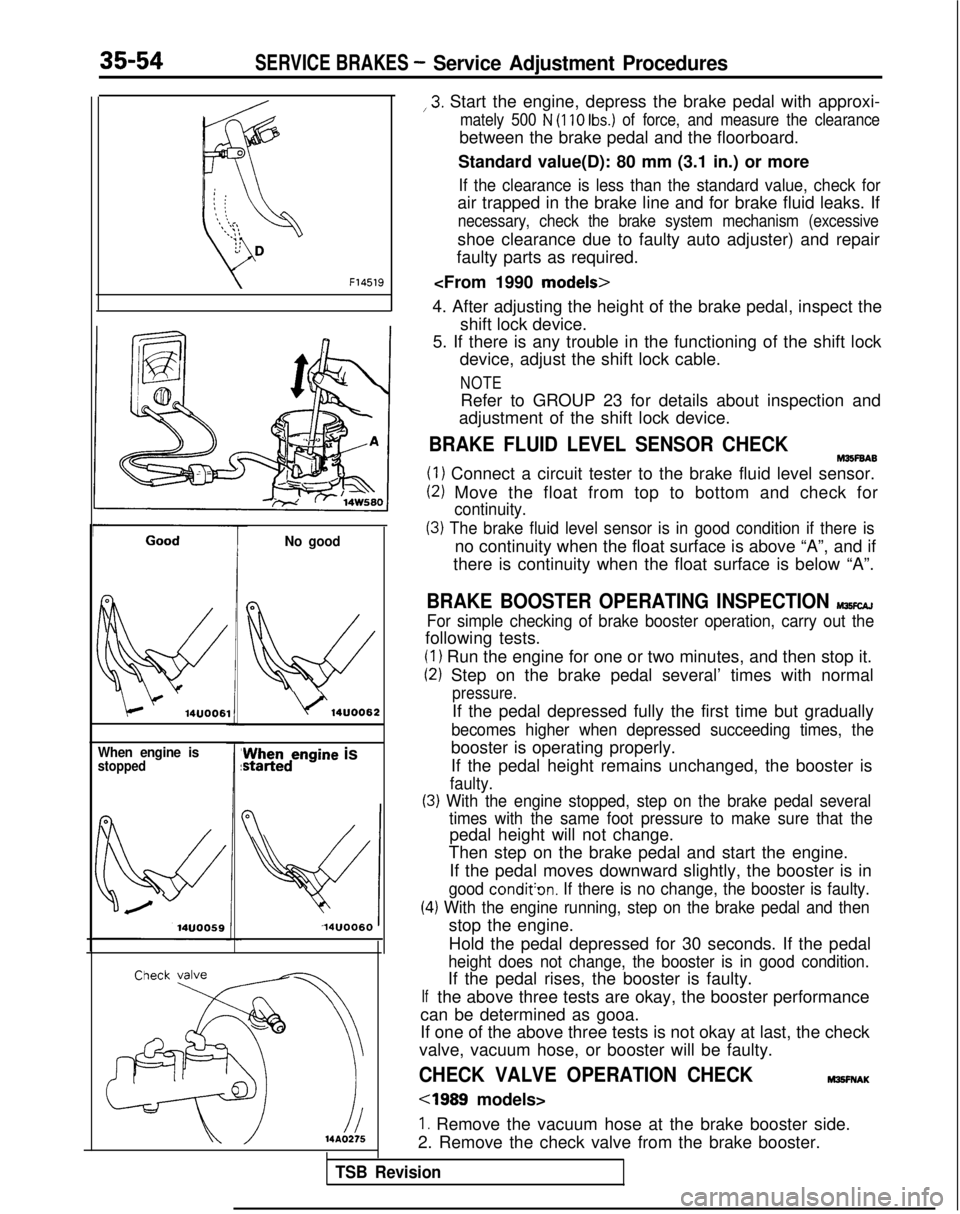
1.Measure the brake pedal height as illustrated. If the brake
pedal height is not within the standard value, adjust as
follows.
Standard value (A): 176-181 mm (6.9-7.1 in.)
(1) Disconnect the stop light switch connector, loosen the
lock nut, and move the stop light switch to a position
where it does not contact the brake pedal arm.
(2) Adjust the brake pedal height by turning the operating
rod with pliers (with the operating rod lock nut
loosened), until the correct brake pedal height is
obtained.
(3) After screwing in the stop light switch until it contactsthe brake pedal stopper (just before the brake pedal is
caused to move), return the stop light switch l/2
to 1
turn and secure by tightening the lock nut.
2.
(4) Connect the connector of the stop light switch.
(5) Check to be sure that the stop light is not illuminated
with the brake pedal unpressed.
Reference value
(B): 0.5-1.0 mm (.02-.04 in.)
With the engine stopped, depress the brake pedal two or
three times. After eliminating the vacuum in the power
brake booster, press the pedal down by hand, and confirm
that the amount of movement before resistance is met
(the free play) is within the standard value range.
Standard value
(C): 3-8 mm (.l-.3 in.)
If the free play is less than the standard value, confirm that
the clearance between the stop light switch and brake pedal is within the standard value.
If the free play exceeds the standard value, it is probably
due to excessive play between the clevis pin and brake
pedal arm. Check for excessive clearance and replace
faulty parts as required.
Page 1175 of 1273
35-54SERVICE BRAKES - Service Adjustment Procedures
F14519
14UOO61
When engine isstopped
No good
0
w
\/‘14UOO62z;redengine
is
14UOO60 ,3.
Start the engine, depress the brake pedal with approxi-
mately 500 N (110 Ibs.) of force, and measure the clearance
between the brake pedal and the floorboard.
Standard value(D): 80 mm (3.1 in.) or more
If the clearance is less than the standard value, check for
air trapped in the brake line and for brake fluid leaks. If
necessary, check the brake system mechanism (excessive
shoe clearance due to faulty auto adjuster) and repair
faulty parts as required.
4. After adjusting the height of the brake pedal, inspect the shift lock device.
5. If there is any trouble in the functioning of the shift lock device, adjust the shift lock cable.
NOTE
Refer to GROUP 23 for details about inspection and
adjustment of the shift lock device.
BRAKE FLUID LEVEL SENSOR CHECKM35F6A6
(1) Connect a circuit tester to the brake fluid level sensor.
(2) Move the float from top to bottom and check for
continuity.
(3) The brake fluid level sensor is in good condition if there is
no continuity when the float surface is above “A”, and if
there is continuity when the float surface is below “A”.
BRAKE BOOSTER OPERATING INSPECTION MlKcAJ
For simple checking of brake booster operation, carry out the
following tests.
(1) Run the engine for one or two minutes, and then stop it.
(2) Step on the brake pedal several’ times with normal
pressure.
If the pedal depressed fully the first time but gradually
becomes higher when depressed succeeding times, the
booster is operating properly.
If the pedal height remains unchanged, the booster is
faulty.
(3) With the engine stopped, step on the brake pedal several
(4
If
times with the same foot pressure to make sure that the
pedal height will not change.
Then step on the brake pedal and start the engine.
If the pedal moves downward slightly, the booster is in
good condit’on. If there is no change, the booster is faulty.
.) With the engine running, step on the brake pedal and then
stop the engine.
Hold the pedal depressed for 30 seconds. If the pedal
height does not change, the booster is in good condition.
If the pedal rises, the booster is faulty.
the above three tests are okay, the booster performance
can be determined as gooa.
If one of the above three tests is not okay at last, the check
valve, vacuum hose, or booster will be faulty.
CHECK VALVE OPERATION CHECKM3!3FNAK
cl989 models>
1. Remove the vacuum hose at the brake booster side.
2. Remove the check valve from the brake booster.
TSB Revision
Page 1178 of 1273
SERVICE, BRAKES - Service Adjustment Procedures35-57
4
1
2314AQ456
FWD
Delay valve L
flc ’
-c
i1
L
3
14AO4l
mit
14RD120
AWD
51
6 2414AO4E
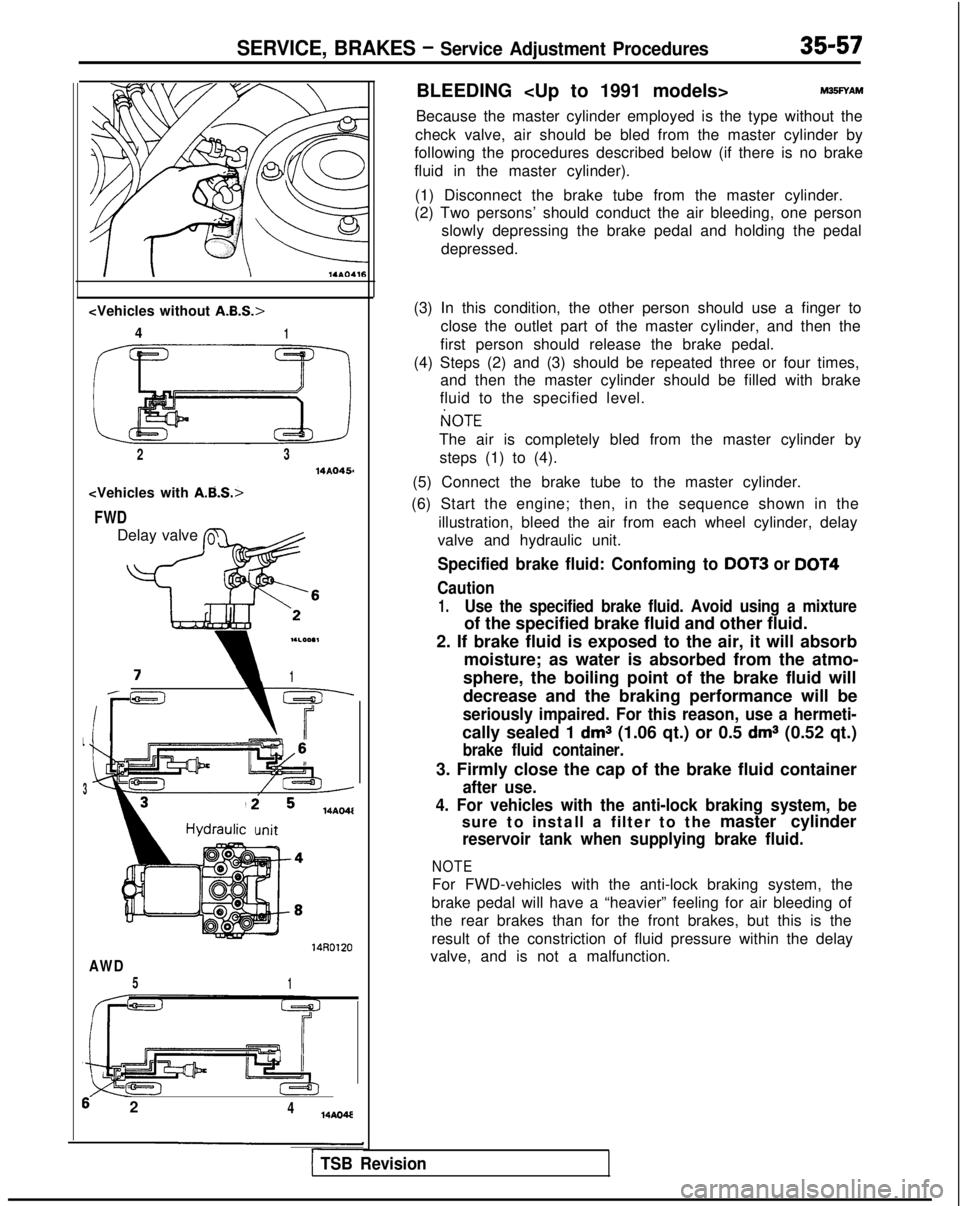
BLEEDING
Because the master cylinder employed is the type without the
check valve, air should be bled from the master cylinder by
following the procedures described below (if there is no brake
fluid in the master cylinder).
(1) Disconnect the brake tube from the master cylinder.
(2) Two persons’ should conduct the air bleeding, one person
slowly depressing the brake pedal and holding the pedal
depressed.
(3) In this condition, the other person should use a finger to close the outlet part of the master cylinder, and then the
first person should release the brake pedal.
(4) Steps (2) and (3) should be repeated three or four times, and then the master cylinder should be filled with brake
fluid to the specified level.
I(]OTE
The air is completely bled from the master cylinder by
steps (1) to (4).
(5) Connect the brake tube to the master cylinder.
(6) Start the engine; then, in the sequence shown in the illustration, bleed the air from each wheel cylinder, delay
valve and hydraulic unit.
Specified brake fluid: Confoming to DOT3 or DOT4
Caution
1.Use the specified brake fluid. Avoid using a mixture
of the specified brake fluid and other fluid.
2. If brake fluid is exposed to the air, it will absorb moisture; as water is absorbed from the atmo-
sphere, the boiling point of the brake fluid will
decrease and the braking performance will be
seriously impaired. For this reason, use a hermeti-
cally sealed 1 dms (1.06 qt.) or 0.5 dms (0.52 qt.)
brake fluid container.
3. Firmly close the cap of the brake fluid container
after use.
4. For vehicles with the anti-lock braking system, be
sure to install a filter to the master cylinder
reservoir tank when supplying brake fluid.
NOTE
For FWD-vehicles with the anti-lock braking system, the
brake pedal will have a “heavier” feeling for air bleeding of
the rear brakes than for the front brakes, but this is the
result of the constriction of fluid pressure within the delay
valve, and is not a malfunction.
1 TSB Revision
Page 1181 of 1273

35-60SERVICE BRAKES - Service Adjustment Procedures
Pad assembly
\
l4RO367
IWhen newWhen wornI
PadWea 5. Securely attach the pad clip to the caliper support.
6. Apply a coating of the specified grease to the pad, shim
and shim holder installation surfaces, and then install the
shim and shim holder.
Apply the grease so that the grease doesn’t ooze out from
the edges.
Specified grease: Brake grease SAE 5310,
NLGI No. 1
Caution
Do not deposit grease or other dirt on pad or brake disc
friction surfaces.
7.Be careful that the piston boot does not become caught,
when lowering the caliper assembly and install the lock pin.
8. Check brake drag torque as follows.
(1) Start engine and hold brake pedal down for 5 seconds.
(2) Stop engine.
(3) Turn brake disc forward IO times.
(4) Check brake drag torque with spring scale.
If the difference between brake drag torque and hub
torque exceeds the standard value, disassemble piston and clean the piston. Check for corrosion or worn piston
seal, and check the sliding condition of the lock pin sleeve
and guide pin sleeve.
Standard value: 70
N (15.4 Ibs.) or less
[4 Nm (3 ftlbs.)]
or less
FRONT DISC BRAKE PAD CHECK AND
REPLACEMENT
NOTE
The brake pads have been equipped with wear indicators, so
that when the brake pad thickness reached 2 mm
(.08 in.), the
wear indicator touches the brake discs and produces a warning
squeaking sound.
Brake disc
Page 1183 of 1273
35-62SERVICE BRAKES - Service Adjustment Procedures
u /@$fi 14A0Ol5CM-R56W>
II
I
Pad
c
4s14FOO97
!m
!
bly
c
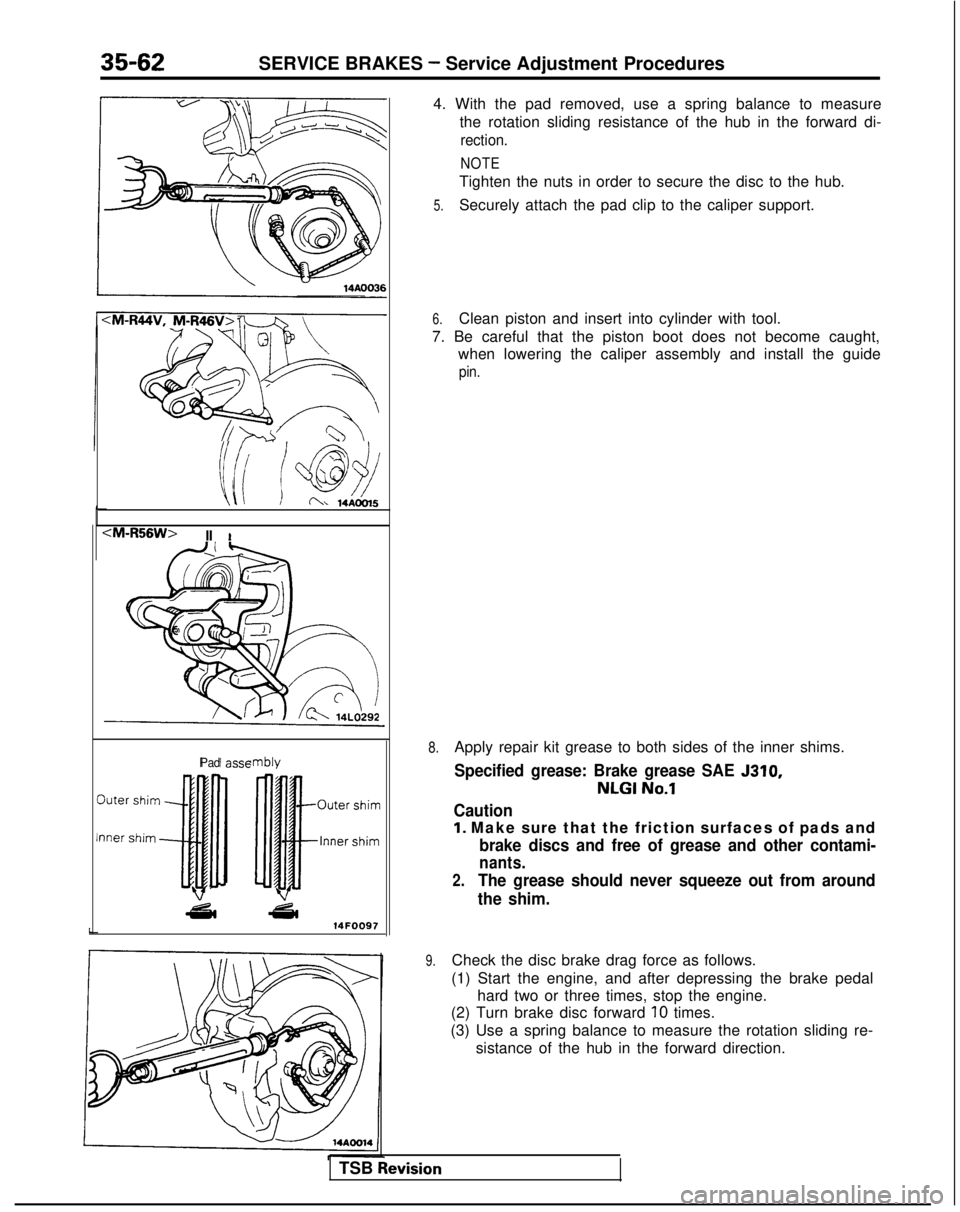
4. With the pad removed, use a spring balance to measure
the rotation sliding resistance of the hub in the forward di-
rection.
NOTE
Tighten the nuts in order to secure the disc to the hub.
5.Securely attach the pad clip to the caliper support.
6.Clean piston and insert into cylinder with tool.
7. Be careful that the piston boot does not become caught, when lowering the caliper assembly and install the guide
pin.
8.Apply repair kit grease to both sides of the inner shims.
Specified grease: Brake grease SAE 5310,
NLGI No.1
Caution
1. Make sure that the friction surfaces of pads and
brake discs and free of grease and other contami-
nants.
2.The grease should never squeeze out from around
the shim.
9.Check the disc brake drag force as follows.
(1) Start the engine, and after depressing the brake pedal hard two or three times, stop the engine.
(2) Turn brake disc forward
10 times.
(3) Use a spring balance to measure the rotation sliding re- sistance of the hub in the forward direction.
TSB
hevision