1989 MITSUBISHI GALANT check engine
[x] Cancel search: check enginePage 459 of 1273
FUEL SYSTEM
Inspection
of MFI
Components13-317
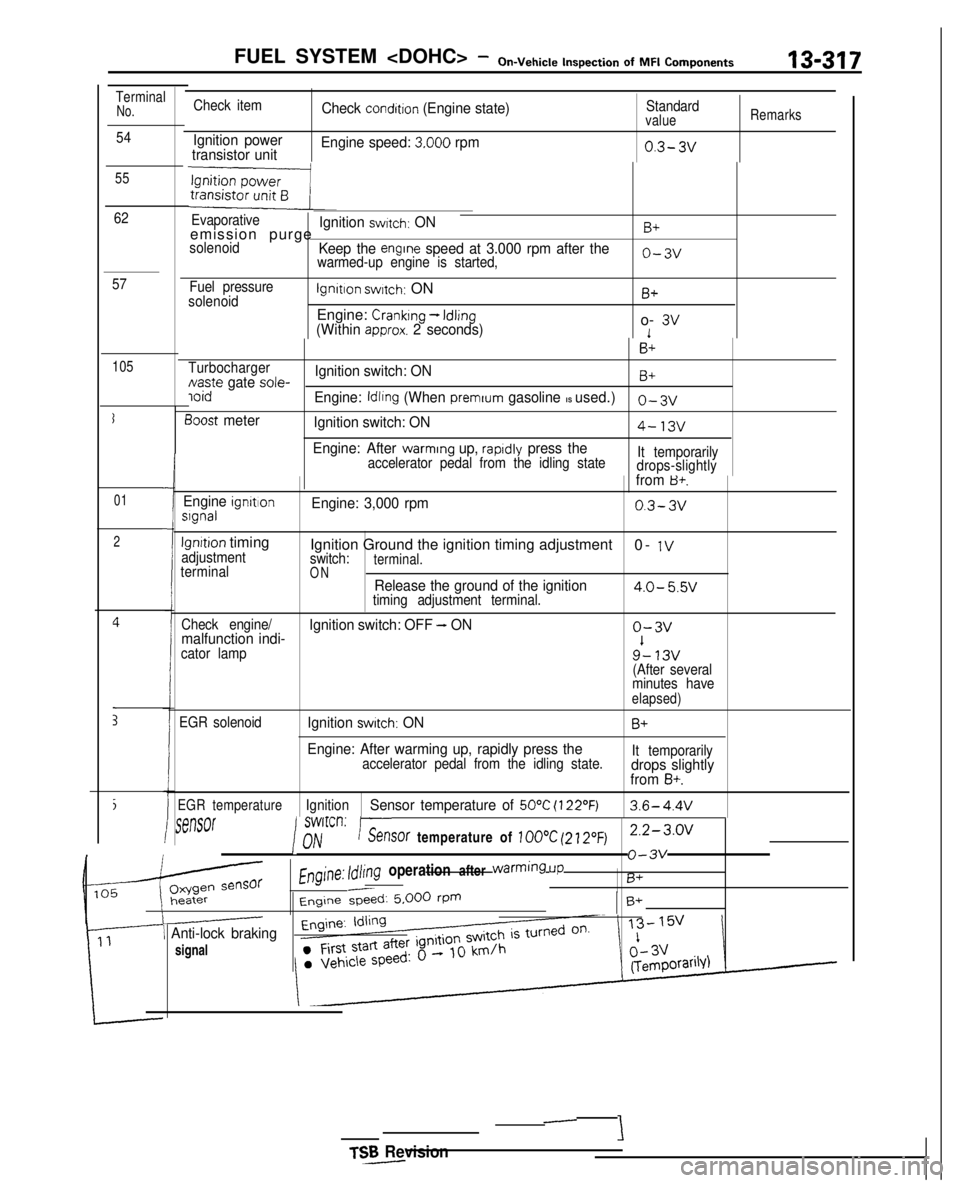
TerminalNo.
54
55
62
57
105
I
01
2
i
E
Check item
Ignition power
transistor unit Check
condition (Engine state)
Engine speed:
3.000 rpm
Standardvalue
0.3- 3v
Remarks
Evaporativeemission purgeIgnition switch: ONB+
solenoidKeep the engrne speed at 3.000 rpm after thewarmed-up engine is started,o-3v
Fuel pressure
solenoidlgnltlon switch: ON
Engine:
Cranking - Idling(Within approx. 2 seconds)
B+
o- 3v1
B+
TurbochargerNaste gate sole-Ignition switch: ONB+ ioid
Engine: Idling (When premrum gasoline IS used.)0-3~
3oost meter
Ignition switch: ON4-13v
Engine: After warming up, rapldly press theaccelerator pedal from the idling state It temporarily
drops-slightlyIfrom B+.
Engine ignrtlonslgnalEngine: 3,000 rpm0.3-3v
lgnrtion timingadjustment
terminalIgnition Ground the ignition timing adjustment 0- 1Vswitch:terminal.ONRelease the ground of the ignition4.0- 5.5vtiming adjustment terminal.
Check engine/
malfunction indi- Ignition switch: OFF - ONo-3v
cator lamp9’- 13v(After several
minutes have
elapsed)
EGR solenoidIgnition switch: ONB+
Engine: After warming up, rapidly press theaccelerator pedal from the idling state. It temporarilydrops slightly
from B+.
EGR temperatureIgnitionSensor temperature of 50°C (122’F)3.6- 4.4V
rSt?MX
I
swlrcrl:nhir--.%?nY/V-_. ..sof temperature of 100°C (21.20~)2.2-3.0~
Engine: Idling operation after warming
UP
o-3v
B+
Engine &ed: 5.000 rPmB+
\ Anti-lock braking
signal
TSR Revision-
-
‘i
Page 465 of 1273
FUEL SYSTEM
03AOllO03AOlll
f%? hose
‘F;el high pressure
-Fuelgaugeand \n pump assembly- 03AO107
TSB Revision
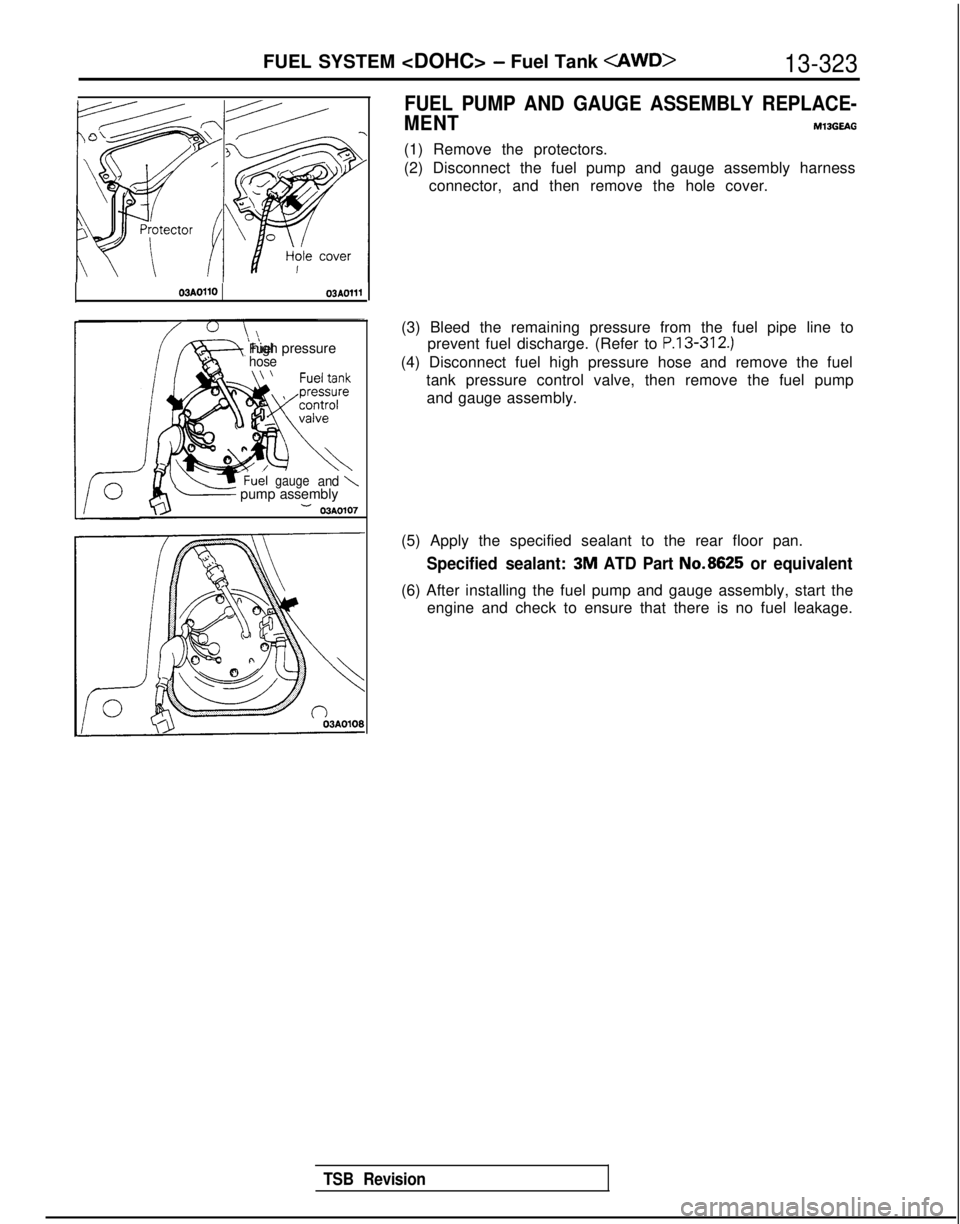
FUEL PUMP AND GAUGE ASSEMBLY REPLACE-
MENT
MlBGEAG
(1) Remove the protectors.
(2) Disconnect the fuel pump and gauge assembly harness connector, and then remove the hole cover.
(3) Bleed the remaining pressure from the fuel pipe line to prevent fuel discharge. (Refer to
P.13-312.)
(4) Disconnect fuel high pressure hose and remove the fuel
tank pressure control valve, then remove the fuel pumpand gauge assembly.
(5) Apply the specified sealant to the rear floor pan.
Specified sealant: 3M ATD Part No.8625 or equivalent
(6) After installing the fuel pump and gauge assembly, start the
engine and check to ensure that there is no fuel leakage.
Page 467 of 1273

t&-----Eye bolt
Gasket
Fuel filter
#-----
Flare nut
;y;; main ------A\
J")
FUEL SYSTEM
Mounting
bolts 03F008
I--l03FOO7Standard value: 20-25 mm (8-1.0 in.)
t&-----Eye bolt
Gasket
Fuel filter
#-----
Flare nut
;y;; main ------A\
J
I
-.
High-presfuel hose
J-ring
O”
SERVICE POINTS OF REMOVALMlSKBAMl
1. REMOVAL OF EYE BOLT
Remove the eye bolt while holding the fuel filter nut
securely.
Caution
Cover the hose connection with rags to prevent splash
of fuel that could be caused by some residual pressure
in the fuel pipe line.
3. REMOVAL OF FUEL FILTER (1) Loosen the main pipe flare nut while holding the fuelfilter nut securely.
(2) Remove the fuel filter mounting bolts, and then remove the fuel filter from the bracket.
INSPECTIONMlOKCABl
l Check the hose and pipes for cracks, bend, deformationand clogging.
lCheck the evaporative emission canister for clogging.
l Check the fuel filter for clogging and damage.
SERVICE POINTS OF INSTALLATIONMlJKDAPl
6. INSTALLATION OF FUEL VAPOR HOSE/4. FUEL RE-
TURN HOSE
(1) If the fuel pipe has a stepped part, connect the fuel
hose to the pipe securely, up to the stepped part, as
shown in the figure.
(2) If the fuel pipe does not have a stepped part, connect the fuel hose to the pipe securely, so that it is the
standard value.
3. INSTALLATION OF FUEL FILTER (1) When installing the fuel filter, first temporarily install thefilter to the filter bracket; then insert the main pipe at
the connector part of the filter, and manually screw in
the main pipe’s flare nut.
(2) Holding the fuel filter nut, tighten the fuel main pipe’s
flare nut and eye bolt at the specified torque. Then
tighten the filter to the bracket.
TSB Revision 2. INSTALLATION OF HIGH PRESSURE FUEL HOSE
Apply engine oil to the hose union.
Insert the hose, being careful not to damage the O-ring, and
tighten securely.
Caution
Because there is high pressure applied between the
fuel pump and the injection mixer, be especially sure
that there is no fuel leakage in this area.
Page 471 of 1273
ENGINE CONTROL - Service Adjustment Procedures13-329
SERVICE ADJUSTMENT PROCEDW,E,t&
ACCELERATOR CABLE INSPECTION AND
ADJUSTMENT
For models equipped with the auto-cruise control system, refer
to P. 13-398.
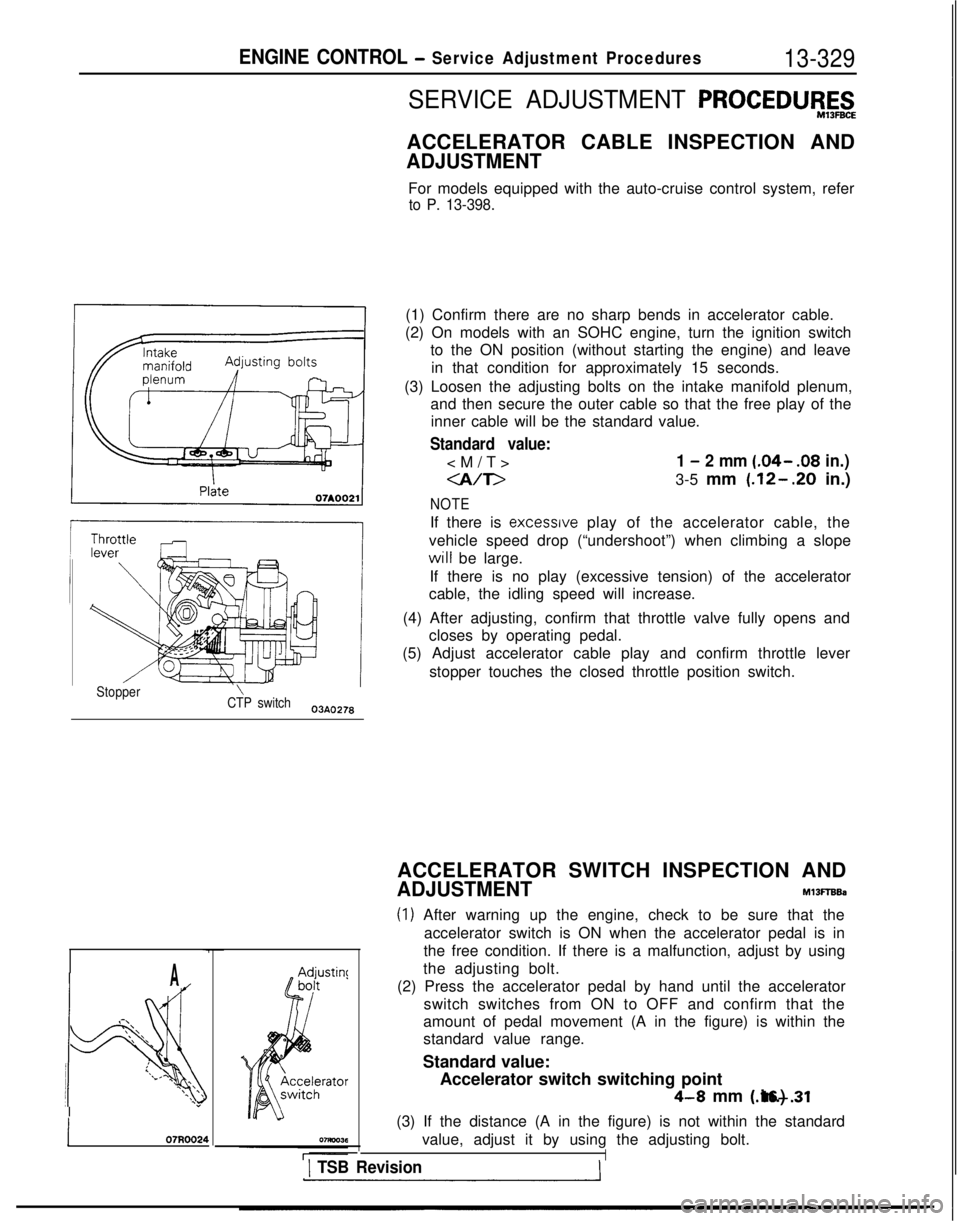
(1) Confirm there are no sharp bends in accelerator cable.
(2) On models with an SOHC engine, turn the ignition switch to the ON position (without starting the engine) and leave
in that condition for approximately 15 seconds.
(3) Loosen the adjusting bolts on the intake manifold plenum, and then secure the outer cable so that the free play of theinner cable will be the standard value.
Standard value:
1 - 2 mm (.04- .08
in.)
-a/T>3-5 mm (.12-.20 in.)
NOTE
If there is excessrve play of the accelerator cable, the
vehicle speed drop (“undershoot”) when climbing a slope will
be large.
If there is no play (excessive tension) of the accelerator
cable, the idling speed will increase.
(4) After adjusting, confirm that throttle valve fully opens and closes by operating pedal.
(5) Adjust accelerator cable play and confirm throttle lever
stopper touches the closed throttle position switch.
Stopper\CTP switch03AO278
A
.-\\‘\.\ ‘\
!4
:l/.\\ \\‘\ I\*\\”
j 07R0024
ACCELERATOR SWITCH INSPECTION AND
ADJUSTMENTM13FTBBa
(1) After warning up the engine, check to be sure that theaccelerator switch is ON when the accelerator pedal is in
the free condition. If there is a malfunction, adjust by using
the adjusting bolt.
(2) Press the accelerator pedal by hand until the accelerator switch switches from ON to OFF and confirm that the
amount of pedal movement (A in the figure) is within the
standard value range.
Standard value: Accelerator switch switching point
4-8 mm (.16-.31 in.)
(3) If the distance (A in the figure) is not within the standard value, adjust it by using the adjusting bolt.
I1 TSB Revision
Page 473 of 1273
ENGINE CONTROL - Engine Control13-331
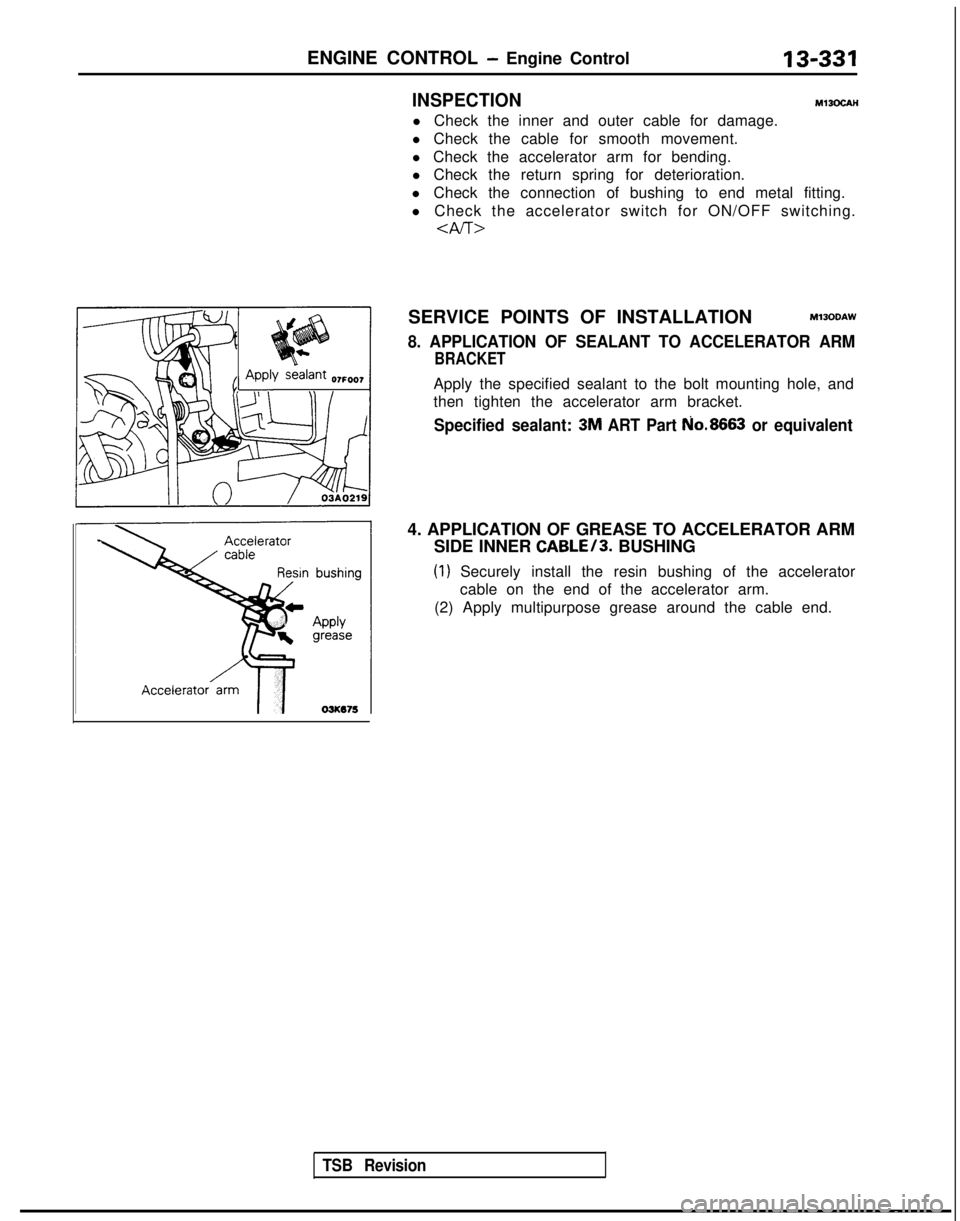
4. APPLICATION OF GREASE TO ACCELERATOR ARM
SIDE INNER
CABLE/3. BUSHING
(1) Securely install the resin bushing of the accelerator
cable on the end of the accelerator arm.
(2) Apply multipurpose grease around the cable end.
INSPECTIONMl3ocAH
l Check the inner and outer cable for damage.
l Check the cable for smooth movement.
l Check the accelerator arm for bending.
l Check the return spring for deterioration.
l Check the connection of bushing to end metal fitting.
l Check the accelerator switch for ON/OFF switching.
SERVICE POINTS OF INSTALLATIONMlJODAW
8. APPLICATION OF SEALANT TO ACCELERATOR ARM
BRACKET
Apply the specified sealant to the bolt mounting hole, and
then tighten the accelerator arm bracket.
Specified sealant: 3M ART Part No.8663 or equivalent
TSB Revision
Page 476 of 1273
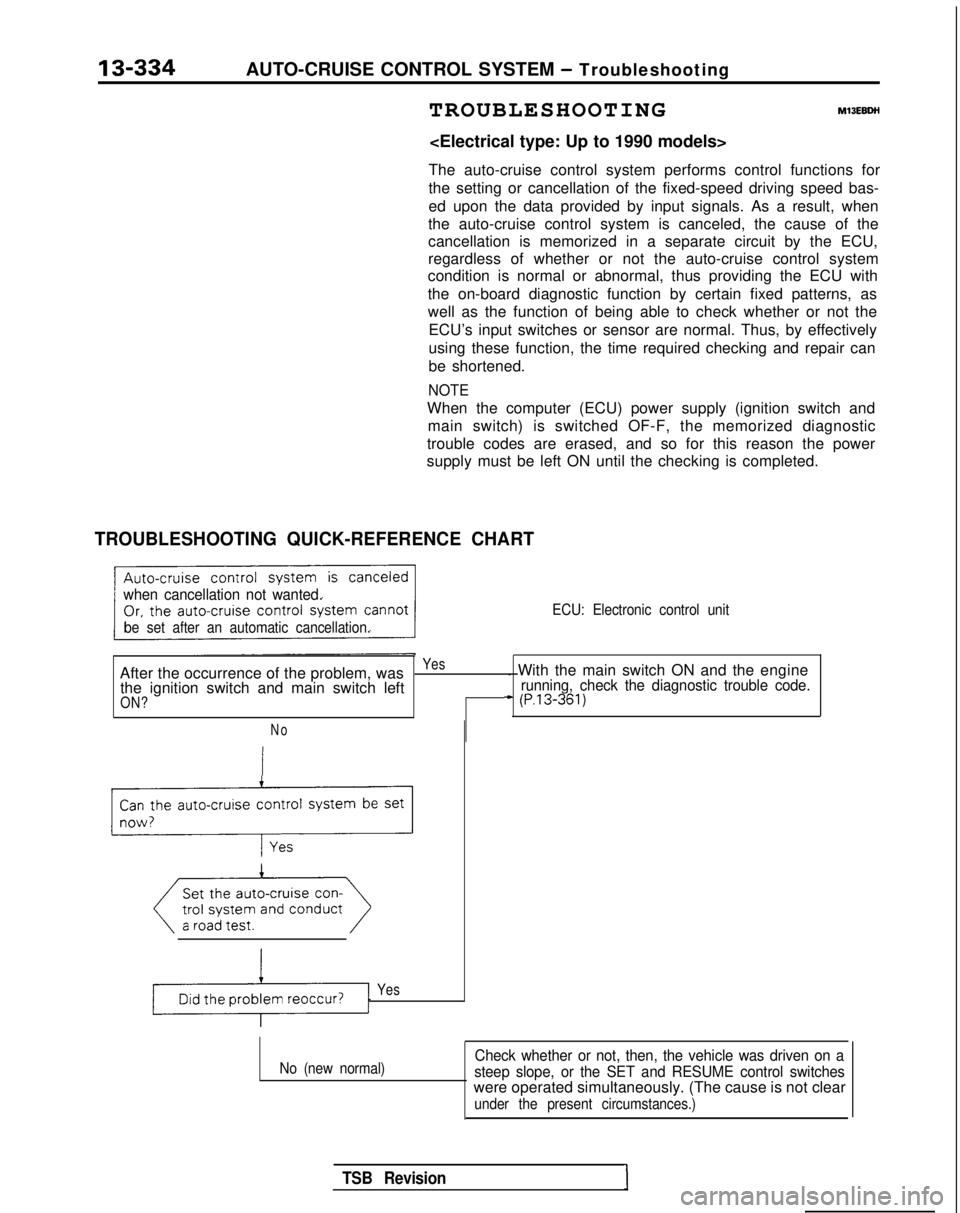
13-334AUTO-CRUISE CONTROL SYSTEM - Troubleshooting
TROUBLESHOOTIN
G
MlJEBDH
The auto-cruise control system performs control functions for
the setting or cancellation of the fixed-speed driving speed bas-
ed upon the data provided by input signals. As a result, when
the auto-cruise control system is canceled, the cause of the
cancellation is memorized in a separate circuit by the ECU,
regardless of whether or not the auto-cruise control system
condition is normal or abnormal, thus providing the ECU with
the on-board diagnostic function by certain fixed patterns, as
well as the function of being able to check whether or not the
ECU’s input switches or sensor are normal. Thus, by effectively
using these function, the time required checking and repair can
be shortened.
NOTE
When the computer (ECU) power supply (ignition switch andmain switch) is switched OF-F, the memorized diagnostic
trouble codes are erased, and so for this reason the power
supply must be left ON until the checking is completed.
TROUBLESHOOTING QUICK-REFERENCE CHART
when cancellation not wanted.
be set after an automatic cancellation. ECU: Electronic control unit
After the occurrence of the problem, wasYes. With the main switch ON and the engine
the ignition switch and main switch leftrunning, check the diagnostic trouble code.
ON?+ (P.13-361)
No
Can the auto-cruise control system be set
_r-l;
Yes
No (new normal)Check whether or not, then, the vehicle was driven on a
steep slope, or the SET and RESUME control switches
were operated simultaneously. (The cause is not clear
under the present circumstances.)
TSB RevisionI
Page 502 of 1273

Auto-crursecontrol unit
I 2EB16 I
lntr’")
13-360AUTO-CRUISE CONTROL SYSTEM - Troubleshooting
11. CHECKING THE THROTTLE POSITION SENSOR AND CLOSED THROTTLE POSITION S\
WITCH
CIRCUIT
Auto-crursecontrol unit
I 2EB16 I
lntr’
(18)
MFI controlmodule1380424
>
control
unrt
I f
Throttleposrtronsensor
Closed throttle-position swrtch
(18)MFI controlmodule
<1993models
>
13A0425(12)Auto-cruise
control unit
Throttleposition
sensorClosed throttle ‘position
switch
(18)MFI controlmodule13A0428
Description of operation
The throttle position sensor and closed throttle position switchare mounted in the idle speed control motor position sensor Orthrottle body and are sensors in the MFI system. The closed
throttle position switch is turned OFF when the accelerator
pedal is pressed and ON when it is released. In addition, throttle
position sensor output voltage varies according to the degree of
opening of the throttle valve.
Troubleshooting hint
Diagnostic-No.17
Diagnostic-No.1 7
ECU terminal voltage
TerminalNo.
4
5 Signal
Conditions
Terminal
voltage
Closed throttle When accelerator Battery
position switch
-pedal is pressedpositive voltage
When accelerator
pedal is releasedov
ThrottleWhen accelerator 4.0v-5%’position sensorpedal is pressedall the way down
When accelerator 0.48~0.72v
pedal is released
1 TSB Revision
Page 540 of 1273
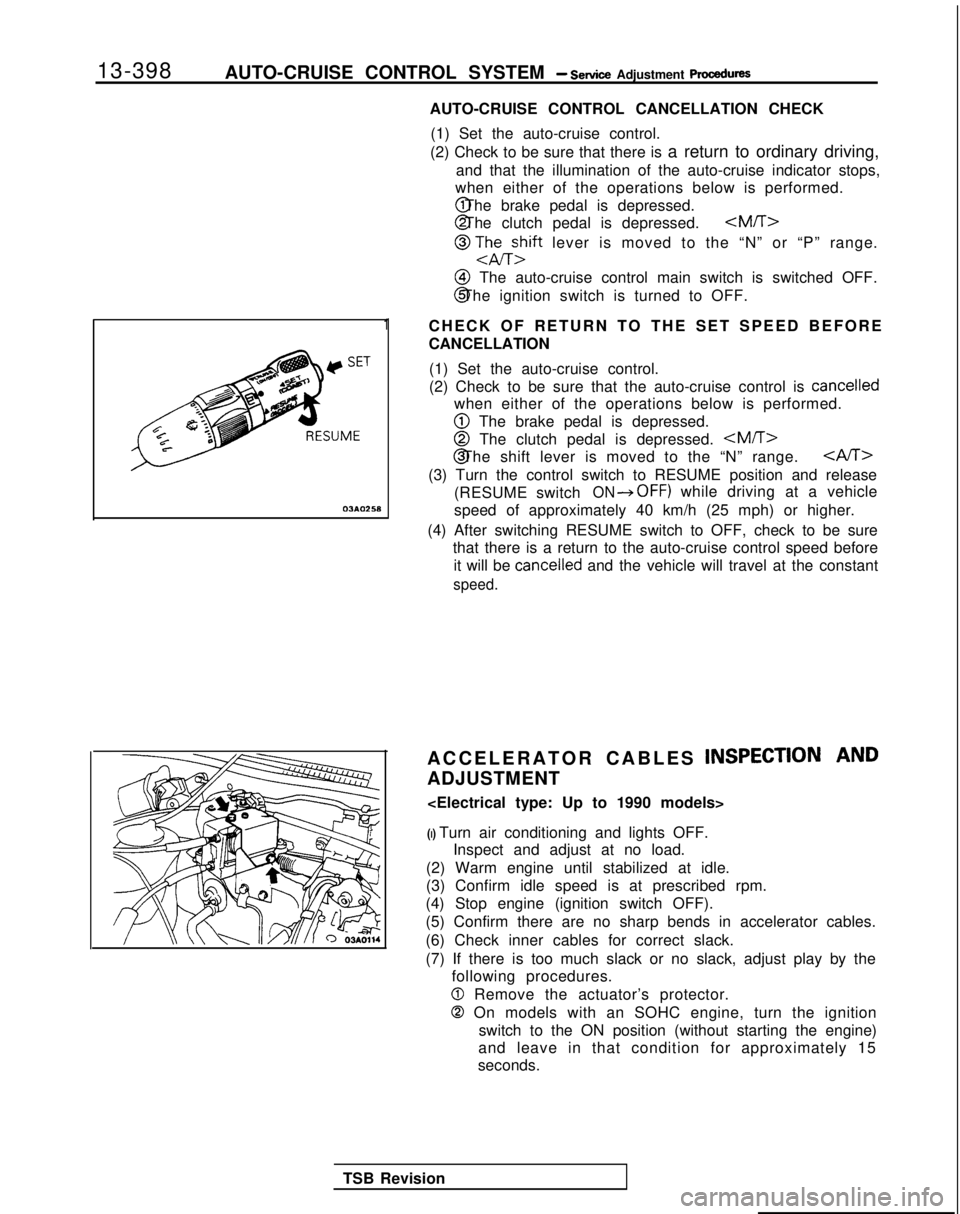
13-398
AUTO-CRUISE CONTROL SYSTEM - Setice Adjustment procedures
03*02.5*
1
AUTO-CRUISE CONTROL CANCELLATION CHECK
(1) Set the auto-cruise control.
(2) Check to be sure that there is a return to ordinary driving,
and that the illumination of the auto-cruise indicator stops,
when either of the operations below is performed. @ The brake pedal is depressed.
@ The clutch pedal is depressed.
@ TJhEzift lever is moved to the “N” or “P” range.
@I The auto-cruise control main switch is switched OFF.
@ The ignition switch is turned to OFF.
CHECK OF RETURN TO THE SET SPEED BEFORE
CANCELLATION (1) Set the auto-cruise control.
(2) Check to be sure that the auto-cruise control is
cancelled
when either of the operations below is performed.
@ The brake pedal is depressed.
@ The clutch pedal is depressed.
CAST>
(3) Turn the control switch to RESUME position and release
(RESUME switch
ON*OFF) while driving at a vehicle
speed of approximately 40 km/h (25 mph) or higher.
(4) After switching RESUME switch to OFF, check to be sure that there is a return to the auto-cruise control speed before
it will be
cancelled and the vehicle will travel at the constant
speed.
ACCELERATOR CABLES INSPECTION AND
ADJUSTMENT
(I) Turn air conditioning and lights OFF. Inspect and adjust at no load.
(2) Warm engine until stabilized at idle.
(3) Confirm idle speed is at prescribed rpm.
(4) Stop engine (ignition switch OFF).
(5) Confirm there are no sharp bends in accelerator cables.
(6) Check inner cables for correct slack.
(7) If there is too much slack or no slack, adjust play by the following procedures.
0 Remove the actuator’s protector.
0 On models with an SOHC engine, turn the ignition
switch to the ON position (without starting the engine)
and leave in that condition for approximately 15
seconds.
TSB Revision