1989 MITSUBISHI GALANT automatic
[x] Cancel search: automaticPage 275 of 1273

FUEL SYSTEM
FUEL TANK AND FUEL LINEMIBEAAB
Symptom
Probable cause Remedy
Engine malfunctions
due to insufficient
fuel supply Bent or kinked fuel pipe or hose
Clogged fuel pipe or hose
Clogged fuel filter or in-tank fuel filter
Water in fuel filter Repair or replace
Clean or replace
Replace
Replace the fuel filter or clean the
fuel tank and fuel line
Dirty or rusted fuel tank interior
Clean or replace
Malfunctioning fuel pump
(Clogged filter in the pump)Replace
Evaporative emission
control system
malfunctions
[When fuel tank filler
tube cap is removed,
pressure releasingnoise is heard) Mispiping of vapor line
Disconnected vapor line piping joint
Folded, bent, cracked or clogged vapor line
Faulty fuel tank filler tube cap
Malfunctioning fuel tank pressure control valve Correct
Correct
Replace
Replace
Replace
SERVICE ADJUSTMENT
PROCEDURES
CURB IDLE SPEED INSPECTIONhll3MAE
(1) The vehicle should be prepared as follows before th
e
inspection.
lEngine coolant temperature: 85-95°C (185-203°F)
l Lights, electric cooling fan and accessories: OFF
l Transaxle: Neutral (P for vehicles with an automatic
transaxle)
(2) Connect a tachometer.
NOTE
Refer to
P.13-134 for information concerning connection Of
a tachometer.
(3) Set a timing light in position.
(4) Ground the terminal for adjustment of ignition timing.
(5) Start the engine and let it idle.
(6) Check whether or not the ignition timing is the standard
value; if not, adjust.
Standard value:
5”BTDC f 2”
(7) Stop grounding the terminal for adjustment of ignition timing.
(8) Let the engine idle for two minutes.
(9) Check the idling rpm.
Curb idle speed: 700
31100 rpm
NOTE
The idling rpm is automatically regulated by the idle aircontrol system.
(lO)lf not within the standard value range, refer to the CHECK
CHART CLASSIFIED BY PROBLEM SYMPTOMS and check
the
MFI component,
TS6 Revision1
Page 300 of 1273
On-Vehicle Inspection of MFI
13-158FUEL SYSTEM (SOHC-16 VALVE> - Components
OPERATION
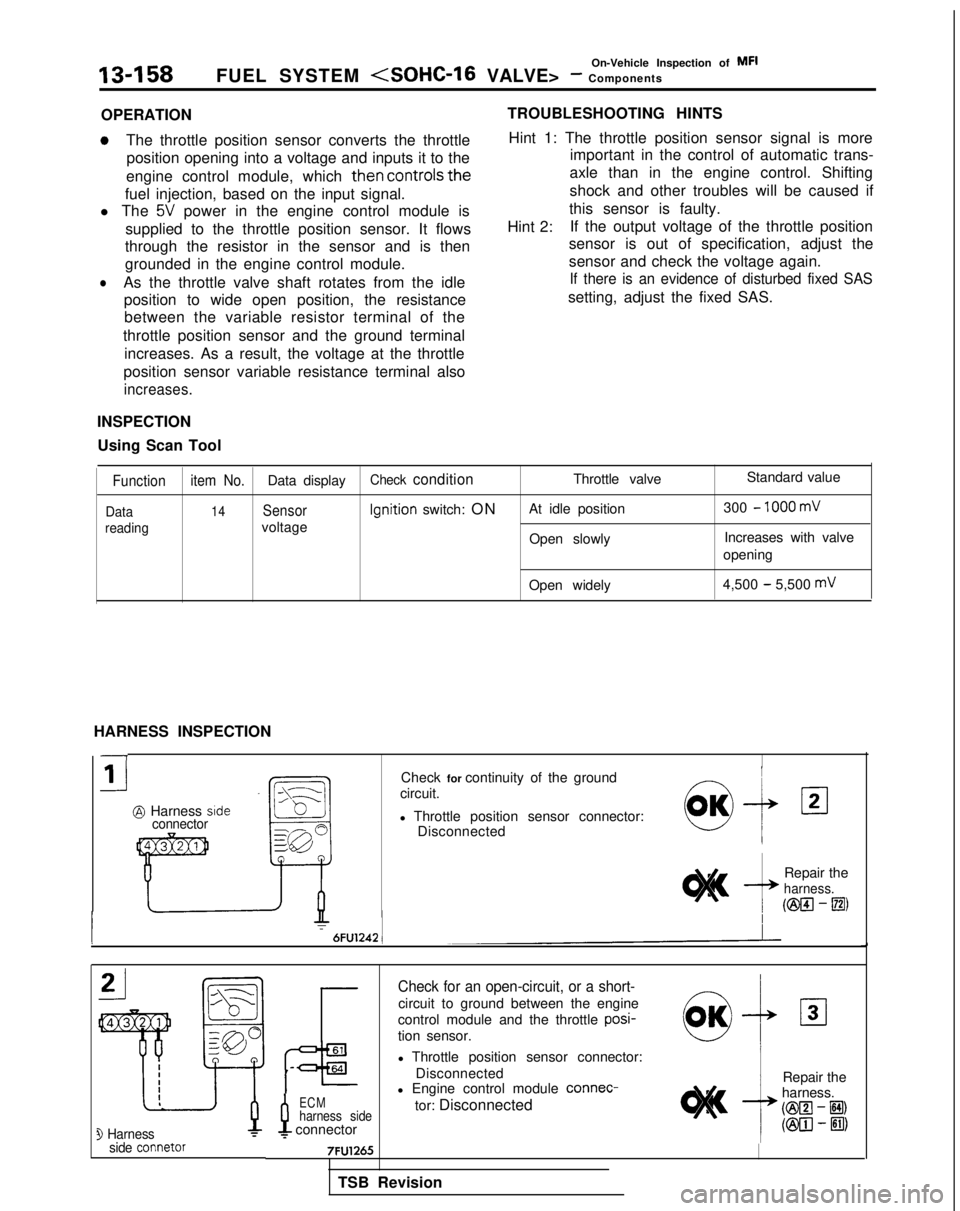
aThe throttle position sensor converts the throttle position opening into a voltage and inputs it to the
engine control module, which
then controls
the
fuel injection, based on the input signal.
l The
5V power in the engine control module is
supplied to the throttle position sensor. It flows
through the resistor in the sensor and is then
grounded in the engine control module.
lAs the throttle valve shaft rotates from the idle position to wide open position, the resistancebetween the variable resistor terminal of the
throttle position sensor and the ground terminal increases. As a result, the voltage at the throttle
position sensor variable resistance terminal also
increases.
INSPECTION
Using Scan Tool TROUBLESHOOTING HINTS
Hint 1: The throttle position sensor signal is more important in the control of automatic trans-
axle than in the engine control. Shifting
shock and other troubles will be caused if
this sensor is faulty.
Hint 2: If the output voltage of the throttle position
sensor is out of specification, adjust the
sensor and check the voltage again.
If there is an evidence of disturbed fixed SAS
setting, adjust the fixed SAS.
Function item No.Data displayCheck conditionThrottle valve Standard value
Data14Sensor Ignition
switch: ON At idle position 300 - 1000 mV
readingvoltage
Open slowlyIncreases with valve
opening
Open widely 4,500
- 5,500 mV
HARNESS INSPECTION
-
i1
@ Harness sideconnector
Check for continuity of the ground
circuit.
l Throttle position sensor connector: Disconnected
Repair the
harness.
(ml-m
3 Harnessside connetor
P
ECMharness sidef connector
Check for an open-circuit, or a short-
circuit to ground between the engine
control module and the throttle posi-
tion sensor.
l Throttle position sensor connector:
Disconnected
l Engine control module connec-
tor: Disconnected Repair the
harness. @El
- El)
(@III-ElII
TSB Revision
Page 387 of 1273
FUEL SYSTEM
cl989 models> -a’i\.-upI t
SERVICE ADJUSTMENT PROCEDURES
CURB IDLE SPEED INSPECTION
MlSFHAB
(1) The vehicle should be prepared as follows before the inspection.
l Engine coolant temperature:
85-95°C (185-205°F)
l Lights, electric cooling fan and accessories: OFF
l Transaxle: Neutral
(P for vehicles with an automatic
transaxle)
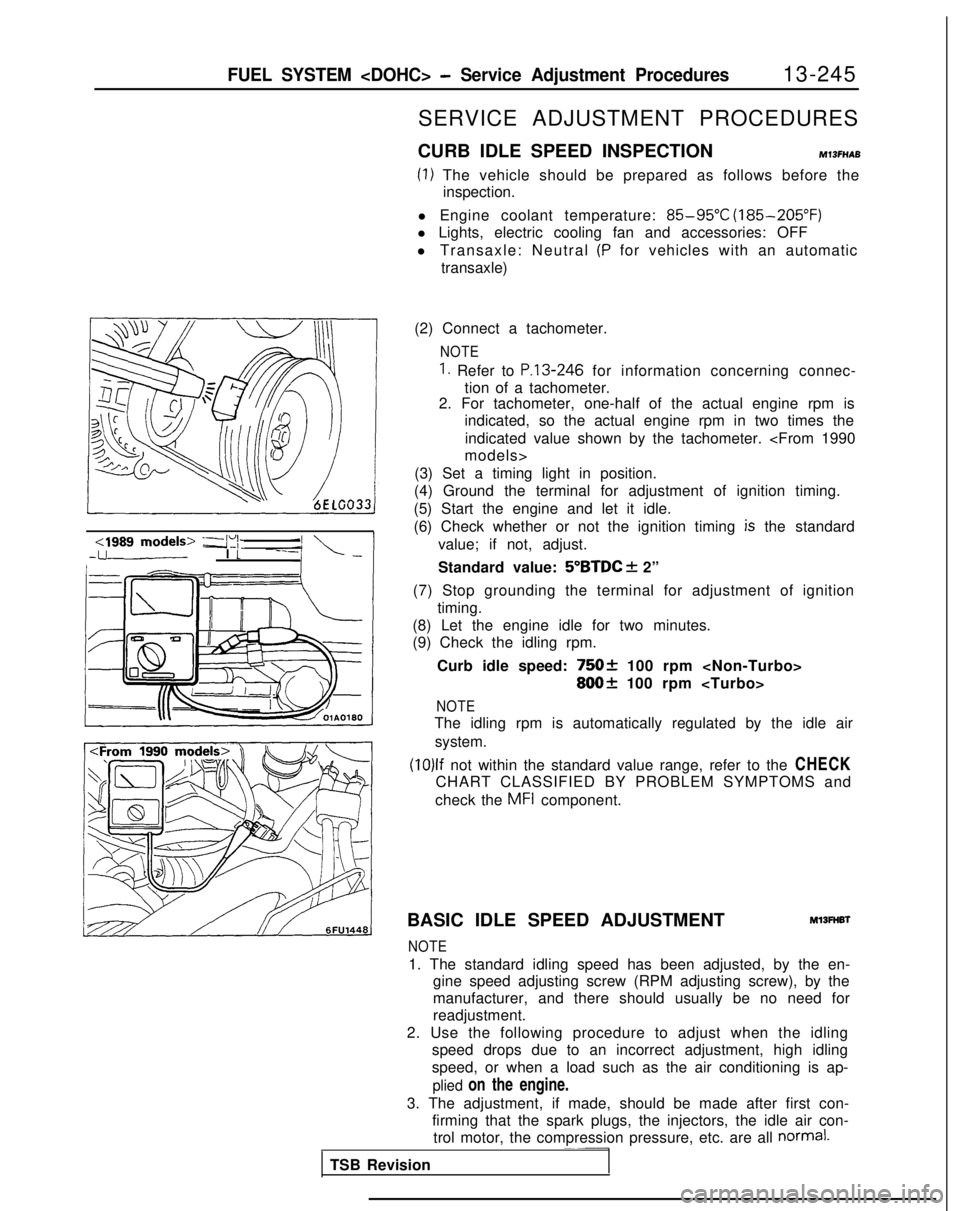
(2) Connect a tachometer.
NOTE
1. Refer to P.13-246 for information concerning connec-
tion of a tachometer.
2. For tachometer, one-half of the actual engine rpm is
indicated, so the actual engine rpm in two times the
indicated value shown by the tachometer.
(3) Set a timing light in position.
(4) Ground the terminal for adjustment of ignition timing.
(5) Start the engine and let it idle.
(6) Check whether or not the ignition timing
is the standard
value; if not, adjust.
Standard value:
5”BTDC f 2”
(7) Stop grounding the terminal for adjustment of ignition timing.
(8) Let the engine idle for two minutes.
(9) Check the idling rpm.
Curb idle speed:
75Ok 100 rpm
800+ 100 rpm
NOTE
The idling rpm is automatically regulated by the idle airsystem.
(10)lf not within the standard value range, refer to the CHECK
CHART CLASSIFIED BY PROBLEM SYMPTOMS and
check the
MFI component.
BASIC IDLE SPEED ADJUSTMENT
Ml3FHBl
NOTE
1. The standard idling speed has been adjusted, by the en- gine speed adjusting screw (RPM adjusting screw), by the
manufacturer, and there should usually be no need for
readjustment.
2. Use the following procedure to adjust when the idling speed drops due to an incorrect adjustment, high idling
speed, or when a load such as the air conditioning is ap-
plied on the engine.
3. The adjustment, if made, should be made after first con- firming that the spark plugs, the injectors, the idle air con-trol motor, the compression pressure, etc. are all
normal.~~-
TSB Revision
Page 388 of 1273
13-246FUEL SYSTEM
17k&---,!E~,~~/iY I
(1) The vehicle should be prepared as follows before the
inspection and adjustment.
l Engine coolant temperature:
85-95°C (185-205°F)
l Lights, electric cooling fan and accessories: OFF l Transaxle: Neutral (P for vehicles with an automatic transaxle)
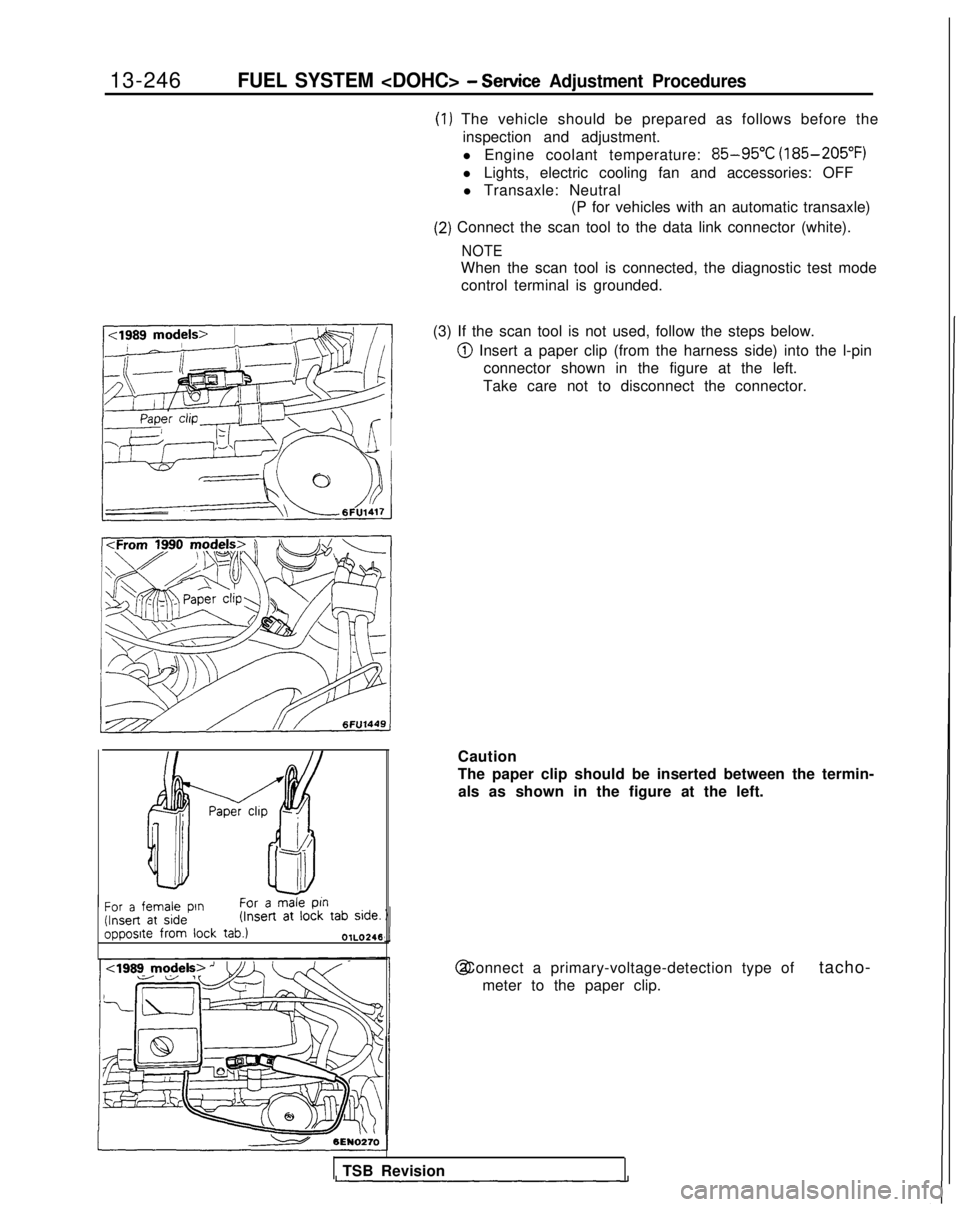
(2) Connect the scan tool to the data link connector (white).
NOTE
When the scan tool is connected, the diagnostic test mode
control terminal is grounded.
(3) If the scan tool is not used, follow the steps below.
@ Insert a paper clip (from the harness side) into the l-pin connector shown in the figure at the left.
Take care not to disconnect the connector.
/ Paper chp -
f!f--i!t
Ah
-II
For a female pin
For a male
ptn (Insert
at side (Insert
at
lock tab side.
opposite from
lock
tab.)OlL0246
Caution
The paper clip should be inserted between the termin-
als as shown in the figure at the left. @ Connect a primary-voltage-detection type of
tacho-
meter to the paper clip.
TSB Revision
Page 413 of 1273
FUEL SYSTEM
TROUBLESHOOTING HINTS
Hint 1:
The signals of the throttle-position sensor are more
important for control of the automatic transaxle than
for control of the engine; shifting “impact shocks”
are produced if there is a malfunction of the
throttle-position sensor.
INSPECTION
Using Scan tool Hint 2:
If the voltage of the throttle-position sensor deviates
from the standard value, check once again after making the throttle-position sensor adjustment.
in
addition, if there are any indications that the fixedSAS has been moved, adjust the fixed SAS.
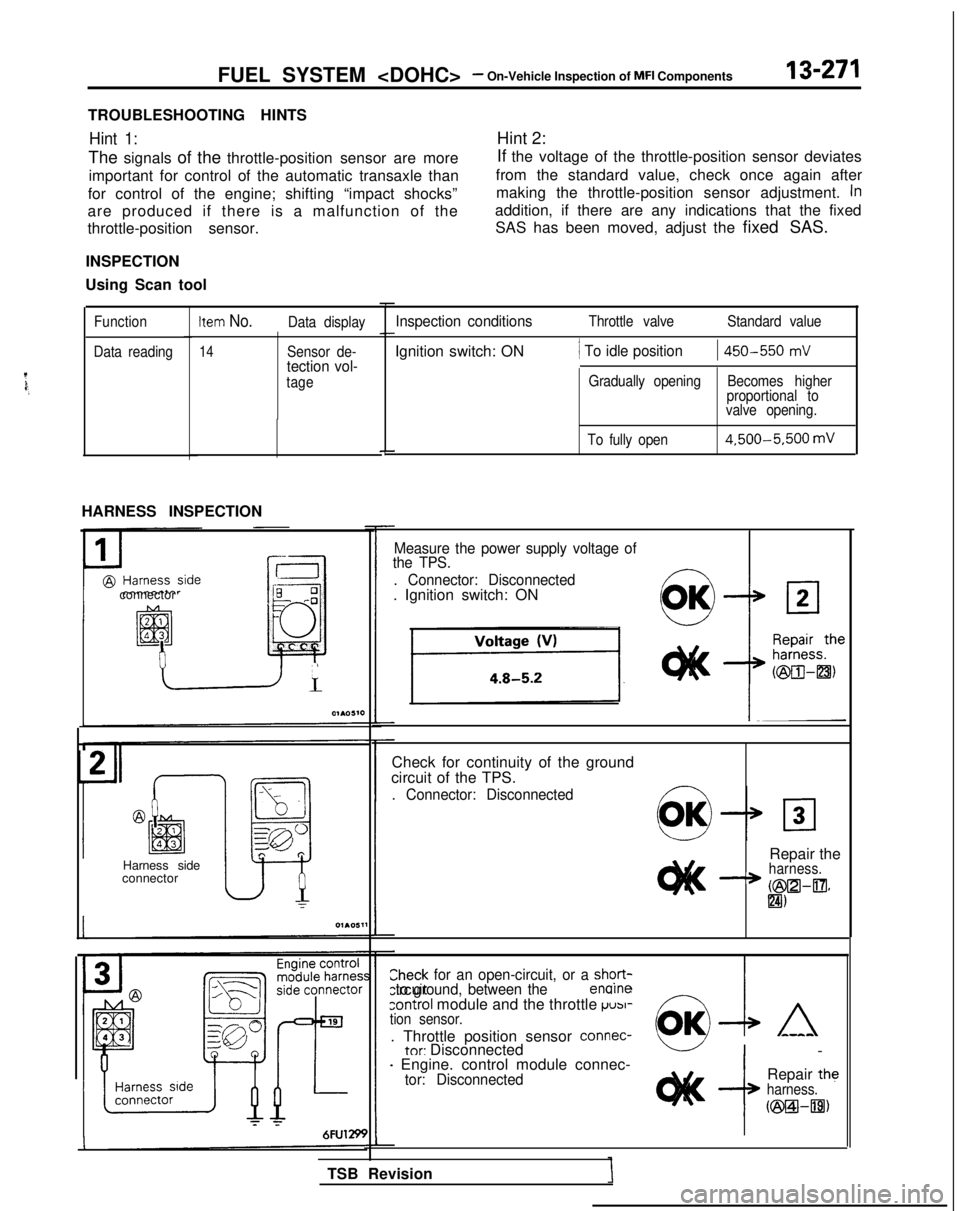
Function
Data readingItem No.Data display
14Sensor de-tection vol-
tage
HARNESS INSPECTION
connector
Harness side
connector
Inspection conditionsThrottle valve Standard value
Ignition switch: ON/ To idle position1 450-550
mV
Gradually opening Becomes higher
proportional to
valve opening.
To fully open 4,500-5,500
mV
Measure the power supply voltage of
the TPS.
. Connector: Disconnected
. Ignition switch: ON
Check for continuity of the ground
circuit of the TPS.
. Connector: Disconnected
Repair theharness.
+ K25xz.l-~~IZI)
LZheck for an open-circuit, or a shqrt-Yrcuit to ground, between the er-.--control module and the throttle ~USI-tion sensor.
. Throttle position sensor connec-tnr: Disconnected I
-
- Engine. control module connec-tor: DisconnectedRepair theharness.
u23Bl-m)
TSB Revision
Page 416 of 1273
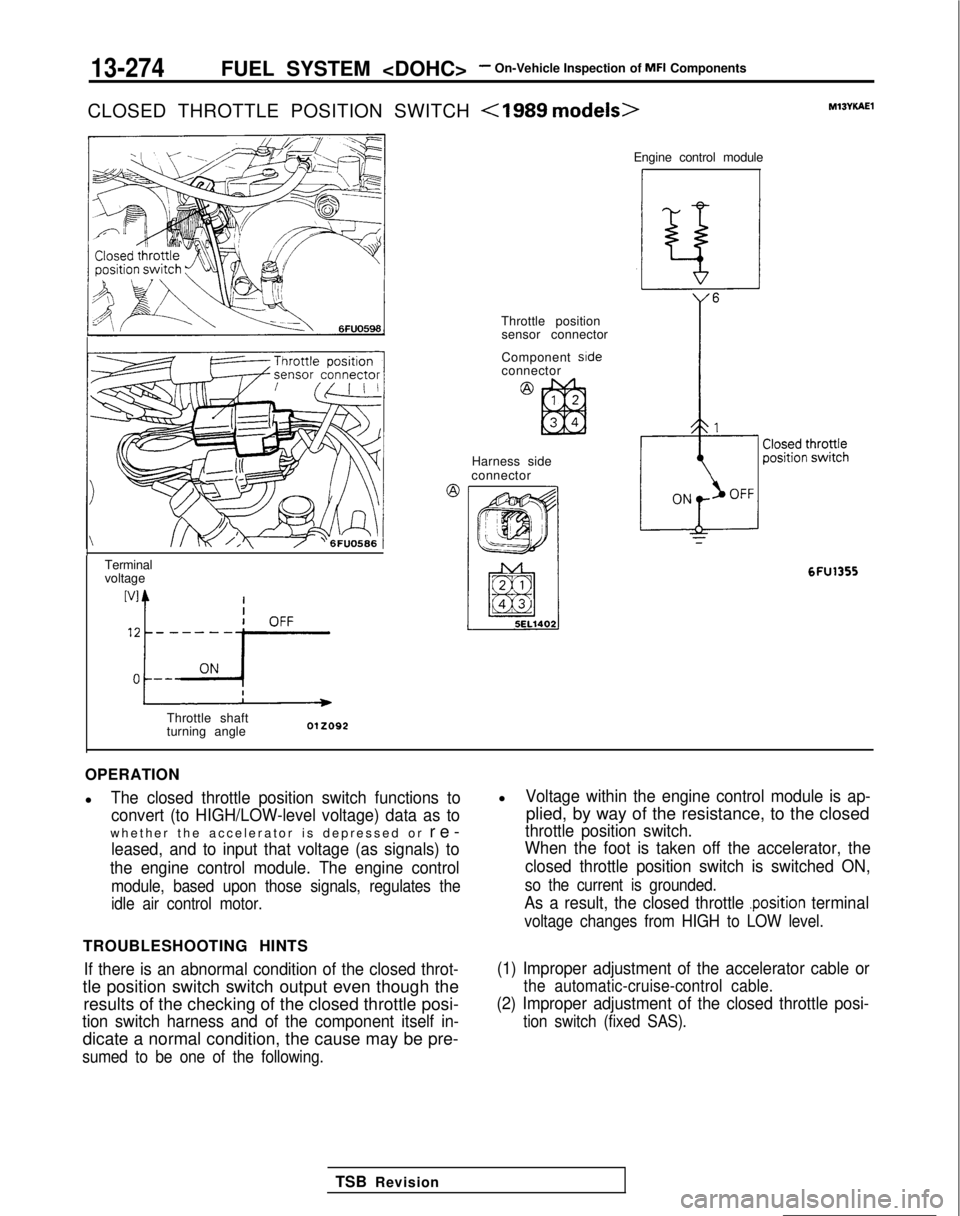
13-274FUEL SYSTEM
CLOSED THROTTLE POSITION SWITCH
Terminal
voltage
Throttle shaft
turning angle Engine control module
1
Throttle position
sensor connector
Component side
connector
Harness side
connector
6FU1355
OPERATION
l
The closed throttle position switch functions to
convert (to HIGH/LOW-level voltage) data as to
whether the accelerator is depressed or re
-
leased, and to input that voltage (as signals) to
the engine control module. The engine control
module, based upon those signals, regulates the
idle air control motor.
TROUBLESHOOTING HINTS
If there is an abnormal condition of the closed throt-
tle position switch switch output even though the results of the checking of the closed throttle posi-
tion switch harness and of the component itself in-
dicate a normal condition, the cause may be pre-
sumed to be one of the following.
lVoltage within the engine control module is ap-
plied, by way of the resistance, to the closed
throttle position switch.
When the foot is taken off the accelerator, the
closed throttle position switch is switched ON,
so the current is grounded.
As a result, the closed throttle .position terminal
voltage changes from HIGH to LOW level.
(1) Improper adjustment of the accelerator cable or
the automatic-cruise-control cable.
(2) Improper adjustment of the closed throttle posi-
tion switch (fixed SAS).
TSB Revision
Page 470 of 1273

13-328ENGINE CONTROL - Specifications/Troubleshooting
ENGINE CONTROL
SPECIFICATIONS
SERVICE SPECIFICATIONSM13CB-B
ItemsSpecifications
Standard value
Accelerator cable playmm (in.)
1-2 (.04-,081
Accelerator switch switching point
mm (in.)4-8 (.16-,311
TORQUE SPECIFICATIONSMlBCC--B
Items
Accelerator arm bracket to body
Throttle body side inner cable to intake manifold plenum
Accelerator arm side inner cable to body
Nmft.lbs.
8-12 6-
9
4-6 3-4
4-6 3-4
SEALANT
MlOCE--B
Items
Accelerator arm bracket Specified sealant 3M ATD Part No.8663 or equivalent
TROUBLESHOOTING
ACCELERATOR CABLE AND ACCELERATOR PEDAL
MlBEGAB
Symptom
Throttle valve will not fully open or close Probable cause
Remedy
Misadjusted accelerator cable
Adjust
Misadjusted automatic speed-control cable Adjust
Broken return
sprinqReplace
Accelerator pedal
operation not smooth (over acceleration)
Throttle lever malfunction
Accelerator pedal wrongly tightened
Misinstalled accelerator cable
Accelerator cable requires lubrication Replace
Repair
Repair
Lubricate or replace
TSB RevisionI
Page 476 of 1273
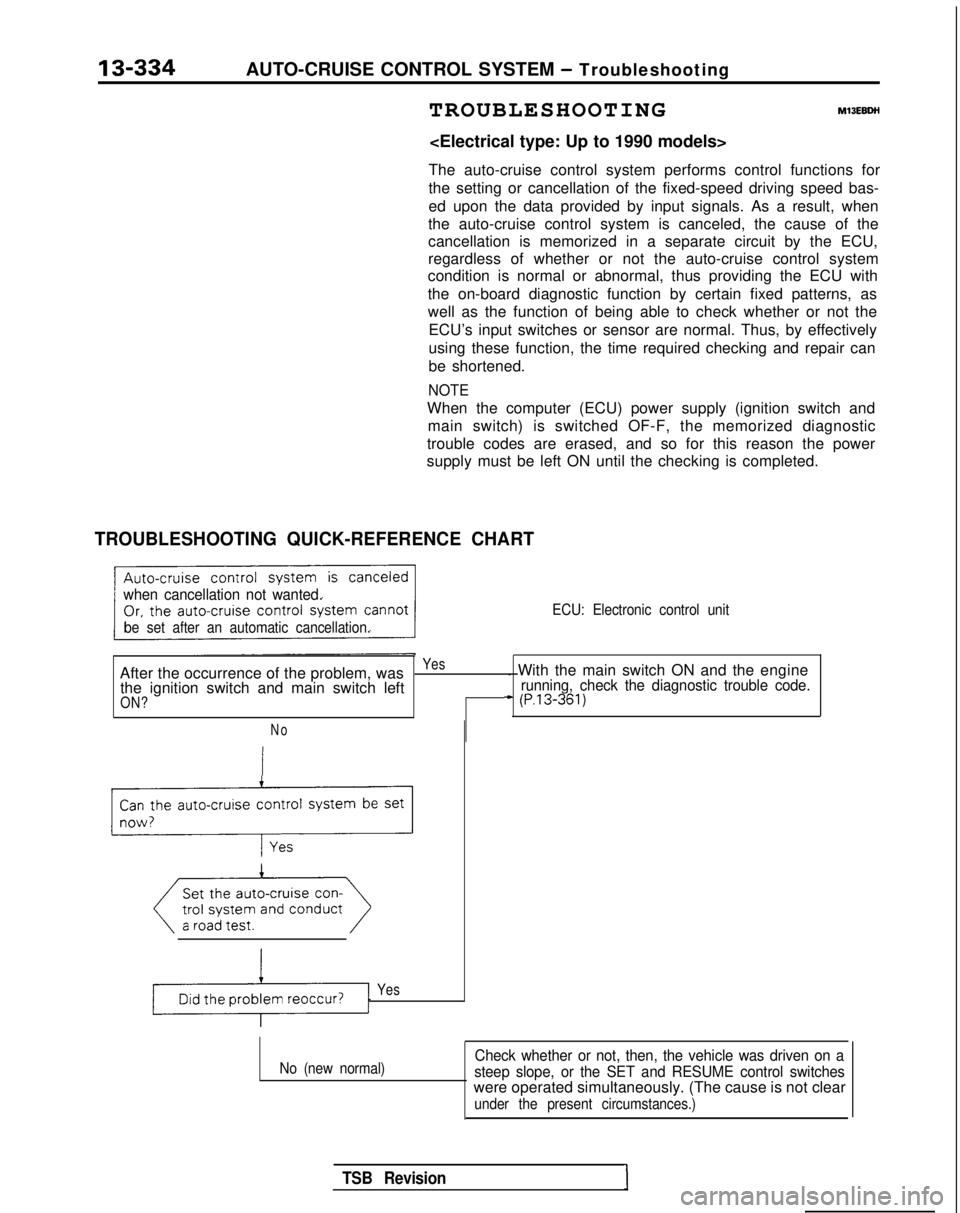
13-334AUTO-CRUISE CONTROL SYSTEM - Troubleshooting
TROUBLESHOOTIN
G
MlJEBDH
The auto-cruise control system performs control functions for
the setting or cancellation of the fixed-speed driving speed bas-
ed upon the data provided by input signals. As a result, when
the auto-cruise control system is canceled, the cause of the
cancellation is memorized in a separate circuit by the ECU,
regardless of whether or not the auto-cruise control system
condition is normal or abnormal, thus providing the ECU with
the on-board diagnostic function by certain fixed patterns, as
well as the function of being able to check whether or not the
ECU’s input switches or sensor are normal. Thus, by effectively
using these function, the time required checking and repair can
be shortened.
NOTE
When the computer (ECU) power supply (ignition switch andmain switch) is switched OF-F, the memorized diagnostic
trouble codes are erased, and so for this reason the power
supply must be left ON until the checking is completed.
TROUBLESHOOTING QUICK-REFERENCE CHART
when cancellation not wanted.
be set after an automatic cancellation. ECU: Electronic control unit
After the occurrence of the problem, wasYes. With the main switch ON and the engine
the ignition switch and main switch leftrunning, check the diagnostic trouble code.
ON?+ (P.13-361)
No
Can the auto-cruise control system be set
_r-l;
Yes
No (new normal)Check whether or not, then, the vehicle was driven on a
steep slope, or the SET and RESUME control switches
were operated simultaneously. (The cause is not clear
under the present circumstances.)
TSB RevisionI