1987 MITSUBISHI MONTERO lock
[x] Cancel search: lockPage 230 of 284

8-210 AUTOMATIC FREE-WHEELING HUB INDICATOR SYSTEM - General Information
EXPLANATION OF INDICATOR OPERATION
.
1.
2. Automatic free-wheeling hub in locked condition
The
output of the pulse generator is input to $ertninal 4 of the control unit, and the output signals from
the vehicle-speed sensor are input
to termi#al 3 of the control unit.
Only when there are pulse signals from the pulse generator, and when, moreover, the vehicle-speed
signals indicate a vehicle speed of approximatkly 2.5 mph (4 km/h) or highter does the control unit judge
that the automatic free-wheeling hub is the locked condition at the lock-discrimination circuit of the
control unit, and therefore the set signal (locked condition) is output.
This signal is entered into the memory circuit, thus causing the indicator light to illuminate.
Pulse generator Speed sensor
(Reed switch)
Pulse-detection circuit / I I
Memory circuit rp*
I
Automatic free-wheeling hub Lock-discrimin&ion circuit
indicator control unit 16W1535 Ignition switch
‘use No. 3 n
J 2
I_
Power-supply circuit
Vehicle-speed
detection circuit 1
Sub fusible link 1
Main fusible link 1
)
1
Battery
When vehicle is stopped (with ignition key still at ON) with automatic free-wheeling hub locked
Signals are not output from the pulse generator and the vehicle-speed sensor when the vehicle is
stopped.
However, because the set signal (locked condition) is entered into the memory circuit, the indicator light
shows the condition in effect when the vehicle was traveling.
Pulse generator Speed sense
Pulse-detecti: ci~uit~~I~ #
Lock-discrimination circuit
Memory circuit ‘use No. 3 Ignition switch
10~ Automatic free-
3; wheeling hub
I/\’ indicator light
Sub fusible link
Power-supply circuit
Main fusible link
detection circuit
Automatic free-wheeling hub
indicator control unit
[ STB Revision
Page 231 of 284

AUTOMATIC FREE-WHEELING HUB INDICATOR SYSTEM - Generallnformation 8-211
3. Automatic free-wheeling hub in free condition
For the free condition, although there are (when the vehicle is traveling) output signals from the vehicle-
speed sensor, there are no signals from the pulse generator, with the result that the memory circuit is
erased (because reset signals are output from the lock-discrimination circuit), and so the indicaotr light
does not illuminate.
I
Lock Use-detection
-discrimination
Memory ipeed sensor Ignition switch
Automatic free-
detection circuit
circuit
circuit
Automatic free-wheeling
indicator control unit -
hub i
Sub fusible link
link
Pulse generator cross-sectional view PULSE GENERATOR
Coil hgnet
16W1547
rator
Front out-
put shaft
16W1546 The pulse generator is located at the rear part of the front
output shaft of the transfer, and is composed of the magnet,
the coil and the pole (iron core).
When a magnetic material (iron, nickel, etc.) is brought close
to and moved away from the pole (iron core), the magnetic flux
within the pole changes, thus generating AC voltage in the
coil.
Because the front output shaft does not rotate when the
automatic free-wheeling hub is in the free condition, there is
no generation of AC voltage in the pulse generator.
In the locked condition, however, the front output shaft and
the pulse rotor rotate, with the result that the magnetic flux
(within the p o e I (’ Iron core) of the pulse generator) changes in
accordance with the rotations of the pulse rotor, thereby
generating AC voltage in the coil.
This AC voltage is transmitted to the automatic free-wheeling
hub indicator control unit.
STB Revision
Page 232 of 284

8-212 AUTOMATIC FREE-WHEELING HUB lNCDlCATOR SYSTEM - $%%60n’~at’on’
Speedometer
I
iensor Vehicle-speed
sensor
16W1506
12R0058
Circuit Diagram
16W153
SPECIFICATIONS
GENERAL SPECIFICATIONS VEHICLE-SPEED SENSOR (REED-TYPE SWITCH)
The vehicle-speed sensor functions to substitute pulse signals
for the rotations (vehicle speed) of the transmission’s output
gear;/ t i is located within the speedometer.
Pulse signals are generated when the speedometer cable
rotates.
AUTbMATlC FREE-WHEELING HUB INDICATOR
CONTROL UNIT
The control unit is located at the upper part of the right cowl
side.
The control unit is composed of the pulse-detection circuit
(which receives the input signals from the pulse generator),
the vehicle-speed-detection circuit (which receives the input
signals from the vehicle-speed sensor), the lock-discrimination
circuit (which, based on both of these input signals, judges the
condition of the automatic free-wheeling hub ‘and then trans-
mits indicator output signals to the memory circuit), and the
memory circuit (which “memorizes” the indicator output
signals from the lock-discrimination circuti).
Items
Automatic free-wheeling hub indicator light
Pulse generator
Type
Vehicle-speed sensor
Type
Pulse generation
SERVICE SPECIFICATIONS
Specifications
W (SAE trade number) 1.4(74)
Magnet coil type
Reed switch type
4 pulses/ rotation
NOORG-
Items Specifications
Standard values
Pulse generator resistance
R 215-275
Vehicle-speed sensor output voltage V
When OFF 4 or more 1 STB Revision
When ON 0
Page 233 of 284

AUTOMATIC FREE-WHEELING HUB INDICATOR SYSTEM -Troubleshooting 8-213
TROUBLESHOOTING NOIRH-
Inspection items
Symptom
Reference page
3-21E
0 The indicator light does not illuminate
although the automatic free-wheeling
hub is in the locked condition and the
vehicle speed is approximately 2.5 mph
(4 km/h) or higher.
0 0 0
0
The indicator light does not illuminate
when the vehicle is stopped (with the
ignition key at ON) after traveling, even
though the automatic free-wheeling hub
is in the locked condition.
The indicator light remains illuminated
when the ignition key is turned from OFF
to ON.
0
0 0 0
a 0
The indicator light remains illuminated
when (after traveling with the automatic
free-wheeling hub in the locked
condition) the vehicle is stopped, the
automatic free-wheeling hub is changed
to the free condition, and the vehicle is
then driven at a speed of approximately
2.5 mph (4 km/h) or higher.
0 Cc 0
NOTE
Number in circle indicates inspection sequence.
/ STB Revision
Page 234 of 284

8-214 AUTOM TIC FREE-WHEELING VU6 INDICATOR SYSTEM - Circuit Diagram
I
m I IA-21 m
v?~
r:
BI I To column switch
2
[Refer to P.8-461 CT
= 9’i A I
I
m z
I ’
c: d
I ’
LR
!J
I I 1
CIRCUIT DIAGRAM
AUTOMATIC FREE-WHEELING HUB INDICATOR SYSTEM
CIRCUIT
F==e=%
Battery lu-!
A-02 Sub fusible link
- 15-w r-)5-w 0.5-G
2-w
I I I I
Main fusible
link
7
N
-22
3
Pulse c:
generator
h Ignition switch
I /Locking check circuit 1
q IIEI Combination meter
Automatic free-wheeling hub
indicator control unit
1 B R
Em El1 Y L
Remark
For information concerning the ground points (example: q ),
refer to P.8-7.
37W610
Wiring color code
B: Black Br: Brown
G: Green L: Blue
LI: Light blue Lg: Light green
0: Orange P: Pink “,r: RG,‘d”Y
Y: Yellow
W: White
1 STB Revision
Page 252 of 284
24-16 HEATER? - Ventilators
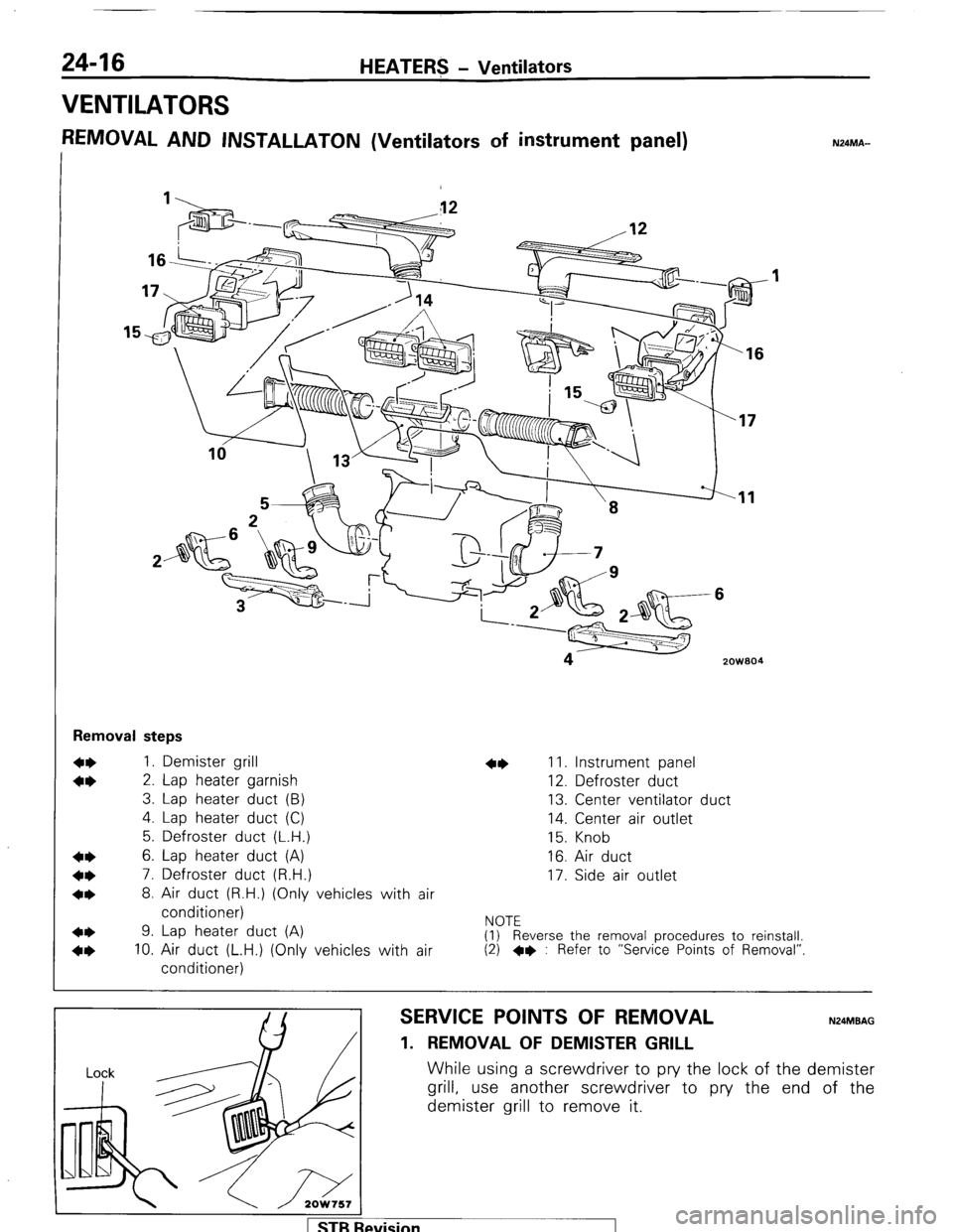
VENTILATORS
REMOVAL AND INSTALLATON (Ventilators of instrument panel) N24MA-
‘16
zowaa I4
Removal steps
1. Demister grill
2. Lap heater garnish
3. Lap heater duct (B)
4. Lap heater duct (C)
5. Defroster duct (L.H.)
6. Lap heater duct (A)
7. Defroster duct (R.H.)
8. Air duct (R.H.) (Only vehicles with air
conditioner)
9. Lap heater duct (A)
10. Air duct (L.H.) (Only vehicles with air
conditioner) 11. Instrument panel
12. Defroster duct
13. Center ventilator duct
14. Center air outlet
15. Knob
16. Air duct
17. Side air outlet
NOTE
(1) Reverse the removal procedures to reinstall.
(2) +e : Refer to “Service Points of Removal”
SERVICE POINTS OF REMOVAL N24MBAG
1. REMOVAL OF DEMISTER GRILL
While using a screwdriver to pry the lock of the demister
grill, use another screwdriver to pry the end of the
demister grill to remove it.
levision
Page 253 of 284
HEATERS - Ventilators 24-17
2OW75l
2OW759
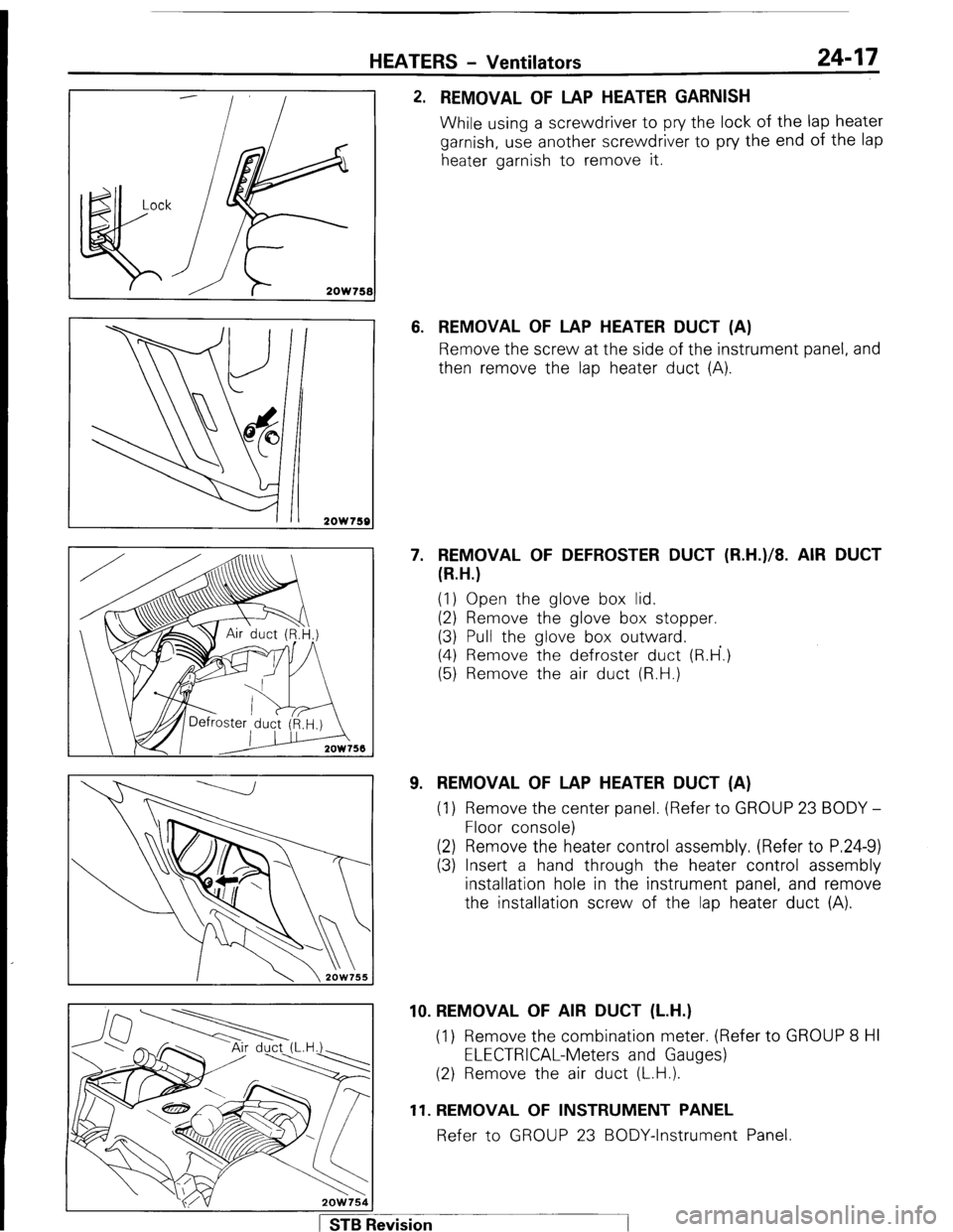
2. REMOVAL OF LAP HEATER GARNISH
While using a screwdriver to pry the lock of the lap heater
garnish, use another screwdriver to pry the end of the lap
heater garnish to remove it.
6. REMOVAL OF LAP HEATER DUCT (A)
Remove the screw at the side of the instrument panel, and
then remove the lap heater duct (A).
7. REMOVAL OF DEFROSTER DUCT (R.H.)/8. AIR DUCT
(R.H.)
(1) Open the glove box lid.
(2) Remove the glove box stopper.
(3) Pull the glove box outward.
(4) Remove the defroster duct (R.H’.)
(5) Remove the air duct (R.H.)
9. REMOVAL OF LAP HEATER DUCT (A)
(1) Remove the center panel. (Refer to GROUP 23 BODY -
Floor console)
(2) Remove the heater control assembly. (Refer to P.24-9)
(3) Insert a hand through the heater control assembly
installation hole in the instrument panel, and remove
the installation screw of the lap heater duct (A).
1 STB Revision 10. REMOVAL OF AIR DUCT (L.H.)
(1) Remove the combination meter. (Refer to GROUP 8 HI
ELECTRICAL-Meters and Gauges)
(2) Remove the air duct (L.H.).
11. REMOVAL OF INSTRUMENT PANEL
Refer to GROUP 23 BODY-Instrument Panel.
Page 266 of 284

24-30 AIR-CONDITIONING -Service Adjustunent Procedures
(4) If the sight glass shows foam or bubbles, the systpm could be low on charge. Occasional foam or bubbles are
normal when the ambient temperature is above 43”C(110”F) or below 21”C(7O”F).
Adjust the engine speed to 1,500 rpm. Block the airflow through the condenser to increase the compressor
discharge pressure to 1,422 to 1,520 kPa (20$ to 220 dsi). If sight glass still shows bubbles or foam, system charge
level is low.
The refrigerant system will not be low on charge unless there is a leak. Find and repair the leak. If the leak can be
repaired without discharging the system an oil level check is not necessary. Use the procedure for correcting low
refrigerant level found in the Refrigerant Sy$em Service Procedure Section.
FUSIBLE PLUG
When ambient temperature of the fusible plug reach& 105~221~F), the fusible plug melts and the refrigerant in
the system is released.
Once the fusible plug is operated, it cannot be used again.
SO, it is necessary to install new one and charge the refrigerant in the system.
Low pressure
switch , LOW PRESSURE SWITCH
The Low Pressure Switch, located on the liquid line, is wired in
series with the magnetic clutch. It cuts off the electrical power
supply to the clutch when refrigerant pressure drops below the
cont$ol point of the switch. Whenever the system is inactivated by
the low pressure switch due to refrigerant loss, the refrigerant oil
may have been lost. Therefore, to prevent damage to the com-
pressor due to operation without sufficient lubrication, the leak
must be repaired and the compressor oil level checked before final
charge of the system. The switch is a sealed, factory calibrated
unit. No attempt should be made to adjust or otherwise repair it.
If it is found to be faulty it must be replaced.
To Test the Low Pressure Switch (Engine Off)
(1) Jump the wire leads.
(2) Press the air conditioner switch and blower switch on.
(3) Momentarily turn the ignition switch on (do not crank the en-
gine), listen for the compressor clutch engaging.
(4) If the clutch does not engage, the fin thermostat, water tem-
perature switch or fuse may be faulty.
(5) If clutch engages, connect the manifold gauge set and
read pressure. At pressure of 210 kPa (30 psi) or above,
switch must actuate the clutch.
If the pressure is below 210 kPa (30 psi), the refrigerant
system is low in charge. For corrective action refer to
refrigerant leak repair procedure.
(6) Reconnect boot on switch and perform step number 3.
If the clutch does not engage, discharge the system, replace
the switch, and recharge the system.
[
STB Revision