Page 194 of 284

a-174 WIPER AND WASHER $YSTEM - Windshield Wipers / Rear Wiper
REAR WIPtER
7
-est light
16K1920
t
REMOVAL AND INSTALLATION
INTERMITTENT OPERATION CHECK
(1) Cpnnect the battery and the test light to the relay, as
shown in the figure.
(2) l&ert a variable resistance between terminal 8 and battery
(1) (VR = O-50 kfl)
(3) The condition is normal if, when the battery’s negative (-)
terminal is connected to terminal 7, the test light illumi-
nates at the same time, and thereafter, in accordance with
the value of the variable resistance, stops illumination
(approx. 1.5 sec. - approx. 10.5 sec.) and then illuminates
(approx. 1 sec.) over and over again.
WASHER INTERLOCK OPERATION CHECK
(1) Connect the battery and the test light’ to the relay, as
shown in the .figure.
(2) When terminal 3 is connected to the battery’s negative (-)
terminal, the test light will illuminate approximately 1
s’econd thereafter, and then there will be a release for
a’bout seconds after connecting to the battery’s negative
( - ) terminal.
The condition is normal if about 3 seconds thereafter the
test light stops illumination. (3
NOOKKAC
16W962
Removal steps
1. inside handle cover
+e l + 2. Back door trim and waterproof film
++ 3. Wiper blade
4. Wiper arm
5. Wiper pivot cap
6. Wiper pivot washer
7. Wiper pivot packing
8. Wiper motor NOTE
(1) Reverse the removal procedures to reinstall.
(2) 4* : Refer to “Service Points of Removal”. (3) l * : Refer to “Service Points of Installation”.
1 STB Revision
-7
Page 204 of 284
8-184
HORN
HORN - Specifications / Troubleshooting
SPECIFICATIONS
GENERAL SPECIFICATIONS I NOBLE--
Items
Effective sounding voltage V
Power consumption (at 12V) A
Sound level dB
Fundamental frequency Hz
“High” sound
“Low” sound 11-14.5
Max. 3.5
100-7 10
400--440
340--380 Specifications
TORQUE SPECIFICATIONS
Steering wheel lock nut Items
i Nm ft.lbs.
35-45 26-33
TROUBLESHOOTING
HORN NOBLH-
Horn does not sound
Horn will not stop sounding
NOTE
Number in circle indicates inspection sequence. 0 Q 0 @I 0 l Horn contact plate
0 0
1 STB Revision
~-1
Page 208 of 284
8-188 ACCESSORY - Specifications / Troubleshooting
ACCESSORY
SPECIFICATIONS
GENERAL SPECIFICATIONS
CIGARETTE LIGHTER
I NOBMB-
Items Specifications
Maximum current A
10
Return time
sec. I
I 18 or less
I
CLOCK
Type
Display type Items Specifications
Crystal oscillating type
Fluorescent digital display
TROUBLESHOOTING
ZIGARETTE LIGHTER AND CLOCK
Inspection items
Symptom
Cigarette lighter fails to operate
Clock stopped
NOTE
Number in circle indicates inspection sequence.
MB Revision
Page 209 of 284
ACCESSORY - Circuit Diagram 8-189
CIRCUIT DIAGRAM
LW
CIGARETTE LIGHTER / CLOCK CIRCUIT EB w
Sub fusible link
,-fs q M 15-W 5-W 25-W m ;I;
I I
-
Main fusible -
link Ignition switch
3e
I I
NN
,
Z-RW To
linht cnntrnl r&v I 4 0 n
I 1 - .J . __._ - -., [Refer to P.8-461
I 4 L-K A
To radio
GW [Refer to P.8-601 + 1 .25- GB
To hazard flasher unit4
[Refer to P.8-491
Multi-purpose fuse
illumination light
’ To heater control
illumination light
[Refer to P 8-511
r
i I
To combination meter BY
Wiring color code
B: Black LI: Light blue
Br: Brown 0: Orange
G: Green P: Pink
Gr: Gray R: Red
L: Blue Y: Yellow
Lg: Light green W: White
I
I - - m
I
N
Q
-
[Refer to P.8-521 -
To dimmer control switch BY
[Refer to P 8-511 .I
Remark 37W615
For information concerning the ground points (example: 0 ).
refer to P.8-7.
1 STB Revision
Page 211 of 284
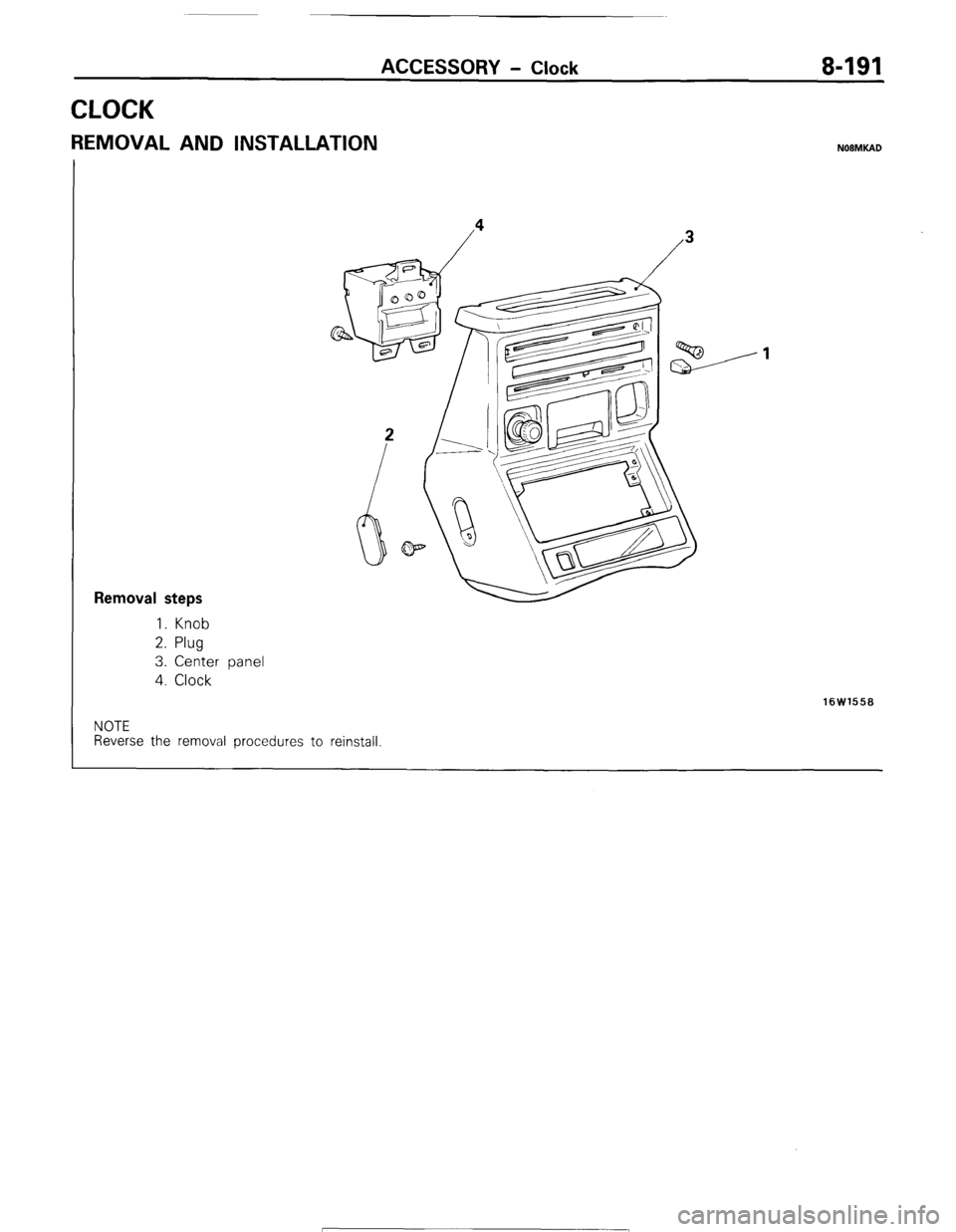
ACCESSORY - Clock 8-191
CLOCK
REMOVAL AND INSTALLATION NOBMKAD
Removal steps
1. Knob
2. Plug
3. Center panel
4. Clock
16W1558
NOTE
Reverse the removal procedures to reinstall 1 STB Revision
Page 216 of 284

8-196 AUDIO SYSTEM - Service Adjustment Procedures
SERVICE ADJUSTMENT PROCEDURES
ANTkNNA TRUMMER NOBNIAA
70R0351
1.
2.
3.
1.
2.
3.
4.
5. The antenna trimmer is essential for matching the antenna
with the radio in order to obtain the maximum sensitivity of
the radio.
It must be adjusted with the antenna actually mounted on
the vehicle. If the trimmer is not adjusted properly, the
radio suffers from not only low sensitivity but also noises,
su’ch as external noise and noise from passing vehicles.
In the following cases, therefore, adjust it as described
below.
(1) When radio is installed.
(2) If antenna is replaced.
(3) If radio has low sensitivity.
(4) If radio is noisy.
AkTENNA TRIMMER ADJUSTMENT
Mgke the following preparations for adjustment:
(1)’ Turn the ignition key to the “ACC” position.
(2) Extend the antenna all the way.
(3) Tune accurately to a station near 1,400 kHz in order to
receive a broadcast in as weak an electric field as can
be barely received. If there is no station near 1,400 kHz,
tune to any high-frequency station (above 1,000 kHz)
available. If there are two or more stations near 1,400
kHz, choose the louder one.
(4) Set the volume control to the proper volume.
(5) Set the tone ccontrol to treble position.
Be sure that preparations 1 through 5 have been correctly
made.
Insert a screwdriver into the trimmer adjusting hole.
Tumrn the screwdriver clockwise or counterclockwise for
maximum sensitivity (maximum broadcast wave sound).
If the optimum sensitivity point cannot be found, check for
an antenna malfunction or a broken wire.
NOTE
The antenna trimmer of an electronic tuning radio does not
require adjustment.
/ STB Revision
Page 228 of 284

8-208 AUTO
ATIC FREE-WHEELING HUB INDICAUOR SYSTEM - General Information
GENERAL INFORMATION ’ N08RAAA
This system is composed of the automatic free-wheeling hub indicator light, the vehicle-speed sensor (reed
type switch), the automaic free-wheeling hub itidicator control unit, and the pulse generator.
The pulse
generator is located at the rear part of the front output shaft of the transfer; the vehicle-speed
sensor is incorporated within the combination meter.
Based upon the output signals from the pulse generator and from the vehicle-speed sensor (reed type
switch), the automatic free-wheeling hub indicator control unit judges whether the automatic free-wheeling
hub is in the locked condition or the free condition.
When it is in the locked condition, the indicatok light
illuminates; when it is in the free condition, the
indicator light does not illuminate.
This is, therefore, a system which makes it easy to see, from the driver’s seat, whether the automatic free-
wheeling hub is in the locked condition or the free condition.
I j
21 1
Automatic free-wheeling hub
hub indicator
16W1506 16W1567
1 STB Revision
Page 229 of 284

AUTOMATIC FREE-WHEELING HUB INDICATOR SYSTEM - General Information 8-209
OPERATIONAL CHARACTERISTICS OF THE SYSTEM
Time-----w
16W1548 Indication by automatic free-wheeling hub indicator light
No illumination of the indicator light when the ignition key is turned from OFF to ON,
regardless of the condition of the automatic free-wheeling hub.
The indicator light illuminates when the automatic free-wheeling hub is locked and pulse
signals are output from the pulse generator, and when, in addition, the vehicle-speed sensor
detects a vehicle speed of approximately 2.5 mph (4 km/h) or higher.
The locked condition is entered in the memory even if the vehicle is stopped (with ignition
key still at ON) while the automatic free-wheeling hub is in the locked condition, and the
indicator light illumination continues.
After the automatic free-wheeling hub is changed from the locked condition to the free
condition (the pulse signals from the pulse generator cease), the indicator light remains
illuminated until the vehicle-speed sensor detects a vehicle speed of approximately 2.5 mph
(4 km/h) or higher. Symbols used in
above diagram
A
B
C
D
1 STB Revision