Page 71 of 284
WIRING HARNESS - Instrument Panel Wumination Circuit 8-51
11 INSTRUMENT PANEL ILLUMINATION CIRCUIT
Battery
Sub fusible link
5-w 0.5-G
5-w l-75-W m 2-R - L-
Main A-23
fusible link
@L
M’ CA
A A-22
Y$lO rx
c-l
Optical fiber
I
I
Multi-purpose
fuse
0
3
a control knob
illumination light
.ight contr
clay
& 01 BY
7t Combination
gauge
Illumination ligl
c-4o1l Shift-position
lmer control switch
C-38
4
Ashtray
illumination Cigaretty Hegpane _
lighter illumination ’ I
minagn light Clock
n+ 63 illumination light Combination meter
illumination light
37w '62; (1) The broken lines are applicable to models equipped with
an automatic transmission.
(2) For information concerning the ground points (exam-
ple: 0 ), refer to P.8-7.
Wiring color code
B: Black Br: Brown G: Green Gr: Gray
LI: Light blue 0: Orange P: Pink R: Red L: Blue
Y: Yellow Lg: Light green
W: White
1 STB Revision
Page 82 of 284
8-62 WIRING HARNESS - Cigarette Lighter / Clock Circuit
18 CIGARETTE LIGHTER / CLOCK CIRCUIT
Sub fusible link Ignition switch
r-l E-f? ‘) n
-u yn;in fusible
7-R \*I
To light control relay
[Refer to P.8-461
To radio
GW [Refer to P&601-, 3F- Pm
To hazard flasher unit4 I .LJ- G
[Refer to P.8-491
II I Multi-purpose fuse
illumination light
To heater control
illumination light
[Refer to P.8-511
Clock
CT
0: 1
h J
6
Jc-36
To combination mete& BY
[Refer to P.8-521 1
Wiring color code
B: Black LI: Light blue To dimmer control switch BY
Br: Brown 0: Orange [Refer to P.8-511 M
G: Green P: Pink
-
Gr: Gray H: Red
L: Blue Y: Yellow
Lg: Light green W: White Remark
For information concerning the ground points (example: 0 1,
refer to P.8-‘7.
Page 88 of 284
WIRING HARNESS - Back Door Lock Circuit
23 BACK DOOR LOCK CIRCUIT
Battery _ Sub fusible link
$’
m 5 Multi-purpose ’
fuse
)
A 1.25F-G -1.25-G
0 2-LR -To heater relay
[Refer to P.8-551
1.25F-R 1.25-R
2-B -To column switch
B-l 2 [Refer to P.8-511
cza
I I
xx 0
I
. .
77
m B-24 [
cLL3
ALA
CVN
. .
77
Back door
lock actuator
Remark
37W602
For information concerning the ground points (example: q ),
Wiring color code refer to P.8-7.
B: Black
Br: Brown G: Green
Gr: Gray L: Blue Lg: Light green
LI: Light blue 0: Orange P: Pink
R: Red Y: Yellow W: White
/ STB Revision
Page 89 of 284
WIRING HARNESS - Centralized Junction
CENTRALIZED JUNCTION
Main Fusible Link
896!
Circuit
Main circuit
Cable color Black
Fusible link size mm’ (ir?.) 1.25 (.0019)
Permissible continuous current A 40
Fusing current A 190
Sub Fusible Link
Item Circuit
Cable color
Fusible link size mm7 (in.2)
Permissible continuous current A
Fusing current A
Dedicated Fuse Lighting circuit
Green
0.5(.0008)
27
100 Alternator circuit Feed back carburetor
control circuit
Stop light, door lock
and heater circuit
Red
0.85(.0013)
34
150 Ignition circuit Power window
circuit
Green Green-
0.5(.0008) 0.5(.0008)
27 27
100 100
Upper beam indicator circuit / Air conditioner cixit
Page 90 of 284

WIRING HARNESS - Centralized Junction
Multi-purpose Fuse
Power supply circuit Fuse No. Rated
capacity A Applicable circuits
Battery 1 20
Clock, Dome light, Hazard warning flashers
Headlight relay 2 10 Tail lights, License plate lights, Illumination lights, Headlight
washer relay, Position lights
__-
Ignition switch (IG) 3 10 Heater relay, Seat belt warning timer, Turn-signal lights,
Alternator, Seat belt switches, Power window relay, Fuel and
water temperature gauges, Oil pressure gauge, Voltage meter,
Indicator and warning lights, Inhibitor switch, Automatic
free-wheeling hub indicator control unit
4
IO Back-up lights, Auto choke relay, OD-OFF relay
__-
5 15 Rear window defogger
Battery 6 20 Heater, Back door lock
7 15 Key-reminder switch, Stop lights, Buzzer
Ignition switch (ACC) 8 15 Windshield wipers and washer, Headlight washer relay,
Intermittent wiper relay, Horn
9 10 Rear window wiper and washer
10 15 Cigarette lighter, Radio, Tape player, Clock (ACC), Spare terminal,
Air conditioner relay
Page 107 of 284
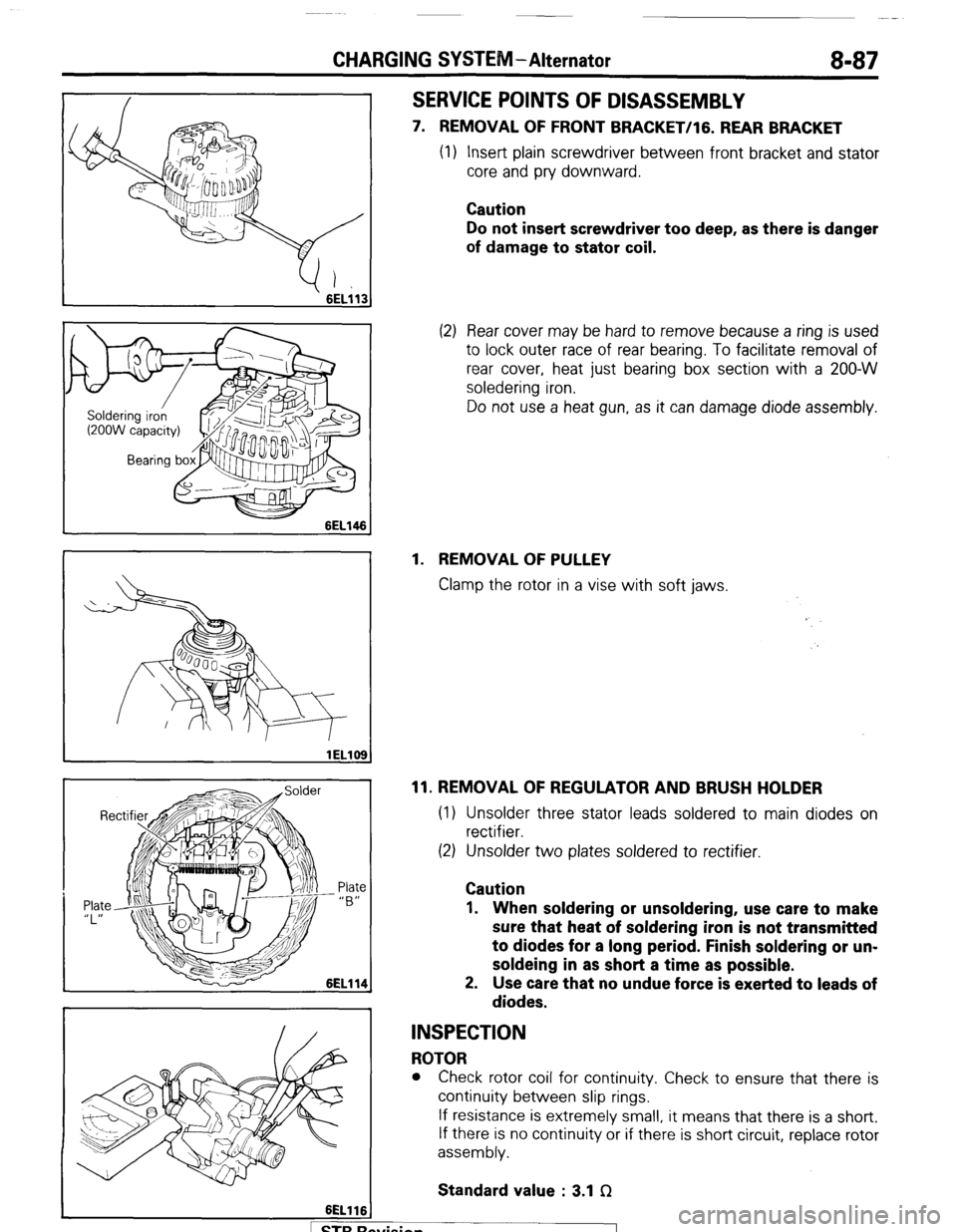
CHARGING SYSTEM-Alternator 8-87
6ELllt
SERVICE POINTS OF DISASSEMBLY
7. REMOVAL OF FRONT BRACKET/lG. REAR BRACKET
(1) Insert plain screwdriver between front bracket and stator
core and pry downward.
Caution
Do not insert screwdriver too deep, as there is danger
of damage to stator coil.
(2) Rear cover may be hard to remove because a ring is used
to lock outer race of rear bearing. To facilitate removal of
rear cover, heat just bearing box section with a 200-W
soledering iron.
Do not use a heat gun, as it can damage diode assembly.
1. REMOVAL OF PULLEY
Clamp the rotor in a vise with soft jaws.
11. REMOVAL OF REGULATOR AND BRUSH HOLDER
(1) Unsolder three stator leads soldered to main diodes on
rectifier.
(2) Unsolder two plates soldered to rectifier.
Caution
1. When soldering or unsoldering, use care to make
sure that heat of soldering iron is not transmitted
to diodes for a long period. Finish soldering or un-
soldeing in as short a time as possible.
2. Use care that no undue force is exerted to leads of
diodes.
INSPECTION
ROTOR
l Check rotor coil for continuity. Check to ensure that there is
continuity between slip rings.
If resistance is extremely small, it means that there is a short.
If there is no continuity or if there is short circuit, replace rotor
assembly.
Standard value : 3.1 f2
. . .
I 1 STB hewsion
Page 121 of 284

STARTING SYSTEM-Starter Motor 8-101
Snap
L Armature
1ELlO
pi-
SERVICE POINTS OF DISASSEMBLY
9. CAUTION OF ARMATURE/ll. BALL
When removing the armature, do not lose the ball which acts
as a bearing for the armature and tip.
17. DISASSEMBLY OF SNAP RING/18. STOP RING
(1) Push the stop ring towards the snap ring using the proper
socket.
(2) After removal of the snap ring with the snap ring pliers,
remove the stop ring and the over-running clutch.
CLEANING STARTER MOTOR PARTS
1, Do not immerse parts in cleaning solvent. Immersing the yoke
and field coil assembly and/or armature will damage insulation.
Wipe these parts with a cloth only.
2. Do not immerse drive unit in cleaning solvent. Overrunning
clutch is pre-lubricated at the factory and solvent will wash
lubrication from clutch.
3. The drive unit may be cleaned with a brush moistened with
cleaning solvent and wiped dry with a cloth.
INSPECTION
CHECKING COMMUTATOR
(1) Place the armature on a pair of V blocks and check run-out with
a dial gauge.
Standard value : 0.05 mm (-0020 in.)
Limit : 0.1 mm (.0039 in.)
wision
I
Page 132 of 284

8-112 IGNITION SYSTEM - Service Adjustment Procedures
CHECKING NEGATIVE PRESSURE ADVANCE EQUIPMENT
1. Set the timing light.
2. Start the engine and allow it to idle.
3. Pull out the vacuum hose from vacuum controller and attach
vacuum pump to nipple.
4. Check the advance while slowly applying negative pressure to
the vacuum pump. If the advance is smooth when accompa-
nying the increase in negative pressure, this is normal.
Secondary cable
~~
Primaw 6-8 mm
Cylinder
block
cable ’ (.24-.31 in.) 5ELO45 1
Spark plug
5ELO46
Iefective insula
5ELO47
/
Symptom
Excessive advances
Sudden advance rise
Insufficient advance or large
hysteresis
No advance Assumed causes
Weakness of vacuum controller
spring
Broken spring
Impaired movement of breaker
base
Broken diaphragm
5. If the malfunction indicators above are confirmed, dismantle
and check the distributor.
6. Allow the engine to idle and then turn the ignition switch to
OFF.
7. Remove the vacuum pump and attach the vacuum hose to the
vacuum controller nipple.
8. Remove the timing light.
SPARK PLUG CABLE TEST NWGIGB
Hold the spark plug cable about 6-8 mm (.24-.31 in.) away from
engine proper (grounding portion such as cylinder block) and crank
engine to verify that sparks are produced.
SPARK PLUG TIEST NOUGIHB
Connect the spark plug to the high tension cable, ground outer
electrode (main body), and crank engine. In the atmosphere, only
short sparks are produced because of small discharge gap. If the
spark plug is good, however, sparks will occur in discharge gap
(between electrodes). In a defective spark plug, no sparks will
occur because of leak of insulation puncture.
fvision
I


