1987 MITSUBISHI MONTERO ABS
[x] Cancel search: ABSPage 6 of 284
6 INTRODUCTION - Vehicle Identification
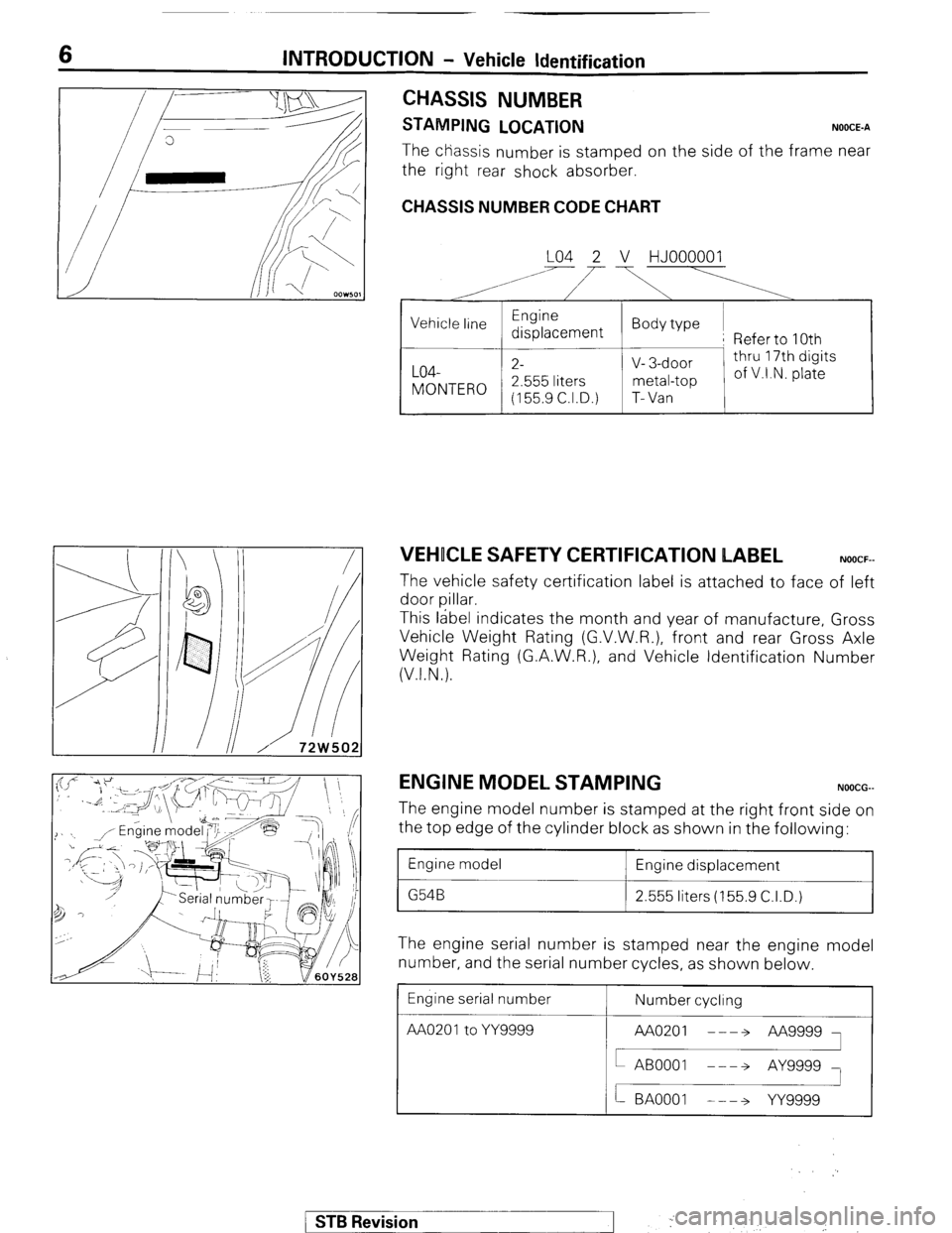
CHASSIS NUMBER
STAMPING LOCATION NOOCE-A
The chassis number is stamped on the side of the frame near
the right rear shock absorber.
CHASSIS NUMBER CODE CHART
LO4 2 V HJOOOOOl
A’ i’
,
VEHICLE SAFETY CERTIFICATION LABEL NOOCF-
The vehicle safety certification label is attached to face of left
door pillar.
This label indicates the month and year of manufacture, Gross
Vehicle Weight Rating (G.V.W.R.), front and rear Gross Axle
Weight Rating (G.A.W.R.), and Vehicle Identification Number
(V.I.N.).
ENGINE MODEL STAMPING NOOCG-
The engine model number is stamped at the right front side on
the top edge of the cylinder block as shown in the following:
1 Engine model
1 Engine displacement
1 2.555 liters (155.9 C.I.D.)
The engine serial number is stamped near the engine model
number, and the serial number cycles, as shown below
Engine serial number
AA020’toYY= Number cycling
/ STB Revision
--I f ,. ..-.
j ‘. .,
Page 264 of 284

24-28 AIR-CONDITIONING-Safety Precautions
SAFETY PRECAUTIONS N24PAAB
SAFETY PRECAUTIONS
I
The refrigerant used in all air-conditioning installations is R-12. It is transparent and colorless in both the liquid and
vapor state. Since it has a boiling point of -29.8T (-21.7”F). at atmospheric pressure, it will be a vapor at all normal
temperatures and pressures. The vapor is heavier than air, non- flammable, and nonexplosive. It is nonpoisonous
except when it is in direct contact with open flame. It is noncorrosive except when combined with water. The
following precautions must be observed when handling R-12.
Caution
Wear
safety goggles when servicing the refrigeration system.
R-12 evaporates so rapidly at normal atmospheric pressures and temperatures that it tends to freeze anything it
contacts. For this reason, extreme care must be taken to prevent any liquid refrigerant from contacting the skin and
especially the eyes.
Always wear safety goggles when servicing the refrigeration part of the air- conditioning system. Keep a bottle of
sterile mineral oil handy when working on the refrigeration system. Should any liquid refrigerant get into the eyes,
use a few drops of mineral oil to wash them out. RI12 is rapidly absorbed by the oil. Next, splash the eyes with
plenty of cold water. Call your doctor immediately even though irritation has ceased after treatment.
Caution
Do not heat R-12 above 52°C (125°F).
In most instances, moderate heat is required to bring the pressure of the refrigerant in its container above the
pressure of the system when charging or adding refrigerant. A bucket or large pan of hot water not over 52°C
(125°F) is all the heat required for this purpose. Do not heat the refrigerant container with a blow torch or any other
means that would raise temperature and pressure above this temperature. Do not weld or steam clean on or near
the system components or refrigerant lines.
Caution
Keep R-12 containers upright when charging the system.
When metering R-12 into the refrigeration system, keep the supply tank or cans in an upright position. If the
refrigerant container is on its side or upside down, liquid refrigerant will enter the system and damage the
compressor.
Caution
Always work in a well-ventilated room.
Good ventilation is vital in the working area. Always discharge the refrigerant into the service bay exhaust system
or outside the building. Large quantities of refrigerant vapor in a small, poorly ventilated room can displace the air
and cause suffocation.
Although R-12 vapor is normally nonpoisonous, contact with an open flame can cause the vapor to become very
poisonous. Do not discharge large quantities of refrigerant in an area having an open flame. A poisonous gas is
producted when using the flame-type leak detector. Avoid inhaling the fumes from the leak detector.
Caution
Do not allow liquid refrigerant to touch bright metal.
Refrigerant will tarnish bright metal and chrome surfaces, and in combination with moisture’can severely corrode
all metal surfaces.
/ STB Revision
-I
Page 272 of 284

COllector
can
2OUO315
24-36 AIR-CONDITIONING-Service Adjustment Procedures
D&ARG,NG THE SYSTEM
Since the air conditioning refrigerant system is pressurized, it will
be necessary to completely discharge the system (in a well ven-
tilated area) before replacing any refrigerant component. The pro-
cedure is as follows:
(1) Install manifold gauge set. Make sure the gauge set valves are
closed before attaching the hoses to the refrigerant system.
(2) Install a long hose to the manifold gauge set connector. Run
this hose to the oil collector can near a shop exhaust system.
A good oil collector can may be made from a large empty
coffee can with a plastic top. Slit the plastic top in the form of
a Y to make an entrance for the refrigerant hose and an exit for
the gas.
(3) Open the compressor discharge and suction line pressure
valves and blow the refrigerant into the oil collect can. Watch
to make sure the hose does not blow out of the collector can.
(4) When the system has been completely discharged, measure
the amount of oil collected in the can. The amount of oil mea-
sured should be added to the refrigerant system before it is
re-charged. Add new oil-discard the used oil.
Caution
It is important to have the correct amount of oil in the refrig-
erant system.
Too little oil will provide inadequate compressor lubrication and
cause a compressor failure. Too much oil will increase discharge
air temperature.
When a 6P148 compressor is installed at the factory, it
contains 110 c.c. (3.7 U.S.fl.oz., 3.9 Imp.fl.oz.) of refrigerant oil.
While the air conditioning system is in operation, the oil is
carried through the entire system by the refrigerant. Some of
this oil will be trapped and retained in various parts of the
system.
When the following system components are changed, it is nec-
essary to add oil to the system to replace the oil being removed
with the component.
Compressor - 4Occ (1.4 U.S.fl.oz., 1.4 Imp.fl.oz.)
Condenser - 30 cc (1.0 U.S.fl.oz., 1.1 Imp.fl.oz.)
Evaporator - 60 cc (2.0 U.S.fl.oz., 2.1 Imp.fl.oz.)
Piping - 10 cc (.3 U.S.fl.oz., .4 Imp.fl.oz.)
Receiver drier - 0 cc (0 U.S.fl.oz., 0 Imp.fl.oz.)
EVACUATING THE SYSTEM
2OUO31
Whenever the system has been opened to the atmosphere, it is
absolutely essential that the system be evacuated or “vacuumed”
to remove all the air and moisture. Air in the refrigerant system
causes high compressor discharge pressures, a loss in system
performance, and oxidation of the compressor oil into gum and
varnish. Moisture in the refrigerant system can cause the expan-
sion valve to malfunction. Under certain conditions, water can
react with the refrigerant to form destructive acids. It is necessary
to adhere to the following procedure to keep air and moisture out
of the system.
(1) Install manifold gauge set. Make sure the gauge set valves are
closed before attaching the hoses to the refrigerant system.
(2) Discharge the system if the manifold gauge set indicates pres-
sure in the system.
(3) Connect a long test hoses from gauge set manifold center
connection to vacuum pump.
(4) Open both manifold gauge set valves.
/
/vision I