Page 517 of 1865
FUEL SYSTEM 4B
TROUBLESHOOTING
Check the condition of the wiring harness and connections before checking the sensors or switches
below.
Note
Make the system inspection first. If no problem is found, continue with the next system
inspection of the Troubleshooting Guide. (Refer to pages 4B—7 and 8.)
Possible \ cause
\ Page
Solenoid valve (Pres-sure regula-tor control)
Water thermo
sensor Intake air
thermo sensor
Engine con-trol unit terminal
2K
System inspection
Symptom 4B—56 4B—97 4B—94 4B—89 4B—55
Engine stalls or rough after hot starting 2 3
A
5 1
76G04B-074
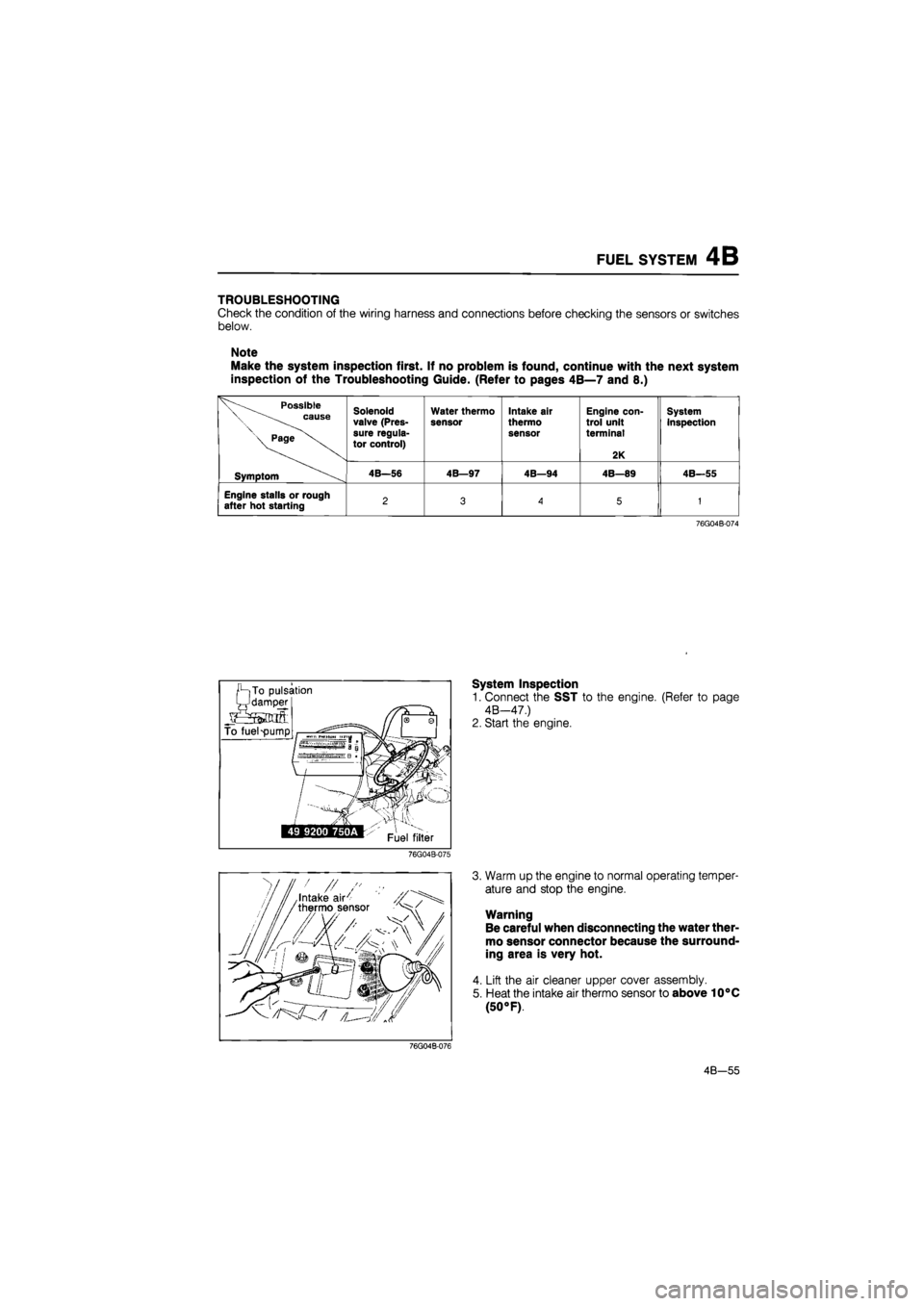
System Inspection
1. Connect the SST to the engine. (Refer to page
4B—47.)
2. Start the engine.
76G04B-075
3. Warm up the engine to normal operating temper-
ature and stop the engine.
Warning
Be careful when disconnecting the water ther-
mo sensor connector because the surround-
ing area is very hot.
4. Lift the air cleaner upper cover assembly.
5. Heat the intake air thermo sensor to above 10°C
(50 °F).
76G04B-076
4B—55
Page 527 of 1865

DECELERATION CONTROL SYSTEM 4B
COMPONENT DESCRIPTIONS
Component Function Remarks
Brake light switch Detects braking operation (deceleration);
sends signal to engine control unit
Clutch switch Detects in-gear condition;
sends signal to engine control unit Switch ON when clutch pedal released
Dashpot (MTX) Prevents sudden closing of throttle valve during deceleration or shifting Adjustment speed: 1,900—2,100 rpm
Engine control unit Detects signals from input sensors and switches; cuts fuel injection
Idle switch Detects when throttle valve fully closed; sends signal to engine control unit Installed in throttle sensor
Ignition coil (-) terminal Detects engine speed; sends signal to engine control unit
Neutral switch Detects in-gear condition; sends signal to engine control unit Switch ON when in-gear
Water thermo sensor Detects coolant temperature; sends signal to engine control unit
Water thermo switch Detects radiator coolant temperature; sends signal to engine control unit ON: above 17°C (63°F)
76G04B-089
4B—65
Page 528 of 1865
4B DECELERATION CONTROL SYSTEM
TROUBLESHOOTING
Check the condition of the wiring harness and connectors before checking the sensor or switches below.
Note
Make the system inspection first. If no problem is found, continue with the next system
inspection of the Troubleshooting Guide. (Refer to page 4B—7 and 8.)
Possible
^^ cause
Symptom
Dashpot Water thermo
sensor
Electrical signal
inspection
(Injector)
Possible
^^ cause
Symptom 4B—67 4B—97 4B-66
High idle speed after warming up 1
Runs rough on deceleration 1 3 2
Afterburn in exhaust system 1 3 2
Poor fuel consumption 1 3 2
Fails emission test 1 3 2
76G04B-090
Electrical Signal Inspection (Injector)
1. Connect the SST between the wiring harness and
engine control unit.
2. Set 3C or 3E position on the SST.
Note
3C — For No. 2 and No. 4 injectors
3E — For No. 1 and No. 3 injectors
76G04B-091
0-6V 0-20V
3. Check that the indicator lamps alternately flash at
idle.
86U04A-125
4B—66
Page 533 of 1865

EGR SYSTEM 4B
EXHAUST GAS RECIRCULATION
(EGR)
SYSTEM
EGR modulator valve Solenoid valve (EGR)
86U04A-127
This system introduces exhaust gas into the intake manifold to reduce NOx in the exhaust gas. It oper-
ates depending on the engine load, engine speed (above 1,500 rpm), engine coolant temperature
(above 70°C, 158°F), and radiator coolant temperature (above 17°C, 63°F).
COMPONENT DESCRIPTIONS
Component Function Remarks
EGR control valve Recirculates portion of exhaust gas
EGR modulator valve Controls vacuum acting on EGR control
valve
Engine control unit Detects signals from input sensors and switches; controls solenoid valve (EGR)
Ignition coil (-) terminal Detects engine speed; sends signal to engine control unit
Solenoid valve (EGR) Controls vacuum line to EGR control
valve
Throttle sensor Detects throttle valve opening angle; sends signal to engine control unit Integrated idle switch
Water thermo sensor Detects coolant temperature; sends signal to engine control unit
Water thermo switch Detects radiator coolant temperature; sends signal to engine control unit
ON: above 17°C (63°F)
76G04B-102
4B-71
Page 534 of 1865
4B EGR SYSTEM
TROUBLESHOOTING
Check the condition of the wiring harness and connectors before checking the sensors or switches below.
Note
Make the system inspection first. If no problem is found, continue with the next system
inspection of the Troubleshooting Guide. (Refer to pages 4B—7 and 8.)
Possible cause
Solenoid
valve (EGR)
EGR modula-tor valve
EGR con-trol valve
Water
thermo sensor
Water
thermo switch
Engine control unit
terminal
System in-spection
2N
Page 4B—72 4B—73 4B—73 4B—97 4B—97 4B—90 4B—72
Checking order 3 2 4 6 5 7 1
76G04B-103
86U04A-130
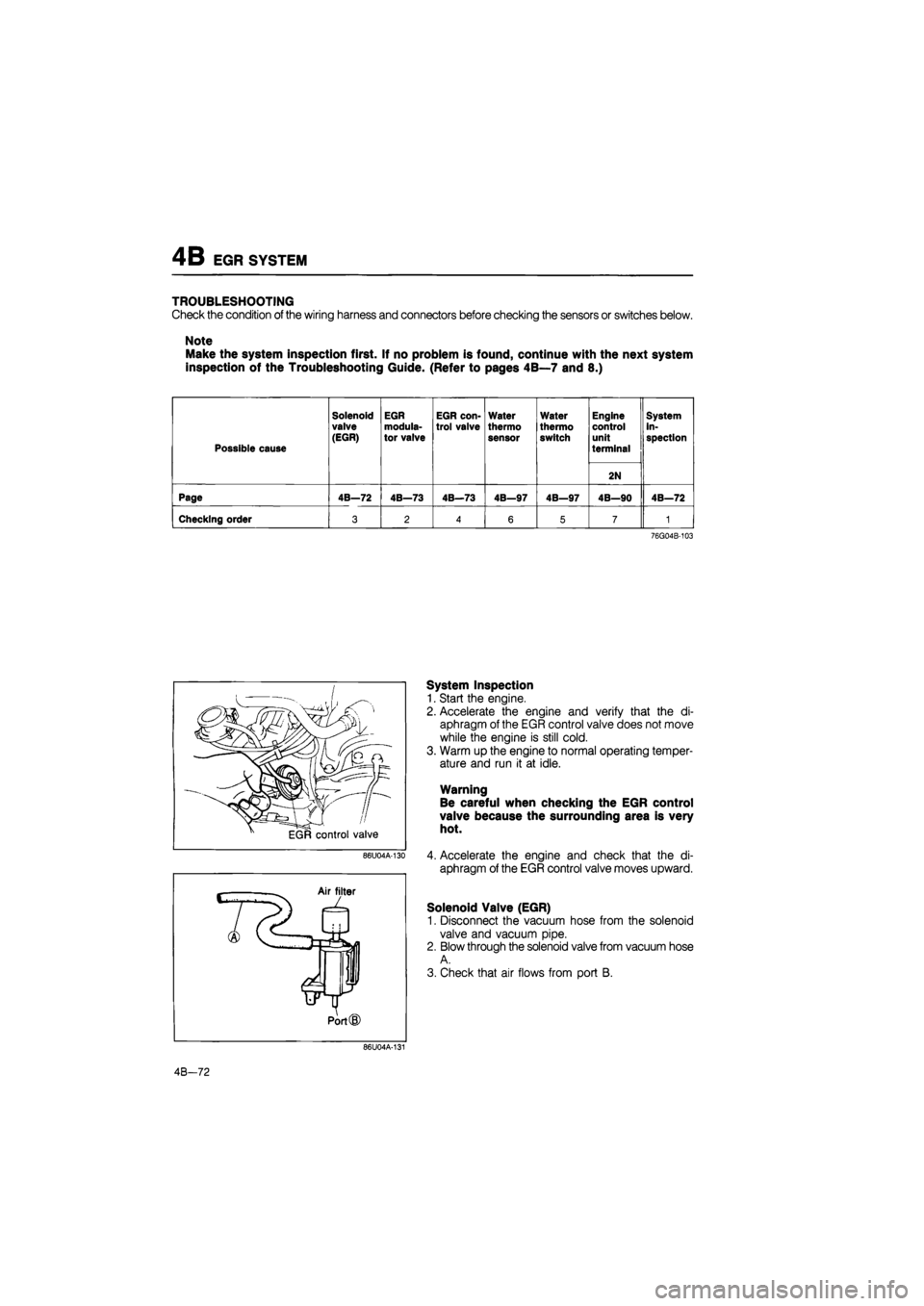
System Inspection
1. Start the engine.
2. Accelerate the engine and verify that the di-
aphragm of the EGR control valve does not move
while the engine is still cold.
3. Warm up the engine to normal operating temper-
ature and run it at idle.
Warning
Be careful when checking the EGR control
valve because the surrounding area is very
hot.
4. Accelerate the engine and check that the di-
aphragm of the EGR control valve moves upward.
Solenoid Valve (EGR)
1. Disconnect the vacuum hose from the solenoid
valve and vacuum pipe.
2. Blow through the solenoid valve from vacuum hose
A.
3. Check that air flows from port B.
86U04A-131
4B-72
Page 536 of 1865

4B EEC SYSTEM
EVAPORATIVE EMISSION CONTROL
(EEC)
SYSTEM
Engine control unit
Solenoid valve
(Purge control)
Vacuum
switch
valve x
From water thermo valve To dynamic -chamber
Three-way
check valve
Orifice Charcoal
canister
From fuel tank
No.2 purge
control valve
Fuel tank
86U04A-136
This system stores fuel vapor generated in the fuel tank in the canister when the engine is not running.
The fuel vapor is stored in the canister until it is drawn into the dynamic chamber and burned when
the engine is started.
COMPONENT DESCRIPTIONS
Component Function Remarks
Air flow meter Detects amount of intake air; sends signal to engine control unit
Intake air thermo sensor and fuel pump
switch are integrated
Charcoal canister Stores fuel tank fumes when engine
stopped
Engine control unit Detects signals from input sensors and switches; controls solenoid valve (Purge control)
Ignition coil (-)
terminal Detects engine speed; sends signal to
engine control unit
Separator Prevents fuel from flowing into charcoal canister
Solenoid valve (Purge control) Controls vacuum line to vacuum switch valve
Three-way check valve Controls pressure in fuel tank
Vacuum switch valve Regulates evaporative fumes from canis-
ter to intake manifold
Water thermo sensor Detects coolant temperature; sends signal to engine control unit
Water thermo valve Controls vacuum applied to No.1 purge control valve and solenoid valve (Purge control)
Opens vacuum line above 54°C (129°F)
76G04B-104
4B—74
Page 537 of 1865
EEC SYSTEM
4B
TROUBLESHOOTING
Check
the
condition
of the
wiring harness
or
connectors, before checking
the
sensors
or
switches.
Note
Make the system inspection first.
If no
problem
is
found, continue with
the
next system
inspection
of the
Troubleshooting Guide. (Refer
to
pages 4B—7 and
8.)
Possible cause
Vacuum
switch
valve
Solenoid
valve
(Purge
control)
0)
<0
m
i
>
« «
o
•C
?
o ** «0 a a
No.1
purge
control
valve
No.2
purge
control
valve
Water
thermo
valve
o E tm 0) £
«>
0)
^
>
Engine
control
unit
terminal
System inspection Vacuum
switch
valve
Solenoid
valve
(Purge
control)
No.1
purge
control
valve
No.2
purge
control
valve
Water
thermo
valve
$
>
2P
System inspection
Page 4B—77 4B—78 4B—78 4B—79 4B—77 4B—77 4B—78 4B—97 4B—90 4B—76
Checking order 3 2 9 10 4 5 6 7 8 1
76G04B-105
4B—75
Page 538 of 1865
4B EEC SYSTEM
86U04A-139
86U04A-141
System Inspection
1. Check the vacuum hose routing.
2. If there is a poor connection, clog, or leak, repair
or replace as necessary.
3. Warm up the engine and run it at idle.
4. Disconnect vacuum hose A from No.
1
purge con-
trol valve and connect the SST to the hose.
86 U 04 A-140
5. Increase the engine speed to above 2,500 rpm
and verify that the gauge shows more than 150
mmHg (5.9 inHg).
6. If not correct, check the water thermo valve.
7. Reconnect hose A to No. 1 purge control valve.
8. Disconnect vacuum hose B from the canister and
place a finger over the end of the hose.
9. Accelerate the engine rapidly and check that vacu-
um is felt at above 1,500 rpm.
10. Reconnect hose B to the canister.
11. Disconnect vacuum hose C from the canister and
place a finger over the end of the hose.
12. Check that vacuum is felt.
13. If not correct, check the vacuum line between the
canister and the dynamic chamber for clogging.
86U04A-142
4B—76


