Page 430 of 1865

EGR SYSTEM 4A
TROUBLESHOOTING
Note
Make the system inspection first. If no problem is found, continue with the next inspec-
tion of the Troubleshooting Guide. (Refer to pages 4A—22.)
Possible cause System inspection EGR control valve Water thermo valve
Page 4A—65 4A—65 4A—66
Checking order 1 2 3
76G04A-123
76G04A-124
76G04A-125
System Inspection
1. Start the engine.
2. Accelerate the engine while it is still cold and check
that the diaphragm of the EGR control valve does
not move.
3. Warm up the engine to normal operating temper-
ature and run it at idle.
Warning
Be careful when checking the EGR control
valve, the surrounding area is very hot.
4. Accelerate the engine and check that the di-
aphragm of the EGR control valve moves.
EGR Control Valve (ATX)
(No. 1)
1. Manually actuate the valves by pushing on the di-
aphragm with finger.
2. Check that the spring resistance is present and the
diaphragm moves freely with no sticking or
binding.
3. Warm up the engine and run it at idle.
4. Connect a vacuum pump to the valve and apply
vacuum.
5. Check that the engine runs roughly or stalls at more
than the specified vacuum.
Specification:
70—90 mmHg (2.8—3.5 inHg)
6. If not correct, replace the EGR control valve.
76G04A-126
4A—65
Page 431 of 1865
4A EGR SYSTEM
76G04A-127
76G04A-128
ji C
Blow here *** I
>3 l^v?
> O-—-/ 1)
Ml
r-
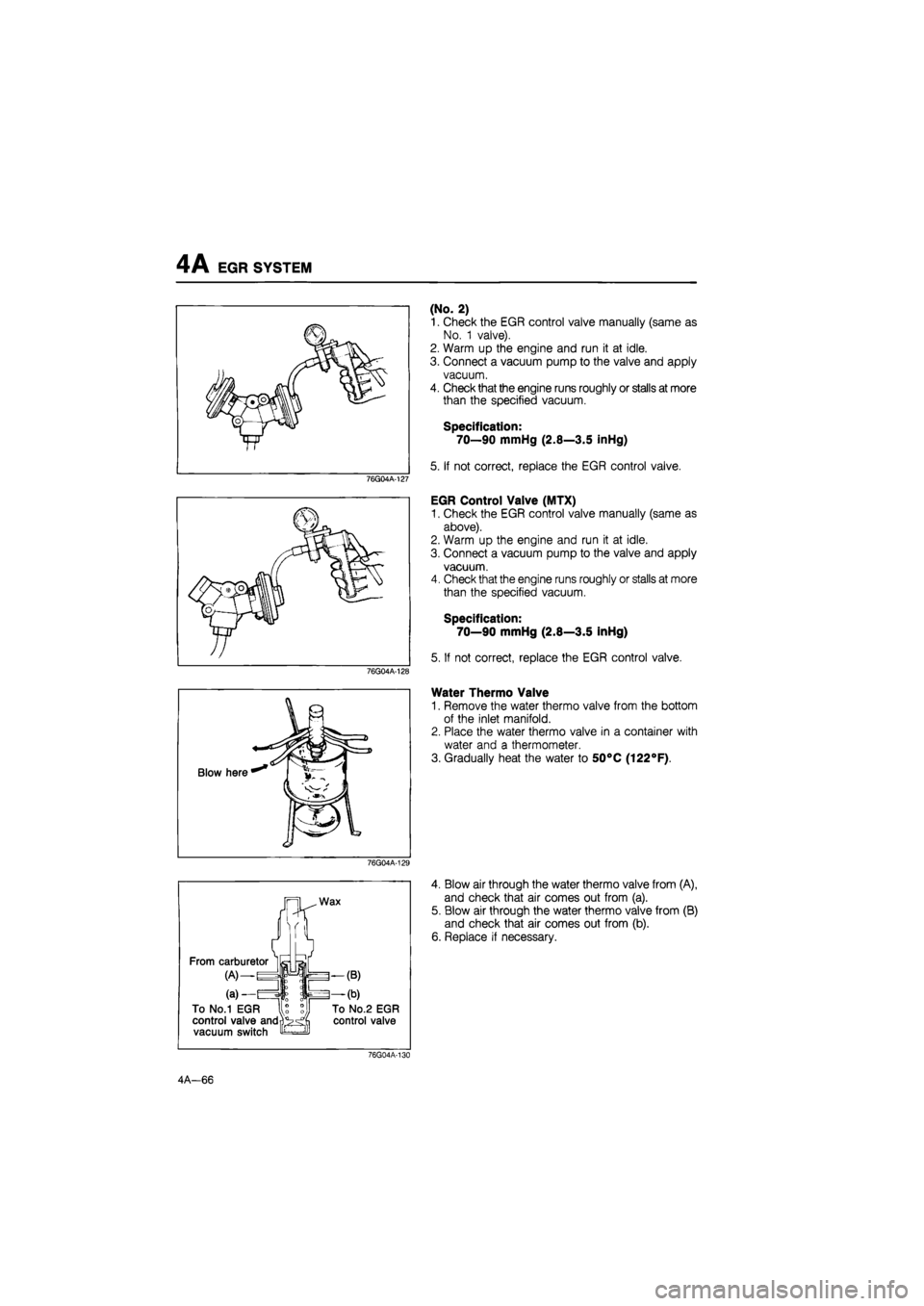
(No. 2)
1. Check the EGR control valve manually (same as
No. 1 valve).
2. Warm up the engine and run it at idle.
3. Connect a vacuum pump to the valve and apply
vacuum.
4. Check that the engine runs roughly or stalls at more
than the specified vacuum.
Specification:
70—90 mmHg (2.8—3.5 inHg)
5. If not correct, replace the EGR control valve.
EGR Control Valve (MTX)
1. Check the EGR control valve manually (same as
above).
2. Warm up the engine and run it at idle.
3. Connect a vacuum pump to the valve and apply
vacuum.
4. Check that the engine runs roughly or stalls at more
than the specified vacuum.
Specification:
70—90 mmHg (2.8—3.5 inHg)
5. If not correct, replace the EGR control valve.
Water Thermo Valve
1. Remove the water thermo valve from the bottom
of the inlet manifold.
2. Place the water thermo valve in a container with
water and a thermometer.
3. Gradually heat the water to 50°C (122°F).
76G04A-129
From carburetor
(A)—E
(a)-
To No.1 EGR
control valve and
vacuum switch
Wax
I— (B)
(b)
To No.2 EGR
control valve
76G04A-130
4. Blow air through the water thermo valve from (A),
and check that air comes out from (a).
5. Blow air through the water thermo valve from (B)
and check that air comes out from (b).
6. Replace if necessary.
4A—66
Page 441 of 1865
4A IDLE-UP CONTROL SYSTEM
IDLE-UP SOLENOID VALVE
FE and F8 (General, ECE, Hong Kong, and Singapore)
Water thermo switch Fan speed control switch Headlights _
Rear defroster
A/C
Engine1
control -
unit
Richer air bleed
Richer jet
/ '
Inhibitor switch
Water thermo switch Fan speed _ control switch Headlights -
Rear defroster —
A/C
Engine
control
unit
Idle-up solenoid valve
Adjust screw
Secondary
throttle valve
From secondary main jet
76G04A-151
The idle-up solenoid valve opens when the following conditions are met.
Condition
When inhibitor switch is OFF (ATX—other than "P" and "N" range) and any of the following:
• Engine coolant temperature less than 72°C (162°F).
• A/C operated.
• Fan speed control switch 3rd or 4th position.
• Headlights turned on.
• Rear defroster turned on.
4A—76
Page 443 of 1865
4 A EVAPOTATIVE EMISSION CONTROL SYSTEM
EVAPORATIVE EMISSION CONTROL SYSTEM
(MIDDLE EAST)
76G04A-155
Operation
Cold engine — below 50°C (122°F)
The No. 1 purge control valve does not operate because the vacuum passage of the water thermo
valve is opened to the atmospheric air side.
Warm engine — above 50 °C (122°F)
1. During normal driving, the carburetor vacuum signal is led to the No. 1 purge control valve with
the result that fuel vapors are drawn into the intake manifold.
4A—78
Page 444 of 1865

EVAPORATIVE EMISSION CONTROL SYSTEM 4A
Troubleshooting
Possible cause No. 1 purge No. 2 purge Water thermo Three-way control valve control valve valve check valve
Page 4A—79 4A—79 4A—79 4A—37
Checking order 1 2 3 4
76G04A-156
No. 1 Purge Control Valve
1. Blow through the purge control valve from port A
and check that air does not flow.
2. Connect a vacuum pump to the purge control
valve.
3. Apply 110 mmHg (4.29 inHg) vacuum with a
vacuum pump, and blow through port A again; air
should flow.
76G04A-157
No. 2 Purge Control Valve
1. Disconnect vacuum hose A from the pipe.
2. Check the air flow of the No. 2 purge control valve.
Specification:
15—35 mmHg (0.6—1.4 inHg): Below
-8—18 mmHg (0.3—0.7 inHg): Suck
76G04A-158
(B)"
* = zu
Blow
'(A)
/ (ft
Water Thermo Valve
1. Remove the water thermo valve.
2. Place the valve in water with a thermometer.
3. Heat the water gradually to 50°C (122°F).
4. Blow through the valve from hose A and check that
air comes out of port B.
76G04A-159
4A-79
Page 448 of 1865
CONTROL SYSTEM 4 A
CONTROL SYSTEM
Idle switch A/C switch
Water thermo switch
'Vacuum switch
Engine control switch
£
-Ignition coil
V
Water thermo switch
•Inhibitor switch
76G04A-166
The control system consists of the engine control unit, water thermo switches, A/C switch, P/S switch,
inhibitor switch, vacuum switch, and idle switch.
4A—83
Page 449 of 1865
4A CONTROL SYSTEM
RELATIONSHIP CHART
O: Related
X
: Not
related
IGNITION COIL
X X
O O O
X
O
X
WATER
THERMO
SWITCH
RADIATOR O O
X X X X
o O WATER
THERMO
SWITCH INTAKE
MANIFOLD o
X X X X
O o
X
VACUUM SWITCH
X X X X X X X
O
IDLE SWITCH
X X
O O O
X X X
A/C SWITCH
X X X X X
O
X X
P/S SWITCH
X X X X X X X X
E/L SWITCHES
/ Headlight Switch
( Rear defroster switch
J
\ Fan speed control switch
/
X X X X X
O
X X
INHIBITOR SWITCH
X X X X X
O O
X
ENGINE CONTROL UNIT
X
o O O O O o O
\
INPUT
DEVICE
AND
ENGINE
CONTROL
UNIT
OUTPUT
DEVICE
PTC
HEATER
CHOKE
OPENER
(FE
and
F8
—
ECE,
Hong
Kong,
&
Singapore)
COASTING
LEANER
COAST
ENRICHMENT
SOLENOID
VALVE
AIR
BYPASS
SOLENOID
VALVE
IDLE-UP
SOLENOID
VALVE
IGNITION
TIMING
CONTROL
SYSTEM
MAIN
AIR
BLEED
CONTROL
SYSTEM
*
FE
8Valve—Unleaded Fuel:
O
(Related)
General and
FE
12Valve—ECE, Hong Kong, Singapore:
X
(Not related)
76G04A-167
4A—84
Page 452 of 1865

CONTROL SYSTEM 4 A
Terminal
(Wire color) Connected to Condition Voltage
2A
(YL)
Ignition coil Ignition switch
ON or
engine running Battery voltage
2B (LB) Fan speed control switch Fan speed control switch
in
3rd
or
4th position Below 1.5 V 2B (LB) Fan speed control switch
Fan speed control switch OFF Battery voltage
2C
(BL)
Rear defroster switch Rear defroster switch
ON
Below 1,5V 2C
(BL)
Rear defroster switch
Rear defroster switch OFF Battery voltage
2D
(LG)
A/C switch A/C operated Below 1,5V 2D
(LG)
A/C switch
A/C not operated Battery voltage
2E
(RG)
Headlight switch Headlight switch OFF Below 1.5 V 2E
(RG)
Headlight switch
Headlight switch
ON
Battery voltage
2F
(GW)
Water thermo switch
(Radiator)
Radiator coolant temperature below 17°C (63°F) Below 1.5V 2F
(GW)
Water thermo switch
(Radiator) Radiator coolant temperature above 17°C (63°F) Battery voltage
2G
-— —
2H
(L)
Water thermo switch (In-
take manifold)
Engine coolant temperature below 72°C (162°F) Below 1,5V 2H
(L)
Water thermo switch (In-
take manifold) Engine coolant temperature above 72°C (162°F) Battery voltage
21
(LY)
Vacuum switch Vacuum less than 200 mmHg (7.9 inHg) Below 1.5V 21
(LY)
Vacuum switch
Vacuum more than 200 mmHg (7.9 inHg) Battery voltage
2J (RL) OD release solenoid valve Engine coolant temperature below 72°C (162°F) Below 1.5V 2J (RL) OD release solenoid valve
Engine coolant temperature above 72°C (162°F) Battery voltage
2K
(-)
— — -
2L (BR)
Inhibitor switch "N"
or "P"
range Below 1.5V 2L (BR)
Inhibitor switch
Others Battery voltage
2M (BY) Ignition switch
(START position)
Ignition switch
ON
Below 1,5V 2M (BY) Ignition switch
(START position) Cranking Battery voltage
2N
(LsB) Idle switch Idling Battery voltage 2N
(LsB) Idle switch
Accelerator pedal depressed Below 1,5V
76G04A-170
{ 2M 2K 21
X
2F 2C
2A
2N 2L 2J 2H 2F 2D 2B
(11 X X
1C 1 A^j
1J 1H 1F 1D 1B
FE and F8 Engine — MTX (ECE, Hong Kong, and Singapore)
Terminal (Wire color) Connected to Condition Voltage
A
(RG) Headlight switch Headlight switch
ON
Below 1,5V A
(RG) Headlight switch
Headlight switch OFF Battery voltage
B
(B)
Ground
—
Below 1,5V
4A-87


