1987 MAZDA 626 water
[x] Cancel search: waterPage 639 of 1865

4C EGR SYSTEM (UNLEADED FUEL)
TROUBLESHOOTING
Check the condition of the wiring harness and connectors before checking the sensors or switches.
Note
Make the system inspection first. If no problem is found, continue with inspection of the
next system of the Troubleshooting Guide. (Refer to pages 4C—10 and 11.)
Possible cause
Throttle
sensor
Solenoid valve
(EGR)
EGR
modula-
tor valve
EGR con-trol valve
Water
thermo
sensor
Water
thermo switch
Engine control unit
terminal
System in-spection
2N
Page 4C—104 4C—78 4C—79 4C—79 4C—107 4C—106 4C—98 4C—78
Checking order 8 2 4 3 6 5 7 1
76G04C-144
System Inspection
1. Start the engine.
2. Accelerate the engine while still cold and verify that
the diaphragm of the EGR control valve does not
move.
3. Warm up the engine to normal operating temper-
ature and run it at idle.
Warning
Be careful when checking the EGR control
valve, the surrounding area is very hot.
4. Accelerate the engine and check that the di-
aphragm of the EGR control valve moves.
Solenoid Valve (EGR)
1. Disconnect the vacuum hose from the vacuum
pipe.
2. Blow through the solenoid valve from vacuum hose
A.
3. Check that air flows from port B.
76G04C-146
4C-78
Page 641 of 1865

4C EEC SYSTEM
EVAPORATIVE EMISSION CONTROL
(EEC)
SYSTEM
Water thermo sensor
76G04C-150
Unleaded fuel:
This system stores fuel vapor generated in the fuel tank in the canister when the engine is not running.
The fuel vapor is stored in the canister until it is drawn into the dynamic chamber and burned when
the engine is started.
Leaded fuel:
Fuel vapor generated in the fuel tank flows out to the atmosphere.
COMPONENT DESCRIPTION
Application
Component Function Remark New
model Prevtoui model
Air flow sensor Detects amount of intake air; sends signal to engine control unit
O X
Charcoal canister Stores fuel tank fumes while engine stopped
o X
Engine control unit Detects signals from input sensors and
switches; controls solenoid valves (Purge
control)
o X
Ne signal pick-up Detect crank angle at 180° intervals; sends signal to engine control unit
Installed in distributor o X
Separator Prevents fuel from flowing into charcoal canister
o o
Solenoid valve
(No.1 purge control)
Controls vacuum to solenoid valve (No.2
purge control) and vacuum switch valve
0 X
Solenoid valve (No.2 Purge control)
Controls vacuum to vacuum switch valve o X
Three-way check valve Controls pressure in fuel tank o X
Two-way check valve Controls pressure in fuel tank X o
Vacuum switch valve Regulates evaporative fumes from canis-ter to intake manifold
o X
Water thermo sensor Detects coolant temperature; sends signal to engine control unit
0 X
76G04C-151
4C-80
Page 652 of 1865
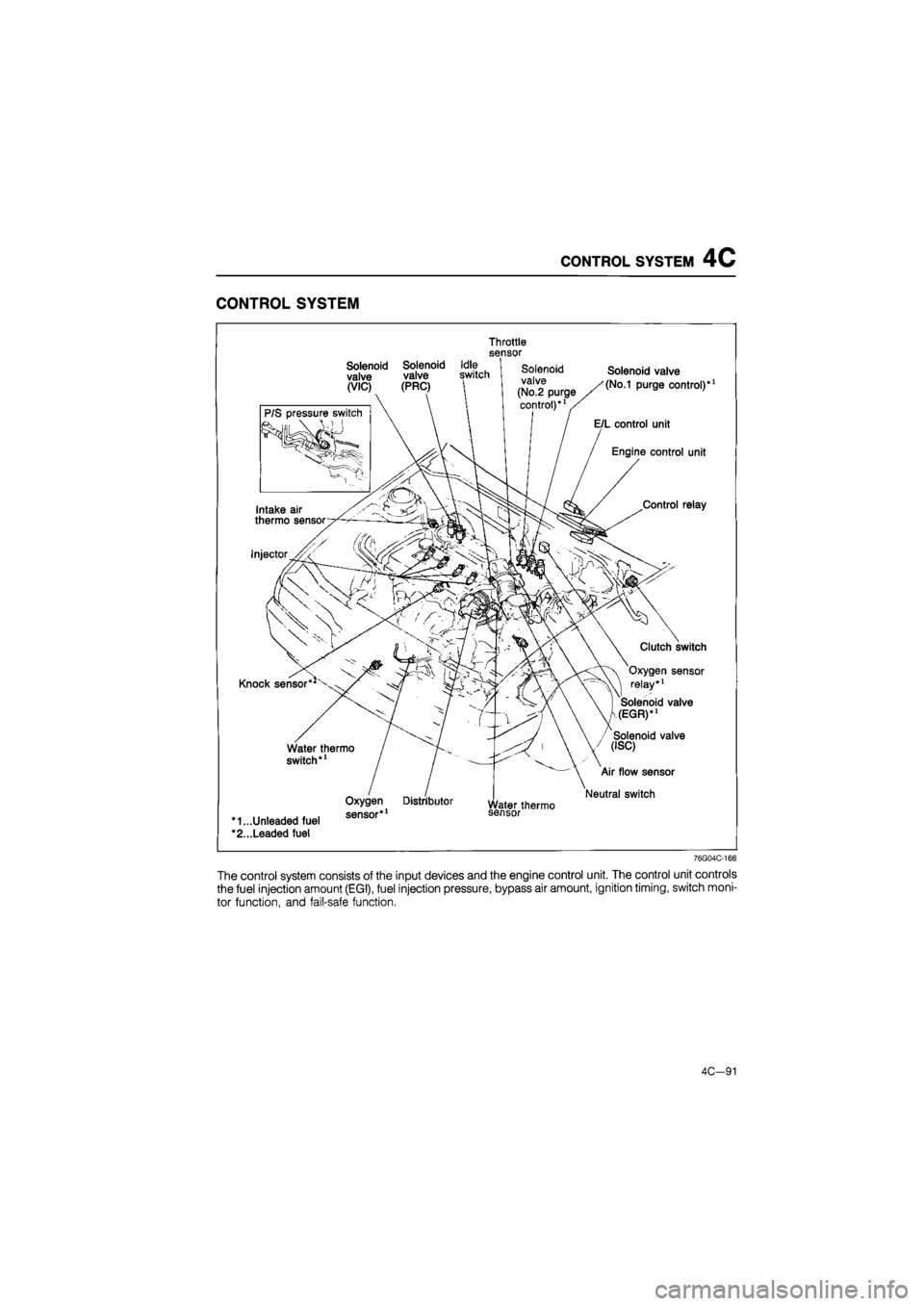
CONTROL SYSTEM 4C
CONTROL SYSTEM
Throttle sensor
Solenoid Solenoid Idle valve valve switch (VIC) (PRC)
Solenoid
valve
control)*
Solenoid valve
'(No.1 purge control)*1
E/L control unit
Engine control unit
Control relay
Injector
Knock sensor* -
Water thermo
switch*1
"1...Unleaded fuel
*2...Leaded fuel
Oxygen Distributor Water thermo sensor*1 sensor
Clutch switch
Oxygen sensor
relay*1
Solenoid valve
(EGR)*1
/ Solenoid valve 7 (ISC)
Air flow sensor
Neutral switch
76G04C-166
The control system consists of the input devices and the engine control unit. The control unit controls
the fuel injection amount (EGI), fuel injection pressure, bypass air amount, ignition timing, switch moni-
tor function, and fail-safe function.
4C-91
Page 653 of 1865

4C CONTROL SYSTEM
RELATIONSHIP CHART
Output Devices
and
Input Devices (Unleaded fuel)
IGNITION SWITCH
(ON POSION) X X X X X O X X X X X X X X O
TEST CONNECTOR X X X O X X X X X X X X X O X
ELECTRICAL LOAD CONTROL UNIT X X X o X X X X X X X X X X X
P/S PRESSURE SWITCH X X X o X X X X X X X X X X X
A/C SWITCH X X X o X X X X X X X X O X X
IGNITION SWITCH
(STA POSITION) O O X o O X X X X O X X X O X
NEUTRAL
AND
CLUTCH SWITCH O X X o X X X X X X X X X X X
OXYGEN SENSOR o X X X X X X X X X X X X X X
WATER THERMO
SWITCH (RADIATOR) o X X X X X X X o X X X X X X
INTAKE
AIR
THERMO SENSOR X X X X X X X X X O X X X X X
WATER
THERMO SENSOR o X X o X X o o O O X X X O o
IDLE SWITCH o X X o X X X X X o X X X O X
THROTTLE SENSOR o X X X X X X X O X X X X o X
AIR FLOW SENSOR o X X X X X X o X X X X X o O
Ne SIGNAL o o X O o X X O O O o o X o O
G SIGNAL X O X X X X X X X X X X X X X
\
INPUT
DEVICE
OUTPUT
DEVICE
FUEL
INJECTION
AMOUNT FUEL
INJECTION
TIMING
AIR
VALVE
ISC
VALVE
FUEL
PUMP
CONTROL
MAIN
POWER
CONTROL
SOLENOID
VALVE
(No.1
PURGE)
SOLENOID
VALVE
(No.2
PURGE)
SOLENOID
VALVE
(EGR)
SOLENOID
VALVE
(PRESSURE
REGULATOR
CONTROL)
SOLENOID
VALVE
(VARIABLE
INERTIA
CONTROL)
OXYGEN
SENSOR
RELAY
I A/C
RELAY
IGNITER
AIR
FLOW
SENSOR
(BURN-OFF)
\
INPUT
DEVICE
OUTPUT
DEVICE
INJECTOR
BAC
VALVE
CONTROL
RELAY
SOLENOID
VALVE
(No.1
PURGE)
SOLENOID
VALVE
(No.2
PURGE)
SOLENOID
VALVE
(EGR)
SOLENOID
VALVE
(PRESSURE
REGULATOR
CONTROL)
SOLENOID
VALVE
(VARIABLE
INERTIA
CONTROL)
OXYGEN
SENSOR
RELAY
I A/C
RELAY
IGNITER
AIR
FLOW
SENSOR
(BURN-OFF)
76G04C-167
4C—92
Page 654 of 1865

CONTROL SYSTEM 4C
Output Devices and In put Devices (Leaded fuel)
IGNITION SWITCH
(ON POSITION) X X X X X O X X X X O
TEST CONNECTOR X X X O X X X X X O X
KNOCK SENSOR X X X X X X X X X o X
ELECTRICAL LOAD
CONTROL UNIT X X X O X X X X X X X
P/S PRESSURE SWITCH X X X o X X X X X X X
A/C SWITCH X X X o X X X X O X X
IGNITION SWITCH (STA POSITION) O O X o O X O X X O X
NEUTRAL AND
CLUTCH SWITCH O X X o X X X X X X X
INTAKE AIR THERMO SENSOR X X X X X X O X X X X
WATER THERMO SENSOR O X X o X X O X X O o
IDLE SWITCH o X X o X X o X X O X
VARIABLE RESISTOR (IN AIR FLOW SENSOR) o X X X X X X X X X X
AIR FLOW SENSOR o X X X X X X X X O O
Ne SIGNAL o o X O o X O o X o O
G SIGNAL X O X X X X X X X X X
INPUT
DEVICE
OUTPUT
DEVICE
FUEL
INJECTION
AMOUNT
FUEL
INJECTION
TIMING
AIR
VALVE
ISC
VALVE
FUEL
PUMP
CONTROL
MAIN
POWER
CONTROL
SOLENOID
VALVE
(PRESSURE
REGULATOR
CONTROL)
SOLENOID
VALVE
(VARIABLE
INERTIA
CONTROL)
A/C
RELAY
IGNITER
AIR
FLOW
SENSOR
(BURN-OFF)
INPUT
DEVICE
OUTPUT
DEVICE
INJECTOR
BAC
VALVE
CONTROL
RELAY
SOLENOID
VALVE
(PRESSURE
REGULATOR
CONTROL)
SOLENOID
VALVE
(VARIABLE
INERTIA
CONTROL)
A/C
RELAY
IGNITER
AIR
FLOW
SENSOR
(BURN-OFF)
76G04C-168
4C—93
Page 660 of 1865

CONTROL SYSTEM 4C
Terminal Voltage
If the input and output devices wiring are normal, but the engine control unit terminal voltage is incor-
rect, replace the engine control unit.
Terminal Input Output Connection to Voltage (After warming-up) Remark Terminal Input Output Connection to Ign: ON Idle Remark
1A — — — — — —
1B o Self-Diagnosis Checker (Code No.)
For 3sec. after ignition switch OFF ->• ON: below 2.5V (Buzzer sounds) After 3sec.: approx. 12V (Buzzer does not sound)
• Using Self-Diagnosis Check-er and test con-nector grounded • Buzzer sounds: below 2.5V • Buzzer does not sound: approx. 12V
1C o
Solenoid valve (Variable inertia control) Approx. 12V
Above 5200 rpm (Unleaded fuel) or 5400 rpm (Leaded fuel): Below 2.5V
1D o Self-Diagnosis Checker (Monitor lamp)
For 3sec.after igni-tion switch OFF -» ON:
approx. 5V (light il-luminates)
After 3sec.: approx. 12V (light does not illuminate)
(Test connector grounded) approx. 5V (Test connector not grounded) Monitor lamp ON: approx. 5V Monitor lamp OFF: approx. 12V
With Self-Diagnosis
Checker
1E O Idle switch Accelerator pedal released: OV
Accelerator pedal depressed: approx. 12V
1F o A/C relay A/C switch ON: below 2.5V
A/C switch OFF: approx. 12V Blower motor ON
1G O Neutral or clutch switch
In-gear condition Clutch pedal depressed: approx. 12V Clutch pedal released: OV
MTX (Neutral: con-stant approx. 12V)
1H
(U/F) o Water thermo
switch
Approx. 12V Radiator temp.: be-low 17°C (63°R 1H
(U/F) o Water thermo
switch OV Radiator temp.:
above 17°C (63°F)
11 o Electrical load control unit E/L switch ON: below 2.5V
E/L switch OFF: approx. 10—12V
Electrical load: Rear defroster switch
Headlight switch Blower motor switch (3rd & 4th position) Electrical fan switch
1J — — — — —
1K o P/S pressure
switch
Constant approx.
12V
P/S ON: below 2.5V P/S OFF: approx. 12V
1L o A/C switch A/C switch ON: below 2.5V A/C switch OFF: aDDrox. 12V Blower motor: ON
1M o Distributor
(Ne signal) OV or 5V Approx. 2.0V
1N o Distributor (G signal) OV or 5V Approx. 1.2V
Note
Terminals labeled "U/F" are only for unleaded fuel.
4C-99
Page 661 of 1865

4C CONTROL SYSTEM
Terminal Input Output Connection to Voltage (After warming-up) Remark Terminal Input Output Connection to Ign: ON Idle Remark
10 o Air flow sensor
(Burn-off control) Below 2.5V White burning off:
Approx. 8—12V
1P o
Control relay (Power supply circuit) Below 2.5V Ignition switch OFF:
Approx. 12V
1Q 0 Control relay (Fuel pump circuit) Approx. 12V Below 2.5V
1R
(L/F) O Knock sensor OV or 2—7V While knocking:
Approx. 0.001
1S — — — — —
1T o Ignition switch
(ON position) Approx. 12V
1U — — — — —
1V — — — — —
1W o Test connector Test connector grounded: OV Test connector not grounded: approx. 12V Green connector, 1-pin
1X o Igniter Approx. 12V *Approx.1V 'Engine Signal
Monitor: green and
red lights flash
2A (U/F) o V ref 4.5—5.5V
2B o Air flow sensor
(Ground) OV
2C — — Ground (E2) OV
2D (U/F) o Oxygen sensor OV 0-1.0V
• Cold engine: 0V at idle
• After warming-up: Increase engine speed: 0.7—1.0V Deceleration: 0—0.2V
2E o Air flow sensor
(Intake air mass) 1.0—1.6V 1.7—2.3V Increase engine speed: voltage increases
2F — — — .— —
2G (U/F) o Throttle sensor Accelerator pedal released: approx. 0.5V
Max. voltage (Throt-tle valve fully opened): approx. ,4.3V
2H (L/F) o Air flow sensor (Variable resister) 0-5V Depends on
adjustment
21 o Water thermo sensor Approx. 0.4V
Engine coolant
temp. 20°C (68°F):
approx. 2.5
2J o Intake air thermo sensor (Dynamic chamber)
Approx. 2.5V at 20°C (68°F)
2K o
Solenoid valve (Pressure regula-tor control)
For 120 sec. after ignition switch OFF - ON: below 2.5V
For 120. sec after starting: below 2.5V
During hot condi-tion: Coolant temp, above 70°C (158°F) Intake air temp, above 30°C (86°F) ...Unleaded fuel above 50°C (122°F) ...Leaded fuel
2K o
Solenoid valve (Pressure regula-tor control)
ADDrox. 12V Other conditions
2L — — — — —
Note
a) Terminal labeled "U/F" are only for unleaded fuel.
b)Terminal labeled "L/F" are only for leaded fuel.
4C-100
Page 667 of 1865

4C CONTROL SYSTEM
4. Make sure that the throttle valve is fully closed.
5. Turn the throttle sensor so that the BLUE wire volt-
age indicates within the specified closed range.
6. Tighten the throttle sensor mounting screw.
7. Recheck that the BLUE wire voltage is within the
specified range.
76G04C-195
8. Turn the ignition switch OFF.
9. Disconnect the SST and reconnect the throttle sen-
sor connector.
10. Disconnect the negative battery terminal and de-
press the brake pedal for 5 seconds to eliminate
the from the malfunction memory from the control
unit.
76G04C-196
76G04C-198
4C-106
IDLE SWITCH
Inspection
1. Disconnect the idle switch connector.
2. Check continuity between the switch and a ground.
Throttle valve condition Continuity
Fully closed Yes
Open No
3. If not correct, check condition of the wiring harness
of the idle switch. Replace the idle switch and throt-
tle body as an assembly, if necessary.
WATER THERMO SWITCH
Inspection
1. Remove the switch from the radiator.
2. Place the switch in water with a thermometer and
heat the water gradually.
3. Check for continuity of the switch with an
ohmmeter.
Coolant temp. Continuity
More than approx. 17°C (63°F) Yes
Less than approx. 10°C (63°F) No
4. If not correct, replace the water thermo switch.