Page 935 of 1865

ELECTRICAL SYSTEM COMPONENTS 7B
76G07B-083
EC-AT CONTROL UNIT (G4A-EL)
SOLENOID VALVES (G4A-EL)
Inspection of Resistance
1. Disconnect the negative battery cable.
2. Disconnect the solenoid valve connector.
3. Measure the resistance of the terminals except (A)
terminal, if necessary replace the solenoid valve.
Resistance: 13—271]
Note
1-2 solenoid valve : F
2-3 solenoid valve : C,E
3-4 solenoid valve : B
Lock-up solenoid valve : D
NO LOAD SIGNAL (G4A-EL)
Refer to STEP 3 in Troubleshooting.
MODE, AND HOLD INDICATOR LIGHT (G4A-EL)
Refer to Section 15.
OD OFF INDICATOR LIGHT (G4A-HL)
Refer to Section 15.
/ 1S 10 10 1M X 1G 1E 1C
1A
1T 1R 1P 1N 1L 1J 1H 1F 1D 1B
/—
20 2M 2K X 2E 2C 2A
2P 2N 2L 2J 2H 2F 2D 2B
Terminal Voltage Chart
Terminal Connected to Voltage Condition
1A (Input) Hold switch Approx. 12V Switch depressed 1A (Input) Hold switch Below 1.5 V Switch released
1B (Input) Mode switch (Power side) Below 1.5V POWER mode 1B (Input) Mode switch (Power side) Approx. 12V ECONOMY mode
1C (Input)
Inhibitor
switch
L range Approx. 12V L range 1C (Input)
Inhibitor
switch
L range Below 1.5V Other ranges
1D (Input) Inhibitor
switch
S range Approx. 12 V S range 1D (Input) Inhibitor
switch
S range Below 1,5V Other ranges
1E (Input)
Inhibitor
switch D range Approx. 12V D range 1E (Input)
Inhibitor
switch D range Below 1.5 V Other ranges
1F (Input)
Inhibitor
switch
N and P range
Below 1,5V N or P range 1F (Input)
Inhibitor
switch
N and P range Approx. 12V Other ranges
1G (Input) Water temperature switch Approx. 12V Above 72°C (162°F) 1G (Input) Water temperature switch Below 1,5V Below 65°C (149°F)
1H — —
11 — —
7B-69
Page 1128 of 1865
7C TROUBLESHOOTING
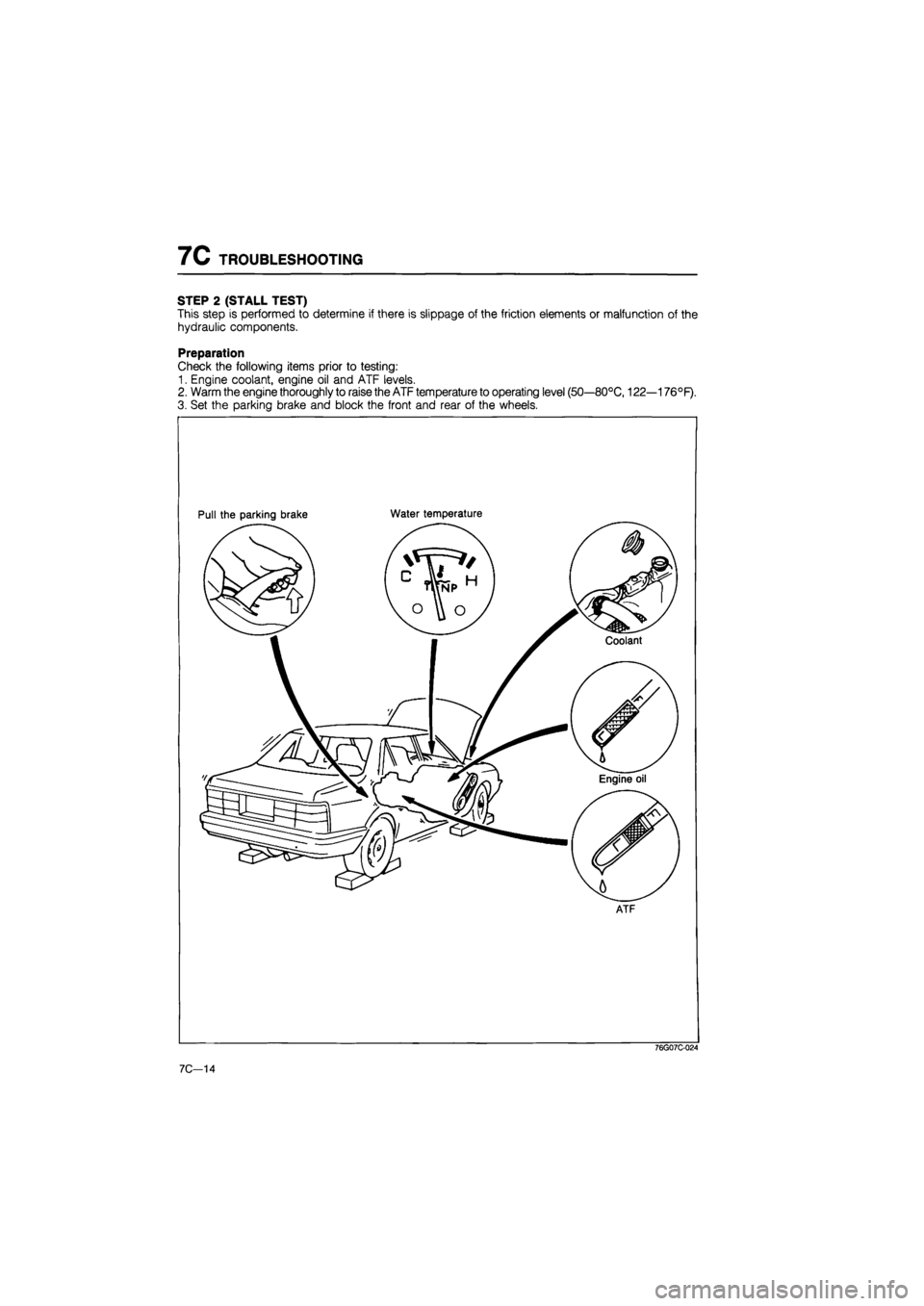
STEP 2 (STALL TEST)
This step is performed to determine if there is slippage of the friction elements or malfunction of the
hydraulic components.
Preparation
Check the following items prior to testing:
1. Engine coolant, engine oil and ATF levels.
2. Warm the engine thoroughly to raise the ATF temperature to operating level (50—80°C, 122—176°F).
3. Set the parking brake and block the front and rear of the wheels.
Pull the parking brake Water temperature
ATF
7C—14
76G07C-024
Page 1338 of 1865
10 MANUAL STEERING
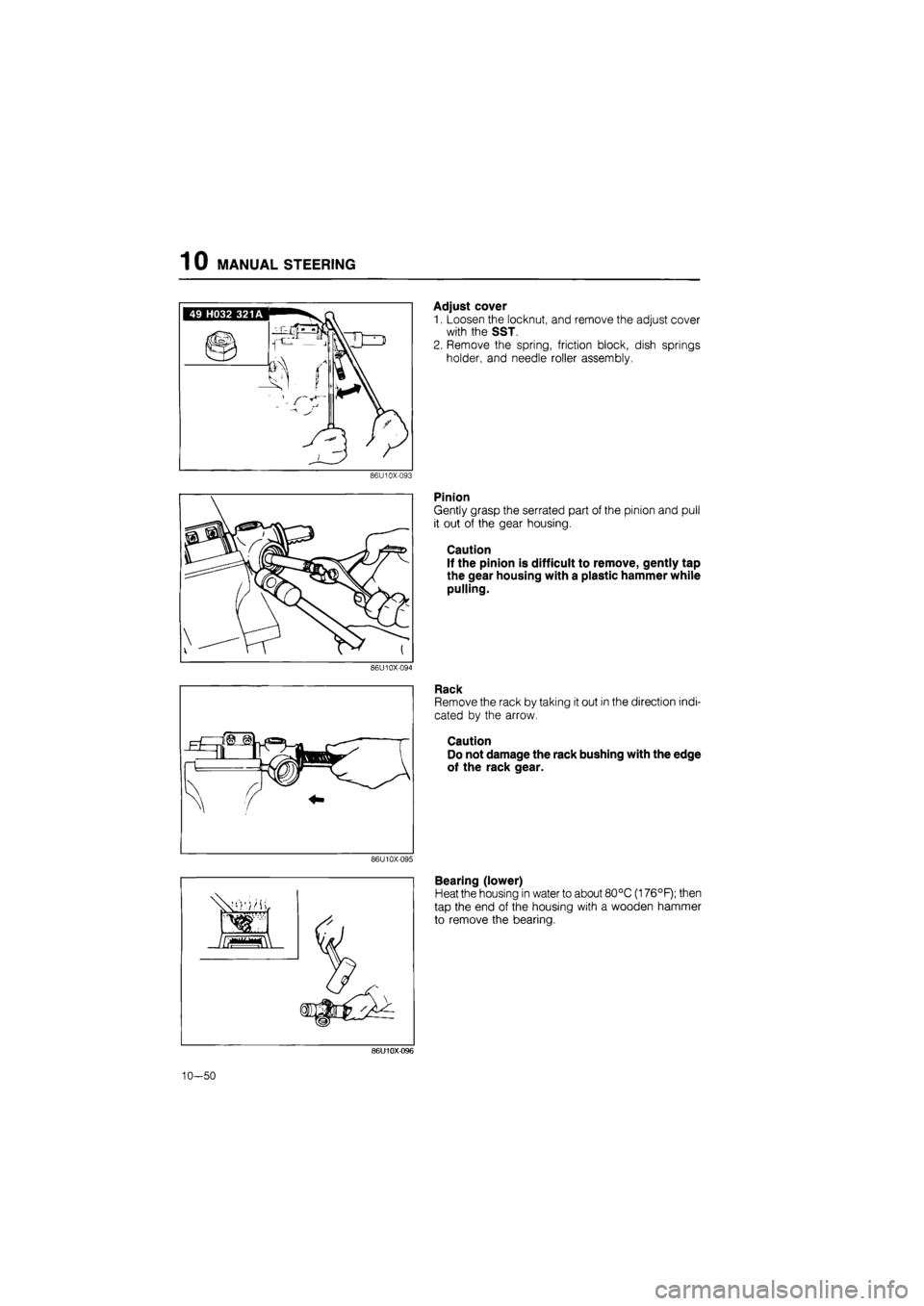
Adjust cover
1. Loosen the locknut, and remove the adjust cover
with the SST.
2. Remove the spring, friction block, dish springs
holder, and needle roller assembly.
86U10X-093
Pinion
Gently grasp the serrated part of the pinion and pull
it out of the gear housing.
Caution
If the pinion is difficult to remove, gently tap
the gear housing with a plastic hammer while
pulling.
86U10X-094
Rack
Remove the rack by taking it out in the direction indi-
cated by the arrow.
Caution
Do not damage the rack bushing with the edge
of the rack gear.
86U10X-095
Bearing (lower)
Heat the housing in water to about 80°C (176°F); then
tap the end of the housing with a wooden hammer
to remove the bearing.
86U10X-096
10—50
Page 1397 of 1865
TROUBLESHOOTING GUIDE 1 1
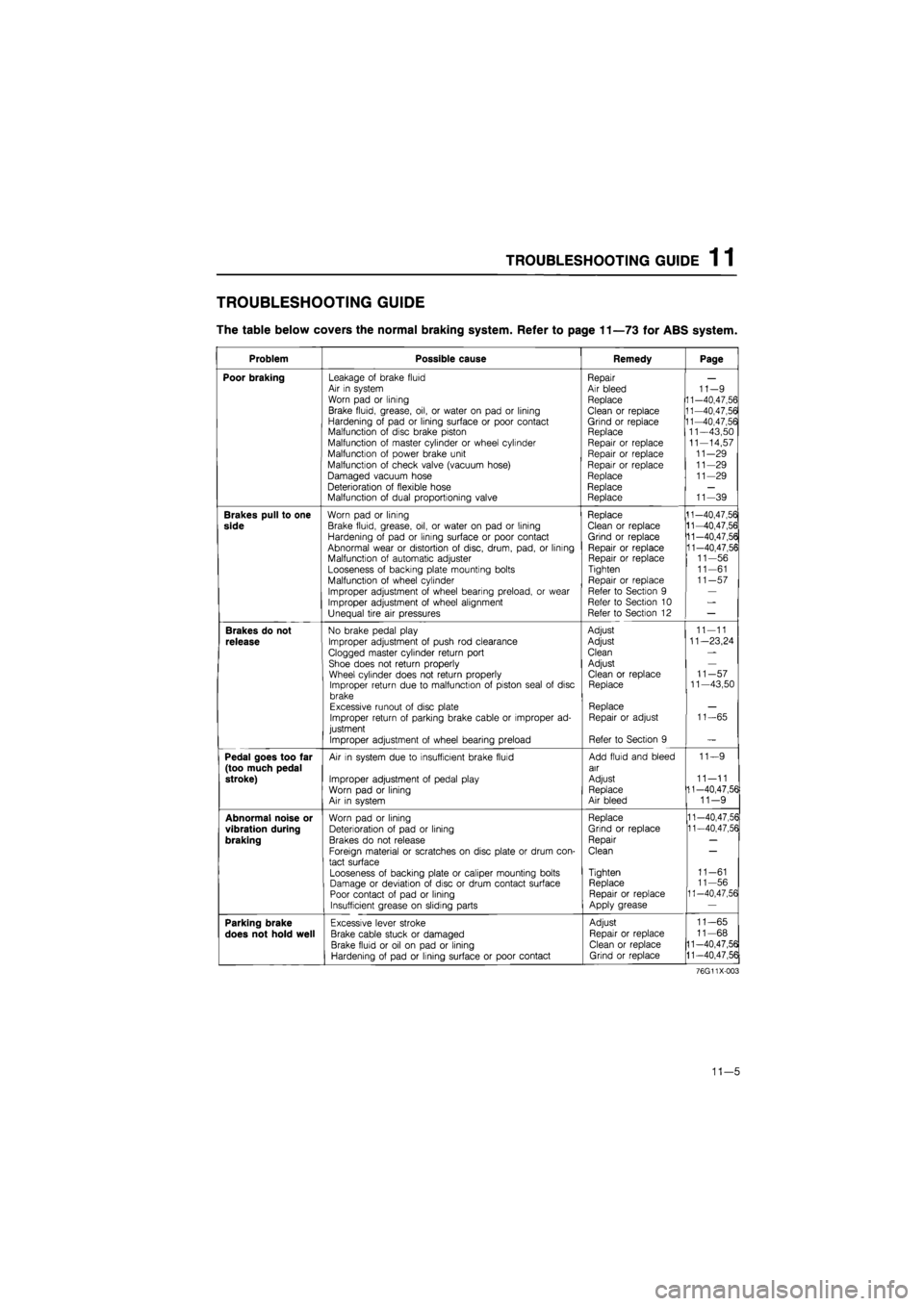
TROUBLESHOOTING GUIDE
The table below covers the normal braking system. Refer to page 11—73 for ABS system.
Problem Possible cause Remedy Page
Poor braking Leakage of brake fluid Air in system Worn pad or lining
Brake fluid, grease, oil, or water on pad or lining Hardening of pad or lining surface or poor contact Malfunction of disc brake piston Malfunction of master cylinder or wheel cylinder Malfunction of power brake unit
Malfunction of check valve (vacuum hose)
Damaged vacuum hose Deterioration of flexible hose Malfunction of dual proportioning valve
Repair Air bleed Replace
Clean or replace Grind or replace Replace Repair or replace Repair or replace Repair or replace Replace Replace Replace
11-9 11-40,47,56 11-40,47,56 11-40,47,56 11—43,50 11-14,57 11-29 11-29 11-29
11-39
Brakes pull to one
side
Worn pad or lining
Brake fluid, grease, oil, or water on pad or lining Hardening of pad or lining surface or poor contact Abnormal wear or distortion of disc, drum, pad, or lining Malfunction of automatic adjuster Looseness of backing plate mounting bolts Malfunction of wheel cylinder
Improper adjustment of wheel bearing preload, or wear Improper adjustment of wheel alignment Unequal tire air pressures
Replace Clean or replace Grind or replace Repair or replace Repair or replace Tighten
Repair or replace Refer to Section 9 Refer to Section 10 Refer to Section 12
11-40,47,56 11-40,47,56 11-40,47,56 11-40,47,56 11-56 11-61 11-57
Brakes do not
release
No brake pedal play
Improper adjustment of push rod clearance
Clogged master cylinder return port Shoe does not return properly Wheel cylinder does not return properly Improper return due to malfunction of piston seal of disc brake Excessive runout of disc plate Improper return of parking brake cable or improper ad-justment
Improper adjustment of wheel bearing preload
Adjust
Adjust
Clean
Adjust Clean or replace Replace
Replace Repair or adjust
Refer to Section 9
11-11
11—23,24
11-57 11—43,50
11-65
Pedal goes too far (too much pedal stroke)
Air in system due to insufficient brake fluid
Improper adjustment of pedal play Worn pad or lining Air in system
Add fluid and bleed air
Adjust Replace Air bleed
11—9
11—11 11-40,47,56 11-9
Abnormal noise or
vibration during
braking
Worn pad or lining Deterioration of pad or lining Brakes do not release
Foreign material or scratches on disc plate or drum con-tact surface
Looseness of backing plate or caliper mounting bolts Damage or deviation of disc or drum contact surface Poor contact of pad or lining Insufficient grease on sliding parts
Replace
Grind or replace
Repair
Clean
Tighten Replace Repair or replace Apply grease
11-40,47,56 11-40,47,56
11-61 11-56 11-40,47,56
Parking brake
does not hold well
Excessive lever stroke
Brake cable stuck or damaged
Brake fluid or oil on pad or lining Hardening of pad or lining surface or poor contact
Adjust
Repair or replace Clean or replace Grind or replace
11-65
11-68
11-40,47,56
11-40,47,56
76G11X-003
11—5
Page 1496 of 1865
WHEELS AND TIRES 1 2
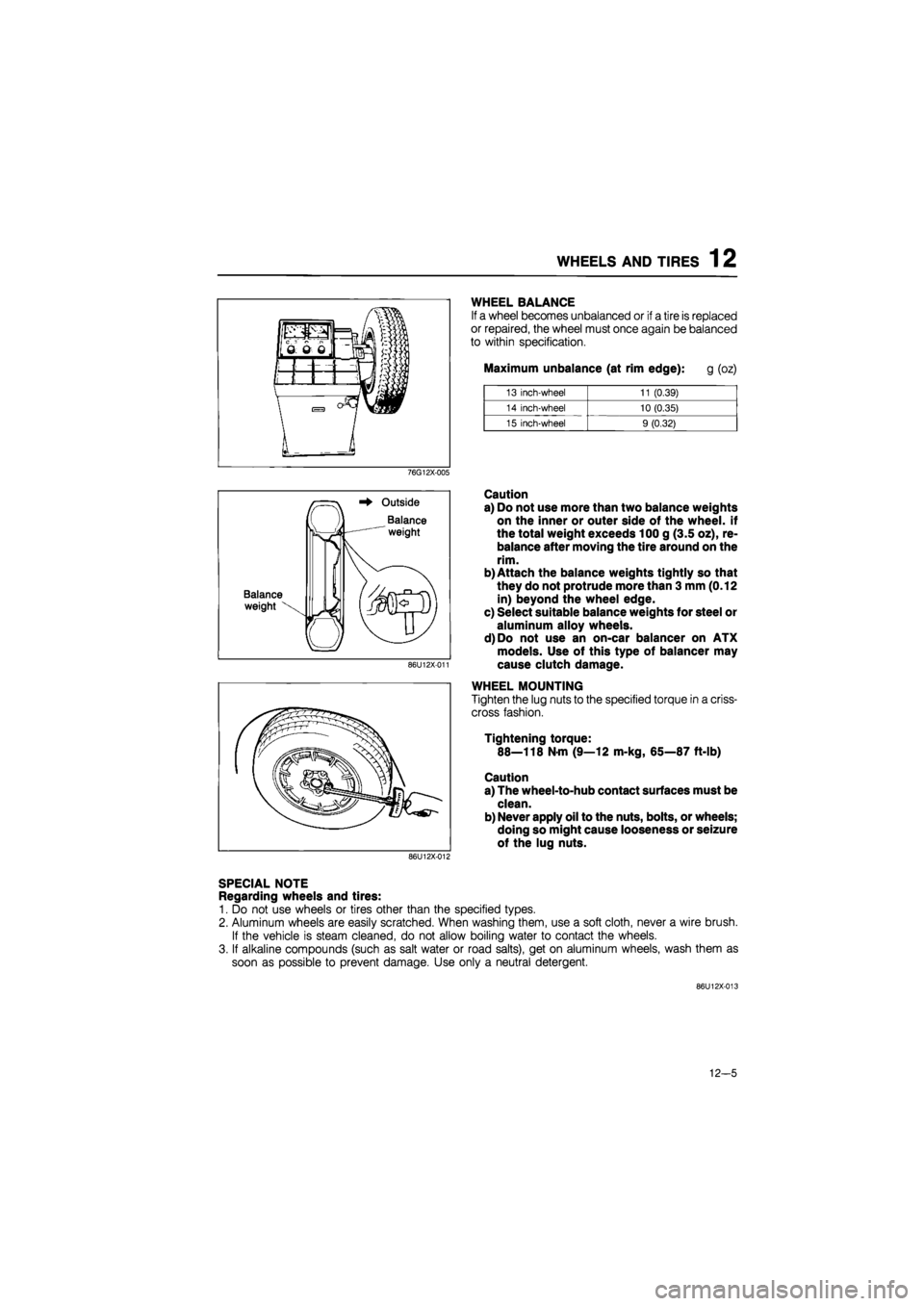
WHEEL BALANCE
If a wheel becomes unbalanced or if a tire is replaced
or repaired, the wheel must once again be balanced
to within specification.
Maximum unbalance (at rim edge): g (oz)
13 inch-wheel 11 (0.39)
14 inch-wheel 10 (0.35)
15 inch-wheel 9 (0.32)
76G12X-005
Balance
weight
Outside
Balance
weight
86U12X-011
Caution
a) Do not use more than two balance weights
on the inner or outer side of the wheel, if
the total weight exceeds 100 g (3.5 oz), re-
balance after moving the tire around on the
rim.
b) Attach the balance weights tightly so that
they do not protrude more than 3 mm (0.12
in) beyond the wheel edge.
c) Select suitable balance weights for steel or
aluminum alloy wheels.
d)Do not use an on-car balancer on ATX
models. Use of this type of balancer may
cause clutch damage.
WHEEL MOUNTING
Tighten the lug nuts to the specified torque in a criss-
cross fashion.
Tightening torque:
88—118 N-m (9—12 m-kg, 65—87 ft-lb)
Caution
a) The wheel-to-hub contact surfaces must be
clean.
b) Never apply oil to the nuts, bolts, or wheels;
doing so might cause looseness or seizure
of the lug nuts.
86U12X-012
SPECIAL NOTE
Regarding wheels and tires:
1. Do not use wheels or tires other than the specified types.
2. Aluminum wheels are easily scratched. When washing them, use a soft cloth, never a wire brush.
If the vehicle is steam cleaned, do not allow boiling water to contact the wheels.
3. If alkaline compounds (such as salt water or road salts), get on aluminum wheels, wash them as
soon as possible to prevent damage. Use only a neutral detergent.
86U12X-013
12-5
Page 1517 of 1865
1 3 FRONT LOWER ARM
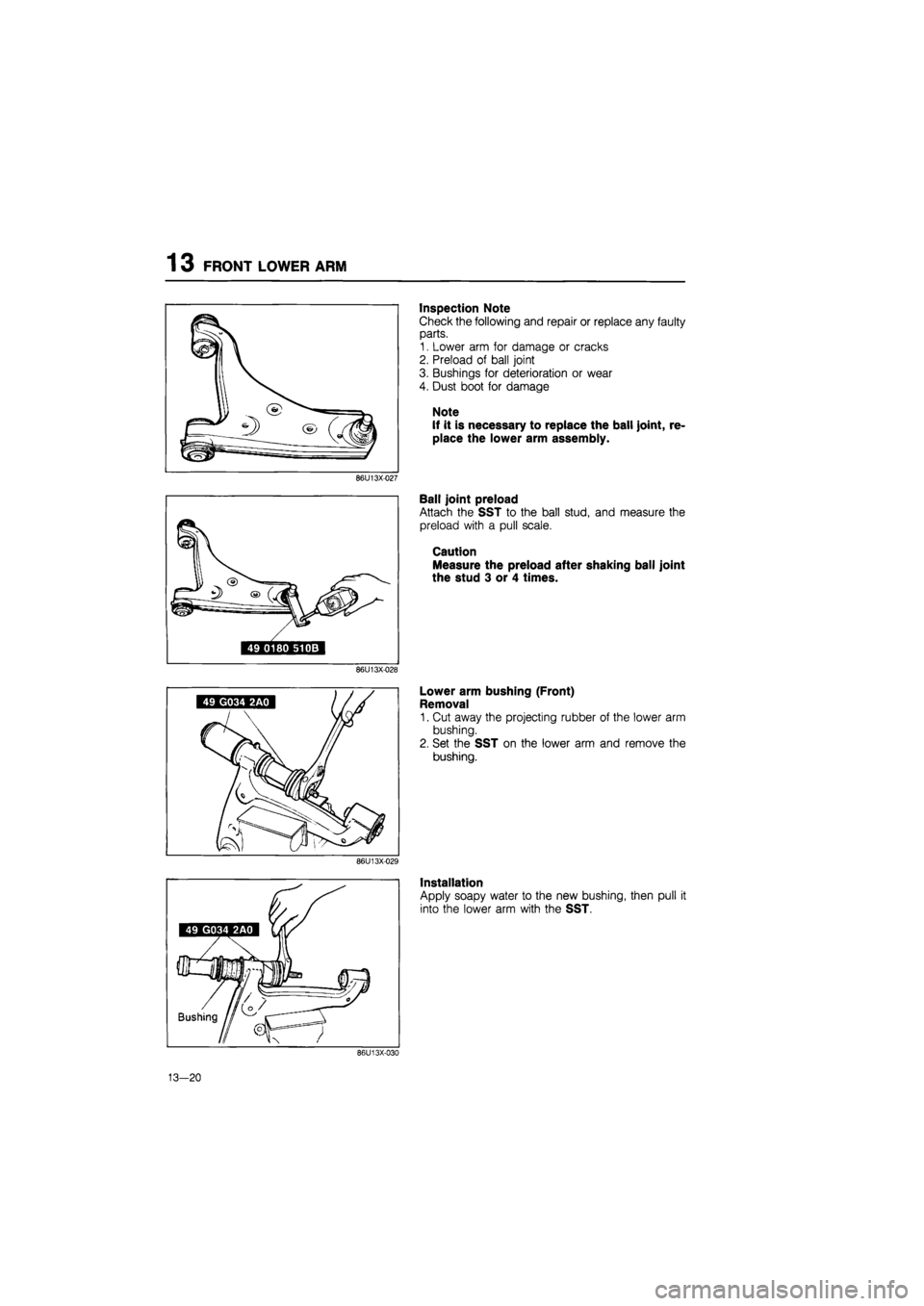
Inspection Note
Check the following and repair or replace any faulty
parts.
1. Lower arm for damage or cracks
2. Preload of ball joint
3. Bushings for deterioration or wear
4. Dust boot for damage
Note
If it is necessary to replace the ball joint, re-
place the lower arm assembly.
86U13X-027
Ball joint preload
Attach the SST to the ball stud, and measure the
preload with a pull scale.
Caution
Measure the preload after shaking ball joint
the stud 3 or 4 times.
86U13X-028
Lower arm bushing (Front)
Removal
1. Cut away the projecting rubber of the lower arm
bushing.
2. Set the SST on the lower arm and remove the
bushing.
86U13X-029
Installation
Apply soapy water to the new bushing, then pull it
into the lower arm with the SST.
86U13X-030
13—20
Page 1535 of 1865
1 3 REAR LOWER ARM AND TRAILING LINK (4WS)
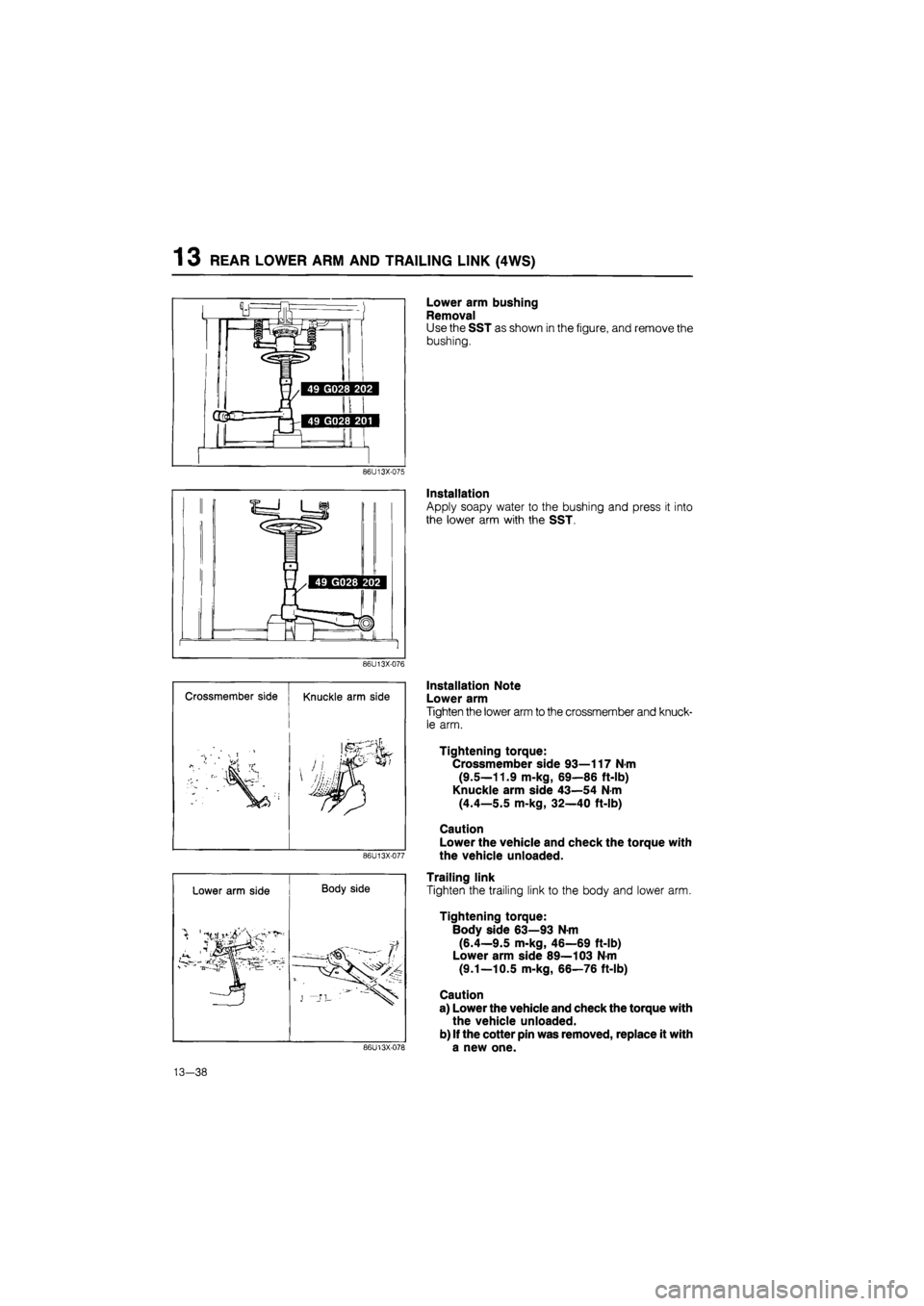
Lower arm bushing
Removal
Use the SST as shown in the figure, and remove the
bushing.
86U13X-075
Installation
Apply soapy water to the bushing and press it into
the lower arm with the SST.
86U13X-076
Crossmember side Knuckle arm side
86U13X-077
Lower arm side Body side
13-38
86U13X-078
Installation Note
Lower arm
Tighten the lower arm to the crossmember and knuck-
le arm.
Tightening torque:
Crossmember side 93—117 N-m
(9.5—11.9 m-kg, 69—86 ft-lb)
Knuckle arm side 43—54 N-m
(4.4—5.5 m-kg, 32—40 ft-lb)
Caution
Lower the vehicle and check the torque with
the vehicle unloaded.
Trailing link
Tighten the trailing link to the body and lower arm.
Tightening torque:
Body side 63—93 N-m
(6.4—9.5 m-kg, 46—69 ft-lb)
Lower arm side 89—103 N-m
(9.1—10.5 m-kg, 66—76 ft-lb)
Caution
a) Lower the vehicle and check the torque with
the vehicle unloaded.
b) If the cotter pin was removed, replace it with
a new one.
Page 1544 of 1865
REAR CROSSMEMBER (4WS) 1 3
Installation
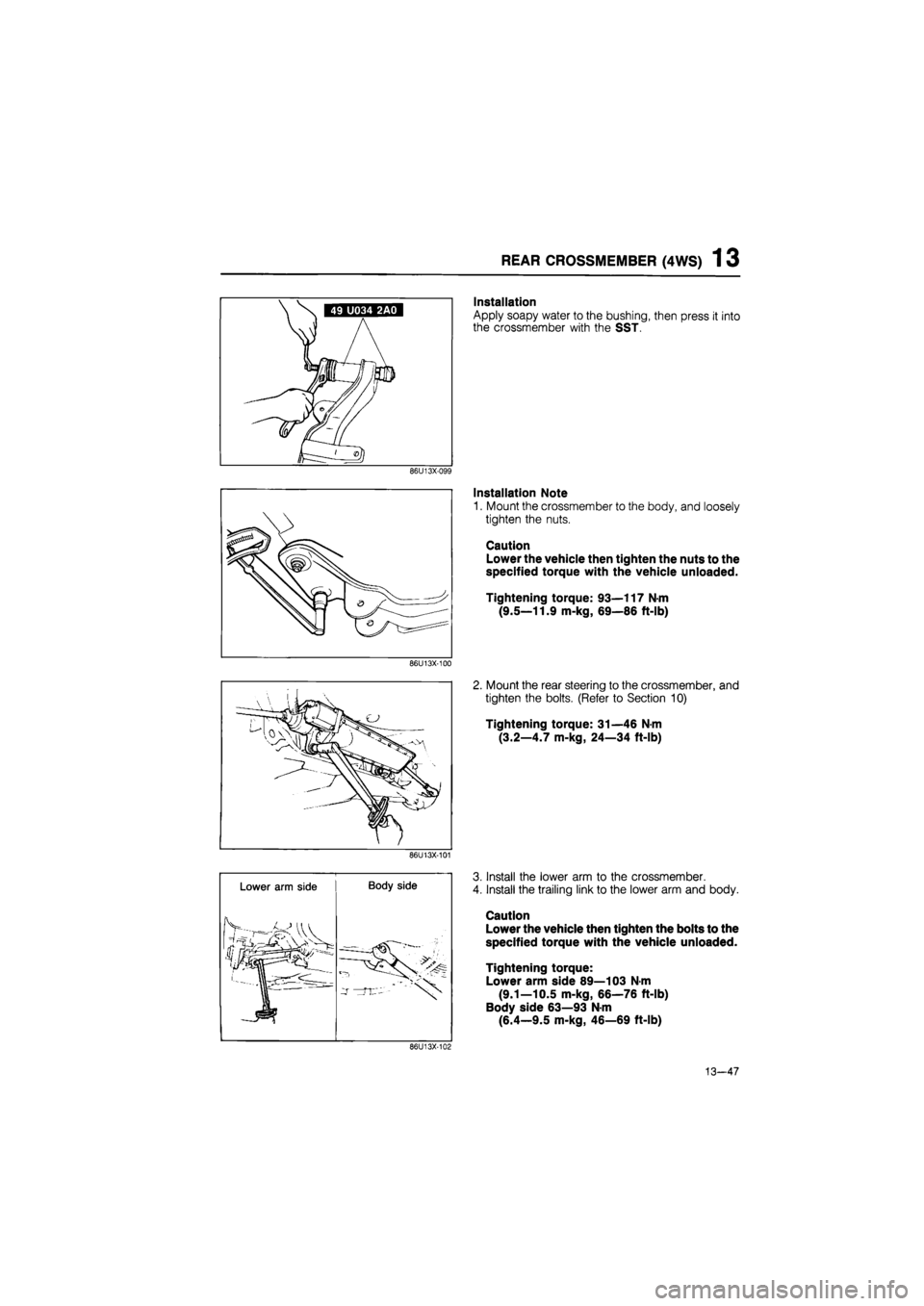
Apply soapy water to the bushing, then press it into
the crossmember with the SST.
86U13X-099
Installation Note
1. Mount the crossmember to the body, and loosely
tighten the nuts.
Caution
Lower the vehicle then tighten the nuts to the
specified torque with the vehicle unloaded.
Tightening torque: 93—117 N-m
(9.5—11.9 m-kg, 69—86 ft-lb)
86U13X-100
2. Mount the rear steering to the crossmember, and
tighten the bolts. (Refer to Section 10)
Tightening torque: 31—46 N-m
(3.2—4.7 m-kg, 24—34 ft-lb)
86U13X-101
3. Install the lower arm to the crossmember.
4. Install the trailing link to the lower arm and body.
Caution
Lower the vehicle then tighten the bolts to the
specified torque with the vehicle unloaded.
Tightening torque:
Lower arm side 89—103 N-m
(9.1—10.5 m-kg, 66—76 ft-lb)
Body side 63—93 N-m
(6.4—9.5 m-kg, 46—69 ft-lb)
13-47