1987 MAZDA 626 water
[x] Cancel search: waterPage 1682 of 1865
![MAZDA 626 1987 Workshop Manual
METER 15
86U15X-033
86U15X-034
104.1t! 21
2330 16.10
a £] U \JEMP j n
JJ
86U15X-035
Standard indication
(km/h)
Allowable range
(km/h)
60 60-63
Standard indication
(mph)
Allowable ran](/manual-img/28/57059/w960_57059-1681.png "MAZDA 626 1987 Workshop Manual
METER 15
86U15X-033
86U15X-034
104.1t! 21
2330 16.10
a £] U \JEMP j n
JJ
86U15X-035
Standard indication
(km/h)
Allowable range
(km/h)
60 60-63
Standard indication
(mph)
Allowable ran")
METER 15
86U15X-033
86U15X-034
104.1t! 21
2330 16.10
a £] U \JEMP j n
JJ
86U15X-035
Standard indication
(km/h)
Allowable range
(km/h)
60 60-63
Standard indication
(mph)
Allowable range
(mph)
60 60-63
86U15X-036
3. Set the SST to the resistance values shown in the
figure.
4. Turn the ignition switch ON, and check that the
needle indicator displays the correct values.
If the needle displays correctly, check the gauge
unit. If not, replace the fuel gauge in the meter or
repair the wiring harness.
Caution
a) Continue the above checks for at least two
minutes each to correctly judge the con-
dition.
b)The allowable indication error is twice the
width of the needle.
Water Temperature Gauge
1. Disconnect the connector from the water thermo
sensor.
2. Connect the red lead of the SST to the connec-
tor, and the black lead to a body ground.
3. Set the SST to the resistance values shown in the
figure.
4. Turn the ignition switch ON, and check that the
needle indicator displays the correct values.
If the needle displays the correct values, the trou-
ble is in the gauge unit; if not, the trouble is in the
meter or the wiring harness.
Caution
a) Continue the above checks for at least two
minutes each to correctly judge the con-
dition.
b)The allowable indication error is twice the
width of the needle.
INSPECTION OF DIGITAL METER
Speedometer
1. Using a speedometer tester, check the speedom-
eter for allowable indication error, and check the
operation of the odometer. Replace the meter as-
sembly if necessary.
2. Check the speedometer for fluctuation and/or ab-
normal noise.
Caution
a) If significant fluctuation occurs or the
speedometer does not move at all, remove
the speedometer cable. If normal, replace
the digital meter assembly.
b)Tire wear and improper inflation will in-
crease speedometer error.
15—27
Page 1684 of 1865
METER 15
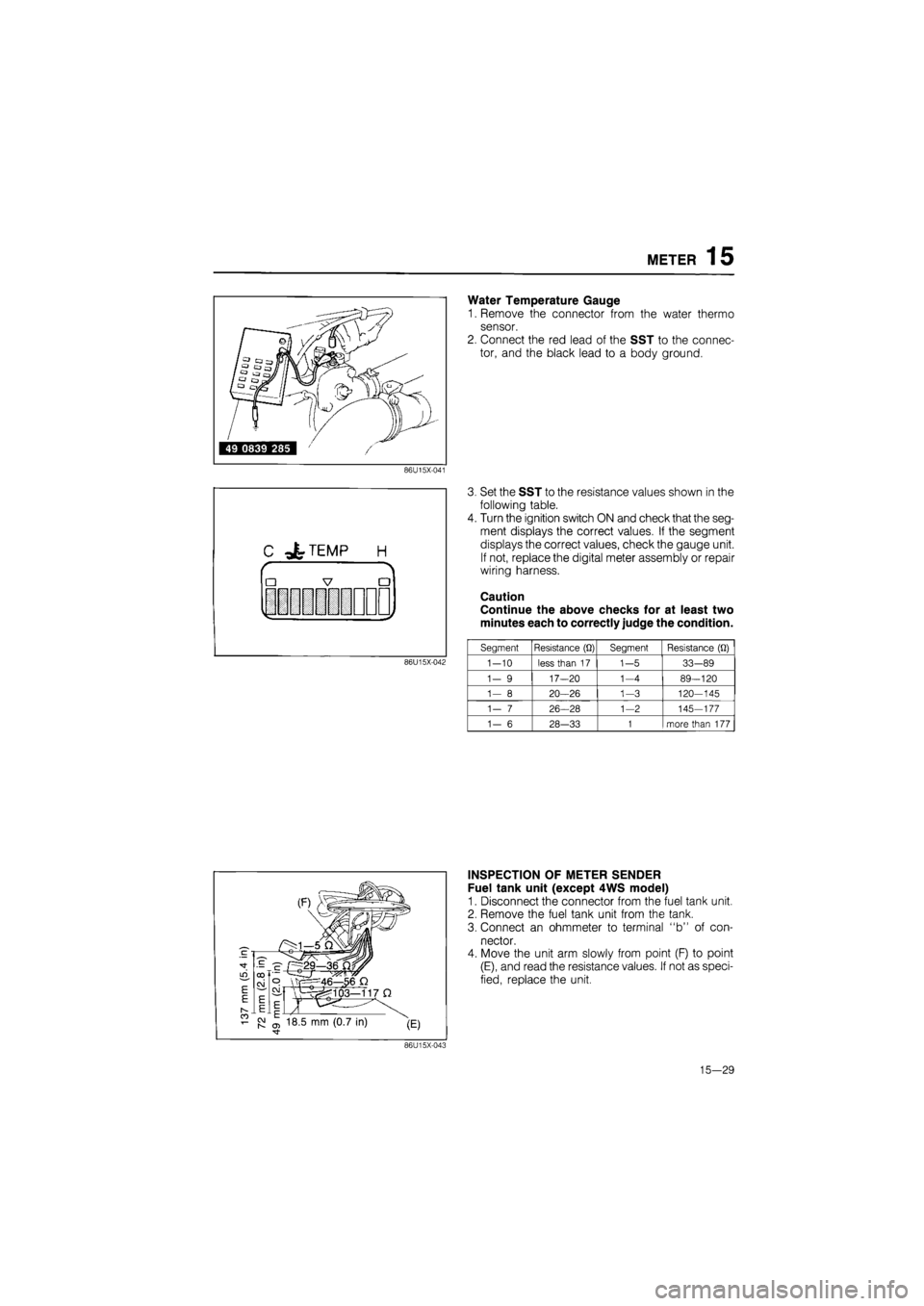
Water Temperature Gauge
1. Remove the connector from the water thermo
sensor.
2. Connect the red lead of the SST to the connec-
tor, and the black lead to a body ground.
86U15X-041
C -&TEMP H
r
•
|
7 •
V i y
86U15X-042
3. Set the SST to the resistance values shown in the
following table.
4. Turn the ignition switch ON and check that the seg-
ment displays the correct values. If the segment
displays the correct values, check the gauge unit.
If not, replace the digital meter assembly or repair
wiring harness.
Caution
Continue the above checks for at least two
minutes each to correctly judge the condition.
Segment Resistance
(Q)
Segment Resistance
(Q)
1-10
less than
17
1-5
33-89
1-
9
17—20
1-4
89-120
1—
8
20—26
1-3
120-145
1—
7
26-28
1-2
145-177
1-
6
28-33
1
more than
177
INSPECTION OF METER SENDER
Fuel tank unit (except 4WS model)
1. Disconnect the connector from the fuel tank unit.
2. Remove the fuel tank unit from the tank.
3. Connect an ohmmeter to terminal "b" of con-
nector.
4. Move the unit arm slowly from point (F) to point
(E), and read the resistance values. If not as speci-
fied, replace the unit.
86U15X-043
15—29
Page 1685 of 1865
15 METER
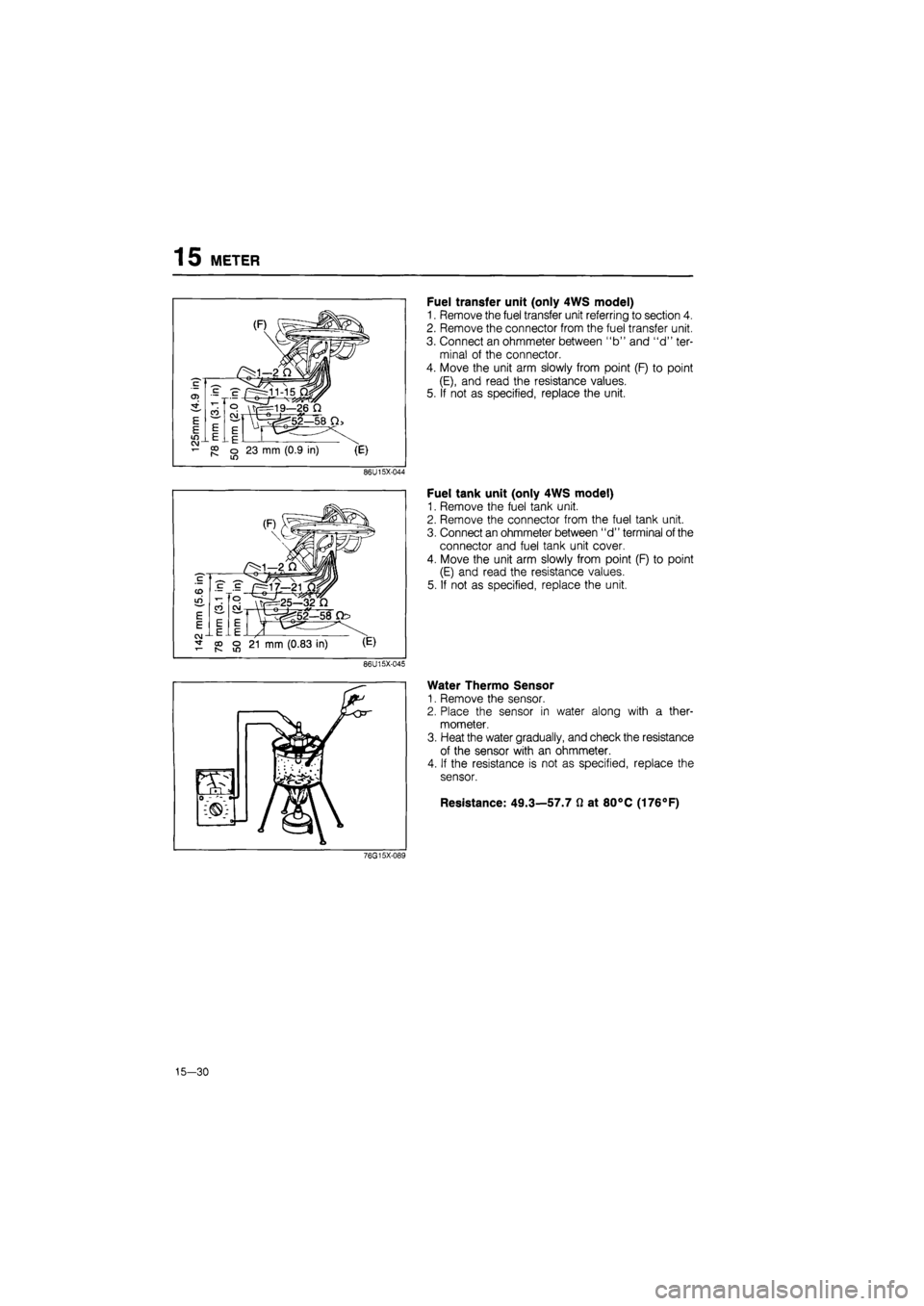
Fuel transfer unit (only 4WS model)
1. Remove the fuel transfer unit referring to section 4.
2. Remove the connector from the fuel transfer unit.
3. Connect an ohmmeter between "b" and "d" ter-
minal of the connector.
4. Move the unit arm slowly from point (F) to point
(E), and read the resistance values.
5. If not as specified, replace the unit.
86U15X-044
iel tank unit (only 4WS model)
Remove the fuel tank unit.
Remove the connector from the fuel tank unit.
Connect an ohmmeter between "d" terminal of the
connector and fuel tank unit cover.
Move the unit arm slowly from point (F) to point
(E) and read the resistance values.
If not as specified, replace the unit.
86U15X-045
Water Thermo Sensor
1. Remove the sensor.
2. Place the sensor in water along with a ther-
mometer.
3. Heat the water gradually, and check the resistance
of the sensor with an ohmmeter.
4. If the resistance is not as specified, replace the
sensor.
Resistance: 49.3—57.7 Q at 80°C (176°F)
76G15X-089
15-30
Page 1793 of 1865
16 OUTLINE
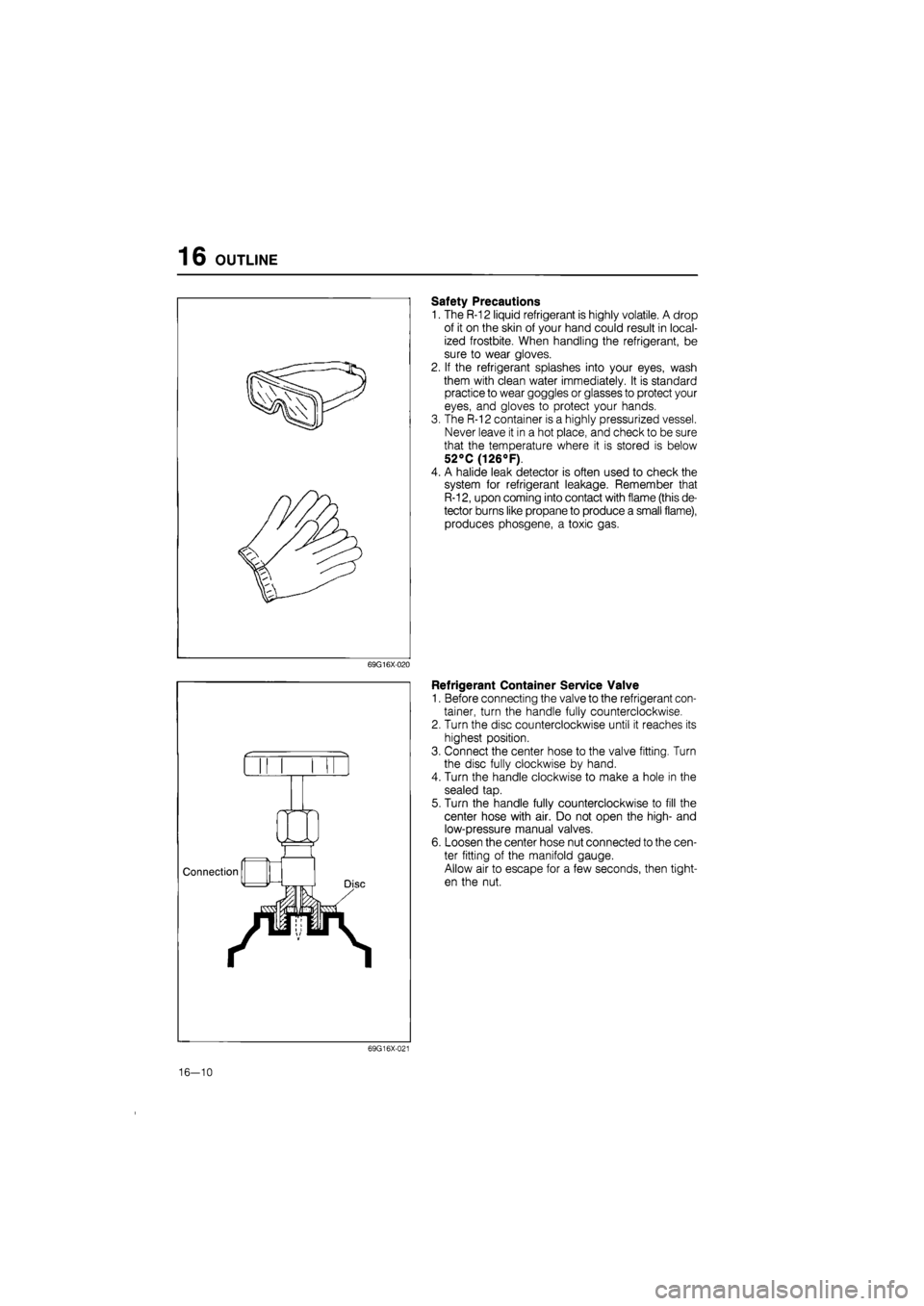
Safety Precautions
1. The R-12 liquid refrigerant is highly volatile. A drop
of it on the skin of your hand could result in local-
ized frostbite. When handling the refrigerant, be
sure to wear gloves.
2. If the refrigerant splashes into your eyes, wash
them with clean water immediately. It is standard
practice to wear goggles or glasses to protect your
eyes, and gloves to protect your hands.
3. The R-12 container is a highly pressurized vessel.
Never leave it in a hot place, and check to be sure
that the temperature where it is stored is below
52°C (126°F).
4. A halide leak detector is often used to check the
system for refrigerant leakage. Remember that
R-12, upon coming into contact with flame (this de-
tector burns like propane to produce a small flame),
produces phosgene, a toxic gas.
69G16X020
V/^V
Connection
LZl
jvmi
Refrigerant Container Service Valve
1. Before connecting the valve to the refrigerant con-
tainer, turn the handle fully counterclockwise.
2. Turn the disc counterclockwise until it reaches its
highest position.
3. Connect the center hose to the valve fitting. Turn
the disc fully clockwise by hand.
4. Turn the handle clockwise to make a hole in the
sealed tap.
5. Turn the handle fully counterclockwise to fill the
center hose with air. Do not open the high- and
low-pressure manual valves.
6. Loosen the center hose nut connected to the cen-
ter fitting of the manifold gauge.
Allow air to escape for a few seconds, then tight-
en the nut.
69G16X-021
16-10
Page 1795 of 1865
16 OUTLINE
Thermometer (Dry)
Thermometer
(Dry & Wet)
76G16X-633
69G16X-024
DETERMINING THE RELATIVE HUMI-DITY: Read the temperatures of the dry- and v^et-bulb thermometers at the air inlet (evapo-rator inlet). Then bring them into mutual relation on the chart and determine the intersection, which is the relative humidity^ For exampie, if the dry-bulb temperature^ is 90° F. and the wet-bulb temper- ^ ature is 78° F, the relative humidity is ^ 60%.
DRV BUL8 TEMPERATURE
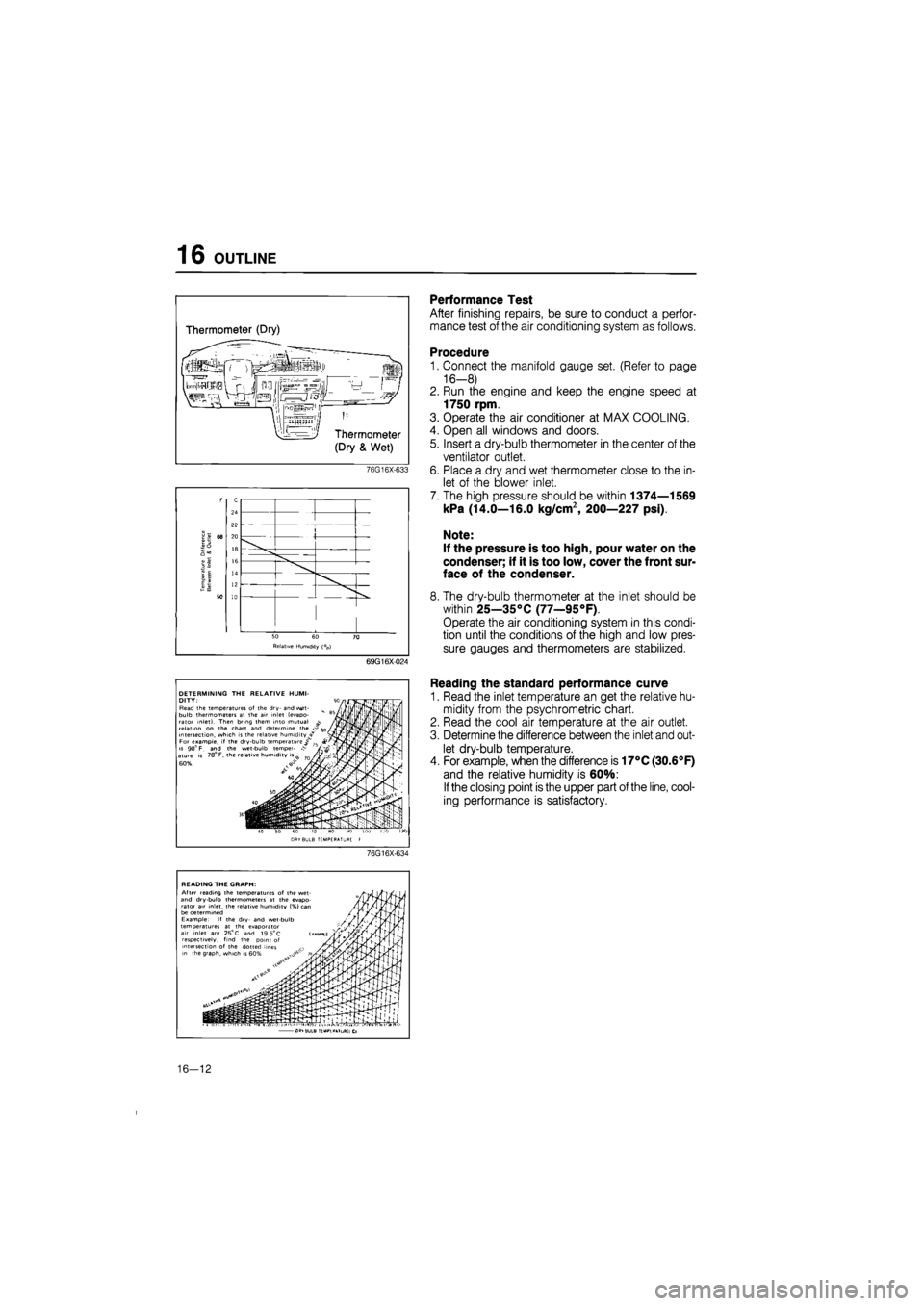
Performance Test
After finishing repairs, be sure to conduct a perfor-
mance test of the air conditioning system as follows.
Procedure
1. Connect the manifold gauge set. (Refer to page
16-8)
2. Run the engine and keep the engine speed at
1750 rpm.
3. Operate the air conditioner at MAX COOLING.
4. Open all windows and doors.
5. Insert a dry-bulb thermometer in the center of the
ventilator outlet.
6. Place a dry and wet thermometer close to the in-
let of the blower inlet.
7. The high pressure should be within 1374—1569
kPa (14.0—16.0 kg/cm2, 200—227 psi).
Note:
If the pressure is too high, pour water on the
condenser; if it is too low, cover the front sur-
face of the condenser.
8. The dry-bulb thermometer at the inlet should be
within 25—35°C (77—95°F).
Operate the air conditioning system in this condi-
tion until the conditions of the high and low pres-
sure gauges and thermometers are stabilized.
Reading the standard performance curve
1. Read the inlet temperature an get the relative hu-
midity from the psychrometric chart.
2. Read the cool air temperature at the air outlet.
3. Determine the difference between the inlet and out-
let dry-bulb temperature.
4. For example, when the difference is 17°C (30.6°F)
and the relative humidity is 60%:
If
the closing point is the upper part of the line, cool-
ing performance is satisfactory.
76G16X-634
READING THE GRAPH: After reading the temperatures of the wet-and dry-bulb thermometers at the evapo-rator air inlet, the relative humidity (%} can be determined Example: If the dry- and wet-bulb temperatures at the evaporator air inlet are 25°
C
and 19 5°C respectively, find the point of intersection of the dotted lines in the graph, which is
• i
•.p-I--!1. fi -GL^TIULB ': "'.L .T.L CL
16—12
Page 1810 of 1865
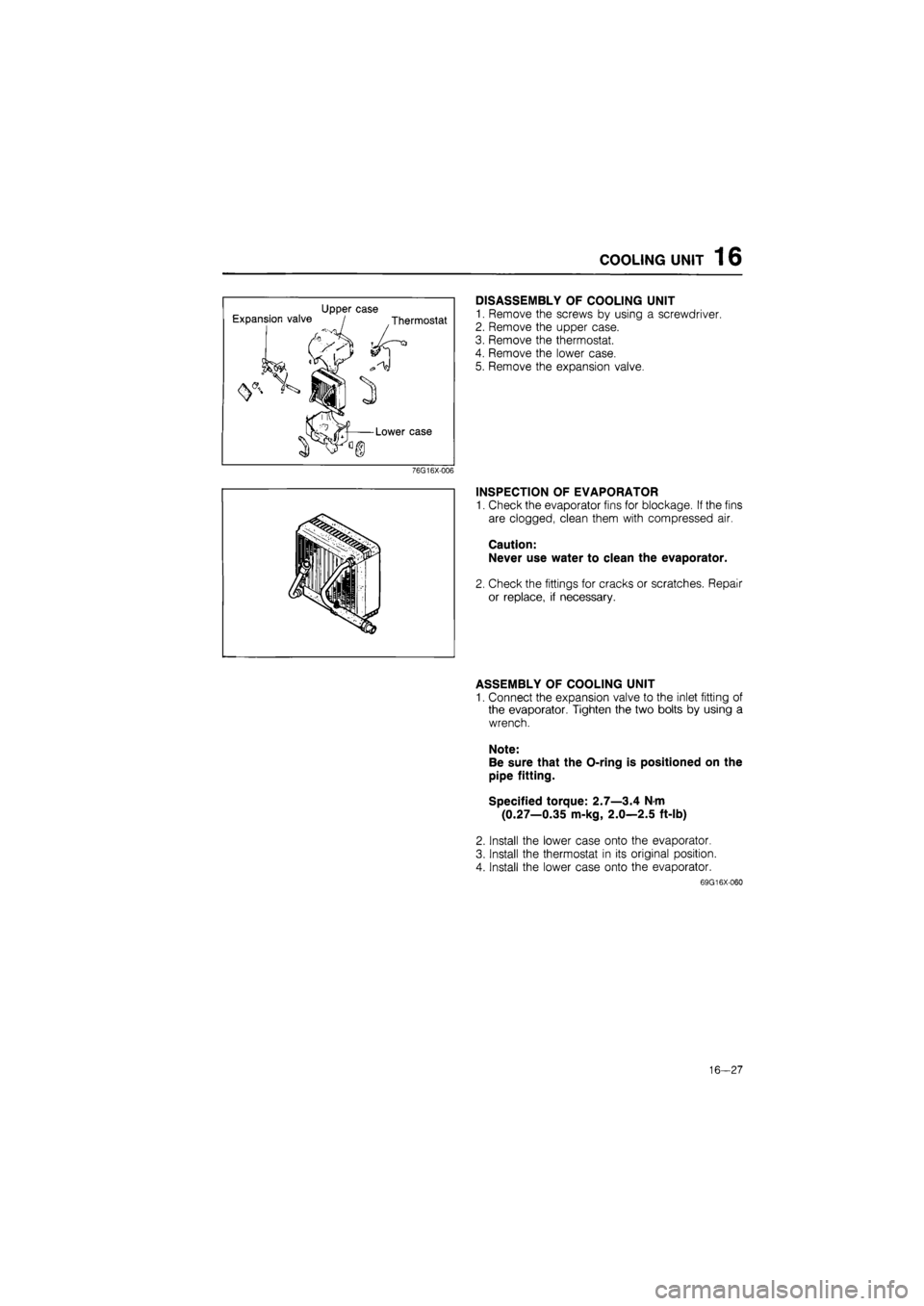
COOLING UNIT 1 6
Upper case Expansion valve / Thermostat
Lower case
76G16X-006
DISASSEMBLY OF COOLING UNIT
1. Remove the screws by using a screwdriver.
2. Remove the upper case.
3. Remove the thermostat.
4. Remove the lower case.
5. Remove the expansion valve.
INSPECTION OF EVAPORATOR
1. Check the evaporator fins for blockage. If the fins
are clogged, clean them with compressed air.
Caution:
Never use water to clean the evaporator.
2. Check the fittings for cracks or scratches. Repair
or replace, if necessary.
ASSEMBLY OF COOLING UNIT
1. Connect the expansion valve to the inlet fitting of
the evaporator. Tighten the two bolts by using a
wrench.
Note:
Be sure that the O-ring is positioned on the
pipe fitting.
Specified torque: 2.7—3.4 N-m
(0.27—0.35 m-kg, 2.0—2.5 ft-lb)
2. Install the lower case onto the evaporator.
3. Install the thermostat in its original position.
4. Install the lower case onto the evaporator.
69G16X-060
16—27
Page 1828 of 1865
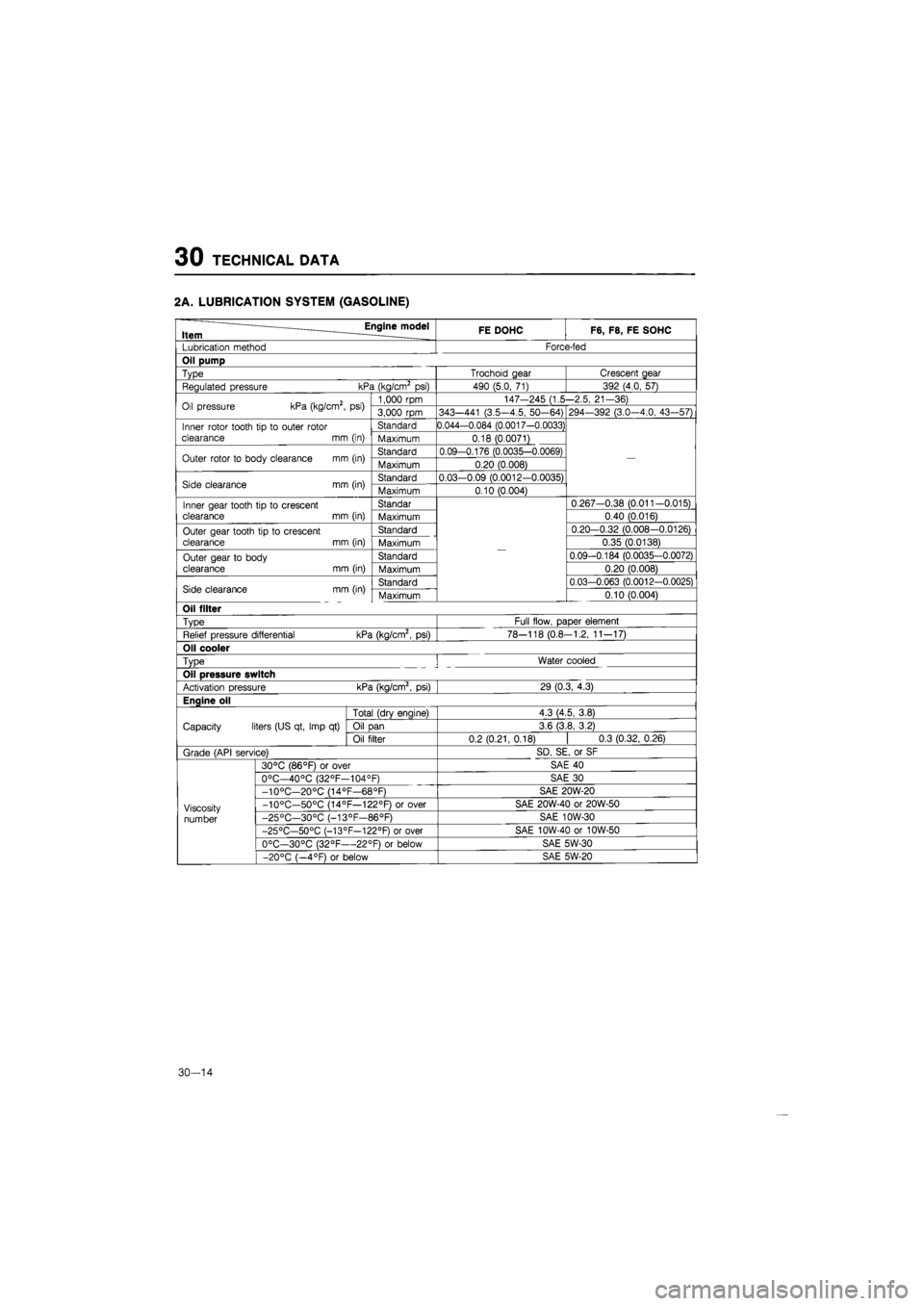
30 TECHNICAL DATA
2A. LUBRICATION SYSTEM (GASOLINE)
Engine model Item ____ FE DOHC F6, F8, FE SOHC
Lubrication method Force-fed
Oil pump
Type Trochoid gear Crescent gear
Regulated pressure kPa (kg/cm2
psi)
490 (5.0,
71)
392 (4.0, 57)
Oil pressure kPa (kg/cm2,
psi)
1,000 rpm 147-245 (1.5-2.5, 21-36) Oil pressure kPa (kg/cm2,
psi)
3,000
rpm
343—441 (3.5-4.5, 50-64) 294—392 (3.0—4.0, 43-57)
Inner rotor tooth
tip to
outer rotor
clearance
mm
(in)
Standard 0.044-0.084 (0.0017-0.0033)
—
Inner rotor tooth
tip to
outer rotor
clearance
mm
(in) Maximum 0.18 (0.0071)
—
Outer rotor
to
body clearance
mm
(in) Standard 0.09-0.176 (0.0035-0.0069)
—
Outer rotor
to
body clearance
mm
(in) Maximum 0.20 (0.008)
—
Side clearance
mm
(in) Standard 0.03-0.09 (0.0012-0.0035)
—
Side clearance
mm
(in) Maximum 0.10 (0.004)
—
Inner gear tooth tip
to
crescent clearance
mm
(in)
Standar
—
0.267-0.38 (0.011-0.015) Inner gear tooth tip
to
crescent clearance
mm
(in) Maximum
—
0.40 (0.016)
Outer gear tooth tip
to
crescent clearance
mm
(in)
Standard
—
0.20-0.32 (0.008-0.0126) Outer gear tooth tip
to
crescent clearance
mm
(in) Maximum
—
0.35 (0.0138)
Outer gear
to
body
clearance
mm
(in)
Standard
—
0.09-0.184 (0.0035-0.0072) Outer gear
to
body
clearance
mm
(in) Maximum
—
0.20 (0.008)
Side clearance mm (in) Standard
—
0.03-0.063 (0.0012-0.0025) Side clearance mm (in) Maximum
—
0.10 (0.004)
Oil filter
Type Full flow, paper element
Relief pressure differential kPa (kg/cm2,
psi)
78-118 (0.8-1.2, 11-17)
Oil cooler
Type
!
Water cooled
Oil pressure switch
Activation pressure kPa (kg/cm2,
psi)
29 (0.3, 4.3)
Enaine oil
Capacity liters (US qt, Imp
qt)
Total (drv enaine) 4.3 (4.5, 3.8)
Capacity liters (US qt, Imp
qt)
Oil
Dan
3.6 (3.8, 3.2) Capacity liters (US qt, Imp
qt)
Oil filter 0.2(0.21,0.18)
|
0.3 (0.32,0.26)
Grade (API service) SD, SE,
or
SF
Viscosity
number
30°C (86°F)
or
over SAE
40
Viscosity
number
0°C—40°C (32°F—104°F) SAE
30
Viscosity
number
-10°C—20°C (14°F—68°F) SAE 20W-20
Viscosity
number
-10°C—50°C (14°F—122°F)
or
over SAE 20W-40
or
20W-50 Viscosity
number -25°C—30°C (-13°F—86°F) SAE 10W-30 Viscosity
number
-25°C—50°C (-13°F—122°F)
or
over SAE 10W-40
or
10W-50
Viscosity
number
0°C—30°C (32°F—22°F)
or
below SAE 5W-30
Viscosity
number
-20°C (—4°F)
or
below SAE 5W-20
30-14
Page 1829 of 1865
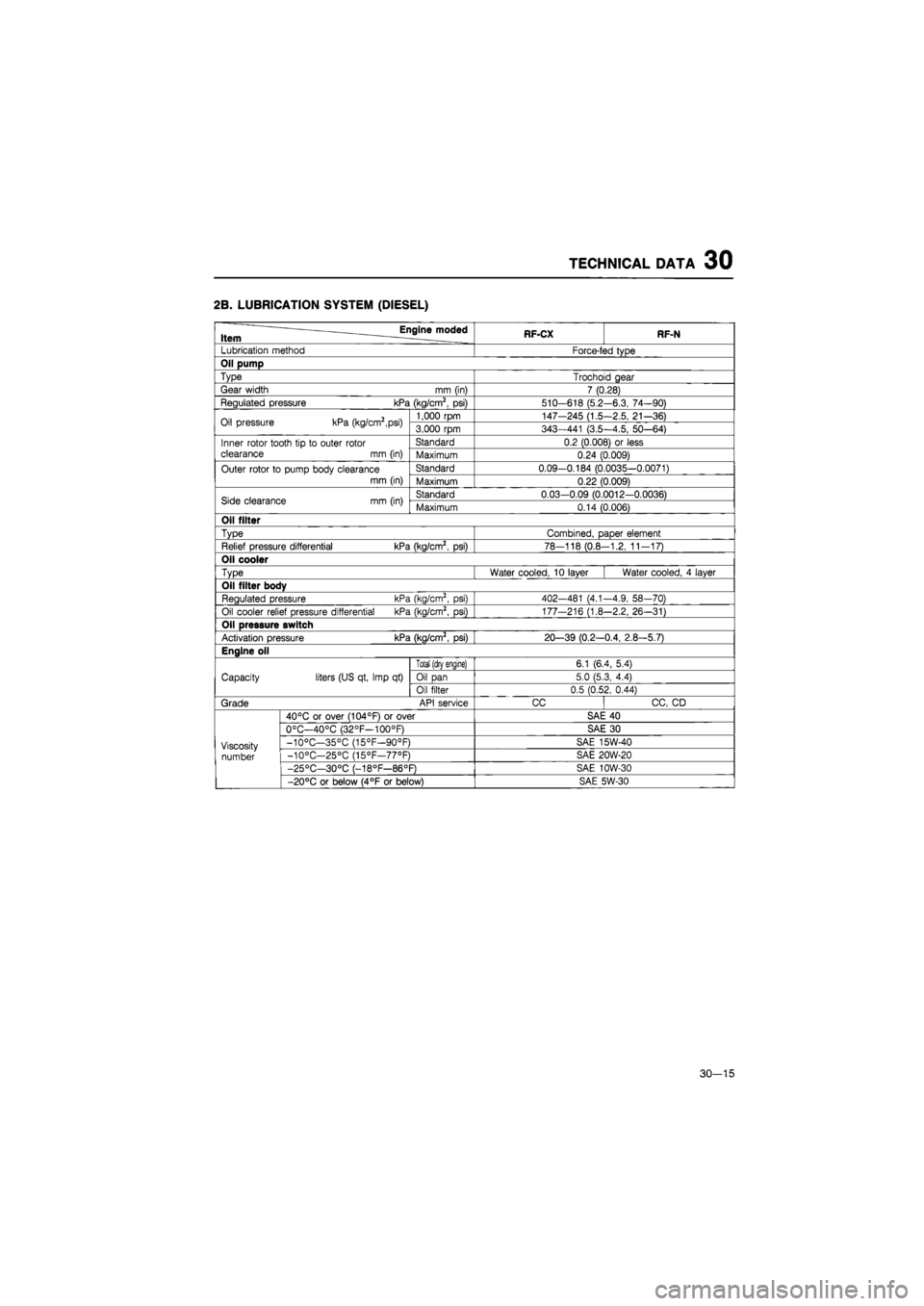
TECHNICAL DATA 30
2B. LUBRICATION SYSTEM (DIESEL)
Engine moded Item RF-CX RF-N
Lubrication method Force-fed type
Oil pump
Type Trochoid gear
Gear width
mm
(in) 7 (0.28)
Regulated pressure kPa (kg/cm2,
psi)
510-618 (5.2-6.3, 74-90)
Oil pressure kPa (kg/cm2,psi) 1,000 rpm 147-245 (1.5-2.5, 21-36) Oil pressure kPa (kg/cm2,psi) 3,000 rpm 343—441 (3.5—4.5, 50—64)
Inner rotor tooth
tip to
outer rotor clearance
mm
(in)
Standard 0.2 (0.008)
or
less Inner rotor tooth
tip to
outer rotor clearance
mm
(in) Maximum 0.24 (0.009)
Outer rotor
to
pump body clearance
mm (in)
Standard 0.09-0.184 (0.0035-0.0071) Outer rotor
to
pump body clearance
mm (in) Maximum 0.22 (0.009)
Side clearance
mm
(in) Standard 0.03-0.09 (0.0012-0.0036) Side clearance
mm
(in) Maximum 0.14 (0.006)
Oil filter
Type Combined, paper element
Relief pressure differential kPa (kg/cm2,
psi)
78-118 (0.8-1.2, 11-17)
Oil cooler
Type Water cooled,
10
layer Water cooled,
4
layer
Oil filter body
Regulated pressure kPa (kg/cm2,
psi)
402-481 (4.1-4.9, 58—70)
Oil cooler relief pressure differential kPa (kg/cm2,
psi)
177-216 (1.8-2.2, 26-31)
Oil pressure switch
Activation pressure kPa (kg/cm2,
psi)
20-39 (0.2—0.4, 2.8-5.7)
Engine oil
Capacity liters (US qt, Imp
qt)
Total (drv enaine) 6.1 (6.4, 5.4)
Capacity liters (US qt, Imp
qt)
Oil pan 5.0 (5.3, 4.4) Capacity liters (US qt, Imp
qt)
Oil filter 0.5 (0.52, 0.44)
Grade API service CC CC,
CD
Viscosity number
40°C
or
over (104°F)
or
over SAE
40
Viscosity number
0°C—40°C (32°F—100°F) SAE
30
Viscosity number
-10°C—35°C (15°F—90°F) SAE 15W-40 Viscosity number -10°C—25°C (15°F—77°F) SAE 20W-20 Viscosity number
-25°C—30°C (-18°F—86°F) SAE 10W-30
Viscosity number
-20°C
or
below (4°F
or
below) SAE 5W-30
30—15