Page 25 of 56
Downloaded from www.Manualslib.com manuals search engine AIR VENTS
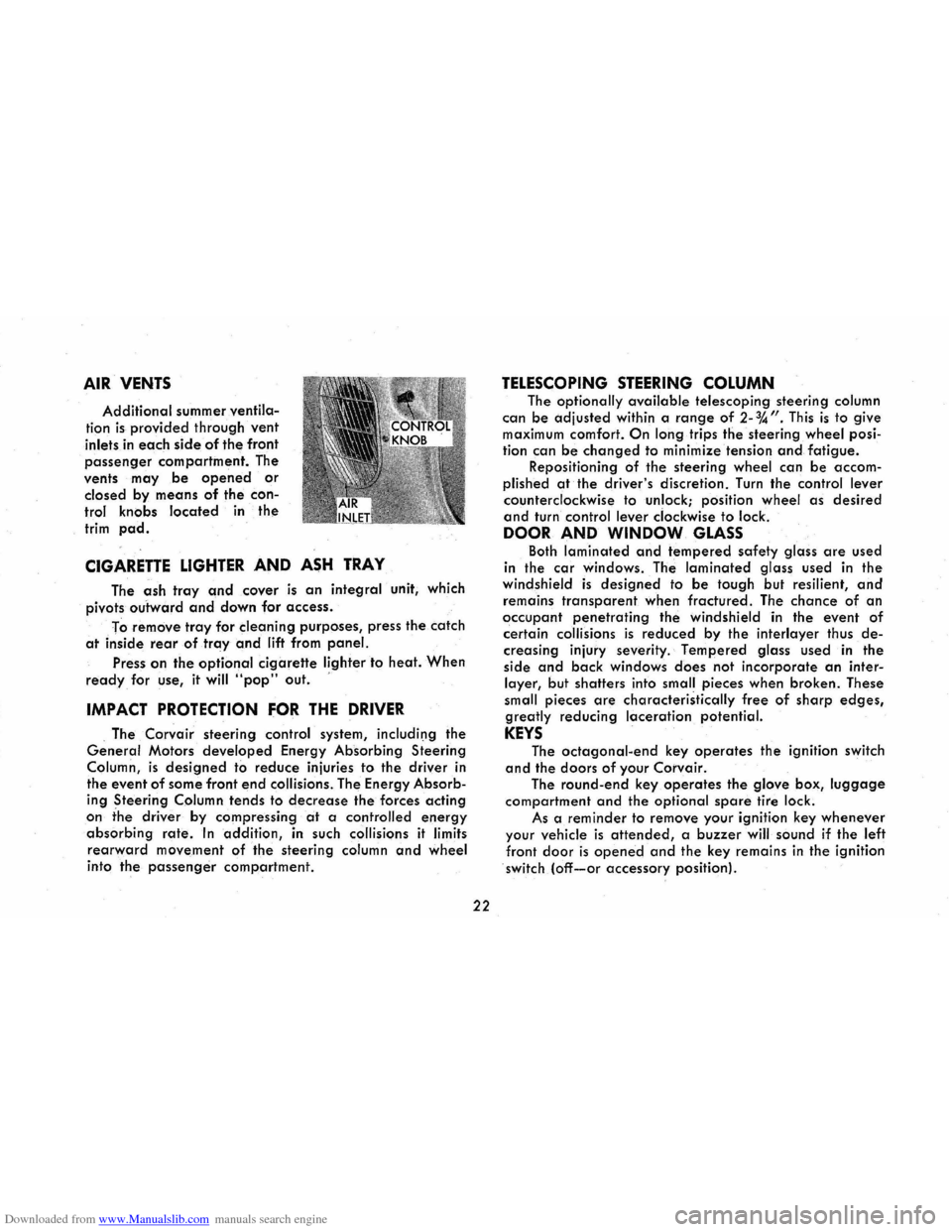
Additional summer ventila
tion is provided through vent
inlets in each side of the front
passenger compartment. The
vents
may be opened or
closed by means of the con
trol knobs located in the
trim pad.
CIGARETTE LIGHTER AND ASH TRAY
The ash tray and cover is an integral unit, which
pivots
outward and down for access.
To
remove tray for cleaning purposes, press the catch
at inside rear of tray and lift from panel.
Press on the optional cigarette lighter to heat. When
ready for use, it will "pop" out. '
IMPACT PROTECTION FOR THE DRIVER
. The Corvair steering control system, includil)g the
General Motors developed Energy Absorbing Steering
Column,
is designed to reduce injuries to the driver in
the event
of some front end collisions. The Energy Absorb
ing Steering Column tends to decrease the forces acting
on the driver by compressing at a controlled energy
absorbing rate. In addition, in such collisions it limits
rearward movement of the steering column and wheel
into the passenger compartment.
22
TELESCOPING STEERING COLUMN
The optionally available telescoping steering column
can be adjusted
within a range of 2-%". This is to give maximum comfort. On long trips the steering wheel posi
tion can
be changed to minimize tension and fatigue. Repositioning of the steering wheel can be accom
plished
at the driver's discretion. Turn the control lever
counterclockwise to unlock; position wheel as desired
and turn control lever clockwise to lock.
DOOR AND WINDOW GLASS
Both laminated and tempered safety glass are used
in the
car windows. The laminated glass used in the windshield is designed to be tough but resilient, and
remains transparent when fractured. The chance of an
occupant penetrating the windshield in the event of
certain collisions is reduced by the interlayer thus de
creasing injury severity. Tempered glass used in the
side
and back windows does not incorporate an inter
layer, but shatters into small pieces when broken. These
small pieces
are characteristically free of sharp edges,
greatly reducing laceration potential.
KEYS
The octagonal-end key operates the ignition switch
and the doors of your Corvair.
The round-end key operates the glove box, luggage
compartment and the optional spare tire lock.
As a
reminder to remove your ignition key whenever
your vehicle is attended, a buzzer will sound if the left
front door is opened and the key remains in the ignition
switch (off-or accessory position).
Page 26 of 56
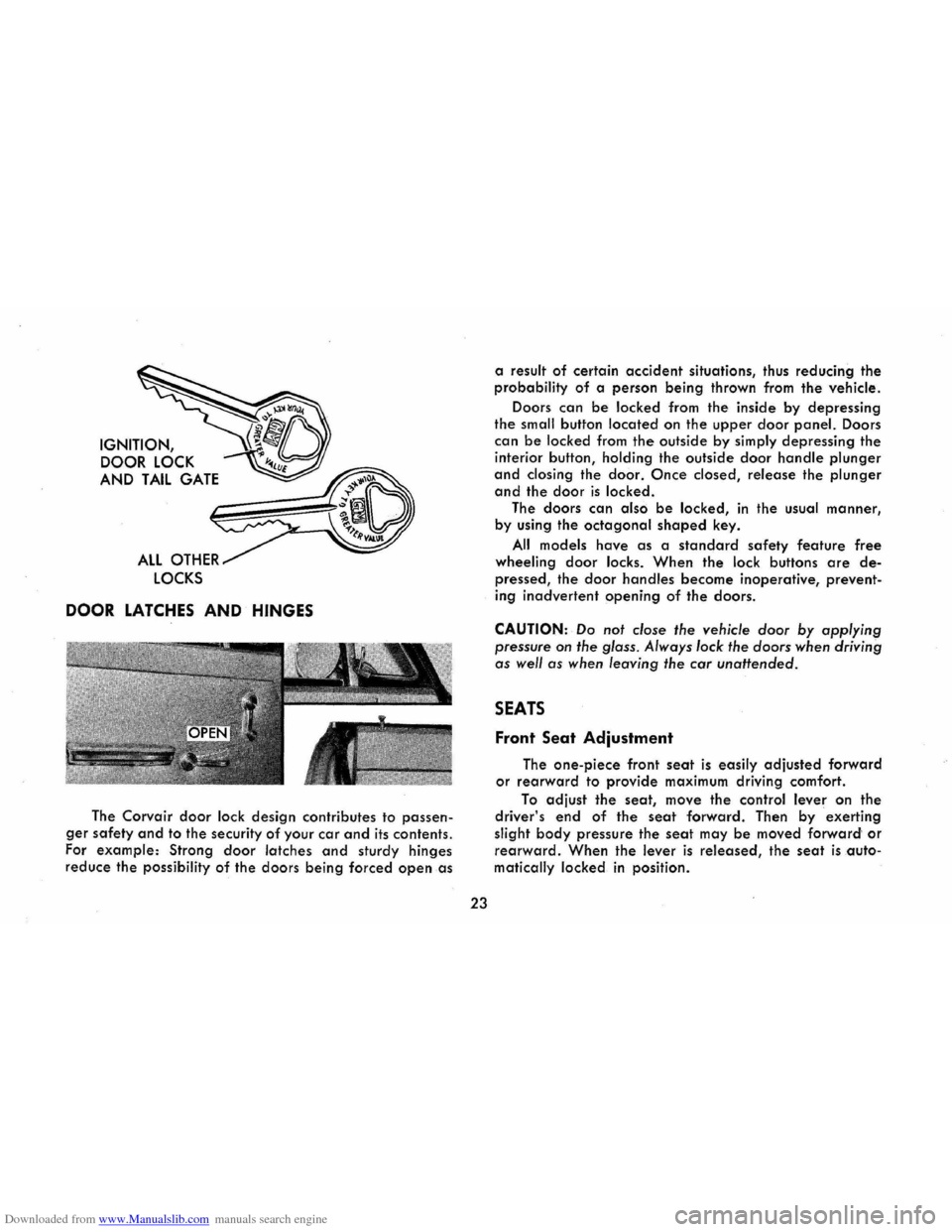
Downloaded from www.Manualslib.com manuals search engine IGNITION, DOOR
LOCK
AND TAIL GATE
ALL OTHER
LOCKS
DOOR LATCHES AND HINGES
The Corvair door lock design contributes to passen
ger safety and to the security of your car and its contents.
For
example: Strong door latches and sturdy hinges
reduce the possibility of the doors being forced open as
23
a result of certain accident situations, thus reducing the
probability
of a person being thrown from the vehicle.
Doors
can be locked from the inside by depressing
the small button located on the upper door panel. Doors
can be locked from the outside by simply depressing the
interior button, holding the outside door handle plunger
and closing the door. Once closed, release the plunger
and the door is locked.
The doors
can also be locked, in the usual manner,
by using
the octagonal shaped key.
All models have as a standard safety feature free
wheeling door locks. When the lock buttons are de
pressed, the door handles become inoperative, prevent
ing
inadvertent opening of the doors.
CAUTION: Do not close the vehicle door by applying
pressure
on the glass. Always lock the doors when driving
as well as when leaving the car unattended.
SEATS
Front Seat Adjustment
The one-piece front seat is easily adjusted forward
or rearward to provide maximum driving comfort.
To adjust the seat, move the control lever on the
driver's end of the seat forward. Then by exerting
slight
body pressure the seat may be moved forward' or
rearward. When the lever is released, the seat is auto
matically locked
in position.
Page 27 of 56
Downloaded from www.Manualslib.com manuals search engine The bucket seats are adjusted in exactly the same
manner. The seat control lever
for each seat is located
beneath the outer edge of the seat (toward the door).
Underneath the seat trim are strong steel seat struc
tures,
anchored firmly to the body. The seats and
anchorages are strong enough to prevent deformation
during low-speed impacts, but are designed in such a way that they absorb some energy by yielding to a de
gree during certain more severe higher-speed impacts.
Seat Back Lock
Folding seat backs are equipped with seH-latching
mechanisms
and release controls designed for the con
venience of entering and exiting passengers.
The release
knob is located at the lower rear of
each backrest nearest the door. lift the knob upward,
then push the seatback forward. The lock will latch
when the
seatback returns to its upright position.
OCCUPANT RESTRAINT BELTS
Suitable occupant restraints are available on all 1968
Corvairs. Worn properly, lap and shoulder belts reduce
the chances
of death or serious injury in the event of cert.ain types of accidents. Get into the habit of using
these restraints,
and using them properly, every single
time you
enter your car. Insist that your passengers use
them,
too. * By using them correctly, you give the belts
a chance
to help prevent injuries and perhaps even
save a
life.
·Shoulder belts should not be worn by persons less thon approximately 55 inches in height.
24
Lap Belts
Lap belts provide added security and comfort for
you and your passengers . Lap belts are standard equip
ment for all seating positions on all models. Proper use
and care of these belts will assure continuance of this
security.
After the front seat has been adjusted to the satis
faction of the driver, grasp the buckle end and the flat
metal "eye" end of your individual belt assembly and
position the belt across the pelvic area as LOW ON THE
PELVIS AS POSSIBLE. Insert the metal eye into the open
end of the buckle until an audible snap is heard. Make
sure the connection is secure and adjust the belt to a
SNUG FIT by pulling on the end of the belt protruding
from the buckle . The snug and low positions are essential
in
order that the force exerted by the lap belt in a colli
sion may be spread over the strong pelvic bone and not
across the soft abdominal area. For retractor equipped
belts, pull retractor half of the belts to a solid stop to
make sure that the belt webbing is completely unwound
from the retractor drum, then connect the belt and make
the necessary adjustments
at the buckle for proper fit. To
release the belts, simply depress the release
tab or button
located on the center of the buckle.
CAUTION: Never use the same belt for more than one
person at a time. Be sure to avoid: (aJ wearing a lap belt
loosely or with slack
in the system; and (bJ wearing the
belt with the
webbing wound around the retractor drum.
Page 28 of 56
Downloaded from www.Manualslib.com manuals search engine Shoulder Belts
All models are equipped with shoulder belt anchors
built into the vehicle for all forward-facing outboard
passengers. All models except convertible coupes are
also equipped with shoulder belts for the driver and
the right front seat passenger as standard equipment.
Shoulder belts are optional for all other forward-facing
outboard passengers, including all outboard occupants
in convertibles.
Shoulder belts should
be worn only in conjunction
with
lap belts and are fastened with individual buckles,
and released in the same manner as the lap belts.
A shoulder belt worn without a lap belt could be
extremely hazardous to the wearer in case of an acci
dent.
Shoulder belts should be tightened only to the
point where controls and switches can be easily reached
without restriction from the belt. The use of shoulder
belts
is not recommended for persons less than approx
imately 55 inches in height, because the belt would
cross over the body at a height too near the throat, and
thereby substantially increase the possibility of throat
injury in an accident. Shoulder belts not in use must be
anchored by inserting buckle into retainer to prevent
buckle end from swinging around in an impact.
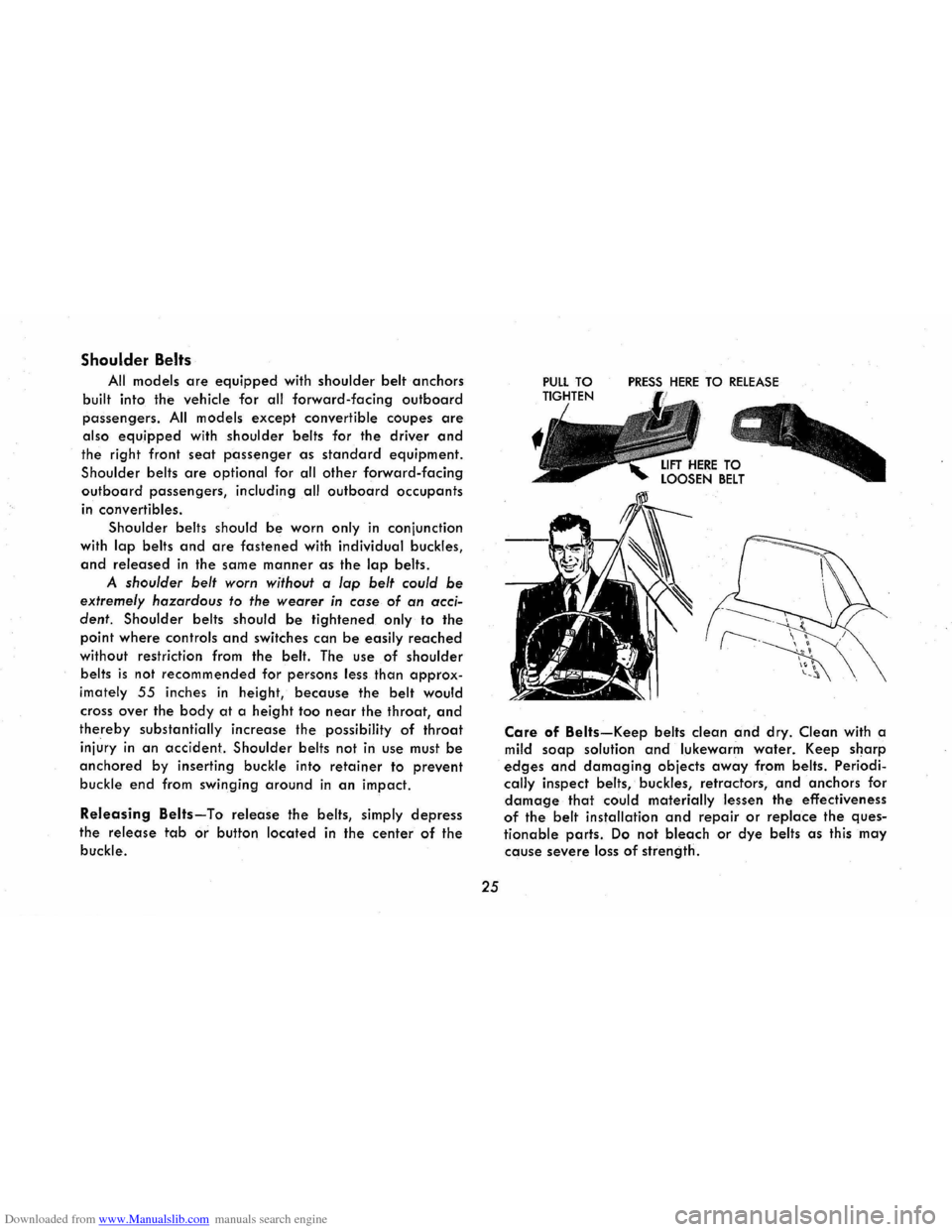
Releasing Belts-To release the belts, simply depress
the release tab or button located in the center of the
buckle.
25
PRESS HERE TO RELEASE
Care of Belts-Keep belts clean and dry. Clean with a
mild soap solution and lukewarm water. Keep sharp
edges and damaging objects away from belts. Periodi
cally inspect belts, buckles, retractors, and anchors for
damage that could materially lessen the effectiveness
of the belt installation and repair or replace the ques
tionable parts. Do not bleach or dye belts as this may
cause severe loss of strength.
Page 29 of 56
Downloaded from www.Manualslib.com manuals search engine HEAD RESTRAINTS
Head restraints are available for the driver and front
right
passenger as factory installed options. They can be
adjusted to different heights by pulling up or pushing
down by
hand. Detents provide positive head restraint
location. Head restraints should be adjusted, within
limits of travel, to contact the center of the back of head
when the head is moved straight back.
CHILD RESTRAINT
Children in automobiles should be restrained. A
restraint system
designed by General Motors specifically
for
children is available from your dealer. If children
are traveling in a vehicle not equipped with this child
restraint system, the following precautions should be
taken:
1. Children should be placed in the rear seat. Never
allow a child to stand or kneel on the rear seat as
this raises his center of gravity.
2. Infants unable to sit up by themselves should be
restrained by placing them in a covered, padded
bassinet which is placed crossways on th·e rear
REARVIEW MIRRORS
Inside and outside rearview mirrors have been care
fully designed and located to give the driver a clear and
reasonably unobstructed view of the rear of the car. It
is not intended that these mirrors be used for operation
in reverse gear, or for surveillance of conditions close
to
the back of the car. It is suggested that the driver
turn his
head and look close to the back for backing
26
seat. The bassinet should be securely restrained
with the regular vehicle seat belt. An alternative
method is to position the bassinet crossways in the
vehicle so
that it rests against the back of the front seat. ..
3. When a child is old enough to sit up by himself in
a car, he should sit on a firm cushion and use the
conventional lap belt to restrain him at the pelvis.
The cushion should be as firm as practical and
enable the child to look horizontally out of the car
windows.
4. The use
of the cushion should be discontinued as
soon as the child is old enough to see out of the
car windows without it.
5. Do not use shoulder belts on children shorter than approximately 55 inches in height.
6. If a child must stand, he should stand on the floor
directly behind the front seat. This will minimize
the possibility of his being thrown from the rear
compartment during a sudden stop. However, this
method
should be used only if more complete re
straint cannot be used.
operations, and survey the area to the immediate rear
of the car prior to entering the car for the backing
operation. The outside mirror and mounting is free of
sharp points or edges that could contribute to injury of
pedestrians. The inside rearview mirror incorporates provisions
for
vertical as well as tilt adjustments to provide better
positioning for the driver. The mounting is designed to
Page 30 of 56
Downloaded from www.Manualslib.com manuals search engine deflect or collapse under certain impacts. The soft vinyl
cover over the mirror support base further protects the occupants.
CAUTION: It is important that the driver check the
mirrors
for proper positioning, and that he make frequent
use of the mirrors to be constantly aware of the rearward
aspect
of his total driving situation.
The windshield wiper arms and blades, inside wind
shield moldings,
horn and steering wheel ornamentation,
inside rearview mirror frame and mounting bracket
incorporate low-gloss finishes. This reduces annoying
glare in the driver's forward field of view and provides
a
safer, more comfortable driving environment.
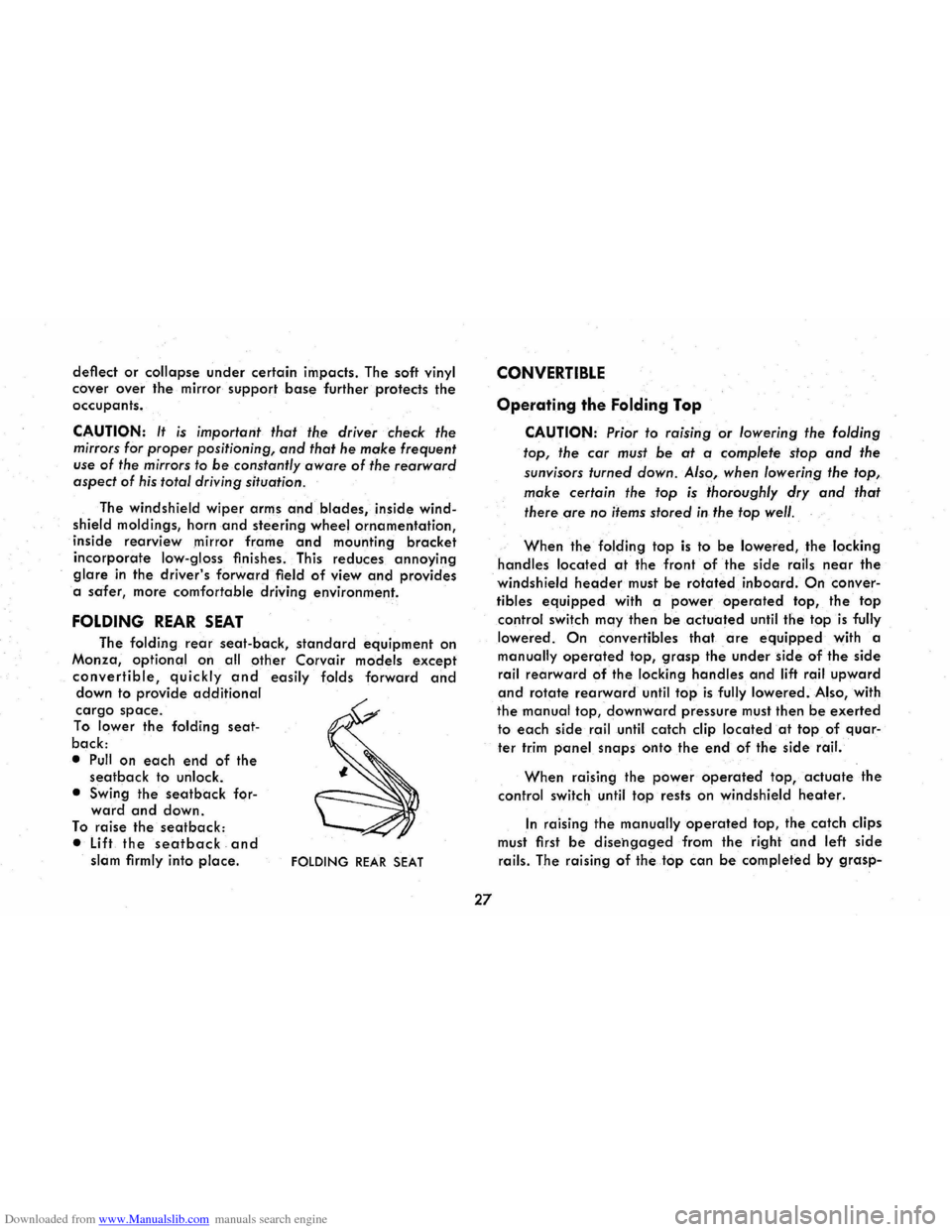
FOLDING REAR SEAT
The folding rear seat-back, standard equipment on
Monza,
optional on all other Corvair models except
convertible, quickly and easily folds forward and down to provide additional
cargo space.
To lower the folding seat
back:
• Pull on each end of the seatback to unlock.
• Swing
the seatback forward and down.
To raise the seatback:
• Lift the seat back and slam firmly into place. FOLDING REAR SEAT
27
CONVERTIBLE
Operating the Folding Top
CAUTION: Prior to raising or lowering the folding
top, the
car must be at a complete stop and the
sunvisors turned down. Also, when lowering the top,
make certain the top is thoroughly dry and that
there are
no items stored in the top well.
When the folding top is to be lowered, the locking
handles located at the front of the side rails near the
windshield header must be rotated inboard. On conver
tibles
equipped with a power operated top, the top
control switch may then be actuated until the top is fully
lowered.
On convertibles that are equipped with a
manually operated top, grasp the under side of the side
rail rearward of the locking handles and lift rail upward
and rotate rearward until top is fully lowered. Also, with
the manual top, downward pressure must then be exerted
to each side rail until catch clip located at top of quar
ter trim panel snaps onto the e.nd of the side rail.
When raising the power operated top, actuate the
control switch until top rests on windshield heater.
In raising the manually operated top, the catch clips
must first
be disehgaged from the right and left side
rails. The raising of the top can be completed by grasp-
Page 31 of 56
Downloaded from www.Manualslib.com manuals search engine ing the front corner of the top and rotating the top for
ward until top rests on windshield header.
The locking handles are then rotated outboard
which engages the lock hooks to the striker assembly
located on the windshield header.
Installing the Top Boot
Remove top boot from its protective case, which is normally stored in the luggage compartment.
Grasping forward
end of the boot, slide the welt on
the
boot into the retainer located on the top of the rear
seat back panel. The boot can then be placed over the
lowered top and the metal snap fasteners on the boot
can be snapped onto the studs on the belt molding and quarter trim. Any wrinkles that may exist may be re
lieved
by sliding the forward portion of the boot to the
right or left in the retainer.
Care of Folding Top and Rear Window
The folding top should never be subiected to vola
tile cleaners or household bleaches. Frequent washing
with
neutral soap suds, lukewarm water and soft bristle
brush
is normally all that is necessary to maintain the
"Factory Fresh" look. In the event heavy soilage or
stubborn stains are encountered, a mild foaming cleanser, lukewarm water, and a soft bristle brush may be
used. If desired, the top may be supported from the
underside during the cleaning
operation. Regardless
which cleaning method is used, a generous amount of
28
rinse water is to be used as any soap that runs down
on the
body finish and allowed to dry, may cause streaks.
After cleaning,
always be sure the top is thoroughly dry before it is lowered.
The pliable plastic window, due to its texture, is sus
ceptible
to scratches and abrasions. As a result, the top
should not be lowered when the rear window is dirty.
When cleaning the
rear window, do not use a dry
cloth or volatile cleaning agents. A soft cloth moistened
with
water should be used to remove superficial dust.
When completely washing the rear window, cold or
luke warm water and a mild neutral soap suds may be
used along with a generous amount of rinse water. In
addition, the rear window can be cleaned with G.M. Plastic Cleaner available at your dealer.
A scraper should never be used for removing snow
or ice from the rear window. In an emergency, warm
water may be cautiously used.
NOTE: DO NOT paste any stickers or masking tape
on rear window as damage will result.
ENGINE COMPARTMENT
• To open: Push up the lid release while lifting the lid.
Lift the lid all the way up, then release.
• To close: Lift up on lid, unlock the support arm catch
lock, then lower the lid. Drop the lid the last six
Page 32 of 56
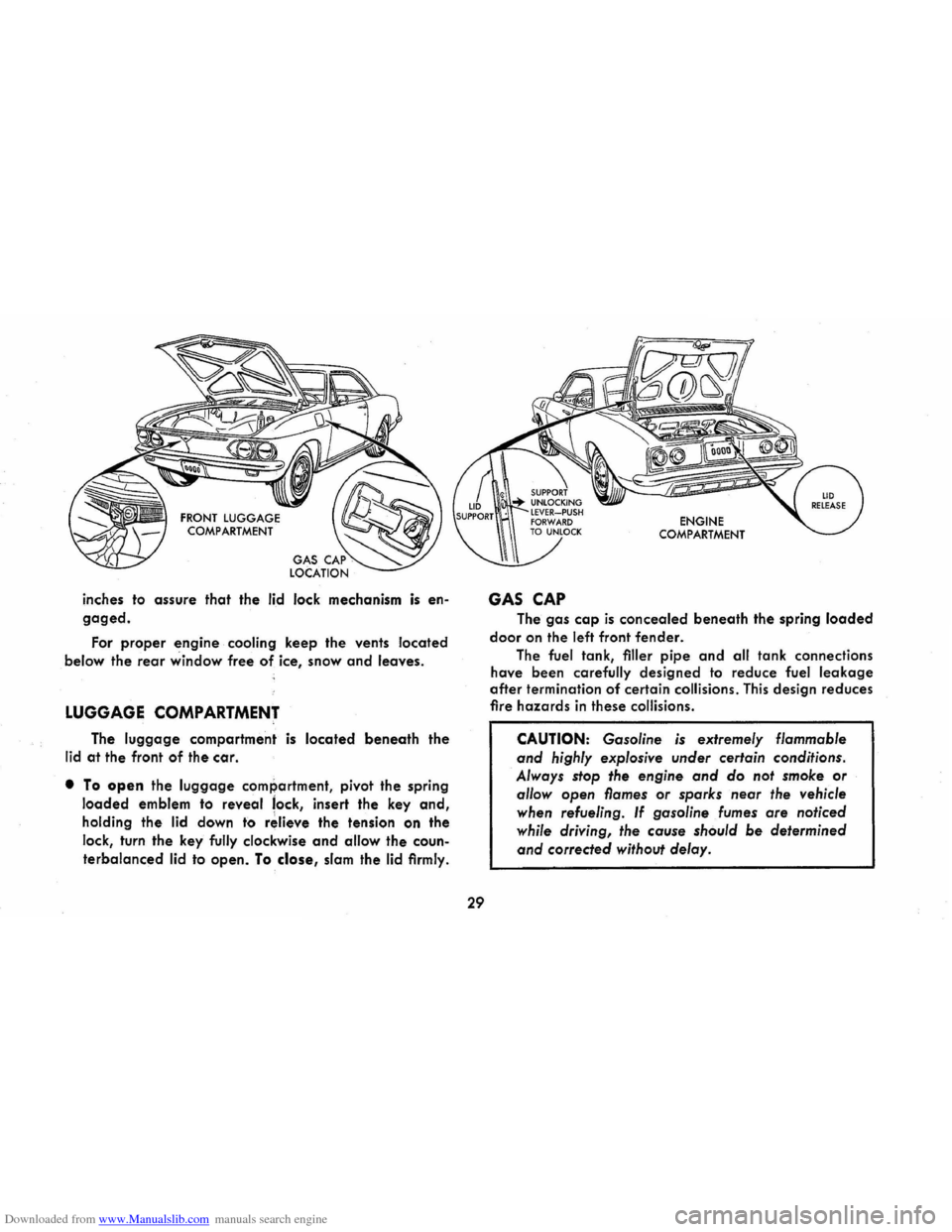
Downloaded from www.Manualslib.com manuals search engine inches to assure that the lid lock mechanism is en
gaged.
For proper engine cooling keep the vents located
below the
rear window free of ice, snow and leaves.
LUGGAGE COMPARTMENT
The luggage compartment is located beneath the
lid at the front of the car.
• To open the luggage compartment, pivot the spring
loaded emblem to reveal lock, insert the key and,
holding the lid down to r~lieve the tension on the
lock, turn the key fully clockwise
and allow the coun
terbalanced lid to open. To close, slam the lid firmly.
29
GAS CAP
ENGINE COMPARTMENT
The gas cap is concealed beneath the spring loaded
door on the left front fender.
The fuel tank, filler pipe and all tank connections
have been carefully designed to reduce fuel
leakage
after termination of certain collisions. This design reduces
fire hazards in these collisions.
CAUTION: Gasoline is extremely flammable
and highly explosive under certain conditions.
Always stop the engine
and do not smoke or
allow open flames or sparks near the vehicle
when refueling.
If gasoline fumes are noticed
while driving,
the cause should be determined
and corrected without delay.


