1986 CHEVROLET CORVAIR seats
[x] Cancel search: seatsPage 5 of 56
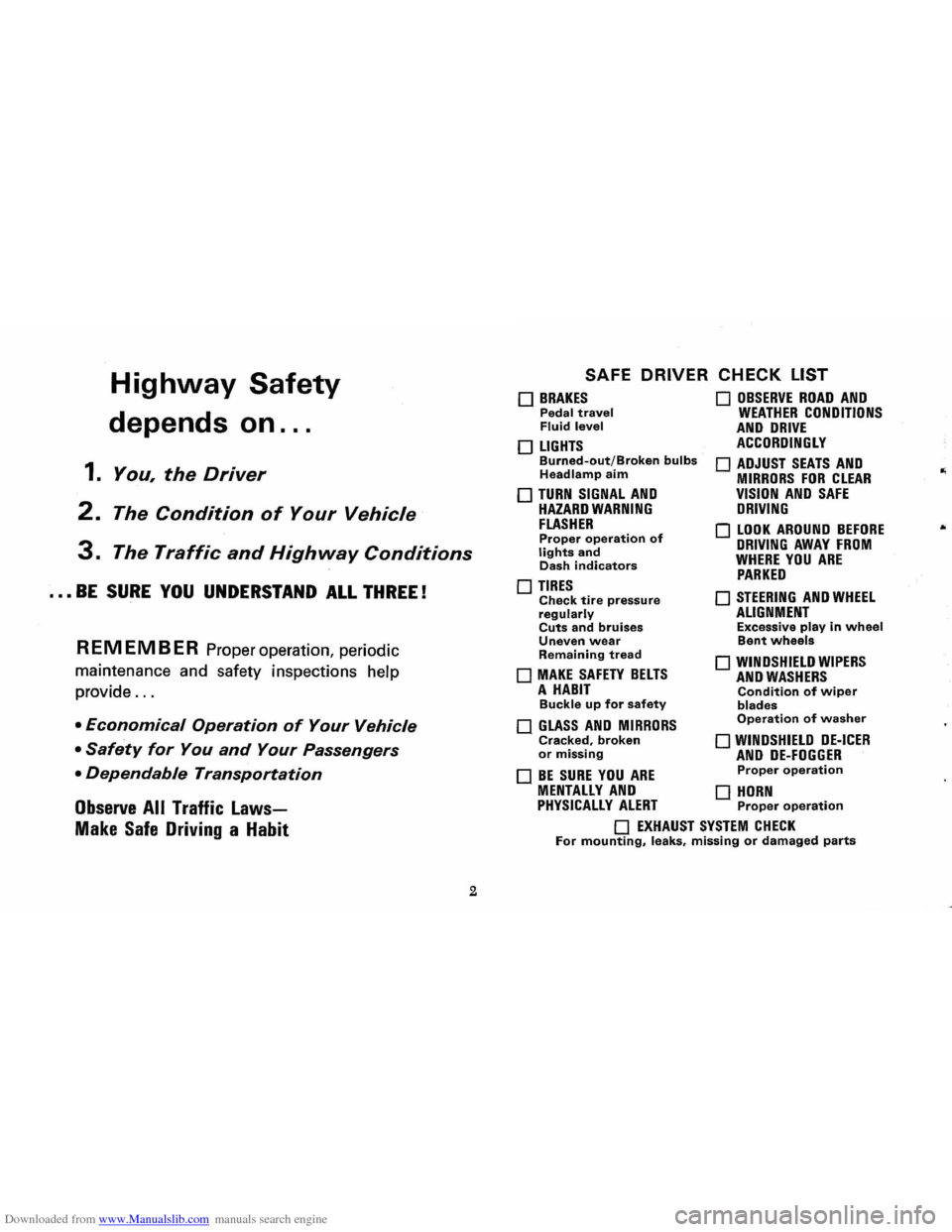
Downloaded from www.Manualslib.com manuals search engine Highway Safety
depends on ...
1. You, the Driver
2. The Condition of Your Vehicle
3. The Traffic and Highway Conditions
••• BE SURE YOU UNDERSTAND ALL THREE!
REMEMBER Proper operation, periodic
maintenance and safety inspections help
provide
...
• Economical Operation of Your Vehicle
• Safety for You and Your Passengers
• Dependable Transportation
Observe All Traffic Laws
Make Safe Driving a Habit
2
SAFE DRIVER CHECK LIST
o BRAKES Pedal travel Fluid level
o LIGHTS Burned-out/Broken bulbs Headlamp aim
o TURN SIGNAL AND HAZARD WARNING FLASHER Proper operation of lights and Dash indicators
o TIRES Check tire pressure regularly Cuts and bruises Uneven wear Remaining tread
o MAKE SAFETY BELTS A HABIT Buckle up for safety
o GLASS AND MIRRORS Cracked, broken or missing
o BE SURE YOU ARE
o OBSERVE ROAD AND WEATHER CONDITIONS AND DRIVE ACCORDINGLY
o ADJUST SEATS AND MIRRORS FOR CLEAR VISION AND SAFE DRIVING
o LOOK AROUND BEFORE DRIVING AWAY FROM WHERE YOU ARE PARKED
o STEERING AND WHEEL ALIGNMENT Excessive play in wheel Bent wheels
o WINDSHIELD WIPERS AND WASHERS Condition of wiper blades Operation of washer
o WINDSHIELD DE-ICER AND DE-FOGGER Proper operation
MENTALLY AND 0 HORN PHYSICALLY ALERT Proper operation
o EXHAUST SYSTEM CHECK For mounting, leaks, missing or damaged parts
Page 8 of 56
Downloaded from www.Manualslib.com manuals search engine STANDARD NO. III Rearview Mirrors
Purpose and Scope. This standard specifies requirements for
rearview mirrors to provide the driver with a clear and rea
sonably unobstmcted view to the rear.
STANDARD NO. 203 Impact Protection for the Driver From the Steering Control System Purpose and Scope. This standard specifies requirements for
steering control systems that will minimize chest, neck, and facial injuries to the driver as a result of impact.
STANDARD NO. 204
Steering Control Rearward Displacement
Purpose and Scope. This standard specifies requirements
limiting the rearward displacement of the steering control
into the passenger compartment to reduce the likelihood of chest, neck, or head injury.
STANDARD NO. 205 Glazing Materials
Purpose and Scope. This standard specifies requirements
for glazing materials to reduce lacerations to the face, scalp, and neck, and to minimize the possibility of occupants being
thrown through the vehicle windows in collisions.
STANDARD NO. 206 Door Latches and Door Hinge Systems Purpose and Scope. This standard specifies load require
m ents for door latches and door hinge systems to minimize
the probability of occupants being thrown from the vehicle
in a collision.
STANDARD NO. 207 Anchorage of Seats Purpose and Scope. This standard establishes requirements
for seats, their attachment assemblies, and their installation
to minimize the possibility of failure by forces acting on the seat as a result of vehicle impact.
5
STANDARD NO. 208
Seat Belt Installations
Purpose and Scope. This standard establishes requirements
for seat belt installations.
STANDARD NO. 2090
Seat Belt Assemblies
Purpose and Scope. This standard specifies requirements
for seat belt assemblies.
STANDARD NO. 210
S ea t Belt Assembly Anchorages
Purpose and Scope. This standard specifies the requirements
for seat belt assembly anchorages to ensure proper location
for effective occupant restraint and reduce the likelihood
of failure in collisions.
STANDARD NO. 211
Wheel Nuts, Wheel Discs, and Hub Caps
Purpose and Scope. This standard precludes the use of wheel nuts, wheel discs, and hub caps that constitute a hazard to
pedestrians and cyclists .
STANDARD NO. 301 Fuel Tanks, Fuel Tank Filler Pipes, and Fuel Tank Con-
nections
Purpose
and Scope. This standard specifies requirements
for the integrity and security of fuel tanks, fuel tank filler
pipes, and fuel tank connections to minimize fire hazard as
a result of collision.
PUBLIC LAW 87·637 (1962) * An Act to provide that hydraulic brake fluid sold or shipped in commerce for use in motor vehicles shall meet cer
tain specifications prescribed by the Secretary of Commerce. The requirements of this law were issued as standards when the National Traffic and Motor Vehicle Safety Act of 1966
was enacted.
"The Sea t (Lap) Belt and Brak e fluid standards are applicable
to all 1968 models of affected vehicles.
Page 26 of 56
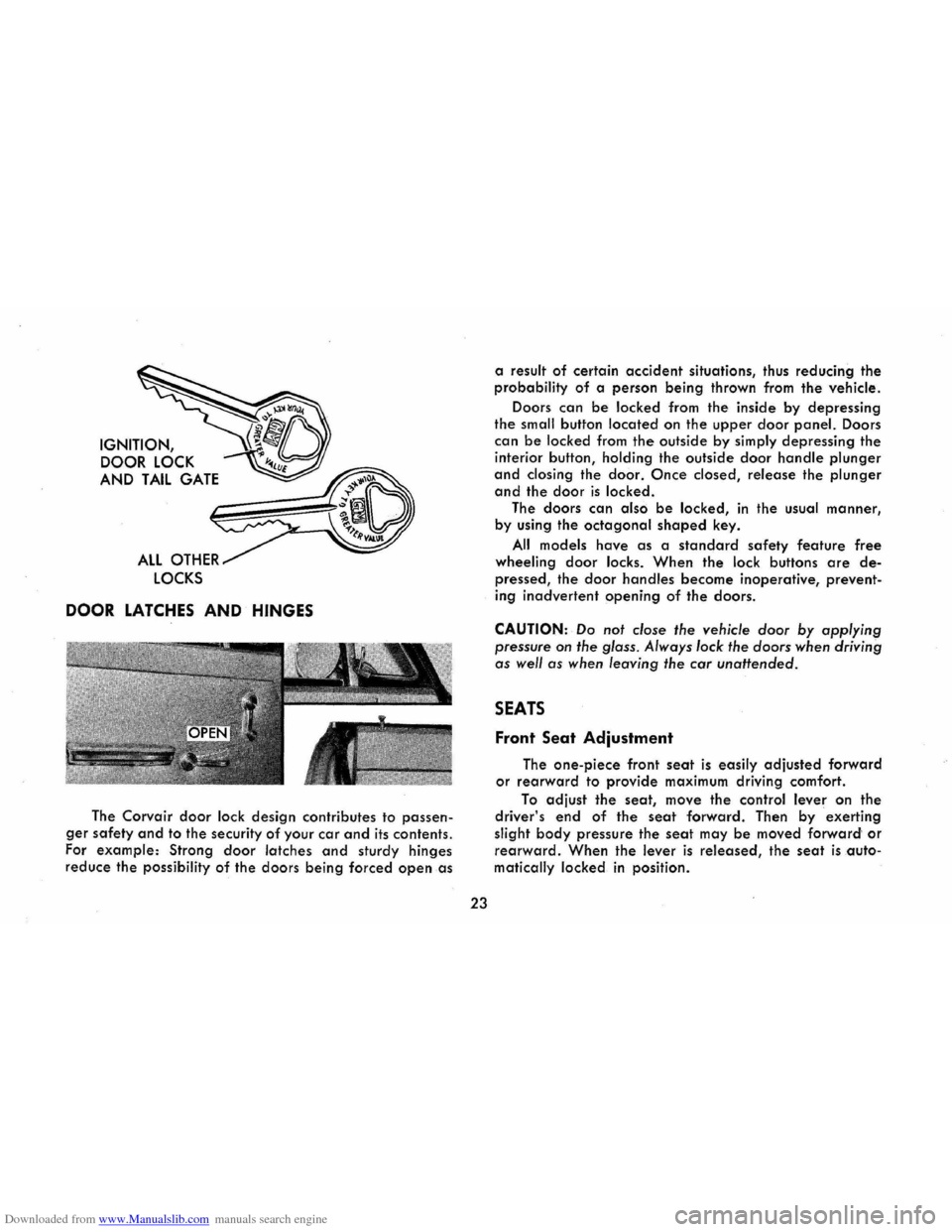
Downloaded from www.Manualslib.com manuals search engine IGNITION, DOOR
LOCK
AND TAIL GATE
ALL OTHER
LOCKS
DOOR LATCHES AND HINGES
The Corvair door lock design contributes to passen
ger safety and to the security of your car and its contents.
For
example: Strong door latches and sturdy hinges
reduce the possibility of the doors being forced open as
23
a result of certain accident situations, thus reducing the
probability
of a person being thrown from the vehicle.
Doors
can be locked from the inside by depressing
the small button located on the upper door panel. Doors
can be locked from the outside by simply depressing the
interior button, holding the outside door handle plunger
and closing the door. Once closed, release the plunger
and the door is locked.
The doors
can also be locked, in the usual manner,
by using
the octagonal shaped key.
All models have as a standard safety feature free
wheeling door locks. When the lock buttons are de
pressed, the door handles become inoperative, prevent
ing
inadvertent opening of the doors.
CAUTION: Do not close the vehicle door by applying
pressure
on the glass. Always lock the doors when driving
as well as when leaving the car unattended.
SEATS
Front Seat Adjustment
The one-piece front seat is easily adjusted forward
or rearward to provide maximum driving comfort.
To adjust the seat, move the control lever on the
driver's end of the seat forward. Then by exerting
slight
body pressure the seat may be moved forward' or
rearward. When the lever is released, the seat is auto
matically locked
in position.
Page 27 of 56
Downloaded from www.Manualslib.com manuals search engine The bucket seats are adjusted in exactly the same
manner. The seat control lever
for each seat is located
beneath the outer edge of the seat (toward the door).
Underneath the seat trim are strong steel seat struc
tures,
anchored firmly to the body. The seats and
anchorages are strong enough to prevent deformation
during low-speed impacts, but are designed in such a way that they absorb some energy by yielding to a de
gree during certain more severe higher-speed impacts.
Seat Back Lock
Folding seat backs are equipped with seH-latching
mechanisms
and release controls designed for the con
venience of entering and exiting passengers.
The release
knob is located at the lower rear of
each backrest nearest the door. lift the knob upward,
then push the seatback forward. The lock will latch
when the
seatback returns to its upright position.
OCCUPANT RESTRAINT BELTS
Suitable occupant restraints are available on all 1968
Corvairs. Worn properly, lap and shoulder belts reduce
the chances
of death or serious injury in the event of cert.ain types of accidents. Get into the habit of using
these restraints,
and using them properly, every single
time you
enter your car. Insist that your passengers use
them,
too. * By using them correctly, you give the belts
a chance
to help prevent injuries and perhaps even
save a
life.
·Shoulder belts should not be worn by persons less thon approximately 55 inches in height.
24
Lap Belts
Lap belts provide added security and comfort for
you and your passengers . Lap belts are standard equip
ment for all seating positions on all models. Proper use
and care of these belts will assure continuance of this
security.
After the front seat has been adjusted to the satis
faction of the driver, grasp the buckle end and the flat
metal "eye" end of your individual belt assembly and
position the belt across the pelvic area as LOW ON THE
PELVIS AS POSSIBLE. Insert the metal eye into the open
end of the buckle until an audible snap is heard. Make
sure the connection is secure and adjust the belt to a
SNUG FIT by pulling on the end of the belt protruding
from the buckle . The snug and low positions are essential
in
order that the force exerted by the lap belt in a colli
sion may be spread over the strong pelvic bone and not
across the soft abdominal area. For retractor equipped
belts, pull retractor half of the belts to a solid stop to
make sure that the belt webbing is completely unwound
from the retractor drum, then connect the belt and make
the necessary adjustments
at the buckle for proper fit. To
release the belts, simply depress the release
tab or button
located on the center of the buckle.
CAUTION: Never use the same belt for more than one
person at a time. Be sure to avoid: (aJ wearing a lap belt
loosely or with slack
in the system; and (bJ wearing the
belt with the
webbing wound around the retractor drum.
Page 55 of 56
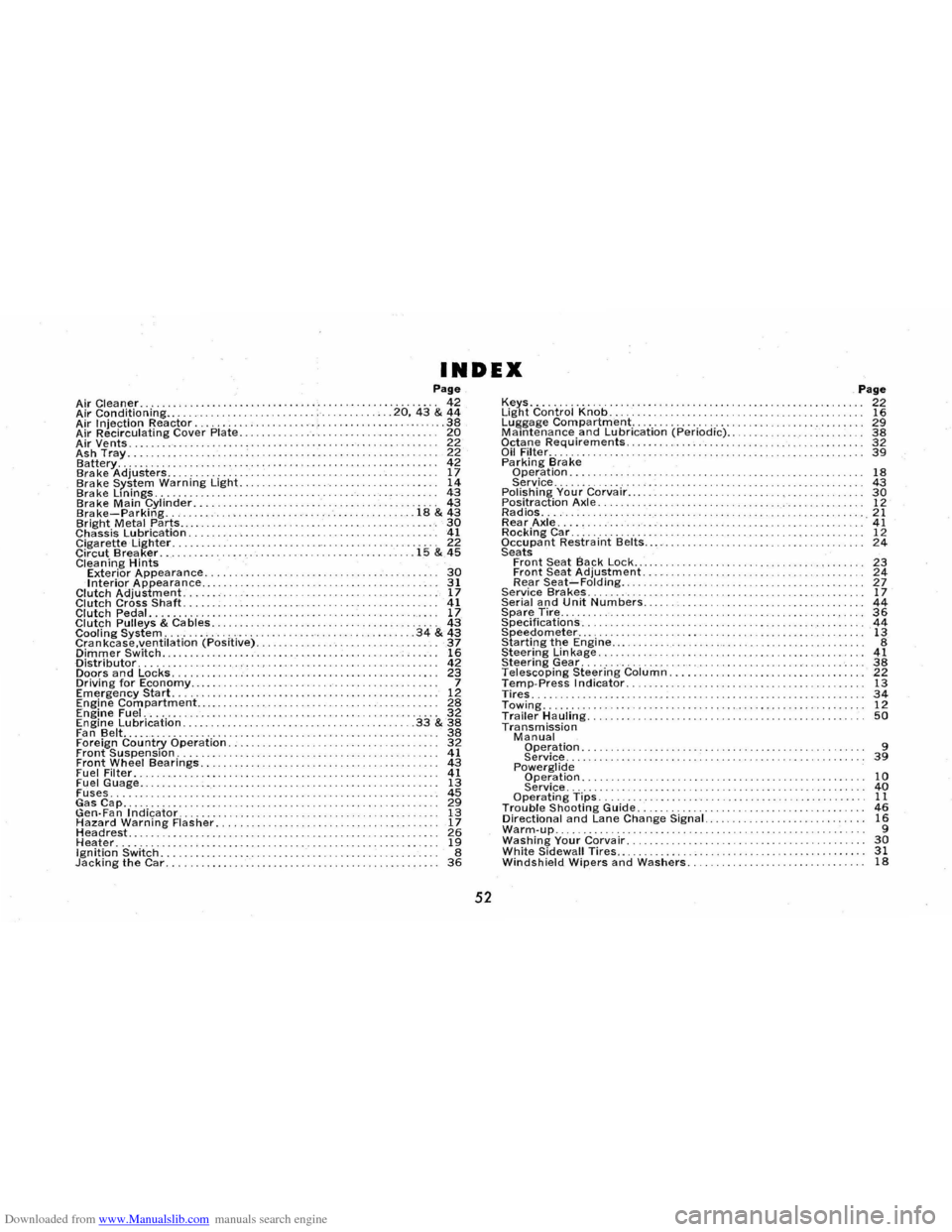
Downloaded from www.Manualslib.com manuals search engine INDEX Page Air Cleaner. . . . . . . . . .. , .. . . . . . . .. . . . . . . . . . . .......... 42 Air Conditioning.. ............ ... .... .• . . .20,43 & 44 Air Injection Reactor......... ........... . ... ... 38 Air Recirculating Cover Plate. . . . . . . . . . . .• . . . . .. . . . .. . . 20 Air Vents. . . . . . . . . . . . . . . . . . . . . . . 22 Ash Tray. ........ .. ... 22 Battery........... ............ ....•...•................. 42 Brake Adjusters...................... .. .. ... ............. 17 Brake System Warning Light. . ................. 14 Brake Lmings. . ....... ....... ........ ............... 43 Brake Main Cylinder.. ........... . ...... 43 Brake-Parking. . ............ .......... . .. 18 & 43 Bright Metal Parts..... .. ..................... '. 30 Chassis Lubrication. . . . . . . . . . . . . . 41 Cigarette Lighter. . . .. .... ... .. . . . .. .. " 22 Circut Brea ker. . . . . . ................. .. .............. 15 & 45 Cleaning Hints Exterior Appearance........ .... .... . ............ . 30 Interior Appearance.. ............... . ............. ........ 31 Clutch Adjustment......... 17 Clutch Cross Shaft. . . .. . . . . . . . ... .. . . 41 Clutch Pedal.. .. . .. .. .. .. . . .. .. . .. .. . 17 Clutch Pulleys & Cables..................... . 43 Cooling System. . . . . . . . . . . . . . . . . . ........ ....... 34 & 43 Crankcase.ventilation (Positive). 37 Dimmer Switch... .......... ..... 16 Distributor. . . . . . . 42 Doors and Locks. .. ..... .................. .• ................. 23 Driving for Economy..... ...... ...... 7 Emergency Start. . . . . . . . . . . . . . . . . . 12 Engine Compartment.... . . . . . . . . . . . . . . . . . . . .. .. . . 28 Engine Fuel. . . . . . . . . . . . . . . . . . . . . . . . . . . . . . . . . . . . . . . . . .. 32 Engine Lubrication. . . . . . . . . .. . . . .• . . . . . . . • . . . . . . .33& 38 Fan Belt........ .... ..................... ..... 38 Foreign Country Operation. .................. 32 Front Suspension. . . . . . . . . . . . . . ... . . . . . . . . . . . . . . . . . . . . . 41 Front Wheel Bearings.. . ............. .......... . 43 Fuel Filter. . . . . . . . . . . . . . . •. . . . . . . . . .. . . . . 41 Fuel Guage.. ............ 13 Fuses.. .. .. ... ...................... ..... 45 ~s~p.......... ~ Gen·Fan .Indicator........ 13 Hazard Warning Flasher. . 17 Headrest...... . . ....... ... .. ........ 26 Heater............................... ..... .. .......... 19 Ignition Switch. . . . . . . . . . . . . . . . . .. . . . . . . . . . . . . 8 Jacking the Car. . . . .. . . . . . . . . . . .. . . . . . . . . . . . . . . . . . . . . . . . . . . . . . .. 36
52
Keys............... . ......... .............. . Light Control Knob ...................... . . Luggage Compartment ................... . Maintenance and Lubrication (Periodic) .. Octane Requirements. . . . . ......... . Oil Filter .... ............ . Pa rking Bra ke Operation . ..................... . Service .......... ...... . Polishing Your Corvair... . . ... . . . . . .. . .........•. .... ........ Positraction Axle. . . ... ............... .. ...... .. .. .... . Radios. . . . .... . ........... . Rear Axle.... . . ...................................... . . Rocking Car .............. . Occupant Restraint Belts .. . . Seats Front Seat Back Lock ....... .•...... Front Seat Adjustment. Rear Seat-Folding ... Service Bra kes. . . . . . . . . .. . ......................... ... . Serial and Unit Numbers .......... .. . Spare Tire..... . .• ......... .................•.•. Specifications. . . . ................... ... .. .• ........ Speedometer ... .. ............... . Starting the Engine .... . Steering Lin kage ...... . Steering Gear ............... . Telescoping Steering Column. Temp·Press Indicator. Tires. Towing ..... Trailer Hauling. Transmission Manual Operation. ................ . ....... .. .... . Service ................... .. .. ...... .. . Powerglide Operation. Service ...... . Operating Tips ....... . Trouble Shooting Guide.......... . .............. ... . Directional and Lane Change Signal. . ....• ...•.... Warm·up... ............ . ....... .. ........... ... . Washing Your Corvair. . . ........ . White Sidewall Tires.. . . . . . . . . . . . . . . ......... .. . Windshield Wipers and Washers. . . .. .. .. .. .
Page 22 16 29 38 32 39
18 43 30 12 21 41 12 24
23 24 27 17 44 36 44 13 8 41 38 22 13 34 12 50
9 39
10 40 11 46 16 9 30 31 18