1986 CHEVROLET CORVAIR instrument panel
[x] Cancel search: instrument panelPage 6 of 56
Downloaded from www.Manualslib.com manuals search engine ..
Don't invite car theft! An unlocked car with the
key still in the ignition offers both opportunity and temptation.
Remember always to lock ignition,
lock all doors ... TAKE THE KEY!
NOTE: Your 1968 Chevrolet features as standard equipment a buzzer device which
will activate when the driver's door is opened and the key left in the switch. Heed
its
warning-let it also serve to remind you to lock all doors.
The identification number
of your vehicle is located on the instrument panel and is
visible from the outside. It is also stamped prominently on the engine and transmission.
These precautions have been taken
for your protection to aid the apprehension of thieves
and the recovery
of stolen vehicles, engines and transmissions and to serve as a deterrent
to
theft itself.
3
Page 16 of 56
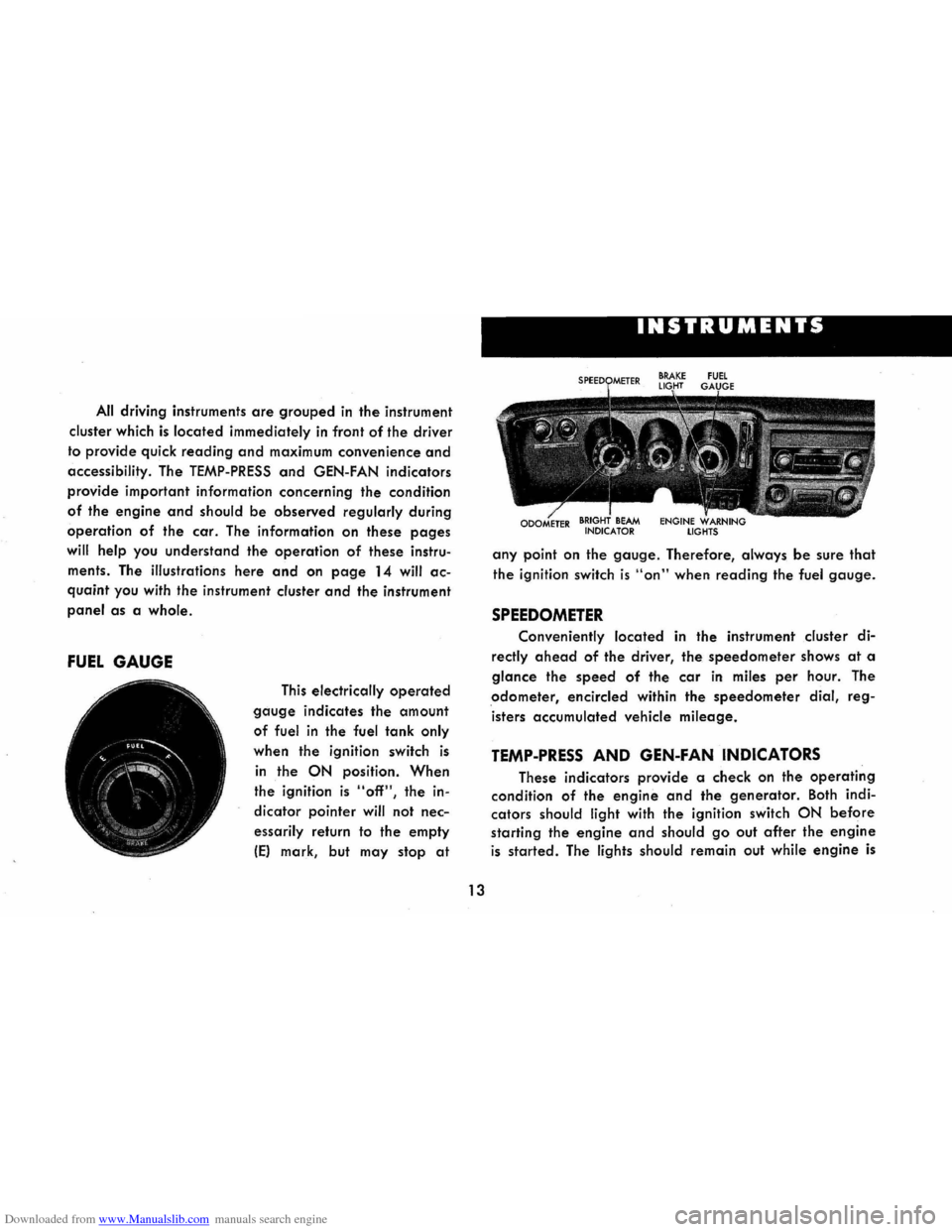
Downloaded from www.Manualslib.com manuals search engine All driving instruments are grouped in the instrument
cluster which
is located immediately in front of the driver
to provide quick
reading and maximum convenience and
accessibility. The TEMP-PRESS and GEN-FAN indicators
provide important information concerning the condition
of the engine and should be observed regularly during
operation of the car. The information on these pages
will help you understand the operation of these instru
ments . The illustrations
here and on page 14 will ac
quaint you with the instrument cluster and the instrument
panel as a whole.
FUEL GAUGE
This electrically operated
gauge indicates the amount
of fuel in the fuel tank only
when the ignition switch is
in the ON position. When
the ignition is "off", the in
dicator pointer
will not nec
essarily return to the empty
IE) mark, but may stop at
I
13
INSTRUMENTS
any point on the gauge. Therefore, always be sure that
the ignition switch is "on" when reading the fuel gauge.
SPEEDOMETER
Conveniently located in the instrument cluster di
rectly ahead of the driver, the speedometer shows at a
glance the speed of the car in miles per hour. The
odometer, encircled within the speedometer dial, reg
isters accumulated vehicle
mileage.
TEMP-PRESS AND GEN-FAN INDICATORS
These indicators provide a check on the operating
condition of the engine and the generator. Both indi
cators
should light with the ignition switch ON before
starting the engine and should go out after the engine
is started. The lights should remain out while engine is
Page 19 of 56
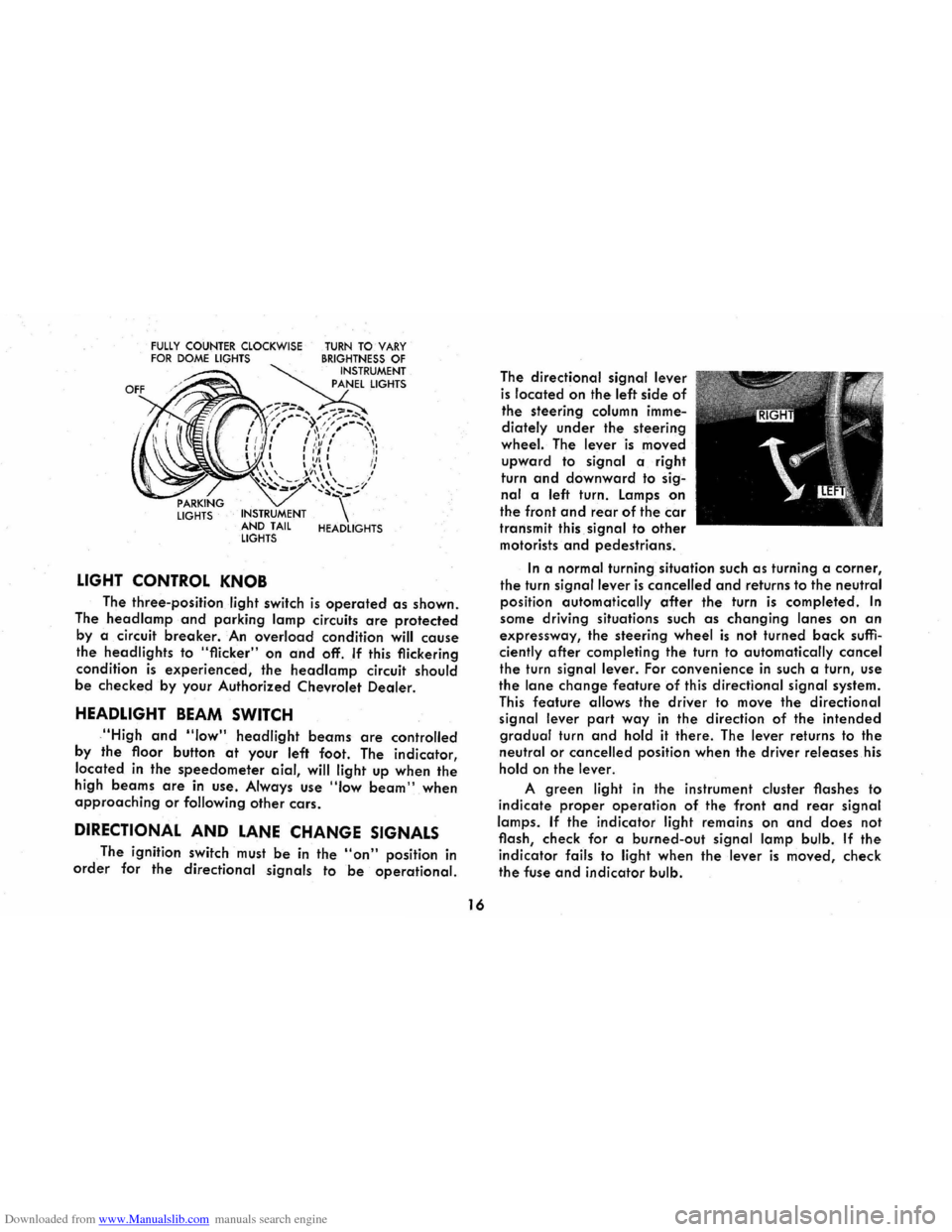
Downloaded from www.Manualslib.com manuals search engine FULLY COUNTER CLOCKWISE FOR DOME LIGHTS
LIGHTS INSTRUMENT
AND TAIL
LIGHTS
LIGHT CONTROL KNOB
TURN TO VARY BRIGHTNESS OF INSTRUMENT
PANEL LIGHTS
HEADLIGHTS
The three-position light switch is operated as shown.
The
head lamp and parking lamp circuits are protected
by a circuit breaker. An overload condition will cause
the headlights to "flicker" on and off. If this flickering
condition
is experienced, the headlamp circuit should
be checked by your Authorized Chevrolet Dealer.
HEADLIGHT BEAM SWITCH
,"High and "low" headlight beams are controlled
by
the floor button at your left foot. The indicator,
located
in the speedometer aial, will light up when the
high beams are in use . Always use "Iow beam" when approaching or following other cars.
DIRECTIONAL AND LANE CHANGE SIGNALS
The ignition switch must be in the "on" position in
order for the directional signals to be operational.
16
The directional signal lever
is located on the left side of
the steering column imme
diately
under the steering
wheel. The lever is moved
upward to signal a right
turn
and downward to sig
nal a left turn. Lamps on
the front and rear of the car
transmit this signal to other
motorists and pedestrians.
In a normal turning situation such as turning a corner,
the turn signal lever is cancelled and returns to the neutral
position automatically
after the turn is completed. In
some driving situations such as changing lanes on an
expressway, the steering wheel is not turned back suffi
ciently after completing the turn to automatically cancel
the turn signal lever. For convenience in such a turn, use
the lane change feature of this directional signal system.
This feature allows the driver to move the directional
signal lever
part way in the direction of the intended
gradual turn and hold it there. The lever returns to the
neutral or cancelled position when the driver releases his
hold on the lever.
A green light in the instrument cluster flashes to
indicate
proper operation of the front and rear signal
lamps.
If the indicator light remains on and does not
flash, check for a burned-out
signal lamp bulb. If the
indicator fails to light when the lever is moved, check
the fuse and indicator bulb.
Page 20 of 56
Downloaded from www.Manualslib.com manuals search engine If the system is not functioning properly, a legal hand
signal should be given, since failure to indicate a turn
is considered a moving traffic violation in many states.
Always signal for a turn
at a reasonable distance before actu 'ally making it.
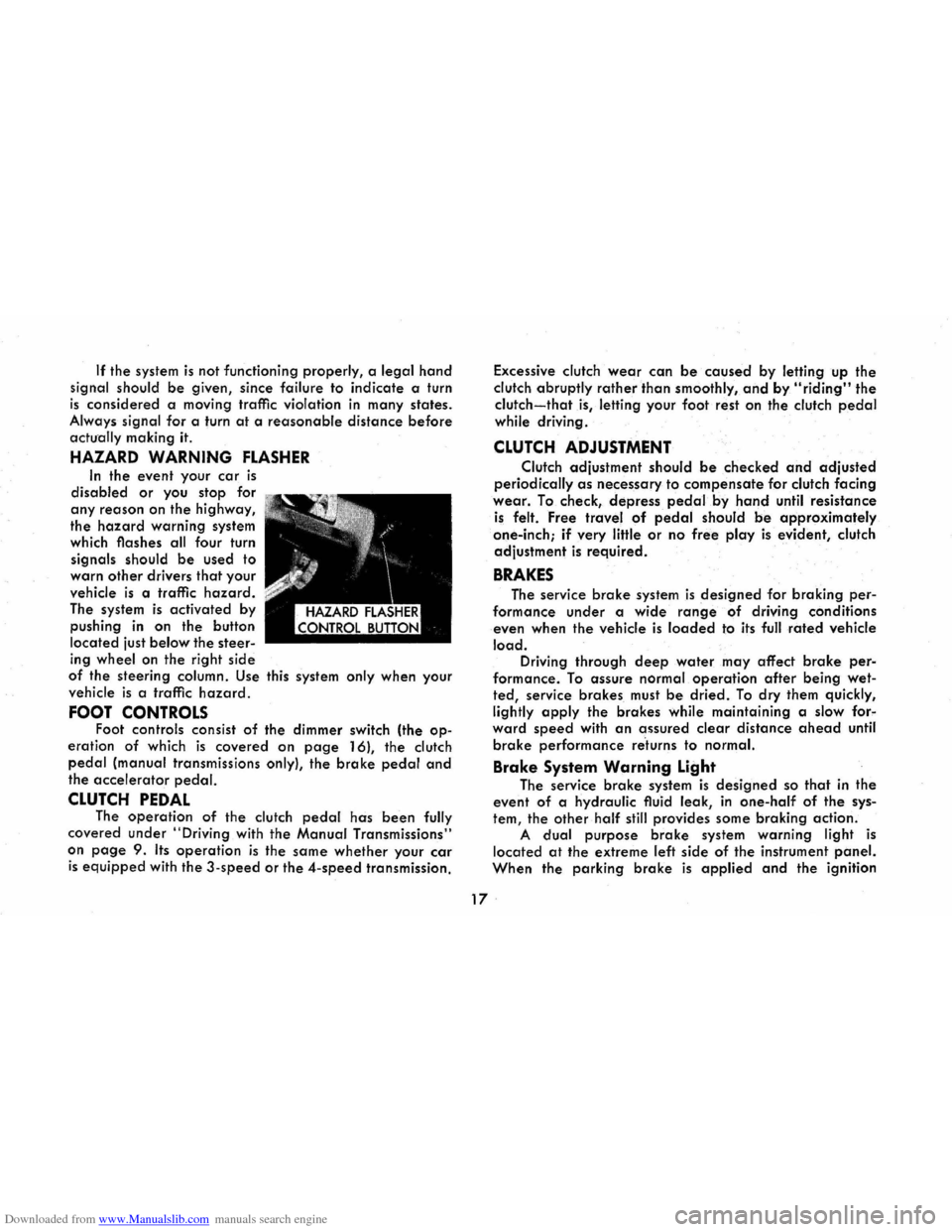
HAZARD WARNING FLASHER
In the event your car is
disabled or you stop for
any reason on the highway,
the
hazard warning system
which flashes all four turn
signals should
be used to
warn
other drivers that your
vehicle
is a traffic hazard.
The system is activated by
pushing
in on the button
located just
below the steer
ing wheel on the right side
of the steering column. Use this system only when your
vehicle
is a traffic hazard.
FOOT CONTROLS Foot controls consist of the dimmer switch (the op
eration of which is covered on page 16), the clutch
pedal (manual transmissions only), the brake pedal and
the accelerator pedal.
CLUTCH PEDAL The operation of the clutch pedal has been fully
covered under
"Driving with the Manual Transmissions"
on
page 9. Its operation is the same whether your car
is equipped with the 3-speed or the 4-speed transmission. Excessive
clutch
wear can be caused by letting up the
clutch abruptly
rather than smoothly, and by "riding" the
clutch-that is, letting your foot rest on the clutch pedal
while driving .
CLUTCH ADJUSTMENT
Clutch adjustment should be checked and adjusted
periodically as necessary to compensate for clutch facing
wear. To check, depress pedal.by hand until resistance
is felt. Free travel of pedal should be approximately
one-inch;
if very little or no free play is evident, clutch
adjustment
is required.
BRAKES
The service brake system is designed for braking per
formance under a wide range of driving conditions
even when the vehicle
is loaded to its full rated vehicle
load. Driving through deep water may affect brake per
formance. To assure normal operation after being wet
ted, service brakes must be dried. To dry them quickly,
lightly
apply the brakes while maintaining a slow for"
ward speed with an assured clear distance ahead until
brake performance re'turns to normal.
Brake System Warning Light
The service brake system is designed so that in the
event of a hydraulic fluid leak,
in one-half of the sys
tem, the other half still provides some braking action.
A dual purpose brake system warning light is
located at the extreme left side of the instrument panel.
When the parking brake is applied and the ignition
17 .
Page 37 of 56
Downloaded from www.Manualslib.com manuals search engine level, remove the oil gauge rod (dip stick), wipe it
clean and reinsert it firmly for an accurate reading.
The oil level should be maintained in the safety margin,
neither going above the FULL line nor below the ADD
mark. Reseat the gauge firmly after taking the reading.
DO NOT OVERFilL.
COOLING SYSTEM CARE
The engine fan belt should be checked for tightness
at regular intervals. When a new belt is needed use only
the approved premium belt available from your Chev
rolet dealer. If any other belt is installed, replace with
recommended belt when possible.
Watch the TEMP-PRESS and GEN-FAN indicators on the
instrument
panel for signs of overheating.
Air inlet louvers, located in the panel below the rear
window, supply air for engine combustion and cooling
and for the Direct Air Heater. Make sure the louvers are
never sealed or blocked.
TIRES
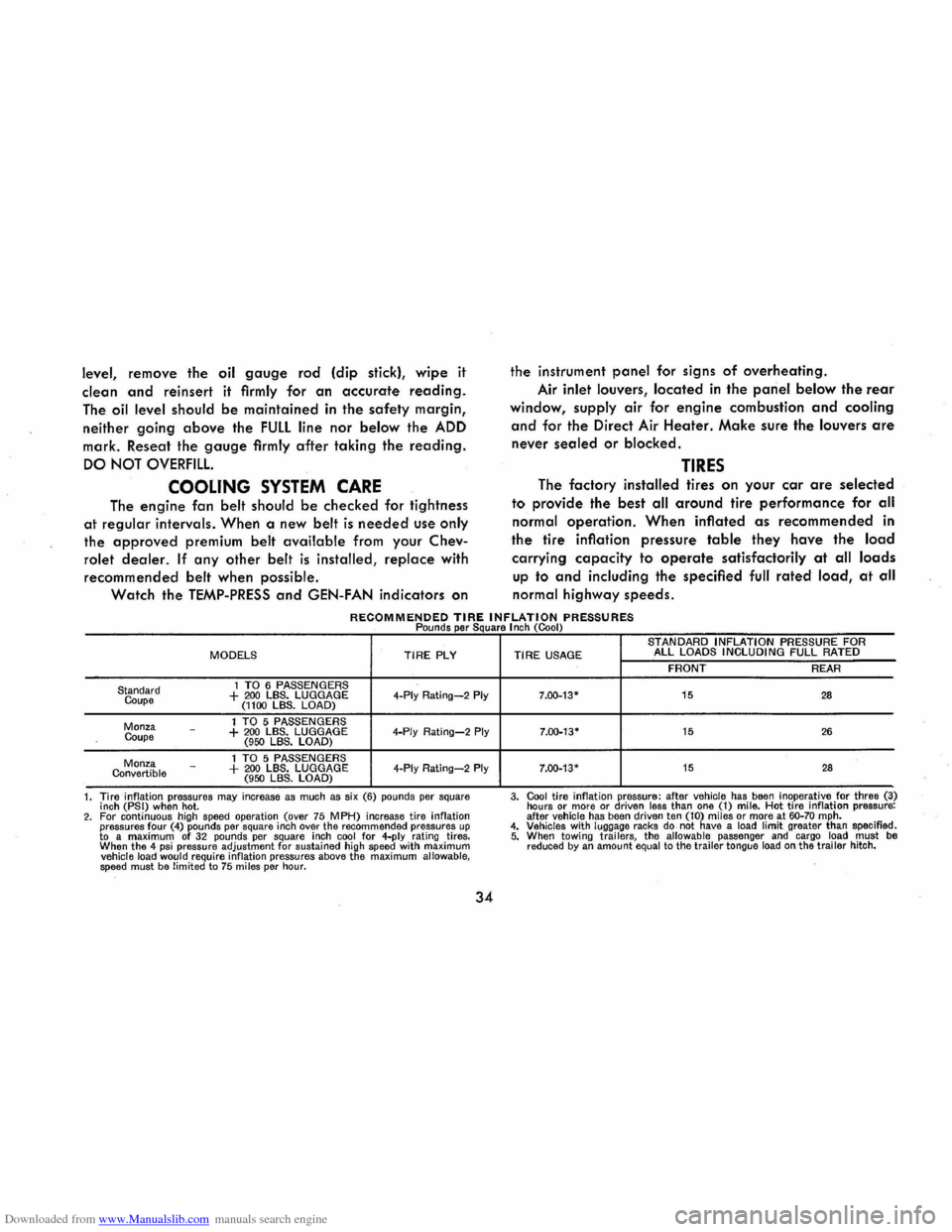
The factory installed tires on your car are selected
to provide the best all around tire performance for all
normal operation. When inflated as recommended in
the
tire inflation pressure table they have the load
carrying capacity to operate satisfactorily at all loads
up to and including the specified full rated load, at all
normal highway speeds.
RECOMMENDED TIRE INFLATION PRESSURES Pounds per Square I nch (Cool)
MODELS TIRE PLY
1 TO 6 PASSENGERS Standard
Coupe + 200 LBS. LUGGAGE 4-Ply Rating-2 Ply (1100 LBS. LOAD)
1 TO 5 PASSENGERS Monza
Coupe -+ 200 LBS. LUGGAGE 4-Ply Rating-2 Ply (950 LBS. LOAD)
1 TO 5 PASSENGERS Monza Convertible -+ 200 LBS. LUGGAGE 4-Ply Rating-2 Ply (950 LBS. LOAD)
1. Tire inflation pressures
may increase as much as six (6) pounds per square
inch (PSI) when hot. 2. For continuous high speed operation (over 75 MPH) increase tire inflation pressures four (4) pounds per square inch over the recommended pressures up to a maximum of 32 pounds per square inch cool for 4-ply rating tires.
When the 4 psi pressure adjustment for sustained high speed with maximum vehicle load would require inflation pressures above the maximum allowable, speed must be limited to 75 miles per hour.
34
STANDARD INFLATION PRESSURE FOR TIRE USAGE ALL LOADS INCLUDING FULL RATED
FRONT REAR
7.00-13-15 28
7.00-13· 15 26
7.00-13· 15 28
3. Cool tire inflation pressure: after vehicle has been inoperative for three (3)
hours or more or driven less than one (1) mile. Hot tire inflation pressure:
after vehicle has been driven ten (10) miles or more at 60-70 mph. 4. Vehicles with luggage racks do not have a load limit greater than specified. 5. When towi ng trai lers, the allowable passenger and cargo load must be reduced by an amount equal to the trailer tongue load on the trailer hitch.
Page 48 of 56
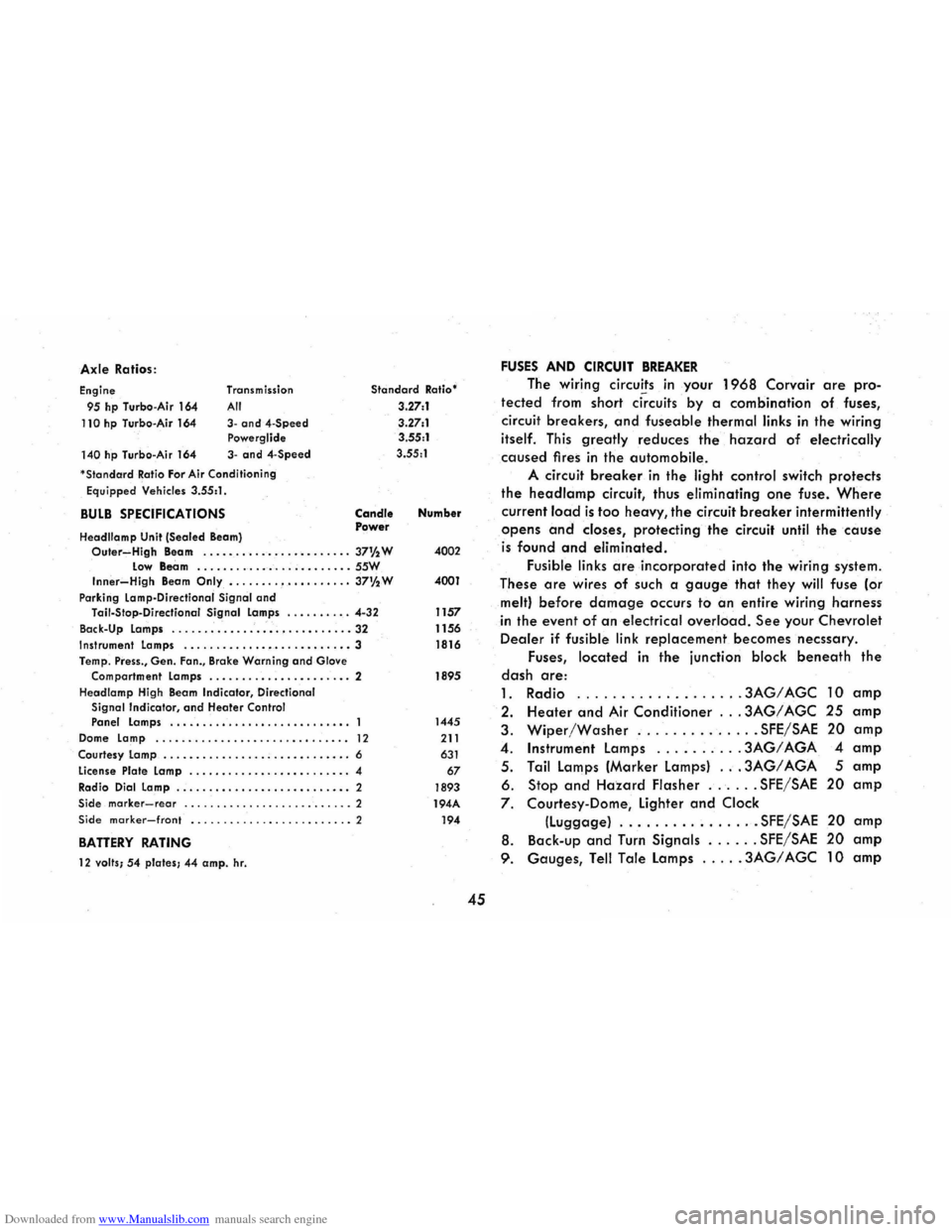
Downloaded from www.Manualslib.com manuals search engine Axle Ratios :
Engine
95 hp Turbo -Air 164
110 hp Turbo-Air 164
140 hp Turbo -Air 164 Transm
ission
All
3-and4-Speed Powerglide
3-and 4-Speed
'
StandardRatio For Air Cond itioning
Equipped Vehicles 3.55:1 .
BULB SPECIFICATIONS
Headllamp Unit (Sealed Beam)
Standard Ratio'
3.27:1
3 .27:1
3.55:1
3.55 :1
Candle Power Number
Outer~High Beam . .....•...•...•........ 37% W 4002 Low Beam .......... _ ....... _ .. _ .. SSW Inner-High Beam Only •....... , •.•. •.•... 37%W 4001
Park ing Lamp-Directional Signal and Tail-Stop -Directianal Signal Lamps ........ . . 4-32 1157
Back-Up Lamps
............................ 32 1156 Instrument Lamps ........ _ ...•••.....•....• 3 1816
Temp . Press., Gen. Fan., Brake Warning and Glove
Compartment Lamps ...........•... ..•..• . 2 1895
Headlamp High Beam
Indicator , Directional Signal Indicator, and Heater Control Panel Lamps ................•......•.•.. 1445
Dome Lamp ........................... ..• 12 211
Courtesy Lamp ............... . ; ....•..••... 6 631
License Plate Lamp ..............• •......... 4 67
Radio Dial Lamp .....................•..• " 2 1893 Side marker-rear .......................... 2 194A Side marker-front ......................... 2 194
BATTERY RATING
12 valls; 54 plates; 44 amp. hr.
45
FUSES AND CIRCUIT BREAKER
The wiring circuits in your 1968 Corvair are pro
tected from short ci~cuits by a combination of fuses,
circuit
breakers, and fuseable thermal links in the wiring
itself. This greatly reduces the hazard of electrically
caused fires in the automobile.
A circuit breaker in the light control switch protects
the headlamp circuit, thus eliminating one fuse. Where
current lo.ad is too heavy, the circuit breaker intermittently
opens and closes, protecting the circuit until the cause
is found and eliminated.
Fusible links are incorporated into the wiring system.
These
are wires of such a gauge that they will fuse (or
melt) before damage occurs to an entire wiring harness
in the event of an electrical overload. See your Chevrolet
Dealer if fusible link replacement becomes necssary.
Fuses,
located in the junction block beneath the
dash are:
1. Radio .
........ ...... .. , .3AG/AGC 10 amp
2. Heater and Air Conditioner ... 3AG/ AGC 25 amp
3. Wiper/Washer .............. SFE/SAE 20 amp
4 . Instrument lamps ......... . 3AG/ AGA 4 amp
5 . Tail lamps (Marker lamps) ... 3AG/ AGA 5 amp
6. Stop and Hazard Flasher ...... SFE/SAE 20 amp
7. Courtesy-Dome, lighter and Clock
(luggage) ................ SFE/SAE 20 amp
8. Back -up and Turn Signals ...... SFE/SAE 20 amp
9. Gauges, Tell Tale lamps ..... 3AG/ AGC 10 amp
Page 51 of 56
Downloaded from www.Manualslib.com manuals search engine and blocked AIR CLEANER ELEMENTS. Replace the air cleaner ele
ments
if necessary. Idle adjustment should be performed by your
Chevrolet Dealer.
If the above Fuel System checks and the checks suggested under
the Electrical System following do not correct the malfunction, it is
recommended that you turn to your Authorized Chevrolet Dealer
for further checks, adjustments
or repairs.
ELECTRICAL SYSTEM
If, when the ignition key is turned to START, the engine will not
turn over, you have
good reason to suspect electrical trouble.
(F) When there is no response at all to attempts to start the car,
check the obvious-your AUTOMATIC TRANSMISSION SELECTOR
LEVER must be in neutral position before the engine can be started.
Turning the IGNITION SWITCH rapidly back and forth several
times
will sometimes correct a poor internal switch contact.
(G) The BATTERY may be discharged. If so, lights will be dim and
the horn will have a poor tone if it will blow at all.
Usually
a garage recharge will be necessary to return the battery
to operotion. Occasionally, however, a long drive will recharge
the battery.
NOTE:
If the battery is determined to be dead, and for no apparent
reason, have
your Authorized Chevrolet Dealer check the
battery, the GENERATOR and the
VOLTAGE REGULATOR.
GENERATOR trouble should already have been indicated
by
the indicator on the instrument panel. Never remove generator
"BAT" lead without first disconnecting battery ground cable.
48
POOR BATTERY CONNECTIONS may be suspected if the car has operated properly a short time before and now not even the horn
will operate. Check both ends of both battery cables. If the con
nections are corroded, a car may sometimes be restored to operation by removing all cable ends, scraping all contacting surfaces
clean with a pen knife, and reassembling. If the cables are broken,
they must be replaced. The power supply should now be restored
unless the battery is dead.
(H) If, however, the lights and horn work properly but the starter will still not turn over, check the STARTER connections. A "click" from the starter solenoid indicates that the wiring to the starter is properly installed. If the wiring seems to be clean and tightly installed, the trouble is probably in the starter itself and should be referred to your Authorized Chevrolet Dealer.
When the engine will "turn over" but will not start, the following
items may be checked along with Fuel System Checks listed previously.
(I) With a clean dry cloth wipe the ceramic portions of the spark plugs dry. In particularly damp or rainy weather dampness may be the cause of not sta rting, especially when the engine is cold.
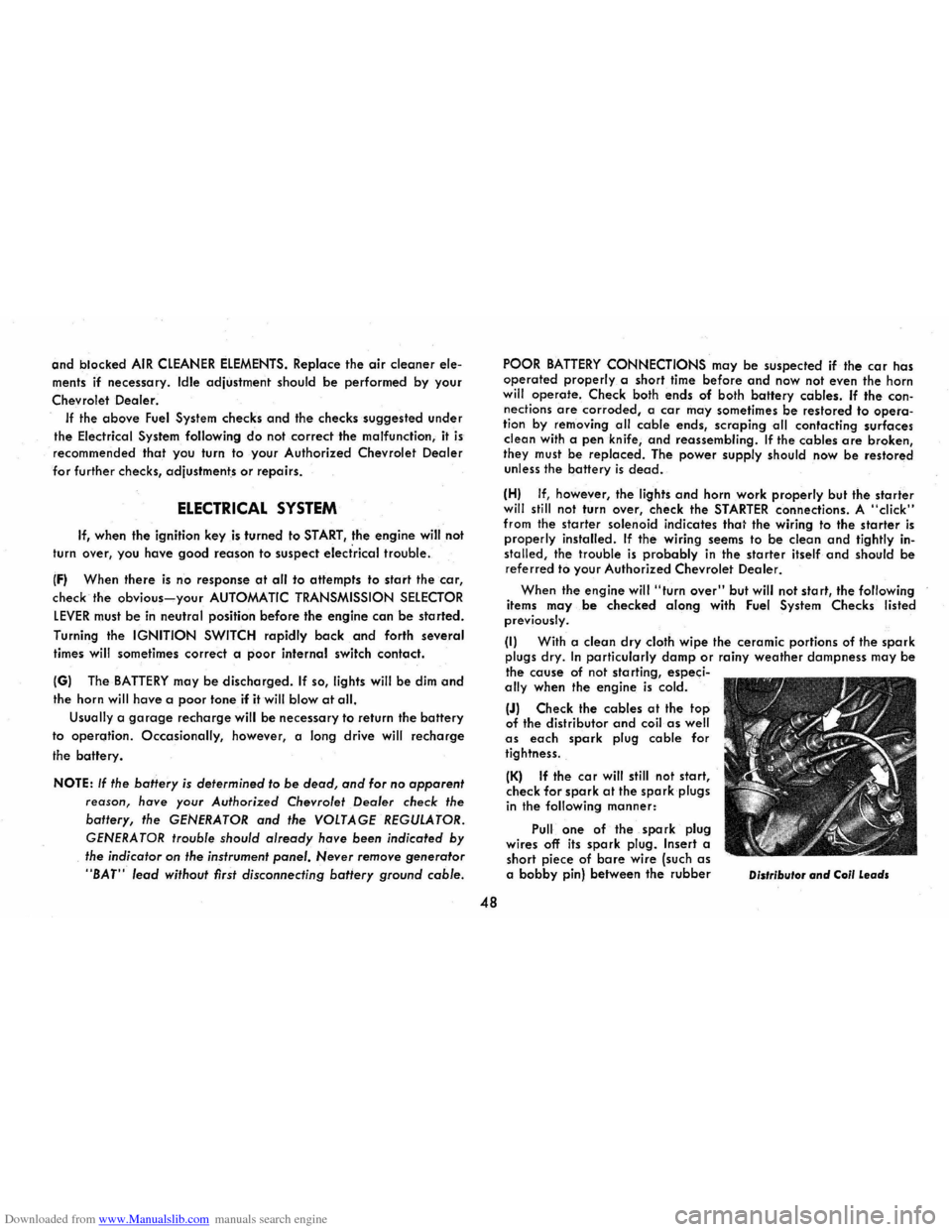
(J) Check the cables at the top of the distributor and coil as well as each spark plug cable for
tightness.
(K) If the car will still not start, check for spark at the spark plugs in the following manner:
Pull one of the spark plug
wires off its spark plug. Insert a
short piece of bare wire (such as a bobby pin) between the rubber Distributor and Coil Leads
Page 52 of 56
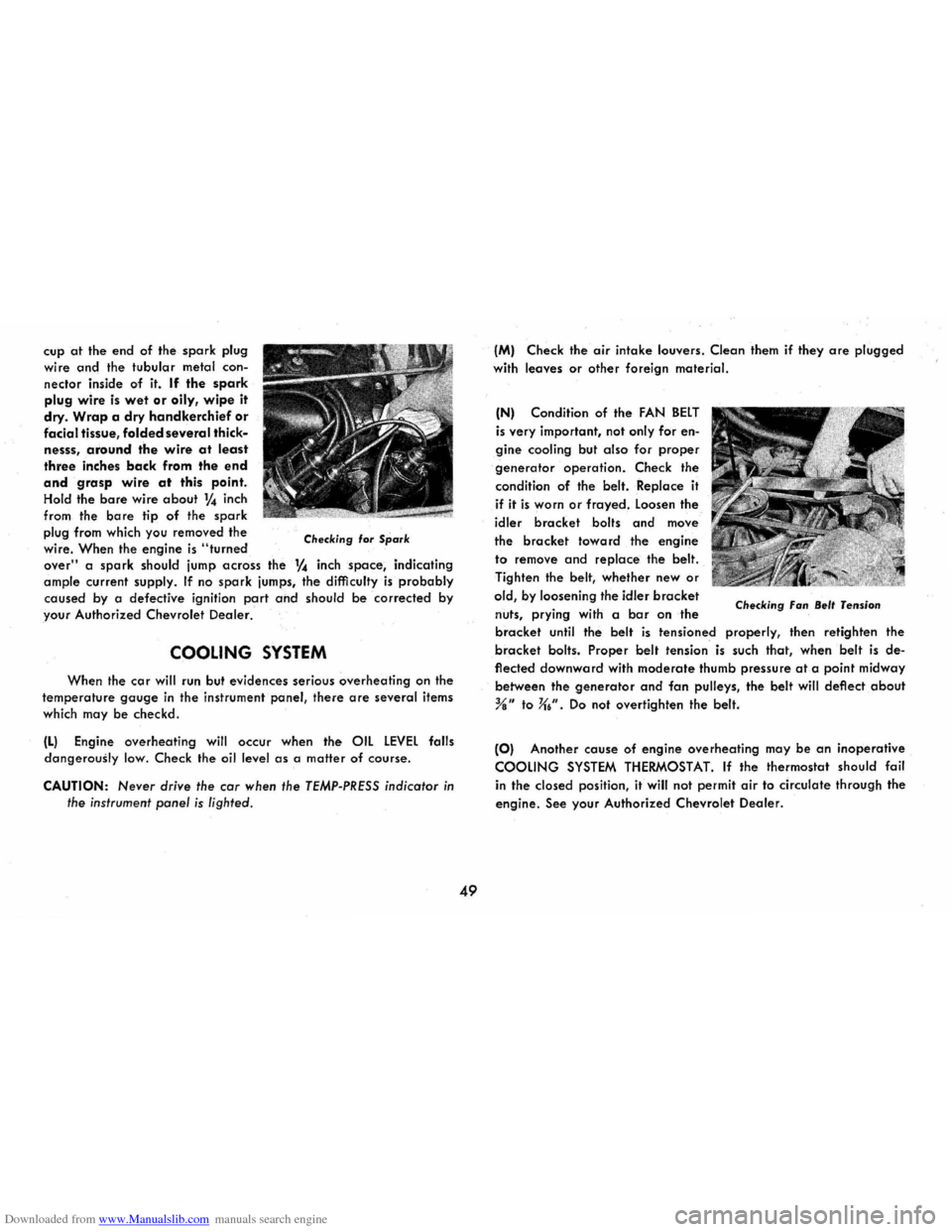
Downloaded from www.Manualslib.com manuals search engine cup at the end of the spark plug
wire
and the tubular metal con
nector inside of it. If the spark
plug wire is wet or oily, wipe it
dry.
Wrap a dry handkerchief or
facial tissue, folded several thick
nesss, around the wire at least
three inches back from the end
and grasp wire at this point.
Hold the
bare wire about V4 inch
from the bare tip of the spark
plug from which you removed the
wire. When the engine is "turned Checking for Spork
over" a spark should jump across the V4 inch space, indicating
ample current supply.
If no spark jumps, the difflcultyis probably
caused by a defective ignition part and should be corrected by
your Authorized
Chevrolet Dealer.
COOLING SYSTEM
When the car will run but evidences serious overheating on the
temperature
gauge in the instrument panel, there are several items
which may
be checkd.
(L) Engine overheating will occur when the OIL LEVEL falls
dangerously low.
Check the oil level as a matter of course.
CAUTION: Never drive the car when the TEMP-PRESS indicator in
the instrument panel is lighted.
49
1M) Check the air intake louvers. Clean them if they are plugged
with leaves
or other foreign material.
IN) Condition of the FAN BELT
is very important, not only for en
gine cooling but also for proper
generator operation. Check the
condition of the belt. Replace
it
if it is worn or frayed. Loosen the
idler
bracket bolts and move
the
bracket toward the engine
to remove and replace the belt.
Tighten the belt, whether new
or
old, by loosening the idler bracket
nuts, prying with a bar on the Checking Fan Be" Tension
bracket until the belt is tensioned properly, then retighten the
bracket bolts. Proper belt tension is such that, when belt is de
flected downward with moderate thumb pressure at a point midway
between the
generator and fan pulleys, the belt will deflect about
:Va" to K6". Do not overtighten the belt.
(0) Another cause of engine overheating may be an inoperative
COOLING SYSTEM THERMOSTAT. If the thermostat should fail
in the closed position, it will not permit air to circulate through the
engine.
See your Authorized Chevrolet Dealer.