Page 9 of 56
Downloaded from www.Manualslib.com manuals search engine A WORD FROM CHEVROLET ...
This Owner's Manual contains important information regarding the operation
and maintenance of your Corvair.
In order to obtain maximum enjoyment and usage from your car, we sug
gest that you familiarize yourself with the contents of this booklet and follow
the recommendations outlined.
Your Chevrolet dealer has the trained personnel and specialized equipment
to properly service your Corvair. Have
him inspect your car and perform any
maintenance or adjustments required.
We would like to take this opportunity to thank you for choosing a Chevrolet
product-and assure you of our continuing interest in your motoring pleasure and
satisfaction.
6
Page 10 of 56
Downloaded from www.Manualslib.com manuals search engine OPERATING INSTRUCTIONS
I
YOUR CORVAIR'S FIRST FEW HUNDRED MILES OF DRIVING
Sound design and precision manufacturing methods
will permit you to operate your new Corvair without
adhering to a formal "break-in" schedule. However,
during the first few hundred miles of driving you can,
by observing a few simple precautions, odd to the future
performance and economy of your cor.
It is recommended that your speed during the first
500 miles be confined to a maximum of 60 MPH, but
do not drive for extended periods at anyone constant
speed,
either fast or slow. During this period, ovoid full
throttle starts and unnecessary, quick abrupt stops .
Gentle braking during the first few hundred miles of
operation will result in longer broke life and better
future performance. Avoid unnecessary, hard stops espe
cially during the first 200 miles of operation since broke
misuse during this period will destroy much future broke
efficiency.
Always drive at a moderate speed until the engine
has completely warmed up.
DRIVING FOR ECONOMY
Proper maintenance and wise operation will com
bine to help you achieve maximum fuel economy with
your Corvair. Your Authorized Chevrolet Dealer can
properly tune and maintain your car but wise operation
is your responsibility. Give the cor sufficient warm-up
time, do not make "Full Throttle" storts or unnecessary
severe stops,
and drive at reasonable speeds and as
steady as traffic permits to gain the benefits of all the
economy built into your Corvair.
CAUTION: Avoid inhaling exhaust gases especially in an enclosed area such as a garage. Exhaust gases
contain
a percentage of carbon monoxide which is a potentially lethal gas that, by itself, is tasteless, color
less, and odorless. The exhaust system should be inspected for proper mounting, leaks and missing or damaged
parts each time the vehicle is raised for lubrication or oil change service.
7
Page 11 of 56
Downloaded from www.Manualslib.com manuals search engine STARTING THE ENGINE
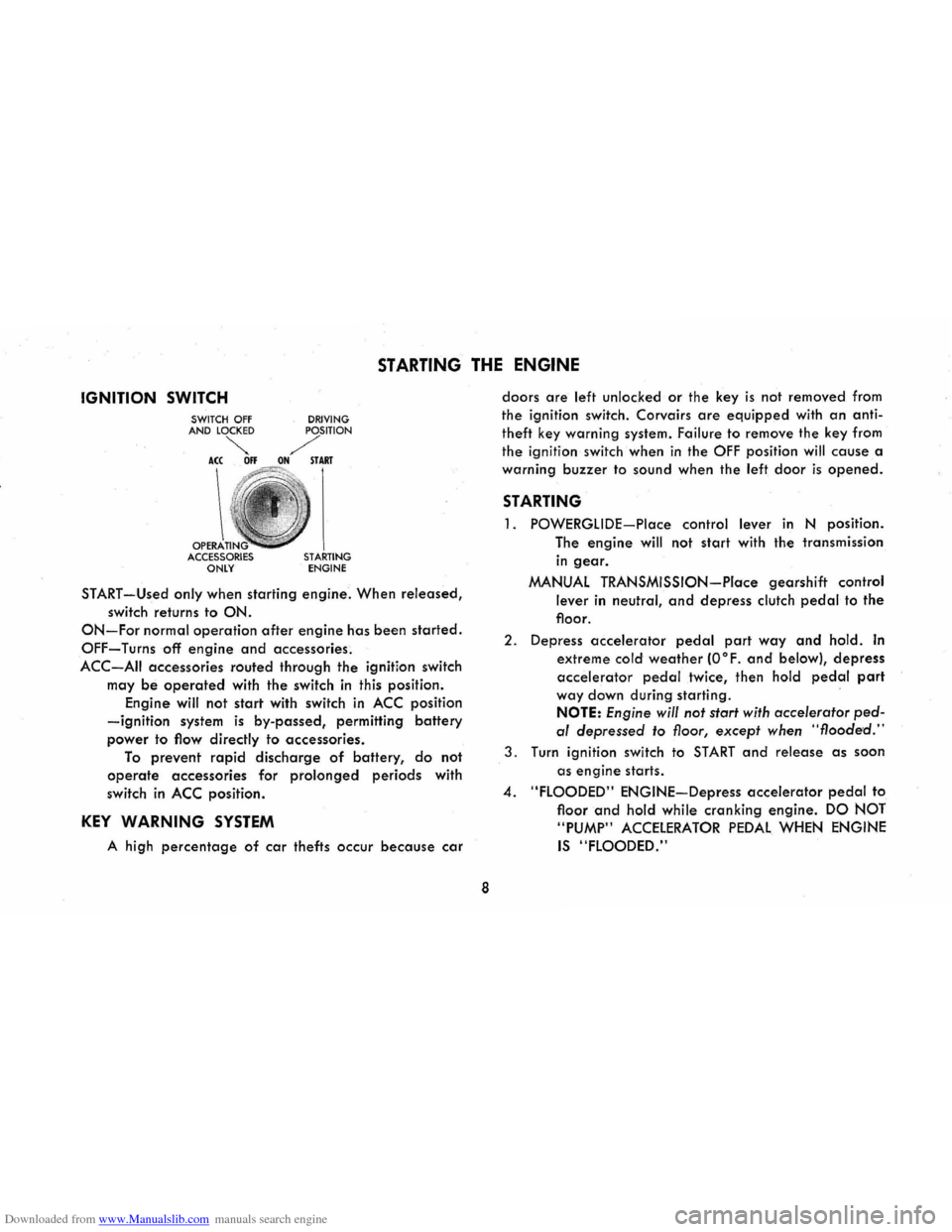
IGNITION SWITCH
OPERA ACCESSORIES ONLY DRIVING STARTING ENGINE
START-Used only when
starting engine. When released,
switch returns to ON.
ON-For normal operation after engine has been started.
OFF-Turns off engine and accessories.
ACC-AII accessories routed through the ignition switch
may
be operated with the switch in this position.
Engine will not
start with switch in ACC position
-ignition system is by-passed, permitting battery
power to flow directly to accessories.
To prevent rapid discharge of battery, do not
operate accessories for prolonged periods with
switch
in ACC position.
KEY WARNING SYSTEM
A high percentage of car thefts occur because car
8
doors are left unlocked or the key is not removed from
the ignition switch. Corvairs
are equipped with an anti
theft key warning system. Failure
to remove the key from
the ignition switch when
in the OFF position will cause a
warning
buzzer to sound when the left door is opened.
STARTING
1. POWERGLIDE-Place control lever in N position.
The
engine will not start with the transmission
in gear.
MANUAL TRANSMISSION-Place gearshift control
lever in neutral, and depress clutch pedal to the
floor.
2. Depress accelerator pedal part way and hold. In
extreme cold weather (O°F. and below), depress
accelerator pedal twice, then hold pedal part
way down during starting .
NOTE: Engine will not start with accelerator ped
al depressed to floor, except when "flooded."
3. Turn ignition switch to START and release as soon
as
engine starts .
4. "FLOODED" ENGINE-Depress accelerator pedal to
floor
and hold while cranking engine. DO NOT
"PUMP"
ACCELERATOR PEDAL WHEN ENGINE
IS "FLOODED."
Page 12 of 56
Downloaded from www.Manualslib.com manuals search engine WARM-UP
Never race engine or drive at high speeds until
engine has
had a chance to warm up. Driving with
moderate accelerator pedal application will prevent
stalling
and hesitation, especially during cold weather.
Failure
to allow sufficient warm up time can cause un
necessary wear to engine, axle or transmission parts
because of inadequate lubrication.
DRIVING WITH THE
MANUAL TRANSMISSIONS
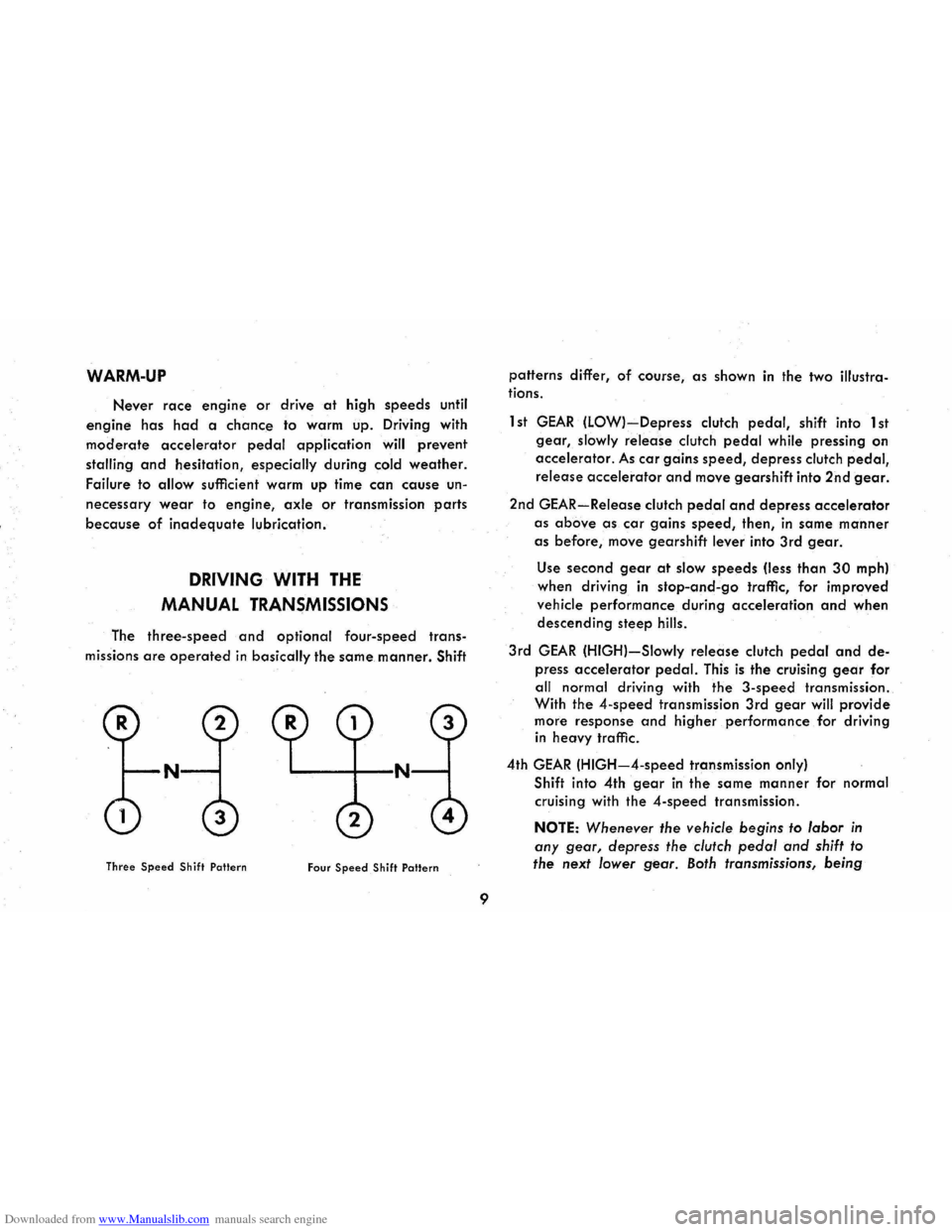
The three-speed and optional four-speed trans
missions are operated in basically the same manner. Shift
N "'-----+--N
Three Speed Shift Pallern Four Speed Shift Pattern
9
patterns differ, of course, as shown in the two illustra
tions.
1 st
GEAR (LOW)-Depress clutch pedal, shift into 1 st
gear, slowly release clutch pedal while pressing on
accelerator.
As car gains speed, depress clutch pedal,
release accelerator and move gearshift into 2nd gear.
2nd GEAR-Release clutch pedaI and depress accelerator
as above as car gains speed, then, in same manner
as before, move gearshift lever into 3rd gear.
Use second gear at slow speeds (less than 30 mph)
when driving
in stop-and-go traffic, for improved
vehicle performance during acceleration
and when
descending steep hills.
3rd
GEAR (HIGH)-Slowly release clutch pedal and de
press accelerator pedal. This is the cruising gear for
all normal driving with the
3-speed transmission.
With the
4-speed transmission 3rd gear will provide
more response
and higher performance for driving
in heavy traffic.
4th
GEAR (HIGH-4-speed transmission only)
Shift into 4th
gear in the same manner for normal
cruising with the
4-speed transmission.
NOTE: Whenever the vehicle begins to labor in
any gear, depress the clutch pedal and shift to
the next lower
gear. Both transmissions, being
Page 13 of 56
Downloaded from www.Manualslib.com manuals search engine fully synchronized, may be downshifted into first
gear at any speed below 20 mph.
TO STOP-Release the accelerator and depress the
brake pedal. As car slows down, depress the clutch
pedal and move the gearshift lever into neutral.
NEUTRAL-For use when starting or idling engine.
REVERSE-Operate as for 1 st gear but always at a
slow speed.
CAUTION: When parking or leaving the car unattended,
even for a few minutes, remove the ignition key, place
the selector lever in first gear or reverse if manual trans
mission, and fully apply the parking brake.
DRIVING WITH THE POWERGLIDE TRANSMISSION
The optional Powerglide transmission is a completely
automatic transmission which replaces the standard clutch
and transmission. After starting the engine with the se
lector lever
in N (neutral) position, merely select the
range desired and depress the accelerator. The Power
glide
transmission will do the rest.
Automatic transmission shift
quadrants of all GM
cars continue the uniform sequence of selector positions.
This particularly benefits multicar families and those who
occasionally drive other cars. Shift indicators are ar
ranged as follows: "Reverse", "Neutral" and the forward
driving
ranges. All automatic transmissions are equipped
with a starter interlock system designed to permit start
ing the engine only when the transmission selector is in
the "Neutral" position. For additional engine braking
effect,
as sometimes needed in mountainous driving,
place the transmission in an intermediate or low range.
10
The dash-mounted driving range selector is equipped
with mechanical stops to prevent unintentional shifting
into reverse
and low ranges. Move lever to the left, to
override stop,
and continue shift for selection of reverse
or low ranges.
With
lever in 0 position the transmission starts in
automatic low gear and will shift to cruising gear at
some point between approximately 12 and 50 mph,
depending on the accelerator position. Thus, a slow start
with a steady, gradual increase of pressure on the accel
erator pedal will enable the transmission to shift into the
more economical cruising gear in the shortest possible
time. Hard acceleration for fast starts will cause the trans
mission to remain in low gear for a considerably longer
period.
When driving at speeds below 45 mph, the transmis-
Page 14 of 56
Downloaded from www.Manualslib.com manuals search engine sion may be shifted into low range for extra acceleration
for passing by depressing the
accelerator pedal fully. The
transmission
will automatically shift back into cruising
gear when the accelerator pedal is momentarily released.
CAUTION: It is important that the parking brake be fully engaged, in addition to removing the ignition key,
when your Corvair is parked or otherwise left unattended. The automatic transmission does not hold the car
regardless
of the position of the selector lever.
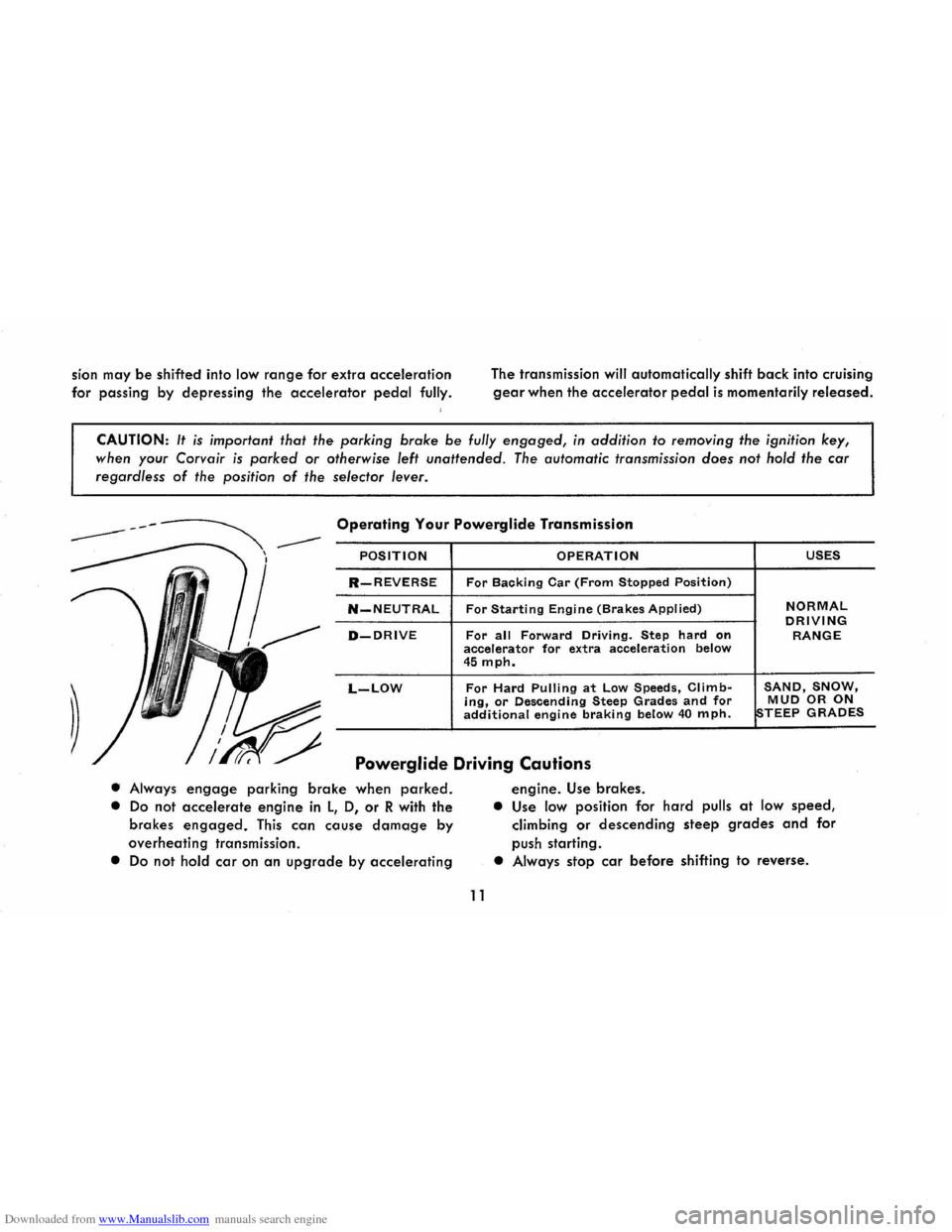
Operating Your Powerglide Transmission
POSITION OPERATION USES
R-REVERSE For Backing Car (From Stopped Position)
N-NEUTRAL For Starting Engine (Brakes Applied) NORMAL DRIVING D-DRIVE For all Forward Driving. Step hard on RANGE accelerator for extra acceleration below 45 mph.
L-LOW For Hard Pulling at Low Speeds, Climb-SAND, SNOW, ing, or Descending Steep Grades and for MUD OR ON additional engine braking below 40 mph. STEEP GRADES
Powerglide Driving Cautions
• Always engage parking brake when parked.
• Do not accelerate engine in l, 0, or R with the
brakes
engaged. This can cause damage by
overheating transmission.
• Do not hold car on an upgrade by accelerating
11
engine. Use brakes.
• Use low position for hard pulls at low speed,
climbing or descending steep grades and for
push starting.
• Always stop car before shifting to reverse.
Page 15 of 56
Downloaded from www.Manualslib.com manuals search engine TRANSMISSION OPERATING TIPS
EMERGENCY STARTING
Your Corvair may be started in an emergency by
pushing. When being pushed to start the engine, turn
off all unnecessary electrical loads, turn the ignition to "ON", and (if manual transmission) depress the
clutch and place the shift lever in high gear or, (if
powerglide) move selector lever to NEUTRAL position.
Release the clutch when car speed reaches 10 to 15 miles per hour (manual transmission); move the selector
lever to LOW position when car speed reaches 20 to
25 miles per hour (powerglidel. Bumpers and other
parts contacted by the pushing vehicle should be pro
tected from damage while pushing. Never tow the car
to start.
TOWING
Normally your Corvair may be towed with all four
wheels on the ground for distances up to 50 miles at
12
speeds of less than 35 mph. The engine should be off
ahd the transmission in neutral.
However, the drive wheels (rear wheels) must be
raised off the ground or the drive shaft disconnected
when the transmission
is not operating properly or when
a speed
of 35 mph or distance of 50 miles will be exceeded.
CAUTION: If car is towed on its front wheels only, the
steering wheel must
be secured with the wheels in a
straight ahead position .
ROCKING CAR
If it becomes necessary to rock the car to free it
from sand, mud or snow, move the selector lever from "D" to "R" (automatic transmission) or the shift lever
from forward to reverse (manual transmission) in a
repeat pattern while simultaneously applying moderate
pressure to the accelerator. Do not race engine. Avoid
spinning wheels when trying to free the car.
Page 16 of 56
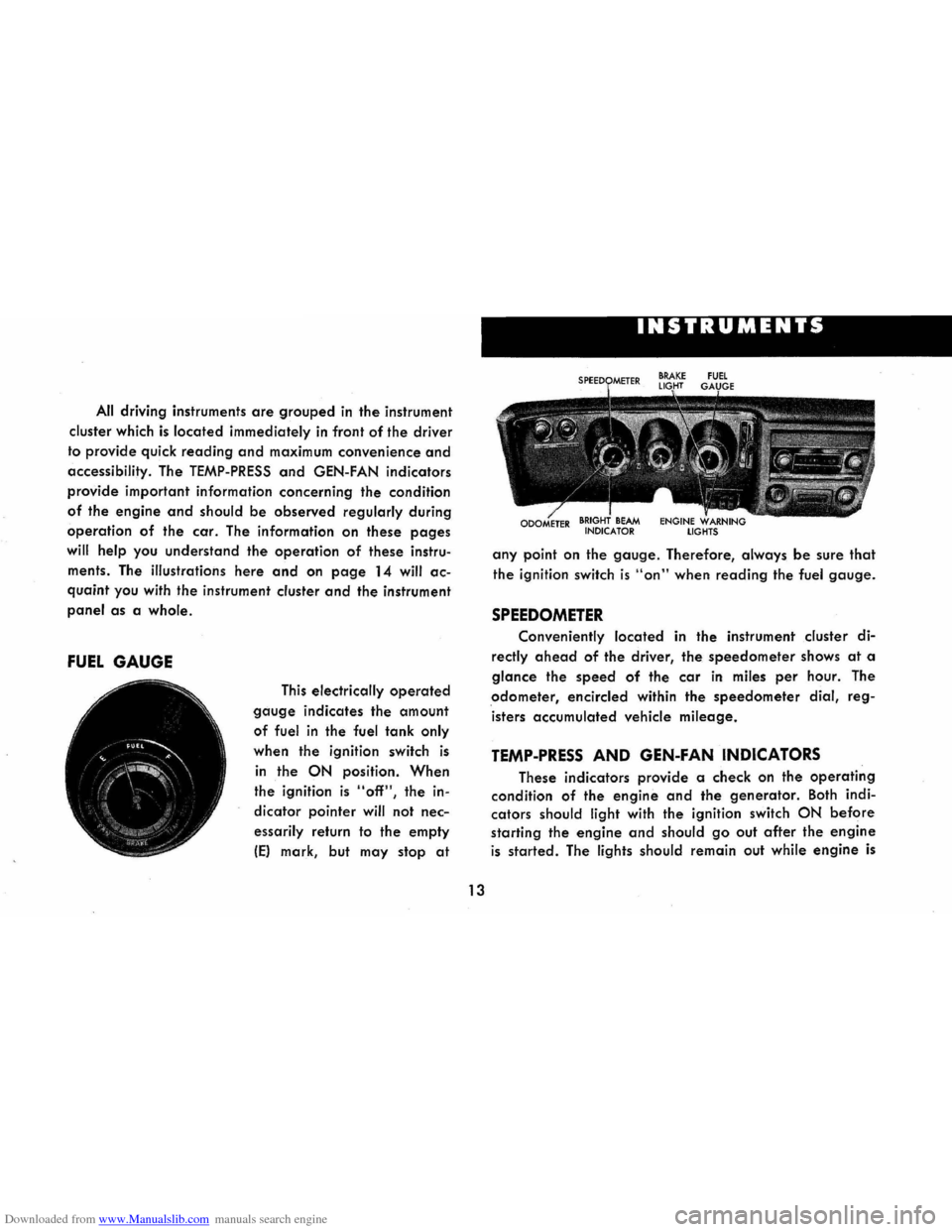
Downloaded from www.Manualslib.com manuals search engine All driving instruments are grouped in the instrument
cluster which
is located immediately in front of the driver
to provide quick
reading and maximum convenience and
accessibility. The TEMP-PRESS and GEN-FAN indicators
provide important information concerning the condition
of the engine and should be observed regularly during
operation of the car. The information on these pages
will help you understand the operation of these instru
ments . The illustrations
here and on page 14 will ac
quaint you with the instrument cluster and the instrument
panel as a whole.
FUEL GAUGE
This electrically operated
gauge indicates the amount
of fuel in the fuel tank only
when the ignition switch is
in the ON position. When
the ignition is "off", the in
dicator pointer
will not nec
essarily return to the empty
IE) mark, but may stop at
I
13
INSTRUMENTS
any point on the gauge. Therefore, always be sure that
the ignition switch is "on" when reading the fuel gauge.
SPEEDOMETER
Conveniently located in the instrument cluster di
rectly ahead of the driver, the speedometer shows at a
glance the speed of the car in miles per hour. The
odometer, encircled within the speedometer dial, reg
isters accumulated vehicle
mileage.
TEMP-PRESS AND GEN-FAN INDICATORS
These indicators provide a check on the operating
condition of the engine and the generator. Both indi
cators
should light with the ignition switch ON before
starting the engine and should go out after the engine
is started. The lights should remain out while engine is