1982 CHEVROLET CAMARO service
[x] Cancel search: servicePage 362 of 875

GM – CAMARO 1982-1992 – Repair Guide (Checked by WxMax) 362
OIL PRESSURE SENDING UNIT
Replace the sending unit by disconnecting
the electrical connector and using a
special socket to remove it.
ENGINE
MECHANICAL ENGINE
REMOVAL & INSTALLATION
In the process of removing the engine, you will come across a number of steps
which call for the removal of a separ ate component or system, such as
"disconnect the exhaust system " or "remove the radiator." In most instances, a
detailed removal procedure can be found elsewhere in this repair guide.
It is virtually impossible to list each individual wire and hose which must be
disconnected, simply because so many different model and engine
combinations have been manufactured. Careful observation and common
sense are the best possible approaches to any repair procedure.
Removal and installation of the engine ca n be made easier if you follow these
basic points:
• If you have to drain any of the fl uids, use a suitable container.
• Always tag any wires or hoses and, if possible, the components they
came from before disconnecting them.
• Because there are so many bolts and fasteners involved, store and label
the retainers from com ponents separately in muffin pans, jars or coffee
cans. This will prevent conf usion during installation.
• After unbolting the transmission or trans axle, always make sure it is
properly supported.
• If it is necessary to disconnect t he air conditioning system, have this
service performed by a qualified tec hnician using a recovery/recycling
station. If the system does not have to be disconnected, unbolt the
compressor and set it aside.
• When unbolting the engine mounts, a lways make sure the engine is
properly supported. When removing t he engine, make sure that any
lifting devices are properly attached to the engine. It is recommended
that if your engine is supplied with lifting hooks, your lifting apparatus be
attached to them.
• Lift the engine from its compartment sl owly, checking that no hoses,
wires or other component s are still connected.
• After the engine is clear of the compar tment, place it on an engine stand
or workbench.
• After the engine has been removed, y ou can perform a partial or full
teardown of the engine using the procedur es outlined in this repair guide.
Page 465 of 875

GM – CAMARO 1982-1992 – Repair Guide (Checked by WxMax) 465
Fig. 12: Muffler hanger attachment
ENGINE RECONDITIONING DETE RMINING ENGINE CONDITION
Anything that generates heat and/or friction will eventually burn or wear out (i.e.
a light bulb generates heat, therefore its life span is limited). With this in mind, a
running engine generates trem endous amounts of both; friction is encountered
by the moving and rotating parts inside the engine and heat is created b\
y
friction and combustion of the fuel. Ho wever, the engine has systems designed
to help reduce the effects of heat and fr iction and provide added longevity. The
oiling system reduces the amount of fr iction encountered by the moving parts
inside the engine, while the cooling system reduces heat created by friction and
combustion. If either system is not main tained, a break-down will be inevitable.
Therefore, you can see how regular main tenance can affect the service life of
your vehicle. If you do not drain, flush and refill your cooling system at the
proper intervals, deposits will begin to accumulate in the radiator, thereby
reducing the amount of heat it can extrac t from the coolant. The same applies to
your oil and filter; if it is not changed often enoug h it becomes laden with
contaminates and is unable to properly lubricate the engine. This increases
friction and wear.
There are a number of methods for evaluat ing the condition of your engine. A
compression test can reveal the condition of your pistons, piston rings, cylinder
bores, head gasket(s), valves and valve seat s. An oil pressure test can warn
you of possible engine bearing, or oil pump failures. Excessive oil consumption,
evidence of oil in the engine air intake area and/or bluish smoke from the tail
pipe may indicate worn piston rings, worn valve guides and/or valve seals. As a
general rule, an engine that uses no more than one quart of oil every 1000
miles is in good condi tion. Engines that use one quart of oil or more in less than
1000 miles should first be checked for oil leaks. If any oil leaks are present,
have them fixed before dete rmining how much oil is consumed by the engine,
especially if blue smoke is not visible at the tail pipe.
COMPRESSION TEST
A noticeable lack of engine power, excessive oil consumption and/or poor fuel
mileage measured over an extended period are all indicators of internal engine
Page 469 of 875

GM – CAMARO 1982-1992 – Repair Guide (Checked by WxMax) 469
ENGINE OVERHAUL TIPS
Most engine overhaul procedures are fair
ly standard. In addition to specific
parts replacement procedures and specifications for your individual engine, this
section is also a guide to acceptabl e rebuilding procedures. Examples of
standard rebuilding practice are given and should be used along with specific
details concerning your particular engine.
Competent and accurate machine sh op services will ensure maximum
performance, reliability and engin e life. In most instances it is more profitable for
the do-it-yourself mechanic to remove, clean and inspect the component, buy
the necessary parts and deliver these to a shop for actual machine work.
Much of the assembly work (crankshaft, bearings, piston rods, and other
components) is well within the scope of t he do-it-yourself mechanic's tools and
abilities. You will have to decide for your self the depth of involvement you desire
in an engine repair or rebuild.
TOOLS
The tools required for an engine overhaul or parts replacement will depend on
the depth of your involvement. With a few exceptions, they will be the tools
found in a mechanic's tool kit (see Gener al Information & Maintenance in this
repair guide). More in-depth work will requ ire some or all of the following:
• A dial indicator (reading in thousandths) mounted on a universal base
• Micrometers and telescope gauges
• Jaw and screw-type pullers
• Scraper
• Valve spring compressor
• Ring groove cleaner
• Piston ring expander and compressor
• Ridge reamer
• Cylinder hone or glaze breaker
• Plastigage®
• Engine stand
The use of most of these tools is illustra ted in this section. Many can be rented
for a one-time use from a local parts jobber or tool supply house specializing in
automotive work.
Occasionally, the use of special tools is called for. See the information on
Special Tools and the Safety Notice in General Information & Maintenance
before substituting another tool.
OVERHAUL TIPS
Aluminum has become extr emely popular for use in engines, due to its low
weight. Observe the follo wing precautions when handl ing aluminum parts:
Page 487 of 875
GM – CAMARO 1982-1992 – Repair Guide (Checked by WxMax) 487
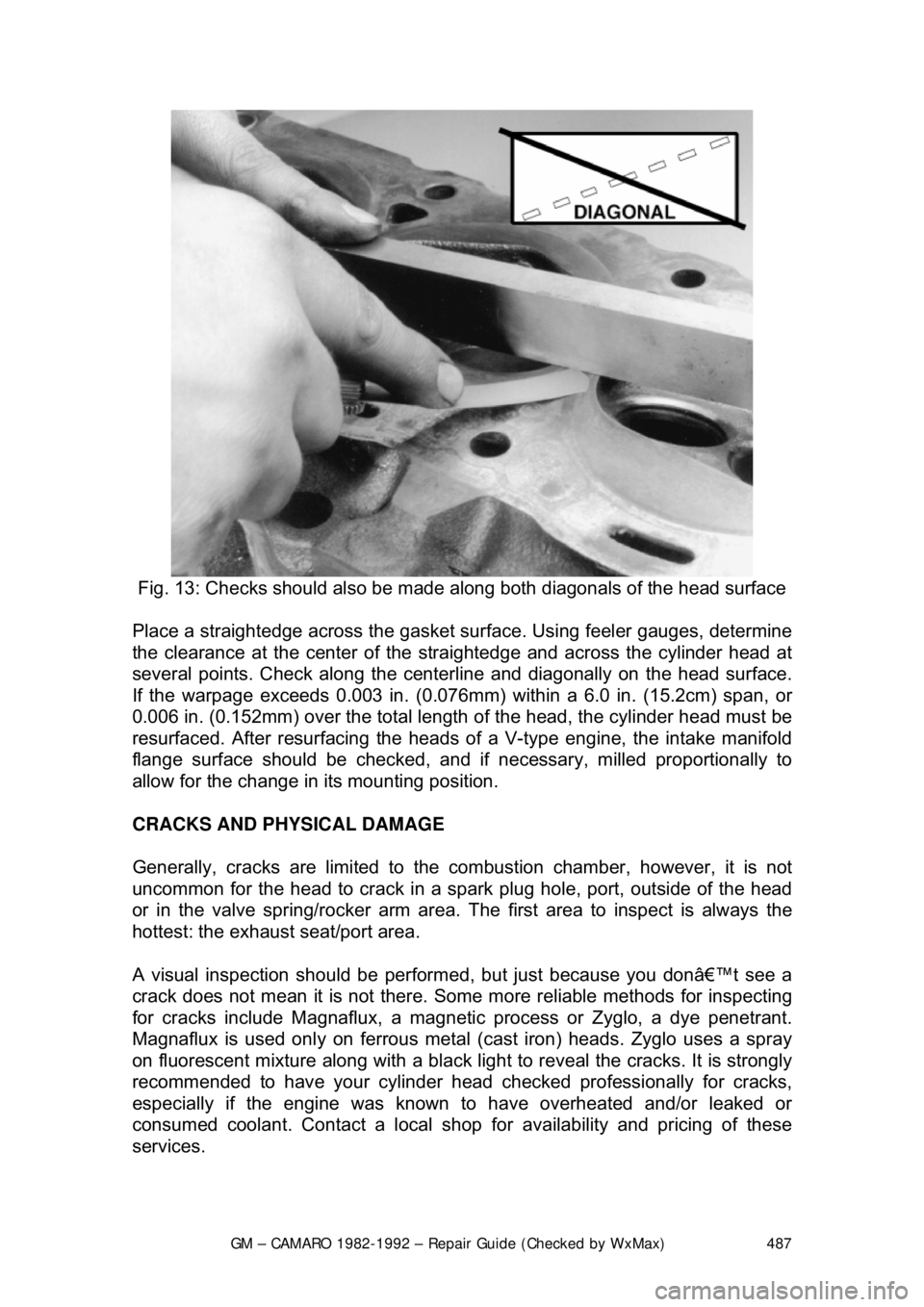
Fig. 13: Checks should also be made al ong both diagonals of the head surface
Place a straightedge across the gasket surf ace. Using feeler gauges, determine
the clearance at the cent er of the straightedge and across the cylinder head at
several points. Check along the centerli ne and diagonally on the head surface.
If the warpage exceeds 0.003 in. (0.076mm) within a 6.0 in. (15.2cm) span, or
0.006 in. (0.152mm) over the total length of the head, the cylinder head must be
resurfaced. After resurfacing the heads of a V-type engine, the intake manifold
flange surface should be checked, and if necessary, milled proportionally to
allow for the change in its mounting position.
CRACKS AND PHYSICAL DAMAGE
Generally, cracks are limited to the comb ustion chamber, however, it is not
uncommon for the head to crack in a s park plug hole, port, outside of the head
or in the valve spring/rocker arm area. The first area to inspect is always the
hottest: the exhaust seat/port area.
A visual inspection should be perform ed, but just because you don’t see a
crack does not mean it is not there. Some more reliable methods for inspecting
for cracks include Magnaflux, a magnetic process or Zyglo, a dye penetrant.
Magnaflux is used onl y on ferrous metal (cast iron) heads. Zyglo uses a spray
on fluorescent mixture along with a black light to reveal the cracks. It is strongly
recommended to have your cylinder head c hecked professionally for cracks,
especially if the engine was known to have overheated and/or leaked or
consumed coolant. Contact a local shop fo r availability and pricing of these
services.
Page 489 of 875

GM – CAMARO 1982-1992 – Repair Guide (Checked by WxMax) 489
There is no repair or refinishing possi
ble with the springs, retainers and valve
locks. If they are found to be worn or defective, they must be replaced with new
(or known good) parts.
CYLINDER HEAD
Most refinishing procedures dealing wit h the cylinder head must be performed
by a machine shop. Read the informati on below and review your inspection
data to determine whether or not machining is necessary.
VALVE GUIDE
If any machining or replacements are made to the valve guides, the seats must
be machined.
Unless the valve guides need machining or replacing, the only service to\
perform is to thoroughly clean them of any dirt or oil residue.
There are only two types of valve gu ides used on automobile engines: the
replaceable-type (all alumi num heads) and the cast-in in tegral-type (most cast
iron heads). There are four recommended methods for repairing worn guides.
• Knurling
• Inserts
• Reaming oversize
• Replacing
Knurling is a process in which metal is displaced and raised, thereby reducing
clearance, giving a true center, and providing oil control. It is the least
expensive way of repairing the valve guides . However, it is not necessarily the
best, and in some cases, a knurled valve guide will not stand up for more than a
short time. It requires a special knurle r and precision reaming tools to obtain
proper clearances. It would not be cost effective to purchase these tools, unless
you plan on rebuilding several of the same cylinder head.
Installing a guide insert involves machin ing the guide to accept a bronze insert.
One style is the coil-type wh ich is installed into a threaded guide. Another is the
thin-walled insert where the guide is ream ed oversize to accept a split-sleeve
insert. After the insert is installed, a s pecial tool is then run through the guide to
expand the insert, locking it to the guide. The insert is then reamed to the
standard size for proper valve clearance.
Reaming for oversize valves restores normal clearances and provides a true
valve seat. Most cast-in type guides can be reamed to accept an valve wi\
th an
oversize stem. The cost factor for this can become quite high as you will need
to purchase the reamer and new, oversize stem valves for all guides which
were reamed. Oversizes ar e generally 0.003 to 0.030 in. (0.076 to 0.762mm),
with 0.015 in. (0.381mm) being the most common.
Page 490 of 875

GM – CAMARO 1982-1992 – Repair Guide (Checked by WxMax) 490
To replace cast-in type valve guides, t
hey must be drilled out, then reamed to
accept replacement guides. This must be done on a fixture which will allow
centering and leveling off of the original valve seat or guide, otherwise a serious
guide-to-seat misalignment may occur maki ng it impossible to properly machine
the seat.
Replaceable-type guides are pressed into the cylinder head. A hammer and a
stepped drift or punch may be used to inst all and remove the guides. Before
removing the guides, measure the protrusi on on the spring side of the head and
record it for installation. Use the stepped drift to hammer out the old guide from
the combustion chamber side of the head. When installing, determine whether
or not the guide also seal s a water jacket in the head, and if it does, use the
recommended sealing agent. If there is no water jacket, grease the valve guide
and its bore. Use the stepped drift, and hamme r the new guide into the cylinder
head from the spring side of the cylinder head. A stack of washers the same
thickness as the measured protrusion may help the installation process.
VALVE SEATS
Before any valve seat machining can be performed, the guides must be within
factory recommended specifications.
If any machining or replacements were made to the valve guides, the seats
must be machined.
If the seats are in good condition, the va lves can be lapped to the seats, and the
cylinder head assembled. See the valves in formation for instructions on lapping.
If the valve seats are worn, cracked or damaged, they must be serviced by a
machine shop. The valve seat must be per fectly centered to the valve guide,
which requires very accurate machining.
CYLINDER HEAD SURFACE
If the cylinder head is war ped, it must be machined flat. If the warpage is
extremely severe, the head may need to be replaced. In some instances, it may
be possible to straighten a warped head enough to allow machining. In either
case, contact a professional machine shop for service.
CRACKS AND PHYSICAL DAMAGE
Certain cracks can be repaired in both ca st iron and aluminum heads. For cast
iron, a tapered threaded insert is inst alled along the length of the crack.
Aluminum can also use the tapered inse rts, however welding is the preferred
method. Some physical damage can be repaired through brazing or welding.
Contact a machine shop to get expert advice for your particular dilemma.
ASSEMBLY
Page 495 of 875

GM – CAMARO 1982-1992 – Repair Guide (Checked by WxMax) 495
Again, rotate the engine, this time
to position the number one cylinder bore
(head surface) up. Turn the crankshaft until the number one piston is at the
bottom of its travel, this should allow t he maximum access to its connecting rod.
Remove the number one co nnecting rods fasteners and cap and place two
lengths of rubber hose over the rod bolts/studs to protect the crankshaft from
damage. Using a sturdy wooden dowel and a hammer, push the connecting rod
up about 1 in. (25mm) from the cranks haft and remove the upper bearing insert.
Continue pushing or tapping the connecti ng rod up until the piston rings are out
of the cylinder bore. Remove the piston and rod by hand, put the upper half of
the bearing insert back into the rod, in stall the cap with its bearing insert
installed, and hand-tighten the cap fasteners. If the parts are kept in order in this
manner, they will not get lost and you wil l be able to tell which bearings came
form what cylinder if any problems are discovered and diagnosis is necessary.
Remove all the other piston assemblie s in the same manner. On V-style
engines, remove all of the pistons from one bank, then reposition the engine
with the other cylinder bank head surface up, and remo ve that banks piston
assemblies.
The only remaining component in the engine block should now be the
crankshaft. Loosen the main bearing ca ps evenly until the fasteners can be
turned by hand, then remove them and the caps. Remove the crankshaft fro\
m
the engine block. Thoroughly clea n all of the components.
INSPECTION
Now that the engine block and all of its components ar e clean, it's time to
inspect them for wear and/or damage. To accurately inspect them, you will need
some specialized tools:
• Two or three separate micromet ers to measure the pistons and
crankshaft journals
• A dial indicator
• Telescoping gauges for the cylinder bores
• A rod alignment fixture to check for bent connecting rods
If you do not have access to the proper tools, you may want to bring the
components to a shop that does.
Generally, you shouldn't expect cracks in the engine block or its components
unless it was known to leak, consume or mix engine fluids, it was severely
overheated, or there was ev idence of bad bearings and/or crankshaft damage.
A visual inspection should be performed on all of the components, but just
because you don't see a crack does not mean it is not there. Some more
reliable methods for inspecting for cracks include Magnaflux, a magnetic
process or Zyglo, a dye penetrant. M agnaflux is used only on ferrous metal
(cast iron). Zyglo uses a spray on fluoresce nt mixture along with a black light to
reveal the cracks. It is strongly recommended to have your engine block
checked professionally for cracks, especia lly if the engine was known to have
overheated and/or leaked or consumed coolant. Contact a local shop for
availability and pricing of these services.
Page 498 of 875

GM – CAMARO 1982-1992 – Repair Guide (Checked by WxMax) 498
3. Measure the gauge with the microm
eter and record the reading.
4. Again, hold the gauge square in t he bore, this time parallel to the
crankshaft centerline, and ge ntly tighten the lock. Again, you will tilt the
gauge back to remove it from the bore.
5. Measure the gaug e with the micrometer and record this reading. The
difference between these two readings is the out-of-round measurement
of the cylinder.
6. Repeat steps 1 through 5, each time going to the next lower position,
until you reach the bottom of the cyli nder. Then go to the next cylinder,
and continue until all of the cylinders have been measured.
The difference between these measurements will tell you all about the wear in
your cylinders. The measurements whic h were taken 90 degrees from the
crankshaft centerline will always reflect t he most wear. That is because at this
position is where the engine power presses the piston against the cylinder bore
the hardest. This is known as thrust wear. Take your top, 90 degree
measurement and compare it to your bottom, 90 degree measurement. The
difference between them is the taper. W hen you measure your pistons, you will
compare these readings to your pist on sizes and determine piston-to-wall
clearance.
CRANKSHAFT
Inspect the crankshaft for visible signs of wear or damage. All of the journals
should be perfectly round and smooth. Slight scores are normal for a used
crankshaft, but you should hardly feel them with your fingernail. When
measuring the crankshaft wit h a micrometer, you will take readings at the front
and rear of each journal, then turn t he micrometer 90 degrees and take two
more readings, front and rear. The differ ence between the front-to-rear readings
is the journal taper and the first-to -90 degree reading is the out-of-round
measurement. Generally, there should be no taper or out-of-roundness found,
however, up to 0.0005 in. (0.0127mm) fo r either can be overlooked. Also, the
readings should fall within the factory s pecifications for journal diameters.
If the crankshaft journals fall within specif ications, it is recommended that it be
polished before being returned to service. Polishing the crankshaft insures that
any minor burrs or high spots are smoot hed, thereby reducing the chance of
scoring the new bearings.
PISTONS AND CONNECTING RODS
PISTONS
The piston should be visually inspect ed for any signs of cracking or burning
(caused by hot spots or detonation), and scuffing or excessive wear on the
skirts. The wristpin attaches the piston to the connecting rod. The piston should
move freely on the wrist pin, both sliding and pivoting. Grasp the connecting rod
securely, or mount it in a vise, and tr y to rock the piston back and forth along
the centerline of t he wristpin. There should not be any excessive play evident
between the piston and the pin. If there are C-clips retaining the pin in the piston