1982 CHEVROLET CAMARO service
[x] Cancel search: servicePage 627 of 875
GM – CAMARO 1982-1992 – Repair Guide (Checked by WxMax) 627
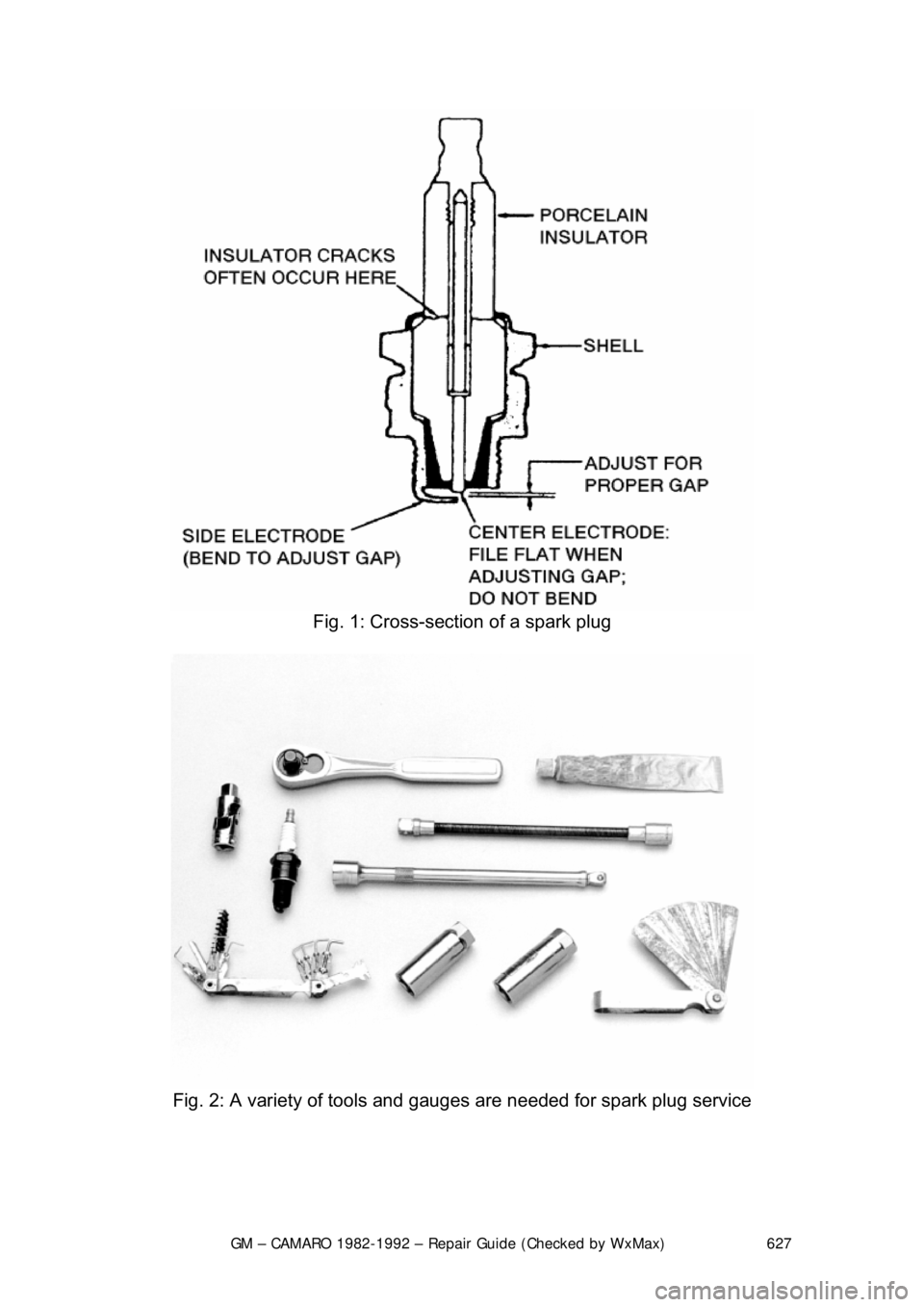
Fig. 1: Cross-secti on of a spark plug
Fig. 2: A variety of tools and gaug es are needed for spark plug service
Page 630 of 875

GM – CAMARO 1982-1992 – Repair Guide (Checked by WxMax) 630
WARNING
- Do not use the spark plug socke t to thread the plugs. Always
carefully thread the plug by hand or us ing an old plug wire to prevent the
possibility of crossthreading and damaging the cylinder head bore.
8. Carefully tighten the spark plug. If the plug you are installing is equipped
with a crush washer, seat the plug, then tighten about
1/4 turn to crush
the washer. If you are installing a t apered seat plug, tighten the plug to
specifications provided by the vehicle or plug manufacturer.
9. Apply a small amount of silicone di electric compound to the end of the
spark plug lead or inside the spark pl ug boot to prevent sticking, then
install the boot to the spark plug and pus h until it clicks into place. The
click may be felt or hear d, then gently pull back on the boot to assure
proper contact.
INSPECTION & GAPPING
Check the plugs for deposits and wear. If they are not going to be replaced,
clean the plugs thoroughly. Remember t hat any kind of deposit will decrease
the efficiency of the plug. Plugs can be cleaned on a spark plug cleaning
machine, which can sometimes be found in service stations, or you can do an
acceptable job of cleaning with a stiff br ush. If the plugs are cleaned, the
electrodes must be filed flat. Use an igni tion points file, not an emery board or
the like, which will leave deposits. The electrodes must be filed perfectly flat
with sharp edges; rounded edges reduce the s park plug voltage by as much as
50%.
Check spark plug gap before installati on. The ground electrode (the L-shaped
one connected to the body of the plug) mu st be parallel to the center electrode
and the specified size wire gauge (please refer to the Tune-Up Specifications
chart for details) must pass between t he electrodes with a slight drag.
NEVER adjust the gap on a used platinum type spark plug .
Always check the gap on new plugs as they are not always set correctly a\
t the
factory. Do not use a flat feeler g auge when measuring the gap on a used plug,
because the reading may be inaccurate. A round-wire type gapping tool is the
best way to check the gap. The co rrect gauge should pass through the
electrode gap with a slight drag. If you're in doubt, try one size smaller and one
larger. The smaller gauge should go through easily, while the larger one\
shouldn't go through at all. Wire gapping tools usually have a bending tool
attached. Use that to adjust the side electrode until the proper distance is
obtained. Absolutely never attempt to bend the center electrode. Also, be
careful not to bend the side electrode too fa r or too often as it may weaken and
break off within the engine, requiring remova l of the cylinder head to retrieve it.
Page 666 of 875

GM – CAMARO 1982-1992 – Repair Guide (Checked by WxMax) 666
FUEL SYSTEM
BASIC FUEL SYSTEM DIAGNOSIS
When there is a problem star ting or driving a vehicle, two of the most important
checks involve the ignition and the fuel systems. The questions most mechanics
attempt to answer first, "is there spark?" an d "is there fuel?" will often lead to
solving most basic problems. For igni tion system diagnosis and testing, please
refer to the information on engine electr ical components and ignition systems
found earlier in this repair guide. If the ignition system checks out (there is
spark), then you must determine if the f uel system is operating properly (is there
fuel?).
CARBURETED FUEL SYSTEM
MECHANICAL FUEL PUMP
All fuel pumps used on carbureted V6 and V8 engines are of the diaphragm
type and are serviced by replacement onl y. No adjustments or repairs are
possible. The fuel pump is mounted on th e left front (V6) and right front (V8) of
the engine.
The fuel pumps are also equipped with vapor return lines for purposes of
emission control and to reduce vapor lock. All pumps are operated by an
eccentric on the camshaft. On V6 an d V8 engines, a pushrod between the
camshaft eccentric and the fuel pump operates the pump.
REMOVAL & INSTALLATION
When disconnecting the fuel pump outlet fitting, always use two wrenches to
avoid twisting the line.
1. Disconnect the fuel in take and outlet lines at the pump, then plug the
pump intake line.
2. Remove the two pump mounting bol ts and lockwashers; remove the
pump and its gasket.
3. If the pump pushrod is to be remo ved from the V8, remove the two
adapter bolts and lockwashers, then re move the adapter and its gasket.
4. Install the fuel pump with a new gasket reversing the removal procedure.
Coat the mating surfaces with sealer.
5. Connect the fuel lines and check for leaks.
Page 688 of 875
GM – CAMARO 1982-1992 – Repair Guide (Checked by WxMax) 688
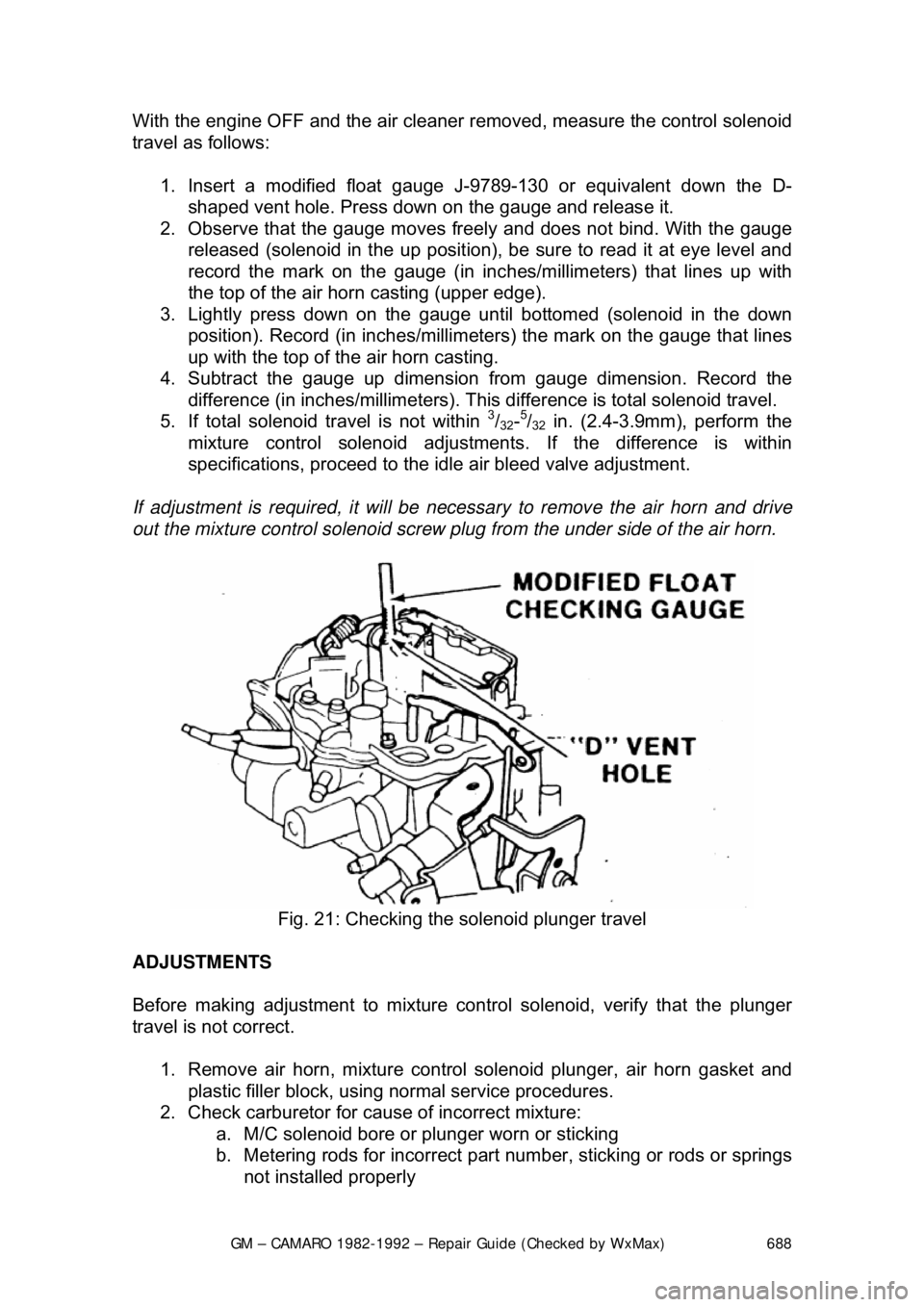
With the engine OFF and the air cleaner re
moved, measure the control solenoid
travel as follows:
1. Insert a modified float gauge J- 9789-130 or equivalent down the D-
shaped vent hole. Press down on the gauge and release it.
2. Observe that the gauge moves freel y and does not bind. With the gauge
released (solenoid in the up position), be sure to read it at eye level and
record the mark on the gauge (in inc hes/millimeters) that lines up with
the top of the air hor n casting (upper edge).
3. Lightly press down on the gauge until bottomed (solenoid in the down
position). Record (in inches/millimeters) the mark on the gauge that lines
up with the top of the air horn casting.
4. Subtract the gauge up dimension from gauge dimension. Record the
difference (in inches/millimet ers). This difference is total solenoid travel.
5. If total solenoid travel is not within
3/32-5/32 in. (2.4-3.9mm), perform the
mixture control solenoid adjustment s. If the difference is within
specifications, proceed to the id le air bleed valve adjustment.
If adjustment is required, it will be necessary to remove the air horn and drive
out the mixture control solenoid screw pl ug from the under side of the air horn.
Fig. 21: Checking the solenoid plunger travel
ADJUSTMENTS
Before making adjustment to mixture cont rol solenoid, verify that the plunger
travel is not correct.
1. Remove air horn, mixture control solenoid plunger, air horn gasket and
plastic filler block, using normal service procedures.
2. Check carburetor for caus e of incorrect mixture:
a. M/C solenoid bore or plunger worn or sticking
b. Metering rods for incorrect part number, sticking or rods or springs
not installed properly
Page 689 of 875

GM – CAMARO 1982-1992 – Repair Guide (Checked by WxMax) 689
c. Foreign material in jets
3. Remove throttle side metering rod. Install mixture control solenoid
gauging tool, J-33815-1, BT-8253-A, or equi valent, over the throttle side
metering jet rod guide and temporarily reinstall the solenoid plunger into
the solenoid body.
4. Holding the solenoid plunger in the DOWN position, use tool J-28696-10,
BT-7928, or equivalent, to turn lean mixture solenoid screw
counterclockwise until the plunger br eaks contact with the gauging tool.
Turn slowly clockwise until the pl unger makes contact with the gauging
tool. The adjustment is correct when t he solenoid plunger is contacting
both the solenoid stop and the gauging tool.
If the total difference in adjustment required less than
3/4 turn of the lean mixture
solenoid screw, the original setting was within the manufacturer's specifications.
5. Remove solenoid plunger and gaugi ng tool and reinstall metering rod
and plastic filler block.
6. Invert air horn and remove rich mixt ure stop screw from bottom side of
air horn, using tool J-28696-4, BT-7967-A, or equivalent.
7. Remove lean mixture screw plug and the rich mixture stop screw plug
from air horn, using a punch.
8. Reinstall rich mixtur e stop screw in air horn and bottom lightly, then back
screw out
1/4 turn.
9. Reinstall air horn gasket, mixture c ontrol solenoid plunger and air horn to
carburetor.
10. Adjust the M/C solenoid pl unger travel as follows:
a. Insert float gauge down D- shaped vent hole. Press down on
gauge and release, observing th at the gauge moves freely and
does not bind. With gauge released, (plunger UP position), read at
eye level and record the reading of the gauge mark (in
inches/millimeters) that lines up with the top of air horn casting,
(upper edge).
b. Lightly press dow n on gauge until bottomed, (plunger DOWN
position). Read and record (in inc hes/millimeters) the reading of
the gauge mark that lines up with top of air horn casting.
c. Subtract gauge UP position from the gauge DOWN position and
record the difference. This difference is the total plunger travel.
Insert external float gauge in vent hole and, with tool J-28696-10,
BT-7928, or equivalent, adjust rich mixture stop screw to obtain
5/32 in. (3.9mm) total plunger travel.
11. With solenoid plunger travel corre ctly set, install plugs (supplied in
service kits) in the air horn, as follows:
a. Install plug, hollow end down, into the access hole for the lean
mixture (solenoid) screw. Use suit ably sized punch to drive plug
into the air horn until t he top of plug is even with the lower. Plug
must be installed to retain the sc rew setting and to prevent fuel
vapor loss.
Page 700 of 875
GM – CAMARO 1982-1992 – Repair Guide (Checked by WxMax) 700
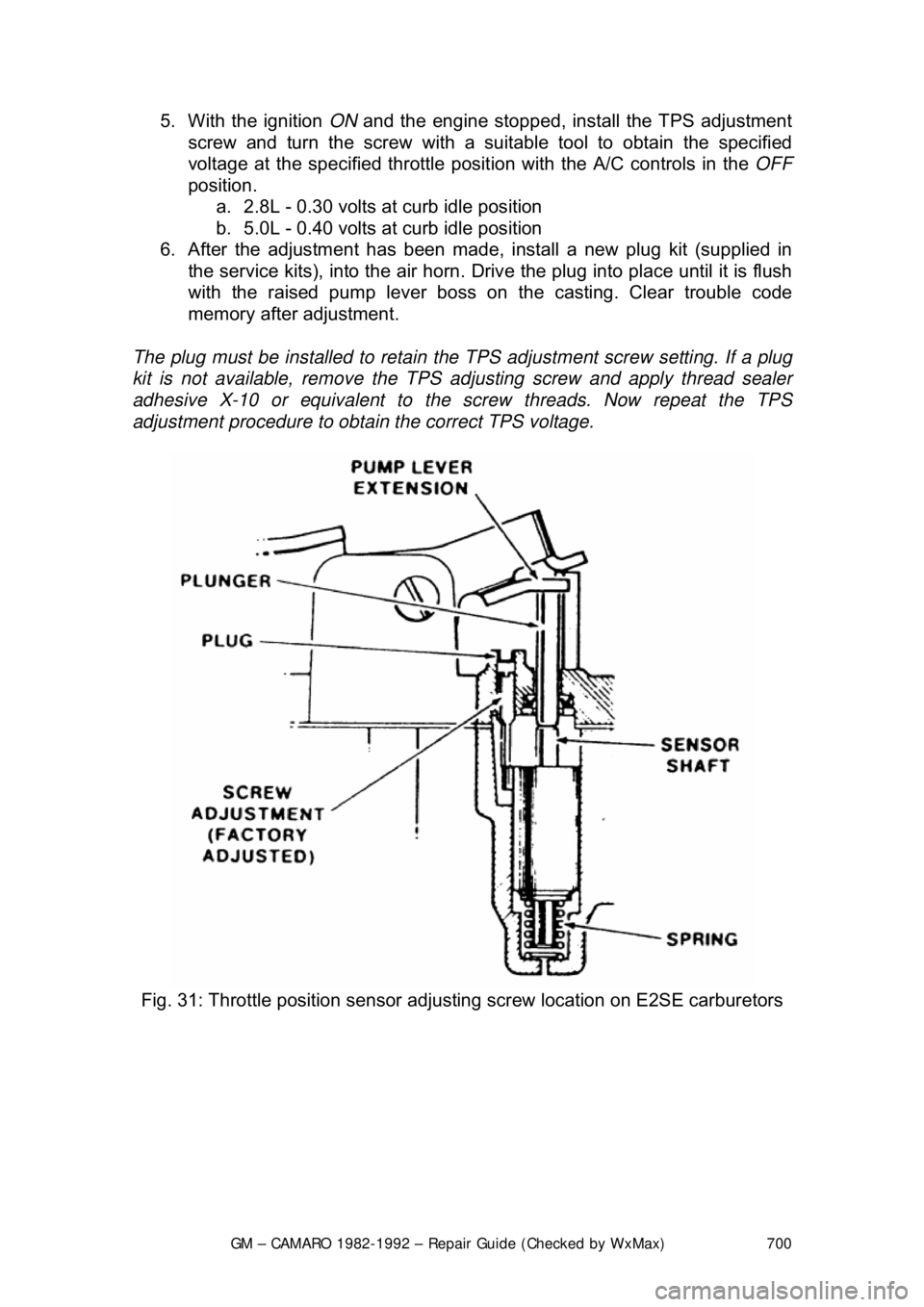
5. With the ignition
ON and the engine stopp ed, install the TPS adjustment
screw and turn the screw with a suitable tool to obtain the specified
voltage at the specified throttle posit ion with the A/C controls in the OFF
position. a. 2.8L - 0.30 volts at curb idle position
b. 5.0L - 0.40 volts at curb idle position
6. After the adjustment has been made, install a new plug kit (supplied in
the service kits), into the air horn. Driv e the plug into place until it is flush
with the raised pump lever boss on t he casting. Clear trouble code
memory after adjustment.
The plug must be installed to retain the TPS adjustment screw setting. If a plug
kit is not available, remove the T PS adjusting screw and apply thread sealer
adhesive X-10 or equivalent to the scr ew threads. Now repeat the TPS
adjustment procedure to obtain the correct TPS voltage.
Fig. 31: Throttle position sensor adjus ting screw location on E2SE carburetors
Page 708 of 875

GM – CAMARO 1982-1992 – Repair Guide (Checked by WxMax) 708
rapidly. Failure to replace all parts s
upplied with the kit (especially gaskets) can
result in poor performance later.
Some carburetor manufacturers supply overhaul kits for three basic types:
minor repair; major repair; and gasket kits. Certain parts may be expected in
most kits based on the desired degree of overhaul.
MINOR REPAIR KITS
• All gaskets
• Float needle valve
• All diaphragms
• Spring for the pump diaphragm
MAJOR REPAIR KITS
• All jets and gaskets
• All diaphragms
• Float needle valve
• Pump ball valve
• Float
• Complete intermediate rod
• Intermediate pump lever
• Some cover hold-down screws and washers
GASKET KITS
• All gaskets
Efficient carburetion depends greatly on careful cleaning and inspection during
overhaul, since dirt, gum, water, or varnis h in or on the carburetor parts are
often responsible for poor performance.
Overhaul your carburetor in a clean, dust-free area. Carefully disassemble the
carburetor, referring often to the explod ed views and directions packaged with
the rebuilding kit. Keep all similar and look-alike parts separated during
disassembly and cleaning to avoid accidental interchange during assembly\
.
Make a note of all jet sizes.
When the carburetor is disassembled, wash all parts (except diaphragms,
electric components, pump pl unger, and any other plastic, leather, fiber, or
rubber parts) in clean carbur etor solvent. Do not leave parts in the solvent any
longer than is necessary to sufficiently loosen the deposits. Excessive cleaning
may remove the special finish from the float bowl and choke valve bodies,
leaving these parts unfit for service. Rinse all parts in clean solvent and blow
them dry with compressed air or allow them to air dry. Wipe clean all cork,
plastic, leather, and fiber parts with a clean, lint-free cloth.
Blow out all passages and jets with comp ressed air and be sure that there are
no restrictions or blockages. Never use wi re or similar tools to clean jets, fuel
Page 710 of 875

GM – CAMARO 1982-1992 – Repair Guide (Checked by WxMax) 710
•
Check the pump passages and the jet(s) for dirt, improper seating of the
discharge checkball or t he temperature bypass disc and/or scores in the
pumpwell. Check the condition of t he pump discharge check ball spring,
replace as necessary
• Check the pump linkage for excessiv e wear; repair or replace as
necessary
HARD STARTING-POOR COLD OPERATION
• Check the choke valve and linkage for excessive wear, binds or
distortion
• Test the vacuum break diaphragm(s) for leaks
• Clean or replace the fuel filter
• Inspect the float valve fo r sticking, dirt, etc.
• Also check the items under "Flooding"
POOR PERFORMANCE-POOR GAS MILEAGE
• Clean all fuel and vacuum passages in the castings
• Check the choke valve fo r freedom of movement
• Check the Mixture Control (M/C) soleno id for sticking, binding or leaking
• Check the air valve and secondary me tering rod for binding conditions. If
the air valve or metering rod is da maged or the metering rod adjustment
is changed from the factory setting, the air horn assembly must be
replaced. Also check the air valve le ver spring for proper installation
ROUGH IDLE
• Inspect the gasket and gasket mating su rfaces on the casting for nicks,
burrs or damage to the sealing beads
• Check the operation and sealing of the mixture control solenoid
• Clean all of the idle field passages
• If removed, inspect the idle mixture needle for ridges, burrs or being bent
• Check the throttle lever and valves for binds, nicks. or other damage
• Check all of the diaphragms for possible ruptures or leaks
After cleaning and checking all components, reassemble the carburetor, using
new parts and referring to the exploded view. When reassembling, make sure
that all screws and jets are tight in their seats, but do not overtighten as the tips
will be distorted. Tighten al l screws gradually, in rotation. Do not tighten needle
valves into their seats; uneven jetting will result. Always use new gaskets. Be
sure to follow all assembly and adjustment procedures.
Before performing any service on the carburet or, it is essential that it be placed
on a suitable holding fixtur e, such as tool J-9789-118, BY-30-15 or equivalent.
Without the use of the holding fixture, it is possible to damage throttle valves or
other parts of the carburetor.