1982 CHEVROLET CAMARO service
[x] Cancel search: servicePage 500 of 875

GM – CAMARO 1982-1992 – Repair Guide (Checked by WxMax) 500
within specifications, install new bear
ings in the rod and take another
measurement. If the clearance is still out of specifications, and the crankshaft is
not, the rod will need to be reconditioned by a machine shop.
You can also use Plastigage to check the bearing clearances. The assembling
section has complete instructions on its use.
CAMSHAFT
Inspect the camshaft and lifters/followers as described earlier in this section.
BEARINGS
All of the engine bearings should be visua lly inspected for wear and/or damage.
The bearing should look evenly worn a ll around with no deep scores or pits. If
the bearing is severely worn, scored, pi tted or heat blued, then the bearing, and
the components that use it, should be brought to a machine shop for inspection.
Full-circle bearings (used on most camshafts, auxiliary shafts, balance shafts,
etc.) require specialized tools for re moval and installation, and should be
brought to a machine shop for service.
OIL PUMP
The oil pump is responsible for provid ing constant lubrication to the whole
engine and so it is re commended that a new oil pump be installed when
rebuilding the engine.
Completely disassemble the oil pump and thoroughly clean all of the
components. Inspect the oil pump gears and housing for wear and/or damage.
Insure that the pressure relief valve oper ates properly and there is no binding or
sticking due to varnish or debris. If all of the parts are in proper working
condition, lubricate the gears and relie f valve, and assemble the pump.
REFINISHING
Almost all engine block refinishing must be performed by a machine shop. If the
cylinders are not to be rebored, then t he cylinder glaze can be removed with a
ball hone. When removing cylinder glaz e with a ball hone, use a light or
penetrating type oil to lubricate the hone. Do not allow the hone to run dry as
this may cause excessive scoring of t he cylinder bores and wear on the hone. If
new pistons are required, t hey will need to be installed to the connecting rods.
This should be performed by a machine shop as the pistons must be installed in
the correct relationship to the rod or engine damage can occur.
Page 501 of 875

GM – CAMARO 1982-1992 – Repair Guide (Checked by WxMax) 501
Fig. 5: Use a ball type cylinder hone to remove any glaze and provide a new
surface for seating the piston rings
PISTONS AND CONNECTING RODS
Only pistons with the wrist pin retained by C-clips are serviceable by the home-
mechanic. Press fit pistons require special presses and/or heaters to
remove/install the connecting rod and sh ould only be performed by a machine
shop.
All pistons will have a mark indicating the direction to the front of the engine and
the must be installed into the engine in that manner. Usually it is a notch or
arrow on the top of the piston, or it ma y be the letter F cast or stamped into the
piston.
Page 537 of 875

GM – CAMARO 1982-1992 – Repair Guide (Checked by WxMax) 537
ENGINE CONTROLS
EMISSION CONTROLS
CRANKCASE VENTILATION SYSTEM
OPERATION
The Positive Crankcase Ventilation (PCV ) system is used to control crankcase
blow-by vapors. As the engine is running, clean, filtered air is drawn through the
air filter and into the crankcase. As the air passes through the crankca\
se, it
picks up the combustion gases and carries them out of the crankcase, through
the PCV valve, and into the induction system . As they enter the intake manifold,
they are drawn into the combustion chamber where they are reburned.
The most critical component in the system is the PCV valve. This valve controls
the amount of gases which are recycled into the combustion chamber. At low
engine speeds, the valve is partially clos ed, limiting the flow of gases into the
intake manifold. As engine speed incr eases, the valve opens to admit greater
quantities of gases into the intake manifold. If the PCV valve becomes clogged,
the system is designed to allow excessive amounts of blow-by gases to back
flow through the crankcase tube into the air cleaner to be consumed by normal
combustion.
Fig. 1: PCV flow on 4, 6 and 8cylinder engines
SERVICE
Inspect the PCV system hose and connecti ons at each tune-up and replace any
deteriorated hoses. Check the PCV valve at every tune-up and replace it at
30,000 mile intervals.
Page 551 of 875
GM – CAMARO 1982-1992 – Repair Guide (Checked by WxMax) 551
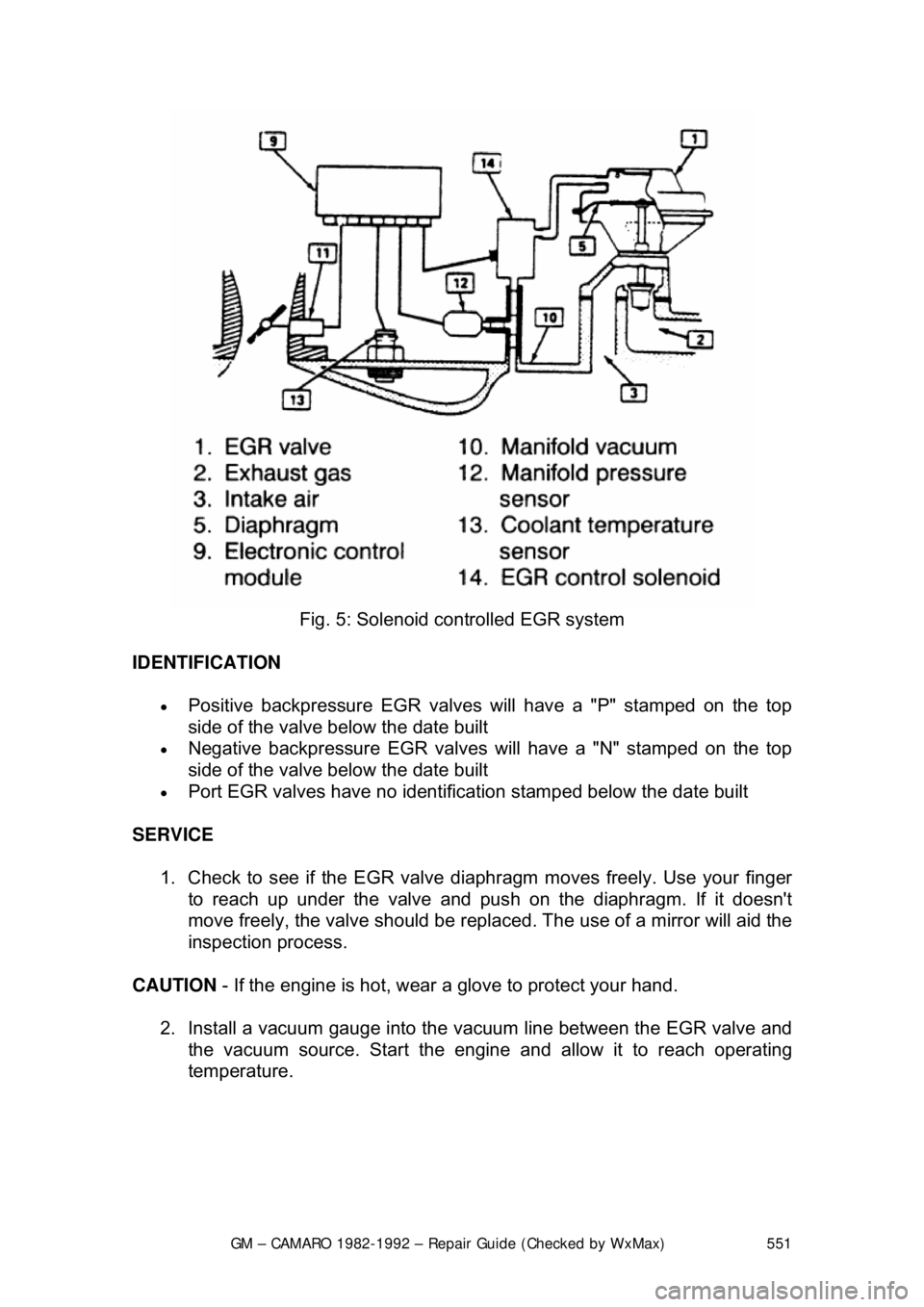
Fig. 5: Solenoid c ontrolled EGR system
IDENTIFICATION
• Positive backpressure EGR valves will have a "P" stamped on the top
side of the valve bel ow the date built
• Negative backpressure EGR valves will have a "N" stamped on the top
side of the valve bel ow the date built
• Port EGR valves have no identificat ion stamped below the date built
SERVICE 1. Check to see if the EGR valve di aphragm moves freely. Use your finger
to reach up under the valve and pus h on the diaphragm. If it doesn't
move freely, the valve should be repl aced. The use of a mirror will aid the
inspection process.
CAUTION - If the engine is hot, wear a glove to protect your hand.
2. Install a vacuum gauge into the vacuum line between the EGR valve and
the vacuum source. Star t the engine and allow it to reach operating
temperature.
Page 560 of 875
GM – CAMARO 1982-1992 – Repair Guide (Checked by WxMax) 560
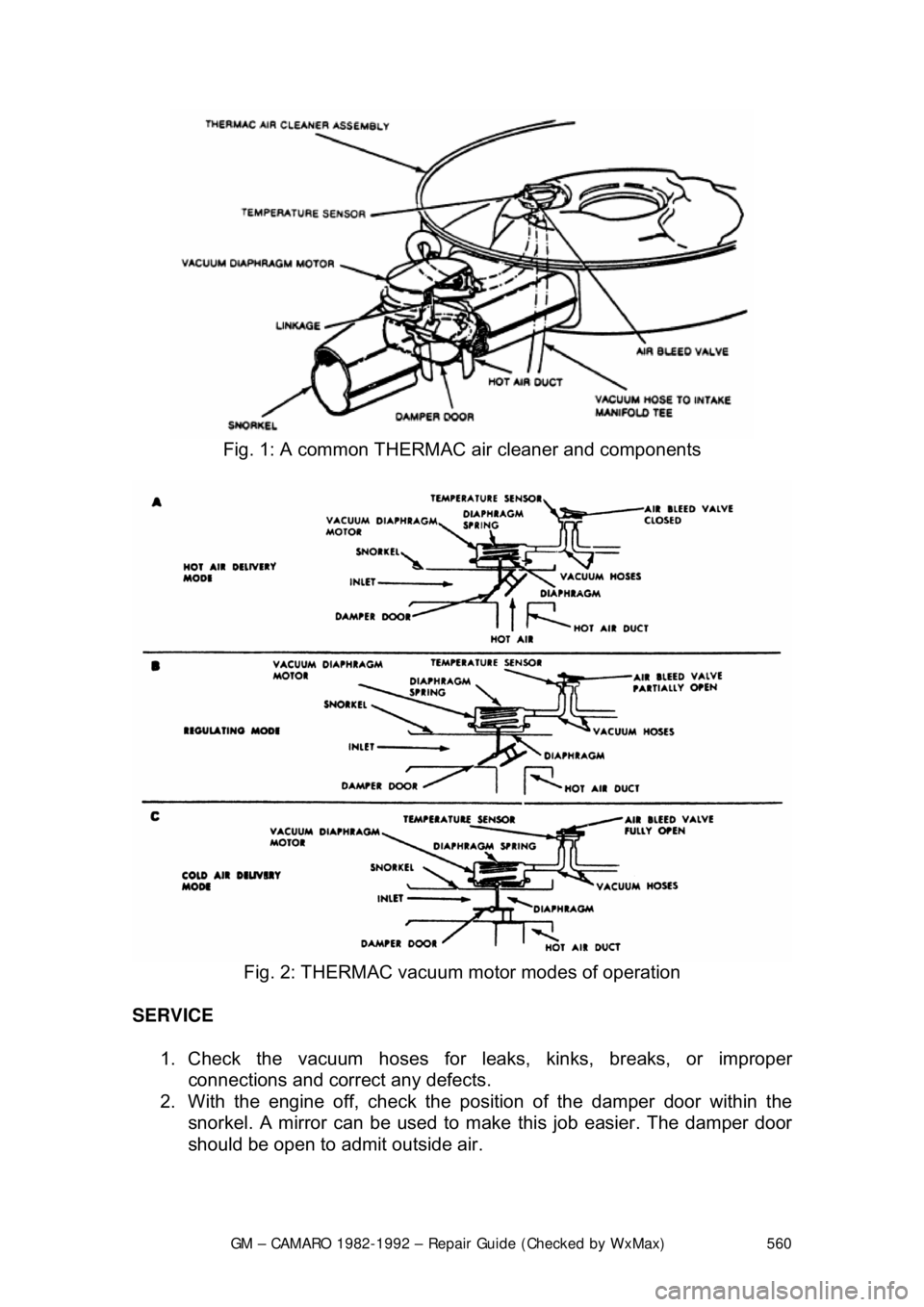
Fig. 1: A common THERMAC air cleaner and components
Fig. 2: THERMAC vacuum motor modes of operation
SERVICE 1. Check the vacuum hoses for leaks, kinks, breaks, or improper connections and correct any defects.
2. With the engine off, check the pos ition of the damper door within the
snorkel. A mirror can be used to make this job easier. The damper door
should be open to admit outside air.
Page 573 of 875

GM – CAMARO 1982-1992 – Repair Guide (Checked by WxMax) 573
7. Install the retaining bracket.
8. Connect the negative battery cable.
ELECTRONIC ENGINE CONTROLS
COMPUTER COMMAND CO NTROL (CCC) SYSTEM
The Computer Command Control (CCC) Sy stem is an electronically controlled
exhaust emission system that can m onitor and control a large number of
interrelated emission cont rol systems. It can monitor various engine/vehicle
operating conditions and then use this in formation to control multiple engine
related systems. The CCC syst em is thereby making constant adjustments to
maintain optimum vehicle performance und er all normal driving conditions while
at the same time allowing the catalyti c converter to effectively control the
emissions of HC, CO and NO
x.
OPERATION
The Electronic Control Module (ECM) is required to maintain the exhaust
emissions at acceptable le vels. The module is a sma ll, solid state computer
which receives signals from many source s and sensors; it uses these data to
make judgements about operating conditions and then control output signals to
the fuel and emission systems to ma tch the current requirements.
Inputs are received from m any sources to form a complete picture of engine
operating conditions. Some inputs are simp ly Yes or No messages, such as that
from the Park/Neutral switch; the vehicle is either in gear or in Park/Neutral;
there are no other choices. Other data is sent in quantitative input, such as
engine rpm or coolant temperature. T he ECM is pre-programmed to recognize
acceptable ranges or combinations of si gnals and control the outputs to control
emissions while providing good driv eability and economy. The ECM also
monitors some output circuits, making sure that the components function as
commanded. For proper engine oper ation, it is essential that all input and output
components function properly and comm unicate properly with the ECM.
Since the control module is programmed to recognize the presence and value
of electrical inputs, it will also note the lack of a signal or a radical change in
values. It will, for example, react to the loss of signal from the vehicle speed
sensor or note that engine coolant temperature has risen beyond acceptable
(programmed) limits. Once a fault is recognized, a numeric code is assigned
and held in memory. The SERVICE ENGIN E SOON Malfunction Indicator Lamp
(MIL), will illuminate to advise the operator that the system has detected a fault.
More than one code may be stored. Although not every engine uses every
code, possible codes range from 12-999. Additionally, the same code may carry
different meanings relative to each engine or engine family. For example, on the
3.3L (VIN N) engine, code 46 indicates a fault found in the power steering
pressure switch circuit. The same code on the 5.7L (VIN F) engine indicates a
fault in the VATS anti-theft system.
Page 577 of 875

GM – CAMARO 1982-1992 – Repair Guide (Checked by WxMax) 577
MALFUNCTION INDICATOR LAMP
The primary function of the MIL is to adv
ise the operator and the technician that
a fault is detected, and, in most cases, a code is stored. Under normal
conditions, the malfunction indicator la mp will illuminate when the ignition is
turned ON. Once the engine is started and running, the ECM will perform a
system check and extinguish the lamp if no fault is found.
Additionally, the lamp can be used to retrieve stored codes after the system is
placed in the Diagnostic Mode. Codes ar e transmitted as a series of flashes
with short or long pauses. When the syst em is placed in the Field Service
Mode, the dash lamp will indicate open loop or closed loop function to the
technician.
INTERMITTENTS
If a fault occurs intermittently, such as a loose connector pin breaking contact
as the vehicle hits a bump, the ECM will note the fault as it occurs and energize
the dash warning lamp. If the problem se lf-corrects, as with the terminal pin
again making contact, the dash lamp will extinguish after 10 seconds but\
a code
will remain stored in the ECM memory.
When an unexpected code appe ars during diagnostics, it may have been set
during an intermittent failure that self-c orrected; the codes are still useful in
diagnosis and should not be discounted.
OXYGEN SENSOR
OPERATION
An oxygen sensor is used on all models. The sensor protrudes into the exhaust
stream and monitors the oxygen content of the exhaust gases. The difference
between the oxygen content of the exhaust gases and that of the outside air
generates a voltage si gnal to the ECM. The ECM monitors this voltage and,
depending upon the value of the signal rece ived, issues a command to adjust
for a rich or a lean condition.
No attempt should ever be made to meas ure the voltage output of the sensor.
The current drain of any conventional vo ltmeter would be such that it would
permanently damage the sensor.
Page 596 of 875

GM – CAMARO 1982-1992 – Repair Guide (Checked by WxMax) 596
recommended to have a qualified technici
an perform any further testing, if
needed.
FIELD SERVICE MODE
On fuel injected models, if the ALDL terminal B is grounded to terminal A with
the engine running, the system enters the Field Service Mode. In this mode, the
MIL will indicate whether the system is operating in open loop or closed loop.
If working in open loop, t he MIL will flash rapidly 2
1/2 times per second. In
closed loop, the flash rate slows to once per second. Additionally, if the system
is running lean in closed loop, the lamp will be off most of the cycle. A rich
condition in closed loop will cause the lamp to remain lit for most of the one
second cycle.
When operating in the Field Service M ode, additional codes cannot be stored
by the ECM. The closed loop timer is bypassed in this mode.
CLEARING CODES
Stored fault codes may be erased from me mory at any time by removing power
from the ECM for at least 30 seconds. It may be necessary to clear stored
codes during diagnosis to check for any re currence during a test drive, but the
stored should be written dow n when retrieved. The codes may still be required
for subsequent troubleshooting. Whenever a repair is complete, the stored
codes must be erased and the vehicle te st driven to confirm correct operation
and repair.
The ignition switch must be OFF any ti me power is disconnected or restored to
the ECM. Severe damage may result if this precaution is not observed.
Depending on the electric di stribution of the particular vehicle, power to the
ECM may be disconnected by removing the ECM fuse in the fusebox or
disconnecting the inline EC M power lead at the positive battery terminal.
Disconnecting the negative battery cable to clear codes will achieve the desired
result, but this will also clear other me mory data in the vehicle such as radio
presets or seat memory.