1982 CHEVROLET CAMARO service
[x] Cancel search: servicePage 160 of 875

GM – CAMARO 1982-1992 – Repair Guide (Checked by WxMax) 160
damage, and legal considerations (such as t
he fact that it is a federal crime to
vent refrigerant into the atmosphere), dictate that the A/C components on your
vehicle should be serviced only by a Motor Vehicle Air Conditioning (MVAC)
trained, and EPA certified aut omotive technician.
If your vehicle's A/C system uses R-12 re frigerant and is in need of recharging,
the A/C system can be c onverted over to R-134a refrigerant (less
environmentally harmful and expensive). Refer to General Information &
Maintenance for additional information on R- 12 to R-134a conversions, and for
additional considerations dealing with your vehicle's A/C system.
CONTROL CABLES
REMOVAL & INSTALLATION
Some of the following cables will not be used on all models and model years.
Left and Right Air Vent Cables 1. Remove the left and right sound insulators.
2. Remove the screws attaching the cabl es to the steering column cover.
3. Disengage the cable clamps at the vent ducts.
4. Disengage the Z-shaped c able ends from the vent valve levers.
5. Remove the air vent cables notin g their positions for installation.
To install: 6. Place the cables in posi tion under the instrument panel.
7. Engage the Z-shaped cable ends to the vent valve levers.
8. Snap the cable clamps into the slot of the bracket formed on the vent
ducts.
9. Attach the air vent cables at the steering column cover.
10. Install the sound insulators and test cable operation.
Fig. 1: Cable attachment at the steering column cover
Page 169 of 875
GM – CAMARO 1982-1992 – Repair Guide (Checked by WxMax) 169
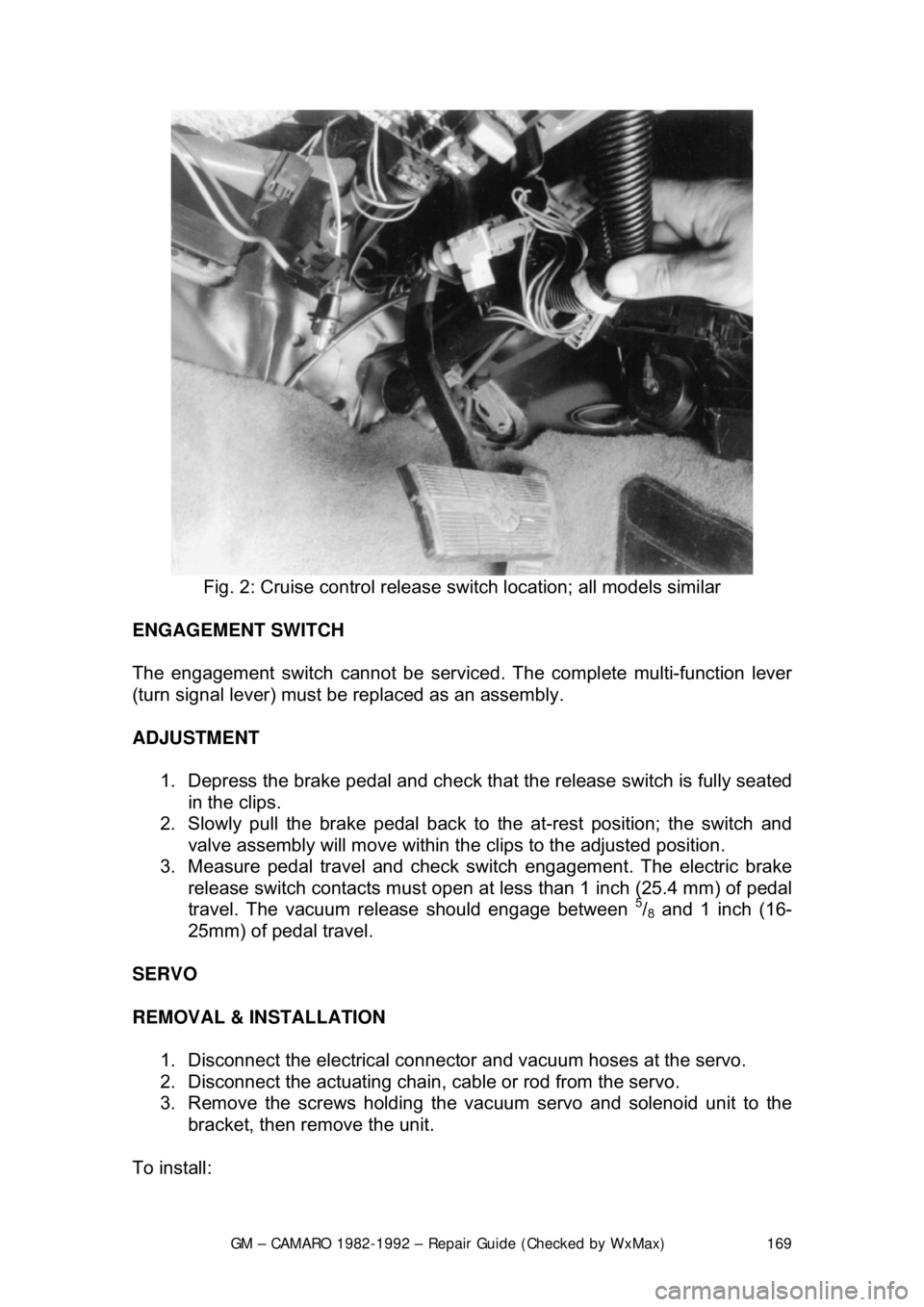
Fig. 2: Cruise control release sw itch location; all models similar
ENGAGEMENT SWITCH
The engagement switch cannot be serviced . The complete multi-function lever
(turn signal lever) must be replaced as an assembly.
ADJUSTMENT
1. Depress the brake pedal and check that the release switch is fully seated
in the clips.
2. Slowly pull the brake pedal back to the at-rest position; the switch and
valve assembly will move within the clips to the adjusted position.
3. Measure pedal travel and check s witch engagement. The electric brake
release switch contacts must open at less than 1 inch (25.4 mm) of pedal
travel. The vacuum release should engage between
5/8 and 1 inch (16-
25mm) of pedal travel.
SERVO
REMOVAL & INSTALLATION 1. Disconnect the electrical connecto r and vacuum hoses at the servo.
2. Disconnect the actuating chain, cable or rod from the servo.
3. Remove the screws holding the vac uum servo and solenoid unit to the
bracket, then remove the unit.
To install:
Page 199 of 875

GM – CAMARO 1982-1992 – Repair Guide (Checked by WxMax) 199
Federal law requires that the
odometer in any replacement
speedometer/odometer must r egister the same mileage as that registered on
the removed speedometer/odometer. Service replacement
speedometer/odometers and odometer modul es with the mileage preset to
actual vehicle mileage are available through the dealer. In nearly all cases, the
mileage continues to accumu late in the odometer memory even if the odometer
does not display mileage. Th is mileage can usually be verified by the dealer.
Contact the dealer for instructi ons to receive a replacement
speedometer/odometer with pres et mileage. If the actual vehicle mileage cannot
be verified, the dealer will supply a spe edometer/odometer with a display set to
zero miles. In addition, an odometer mileage sticker is supplied with the
replacement odometer. The sticker must display the estimated vehicle mileage
and is to be affixed to the driver's door.
REMOVAL & INSTALLATION 1. The gauges can be removed from the cluster assembly by: a. Removing the cluster lens.
b. Removing the printed circuit board from the back of the cluster.
c. Removing the gauge attaching screws.
2. Installation is the reverse of removal.
SPEEDOMETER CABLE
REMOVAL & INSTALLATION 1. Disconnect the negative batte ry cable at the battery.
2. On models without cruise control, disconnect the speedometer cable
strap at the power brake booster. On models with cruise control,
disconnect the speedometer cable at the cruise control transducer.
3. Remove the instrument cluster trim plate.
4. Remove the instrument cluster a ttaching screws and pull the cluster out
far enough to gain access to the r ear of the speedometer head.
5. Reach beneath the c able connection at the speedometer head, push in
on the cable retaining spring, and disconnect the cable from the
speedometer.
6. Slide the old cable ou t of the speedometer cable casing. If the cable is
broken, remove the cable from both ends of the casing. Using a short
piece of the old cable to fit t he speedometer connection, turn the
speedometer to increase the speed i ndicated on the dial and check for
any binding during rotation. If binding is noted, the speedometer must be
removed for repair or replacement. Check the entire cable casing for
extreme bends, chafing, breaks, et c., and replace if necessary.
To install: 7. Wipe the cable clean us ing a lint free cloth.
8. If the old casing is to be reused, flush the casing with petroleum spirits
and blow dry with compressed air.
Page 224 of 875

GM – CAMARO 1982-1992 – Repair Guide (Checked by WxMax) 224
BUZZERS, RELAYS, AND FLASHERS
The electrical protection dev
ices are located in the convenience center, which is
a swing down unit located under the inst rument panel. All units are serviced by
plug-in replacements.
TURN SIGNAL FLASHER
The turn signal flasher is located inside th e convenience center. In order to gain
access to the turn signal flasher, it ma y be necessary to first remove the under
dash padding.
HAZARD FLASHER
The hazard flasher is located inside the convenience center. In order to gain
access to the turn signal flasher, it ma y be necessary to first remove the under
dash padding.
Page 314 of 875

GM – CAMARO 1982-1992 – Repair Guide (Checked by WxMax) 314
Fig. 1: Neutral start/back-up light switch
4. To install a new switch: a. Place the switch onto the trans mission control shifter and loosely
install the attaching screws. Po sition the transmission control
shifter assembly in the N notch in the detent plate.
b. Assemble the switch to the tr ansmission control shifter assembly
by inserting the carrier tang into the hole in the shifter lever.
c. Install the attaching screws and tighten.
d. Move the transmission control shifter assembly out of N position.
This will shear the switch internal plastic pin.
5. To install the original switch:
a. Place the switch onto the trans mission control shifter and loosely
install the attaching screws. Po sition the transmission control
shifter assembly in the N notch in the detent plate.
b. Rotate the switch on the shifter assembly to align the service adjustment hole with the carrier tang hole. Insert a
3/32 in.
(2.38mm) diameter g auge pin to a depth of 9/16 in. (15mm) and
tighten attaching screws.
c. Remove the gauge pin.
6. Connect the electrical connector to the switch.
Page 323 of 875

GM – CAMARO 1982-1992 – Repair Guide (Checked by WxMax) 323
Replacement kits include new bearing
cups and conventional snaprings to
replace the original nylon rings. These replacement rings must go inboard of the
yoke in contrast to outboard mounting of the Dana and Cleveland designs.
Previous service to the Saginaw U-joints can be recognized by the presence of
snaprings inboard of the yoke.
Bad U-joints, requiring replacement, will produce a clunking sound when the car
is put into gear. This is due to worn needle bearings or a scored trunnion end
possibly caused by improper lubricati on during assembly. Camaro U-joints
require no periodic maintenance and theref ore have no lubrication fittings.
DRIVESHAFT
REMOVAL & INSTALLATION 1. Raise the vehicle and safely su pport it on jackstands. Paint a reference
line from the rear end of the drives haft to the companion flange so that
they can be reassembled in the same position.
2. Disconnect the rear universal join t by removing the U-bolts, retaining
straps, or the flange bolts.
3. To prevent loss of the needle bear ings, tape the bearing caps to the
trunnion.
Fig. 1: Driveshaft
4. Remove the driveshaft from the tr ansmission by sliding it rearward.
Do not be alarmed by oil l eakage at the transmission output shaft. This oil is
there to lubricate the sp lines of the front yoke.
To install: 5. Check the yoke seal in the transmi ssion case extension and replace it if
necessary. See the transmission sect ion for replacement procedures.
6. Position the driveshaft and insert t he front yoke into the transmission so
the splines mesh with the transmission shaft splines.
7. Using reference marks made during re moval, align the driveshaft with the
companion flange and secure it with U-bolts or, retaining straps.
U-JOINT REPLACEMENT 1. Support the driveshaft horizontally in line with the base plate of a press.
Page 352 of 875

GM – CAMARO 1982-1992 – Repair Guide (Checked by WxMax) 352
To prevent serious damage to the alte
rnator and the rest of the charging
system, the following precauti ons must be observed:
• Never reverse the battery connections.
• Booster batteries for starting must be connected properly: positive-to-
positive and negative-to-ground.
• Disconnect the battery cables before using a fast charger; the charger
has a tendency to force current through the diodes in the opposite
direction for which they were designed. This burns out the diodes.
• Never use a fast charger as a booster for starting the vehicle.
• Never disconnect the voltage regulator while the engine is running.
• Avoid long soldering times when replacing diodes or transistors.
Prolonged heat is damaging to AC alternators.
• Do not use test lamps of more t han 12 volts (V) for checking diode
continuity.
• Do not short across or ground any of the terminals on the AC alternator.
• The polarity of the battery, alter nator, and regulator must be matched
and considered before making any elec trical connections within the
system.
• Never operate the alternator on an open circuit. make sure that all
connections within the circ uit are clean and tight.
• Disconnect the battery terminals when performing any service on the
electrical system. This wil l eliminate the possibility of accidental reversal
of polarity.
• Disconnect the battery ground cable if arc welding is to be done on any
part of the car.
CHARGING SYSTEM TROUBLESHOOTING
There are many possible ways in whic h the charging system can malfunction.
Often the source of a problem is diffi cult to diagnose, requiring special
equipment and a good deal of experience. However, when the charging system
fails completely and causes the dash boar d warning light to come on or the
battery to become dead the following items may be checked:
1. The battery is known to be good and fully charged.
2. The alternator belt is in good condition and adjusted to the proper
tension.
3. All connections in t he system are clean and tight.
REMOVAL & INSTALLATION
Page 356 of 875

GM – CAMARO 1982-1992 – Repair Guide (Checked by WxMax) 356
This procedure is to be performed with t
he alternator removed from the vehicle.
The new style CS alternators on 1987-92 vehicles are non-serviceable and
must be replaced as an assembly.
1. Make scribe marks on the end fram es to make reassembly easier.
2. Remove the 4 through-bolts and s eparate the drive end frame assembly
from the rectifier end frame assembly.
3. Remove the 3 diode trio attachi ng nuts and the 3 regulator attaching
screws.
4. Remove the diode trio and the regulator from the end frame.
To install: 5. Push the brushes into the brush hol der and install a brush retainer or a
tooth pick to hold the brushes in place.
6. Install the regulator into the alternator.
7. Install the diode trio.
8. Install the halves of the alternat or and secure the halves with the 4
through-bolts. After the alternator is assembled, remove the brush
retainer.
STARTER
REMOVAL & INSTALLATION
Fig. 1: View of the starter on a V8