1973 DATSUN B110 check engine
[x] Cancel search: check enginePage 449 of 513
ENGINE
ElECTRICAL
SYSTEM
IGNITION
CIRCUIT
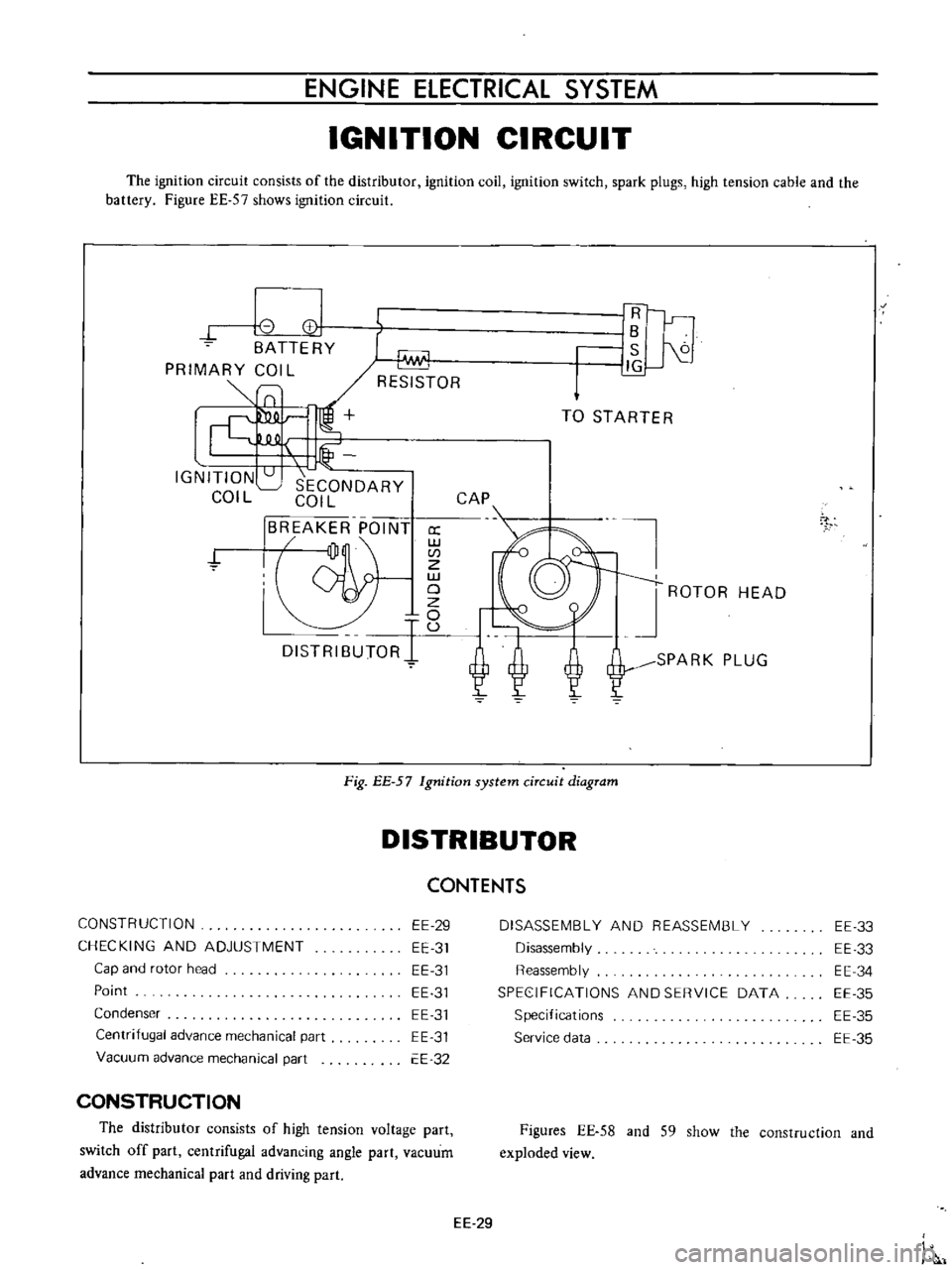
The
ignition
circuit
consists
of
the
distributor
ignition
coil
ignition
switch
spark
plugs
high
tension
cable
and
the
battery
Figure
EE
57
shows
ignition
circuit
8
I
CC
BATTERY
PRIMARY
COIL
SlO
Lf
IGNITION
SECONDARY
COIL
COIL
BREAKER
POINT
jJ
a
w
CI
Z
w
19
DISTRIBUTORI
U
1Fl
r
lB
S
J1G
TO
STARTER
CAP
ROTOR
HEAD
SPARK
PLUG
7
Fig
EE
57
Ignition
system
circuit
diagram
DISTRIBUTOR
CONSTRUCTION
CHECKING
AND
ADJUSTMENT
Cap
and
rotor
head
Point
Condenser
Centrifugal
advance
mechanical
part
Vacuum
advance
mechanical
part
EE
29
EE
31
EE
31
EE
31
EE
31
EE
31
EE
32
CONSTRUCTION
The
distributor
consists
of
high
tension
voltage
part
switch
off
part
centrifugal
advancing
angle
part
vacuum
advance
mechanical
part
and
driving
part
CONTENTS
DISASSEMBLY
AND
REASSEMBLY
Disassembly
Reassembly
SPEC
IFICATIONS
AND
SERVICE
DATA
Specifications
Service
data
EE
33
EE
33
EE
34
EE
35
EE
35
EE
35
Figures
EE
58
and
S9
show
the
construction
and
exploded
view
EE
29
Page 451 of 513
ENGINE
ElECTRICAL
SYSTEM
CHECKING
AND
ADJUSTMENT
Cap
and
rotor
head
Cap
and
rotor
head
must
always
be
kept
clean
to
maintain
good
insulation
durability
since
high
tension
voltage
from
ignition
coil
is
imposed
on
them
Sometimes
inside
of
the
cap
and
rotor
head
is
covered
with
fine
carbon
particles
and
dust
Whenever
crack
or
trace
of
leakage
is
found
on
the
cap
replace
with
a
new
one
Recommend
the
rotor
head
also
be
replaced
with
a
new
one
if
excessively
damaged
Point
When
point
surface
is
roughened
due
to
burning
polish
with
a
fine
emery
paper
No
500
or
600
or
oil
stone
When
the
point
is
worn
excessively
replace
When
the
point
is
replaced
with
a
new
one
apply
grease
to
the
arm
pivot
receiver
and
earn
surface
For
causes
of
damaged
burnt
point
improper
point
contact
insufficient
point
gap
and
defective
condenser
are
considered
The
standard
point
gap
is
0
45
to
0
55
mm
0
0177
to
0
0217
in
When
gap
is
deviated
from
the
standard
gap
adjust
Turn
the
shaft
to
a
position
where
the
breaker
arm
heel
rides
the
com
lug
a
position
where
point
gap
is
maximum
loosen
the
gap
adjusting
screw
apply
a
thickness
gauge
between
contacts
and
adjust
to
the
standard
point
gap
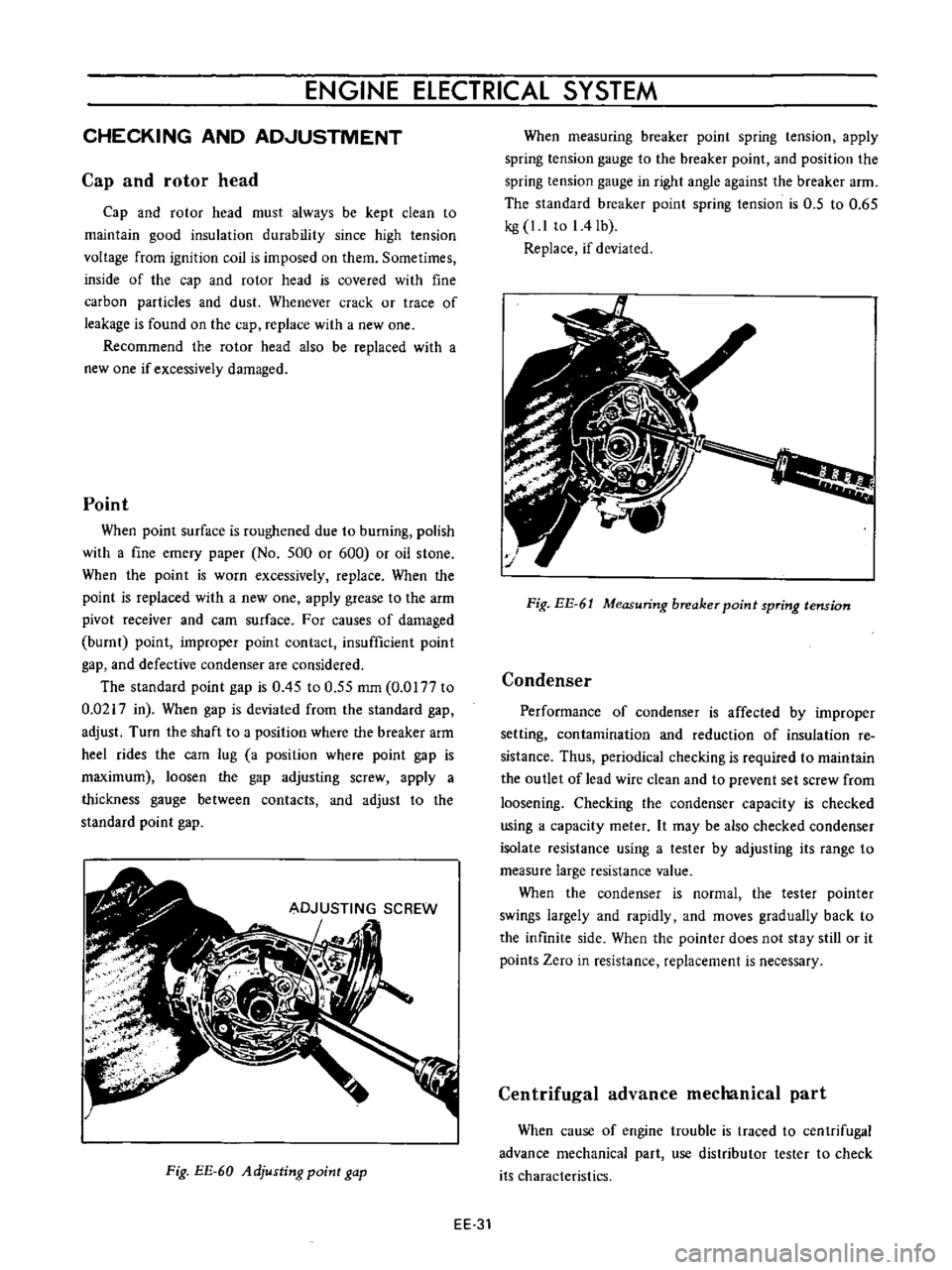
Fig
EE
60
Adjusting
point
gap
When
measuring
breaker
point
spring
tension
apply
spring
tension
gauge
to
the
breaker
point
and
position
the
spring
tension
gauge
in
right
angle
against
the
breaker
arm
The
standard
breaker
point
spring
tension
is
0
5
to
0
65
kg
1
1
to
I
4Ib
Replace
if
deviated
Fig
EE
61
Measuring
breaker
point
spring
tension
Condenser
Performance
of
condenser
is
affected
by
improper
setting
contamination
and
reduction
of
insulation
re
sistance
Thus
periodical
checking
is
required
to
maintain
the
outlet
of
lead
wire
clean
and
to
prevent
set
screw
from
loosening
Checking
the
condenser
capacity
is
checked
using
a
capacity
meter
It
may
be
also
checked
condenser
isolate
resistance
using
a
tester
by
adjusting
its
range
to
measure
large
resistance
value
When
the
condenser
is
normal
the
tester
pointer
swings
largely
and
rapidly
and
moves
gradually
back
to
the
infinite
side
When
the
pointer
does
not
stay
still
or
it
points
Zero
in
resistance
replacement
is
necessary
Centrifugal
advance
mechanical
part
When
cause
of
engine
trouble
is
traced
to
centrifugal
advance
mechanical
part
use
distributor
tester
to
check
its
characteristics
EE
31
Page 452 of 513
ENGINE
When
nothing
is
wrong
with
its
characteristics
con
ceivable
causes
are
defectiveness
or
abnormal
wearing
of
driving
part
or
others
Do
not
disassemble
it
When
characteristics
are
improper
check
earn
as
sembly
governor
weight
shaft
and
governor
spring
and
other
relative
parts
carefully
When
reassembling
the
centrifugal
advance
mechanical
part
be
sure
to
check
advance
characteristics
by
the
use
of
a
distributor
tester
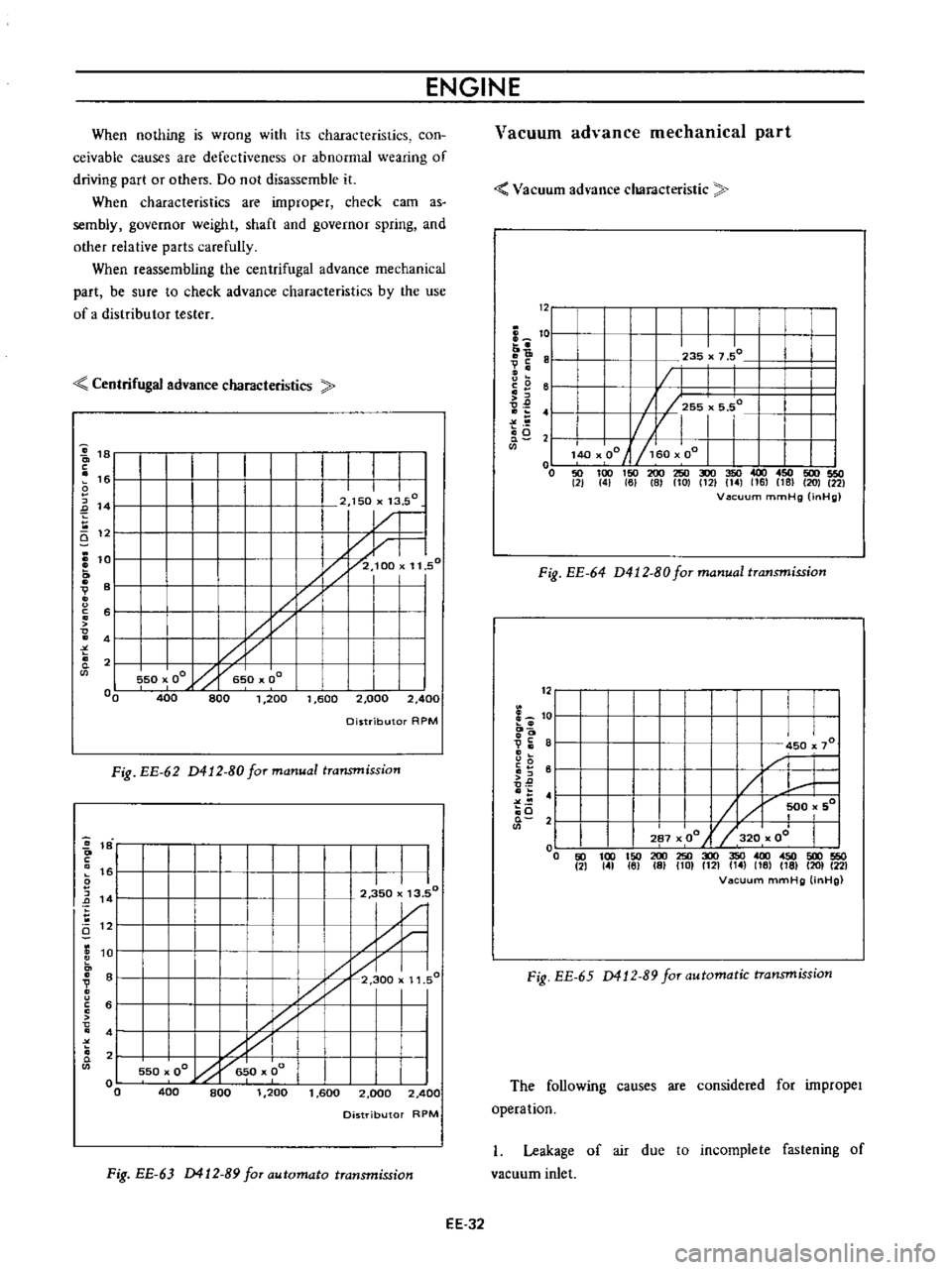
Centrifugal
advance
characteristics
1
c
1
Ei
12
L
o
V
o
u
c
o
o
t
D
c
s
151
14
e
101
0
81
V
0
u
c
51
0
41
t
0
Q
2
01
0
I
I
I
1
rj
11
50
I
J
2
100
50
oQ
5
00
400
800
1
200
1
600
2
00
Distributor
RPM
Fig
EE
62
D412
80formanual
transmission
I
I
I
2
350
13
50
1
1
1
300
1
1
550
00
h
6
0
0
I
400
800
1
200
1
600
2
000
Distributor
RPM
Fig
EE
63
D412
B9
faT
automata
transmission
2
400
I
11
50
2
400
EE
32
Vacuum
advance
mechanical
part
Vacuum
ad
ance
characteristic
12
I
I
I
I
I
II1
5515
5Q
i
01
40
00
i1j
50
00
1
I
o
50
100
150
200
250
300
350
400
450
500
550
21
41
6
8
101
C121
141
161
181
201
22
V2Icuum
mmHg
inHg
I
I
I
I
7
50
1
1Q
Ii
V
I
o
0
u
i
e
6
tI
2
o
i5
0
235
Fig
EE
64
D412
80
for
manual
transmission
c
1
0
I
o
9i
8
o
u
0
i
61
0
0
0
4
o
Q
2
I
I
I
450
x
70
L
H
1
500
501
287
00
l
320
oJ
I
I
200250300350400450500550
IS
101
1121
t4
16
16
1201
22
Vacuum
mmHg
OnHg
o
50
100
150
2
141
161
Fig
EE
65
0412
89
for
automatic
transmission
The
following
causes
are
considered
for
impropeI
opera
tion
I
Leakage
of
air
due
to
incomplete
fastening
of
vacuum
inlet
Page 457 of 513
ENGINE
ElECTRICAL
SYSTEM
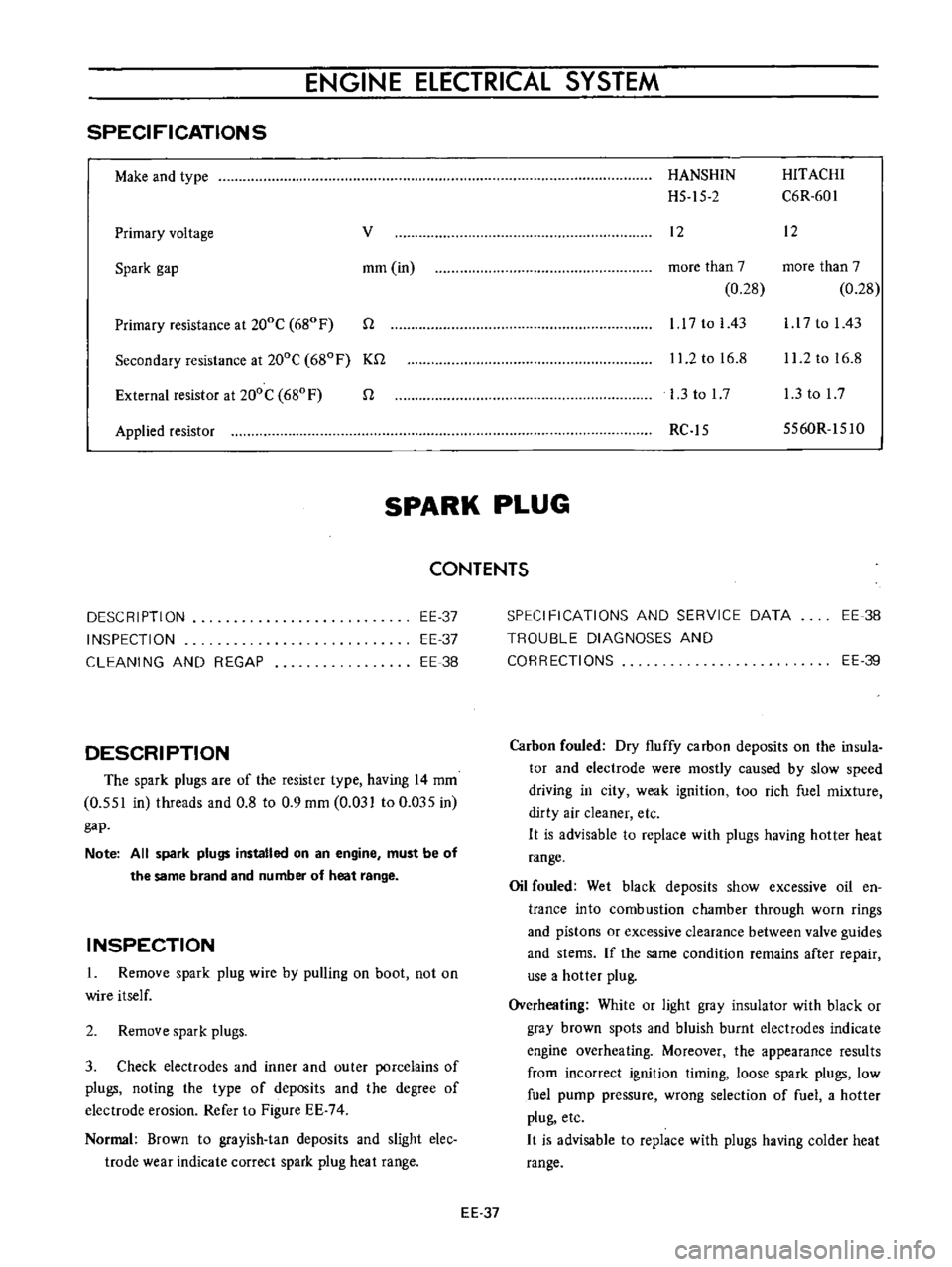
SPECIFICATIONS
Make
and
type
Primary
voltage
v
Spark
gap
mm
in
Primary
resistance
at
200C
680
F
n
Secondary
resistance
at
200C
680F
Kn
External
resistor
at
200C
680
F
n
Applied
resistor
HANSHIN
HITACHI
H5
15
2
C6R
601
12
12
more
than
7
more
than
7
0
28
0
28
1
17
to
I
43
l
l
7
to
I
43
11
2
to
16
8
11
2
to
16
8
l
3tol7
l
3tol7
RC
15
5560R
151O
SPARK
PLUG
CONTENTS
DESCRIPTION
INSPECTION
CLEANING
AND
REGAP
EE
37
EE
37
EE
38
DESCRIPTION
The
spark
plugs
are
of
the
resister
type
having
14
mm
0
551
in
threads
and
0
8
to
0
9
mm
0
031
to
0
Q35
in
gap
Note
All
spark
plugs
installed
on
an
engine
must
be
of
the
same
brand
and
number
of
heat
range
INSPECTION
1
Remove
spark
plug
wire
by
pulling
on
boot
not
on
wire
itself
2
Remove
spark
plugs
3
Check
electrodes
and
inner
and
outer
porcelains
of
plugs
noting
the
type
of
deposits
and
the
degree
of
electrode
erosion
Refer
to
Figure
EE
74
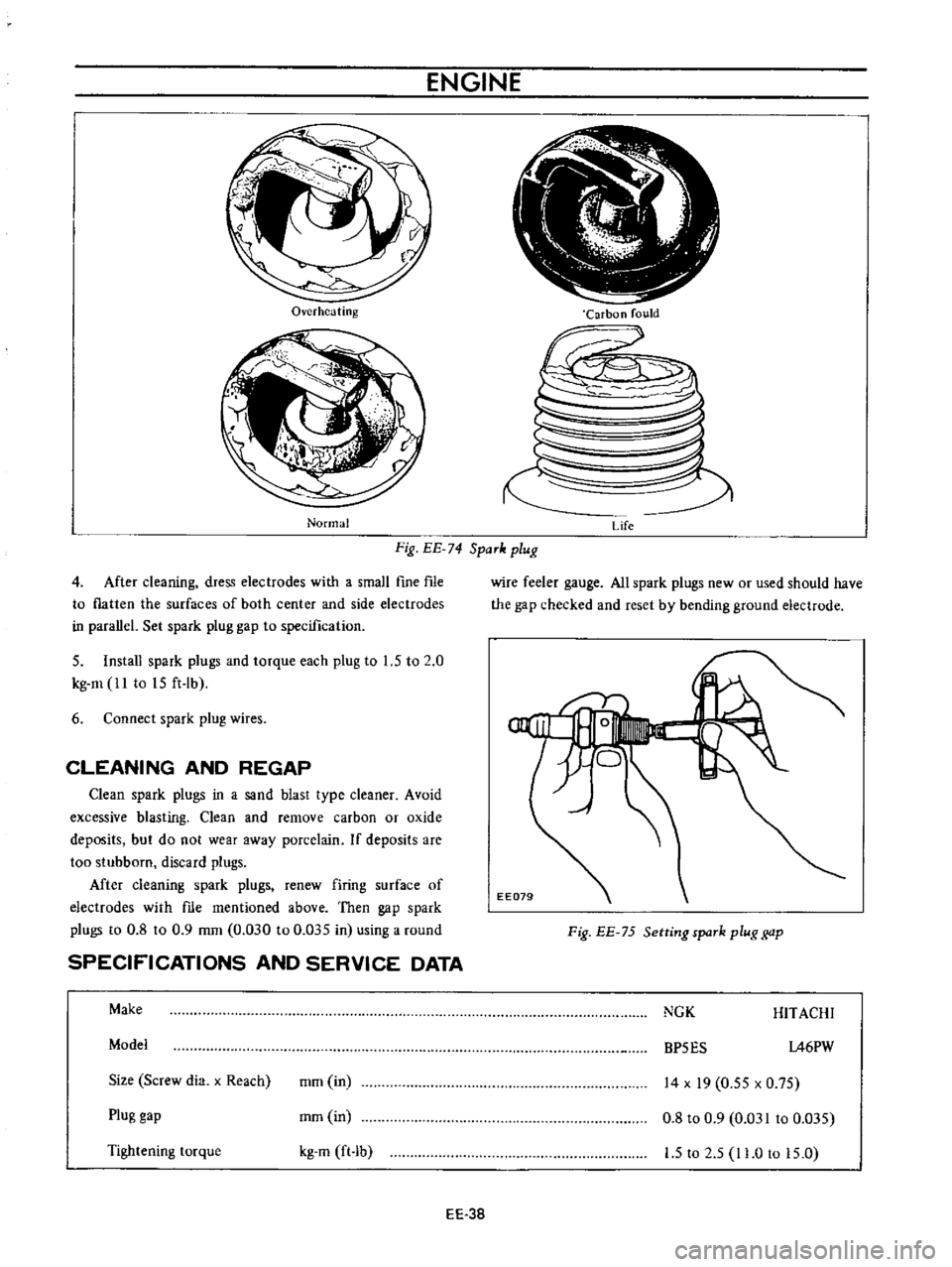
Normal
Brown
to
grayish
tan
deposits
and
slight
elec
trode
wear
indicate
correct
spark
plug
heat
range
SPECIFICATIONS
AND
SERVICE
DATA
TROUBLE
DIAGNOSES
AND
CORRECTIONS
EE
38
EE
39
Carbon
fouled
Dry
fluffy
carbon
deposits
on
the
insula
tor
and
electrode
were
mostly
caused
by
slow
speed
driving
in
city
weak
ignition
too
rich
fuel
mixture
dirty
air
cleaner
etc
H
is
advisable
to
replace
with
plugs
having
hotter
heat
range
Oil
fouled
Wet
black
deposits
show
excessive
oil
en
trance
into
combustion
chamber
through
worn
rings
and
pistons
or
excessive
clearance
between
valve
guides
and
stems
If
the
same
condition
remains
after
repair
use
a
hotter
plug
Overheating
White
or
light
gray
insulator
with
black
or
gray
brown
spots
and
bluish
burnt
electrodes
indicate
engine
overheating
Moreover
the
appearance
results
from
incorrect
ignition
timing
loose
spark
plugs
low
fuel
pump
pressure
wrong
selection
of
fuel
a
hotter
plug
etc
H
is
advisable
to
replace
with
plugs
having
colder
heat
range
EE
37
Page 458 of 513
ENGINE
Overheating
Normal
Carbon
fould
Fig
EE
74
SpaTk
plug
Life
4
After
cleaning
dress
electrodes
with
a
small
fine
fIle
to
flatten
the
surfaces
of
both
center
and
side
electrodes
in
parallel
Set
spark
plug
gap
to
specification
5
Install
spark
plugs
and
torque
each
plug
to
1
5
to
2
0
kg
m
ll
to
15
ft
lb
6
Connect
spark
plug
wires
CLEANING
AND
REGAP
Clean
spark
plugs
in
a
sand
blast
type
cleaner
Avoid
excessive
blasting
Clean
and
remove
carbon
or
oxide
deposits
but
do
not
wear
away
porcelain
If
deposits
are
too
stubborn
discard
plugs
Mter
cleaning
spark
plugs
renew
firing
surface
of
electrodes
with
me
mentioned
above
Then
gap
spark
plugs
to
0
8
to
0
9
mm
0
030
to
0
035
in
using
a
round
SPECIFICATIONS
AND
SERVICE
DATA
Make
Model
Size
Screw
dia
x
Reach
mm
in
Plug
gap
mm
in
Tightening
torque
kg
m
ft
b
EE
38
wire
feeler
gauge
All
spark
plugs
new
or
used
should
have
the
gap
checked
and
reset
by
bending
ground
electrode
Fig
EE
75
Setting
spaTk
plug
gap
NGK
HITACHI
BP5ES
1A6PW
14
x
19
0
55
x
0
75
0
8
to
0
9
0
031
to
0
035
1
5
to
2
5
11
0
to
15
0
Page 459 of 513

ENGINE
ELECTRICAL
SYSTEM
TROUBLE
DIAGNOSES
AND
CORRECTIONS
When
engine
does
not
start
If
there
is
no
trouble
in
fuel
system
ignition
system
should
be
checked
This
can
be
easily
done
by
detaching
a
high
tension
cable
from
spark
plug
starting
engine
and
observing
condition
of
spark
that
occurs
between
high
tension
cable
and
spark
plug
terminal
After
checking
this
repair
as
necessary
Length
of
Trouble
location
Cause
Remedies
spark
gap
No
sparks
at
all
Distributor
Defective
insulation
of
condenser
Replace
Breakage
of
lead
wire
on
low
tension
side
Repair
Defective
insulation
of
cap
and
rotor
head
Replace
Point
does
not
open
or
close
Repair
Ignition
coil
Wire
breakage
or
short
circuit
of
coil
Replace
with
new
one
High
tension
cable
Wire
coming
off
Repair
Defective
insulation
Replace
I
to
2
mm
0
0394
Distributor
Point
gap
too
wide
Correct
to
0
0787
in
or
Oil
sticking
on
point
Clean
irregular
Point
burnt
too
much
Replace
Less
than
6
mm
Spark
plugs
Electrode
gap
too
wide
Correct
or
replace
0
2362
in
Too
much
carbon
Clean
or
replace
Broken
neck
of
insulator
Replace
Expiry
of
plug
life
Replace
2
When
engine
rotates
but
does
not
run
smoothly
In
this
case
there
are
many
causes
resulting
from
the
ignition
system
and
other
engine
conditions
not
related
to
ignition
Therefore
first
complete
inspection
of
ignition
system
should
be
carried
out
EE
39
Page 472 of 513
CHASSIS
REMOVAL
The
clutch
assembly
is
dismounted
primarily
in
the
same
manner
as
the
engine
assembly
Thus
when
dis
mounting
the
clutch
assembly
refer
to
the
Section
TM
Transmission
Removal
and
other
relative
sections
W
II
11
I
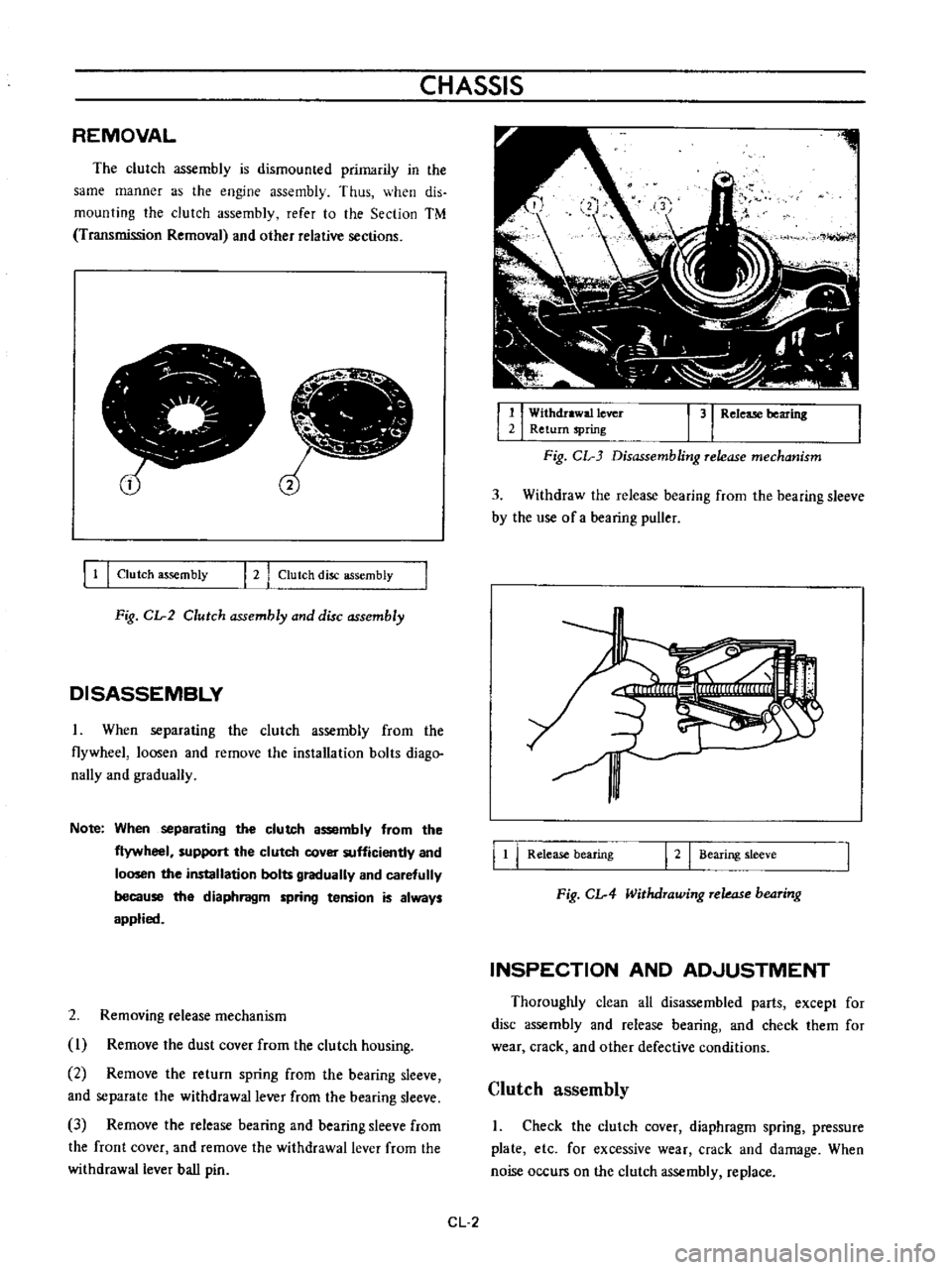
Clutch
assembly
I
2
I
Clutch
disc
assembly
Fig
CIr2
Clutch
assembly
and
disc
assembly
DISASSEMBLY
When
separating
the
clutch
assembly
from
the
flywheel
loosen
and
remove
the
installation
bolts
diago
nally
and
gradually
Note
When
separating
the
clutch
assembly
from
the
flywheel
support
the
clutch
cover
sufficiently
and
loosen
the
installation
bolts
gradually
and
carefully
because
the
diaphragm
spring
tension
is
always
applied
2
Removing
release
mechanism
I
Remove
the
dust
cover
from
the
clutch
housing
2
Remove
the
return
spring
from
the
bearing
sleeve
and
separate
the
withdrawal
lever
from
the
bearing
sleeve
3
Remove
the
release
bearing
and
bearing
sleeve
from
the
front
cover
and
remove
the
withdrawal
lever
from
the
withdrawal
lever
ball
pin
1
I
Withdrawal
lever
3
Release
bearing
2
Return
spring
Fig
CL
3
Disassembling
release
mechanism
3
Withdraw
the
release
bearing
from
the
bearing
sleeve
by
the
use
of
a
bearing
puller
I
t
I
Release
bearing
I
2
I
Bearing
sleeve
Fig
CIr4
Withdrawing
rekas
b04ring
INSPECTION
AND
ADJUSTMENT
Thoroughly
clean
all
disassembled
parts
except
for
disc
assembly
and
release
bearing
and
check
them
for
wear
crack
and
other
defective
conditions
Clutch
assembly
I
Check
the
clutch
cover
diaphragm
spring
pressure
plate
etc
for
excessive
wear
crack
and
damage
When
noise
occurs
on
the
clutch
assembly
replace
CL
2
Page 483 of 513
CLUTCH
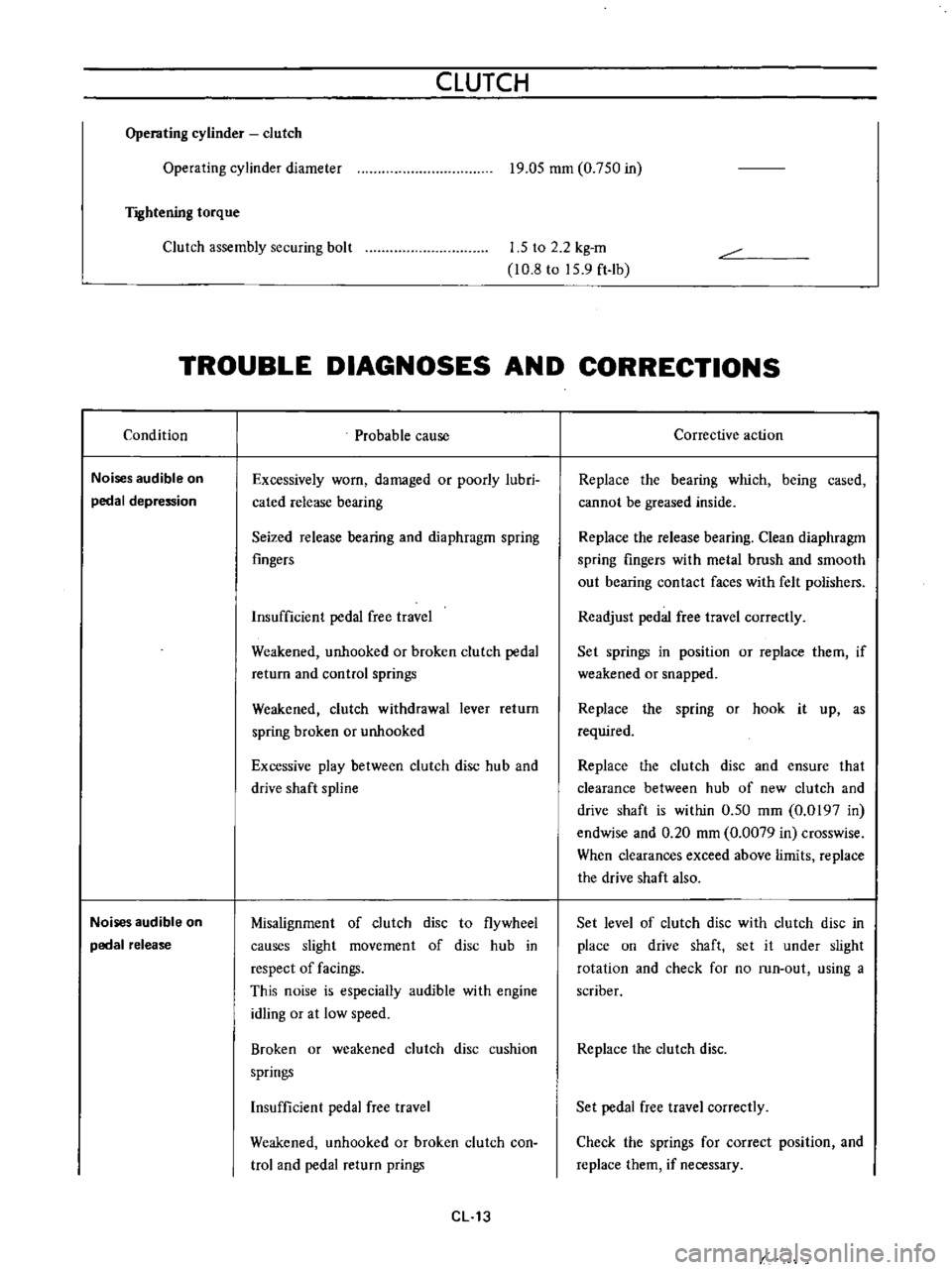
Operating
cylinder
clutch
Operating
cylinder
diameter
T
Ilhtening
torque
19
05
mm
0
750
in
Clutch
assembly
securing
bolt
1
5
to
2
2
kg
m
10
8
to
15
9
ft
Ib
TROUBLE
DIAGNOSES
AND
CORRECTIONS
Condition
Noises
audible
on
pedal
depression
Noises
audible
on
pedal
release
Probable
cause
Excessively
worn
damaged
or
poorly
lubri
cated
release
bearing
Seized
release
bearing
and
diaphragm
spring
fingers
Insufficient
pedal
free
travel
Weakened
unhooked
or
broken
clutch
pedal
return
and
control
springs
Weakened
clutch
withdrawal
lever
return
spring
broken
or
unhooked
Excessive
play
between
clutch
disc
hub
and
drive
shaft
spline
Misalignment
of
clutch
disc
to
flywheel
causes
slight
movement
of
disc
hub
in
respect
of
facings
This
noise
is
especially
audible
with
engine
idling
or
at
low
speed
Broken
or
weakened
clutch
disc
cushion
springs
Insufficient
pedal
free
travel
Weakened
unhooked
or
broken
clutch
con
trol
and
pedal
return
prings
CL
13
Corrective
action
Replace
the
bearing
which
being
cased
cannot
be
greased
inside
Replace
the
release
bearing
Clean
diaphragm
spring
fingers
with
metal
brush
and
smooth
out
bearing
contact
faces
with
felt
polishers
Readjust
pedal
free
travel
correctly
Set
springs
in
position
or
replace
them
if
weakened
or
snapped
Replace
the
spring
or
hook
it
up
as
required
Replace
the
clutch
disc
and
ensure
that
clearance
between
hub
of
new
clutch
and
drive
shaft
is
within
0
50
mm
0
0197
in
endwise
and
0
20
mm
0
0079
in
crosswise
When
clearances
exceed
above
limits
replace
the
drive
shaft
also
Set
level
of
clutch
disc
with
clutch
disc
in
place
on
drive
shaft
set
it
under
slight
rotation
and
check
for
no
run
out
using
a
scriber
Replace
the
clutch
disc
Set
pedal
free
travel
correctly
Check
the
springs
for
correct
position
and
replace
them
if
necessary