1969 FORD MUSTANG parking brake
[x] Cancel search: parking brakePage 226 of 413
04-03-06
Rear Axles — Integral Carrier Type
04-03-06
9. Install a new integral nut and
ivasher on the pinion shaft. (Apply a
small amount of lubricant on the
washer side of the nut.)
10.
Hold the flange with the tool
shown in Fig. 9 while the nut is being
tightened.
11.
Tighten the pinion shaft nut,
rotating the pinion occasionally to in-
sure proper bearing seating, (Fig. 6)
and take frequent preload readings
until the preload is at the original rec-
orded reading established in step 3.
12.
After original preload has been
reached, tighten the pinion nut slowly,
until an additional preload of 6 to 12
in-lbs has been added.
The preload should not exceed the
amount shown above, or bearing fail-
ure may result.
Under no circumstances should the
pinion nut be backed off to lessen pre-
load. If this is done, a new pinion
bearing spacer must be installed. (In
addition, the U-joint flange must
never be hammered on, or pneumatic-
-tools used.)
13.
Remove the oil seal replacer
tool from the transmission extension
housing. Install the front end of the
drive shaft on the transmission output
shaft.
14.
Connect the rear end of the
drive shaft to the axle U-joint flange,
aligning the scribe marks made on the
drive shaft end yoke and the axle U-
joint flange (Fig. 14).
15.
Check the lubricant level. Make
sure the axle is in running position.
Add whatever amount of specified lu-
bricant is required to reach the lower
edge of the filler plug hole, located in
the carrier casting or housing cover.
REMOVAL AND INSTALLATION
REAR AXLE HOUSING
REMOVAL
1.
Raise the vehicle and support it
with safety stands under the rear
frame member.
2.
Drain the lubricant from the
axle.
3.
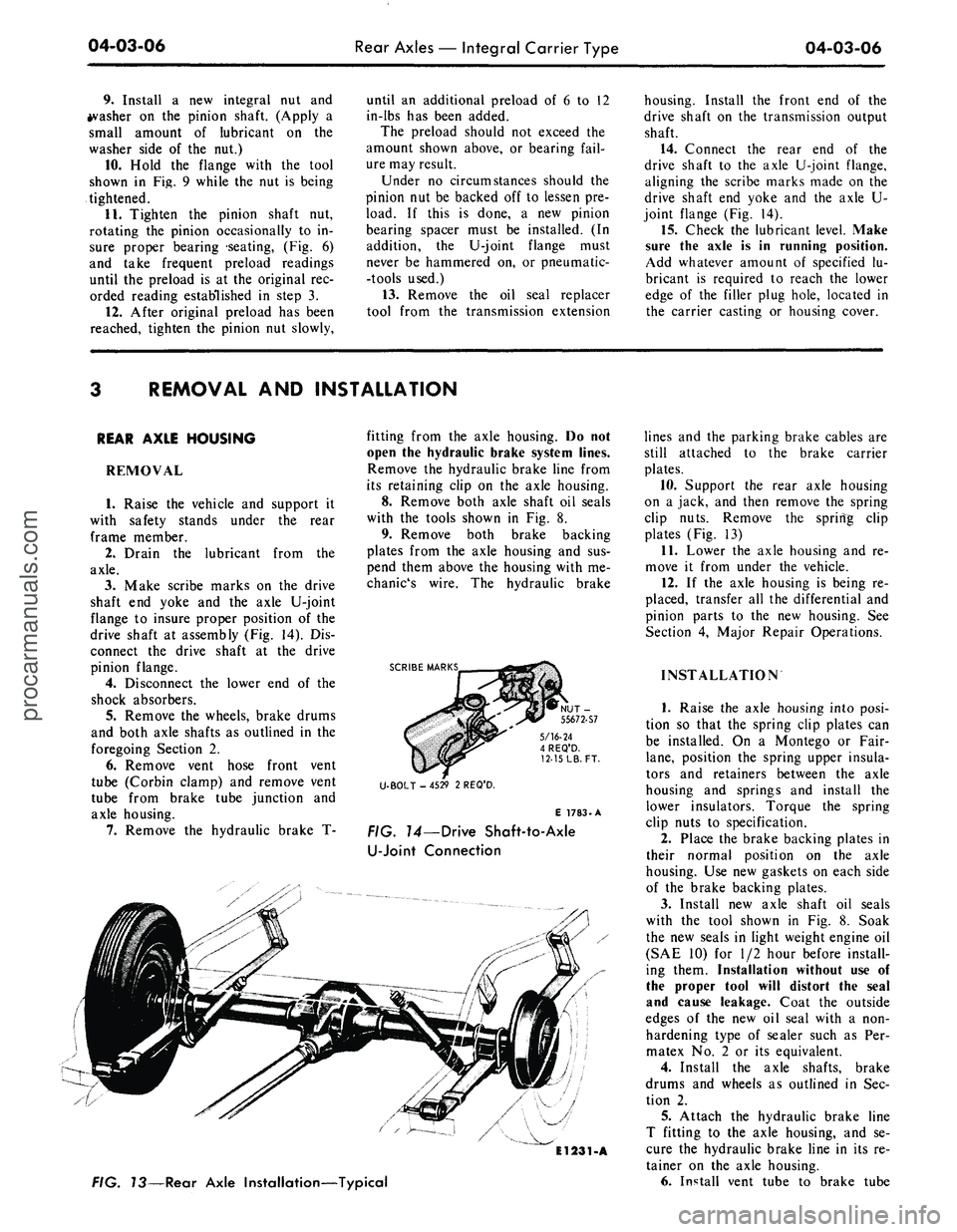
Make scribe marks on the drive
shaft end yoke and the axle U-joint
flange to insure proper position of the
drive shaft at assembly (Fig. 14). Dis-
connect the drive shaft at the drive
pinion flange.
4.
Disconnect the lower end of the
shock absorbers.
5.
Remove the wheels, brake drums
and both axle shafts as outlined in the
foregoing Section 2.
6. Remove vent hose front vent
tube (Corbin clamp) and remove vent
tube from brake tube junction and
axle housing.
7.
Remove the hydraulic brake T-
fitting from the axle housing. Do not
open the hydraulic brake system lines.
Remove the hydraulic brake line from
its retaining clip on the axle housing.
8. Remove both axle shaft oil seals
with the tools shown in Fig. 8.
9. Remove both brake backing
plates from the axle housing and sus-
pend them above the housing with me-
chanic's wire. The hydraulic brake
SCRIBE MARKS
5/16-24
4 REQ'D.
12-15
LB.
FT.
U-BOLT - 4529 2 REQ'D.
E 1783-A
FIG. 14—Drive Shaft-to-Axle
U-Joint
Connection
El231-A
FIG. 73—Rear Axle Installation—Typical
lines and the parking brake cables are
still attached to the brake carrier
plates.
10.
Support the rear axle housing
on a jack, and then remove the spring
clip nuts. Remove the spring clip
plates (Fig. 13)
11.
Lower the axle housing and re-
move it from under the vehicle.
12.
If the axle housing is being re-
placed, transfer all the differential and
pinion parts to the new housing. See
Section 4, Major Repair Operations.
INSTALLATION
1.
Raise the axle housing into posi-
tion so that the spring clip plates can
be installed. On a Montego or Fair-
lane,
position the spring upper insula-
tors and retainers between the axle
housing and springs and install the
lower insulators. Torque the spring
clip nuts to specification.
2.
Place the brake backing plates in
their normal position on the axle
housing. Use new gaskets on each side
of the brake backing plates.
3.
Install new axle shaft oil seals
with the tool shown in Fig. 8. Soak
the new seals in light weight engine oil
(SAE 10) for 1/2 hour before install-
ing them. Installation without use of
the proper tool will distort the seal
and cause leakage. Coat the outside
edges of the new oil seal with a non-
hardening type of sealer such as Per-
matex No. 2 or its equivalent.
4.
Install the axle shafts, brake
drums and wheels as outlined in Sec-
tion 2.
5.
Attach the hydraulic brake line
T fitting to the axle housing, and se-
cure the hydraulic brake line in its re-
tainer on the axle housing.
6. Install vent tube to brake tubeprocarmanuals.com
Page 235 of 413
04-04-04
Rear Axle — Ford Light-Duty (WER)
04-04-04
REMOVAL AND INSTALLATION
AXLE HOUSING
Refer to Fig. 7.
REMOVAL
1.
Raise the vehicle on a hoist.
2.
Remove the wheels and tires
from the brake drums.
3.
Position a drain pan and loosen
the rear axle cover to housing attach-
ing bolts. Drain the housing.
4.
Remove the attaching (Tinner-
man) nuts that secure the brake drums
to the axle shaft flanges, and then re-
move the drums (Fig. 7).
5.
Remove the axle housing cover
bolts,
cover and gasket. Discard the
gasket. Remove the drain pan.
6. Disconnect the drive shaft at the
drive pinion companion flange. Re-
move the drive shaft from the trans-
mission extension housing. Install an
oil seal replacer tool in the transmis-
sion housing to prevent leakage. Refer
to the transmission group for the ap-
propriate tool.
7.
Disconnect the lower end of the
shock absorbers at the mounting
brackets.
8. Disconnect the track bar from
the axle housing stud. If the axle
housing is to be replaced, transfer the
stud to the new housing.
9. Position safety stands under the
rear frame members. Lower the vehi-
cle with the hoist and allow the axle
to lower far enough to relieve rear
spring tension.
10.
Remove the pinion shaft lock
bolt and pinion shaft (Fig. 2), differ-
ential pinion gears and thrust washers.
11.
Push the axle shaft(s) inward
toward the center of the axle housing.
Remove the C-locks from the inner
ends of the axles (Fig. 3). Remove the
axle shafts from the housing. Extreme
care must be used to avoid contacting
the axle shaft seal lip with any portion
of the axle shaft other than the seal
journal.
12.
Disconnect the vent hose from
the rear vent tube and remove all
brake lines from the axle housing re-
taining clips.
13.
Remove the brake backing
plate attaching nuts and the plates
from the axle housing. Suspend the
plates above the axle housing with
mechanics wire. The hydraulic brake
lines and the parking brake cables will
remain attached to the brake backing
plates.
14.
Support the rear axle housine
on a jack.
15.
Remove the right and left rear
springs and insulators.
16.
Remove the nuts, washers and
pivot bolts that connect the suspension
lower arms to the axle housing. Dis-
connect both arms from the axle
housing.
17.
Disconnect the upper suspen-
sion arm from the axle housing by re-
moving the pivot bolt, nut, lock wash-
er and two eccentric washers.
18.
Lower the rear axle to the floor
with the jack and remove the axle
from under the vehicle.
19.
Remove the wheel bearings and
oil seals with the tool shown in Fig. 4.
20.
If the axle housing is being re-
placed, transfer all the differential and
pinion parts to the new housing. Refer
to Section 4, Major Repair Operation
for the procedure.
INSTALLATION
1.
Lightly coat the wheel bearing
rollers with axle lubricant. Install
wheel bearings in the axle housing
with the tool shown in Fig. 5. The
bearings should seat firmly against the
shoulder.
2.
Wipe all lubricant from the oil
seal bore before installing the seal. If
axle housing is being replaced, new
seals must be installed.
3.
Inspect the original seal for
nicks,
scuffs or abnormal wear, and
replace if necessary. New seals are
pre-packed with lubricant and do not
require an oil soak.
4.
Install the seal with the tool
shown in Fig. 6. Installation without
the use of the proper tool will distort
the seal and cause leakage.
5. Raise the rear axle into position
under the vehicle with a hoist or floor
jack. Connect the suspension lower
arms to their mounting brackets on
the axle housing with pivot bolts and
nuts.
Do not tighten the mounting
bolts at this point.
6. Position the suspension upper
arm in its mounting bracket on the
axle housing and install the adjusting
bolt, eccentric washers, lock washer
and nut. Do not tighten the mounting
bolt at this point.
7.
Place the rear coil springs and
insulators into position in the pockets
provided.
8. Place the brake backing plates
on the axle housing flanges, install 4
attaching bolts and nuts and torque
them to specifications.
9. Position the brake lines to the
axle housing and secure them with the
retaining clips. If the axle housing is
new, install a new vent. When install-
ing the new axle vent apply a small
amount of Locktite (C5AZ-19554-B)
to prevent oil leakage between vent
and axle housing. Connect the vent
tube to the vent.
10.
Install the pinion side gears and
thrust washer.
11.
Slide the axle shafts into place
in the axle housing. Exercise care that
splines or any portion of the axle
shafts do not damage the oil seals and
that they engage with the splines of
the differential side gears.
12.
Install the axle shaft C-lock O-
ring and C-lock on the inner end of
the shaft and push the shaft outward
so that the shaft lock seats in the
counterbore of the differential side
gear.
13.
Position the pinion differential
gears and thrust washers 180 degrees
apart to the differential side gears.
Revolve the gear assembly until the
holes in the differential case are al-
igned with the pinion gears.
14.
Position the differential pinion
shaft through the case and pinions, al-
igning the hole in the shaft with the
lock bolt hole. Install the lock bolt
and tighten it to specification.
15.
Clean the gasket mounting sur-
face of the rear axle housing and the
cover. Install a new cover gasket,
cover and the attaching bolts. Torque
the bolts to specification.
16.
Raise the rear axle on a hoist
and remove the safety stands.
17.
Connect the track bar to the
mounting stud. Install the washer and
nut. Torque the nut to specification.
18.
Connect the two rear shock ab-
sorbers to the mounting brackets on
the axle housing and torque the at-
taching nuts to specification.
19.
Make sure that both the front
and rear pivot bolts of the upper and
the two lower arms are loose, then
raise the axle assembly to the con-
trolled height (Fig. 8). Hold the axle
at the controlled height by placing
blocks or pieces of steel pipe between
the axle housing and the bumper rear
screw on the side rail.procarmanuals.com
Page 264 of 413

05-03-06
Clutch
05-03-06
8. Remove the starter cable then
remove the starter motor from the fly-
wheel housing.
9. Remove the bolts that secure the
engine rear plate to the front lower
part of the flywheel housing.
10.
Remove the flywheel housing
lower cover (390 CID housing only).
11.
Remove the bolts that attach
the housing to the cylinder block.
12.
Move the housing back just far
enough to clear the pressure plate,
then move it to the right to free the
pivot from the clutch equalizer bar. Be
careful not to disturb the linkage and
assist spring.
13.
Loosen the six pressure plate
cover attaching bolts evenly to release
the spring tension. If the same pres-
sure plate and cover is to be installed
after the clutch is overhauled, mark
the cover and flywheel so that the
pressure plate can be installed in the
same position.
14.
Remove the pressure plate and
the clutch disc from the flywheel.
CLUTCH INSTALLATION
1.
Install the clutch release lever if
it was removed.
2.
Place the clutch disc, and pres-
sure plate assembly in position on the
flywheel. Start the cover attaching
bolts to hold the pieces in place, but
do not tighten them. Avoid touching
the clutch disc facing, dropping the
parts or contaminating them with oil
or grease as clutch chatter may result.
3.
Align the clutch disc with the
tool shown in Fig. 7, and alternately
tighten the bolts a few turns at a time
until they are all tight. Then torque
the six pressure plate cover attaching
bolts to specification before removing
the tool.
4.
Apply a light film of grease
(C3VY-19586-A) to the outside diam-
eter of the transmission front bearing
retainer. Apply a light film of grease
(C3VY-19586-A) to both sides of the
release lever fork where it contacts the
release bearing bore spring clips.
Apply a light film of grease to the re-
lease bearing surface that contacts the
pressure plate release fingers. Fill the
grease groove of the release bearing
hub with lithium base grease (C3VY-
19586-A). Clean all excess grease
from inside the bore of bearing hub.
Excess grease will be forced onto the
spline by the transmission input shaft
bearing retainer and will contaminate
the clutch disc. Also, place the release
bearing and hub on the release lever.
5.
Make certain that the flywheel
housing and the cylinder block mount-
ing surfaces are clean. Position the
felt washer on the pivot in the fly-
wheel housing. Slip the pivot into the
clutch equalizer shaft being careful
not to disturb the linkage and at the
same time position the housing on the
dowels in the cylinder block. Install
and torque the attaching bolts to spec-
ification.
6. Install the starting motor and
connect the cable.
7.
The mounting surfaces of the
transmission and the flywheel housing
must be free of dirt, paint, and burrs.
Install two guide pins in the flywheel
housing lower mounting bolt holes.
Move the transmission forward on the
guide pins until it is tightly positioned
against the flywheel housing.
8. Install the two upper mounting
bolts.
Then, remove the guide pins
and install the two lower mounting
bolts.
Torque all the bolts to specifica-
tion.
9. Raise the rear of the engine and
install the crossmember. Install and
torque the crossmember attaching
bolts to specifications, then lower the
engine.
10.
Install the extension housing-
to-engine rear support attaching bolts.
Torque the bolts to specification.
11.
Remove the transmission jack
and connect the parking brake cable.
12.
If the vehicle is equipped with a
four-speed transmission, connect the
gear shift linkage control bracket to
the extension housing.
13.
Connect the gear shift rods to
the transmission. Adjust the shift link-
age as required.
14.
Connect the release lever retain-
ing spring. Install the flywheel housing
cover (390 CID housing only).
15.
Remove the tool from the
transmission output shaft and install
the drive shaft.
16.
Check the clutch pedal free
travel.
CLUTCH ARBOR CLUTCH DISC
PRESSURE PLATE
C 1788-A
FIG. 7—Installing Clutch Disc —
Typicalprocarmanuals.com
Page 273 of 413
06-02-04
Ford Design Three Speed Transmission
06-02-04
shift selector, remove
the
shift selector
assembly from
the
extension housing.
6.
On
Ford, Mercury
and
Meteor
vehicles disconnect
the
parking brake
cable from the equalizer lever and sep-
arate
the
lever from
the
crossmember.
7.
On
Ford, Mercury
and
Meteor
models, remove
the
bolts that secure
the extension housing
to the
engine
rear support.
8. Raise
the
rear
of
the engine high
enough
to
remove
the
weight from
the
crossmember.
9. Support
the
transmission with
a
transmission jack
and
remove
the
transmission from
the
flvwheel hous-
ing.
10.
Move
the
transmission and jack
rearward until
the
input shaft
is
clear
of
the
flywheel housing.
11.
Remove
the
transmission from
the jack
and
mount
it in a
holding
fixture.
Do
not
depress
the
clutch pedal
while
the
transmission
is
removed.
INSTALLATION
1.
Make certain that
the
machined
surfaces
of the
transmission case
and
the flywheel housing
are
free
of
dirt,
paint,
and
burrs.
2.
Install
a
guide
pin in
each lower
mounting bolt hole.
3.
Start
the
input shaft through
the
release bearing. Align
the
splines
on
the input shaft with
the
splines
in the
clutch disc. Move
the
transmission
forward
on the
guide pins until
the
input shaft pilot enters
the
bearing
or
bushing
in the
crankshaft.
If the
transmission front bearing retainer
binds
up on the
clutch release bearing
hub,
work
the
release bearing lever
until
the hub
slides onto
the
transmis-
sion front bearing retainer. Install
the
two transmission-to-flywheel housing
upper mounting bolts
and
lockwash-
ers.
Remove
the two
guide pins
and
install
the
lower mounting bolts
and
lock washers.
4.
Raise
the
rear
of the
engine high
enough
to
provide clearance
for in-
stalling
the
crossmember. Bolt
the
crossmember assembly
to the
frame
side supports.
5.
On
Ford, Mercury
and
Meteor
models, lower
the
engine until
the ex-
tension housing just contacts
the
rear
support. Align
the
bolt holes
in the
extension housing with those
in the
support. Then lower
the
engine
and
remove the jack. Install the two exten-
sion housing-to-support attaching
bolts
and
lock washers.
6.
On
Ford, Mercury
and
Meteor
models, insert
the
parking brake front
cable
in the
equalizer
and
install
the
equalizer
in the
bracket
on the
crossmember. Secure
the
parking
brake rear cable
to the
equalizer.
7.
On
vehicles equipped with
a
column-mounted gear shift selector,
secure
the
shift rods
to the
shift levers
at
the
transmission.
On
vehicles
equipped with
a
floor-mounted gear
shift selector, attach
the
shift selector
assembly
to the
extension housing.
8. Insert
the
speedometer cable
and
driven gear
in the
extension housing
and secure
it
with
a cap
screw
and
lock washer.
9. Remove
the
tool shown
in
Fig.
2,
Part 6-1, from
the
extension housing.
Align
the
reference marks
and
slide
the front universal joint yoke onto
the
output shaft
and
into
the
extension
housing. Connect
the
rear universal
joint
to the
axle pinion flange
and tor-
que
the
nuts
to
specifications.
10.
Fill
the
transmission
to the
proper level with
the
approved lubri-
cant.
11.
Adjust
the
clutch pedal free
travel
and the
shift linkage
as re-
quired.
MAJOR REPAIR OPERATIONS
DISASSEMBLY
1.
Mount
the
transmission
in a
holding fixture and drain
the
lubricant
by removing
the
drain plug,
if so
equipped,
or the
lower extension hous-
ing bolt.
2.
Remove
the cap
screws that
at-
tach
the
cover
to
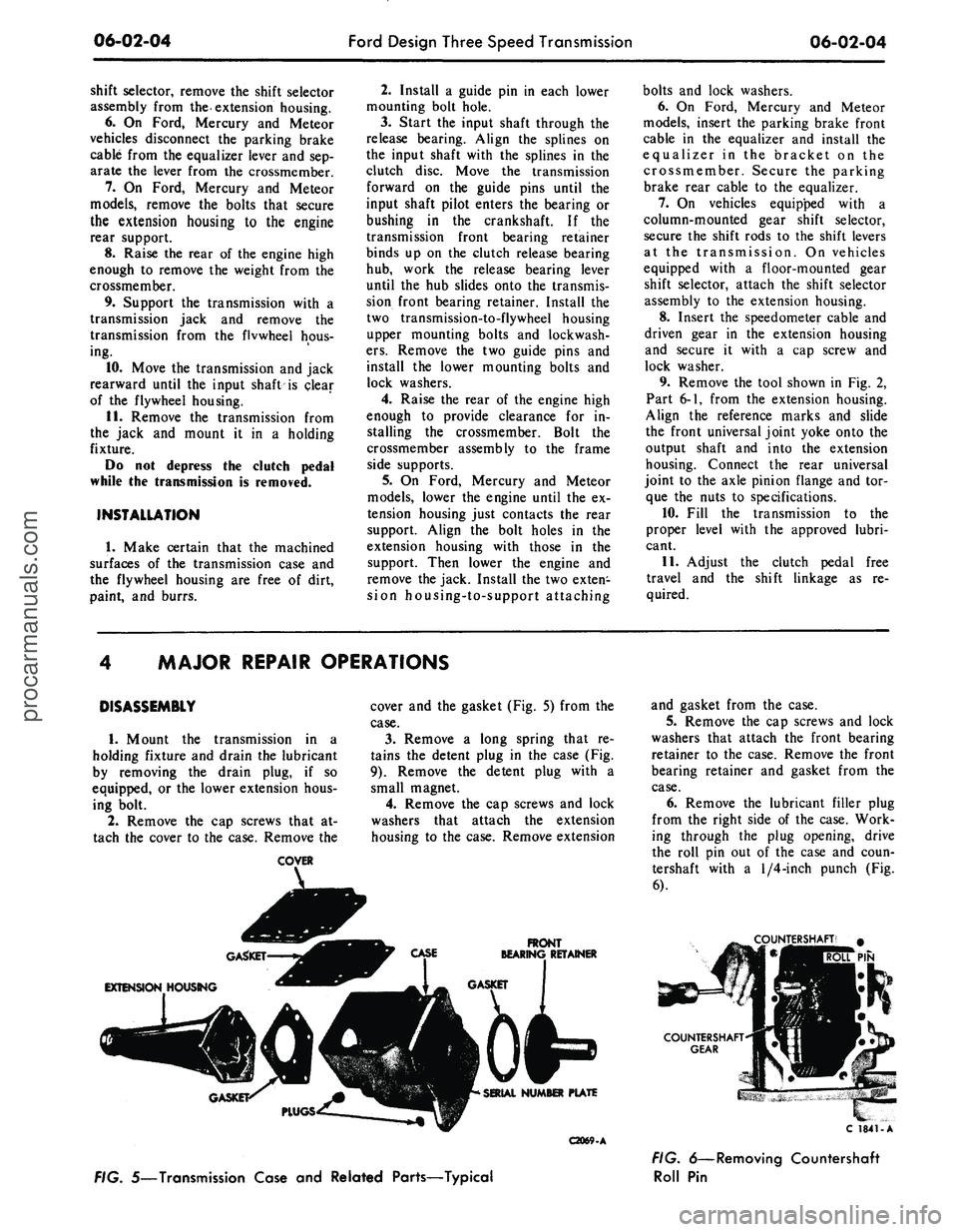
the case. Remove
the
COVER
cover
and the
gasket (Fig.
5)
from
the
case.
3.
Remove
a
long spring that
re-
tains
the
detent plug
in the
case (Fig.
9).
Remove
the
detent plug with
a
small magnet.
4.
Remove
the cap
screws
and
lock
washers that attach
the
extension
housing
to
the case. Remove extension
FRONT
BEARING RETAINER
C2069-A
and gasket from
the
case.
5.
Remove
the cap
screws
and
lock
washers that attach
the
front bearing
retainer
to the
case. Remove
the
front
bearing retainer
and
gasket from
the
case.
6. Remove
the
lubricant filler plug
from
the
right side
of the
case. Work-
ing through
the
plug opening, drive
the roll
pin out of the
case
and
coun-
tershaft with
a
1/4-inch
punch
(Fig.
6).
TERSHAFT'
#
PIN
C 1841-A
FIG. 5—Transmission Case
and
Related Parts—Typical
FIG. 6—Removing Countershaft
Roll
Pinprocarmanuals.com
Page 281 of 413

06-03-02
Ford Design Four-Speed Transmission
06-03-02
1 DESCRIPTION
DESCRIPTION
The Ford designed 4-speed trans-
mission
(Fig. 1) is of the
fully
syn-
chronized type with
all
gears except
the reverse sliding gear being
in con-
stant mesh.
All
forward-speed changes
are accomplished with synchronizer
sleeves.
All forward-speed gears
in the
transmission
are
helical-type, however,
the reverse sliding gear
and the
exter-
ior
of the
first-and second-speed
syn-
chronizer sleeve
are
spur-type gears.
The specifications
of
this section Part
6-4 lists
the
transmission model
num-
bers
and
vehicles
in
which they
are
used.
C 1765-B
FIG. 7—Four-Speed Transmission—Typical
A transmission service identification
tag
is
located
on the
right side
of the
case
at the
front
(Fig. 2). The
first
line
on the tag
will show
the
transmis-
sion model
and
service identification
code when required.
The
second line
will show
the
transmission serial
num-
ber. Additionally,
a
driveline compo-
nent identification
tag is
attached
to
the upper right side
of the
transmis-
sion case.
TRANS.
MODEL
O
RUG-C-2
10001
O
SERIAL NO.
C 2088-A
FIG. 2—Transmission
Identification
Tag
IN-VEHICLE ADJUSTMENTS
AND
REPAIRS
SHIFT LINKAGE ADJUSTMENT
1.
Loosen
the
three shift linkage
adjustment nuts. Install
a 1/4
inch
di-
ameter alignment tool through
the
control bracket
and
lever holes
as
shown
in Fig. 13.
An alignment tool
can be
made
from
1/4
inch diameter drill
rod
bent
to
an "L"
shape.
The
extensions
should
be 2 1/2
inch
and 3 3/4
inch
from
the
elbow. Short
end of
align-
ment
pin
should
be
inserted into
con-
trol bracket
and
linkage holes until
it
bottoms.
2.
Disconnect
the
reverse gear shift
rod from
the
shift lever.
3.
Shift
the
transmission into
re-
verse gear.
4.
Tighten
the 1-2 and 3-4
shift
rod
adjustment nuts.
5.
Connect
the
reverse gear shift
rod
to the
shift lever. Shift
the
reverse
lever
to the
neutral position
and
tight-
en
the
adjustment
nut.
6. Remove
the
alignment
pin.
7.
Check
the
gear shift lever
for a
smooth crossover.
REMOVAL
AND
INSTALLATION
REMOVAL
1.
Raise
the
vehicle
on a
hoist.
2.
Mark
the
driveshaft
so
that
it
may
be
installed
in the
same relative
position. Disconnect
the
drive shaft
from
the
rear U-joint flange. Slide
the
drive shaft
off the
transmission output
shaft
and
install
the
extension housing
seal installation tool into the extension
housing
to
prevent lubricant leakage.
See
Fig. 2,
Part
6-1.
3.
Disconnect
the
speedometer
cable from
the
extension housing.
4.
Disconnect
the
parking brakeprocarmanuals.com
Page 282 of 413
06-03-03
Ford Design Four-Speed Transmission
06-03-03
cable from the equalizer lever and sep-
arate the lever from the crossmember.
5.
Remove the hairpin retainer se-
curing the cable to the transmission
rear support crossmember, and then
pull the cable assembly forward and
out of the crossmember.
6. Remove the retaining clip, flat
washer, and spring washer that se-
cures the shift rods to the shift levers.
7.
Remove the bolts that attach the
shift linkage control bracket to the ex-
tension housing and position the as-
sembly out of the way.
8. Support the engine with a trans-
mission jack and remove the extension
housing-to-engine rear support attach-
ing bolts.
9. Raise the rear of the engine high
enough to remove the weight from the
crossmember. Remove the bolts re-
taining the crossmember to the frame
side supports and remove the
crossmember.
10.
Support the transmission on a
jack and remove the bolts that attach
the transmission to the flywheel hous-
ing.
11.
Move the transmission and jack
rearward until the transmission input
shaft clears the flywheel housing. If
necessary, lower the engine enough to
obtain clearance for transmission re-
moval.
Do not depress the clutch pedal
while the transmission is removed.
INSTALLATION
1.
Make sure that the mounting
surface of the transmission and the
flywheel housing are free of dirt,
paint, and burrs. Install two guide
pins in the flywheel housing lower
mounting bolt holes. Move the trans-
mission forward on the guide pins
until the input shaft splines enter the
clutch hub splines and the case is posi-
tioned against the flywheel housing.
2.
Install the two upper transmis-
sion to flywheel housing, mounting
bolts snug, and then remove the two
guide pins. Install the two lower
mounting bolts. Torque all mounting
bolts to specifications.
3.
Raise the rear of the engine and
install the crossmember. Install and
torque the crossmember attaching
bolts to specifications, then lower the
engine.
4.
With the transmission extension
housing resting on the engine rear
support, install the transmission ex-
tension housing attaching bolts. Tor-
que the bolts to specifications.
5.
Position the shift linkage control
bracket to the extension housing and
install the attaching bolts.
6. Secure each shift rod to its re-
spective lever with the spring washer,
flat washer, and retaining pin.
7.
Guide the parking brake cable
assembly through the hole in the
transmission rear support crossmemb-
er. Secure the cable assembly to the
crossmember with the hair pin retain-
er.
8. Insert the parking brake front
cable in the equalizer and install the
equalizer in the bracket on the
crossmember. Secure the parking
brake rear cable to the equalizer.
9. Connect the speedometer cable
to the extension housing.
10.
Remove the extension housing
installation tool and slide the forward
end of the drive shaft over the trans-
mission output shaft. Connect the
drive shaft to the rear U-joint flange.
11.
Place both forward gear shift
levers and the reverse shift lever in the
neutral position and insert a 1/4 inch
diameter alignment tool in the shift
linkage alignment hole (Fig. 17). It
may be necessary to loosen the adjust-
ment nuts to install the alignment
tool. Adjust the linkage as necessary
and tighten the adjustment nuts to
specifications. Remove the alignment
tool.
12.
Fill the transmission to the
proper level with the specified lubri-
cant.
13.
Lower the car. Check tne shift
and crossover motion for full shift en-
gagement and smooth crossover oper-
ation.
MAJOR REPAIR OPERATIONS
DISASSEMBLY
1.
Mount the transmission in a
holding fixture and drain the lubri-
cant.
2.
Remove the cover attaching
screws from the case. Lift the cover
and gasket from the case.
3.
Remove the long spring that re-
tains the detent plug in the case (Fig.
4).
Remove the detent plug with a
small magnet.
4.
Remove the extension housing
attaching screws and lock washers.
Remove the housing and the gasket.
5.
Remove the input shaft bearing
retainer attaching screws. Slide the re-
tainer off the input shaft.
6. Support the countershaft gear
with a wire hook. Working from the
front of the case, push the counter-
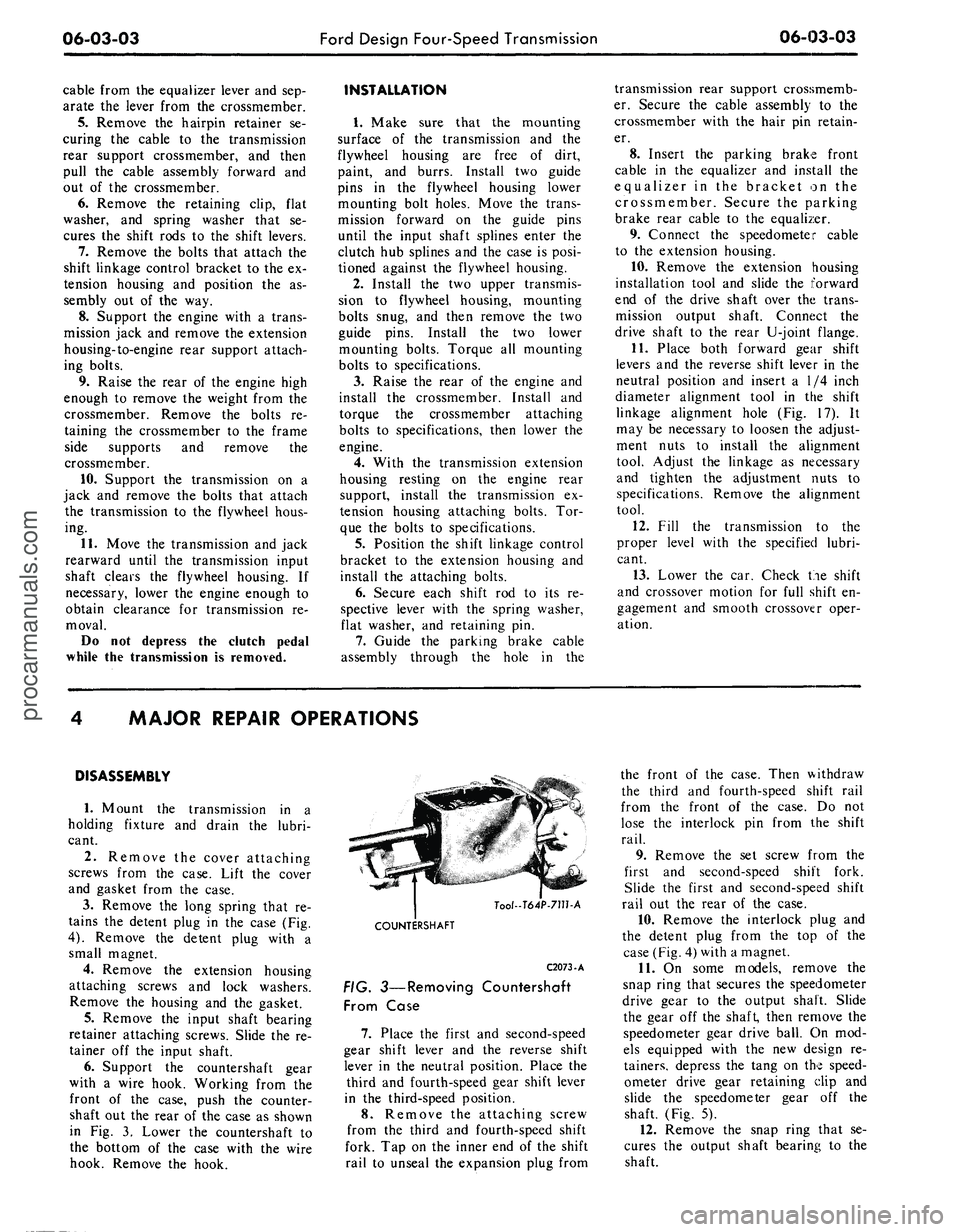
shaft out the rear of the case as shown
in Fig. 3. Lower the countershaft to
the bottom of the case with the wire
hook. Remove the hook.
Tool-T64P-711hA
COUNTERSHAFT
C2073-A
FIG. 3—Removing Countershaft
From Case
7.
Place the first and second-speed
gear shift lever and the reverse shift
lever in the neutral position. Place the
third and fourth-speed gear shift lever
in the third-speed position.
8. Remove the attaching screw
from the third and fourth-speed shift
fork. Tap on the inner end of the shift
rail to unseal the expansion plug from
the front of the case. Then withdraw
the third and fourth-speed shift rail
from the front of the case. Do not
lose the interlock pin from the shift
rail.
9. Remove the set screw from the
first and second-speed shift fork.
Slide the first and second-speed shift
rail out the rear of the case.
10.
Remove the interlock plug and
the detent plug from the top of the
case (Fig. 4) with a magnet.
11.
On some models, remove the
snap ring that secures the speedometer
drive gear to the output shaft. Slide
the gear off the shaft, then remove the
speedometer gear drive ball. On mod-
els equipped with the new design re-
tainers, depress the tang on the speed-
ometer drive gear retaining clip and
slide the speedometer gear off the
shaft. (Fig. 5).
12.
Remove the snap ring that se-
cures the output shaft bearing to the
shaft.procarmanuals.com
Page 294 of 413

07-01-03
General Transmission Service
07-01-03
COMPONENT INDEX
FMX Transmission
REAR SUPPORT (FMX)
Inspection
SHIFT POINT CHECKS
STATOR ONE-WAY CLUTCH CHECK
STATOR TO IMPELLOR INTERFERENCE
CHECK
STATOR TO TURBINE INTERFERENCE
CHECK
TRANSMISSION CLEANING
TURBINE AND STATOR END PLAY
CHECK
VACUUM DIAPHRAGM ADJUSTMENT
Altitude Compensating Type
Non-Altitude Compensating Type
VACUUM UNIT CHECK
Altitude Compensating Type
Non-Altitude Compensating Type
MODEL APPLICATION
All
Models
01-06
01-12
01-12
01-12
01-11
01-12
Ford
01-17
01-16
N/A
01-08
N/A
01-05
Mercury
N/A
N/A
N/A
01-08
N/A
01-05
Meteor
01-17
01-16
N/A
01-08
N/A
01-05
Cougar
01-17
01-16
N/A
01-08
N/A
01-05
Fairlane
01-17
01-16
N/A
01-08
N/A
01-05
Falcon
N/A
N/A
N/A
01-08
N/A
01-05
Montego
01-17
01-16
N/A
01-08
N/A
01-05
Mustang
01-17
01-16
N/A
01-08
N/A
01-05
Lincoln-
Continental
N/A
N/A
01-09
N/A
01-06
N/A
Thunderbird
N/A
N/A
01-09
N/A
01-06
N/A
Continental-
Mark
III
N/A
N/A
01-09
N/A
01-06
N/A
A page number indicates that the item is for the vehicle listed at the head of the column.
N/A indicates that the item is not applicable to the vehicle listed.
Three different three-speed trans-
missions are used. The C4 Automatic,
C6 Automatic and the FMX Auto-
matic. Part 7-1 covers testing, com-
mon adjustments and repairs, and
cleaning and inspection for the three
types of transmissions. Where there
are differences in procedures or speci-
fications, the type of transmission af-
fected will be designated.
l
AUTOMATIC TRANSMISSION TESTS
When diagnosing transmission
problems, refer to the Ford Car and
Truck Diagnosis Manual for the de-
tailed information on the items that
could be causing the problem.
The following preliminary checks
should be made before proceeding
with other diagnosis checks.
TRANSMISSION FLUID LEVEL
CHECK
1.
Make sure that the vehicle is
standing level. Then firmly apply the
parking brake.
2.
Run the engine at normal idle
speed. If the transmission fluid is cold
run the engine at fast idle speed
(about 1200 rpm) until the fluid reach-
es its normal operating temperature.
When the fluid is warm, slow the en-
gine down to normal idle speed.
3.
On a vehicle equipped with a
vacuum brake release, disconnect the
release line and plug the end of the
line;
otherwise the parking brake will
not hold the transmission in any drive
position.
4.
Shift the selector lever through
all positions, and place the lever at P.
Do not turn off the engine during the
fluid level checks.
5.
Clean all dirt from the transmis-
sion fluid dipstick cap before remov-
ing the dipstick from the filler tube.
6. Pull the dipstick out of the tube,
wipe it clean, and push it all the way
back into the tube. Be sure it is prop-
erly seated.
7.
Pull the dipstick out of the tube
again, and check the fluid level. The
fluid level should be above the ADD
mark. If necessary, add enough fluid
to the transmission through the filler
tube to bring the level between the
ADD and FULL marks on the dip-
stick. Do not overfill the transmission.
Install the dipstick, making sure it is
fully seated in the tube.
8. Connect the vacuum brake re-
lease line if so equipped, and test it
for proper operation.
FLUID AERATION CHECK
A fluid level that is too high will
cause the fluid to become aerated:
Aerated fluid will cause low control
pressure, and the aerated fluid may be
forced out the vent.
Check the transmission fluid level.
Low fluid level can affect the opera-
tion of the transmission, and may in-
dicate fluid leaks that could cause
transmission damage.
TRANSMISSION FLUID
LEAKAGE CHECKS
Check the speedometer cable con-
nection at the transmission. Replace
the rubber seal if necessary.
Leakage at the oil pan gasket often
can be stopped by tightening the at-
procarmanuals.com
Page 296 of 413
07-01-05
General Transmission Service
07-01-05
linkage may cause crossleakage and
subsequent transmission failure. Refer
to Linkage Adjustments in Part 7-2,
7-3 or 7-4 for detailed manual linkage
adjustment procedures.
CONTROL PRESSURE
CHECK
When the vacuum diaphragm unit is
operating properly and the downshift
linkage is adjusted properly, all the
transmission shifts (automatic and
kickdown) should occur within the
road speed limits specified in Part 7-5.
If the shifts do not occur within
limits or the transmission slips during
shift point, the following procedure is
suggested to determine engine, trans-
mission, linkage, vacuum diaphragm
unit or valve body problems.
1.
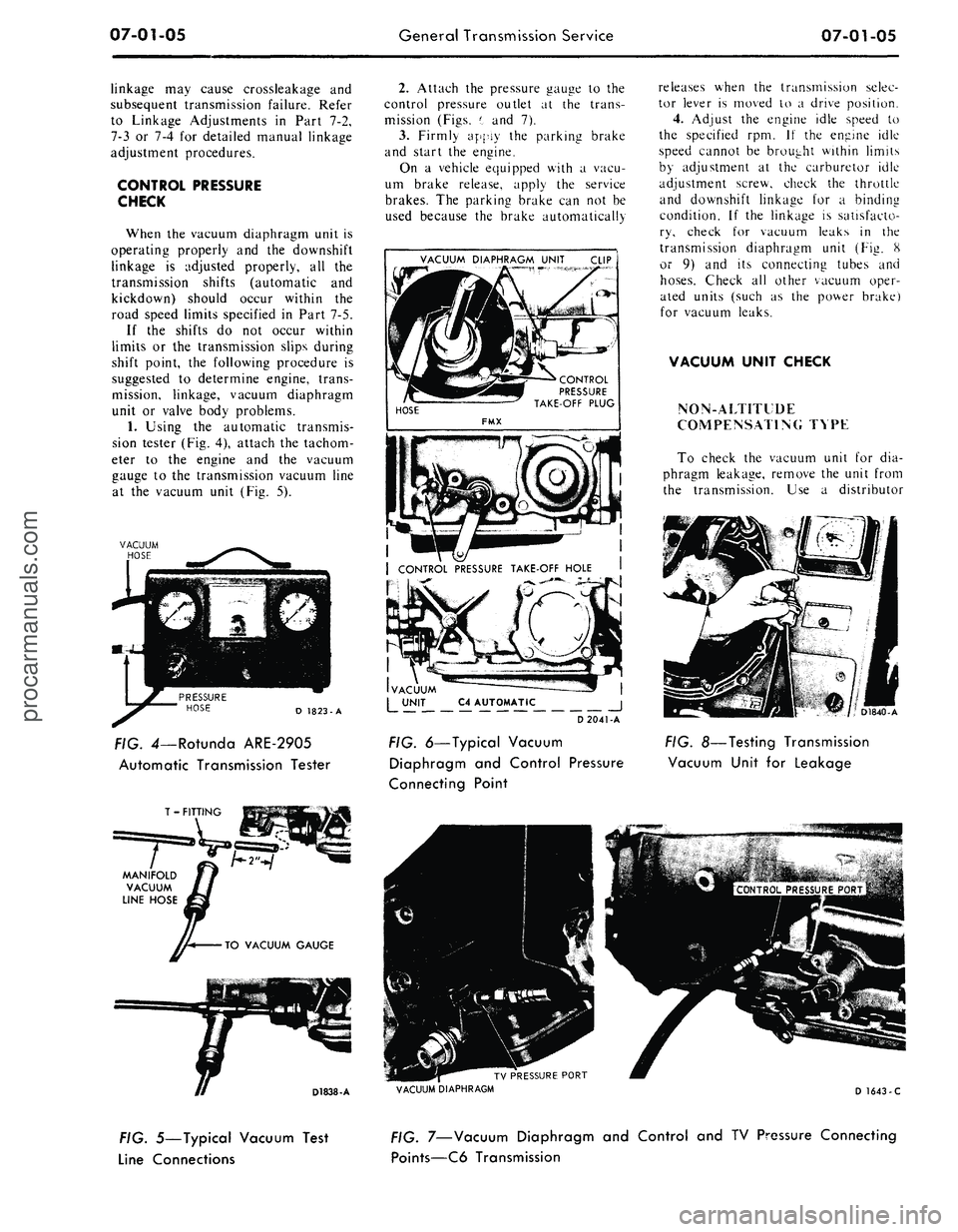
Using the automatic transmis-
sion tester (Fig. 4), attach the tachom-
eter to the engine and the vacuum
gauge to the transmission vacuum line
at the vacuum unit (Fig. 5).
D 1823-A
. 4—Rotunda ARE-2905
Automatic Transmission Tester
T - FITTING
2.
Attach the pressure gauge to the
control pressure outlet at the trans-
mission (Figs. '., and 7).
3.
Firmly apply the parking brake
and start the engine.
On a vehicle equipped with a vacu-
um brake release, apply the service
brakes. The parking brake can not be
used because the brake automatically
VACUUM DIAPHRAGM UNIT
CLIP
I
| CONTROL PRESSURE TAKE-OFF HOLE
D2041-A
FIG. 6—Typical Vacuum
Diaphragm and Control Pressure
Connecting Point
releases when the transmission selec-
tor lever is moved to a drive position.
4.
Adjust the engine idle speed lo
the specified rpm. If the engine idle
speed cannot be brought within limits
by adjustment at the carburetor idle
adjustment screw, check the throttle
and downshift linkage for a binding
condition. If the linkage is satisfacto-
ry, check for vacuum leaks in the
transmission diaphragm unit (Fig. 8
or 9) and its connecting tubes and
hoses.
Check all other vacuum oper-
ated units (such as the power brake)
for vacuum leaks.
VACUUM UNIT CHECK
NON-ALTITIDE
COMPENSATING TYPE
To check the vacuum unit for dia-
phragm leakage, remove the unit from
the transmission. Use a distributor
D1840-A
FIG. 8—Testing Transmission
Vacuum Unit for Leakage
VACUUM DIAPHRAGM
D 1643 -C
FIG. 5—Typical Vacuum Test
Line Connections
FIG.
7—Vacuum
Diaphragm and Control and TV Pressure Connecting
Points—C6 Transmissionprocarmanuals.com