1969 FORD MUSTANG parking brake
[x] Cancel search: parking brakePage 52 of 413
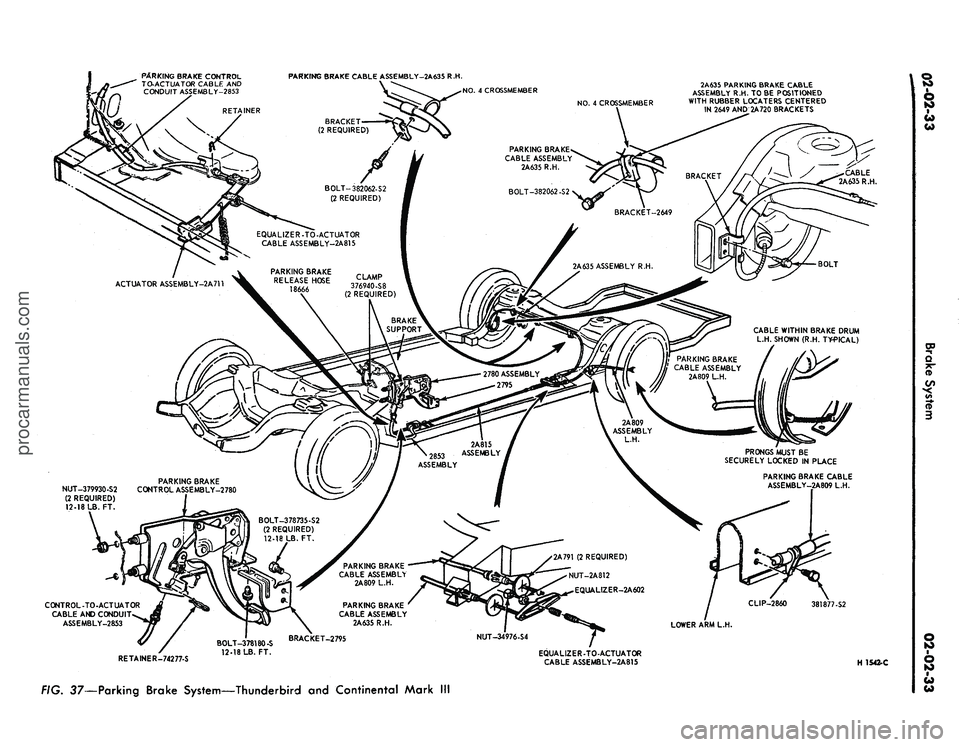
PARKING BRAKE CONTROL
TO-ACTUATOR CABLE AND
CONDUIT ASSEMBLY-2853
PARKING BRAKE CABLE ASSEMBLY-2A635 R.H.
2A635 PARKING BRAKE CABLE
ASSEMBLY R.H. TO BE POSITIONED
WITH RUBBER LOCATERS CENTERED
IN 2649 AND
2A 720
BRACKETS
NO.
4 CROSSMEMBER
NO.
4 CROSSMEMBER
BRACKET
(2 REQUIRED)
PARKING BRAKE
CABLE ASSEMBLY
2A635 R.H.
BOLT-382062-S2
(2 REQUIRED)
EQUALIZER.TO-ACTUATOR
CABLE ASSEMBLY-2A815
2A635 ASSEMBLY R.H.
ACTUATOR ASSEMBLY-2A7U
CABLE WITHIN BRAKE DRUM
L.H. SHOWN (R.H. TYPICAL)
PARKING BRAKE
CABLE ASSEMBLY
2A809 UH.
2780 ASSEMBLY
2795
2A809
ASSEMBLY
L.H.
PRONGS MUST BE
SECURELY LOCKED IN PLACE
PARKING BRAKE CABLE
ASSEMBLY-2A809 L.H.
PARKING BRAKE
CONTROL ASSEMBLY-2780
BOLT-378735-S2
(2 REQUIRED)
LB.
FT.
2A791 (2 REQUIRED)
PARKING BRAKE
CABLE ASSEMBLY
2A809 L.H.
NUT-2A812
EQUALIZER-2A602
PARKING BRAKE
CABLE ASSEMBLY
2A635 R.H.
NUT-379930-S2
(2 REQUIRED)
12-18 LB. FT.
CONTROL-TO-ACTUATOR
CABLE AND CONDUIT
ASSEMBLY-2853
381877-S2
RETAINER-74277-S
BOLT-378180-S
12-18 LB. FT.
EQUALIZER.TO-ACTUATOR
CABLE ASSEMBLY-2A815
H1542-C
FIG. 37—Parking Brake System—Thunderbird and Continental Mark IIIprocarmanuals.com
Page 53 of 413
02-02-34
Brake System
02-02-34
strument panel. Install the lower con-
trol panel retaining screws.
8. Install the windshield wiper con-
trol bezel and knob.
9. Working in the engine compart-
ment connect the wire harness and
vacuum hoses to the Automatic Tem-
perature Control box.
10.
Connect the battery cable.
11.
Raise the vehicle on a hoist.
12.
Connect the cable ball to the
equalizer and install the equalizer
lever return ^spring.
13.
Adjust the parking brake cable
tension.
14.
Lower the vehicle.
PARKING BRAKE ACTUATOR—
TO CONTROL CABLE
FORD, MERCURY
AND METEOR
Removed
1.
Raise the vehicle on a hoist.
2.
Loosen the actuator lever to
equalizer cable adjusting nut at the
equalizer (Fig. 34).
3.
Disconnect the cable ball from
the clevis on the actuator lever.
4.
Remove spring clip that retains
the cable to the frame.
5.
From inside of passenger com-
partment, remove spring clip that re-
tains the cable to the parking brake
control. Disconnect the cable ball
from the control assembly.
6. Remove the cable assembly from
the vehicle.
Installation
1.
Position the cable through the
provided openings and in the approxi-
mate final installation position.
2.
Install the hairpin retainer on the
cable at the frame crossmember.
3.
Connect the ball end of the cable
to the parking brake control. Install
the cable-to-control hairpin retaining
clip.
4.
Position the cable seal at the
dash panel, and slide the retaining clip
upward to seal the cable at the dash
opening.
5.
Connect the ball end of the cable
to the clevis on the actuator lever.
6. Adjust the parking brake (Part
2-1,
Section 2).
7.
Lower vehicle on hoist.
THUNDERBIRD AND
CONTINENTAL MARK III
Removal
Refer to Fig. 37.
1.
Partially raise the vehicle.
2.
Back off the adjusting nut at the
equalizer to relieve the tension on the
cable.
3.
Remove the spring at the actua-
tor lever and disconnect the control
cable from the clevis on the lever.
4.
Remove the clip retaining the
control cable assembly to
thq*.
frame
bracket. B
5.
Attach a length of wire to the
control cable.
6. Working inside the vehicle re-
move two screws retaining the left
scuff plate.
7.
Remove one screw and remove
the left cowl side trim panel.
8. Remove the two screws retaining
the left air duct to the inner panel and
remove the air duct.
9. Remove the two screws retaining
the dimmer switch and position the
dimmer switch back out of the way.
10.
Remove the clip retaining the
cable assembly to the control and re-
move the cable ball from the control
clevis.
11.
Pull the cable up through the
opening in the dash panel and remove
the cable from the length of wire.
Installation
1.
Attach the cable to the length of
wire and pull the cable down through
the opening in the dash panel.
2.
Position the upper end of the
control cable to the control. Connect
the cable ball to the control clevis and
install the clip retaining the cable
housing to the control.
3.
Remove the length of wire from
the cable assembly and position the
cable in the frame bracket. Install the
retainer,
4.
Connect the cable ball to the
clevis on the actuator lever and install
the actuator lever spring.
5.
Adjust the parking brake.
6. Reposition the dimmer switch
and install the retaining screws.
7.
Position the air duct to the inner
panel and install the retaining screws.
& Position the cowl side trim panel
and install the retaining screw.
9. Install the two screws in the
scuff plate.
PARKING BRAKE
EQUALIZER TO CONTROL
CABLE
FAIRLANE, MONTEGO
AND FALCON
Removal
Refer to Fig. 35.
1.
Make certain the parking brake
is fully released.
2.
Raise the vehicle on a hoist. Re-
move the two nuts that attach the
cable to the equalizer. Remove the
equalizer, spring seat and spring.
3.
Remove the hairpin retainer
holding the cable assembly to i:he body
bracket and remove the cable from
the slot in the bracket.
4.
Lower the vehicle partially.
5.
Remove the hairpin retainer
which retains the cable assembly to
the control.
6. Remove the cable bolt retaining
clip from the control clevis and dis-
connect the cable ball from the clevis.
7.
Pull the cable down through the
opening in the floor pan and frame
side rail.
Installation
1.
Route the new cable through
the frame side rail and up through
the opening in the floor pan. Pull the
cable up into position.
2.
Connect the cable ball in the con-
trol clevis.
3.
Insert the cable housing into
the control and install the hairpin re-
tainer.
4.
Raise the vehicle.
5.
Position the cable in the body
bracket and install the hairpin re-
tainer.
6. Position the spring, spring re-
tainer and equalizer on the cable and
install the two nuts.
7.
Adjust the parking brake.
MUSTANG AND COUGAR
Removal
Refer to Fig. 36.
1.
Make certain the parking brake
is fully released.
2.
Raise the vehicle on a hoist. Re-
move the two nuts that attach the
cable to the equalizer. Remove the
equalizer spring seat and spring.
3.
Remove the hairpin retainer
holding the cable assembly to the
body bracket and pull the cable out
of the side rail access holes.procarmanuals.com
Page 54 of 413
02-02-35
Brake System
02-02-35
4.
Attach a wire to the end of the
cable to assist in routing new cable.
5.
Lower the vehicle.
6. Remove the parking brake front
cable ball retaining clip from the
clevis.
7.
Disconnect the cable ball from
the notch in the brake clevis.
8.. Remove the hairpin retainer and
remove the cable assembly from the
brake control assembly.
9. Pull the cable assembly up through
the opening in the floor and remove
the wire from the end of the cable.
Installation
Refer to Fig. 36.
1.
Connect the wire to the end of
the cable assembly and pull the cable
down through the opening in the
floor. Remove the wire.
2.
Connect the cable assembly to
the brake control assembly and in-
stall the hairpin retainer.
3.
Position the ball end of the
cable in the notch of the brake clevis.
4.
Raise the vehicle on a hoist.
5.
Pull the cable grommet into po-
sition and route the cable through
the access holes in the side rail and
under the fuel line.
6. Insert the cable into the body
bracket and install the hairpin re-
tainer.
7.
Position the spring, spring seat,
and equalizer on the cable and install
the two nuts.
8. Adjust the parking brake.
LINCOLN CONTINENTAL
Removal
1.
Raise the car on a hoist. Dis-
connect the parking brake cable from
the equalizer lever underneath the
car (Fig. 38).
2.
Remove the retaining clip at the
cable bracket, and disengage the cable
from the bracket (Fig. 38).
3.
Remove the supporting clip re-
taining bolts and remove the support
plate from the underbody.
4.
Lower the car on a hoist.
5.
With the parking brake in the
fully released position, disconnect the
cable at the control assembly.
6. Raise the vehicle on a hoist. Re-
move the left front fender apron
splash shield retaining bolts and the
splash shield.
7.
Remove the two bolts securing
the parking brake control to equaliz-
er cable bracket to the dash panel
and remove the cable from the vehicle.
Installation
1.
Route the parking brake control
to equalizer cable to the control as-
sembly and the equalizer, and install
the two bolts that retain the cable
to the dash panel (Fig. 38).
2.
Install the left fror%/ender apron
splash shield and the ^u attaching
bolts.
3.
Lower the vehicle.
4.
Connect the control cable to the
clevis on the control assembly.
5.
Raise the car on a hoist.
6. Position the supporting clip and
cable on the vehicle and install the
retaining bolts. Do not tighten the
bolts.
Position the cable armor ap-
proximately 1/2 inch to the right of
the clip (looking toward the rear of
the car) and tighten the retaining
bolts.
7.
Position the equalizer control
cable to the support bracket and in-
stall the retaining hairpin clip.
8. Connect the ball end of the con-
trol cable to the equalizer lever.
9. Adjust the parking brake linkage
(Part
2-1,
Section 2).
10.
Check the operation of the auto-
matic release mechanism.
PARKING BRAKE
ACTUATOR-TO-EQUALIZER
CABLE
FORD, MERCURY,
METEOR, THUNDERBIRD
AND CONTINENTAL
MARK III
Removal
Refer to Figs. 34 and 37.
1.
Raise the vehicle on a hoist.
2.
Remove the lock and adjusting
nut which retains the cable to the
equalizer.
3.
Remove the cable end from the
equalizer.
4.
Unhook the cable from the act-
uator, and remove from the vehicle. *
Installation
1.
Insert new cable end into act-
uator.
2.
Insert cable end into equalizer
and tighten the adjusting nut snug.
Install the lock nut.
3.
Adjust the parking brake cable
tension and check operation as out-
lined in Part
2-1,
Section 2.
4.
Lower the vehicle.
PARKING BRAKE EQUALIZER
TO REAR WHEEL CABLE
FORD, MERCURY,
METEOR, THUNDERBIRD
AND CONTINENTAL
MARK III
Removal
1.
Raise the vehicle and tffosen the
parking brake equalizer rod" adjusting
nut. Disconnect the equalizer from the
rear cables (Figs. 34 and 37).
2.
Compress the prongs on the left
cable-to-frame side member retainer
so the prong can pass through the
side-member. Remove the clip that at-
taches the left cable to the left lower
arm. Pull the cable thru the frame left
side member.
3.
Compress the prongs on the
right cable-to-frame side member re-
tainer bracket so the prong can pass
through the bracket. Remove the clips
retaining the right cable to the frame
crossmember.
4.
Remove the rear wheel cover and
wheel. Remove the three Tinnerman
nuts that hold the brake drum in place
and remove the drum.
5.
Working on the wheel side of the
rear brake, remove the automatic
brake adjuster spring. Compress the
prongs on the parking brake cable re-
tainer so that they can pass through
the hole in the brake backing plate.
Draw the cable retainer through the
hole.
6. With the spring tension off the
parking brake lever, lift the cable out
of the slot in the lever and remove the
cable through the backing plate hole.
Installation
1.
Pull enough of the parking brake
cable through the housing so that the
end of the cable may be inserted over
the slot in the parking brake lever on
the rear brake shoe.
2.
Pull the excess slack from the
cable, and insert the cable housing
into the brake backing plate access
hole so that the retainer prongs ex-
pand. The prongs must be securely
locked in place. Install the automatic
brake adjuster spring.
3.
Position the right hand cable and
the two retaining clips and screws on
the rear crossmember. Compress the
prongs on the right cable and position
the cable in the retaining bracket on
the frame side member. Be sure theprocarmanuals.com
Page 55 of 413
02-02-36
Brake System
02-02-36
locating stripe on the cable is midway
between the retaining clips and tighten
all retaining clip screws.
4.
Position the left cable, retaining
clip and screw on the left lower sus-
pension arm. Compress the prongs on
the left cable and position the cable
through the frame side-member. The
prongs must be securely locked in
place.
5.
Insert the ball ends of the cables
into the equalizer assembly.
6. Install the rear drum(s) and
tighten the three Tinnerman nuts and
secure the drum. Install the wheel and
tire and the wheel cover.
7.
Adjust the parking brake linkage
as outlined in Part 2-1, Section 2. Ad-
just the rear brakes, as required (Part
2-1,
Section 2).
FAIRLANE, MONTEGO,
MUSTANG AND COUGAR—
EXCEPT STATION WAGON
Removal
1.
Remove the equalizer lock nut
and adjusting nut, equalizer, spring
and spring seat.
2.
With the cables slack, discon-
nect the ball-ends from the connector
(Figs.
35 and 36).
3.
Remove the cable from the re-
tainer hooks (station wagon models)
and the underbody guide (convertible
models) if required.
4.
Remove the hairpin lock retain-
ing the cable housing to the side rail
bracket.
5.
Remove the wheel cover, wheel
and tire and the rear brake drum as
outlined in Section 2.
6. Remove self-adjuster springs to
allow clearance to remove cable re-
tainer from the backing plate. Discon-
nect the rear end of the cable from the
parking brake lever on the brake shoe.
Disengage the cable housing retaining
grommet or steel-pronged Hi-Hat
from the backing plate and withdraw
the cable and housing from the in-
board side of the backing plate.
7.
Slide the cable and housing out
of the side rail bracket.
Installation
1.
Insert the rear end of the cable
through the side rail bracket and pull
the cable and housing into position.
2.
Insert the rear end of the cable
and housing through the hole in the
backing plate from the inboard side.
3.
Connect the cable to the parking
brake lever on the brake shoe and in-
stall the cable housing retaining grom-
met or steel-pronged Hi-Hat in the
backing plate.
4.
Install the self-adjuster springs.
Position the cable housing in the side
rail bracket and install the hairpin
type retainer.
5.
Install rear hub and drum as-
sembly, wheel and tire assemblies and
wheel cover as outlined in Section 2.
6. Position the cable retainer hooks
(station wagon models) in the under-
body guide (convertible models) and
install the connector, thus hooking the
two cables together.
7.
Insert the cable into the equaliz-
er and install the equalizer, spring
seat, spring, adjusting nut and lock
nut to the front, parking brake control
cable.
8. Adjust the parking brake^as di-
rected in Part 2-1, Section 2.
FAIRLANE AND MONTEGO
STATION WAGONS AND
FALCON PASSENGER
MODELS
Removal and Installation
Refer to Fig. 35.
Generally follow the procedure
given above, omitting separation of
the cables, since the parking brake
rear cable assemblies supplied for
these models is in one piece. Removal
and installation of both rear wheels,
tires and drums will also be required.
LINCOLN CONTINENTAL
Removal
1.
Raise the car. Remove the rear
wheel cover. Remove the wheel and
tire as an assembly.
2.
Remove the three Tinnerman
nuts that hold the brake drum in
place, and remove the drum.
3.
Remove the brake shoe retract-
ing springs.
4.
Loosen the equalizer rod adjust-
ing nut and disconnect the cable from
the equalizer (Fig. 38).
5.
Remove the hairpin-type retainer
clip that secures the cable housing to
the body bracket, and pull the cable
and housing out of the bracket (Fig.
38).
6. Remove the cable to underbody
clamp attaching nuts and the clamp.
Disengage the cable housing from the
hook-type retainer at the spring U-
bolt.
7.
Working on the wheel side of the
backing plate (Fig. 38), compress the
prongs on the cable retainer so that it
can pass through the hole in the back-
ing plate. Draw the cable retainer out
of the hole.
8. With the spring tension off the
parking brake lever, lift the cable out
of the slot in the lever and remove it
through the backing plate hols.
Installation
1.
Pull enough of the cable through
the cable housing so that the end of
the cable may be inserted through the
backing plate hole from the inner side
and engage the cable end with the slot
in the parking brake lever.
2.
Pull the excess slack from the
cable and insert the cable housing into
the backing plate access hole (Fig.
38).
The prongs must be securely
locked in place.
3.
Install the brake shoe retracting
springs.
4.
Position the cable to the under-
body and install the retaining clamp
so that the cable conduit armor ex-
tends forward of the clamp as shown
in Fig. 38. Install the clamp retaining
nuts.
5.
Hook the cable housing to the
retainer at the spring U-bolt.
6. Engage the forward end of the
cable housing with the frame bracket
and secure it with the hairpin-type
clip.
7.
Insert the ball end of the cable
into the equalizer.
8. Make a preliminary brake ad-
justment with the use of Tool HRA-
8650 (Fig. 11).
9. Install the rear drum. Tighten
the three Tinnerman nuts that secure
the drum. Install the wheel and wheel
cover.
10.
Adjust the parking brake link-
age.
11.
Lower the vehicle.
ANTI-SKID CONTROL
ACTUATOR
REMOVAL
Refer to Fig. 39.
1.
Working in the passenger com-
partment, under the glove box, remove
the screw that attaches the forward
end of the control module retainer to
the support assembly. Lower the for-
ward end of the control module re-
tainer and remove the module assem-
bly.procarmanuals.com
Page 64 of 413

02-03-03
Specifications
02-03-03
ROTOR REFINISH
The following requirements must be met when resurfacing disc
brake rotors:
Rotunda Disc Brake Attachment FRE-2249-2 is the only approv-
ed tool to be used to ref inish the disc brake rotors. The step-by-
step resurfacing procedure provided with the tool must be adhered
t0" The finished braking surfaces of the rotor must be flat and
parallel within 0.0007
inch;
lateral runout must not exceed 0.003
inch total indicator reading, and the surface finish of the braking
surfaces are to be 15-80 micro inches.
On all models except Lincoln Continental the limiting dimen-
sion from the inner bearing cup to the inner rotor face must be
measured with a ball and gage bar (Rotunda FRE-70160).
On Lincoln Continental models the limiting dimension from the
inboard bearing cup to the inboard rotor face of 0.755 inch
mini-
mum and from the inboard bearing cup to the outboard rotor face
of 0.395 inch minimum must be observed.
TORQUE LIMITS -GENERAL -FT-LBS.
Parking Brake Control Assembly
Mounting Nuts and Bolts
Master Cylinder to Dash Panel Screw
Master Cylinder to Booster
Booster to Dash Panel
Disc Brake Caliper to Spindle Bolts
Disc Brake Rotor Splash Shield
to Spindle
Brake Hose to Caliper Connection Bolt
Caliper Locating Pins
Caliper Stabilizer to Anchor Plate
Bolt
Caliper Brake Shoe Clips
Caliper Bleeder Screws
Wheel Cylinder to Backing Plate Screws
Wheel Cylinder & Backing Plate
Anchor Pin Nut
Rear Brake Backing Plate to Axle
Housing:
Removable Carrier
Integral Type
Front Brake Backing Plate to Spindle
Wheel Cylinder Bleeder Screw
Brake Hose Connection to Front
Wheel Cylinder
Brake Line Connection to Rear Axle
Housing:
Removable Carrier
Integral Type
Hydraulic Tube Connections ®
3/8 x 24
7/16 x 24
1/2 x 20
9/16 x 18
Wheel to Hub and Drum or Hub and
Rotor Nuts
Ford-Mercury
Meteor
Cap Screw
12-19
Nuts 7-11
13-20
13-?0
13-20
Upper ©
110-140
Lower
90-120
9-14
17-25
25-35
8-11
6-10
6-15
10-20
20-30
50-70
IPo
25-40
6-15
12-20
30-40
25-35
10-15
10-15
10-17
10-17
70-115
Fair
lane-
Montego
Falcon
12-25
13-20
13-20
13-20
Upper CD
100-140
Lower
55-75
9-14
17-25
25-35
8-11
6-10
6-15
10 in. Brake
10-20
9 in. Brake
5-7
50-70
20-40
28-35
32-65 ®
Inch-lb.
12-20
12-19
12-19
10-15
10-15
10-17
10-17
4 lug
55-85
5 lug
70-115
Mustang-
Cougar
12-25
13-20
13-20
13-20
Upper ©
100-140
Lower
55-75
9-14
17-25
25-35
8-11
6-10
6-15
10 in. Brake
10-20
9 in. Brake
5-7
50-70
20-40
28-35
32-65 ®
Inch-lb.
12-20
12-19
12-19
10-15
10-15
10-17
10-17
4 lug
55-85
5 lug
70-115
Thunderbird
Continental
Mark III
1218
13-20
13-20
Upper ©
110-140
Lower
90-120
9-14
17-25
25-35
8-11
6-10
6-15
10-20
50-70
6-15
30-40
10-15
10-15
10-17
10-17
70-115
Lincoln
Continental
Dash Panel
10-20
Inst. Panel
712
13-20
13-20
100-140
9-14
7-9
6-15
10-20
30-35
6-15
10-15
10-15
10-17
10-17
70-115
® The upper bolt must be tightened first.
® On front disc brake calipers 6-15 ft-lbs.
® All hydraulic lines must be tightened to the specified torque value and be free of fluid leakage.procarmanuals.com
Page 67 of 413

03-01-02
Suspension — Steering, Wheels And Tires — General Service
03-01-02
1 TESTING
POWER STEERING-
PRELIMINARY TESTS
The following preliminary checks
should always be made before per-
forming any operations.
AIR BLEEDING
Air in the power steering system
(shown by bubbles in the fluid) should
be bled. After making sure that the
reservoir is filled to specification (the
fluid must be at normal operating
temperature when the check is made),
turn the steering wheel through its full
travel three or four times. Do not hold
the wheels against their stops. Re-
check the fluid level.
CHECK FLUID LEVEL
Run the engine until the fluid is at
normal operating temperature. Then
turn the steering wheel all the way to
the left and right several times, and
shut off the engine.
Check the fluid level in the power
steering reservoir. The level must show
on the cross hatching between the bot-
tom of the dipstick and the full mark
(Fig. 1). If the level is low, add
enough automatic transmission fluid
C1AZ-19582-A to raise the level to
the F mark on the dipstick. Do not
overfill the reservoir.
CHECK PUMP BELT
If the pump belt is broken, glazed,
or worn, replace it with a new belt.
Use only the specified type of belt.
Refer to Part 3-13 for belt adjustment
procedure.
CHECK FOR FLUID
LEAKS
With the engine idling, turn the
steering wheel from stop to stop sever-
al times. Check all possible leakage
points. Tighten all loose fittings, and
replace any damaged lines or defective
seats.
CHECK TURNING EFFORT
With the front wheels properly al-
igned and tire pressures correct, check
the effort required to turn the steering
wheel.
G 1508- A
FIG.
1—Power
Steering Pump
Dipstick
1.
With the vehicle on dry concrete,
set the parking brakes.
2.
With the engine warmed up and
running at idle speed, turn the steering
wheel to the left and right several
times to warm the fluid.
3.
Attach a pull scale to the rim of
the steering wheel. Measure the pull
required to turn the wheel one com-
plete revolution in each direction. The
effort required to rotate the steering
wheel should not exceed specifications
given in Part 3-13.
POWER STEERING PUMP FLOW
AND PRESSURE TESTS—
EXCEPT LINCOLN CONTINENTAL
AND CONTINENTAL MARK III
The power steering flow and pres-
sure tests will show whether the pump,
steering gear or power assist control
RETURN LINE
POWER
STEERING PUMP
Sr
valve is causing the trouble. Steps out-
lined below should be followed to de-
termine the cause of the trouble.
PUMP FLOW TEST
1.
Depending on the equipment
present on the vehicle (air condition-
ing, power brakes, standard transmis-
sion),
one of the following options
may be used to connect the pump
pressure and return hoses to the test
tool (T56L-3361O-D and T68L-
33610-A):
a. Disconnect the pressure and re-
turn lines at the power steering pump
(Fig. 2). Obtain a power steering re-
turn hose from stock and connect the
end with the fitting to the output fit-
ting of the tool using the
5/8-18
SAE
female, 1/4 N.P. thread male fitting
provided. The end of the stock hose
(without the fitting) should be con-
nected to the return tube of the pump.
Connect the pressure hose from the
tool to the outlet fitting of the pump.
b.
Disconnect the pressure line at
the pump and connect the pressure
line from the test tool to the outlet fit-
ting of the pump. Disconnect the re-
turn line at the gear and connect it to
the output fitting of the tool, using the
5/8-18
SAE female, 1/4 N.P. thread
male fitting provided.
2.
After installing the lines by the
most advantageous method, proceed
as follows:
3.
Open the manual valves A and B
fully (Fig. 2).
CALIBRATED FLOW
DETERMINING ORIFICE
PRESSURE LINE
FIG. 2—Power Steering Pump Test Circuit Diagram
PRESSURE GAGE
G1611-Aprocarmanuals.com
Page 207 of 413
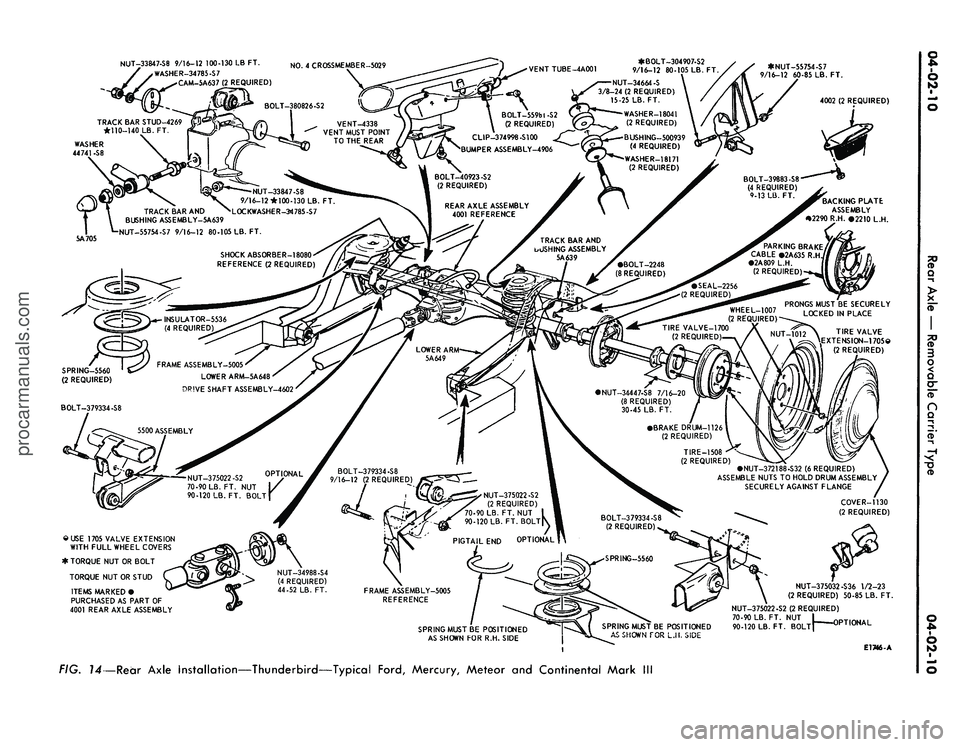
NUT-33847-S8
9/16-12
100-130 LB FT.
*-34785-S7
-CAM-5A637 (2 REQUIRED)
• NUT-55754-S7
9/16-12
60-85 LB. FT.
4002 (2 REQUIRED)
• BOLT-304907-S2
9/16-12
80-105 LB. FT.
NO.
4 CROSSMEMBER-5029
VENT TUBE-4A001
NUT-34664-S
3/8-24
(2 REQUIRED)
15-25 LB. FT.
WASHER-18041
(2 REQUIRED)
BOLT-559bl-S2
(2 REQUIRED)
TRACK BAR STUD-4269
•110-140 LB. FT.
VENT-4338
VENT MUST POINT
TO THE REAR
CLIP-374998-S100
BUMPER ASSEMBLY-4906
BUSHING-500939
(4 REQUIRED)
WASHER-18171
(2 REQUIRED)
BOLT-40923-S2
(2 REQUIRED)
BOLT-39883-S8
(4 REQUIRED)
9-13 LB. FT.
NUT-33847-
9/16-12*100-130
LB. FT
L
OC
KWASHE R -34
785
-S 7
BACKING PLATE
ASSEMBLY
*2290 R.H. #2210 L.H.
REAR AXLE ASSEMBLY
4001 REFERENCE
TRACK BAR AND
BUSHING ASSEMBLY-5A639
NUT-55754-S7
9/16-12
80-105 LB. FT.
TRACK BAR AND
oJSHfNG ASSEMBLY
5A639
PARKING BRAKE
CABLE »2A635 R.H
•2A809 L.H.
(2 REQUIRED)
SHOCK ABSORBER-18080'
REFERENCE (2 REQUIRED)
•BOLT-2248
(8 REQUIRED)
• SEAL-2256
(2 REQUIRED)
PRONGS MUST BE SECURELY
LOCKED IN PLACE
WHEEL-1007
(2 REQUIRED)
INSULATOR-5536
(4 REQUIRED)
TIRE VALVE-1700
(2 REQUIRED
TIRE VALVE
XTENSION-1705©
(2 REQUIRED)
FRAME ASSEMBLY-5005
LOWER ARM-5A648
DRIVE SHAFT ASSEMBLY-4602
SPRING-5560
(2 REQUIRED)
• NUT-34447-S8
7/16-20
(8 REQUIRED)
30-45 LB. FT.
•BRAKE DRUM-1126
(2 REQUIRED)
TIRE-1508
(2 REQUIRED)
• NUT-372188-S32 (6 REQUIRED)
ASSEMBLE NUTS TO HOLD DRUM ASSEMBLY
SECURELY AGAINST FLANGE
BOLT-379334-S8
9/16-12
(2 REQUIRED)
NUT-375022-S2
70-90 LB. FT. NUT
90-120 LB. FT. BOLT
NUT-375022-S2
(2 REQUIRED)
-90 LB. FT. NUT
90-120 LB. FT. BOLT
BOLT-3 79334-S8
(2 REQUIRED)
NUT-34988-S4
(4 REQUIRED)
44-52 LB. FT.
FRAME ASSEMBLY-5005
REFERENCE
2
o
i
O
TO
Q
>
X
TO
O
3
n
Q
©USE 1705 VALVE EXTENSION
WITH FULL WHEEL COVERS
* TORQUE NUT OR BOLT
TORQUE NUT OR STUD
ITEMS MARKED •
PURCHASED AS PART OF
4001 REAR AXLE ASSEMBLY
NUT-375032-S36
1/2-23
(2 REQUIRED) 50-85 LB. FT.
SPRING MUST BE POSITIONED
AS SHOWN FOR R.H. SIDE
SPRING MUST BE POSITIONED
AS SHOWN FOR L.H. SiDE
NUT-375022-S2 (2 REQUIRED)
70-90 LB. FT. NUT
90-120 LB. FT. BOLTl
TIONAL
El 746-A
?
6
FIG. 14—Redr Axle Installation—Thunderbird—Typical Ford, Mercury, Meteor and Continental Markprocarmanuals.com
Page 208 of 413
04-02-11
Rear Axle — Removable Carrier Type
04-02-11
If the axle housing is new, install a
new vent. The hose attaching portion
must face toward the front of the ve-
hicle.
2.
If leather-type wheel bearing ser-
vice seals are to be installed, soak the
new rear wheel bearing oil seals in
SAE 10 oil for 1/2 hour before instal-
lation. Wipe a small amount of an oil
resistant sealer on the outer edge of
each seal before it is installed. Do not
put any of the sealer on the sealing
lip.
Install the oil seals in the ends of
the axle housing with one of the tools
shown in Fig. 10 and 12.
3.
Position the replacement axle
housing under the vehicle, and raise
the axle with a hoist or floor jack.
Connect the suspension lower arms to
their mounting brackets on the axle
housing with pivot bolts and nuts. Do
not tighten the bolts and nuts at this
point.
4.
Position the suspension upper
arm in its mounting bracket on the
axle housing, and install the adjusting
bolt, eccentric washers, lock washer
and nut. Leave the bolt and nut loose
at this point.
5.
Position the brake lines to the
axle housing, and secure with the re-
taining clips.
6. Install the brake backing plates
on the axle housing flanges.
7.
Connect the track bar to the
mounting stud, install the washer and
attaching nut, and torque to specifica-
tions.
8. Position the rear coil springs and
insulators in the pockets provided.
9. Connect the lower studs of the
two rear shock absorbers to the
mounting brackets on the axle hous-
ing. Install the attaching nuts, and
torque to specifications.
10.
Connect the vent tube to the
vent on the housing. If axle housing is
new, install a new vent.
11.
Clean the mating surfaces of
the axle housing and differential car-
rier. Position the carrier on the
mounting studs on the housing using a
new gasket between carrier and hous-
ing. Install the copper washers and the
carrier-to-housing attaching nuts, and
torque to specifications.
12.
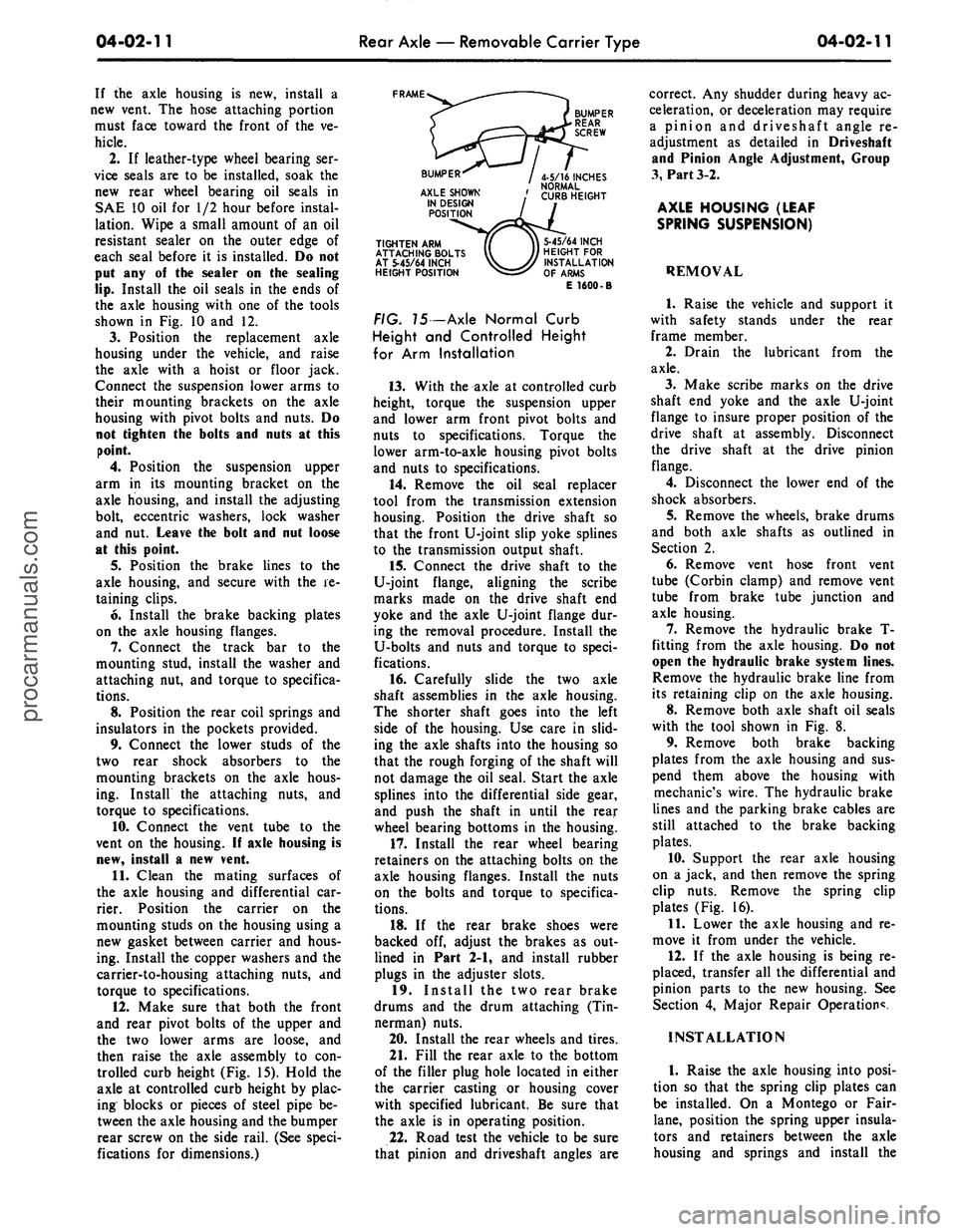
Make sure that both the front
and rear pivot bolts of the upper and
the two lower arms are loose, and
then raise the axle assembly to con-
trolled curb height (Fig. 15). Hold the
axle at controlled curb height by plac-
ing blocks or pieces of steel pipe be-
tween the axle housing and the bumper
rear screw on the side rail. (See speci-
fications for dimensions.)
FRAME
TIGHTEN ARM
ATTACHING BOLTS
AT 5-45/64 INCH
HEIGHT POSITION
5-45/64 INCH
HEIGHT FOR
INSTALLATION
OF ARMS
E 1600-B
FIG. 75 -Axle Normal Curb
Height and Controlled Height
for Arm Installation
13.
With the axle at controlled curb
height, torque the suspension upper
and lower arm front pivot bolts and
nuts to specifications. Torque the
lower arm-to-axle housing pivot bolts
and nuts to specifications.
14.
Remove the oil seal replacer
tool from the transmission extension
housing. Position the drive shaft so
that the front U-joint slip yoke splines
to the transmission output shaft.
15.
Connect the drive shaft to the
U-joint flange, aligning the scribe
marks made on the drive shaft end
yoke and the axle U-joint flange dur-
ing the removal procedure. Install the
U-bolts and nuts and torque to speci-
fications.
16.
Carefully slide the two axle
shaft assemblies in the axle housing.
The shorter shaft goes into the left
side of the housing. Use care in slid-
ing the axle shafts into the housing so
that the rough forging of the shaft will
not damage the oil seal. Start the axle
splines into the differential side gear,
and push the shaft in until the rear
wheel bearing bottoms in the housing.
17.
Install the rear wheel bearing
retainers on the attaching bolts on the
axle housing flanges. Install the nuts
on the bolts and torque to specifica-
tions.
18.
If the rear brake shoes were
backed off, adjust the brakes as out-
lined in Part 2-1, and install rubber
plugs in the adjuster slots.
19.
Install the two rear brake
drums and the drum attaching (Tin-
nerman) nuts.
20.
Install the rear wheels and tires.
21.
Fill the rear axle to the bottom
of the filler plug hole located in either
the carrier casting or housing cover
with specified lubricant. Be sure that
the axle is in operating position.
22.
Road test the vehicle to be sure
that pinion and driveshaft angles are
correct. Any shudder during heavy ac-
celeration, or deceleration may require
a pinion and driveshaft angle re-
adjustment as detailed in Driveshaft
and Pinion Angle Adjustment, Group
3,
Part 3-2.
AXLE HOUSING (LEAF
SPRING SUSPENSION)
REMOVAL
1.
Raise the vehicle and support it
with safety stands under the rear
frame member.
2.
Drain the lubricant from the
axle.
3.
Make scribe marks on the drive
shaft end yoke and the axle U-joint
flange to insure proper position of the
drive shaft at assembly. Disconnect
the drive shaft at the drive pinion
flange.
4.
Disconnect the lower end of the
shock absorbers.
5.
Remove the wheels, brake drums
and both axle shafts as outlined in
Section 2.
6. Remove vent hose front vent
tube (Corbin clamp) and remove vent
tube from brake tube junction and
axle housing.
7.
Remove the hydraulic brake T-
fitting from the axle housing. Do not
open the hydraulic brake system lines.
Remove the hydraulic brake line from
its retaining clip on the axle housing.
8. Remove both axle shaft oil seals
with the tool shown in Fig. 8.
9. Remove both brake backing
plates from the axle housing and sus-
pend them above the housing with
mechanic's wire. The hydraulic brake
lines and the parking brake cables are
still attached to the brake backing
plates.
10.
Support the rear axle housing
on a jack, and then remove the spring
clip nuts. Remove the spring clip
plates (Fig. 16).
11.
Lower the axle housing and re-
move it from under the vehicle.
12.
If the axle housing is being re-
placed, transfer all the differential and
pinion parts to the new housing. See
Section 4, Major Repair Operation*.
INSTALLATION
1.
Raise the axle housing into posi-
tion so that the spring clip plates can
be installed. On a Montego or Fair-
lane,
position the spring upper insula-
tors and retainers between the axle
housing and springs and install theprocarmanuals.com