1969 FORD MUSTANG oil
[x] Cancel search: oilPage 150 of 413

03-08-06
Ford Design Integral Power Steering Gear
03-08-06
VALVE HOUSING
7W-T65P
C1239 -A
FIG. 7—Removing or Installing Lock
Nut
drain the remaining fluid from the
gear.
2.
Mount the gear in a soft-jawed
vise.
3.
Remove the lock nut and the
brass washer from the adjusting screw.
4.
Turn the input shaft to either
stop then, turn it back approximately
1 3/4 turns to center the gear.
5.
Remove the two sector shaft
cover attaching screws and the
identif-
ication tag.
6. Tap the lower end of the sector
shaft with a soft-hammer to loosen it,
then lift the cover and shaft from the
housing as an assembly. Discard the
O-ring.
7.
Turn the sector shaft cover coun-
terclockwise off the adjuster screw.
8. Remove the four valve housing
attaching bolts. Lift the valve housing
from the steering gear housing while
holding the piston to prevent it from
rotating off the worm shaft. Remove
the valve housing and the lube passage
O-rings and discard them.
9. Stand the valve body and piston
on end with the piston end down. Ro-
tate the input shaft counterclockwise
out of the piston allowing the ball
bearings to drop into the piston.
10.
Place a cloth over the open end
of the piston and turn it upside down
to remove the balls.
11.
Remove the two screws that at-
tach the ball guide clamp (Fig. 6) to
the ball nut and remove the clamp and
the guides.
12.
Install the valve body assembly
in the holding fixture (do not clamp
in a vise) and remove the lock nut and
the attaching nut as shown in Fig. 7.
13.
Carefully slide the input shaft,
worm and valve assembly out of the
valve housing. Due to the close diame-
trical clearance between the spool and
housing, the slightest cocking of the
spool may cause it to jam in the hous-
ing.
14.
Remove the shim from the
valve housing bore.
OIL SEAL
INLET TUBE SEAT
OUTLET TUBE SEAT
DUST SEAL
G1549-A
FIG.
8—Valve Housing Disassembled
Too/-T<
Tool-
T57L-500-A ,^^^
G1364-A
FIG. 9—Removing Bearing and Oil
Seal
PARTS REPAIR
OR REPLACEMENT
Valve Housing
1.
Remove the dust seal (Fig. 8)
from the rear of the valve housing
with Tools T59L-100-B and T58L-
101-A and discard the seal.
2.
Remove the snap ring from the
valve housing.
3.
Turn the fixture to place the
valve housing in an inverted position.
4.
Insert special tool in the valve
body assembly opposite the seal end
and gently tap the bearing and seal
out of the housing as shown in Fig.
9. Discard the seal. Caution must be
exercised when inserting and removing
the tool to prevent damage to the
valve bore in the housing.
5.
Remove the fluid inlet and outlet
tube seats with an EZ-out if they are
damaged.
Press Ra
Tool-
T65P-3524-A7
G1363-A
FIG. 10—Installing Valve Housing
Bearing
6. Coat the fluid inlet and outlet
tube seats with vaseline and position
them in the housing. Install and tight-
en the tube nuts to press the seats to
the proper location.
7.
Coat the bearing and seal surface
of the housing with a film of vaseline.
8. Position the bearing in the valve
housing. Seat the bearing in the valve
housing with the tool shown in Fig.
10.
Make sure that the bearing is
free to rotate.
9. Dip the new oil seal in gear lu-
bricant; then, place it in the housing
with the metal side of the seal facing
outward. Drive the seal into the hous-
ing until the outer edge of seal does
not quite clear the snap ring groove
(Fig. 11).
10.
Place the snap ring in the hous-
ing; then, drive on the ring with the
tool shown in Fig. 11 until the snap
ring seats in its groove to properly lo-
cate the seal.procarmanuals.com
Page 151 of 413

03-08-07
Ford Design Integral Power Steering Gear
03-08-07
Press Ram
Tool-
T65P.3524-A1
G1362-A
FIG.
17—Installing
Oil Seal in
Valve Housing
11.
Place the dust seal in the hous-
ing with the dished side (rubber side)
facing out. Drive the dust seal into
place with the tool shown in Fig. 11.
the seal must be located behind the
undercut in the input shaft when it is
installed.
Worm and Valve
1.
Remove the snap ring from the
end of the actuator.
2.
Slide the control valve spool
(Fig. 6) off the actuator.
3.
Install the valve spool evenly and
slowly with a slight oscillating motion
into the flanged end of valve housing
with the Valve identification groove
between the valve spool lands out-
ward, checking for freedom of valve
movement within the housing working
area. The valve spool should enter the
housing bore freely and fall by its own
weight.
4.
If the valve spool is not free,
check for burrs at the outward edges
of the working lands in the housing
and remove with a hard stone.
5.
Check the valve for burrs and if
burrs are found, stone the valve in a
radial direction only. Check for free-
dom of the valve again.
6. Remove the valve spool from the
housing.
7.
Slide the spool onto the actuator
making, sure that the groove in the
spool annulus is toward the worm.
8. Install the snap ring to retain the
spool.
9. Check the clearance between the
spool and the snap ring. The clearance
should be between 0.002-0.005 inch. If
the clearance is not within these lim-
its,
select a snap ring that will allow a
clearance of 0.003 inch.
STEERING GEAR HOUSING
J
UPPER SEAL
I LOWER SEAL
SNAP RING
SPACER WASHER
FIG. 12—Steering Gear Housing Disassembled
Tool - T59L - 100-B
Tool T57L-500 - A
G1551-A
FIG. 13—Removing Lower Seal
Piston and Ball Nut
1.
Remove the teflon ring and the
O-ring (Fig. 7) from the piston and
ball nut.
2.
Dip a new O-ring in gear lubri-
cant and install it on the piston and
ball nut.
3.
Install a new teflon ring on the
piston and ball nut being careful not
to stretch it any more than necessary.
Steering Gear Housing
1.
Remove the snap ring and the
spacer washer (Fig. 12) from the
lower end of the steering gear housing.
2.
Remove the lower seal from the
housing as shown in Fig. 13. Lift the
spacer washer from the housing.
3.
Remove the upper seal in the
same manner as the lower seal.
4.
Dip both sector shaft seals in
gear lubricant.
SHORT END
AWAY
FROM SEAL
G1550-A
Press Rom
G1374-A
FIG. 14—Installing Sector Shaft
Inner Seal
5. Apply Lubricant to the sector
shaft seal bore of the housing and
position the sector shaft inner seal
into the housing with the lip facing in-
ward. Press the seal into place with
the tool shown in Fig. 14. Place a spa-
cer washer (0.090 inch) on top of the
seal and apply more Lubricant to the
housing bore.
6. Place the outer seal in the hous-
ing with the lip facing inward and
press it into place as shown in Fig. 15.
Then, place a 0.090 inch spacer wash-
er on top of the seal.
7.
Position the snap ring in the
housing. Press the snap ring into the
housing with the tool shown in Fig. 15
to properly locate the seals and en-
gage the snap ring in the groove.
STEERING GEAR
ASSEMBLY
Do not clean, wash, or soak seals in
cleaning solvent.procarmanuals.com
Page 156 of 413
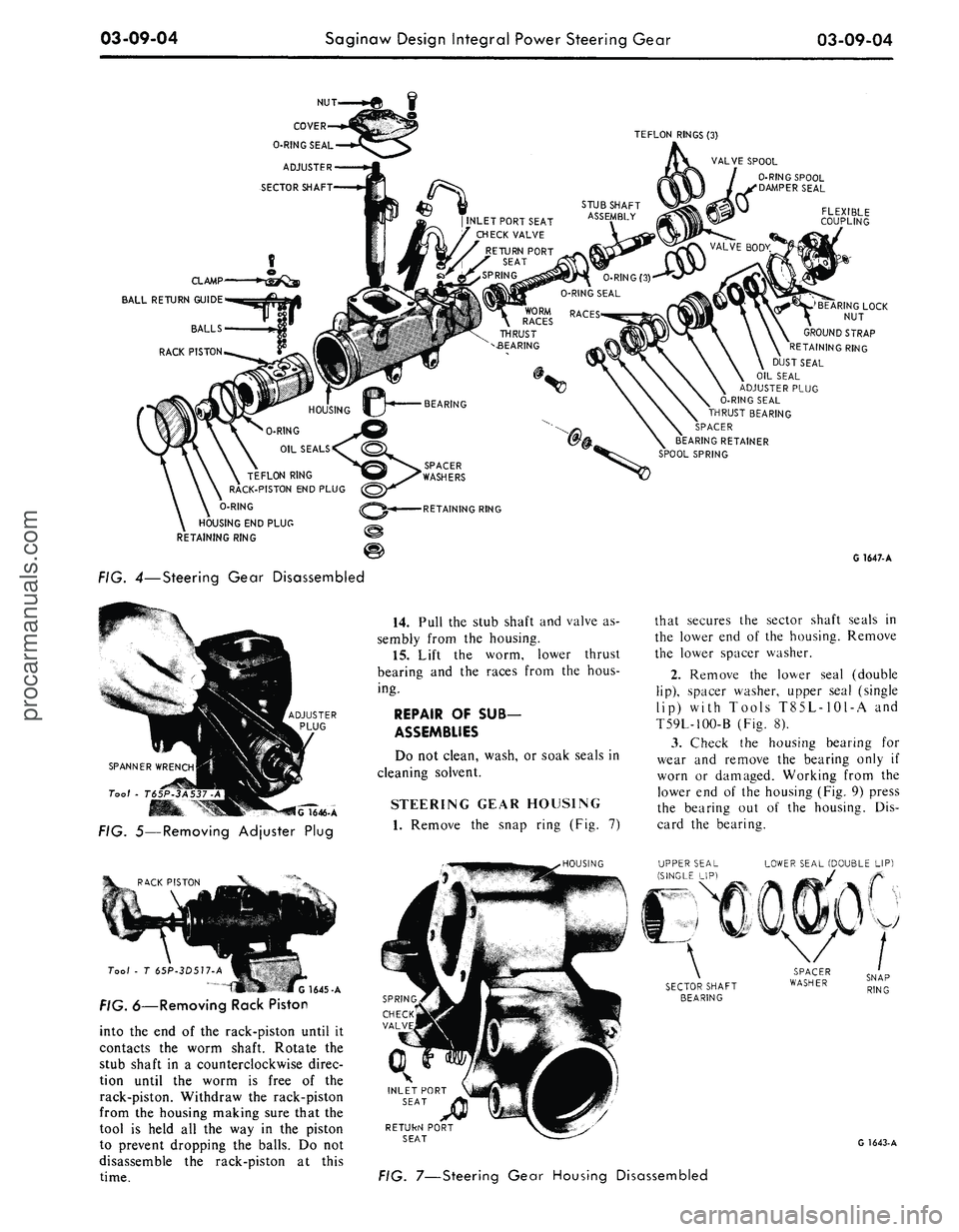
03-09-04
Saginaw Design Integral Power Steering Gear
03-09-04
CLAMP
BALL
RETURN GUIDE
TEFLON
RINGS (3)
VALVE
SPOOL
0-RING SPOOL
SEAL
INLET
PORT SEAT
CHECK
VALVE
RETURN
PORT
SEAT
SPRING
STUB
SHAFT
ASSEMBLY
TEFLON
RING
RACK-PISTON
END PLUG
O-RING
HOUSING
END PLUG
RETAINING
RING
FLEXIBLE
COUPLING
'BEARING
LOCK
NUT
GROUND
STRAP
RETAINING
RING
DUST
SEAL
OIL
SEAL
ADJUSTER
PLUG
O-RING SEAL
THRUST
BEARING
SPACER
BEARING
RETAINER
SPOOL
SPRING
RETAINING
RING
FIG. 4—Steering Gear Disassembled
SPANNER
WRENCH
Tool - T65P-
lG
1646-A
FIG. 5—Removing Adjuster Plug
14.
Pull the stub shaft and valve as-
sembly from the housing.
15.
Lift the worm, lower thrust
bearing and the races from the hous-
ing.
REPAIR
OF SUB-
ASSEMBLIES
Do not clean, wash, or soak seals in
cleaning solvent.
STEERING GEAR HOUSING
1.
Remove the snap ring (Fig. 7)
G
1647-A
that secures the sector shaft seals in
the lower end of the housing. Remove
the lower spacer washer.
2.
Remove the lower seal (double
lip),
spacer washer, upper seal (single
lip) with Tools T85L-1O1-A and
T59L-100-B (Fig. 8).
3.
Check the housing bearing for
wear and remove the bearing only if
worn or damaged. Working from the
lower end of the housing (Fig. 9) press
the bearing out of the housing. Dis-
card the bearing.
.HOUSING
LOWER
SEAL (DOUBLE LIP)
Tool
- T 65P-3D517-A
G
1645-A
FIG. 6—Removing Rack Piston
into the end of the rack-piston until it
contacts the worm shaft. Rotate the
stub shaft in a counterclockwise direc-
tion until the worm is free of the
rack-piston. Withdraw the rack-piston
from the housing making sure that the
tool is held all the way in the piston
to prevent dropping the balls. Do not
disassemble the rack-piston at this
time.
SNAP
RING
INLET
PORT
SEAT
RETUkN
PORT
SEAT
G
1643-A
FIG. 7—Steering Gear Housing Disassembledprocarmanuals.com
Page 157 of 413

03-09-05
Saginaw Design Integral Power Steering Gear
03-09-05
Tool . T59L -100S
FIG. 8—Removing Sector
Shaft Seals
Too/
-
T65P -3576-C
G 1641-A
FIG. 9—Removing Sector
Shaft Bearings
4.
Working from
the
upper
end of
the housing, press
in a new
bearing
until
the
upper
end
is
0.030 inch below
the housing bore. When installing
the
bearing, make sure
it is
pressed
in
from
the
identification
end
(stamped
end).
5.
Lubricate
new
sector shaft seals
(Fig.
7) in
C1AZ-19582-A hydraulic
fluid. Install
the
single
lip
seal first,
then
a
back-up washer. Using special
tool
(Fig. 10),
drive
the
seal
and
wash-
er
in far
enough
to
provide clearance
for
the
other seal
and
back-up washer
and
the
retaining ring.
The
seal must
not bottom
on the end of
the
counter-
bore.
Install
the
double
lip
seal
and
the second back-up washer. Again using
the special tool, drive
the
seal
and
back-up washer
in
only
far
enough
to
provide clearance
for the
retaining
ring. Install
the
sector shaft seal
re-
taining ring with snap ring pliers,
making certian that
the
ring
is
seated
properly.
6.
To
remove
a
damaged port seat,
use
a
5/16-18 inch
U.S.
thread
(coarse)
tap and
turn
it
two
turns into
the seat.
7.
Thread
a
bolt
and nut
with
a
flat
washer into
the
tapped hole
(Fig.
11).
8. Hold
the
bolt from turning
and
tighten
the nut to
extract
the
seat.
Discard
the
seat.
9. Remove
the
check valve
and
spring from
the
inlet port.
10.
Blow
all
chips from
the
hous-
ing.
11.
Position
the
spring, check valve
and
new
seat
in the
inlet port.
12.
Use the
tool shown
in Fig. 12
and drive
the
seat into place.
.
T65P-3D642-A
G1287-
A
FIG.
10
— Installing Sector
Shaft Seal
5/16
•
16x2"
BOLT
13.
Install
the
outlet port seat
in
the same manner.
ADJUSTER PLUG
1.
Lift
the
adjuster plug
off
the
stub
shaft
(Fig.
4).
2.
Pry the
thrust bearing retainer
off
the
adjuster plug
as
shown
in Fig.
13.
Be
careful
not to
score
the
needle
bearing bore. Discard
the
retainer.
3.
Lift
the
spacer, thrust bearing,
races
and the
O-ring, from
the
plug
(Fig.
14).
Discard
the
O-ring.
4.
If
necessary
to
replace
the
roller
bearing, remove
the
dust seal retaining
ring. Working from
the
spacer
end of
the adjuster plug, remove
the
roller
bearing,
oil
seal
and the
dust seal
as
shown
in Fig. 15.
G1639-A
FIG.
12
-Installing Inlet Port
BEARING RETAINER
G1640-A
FIG. 11 —Removing Port Seat
C1638-A
FIG. 73—Removing Thrust
Bearing Retainer
If
the
roller bearing does
not
need
replacing
do not
remove
it. Pry the
dust seal
and the oil
seal from
the ad-
juster plug with
a
screwdriver.
5.
Place
a new
roller bearing
on the
tool shown
in Fig.
15
with
the
bearing
manufacturer's identification facing
toward
the
tool.
6. Position
the
bearing
and
tool
in
the bore. Drive
the
bearing into
the
plug until
it is
flush with
the
bottom
surface
of the
stub shaft seal bore.
7.
Lubricate
a new oil
seal with
C1AZ-19582-A. Install
the
seal with
Tool T65P-3D536-A pressing
it
intoprocarmanuals.com
Page 158 of 413

03-09-06
Saginaw Design Integral Power Steering Gear
03-09-06
ADJUSTER
PLUG
DUST
SEAL
FIG. 14 —Adjuster Plug Disassembled
the plug far enough to provide clear-
ance for the dust seal and the snap
ring.
8. Lubricate a new dust seal
C1AZ-19582-A and install it with
smooth rubber surface facing outward.
9. Secure the dust seal with the
ring, making sure that the ring is
properly seated.
10.
Lubricate a new O-ring seal
with vaseline and install it on the ad-
juster plug.
11.
Assemble the thrust bearing
outer race, thrust bearing, inner race,
and the thrust bearing spacer on the
adjuster plug (Fig. 16).
OIL
RETAINING
SEAL
RING
G
1637-A
12.
Press a new bearing retainer
into the bearing bore. The radial loca-
tion of the dimples is not important.
STUB SHAFT AND
VALVE ASSEMBLY
The control valve and spool is a se-
lect fit and cannot be serviced other
BEARING
AND
RACES
1636-A
FIG. 15 —Removing or Installing
Roller Rearing from Adjuster Plug
G
1635-A
FIG.
76
—Installing Thrust
Bearing Retainer
SPOOL
SPRING
DOWEL
BEARING
RACE
G1634-A
FIG. 77—Control Valve Disassembled
than removing the spool to replace the
dampener O-ring or replace the three
teflon seals or O-rings under the teflon
seals.
1.
Remove the cap to worm O-ring
and discard it (Fig. 17).
2.
Work the rear coil of spool
spring onto the stub shaft bearing sur-
face.
Do not pry on the valve body.
Slide the spring off the shaft.
3.
Extreme care must be used when
removing the valve spool. The diame-
tral clearance between the valve body
and the spool may be as low as 0.0004
inch. The slightest cocking of the
spool may jam it in the valve body.
a. To remove the valve spool, hold
the valve assembly in both hands with
the stub shaft pointing downward.
Push lightly on the valve spool with a
small rod by inserting the rod through
the openings in the end cap (Fig. 18)
until the spool is far enough out of the
valve so that it may be grasped by the
hand. Withdraw the spool with a
steady oscillating pull to prevent jam-
ming. If slight sticking occurs, make a
gentle attempt to reverse the with-
drawal procedure. If this does not free
the spool, it has become cocked in the
valve body bore. Do not attempt to
force the spool in or out if it becomes
cocked. In this case, continue to disas-
semble the valve assembly as follows
and return to the spool as described
later. Remove the stub shaft, torsion
bar, and end cap assembly by holding
the thumbs on the valve body as
shown in Fig. 18. Tap the torsion bar
lightly against the workbench. This
will dislodge the cap from the valve
body to cap pin. The stub shaft, tor-
sion bar and end cap assembly can
now be removed from the valve body.
b.
If the valve spool has become
cocked as described in step 3 above, it
can now be freed. By visual inspection
on a flat surface it can be determined
in which direction the spool is cocked.
A few very light taps with a light soft
plastic or raw-hide mallet should align
the spool in the bore and free it. Do
not tap with anything metallic. If
spool can be rotated, it can be re-
moved.
4.
Remove O-ring dampener seal
from the spool and discard it.
5.
Carefully cut the valve rings and
the ring back-up seals, remove and
discard them, providing the rings show
evidence of excessive wear. The valve
rings are made of filled teflon and it is
very unusual that replacement is re-
quired.
6. Remove the dampener O-ring
from the valve spool and discard it.procarmanuals.com
Page 164 of 413
03-10-03
Ford-Thompson Power Steering Pump
03-10-03
EIGHT CYLINDER WITH
AIR CONDITIONER
1.
Remove the power steering fluid
from the pump reservoir by discon-
necting the fluid return hose from the
reservoir and allow the fluid to drain
in a suitable container.
2.
Disconnect the pressure hose
from the pump.
3.
Remove 3 bolts from the front of
the pump and the one nut at the rear
that attach the pump to the mounting
bracket and remove the drive belt
from the pump pulley.
4.
Loosen the upper pump bracket-
to-engine attaching bolt and remove
the bolt in the belt adjusting slot. Re-
move the pump.
5.
Position the pump to the bracket
and install the bracket-to-pump at-
taching bolts and nuts. Tighten to spe-
cifications.
6. Place the belt on the pump pul-
ley. Adjust the belt tension as outlined
in Section 2 and tighten the bolts and
nut to specification.
7.
Torque the pressure hose fitting
hex nut to specification. Then, connect
the pressure hose to the fitting and
torque the hose nut to specification.
8. Connect the return hose to the
power steering pump and tighten the
clamp.
9. Fill the pump with automatic
transmission fluid C1AZ-19582-A.
Bleed the air from the system (Part
3-1) and check for leaks and again
check the fluid level. Add fluid as re-
quired.
POWER STEERING PUMP
PULLEY REPLACEMENT
REMOVAL
1.
Drain as much of the fluid as
possible from the pump through filler
pipe.
2.
Install a 3/8-16 inch capscrew in
the end of the pump shaft to prevent
damage to the shaft end by the tool
screw.
3.
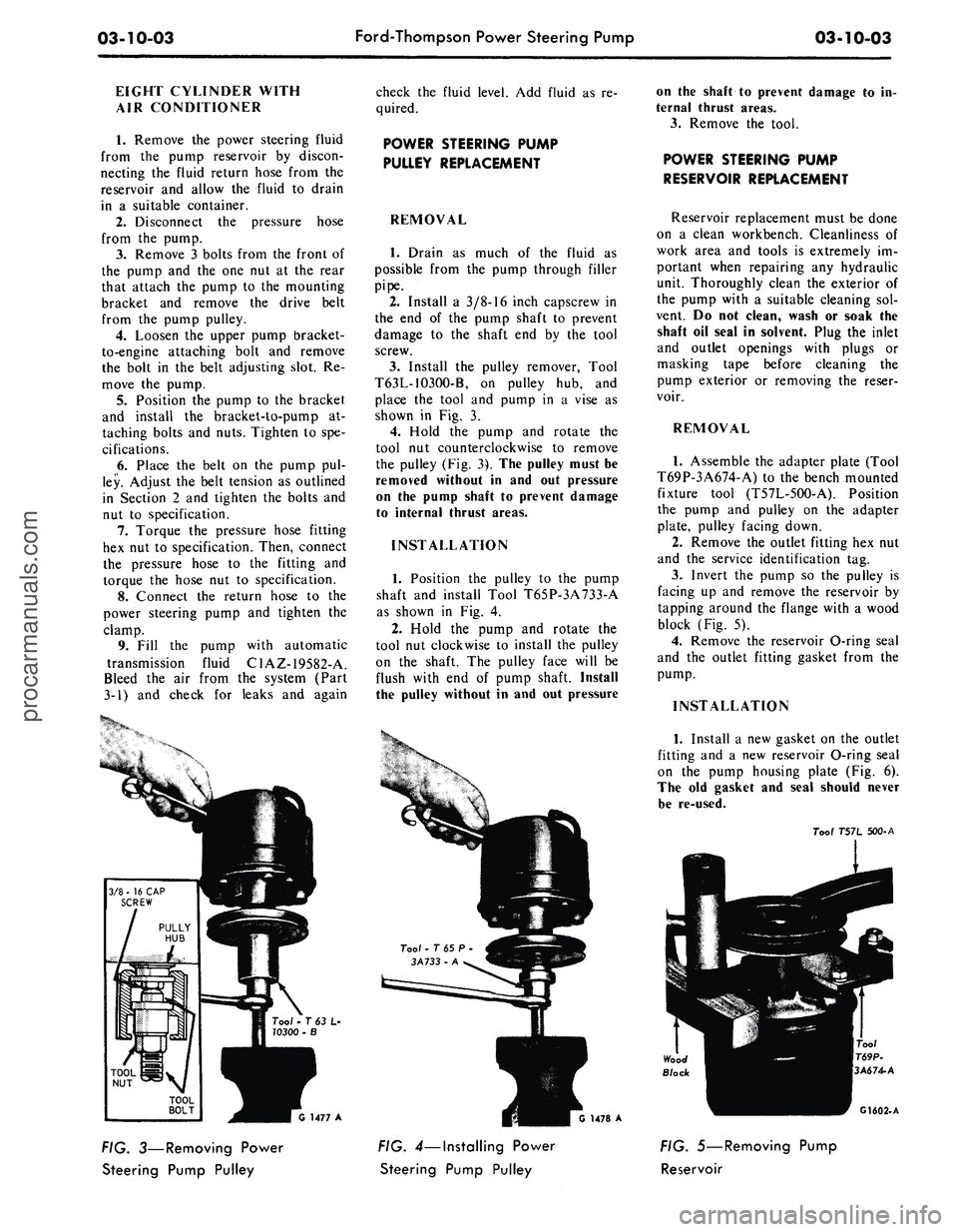
Install the pulley remover, Tool
T63L-1O3OO-B, on pulley hub, and
place the tool and pump in a vise as
shown in Fig. 3.
4.
Hold the pump and rotate the
tool nut counterclockwise to remove
the pulley (Fig. 3). The pulley must be
removed without in and out pressure
on the pump shaft to prevent damage
to internal thrust areas.
INSTALLATION
1.
Position the pulley to the pump
shaft and install Tool T65P-3A733-A
as shown in Fig. 4.
2.
Hold the pump and rotate the
tool nut clockwise to install the pulley
on the shaft. The pulley face will be
flush with end of pump shaft. Install
the pulley without in and out pressure
on the shaft to prevent damage to in-
ternal thrust areas.
3.
Remove the tool.
POWER STEERING PUMP
RESERVOIR REPLACEMENT
Reservoir replacement must be done
on a clean workbench. Cleanliness of
work area and tools is extremely im-
portant when repairing any hydraulic
unit. Thoroughly clean the exterior of
the pump with a suitable cleaning sol-
vent. Do not clean, wash or soak the
shaft oil seal in solvent. Plug the inlet
and outlet openings with plugs or
masking tape before cleaning the
pump exterior or removing the reser-
voir.
REMOVAL
1.
Assemble the adapter plate (Tool
T69P-3A674-A) to the bench mounted
fixture tool (T57L-5OO-A). Position
the pump and pulley on the adapter
plate, pulley facing down.
2.
Remove the outlet fitting hex nut
and the service identification tag.
3.
Invert the pump so the pulley is
facing up and remove the reservoir by
tapping around the flange with a wood
block (Fig. 5).
4.
Remove the reservoir O-ring seal
and the outlet fitting gasket from the
pump.
INSTALLATION
Tool • T 63 L-
10300 -
G 1477 A
FIG. 3—Removing Power
Steering Pump Pulley
1478 A
FIG. 4—Installing Power
Steering Pump Pulley
1.
Install a new gasket on the outlet
fitting and a new reservoir O-ring seal
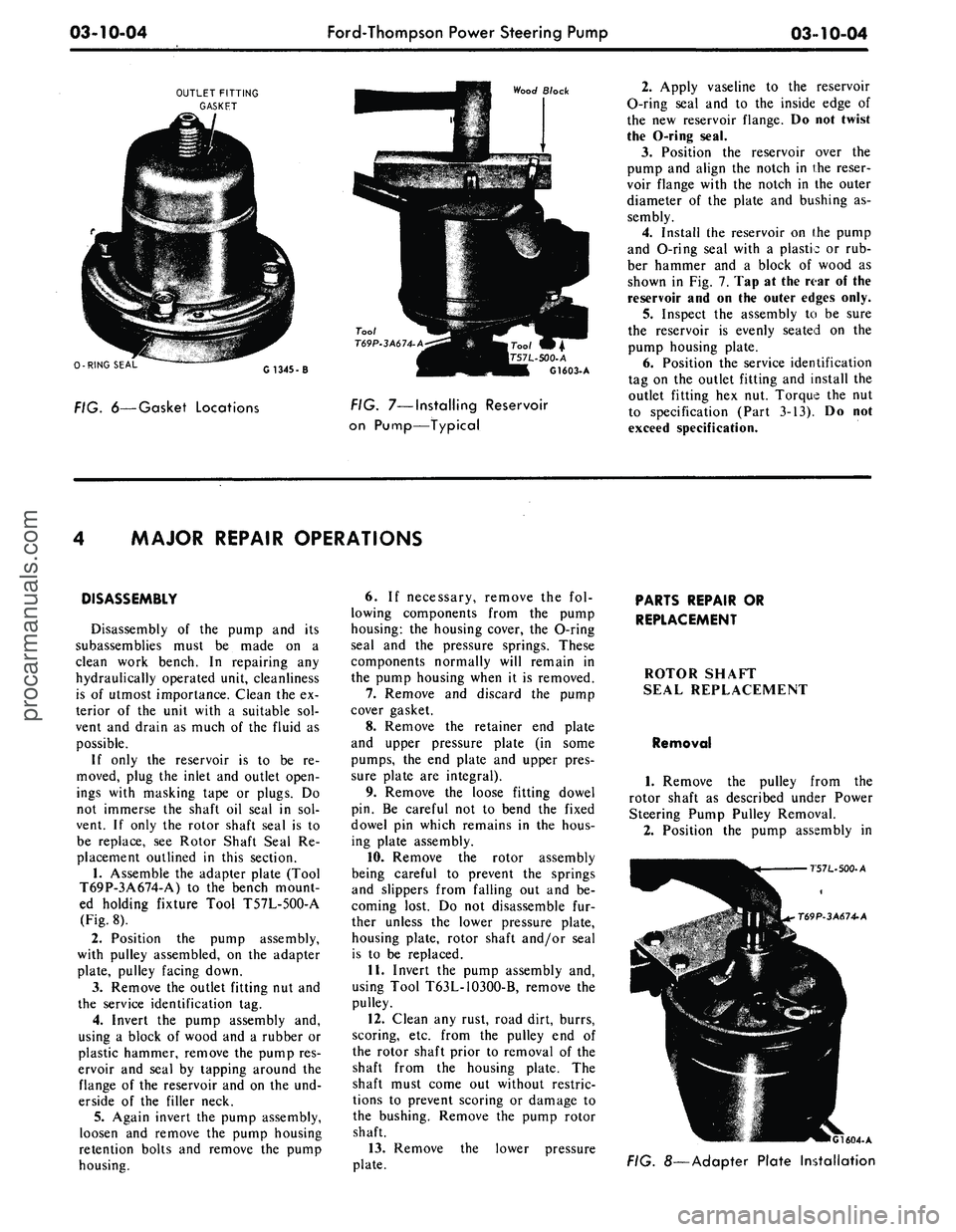
on the pump housing plate (Fig. 6).
The old gasket and seal should never
be re-used.
Too/
T57L 500-A
G1602-A
FIG. 5—Removing Pump
Reservoirprocarmanuals.com
Page 165 of 413
03-10-04
Ford-Thompson Power Steering Pump
03-10-04
OUTLET FITTING
GASKET
Wood Block
0-RING SEAL
G1345-
-500-
A
G1603- A
FIG. 6—Gasket Locations
FIG.
7—Installing
Reservoir
on Pump—Typical
2.
Apply vaseline to the reservoir
O-ring seal and to the inside edge of
the new reservoir flange. Do not twist
the O-ring seal.
3.
Position the reservoir over the
pump and align the notch in the reser-
voir flange with the notch in the outer
diameter of the plate and bushing as-
sembly.
4.
Install the reservoir on the pump
and O-ring seal with a plastic or rub-
ber hammer and a block of wood as
shown in Fig. 7. Tap at the rear of the
reservoir and on the outer edges only.
5.
Inspect the assembly to be sure
the reservoir is evenly seated on the
pump housing plate.
6. Position the service identification
tag on the outlet fitting and install the
outlet fitting hex nut. Torque the nut
to specification (Part 3-13). Do not
exceed specification.
MAJOR REPAIR OPERATIONS
DISASSEMBLY
Disassembly of the pump and its
subassemblies must be made on a
clean work bench. In repairing any
hydraulically operated unit, cleanliness
is of utmost importance. Clean the ex-
terior of the unit with a suitable sol-
vent and drain as much of the fluid as
possible.
If only the reservoir is to be re-
moved, plug the inlet and outlet open-
ings with masking tape or plugs. Do
not immerse the shaft oil seal in sol-
vent. If only the rotor shaft seal is to
be replace, see Rotor Shaft Seal Re-
placement outlined in this section.
1.
Assemble the adapter plate (Tool
T69P-3A674-A) to the bench mount-
ed holding fixture Tool T57L-5OO-A
(Fig. 8).
2.
Position the pump assembly,
with pulley assembled, on the adapter
plate, pulley facing down.
3.
Remove the outlet fitting nut and
the service identification tag.
4.
Invert the pump assembly and,
using a block of wood and a rubber or
plastic hammer, remove the pump res-
ervoir and seal by tapping around the
flange of the reservoir and on the und-
erside of the filler neck.
5.
Again invert the pump assembly,
loosen and remove the pump housing
retention bolts and remove the pump
housing.
6. If necessary, remove the fol-
lowing components from the pump
housing: the housing cover, the O-ring
seal and the pressure springs. These
components normally will remain in
the pump housing when it is removed.
7.
Remove and discard the pump
cover gasket.
8. Remove the retainer end plate
and upper pressure plate (in some
pumps, the end plate and upper pres-
sure plate are integral).
9. Remove the loose fitting dowel
pin. Be careful not to bend the fixed
dowel pin which remains in the hous-
ing plate assembly.
10.
Remove the rotor assembly
being careful to prevent the springs
and slippers from falling out and be-
coming lost. Do not disassemble fur-
ther unless the lower pressure plate,
housing plate, rotor shaft and/or seal
is to be replaced.
11.
Invert the pump assembly and,
using Tool T63L-1O3OO-B, remove the
pulley.
12.
Clean any rust, road dirt, burrs,
scoring, etc. from the pulley end of
the rotor shaft prior to removal of the
shaft from the housing plate. The
shaft must come out without restric-
tions to prevent scoring or damage to
the bushing. Remove the pump rotor
shaft.
13.
Remove the lower pressure
plate.
PARTS REPAIR OR
REPLACEMENT
ROTOR SHAFT
SEAL REPLACEMENT
Removal
1.
Remove the pulley from the
rotor shaft as described under Power
Steering Pump Pulley Removal.
2.
Position the pump assembly in
T57L-500-A
T69P-3A674-A
•
G1604-A
FIG. 8—Adapter Plate Installationprocarmanuals.com
Page 171 of 413

03-11-03
Eaton Power Steering Pump
03-11-03
POWER STEERING PUMP
DISASSEMBLY
A clean working area should be
used when overhauling the power
steering pump. Foreign matter picked
up on working parts may cause dam-
age or failure of the unit. Clean con-
tainers should be used for parts.
1.
Drain the fluid from the pump.
Remove the pump cover-to-housing
cap screws (Fig. 1). Place the pump
on the bench, cover side down. Lift
the housing from the cover.
2.
Remove the large and the small
O-rings from the pump cover. Remove
the O-ring from the pressure plate
hub.
3.
Remove the pressure plate-
to-cover screws, and remove the plate.
Lift the cam ring off the dowel pins.
4.
Remove the rollers. Lift the
rotor off the shaft, and remove the
drive key from the shaft. Remove the
dowel pins from the cover.
5.
Remove the rotor shaft from the
cover. Do not remove the snap ring
from the shaft unless it, or the shaft,
is damaged.
6. Pry the rotor shaft seals out of
the cover and the housing.
7. Do not disturb the control valve
unless diagnosis indicated a control
valve problem or foreign matter in the
valve. To remove the valve, drive the
roll pin out of the housing. Remove
the plug and O-ring, control valve,
and the spring. If the plug or valve is
stuck, tap the end of the housing on a
piece of wood or tap it with a soft-
faced hammer. Remove the O-ring
from the plug.
ASSEMBLY
Apply automatic transmission fluid
to all parts as they are assembled. Al-
ways use new seals and O-rings.
1.
Install the control valve spring in
the housing. Install the valve with the
small sensing hole in the end of the
valve toward the spring. Install a new
O-ring on the plug. The plug O-ring is
1/8 inch smaller in diameter than the
bypass O-ring. Make sure the proper
O-ring is used. Install the plug and a
new roll pin (Fig. 1).
2.
The rotor shaft oil seals are in-
stalled in the cover and the housing
with Tool 3583-J, which consists of a
driver and an adapter. The procedure
is as follows:
a. Support the cover on wood
blocks (Fig. 2) to provide tool clear-
ance.
Use clean blocks that will not
nick or damage the inner face of the
cover.
b.
Start the seal (metal shell up-
ward) square!y into the bore with fin-
ger pressure. Place the adapter on the
driver with the square corner of the
FIG. 2—Preparation for Installing
Rotor Shaft Seals
adapter toward the seal (Fig. 2). Drive
the seal into the cover, as shown in
Fig. 3, until it bottoms.
Driving the seal beyond this point
can damage it. Install the seal in the
pump housing in the same manner.
3.
Install the rotor shaft in the
FIG. 3—Installing Rotor
Shaft Seals
cover as shown in Fig. 4 to prevent
damage to the seal.
4.
Install the dowel pins in the
cover. Place the rotor drive key in the
shaft. Install the rotor on the shaft
with the drive key groove aligned with
the key and the counterbored side of
the rotor toward the cover so that it
goes over the snap ring.
5.
Place the cam ring on the dowel
pins with the chamfered edge upward
(Fig. 5). Place the rollers in the rotor.
6. Place the pressure plate on the
dowel pins. Install and tighten the
screws to 20 in-lbs torque. Install the
O-ring on the pressure plate hub. In-
stall O-rings in the groove at the fluid
bypass hole and around the cam ring
(Fig. 6).
7.
Place the tool shown in Fig. 6 in
the rotor shaft to prevent damage to
the oil seal, then install the housing on
the cover. Install and torque the cap
screws to 15-20 ft-lbs.
FIG. 5—Cam Ring Installation
FIG. 4—Installing Rotor Shaft
in Cover
FIG. 6—O-Ring Installationprocarmanuals.com