1969 FORD MUSTANG oil
[x] Cancel search: oilPage 94 of 413

03-02-18
Suspension
03-02-18
5.
Remove the cotter pin from the
upper ball joint stud nut.
6. Loosen the upper ball joint stud
nut one or two turns. Do not remove
the nut from the stud at this time.
7.
Install tool T57P-3006-A be-
tween the upper and lower ball joint
studs with the adapter screw on top
(Fig. 13). The tool should be seated
firmly against the ends of both studs
and not against the nuts or lower stud
cotter pin.
8. With a wrench, turn the adapter
screw until the tool places the stua
under tension. Tap the spindle near
the upper stud with a hammer to loos-
en the stud in the spindle. Do not
loosen the stud from the spindle with
tool pressure only.
9. Remove the tool from between
the ball joint studs and place a floor
jack under the lower arm.
10.
Raise the floor jack to relieve
the pressure from the upper ball joint
stud nut and remove the nut.
11.
Remove the upper arm inner
shaft attaching bolts. Remove the
upper arm and inner shaft as an as-
sembly (Fig. 1).
12.
Remove the bumpei from the
upper arm.
Installation
1.
Position the bumper to the upper
arm and install the nut and washer.
Torque the nut to specifications.
2.
Position the upper arm inner
shaft to the frame side rail and install
the 2 attaching bolts and washers
snug.
3.
Connect the upper ball joint stud
to the spindle and install the attaching
nut. Torque the nut to specification
and continue to tighten the nut until
the cotter pin hole in the stud is in
line with the nut slots. Then, install
the cotter pin.
4.
If equipped with drum type bra-
kes—Adjust the brakes as outlined in
Part 2-2. Install the wheel, tire, and
drum to the spindle and adjust the
wheel bearings as outlined in Part
3-12.
5.
If equipped with disc brak-
es—Install the wheel and tire on the
hub and adjust the wheel bearings as
outlined in Part 3-12.
6. Install the hub cap or wheel
cover.
7.
Remove the safety stands and
lower the front of the vehicle.
8. Check caster, camber, and toe-in
and adjust as required (Section 2, Part
3-D.
COUGAR, FAIRLANE,
FALCON, MONTEGO,
MUSTANG
Removal
1.
Raise the front of the vehicle,
position safety stands under the
frame, and lower the vehicle slightly.
2.
Remove the wheel and tire.
3.
Remove the shock absorber
lower attaching nuts and washers.
4.
Remove the shock absorber
upper mounting bracket attaching
nuts,
and remove the shock absorber
and bracket as an assembly (Fig. 26).
On all 8-cylinder vehicles, remove
the air cleaner to obtain access for
tool installation.
5.
Install the spring compressor
tool and compress the spring (Figs.
19,
20 and 21).
6. Position a safety stand under the
lower arm.
7.
Remove the cotter pin from the
nut on the upper ball joint stud, and
loosen the nut one or two turns. Do
not remove the nut from the stud at
this time.
8. Position the ball joint remover
tool between the upper and lower ball
joint studs as shown in Fig. 10. The
tool should seat firmly against the
ends of both studs and not against the
stud nuts.
9. Turn the tool with a wrench until
the tool places the studs under consid-
erable tension; then, hit the spindle
smartly near the upper stud with a
hammer to break the stud loose in the
spindle. Do not loosen the stud in the
spindle with tool pressure only. If
both arms are being removed, loosen
the lower stud in the same manner as
the upper stud.
10.
Remove the nut from the upper
stud and lift the stud out of the
spindle.
11.
Remove the upper arm inner
shaft attaching nuts from the engine
compartment, and remove the upper
arm.
12.
Wipe off all loose dirt from the
upper arm parts. Do not wash the ball
joint with a solvent.
Installation
1.
Position the upper arm on the
underbody mounting bracket, and in-
stall the nuts and lock washers on the
two inner shaft attaching bolts. The
specified keystone-type lock washers
must be used. Torque the nuts to
soecification.
2.
Position the upper ball joint stud
in the top of the wheel spindle, and in-
stall the stud nut. Torque the nut to
specification, and continue to tighten
it until the cotter pin hole and slots
line up. Install a new cotter pin.
3.
Release the coil spring, remove
the tool, and install the front shock
absorber and the wheel and tire.
LINCOLN CONTINENTAL
Removal
1.
Place a jack under the outer end
of the suspension lower arm and raise
the arm. Refer to Fig. 22.
2.
Remove the wheel and tire.
3.
Remove the cotter pin from the
upper ball joint stud. Loosen the nut
one or two turns.
4.
Place a box wrench over the
lower end of the ball joint remover
tool, and position the tool as in Fig.
13.
The tool should seat firmly against
the ends of both studs, and not
against the upper stud nut.
5.
Turn the wrench until both studs
are under tension, and then, tap the
spindle with a hammer near the upper
stud to loosen it from the spindle. Do
not loosen the stud with tool pressure
alone. Remove the nut.
UPPER MOUNTING BRACKET
LOWER RETAINING BOLTS F 1490-A
FIG. 26—Removing or Installing
Front Shock Absorber—Typicalprocarmanuals.com
Page 97 of 413

03-02-21
Suspension
03-02-21
8. Place a box wrench over the
lower end of the ball joint remover
tool, and position the tool as in Fig.
13.
The tool should seat firmly against
the ends of both studs, and not
against the stud nuts.
9. Turn the wrench until both studs
are under tension, and then, tap the
spindle with a hammer near the studs
to loosen them from the spindle. Do
not loosen
the
studs with tool pressure
alone.
10.
Place a jack under the outer
end of the lower arm, and raise the
arm several inches. Remove both ball
stud nuts, and remove t^e spindle.
Installation
1.
Position the new spindle onto the
upper and lower ball joint studs, in-
stall the stud nuts and tighten the nuts
to specifications. Continue to tighten
both nuts until the cotter pin holes
line up with the slots, then install new
cotter pines.
2.
Connect the spindle connecting
rod to the spindle arm. Install the re-
taining nut and tighten the nut to
specification. Continue to tighten the
nut until the cotter pin hole lines up
with the slot, then install a new cotter
pin.
3.
Install the gasket and splash
shield on the spindle. Tighten the at-
taching bolts to specifications.
4.
Install the hub and rotor on the
spindle.
5.
Install the caliper to the spindle
and tighten the attaching bolts to spe-
cifications. Check for the correct flex-
ible hose routing (Part 2-2).
6. Install the wheel and tire and ad-
just the wheel bearings (Part 3-12).
7.
Lubricate the steering stop on
the lower arm and the mating flat on
the spindle with the specified lubri-
cant.
8. Remove the safety stands, lower
the car and check camber, caster and
toe-in.
FRONT SHOCK ABSORBER
REPLACEMENT
FORD, MERCURY,
METEOR, THUNDERBIRD,
CONTINENTAL MARK III
1.
Remove the nut, washer, and
bushing from the shock absorber
upper end.
2.
Raise the vehicle on a hoist and
install safety stands.
3.
Remove 2 bolts attaching the
shock absorber to the lower arm and
remove the shock absorber.
4.
Place a washer and bushing on
the shock absorber top stud and posi-
tion the shock absorber inside the
front spring. Install the 2 lower at-
taching bolts and torque them to spe-
cifications.
5.
Remove the safety stands and
lower the vehicle.
6. Place a bushing and washer on
the shock absorber top stud and in-
stall the attaching nut. Torque it to
specification.
COUGAR, FAIRLANE,
FALCON, MONTEGO,
MUSTANG
Removal
1. Raise the hood and remove 3
shock absorber upper mounting
bracket-to-spring tower attaching
nuts.
2.
Raise the front of the vehicle and
place safety stands under the lower
arms.
3.
Remove 2 shock absorber lower
attaching nuts and washers.
4.
Lift the shock absorber and
upper bracket from the spring tower
(Fig. 26) and remove the bracket from
the shock absorber.
Installation
1. Install the upper mounting
bracket on the shock absorber and
torque to specification.
2.
Position the shock absorber and
upper mounting bracket in the spring
tower, making sure the shock absor-
ber lower studs are in the pivot plate
holes.
3.
Install the 2 washers and attach-
ing nuts on the shock absorber lower
studs and torque to specification.
4.
Install the 3 shock absorber
upper mounting bracket-to-spring
tower attaching nuts and torque to
specification. Then, remove the safety
stands and lower the vehicle.
LINCOLN CONTINENTAL
Removal
1.
Remove the stud nut at the
upper eye of the shock absorber. Re-
move the upper eye stud bracket to
crossmember attaching bolt and re-
move the stud bracket. Refer to Fig.
22.
2.
Remove the bolts which attach
the shock absorber to the suspension
lower arm. Lower, and remove the
shock absorber.
3.
Examine the shock absorber unit
and rubber bushings. Replace parts
that are defective, deteriorated, or
worn.
Installation
1. Fully extend the shock absorber
and position it inside the coil spring.
Connect the lower end of the shock
absorber to the suspension lower arm.
Torque the attaching nuts to specifica-
tion.
2.
Insert the upper bracket stud
through the bushing in the shock ab-
sorber upper eye. Install the stud
bracket to crossmember attaching
bolt. Do not tighten the bolt: at this
time.
3.
Install the upper eye bracket
stud nut. Torque the nut to specifica-
tion.
4.
Torque the stud bracket- to-
crossmember attaching bolt to specifi-
cation.
The
shock absorber upper
eye
stud
nut
must
be
tightened
to com-
press
the
rubber bushing before
the
stud bracket
is
bolted
to the
crossmember;
otherwise,
the
upper
at-
tachment could
be
loose
and
noisy.
REAR SHOCK ABSORBER
REPLACEMENT
FORD, MERCURY,
METEOR, THUNDERBIRD,
CONTINENTAL MARK 1(11
1.
Raise the vehicle on a hoist.
2.
Remove the shock absorber at-
taching nut, washer and insulator
from the upper stud at the upper side
of the spring upper seat. Compress the
shock absorber to clear the hole in the
spring seat, and remove the inner in-
sulator and washer from the upper at-
taching stud.
3.
Remove the self-locking attach-
ing nut, and disconnect the shock ab-
sorber lower stud from the mounting
bracket on the rear axle housing (Fig.
4).
4.
Expel all air by performing step
3 On Vehicle Tests in Part 3-1.
5.
Place the inner washer and insu-
lator on the upper attaching stud, and
position the shock absorber so that
the upper attaching stud enters the
hole in the spring upper seat. While
holding the shock absorber in this po-
sition, install the outer insulator andprocarmanuals.com
Page 100 of 413

03-02-24
Suspension
03-02-24
LOCK NUT
INSULATOR
NG
NUT
MOUNTING STUD
WASHER
LOCK WASHER
FIG. 31—Rear Shock Absorber Mounting
F1486-A
TRACK BAR
MOUNTING
STUD AXLE
VENT
SHOCK
ABSORBER
MOUNTING
BRACKET
SHOCK
ABSORBER
MOUNTING
BRACKET
V-V.
FIG. 32—Removing or Installing Rear Spring—Typical
COIL SPRING
F1438-A
Place jack stands under the frame side
rails.
2.
Disconnect the lower studs of the
two rear shock absorbers from the
mounting brackets on axle housing.
3.
Lower the hoist and axle housing
until the coil springs are released (Fig.
32).
4.
Remove the springs and the insu-
lators from the vehicle.
Installation
1.
Position the spring in the upper
and lower seats with an insulator be-
tween each seat and the spring.
2.
Raise the hoist and axle housing
with the spring in position and con-
nect the lower studs of the rear shock
absorbers to the mounting brackets on
the axle housing. Install the attaching
nuts,
and torque to specifications.
3.
Remove the jack stands and
lower the vehicle.
REAR SUSPENSION
LOWER ARM
FORD, MERCURY,
METEOR, THUNDERBIRD,
CONTINENTAL MARK III
Removal
1.
Raise the vehicle on a hoist and
place jack stands under the frame side
rails.
2.
Remove the attaching nut and
bolt from the frame track bar mount-
ing bracket and disconnect the bar
from the stud (Fig. 4).
3.
Lower the axle enough to relieve
spring pressure.
4.
Support axle under differential
pinion nose as well as under axle.
5.
Remove the lower arm pivot bolt
and nut from the axle bracket. Then,
disengage the lower arm from the
bracket.
6. Remove the pivot bolt and nut
from the frame bracket and remove
the lower arm from the vehicle.
Installation
The rear suspension lower arms are
not interchangeable. The lower arm
for the left side can be identified by
notches in the bushing flange (Fig. 4).
The right arm does not have the
notches.
1.
Position the lower arm in the
bracket on the frame side rail. Install
a new pivot bolt and new nut (Fig.
33).
Do not tighten the nut at this
time.
2.
Position the lower arm to the
axle bracket and install a new bolt
and new nut (Fig. 33). Do not tighten
the nut at this time.
3.
Raise the axle.
4.
Install alignment spacers be-
tween the rear axle and frame (Fig. 3,
Part 3-1). Then, torque the lower armprocarmanuals.com
Page 105 of 413

03-02-29
Suspension
03-02-29
SPRING LEAVES
AND TIE-BOLT
LINCOLN CONTINENTAL
Check for broken spring leaves. In-
spect the anti-squeak inserts between
the leaves, and replace them if they
are worn. The spring leaves must be
dry and free of oil and dirt before new
inserts are installed.
If the spring center tie-bolt requires
replacement, clamp the spring in a
vise to keep the spring compressed
during bolt removal and installation.
REAR SHACKLE AND
HANGER ASSEMBLY
LINCOLN CONTINENTAL
Inspect the rear shackle, bushings,
and studs for wear or damage. Re-
place parts where necessary (Fig. 6).
If the rear shackle bushings are to
be replaced, it will be necessary to re-
move the rear hanger assembly. Tor-
que the hanger attaching bolts to
specification when installed.procarmanuals.com
Page 106 of 413

03-03-01
Automatic
Air
Leveling System
03-03-01
PART
3-3
Automatic
Air
Leveling System
COMPONENT INDEX
AIR COMPRESSOR
Disassembly
and
Overhaul
Removal
and
Installation
AIR CYLINDER
Removal
and
Installation
DESCRIPTION
HEIGHT CONTROL VALVE
Disassembly
and
Overhaul
Removal
and
Installation
MODEL APPLICATION
All
Models
Ford
03-03
03-02
03-02
03-01
03-03
03-02
Mercury
03-03
03-02
03-02
03-01
03-03
03-02
Meteor
03-03
03-02
03-02
03-01
03-03
03-02
Cougar
N/A
N/A
N/A
N/A
N/A
N/A
Fairlane
N/A
N/A
N/A
N/A
N/A
N/A
A page number indicates that the item
is for the
vehicle listed
at
the head
of
the column.
N/A indicates that
the
item
is not
applicable
to the
vehicle listed.
Falcon
N/A
N/A
N/A
N/A
N/A
N/A
Montego
N/A
N/A
N/A
N/A
N/A
N/A
Mustang
N/A
N/A
N/A
N/A
N/A
N/A
Lincoln-
Continental
N/A
N/A
N/A
N/A
N/A
N/A
Thunderbird
N/A
N/A
N/A
N/A
N/A
N/A
Continental-
Mark III
N/A
N/A
N/A
N/A
N/A
N/A
DESCRIPTION
The automatic level control
is an
accessory item
on the
Ford, Mercury
and Meteor vehicles
(Fig. 1).
This
de-
vice
is a
supplement
to the
rear coil
spring suspension,
and
will automati-
cally maintain
the
rear standing height
of
the
vehicle
at an
approximate
con-
stant position compensating
for
vary-
ing loaded conditions.
The
system
consists
of a
vacuum operated
com-
pressor, control valve,
air
cylinders
and
the
connecting lines
and
fittings.
In
the
event
of
accidental
air
loss,
the
conventional coil springs will support
the vehicle.
RUBBER
AIR
CYLINDER
WITHIN COIL SPRING
HEIGHT CONTROL
VALVE
RUBBER
AIR
CYLINDER
WITHIN COIL SPRING
RUBBER VACUUM LINE
TO
VACUUM
DISTRIBUTION CONNECTOR
RED CLAMP STATION WAGON ONLY
COMPRESSOR
NYLON
AND
STEEL LINES
FROM VALVE
TO
CYLINDERS
FIG.
1
—
Air Leveling System
FT475-A
procarmanuals.com
Page 133 of 413
03-05-20
Steering Columns And Linkage
03-05-20
placed if it becomes worn or damaged
(Figs.
18 through 21). Do not attempt
to straighten the sleeve if damaged.
1.
Remove the spindle connecting
rod end assemblies as described in the
previous sub-section.
2.
Screw the spindle rod end assem-
blies into the new sleeve the same
number of turns as the ends that were
removed. Do not tighten the clamp
bolts at this time.
3.
Position the sleeve and end as-
sembly on the center link and the
spindle arm. Install the attaching nut,
torque it to specification, and install
the cotter pin.
4.
Check and, if necessary, adjust
toe-in (Part 3-1). After toe-in is
checked and adjusted, oil the sleeve
clamp bolts then torque them to speci-
fication. The sleeve clamp must be in-
stalled as shown in Figs. 18 through
21.
CENTER LINK
REPLACEMENT
The center link connecting the Pit-
man arm and the idler arm is non-
adjustable and is provided with ta-
pered holes to accommodate the ball
studs (Figs. 18 through 21). The link
should be replaced when damaged or
when worn at the ball studs. On Lin-
coln Continental models, the link
should be replaced if excessive loose-
ness is noticed in either ball stud sock-
et.
REMOVAL
1.
Raise the vehicle on a hoist and
position safety stands.
2.
Remove the cotter pins and nuts
that attach both inner connecting rod
ends to the center link (Figs. 18
through 21).
3.
Disconnect the inner connecting
rod ends from the center link using
Tool 3290-C (Fig. 22).
4.
Remove the cotter pin and nut
attaching the idler arm to the center
link. Disconnect the idler arm from
the center link using Tool 3290-C for
Lincoln Continental models only.
5.
Remove the cotter pin and nut
attaching the Pitman arm to the cen-
ter link. Disconnect the Pitman arm
from the center link (use Tool 3290-C)
and remove the center link. On ve-
hicles equipped with the non-integral
power steering system, remove the
center link from the control valve as
detailed in Part 3-7.
INSTALLATION
1.
Replace the rubber seals on the
spindle connecting rod ends, if re-
quired.
2.
Position the center link to the
Pitman arm and idler arm and install
the attaching nuts loosely. On all ve-
hicles except Lincoln Continental
models, place the idler arm and the
front wheels in the straight ahead po-
sition to insure keeping the steering
wheel aligned and to prevent bushing
damage after the attaching nuts have
been torqued. On Lincoln Continental
models, insure that the seal is properly
installed on the center link. Torque
the nuts to the low end of the specifi-
cation. Continue to tighten each nut
until the slots in the nut align with the
hole in the stud. Then install a new
cotter pin.
3.
Position the spindle connecting
rod ends to the center link and install
the attaching nuts. Torque the nuts to
the low end of the specification. Con-
tinue to tighten each nut until the
slots in the nut align with the hole in
the stud. Then, install a new cotter
pin.
4.
Remove the safety stands, lower
the vehicle, check and adjust toe-in to
specification (Part 3-1).
STEERING IDLER ARM
AND BRACKET ASSEMBLY
REPLACEMENT
REMOVAL
If the idler arm bushings are worn
the complete idler arm assembly must
be replaced. In Lincoln Continental
models, if the socket at the idler
bracket is excessively loose, replace
the complet assembly.
1.
Remove the cotter pin and nut
attaching the steering center link at
the idler arm (Figs. 18 through 21).
2.
Disconnect the center link from
the idler arm (on Lincoln Continental
models, use Tool 3290-C).
3.
Remove the two bolts that attach
the idler arm and bracket assembly to
the frame.
INSTALLATION
1.
Secure the new idler arm and
bracket assembly to the frame with
the two attaching bolts (nuts and flat
washers as shown in Figs. 18, 19 and
21).
2.
On all vehicles except Lincoln
Continental models, place the idler
arm and the front wheels in the
straight ahead position to insure keep-
ing the steering wheel aligned and to
prevent bushing damage after the at-
taching nut has been torqued. Insert
the center link stud through the hole
in the end of the idler arm and install
the nut and washer.
On Lincoln Continental models, in-
sert the center link stud through the
hole in the end of the idler arm insur-
ing that the seal is properly installed
on the center link.
3.
Torque the idler arm rod nut to
specification and install a new cotter
pin.
PITMAN ARM
REPLACEMENT
REMOVAL
1.
Remove the cotter pin from the
castellated nut that attaches the steer-
ing center link to the Pitman arm.
Remove the castellated nut.
2.
Disconnect the steering center
link from the Pitman arm with tool
3290-C.
3.
Remove the Pitman arm attaching
nut and lock washer.
4.
Position the front wheels in the
straight ahead position. Remove the
Pitman arm with tool T64P-3590-F
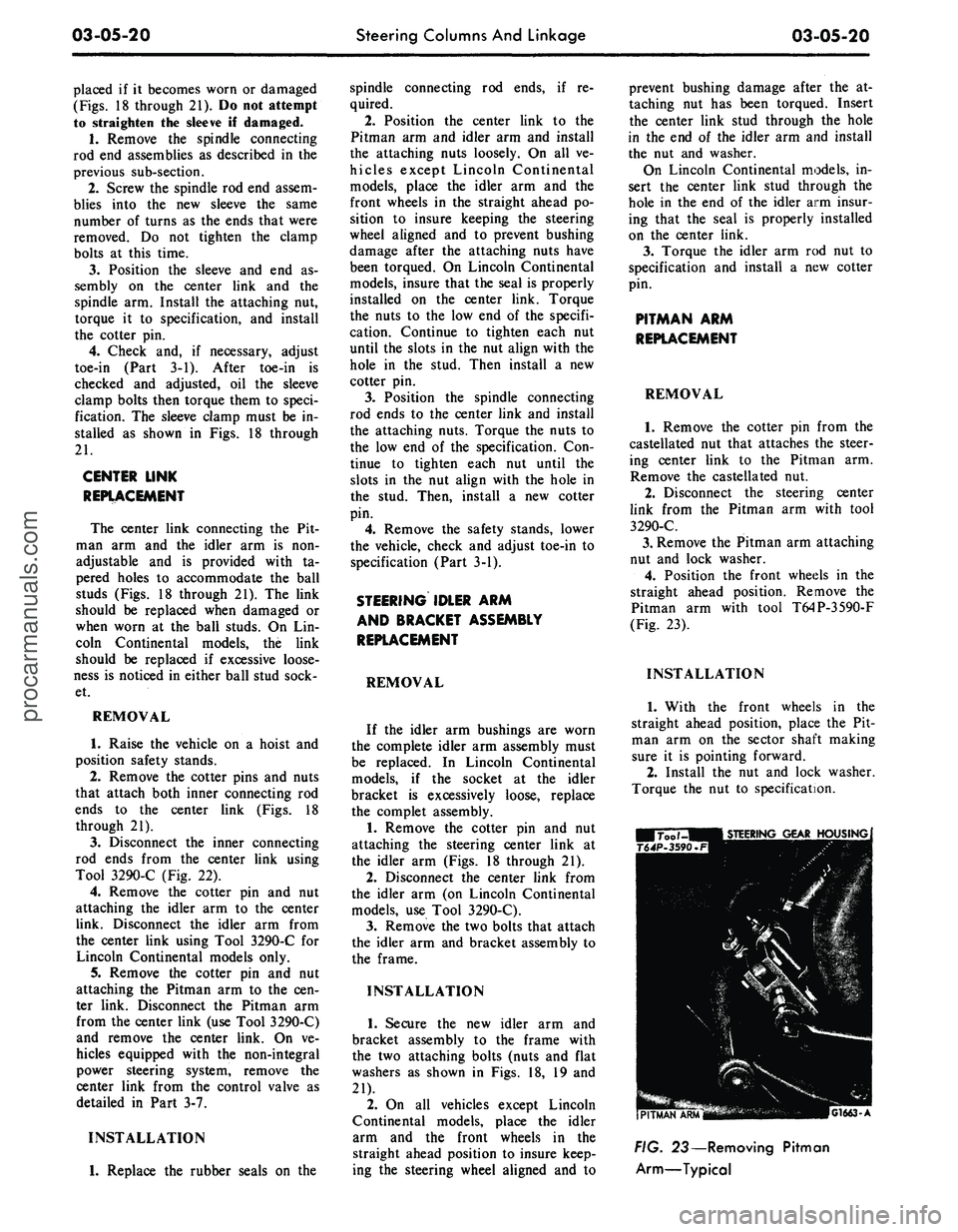
(Fig. 23).
INSTALLATION
1.
With the front wheels in the
straight ahead position, place the Pit-
man arm on the sector shaft making
sure it is pointing forward.
2.
Install the nut and lock washer.
Torque the nut to specification.
G1663-A
FIG. 23— Removing Pitman
Arm—Typicalprocarmanuals.com
Page 137 of 413
03-06-03
Manual Steering
03-06-03
MAJOR REPAIR OPERATIONS
STEERING GEAR
DISASSEMBLY
1. Rotate the steering shaft 3 turns
from either stop.
2.
After removing the sector adjust-
ing screw locknut and the housing
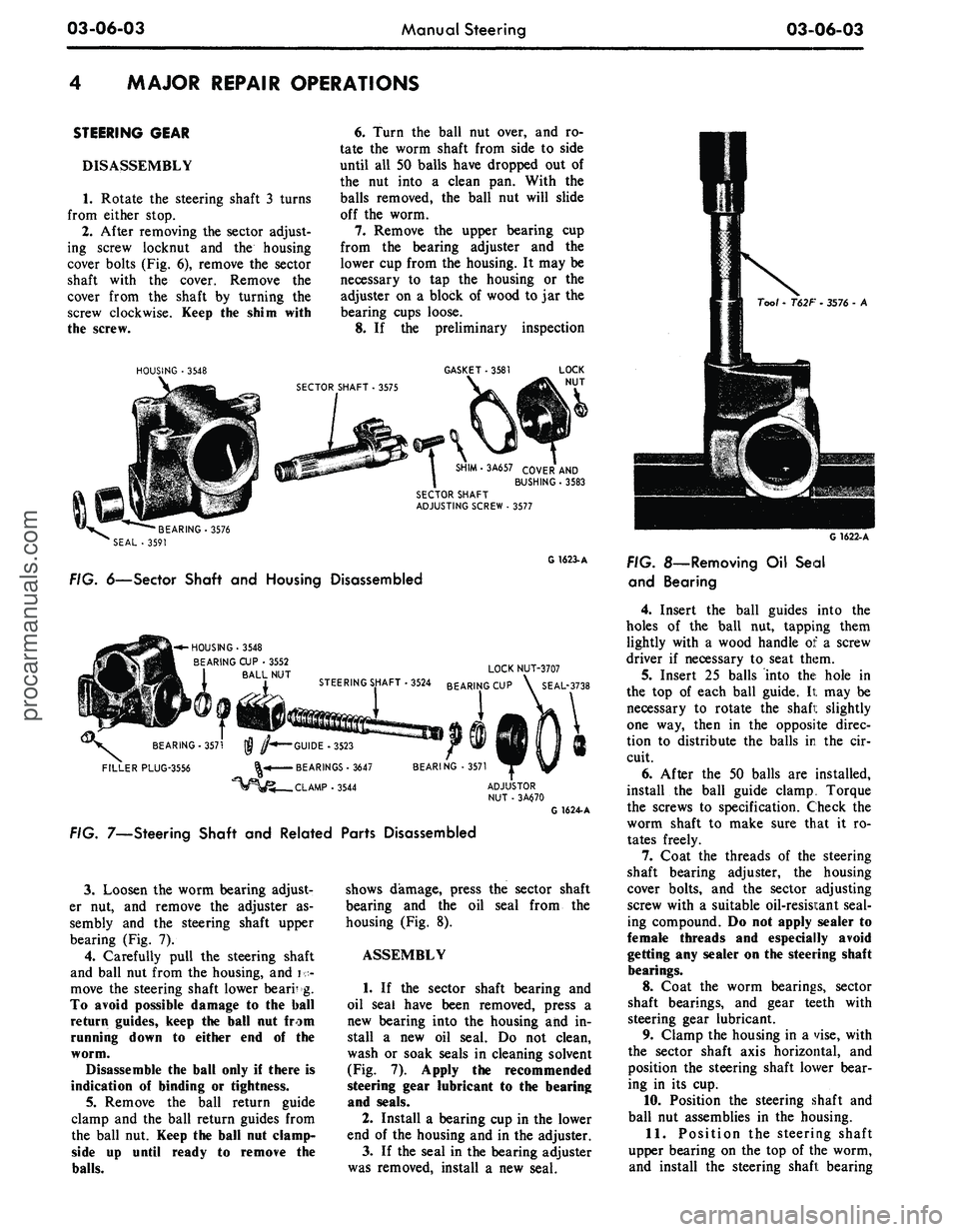
cover bolts (Fig. 6), remove the sector
shaft with the cover. Remove the
cover from the shaft by turning the
screw clockwise. Keep the shim with
the screw.
HOUSING
•
3548
6. Turn the ball nut over, and ro-
tate the worm shaft from side to side
until all 50 balls have dropped out of
the nut into a clean pan. With the
balls removed, the ball nut will slide
off the worm.
7. Remove the upper bearing cup
from the bearing adjuster and the
lower cup from the housing. It may be
necessary to tap the housing or the
adjuster on a block of wood to jar the
bearing cups loose.
8. If the preliminary inspection
GASKET
• 3581
SHIM-3A657 COVER
AND
BUSHING
•
3583
SECTOR SHAFT
ADJUSTING SCREW
.
3577
•BEARING-3576
SEAL
- 3591
G 1623-A
FIG. 6—Sector Shaft
and
Housing Disassembled
-^-HOUSING-3548
BEARING
CUP •
3552
BALL
NUT
BEARING-3571
FILLER PLUG-3556
LOCK NUT-3707
3524 BEARING
CUP \
SEAL-3738
•GUIDE -3523
• BEARINGS
•
3647
.CLAMP-3544
BEARING
• 3571
G 1624-A
FIG. 7—Steering Shaft
and
Related Parts Disassembled
3.
Loosen the worm bearing adjust-
er nut, and remove the adjuster as-
sembly and the steering shaft upper
bearing (Fig. 7).
4.
Carefully pull the steering shaft
and ball nut from the housing, and i •-
move the steering shaft lower bearr g.
To avoid possible damage to the ball
return guides, keep
the
ball
nut
from
running down
to
either
end of the
worm.
Disassemble
the
ball only
if
there
is
indication
of
binding
or
tightness.
5.
Remove the ball return guide
clamp and the ball return guides from
the ball
nut.
Keep
the
ball
nut
clamp-
side up until ready to remove the
balls.
shows damage, press the sector shaft
bearing and the oil seal from the
housing (Fig. 8).
ASSEMBLY
1. If the sector shaft bearing and
oil seal have been removed, press a
new bearing into the housing and in-
stall a new oil seal. Do not clean,
wash or soak seals in cleaning solvent
(Fig.
7).
Apply
the
recommended
steering gear lubricant
to the
bearing
and seals.
2.
Install a bearing cup in the lower
end of the housing and in the adjuster.
3.
If the seal in the bearing adjuster
was removed, install a new seal.
Tool
-
T62F
•
3576
- A
G 1622-A
FIG.
8—Removing
Oil
Seal
and Bearing
4.
Insert the ball guides into the
holes of the ball nut, tapping them
lightly with a wood handle of a screw
driver if necessary to seat them.
5.
Insert 25 balls into the hole in
the top of each ball guide. It may be
necessary to rotate the shafi: slightly
one way, then in the opposite direc-
tion to distribute the balls in the cir-
cuit.
6. After the 50 balls are installed,
install the ball guide clamp. Torque
the screws to specification. Check the
worm shaft to make sure that it ro-
tates freely.
7. Coat the threads of the steering
shaft bearing adjuster, the housing
cover bolts, and the sector adjusting
screw with a suitable oil-resisi:ant seal-
ing compound. Do not apply sealer to
female threads and especially avoid
getting any sealer on the steering shaft
bearings.
8.
Coat the worm bearings, sector
shaft bearings, and gear teeth with
steering gear lubricant.
9. Clamp the housing in a vise, with
the sector shaft axis horizontal, and
position the steering shaft lower bear-
ing in its cup.
10.
Position the steering shaft and
ball nut assemblies in the housing.
11.
Position the steering shaft
upper bearing on the top of the worm,
and install the steering shaft bearingprocarmanuals.com
Page 147 of 413

03-08-03
Ford Design Integral Power Steering Gear
03-08-03
factory adjustments will change. These
changes in adjustment do not neces-
sarily affect the satisfactory operation
of the steering gear assembly, and
therefore ordinarily do not require
readjustment unless there is excessive
lash or other malfunctioning.
ADJUSTMENT IN
VEHICLE
The only adjustment which can be
performed is the total over center
position load, to eliminate excessive
lash between the sector and rack
teeth.
1.
Disconnect the pitman arm from
the sector shaft.
2.
Disconnect the fluid return line
at the reservoir, at the same time cap
the reservoir return line pipe.
3.
Place the end of the return line
in a clean container and cycle the
INPUT SHAFT
SECTOR SHAFT
ADJUSTMENT SCREW
C1547- A
FIG.
2—Adjusting Mesh Load
steering wheel in both directions as re-
quired, to discharge the fluid from the
gear.
4.
Remove the ornamental cover
from the steering wheel hub and turn
the steering wheel to 45 degrees from
the left stop.
5.
Using an in-lb torque wrench on
the steering wheel nut, determine the
torque required to rotate the shaft
slowly through an approximately 1/8
turn from the 45 degree position.
6. Turn the steering gear back to
center, then determine the torque re-
quired to rotate the shaft back and
forth across the center position. Loos-
en the adjuster nut, and turn the ad-
juster screw in (Fig. 2) until the read-
ing is 8-9 in-lb greater than the torque
45 degrees from the stop.
Tighten the lock nut while holding
the screw in place.
7.
Recheck the readings and replace
pitman arm and steering wheel hub
cover.
8. Connect the fluid return line to
the reservoir and fill the reservoir with
specified lubricant to the proper level.
REMOVAL AND INSTALLATION
REMOVAL
1.
Disconnect the pressure and the
return lines from the steering gear.
Plug the lines and the ports in the
gear to prevent entry of dirt.
2.
Remove the two bolts that secure
the flex coupling to the steering gear
and to the column.
3.
Raise the vehicle and remove the
sector shaft attaching nut.
4.
Remove the Pitman arm from
the sector shaft with Tool T64P-
3590-F.
Remove the tool from the
Pitman arm. Do not damage the
seals.
5.
If working on a vehicle equipped
with a standard transmission, remove
the clutch release lever retracting
spring to provide clearance for remov-
ing the steering gear.
6. Support the steering gear then
remove the three steering gear attach-
ing bolts.
7.
Work steering gear free of the
flex coupling and remove it from the
vehicle.
8. If the flex coupling stayed on the
input shaft, lift if off the shaft at this
time.
INSTALLATION
1.
Slide the flex coupling into place
on the steering shaft. Turn the steer-
ing wheel so that the spokes are in the
horizontal position.
2.
Center the steering gear input
shaft.
3.
Slide the steering gear input
shaft into the flex coupling and into
place on the frame side rail. Install
the three attaching bolts and torque
them to specification.
4.
Make sure that the wheels are in
the straight ahead position, then in-
stall the Pitman arm on the sector
shaft. Install and tighten the sector
shaft and install and tighten the at-
taching bolts to specification.
5.
Move the flex coupling into
place on the input and steering co-
lumn shaft and install and tighten the
attaching bolts to specification.
6. Connect and tighten the fluid
pressure and the return line to the
steering gear.
7.
Fill the power steering pump and
cycle the steering gear. Check for
leaks and again check the fluid level.
Add fluid as required.
MAJOR REPAIR OPERATIONS
In most cases, complete disassembly
of the power steering gear will not be
necessary. It is suggested that only
those assemblies that are faulty be dis-
assembled. Disassembly and reassem-
bly of the unit and the subassemblies
must be made on a clean workbench.
As in repairing any hydraulically op-
erated unit, cleanliness is of utmost
importance. Therefore, the bench,
tools,
and parts must be kept clean at
all times. Thoroughly clean the exter-
ior of the unit with a suitable solvent
and when necessary, drain as much of
the hydraulic oil as possible. Handle
all parts very carefully to avoid nicks,
burrs,
scratches and dirt, which could
make the parts unfit for use. Do not
clean, wash or soak seals in cleaning
solvent.
VALVE CENTERING
SHIM REPLACEMENT
1.
Hold the steering gear over a
drain pan in an inverted position and
cycle the input shaft several times to
drain the remaining fluid from the
gear.
2.
Mount the gear in a soft-jawed
vise.procarmanuals.com