1967 CHEVROLET CAMARO length
[x] Cancel search: lengthPage 254 of 659
BRAKES 5-21
brake fluid. Coat the primary and secondary seals
on the secondary piston with clean brake fluid. Insert
the secondary piston spring retainer into the sec-
ondary piston spring. Place the retainer and spring
down over the end of the secondary piston until the
retainer locates inside of the lips of the primary
cup.
10.
Hold the master cylinder with the open end of the
bore down. Push the secondary piston into the bore
until the spring seats against the closed end of the
bore.
11.
Position the master cylinder in a vise with the
open end of the bore up. Coat the primary and
secondary seal on the primary piston with clean
brake fluid. Push the primary piston assembly,
spring end first, into the bore of the master cylinder*
Hold the piston down and snap the lock ring into
position in the small groove in the I.D. of the bore.
12.
Push the primary piston down to move the secondary
piston forward far enough to clear the stop screw
hole in the bottom of the front fluid reservoir. Install
the stop screw.
13.
Install reservoir diaphragm in the reservoir cover
and install the cover on the main cylinder. Push
bail wire into position to secure the reservoir cover.
Installation
1.
Assemble the push rod through the push rod retainer,
if it has been disassembled.
2.
Push the retainer over the end of the main cylinder.
Assemble new boot over push rod and press it down
over the push rod retainer. Slide new mounting
gasket into position.
3.
Secure .the main cylinder to the firewall with mount-
ing bolts.
4.
Connect the push rod clevis to the brake pedal with
pin and retainer.
5. Connect the brake lines to the main cylinder.
6. Fill the main cylinder reservoirs to the levels
shown in Figure 8. Bleed the brake system as out-
lined in this section.
7. K necessary, adjust the brake pedal free play as
outlined in this section.
WHEEL CYLINDER (Fig. 33)
The wheel cylinder boots should be removed from a
cylinder body only when they are visibly damaged or
leaking fluid. Wheel cylinders having torn, cut, or heat-
cracked boots should be completely overhauled.
Removal
1.
Raise vehicle and place on jack stands.
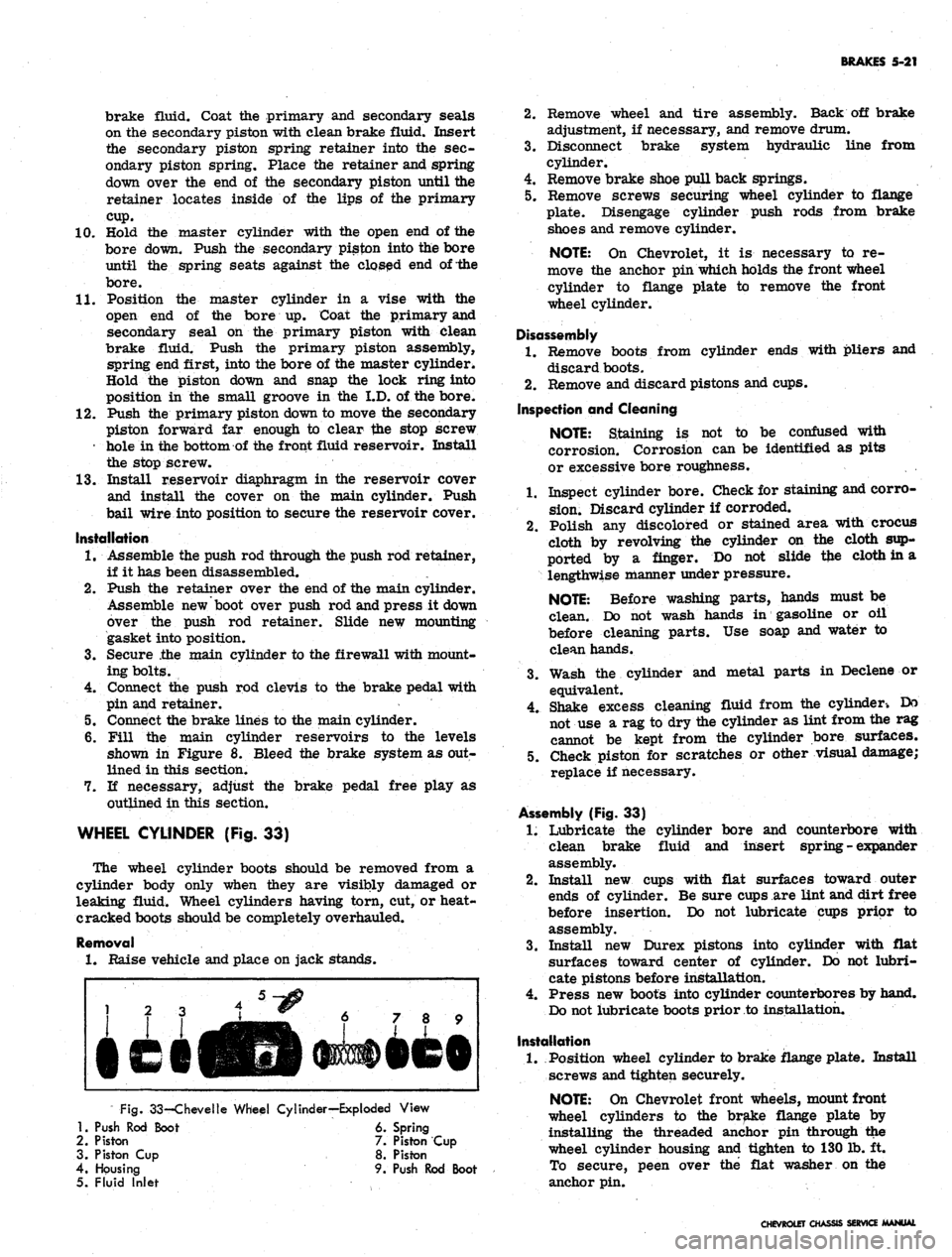
Fig.
33-Chevelle Wheel Cylinder—Exploded View
1.
Push Rod Boot 6. Spring
2.
Piston 7. Piston Cup
3. Piston Cup 8. Piston
4.
Housing 9. Push Rod Boot
5. Fluid Inlet
2.
Remove wheel and tire assembly. Back off brake
adjustment, if necessary, and remove drum.
3.
Disconnect brake system hydraulic line from
cylinder.
4.
Remove brake shoe pull back springs.
5. Remove screws securing wheel cylinder to flange
plate. Disengage cylinder push rods from brake
shoes and remove cylinder.
NOTE:
On Chevrolet, it is necessary to re-
move the anchor pin which holds the front wheel
cylinder to flange plate to remove the front
wheel cylinder.
Disassembly
1.
Remove boots from cylinder ends with pliers and
discard boots.
2.
Remove and discard pistons and cups.
Inspection and Cleaning
NOTE:
Staining is not to be confused with
corrosion. Corrosion can be identified as pits
or excessive bore roughness.
1.
Inspect cylinder bore. Check for staining and corro-
sion.
Discard cylinder if corroded.
2.
Polish any discolored or stained area with crocus
cloth by revolving the cylinder on the cloth sup-
ported by a finger. Do not slide tfce cloth in a
lengthwise manner under pressure.
NOTE:
Before washing parts, hands must be
clean. Do not wash hands in gasoline or oil
before cleaning parts. Use soap and water to
clean hands.
3.
Wash the cylinder and metal parts in Declene or
equivalent.
4.
Shake excess cleaning fluid from the cylinder-. Do
not use a rag to dry the cylinder as lint from the rag
cannot be kept from the cylinder bore surfaces.
5. Check piston for scratches or other visual damage;
replace if necessary.
Assembly (Fig. 33)
1.
Lubricate the cylinder bore and counterbore with
clean brake fluid and insert spring - expander
assembly.
2.
Install new cups with flat surfaces toward outer
ends of cylinder. Be sure cups are lint and dirt free
before insertion. Do not lubricate cups prior to
assembly.
3.
Install new Durex pistons into cylinder with flat
surfaces toward center of cylinder. Do not lubri-
cate pistons before installation.
4.
Press new boots into cylinder counterbores by hand.
Do not lubricate boots prior to installation.
Installation
1.
Position wheel cylinder to brake flange plate. Install
screws and tighten securely.
NOTE:
On Chevrolet front wheels, mount front
wheel cylinders to the brake flange plate by
installing the threaded anchor pin through the
wheel cylinder housing and tighten to 130 lb. ft.
To secure, peen over the flat washer on the
anchor pin.
CHEVROLET CHASSIS SERVICE MANUAL
Page 272 of 659

ENGINE 6-7
Tune Up should be checked whenever the Air Injection
Reactor System seems to be malfunctioning. Particular
care should be taken in checking items that affect fuel-air
ratio such as the crankcase ventilation system, the car-
buretor and the carburetor air cleaner. Carburetors and
distributors for engines with the Air Injection Reactor
System are designed, particularly, for these engines;
therefore, they must not be interchanged with or replaced
by a carburetor or distributor designed for an engine
without the Air Injection Reactor System.
Choke Adjustment (Fig. 11)
With Remote Choke
1.
Remove air cleaner and check to see that choke
valve and rod move freely.
2.
Disconnect choke r*od at choke lever.
Check choke adjustment as follows:
On all except 275 hp 327 cu. in. engines, hold
choke valve closed and pull rod up against stop. The
top of choke rod end should be 1/2 - 1 rod diameter
4.
5.
above top of hole in choke valve lever.
On 275 hp 327 cu. in. engines, hold choke valve
closed and push rod down against stop on thermostat
bracket. The top of the choke rod should be 1/2 - 1
rod diameter below the top of the hole in the choke
lever.
If necessary, adjust rod length by bending rod at off-
set. (Bend must be such that rod enters choke lever
hole freely and squarely.)
Connect rod at choke lever and install air cleaner.
3.
With Manual
Choke
1.
Remove air cleaner.
2.
Push hand choke knob in to within 1/8" of instrument
panel.
3.
Loosen choke cable at carburetor bracket and adjust
cable through the clip until the choke valve is wide
open.
4.
Tighten cable clamp at carburetor bracket and check
operation of choke valve to ensure full closed and
wide open positions.
INSTRUMENT CHECK-OUT
Instrument Hook Up
Connect vacuum gauge, dwell meter, tachometer and
timing light as recommended by the manufacturer of the
equipment being used.
Check and Adjust Dwell
1.
Start engine then ch^ck ignition dwell.
.2.
If dwell is not within specifications, adjust dwell as
follows:
V8 ENGINES
• With engine running at idle, raise the adjustment
screw window-and insert an Allen wrench in the
socket of the adjusting screw (fig. 12).
• Turn the adjusting screw as required until a dwell
reading of 30° is obtained. A 2° variation is al-
lowable for wear.
• Close access cover fully to prevent the entry of
dirt into the distributor.
NOTE: If a dwell meter is not available, turn
adjusting screw clockwise until engine starts to
misfire, then turn screw one-half turn in the op-
posite direction to complete adjustment.
IN LINE ENGINES
• Remove distributor cap and recheck point setting.
If dwell is still not within specifications check the
distributor as outlined in Section 6Y.
Check Dwell Variation
Slowly accelerate engine to 1500 rpm and note dwell
reading. Return engine to idle and note dwell reading. If
dwell variation exceeds specifications, check for worn
distributor shaft, worn distributor shaft bushing or loose
breaker plate.
WINDOW
"HEX" TYPE
WRENCH
Fig.
12 - Setting Point Dwell (V8)
Fig.
13 - Ignition Timing Marks
CHEVROLET CHASSIS SERVICE MANUAL
Page 280 of 659

ENGINE 6-15
2.
Install rocker arms, rocker arm balls and rocker
arm
nuts.
\
Tighten rocker arm nuts until all lash is
eliminated. .
3.
Adjust valves when lifter is on base circle of cam-
shaft lobe as follows:
a. Mark distributor housing, with chalk, at each cyl-
inder position (plug wire) then disconnect plug
wires at spark plugs and coil and remove distri-
butor cap and plug wire assembly (if not previ-
ously done).
b.
Crank engine until distributor rotor points to
number one cylinder position and breaker points
are open. Both valves on number one cylinder
may now be adjusted.
c. Back out adjusting nut until lash is felt at the push
rod then turn in adjusting nut until all lash is re-
moved. This can be determined by checking push
rod side play while turning adjusting nut (fig. 2L).
When play has been removed, turn adjusting nut
in one full additional turn (to center lifter
plunger).
d. Adjust the remaining valves, one cylinder at a
time,
in the same manner.
4.
Install distributor cap and spark plug wire assembly.
5.
Install rocker arm cover as outlined.
6. Adjust carburetor idle speed and mixture.
VALVE LIFTERS
Hydraulic valve lifters very seldom require attention.
The lifters are extremely simple in design readjustments
are not necessary, and servicing of the lifters requires
only that care and cleanliness be exercised in the han-
dling of parts.
Locating Noisy Lifters
Locate a noisy valve lifter by using a piece of garden
Fig.
2L - Valve Adjustment
hose approximately four feet in length. Place one end of
the hose near the end of each intake and exhaust valve
with the other end of the hose to the ear. In this manner,
the sound is localized making it easy to determine which
lifter is at fault.
Another method is to place a finger on the face of the
valve spring retainer. If the lifter is not functioning
properly, a distinct shock will be felt when the valve
returns to its seat.
The general types of valve lifter noise are as follows:
1.
Hard Rapping Noise--Usually caused by the plunger
becoming tight in the bore of the lifter body to such
an extent that the return spring can no longer push
the plunger back up to working position. Probable
causes are:
a. Excessive varnish or carbon deposit causing
abnormal stickiness.
b.
Galling or "pickup" between plunger and bore of
lifter body, usually caused by an abrasive piece
of dirt or metal wedging between plunger and
lifter body.
2.
Moderate Rapping Noise--Probable causes are:
a. Excessively high leakdown rate.
b.
Leaky check valve seat.
c. Improper adjustment.
3.
General Noise Throughout the Valve Train—This
will, in almost all cases, be a definite indication of
insufficient oil supply, or improper adjustment.
4.
Intermittent Clicking—Probable causes are:
a. A microscopic piece of dirt momentarily caught
between ball seat and check valve ball.
b.
In rare cases, the ball itself may be
out-of-
round or have a flat spot.
c. Improper adjustment.
In most cases where noise exists in one or more lifters
all lifter units should be removed, disasssmbled, cleaned
in a solvent, reassembled, and reinstalled in the engine.
If dirt, varnish, carbon, etc. is shown to exist in one unit,
it more than likely exists in all the units, thus it would
only be, a matter of time before all lifters caused trouble.
Removal
1.
Remove valve mechanism as outlined.
2.
Mark distributor housing, with chlak, at each cylin-
der position (plug wire) then disconnect plug wires at
spark plugs and coil and remove distributor cap and
plug wire assembly.
3.
Crank engine until distributor rotor points to number
one position, then disconnect distributor primary lead
at coil and remove distributor.
4.
Remove push rod covers (discard gaskets).
5.
Remove valve lifters.
NOTE: Place valve lifters in a rack so they
may be reinstalled in the same location.
Installation
1.
Install valve lifters.
NOTE:
Whenever new valve lifters are being
installed, coat foot of valve lifters with Molykote
or its equivalent.
2.
Install push rod covers, using new gaskets, and
torque bolts to specifications.
3.
Install distributor, positioning rotor to number one
cylinder position, then connect primary lead at coil.
4.
Install and adjust valve mechanism as outlined.
CHEVROLET CHASSIS SERVICE MANUAL
Page 282 of 659

ENGINE 6-17
Fig.
5L
-
Engine Blocked for Pan Removal
NOTE: Do not install rocker arm cover.
11.
Start engine and allow warm up then retorque cylin-
der head
as
outlined in Step 4 and readjust valves as
outlined under Engine Tune Up.
OIL PAN
Removal
Chevrolet
and Camaro
1.
Disconnect battery positive cable.
2.
Remove through bolts from engine front mounts.
3.
Drain radiator, then disconnect upper and lower ra-
diator hoses at radiator.
4.
Remove fan blade as outlined in Section 6K.
5.
Raise vehicle then drain engine oil.
6. Disconnect and remove* starter.
7.
On
vehicles equipped with automatic transmission,
disconnect transmission cooler lines at transmission
and remove converter housing underpan.
8. Disconnect steering
rod at
idler lever then swing
steering linkage for oil pan clearance.
9. Rotate crankshaft until timing mark
on
torsional
damper is at 6:00 o'clock position.
10.
Using
a
suitable jack (and a block of wood to prevent
damaging oil pan), raise engine enough to insert 2"
x
4"
wood blocks under engine mounts (fig. 5L), then
lower engine onto blocks.
NOTE:
If
2"
x
4" wood blocks are cut 5-1/2"
long they can be used on all Chevrolet engines.
The 5-1/2" length up for in line engines and the
4"
side up for V8 engines.
11.
Remove oil pan and discard gaskets and seals.
Cfievel/e
1.
Remove enginfe from vehicle as outlined.
2.
Place engine on jack stands, one at each front mount
and one at transmission extension.
CAUTION: Leave engine lift attached
to
en-
gine.
Do not remove all weight
of
engine from
engine lift.
3.
On
vehicles equipped with automatic transmissions
remove converter housing underpan.
4.
Remove starter.
5.
Remove oil pan and discard gaskets and seals.
Chevy//
1.
Disconnect battery positive cable.
2.
Drain engine oil.
3.
Disconnect then remove starter.
4.
Disconnect-steering idler arm bracket at right hand
frame rail and swing steering linkage down for pan
clearance.
5.
On L6 engines, remove front crossmember.
NOTE:
On
station wagon
let
stabilizer
bar
hang while removing crossmember.
"
6. Remove oil pan and discard gaskets and seals.
Installation
1.
Thoroughly clean all gasket sealing surfaces.
NOTE: Use
a
new pan gasket set.
2.
Install rear seal in rear main bearing cap.
3.
Install front Seal on crankcase front cover pressing
tips into holes provided in cover.
4.
Install side gaskets on cylinder block (fig. 6L).
5.
Complete installation as follows:
Life
1
i
If ^
jfp^;.^3p
>\~^^ \s3^^r' -'••'•'-^^Hll
|^=-5p|:*iil^
mm
Fig.
6L
-
Pan Gaskets and Seals
CHEVROLET CHASSIS SERVICE MANUAL
Page 293 of 659

ENGINE 6-28
damper comes near the "0" mark on the front
cover.
11
the valves are not moving, the engine is
in the number 1 firing position. If the valves
move as the mark comes up to the timing tab, the
.
engine is in number 6 firing position and crank-
shaft should be rotated one more revolution to
reach the number 1 position,
b.
Valve adjustment is made by backing off the ad-
justing nut (rocker arm stud nut) until there is
play in the push rod and then tighten nut to just
remove all push rod to rocker arm clearance.
' this may be determined by rotating push rod with
fingers as the nut is tightened (fig. 4
V).
When
push rod does not readily move in relation to the
rocker arm, the clearance has been eliminated.
The adjusting nut should then be tightened an
additional 1 turn to place the hydraulic lifter
plunger in the center of its travel. No other
adjustment is required.
c. With the engine in the number 1 firing position
as determined above, the following valves may be
adjusted.
Exhaust - 1, 3, 4, 8
Intake - 1, 2, 5, 7
d. Crank the engine one revolution until the pointer
"(X" mark and torsional damper mark are again
in alignment. This is number 6 firing position.
With the engine in this position the following
valve may be adjusted.
Fig.
5V - Valve Adjustment (Mechanical)
Exhaust - 2, 5, 6, 7
Intake
-•
3, 4, 6, 8
With Mechanical Valve
Lifters
a. Crank engine until mark on torsional damper
lines up with center or "0" mark on the timing
tab and the engine is in the number 1 firing posi-
tion. This may be determined by placing fingers
on t£e number 1 cylinder valve as the mark on the
damper comes near the n0" mark on the front
cover. If the valves are not moving, the engine
is in the number 1 firing position. If the valves
move as the mark comes up to the timing tab, the
engine is in number 6 firing position and crank-
shaft should be rotated one more revolution to
reach the number 1 position.
b.
With the engine in the number 1 firing position as
determined above, adjust the following valves to
specifications with a feeler gauge (fig. 5V).
Exhaust - 4, 8
Intake - 2, 7. .
c. Turn crankshaft 1/2 revolution (180°) clockwise
and adjust the following valve to specifications
with a feeler gauge.
Exhaust -3,6
Intake - 1, 8
d. Turn crankshaft 1/2 revolution (180°) clockwise
until the pointer "0" mark and torsional-damper
mark are again in alignment. This is number 6
firing position. With the engine in this position,
adjust the following valves to specifications with
a feeler gauge.
Exhaust -5,7
Intake - 3, 4
e. Turn crankshaft 1/2 revolution (180°) clockwise
and adjust the following valves to specifications
with a feeler gauge.
Exhaust - 1, 2
Intake - 5, 6
f. Readjust valves (hot and running) as outlined
under "Engine Tune Up".
4.
Install rocker arm covers as outlined.
5.
Adjust carburetor idle speed and mixture.
VALVE LIFTERS
Hydraulic valve lifters very seldom require attention;
The lifters are extremely simple in design, readjust-
ments are not necessary, and servicing of the lifters re-
quires only that care and cleanliness be exercised in the
handling of parts.
Locating Noisy Lifters (Hydraulic)
Locate a noisy valve lifter by using a piece of garden
hose approximately four feet in length. Place one end of
the hose near the end of each intake and exhaust valve
with the other end of the hose to the ear. In this manner,
the sound is localized making it easy to determine which
lifter is at fault.
Another method is to place a finger on the face of the
valve spring retainer. If the lifter is not functioning
properly, a distinct shock will be felt when the valve re-
turns to its seat.-*
The general types of valve lifter noise are as follows:
1.
Hard Rapping Noise—Usually caused by the plunger
becoming tight in the bore of the lifter body to such
CHEVROLET CHASSIS SERVICE MANUAL
Page 295 of 659

ENGINE 6-30
c". Install the valve locks and release the compres-
sor tool making sure the locks seat properly in
the upper groove of the valve stem.
NOTE: Grease may be used to hold the locks
in place while releasing the compressor tool.
396 and 427
cu.
in.
Engines
a. Install new valve stem oil seal (coated with oil)
in position over valve guide.
b.
Set the valve spring and damper and valve cap in
place.
c. Compress the spring with Tool J-5892 and install
the valve locks, then release the compressor tool,
making sure the locks seat properly in the groove
of the valve stem.
NOTE: Grease may be used to hold the locks
in place while releasing the compressor tool.
7.
Install spark ,plug, using a new gasket, and torque to
specifications. -
8. Install and adjust valve mechanism as outlined.
CYLINDER HEAD ASSEMBLY
Removal
1.
Remove intake manifold as outlined.
2.
Remove exhaust manifolds as outlined.
3.
Remove valve mechanism as outlined.
4.
Drain cooling system (block).
5.
Remove cylinder head bolts, cylinder head and gas-
ket. Place cylinder head on two blocks of wood to
prevent damage.
Installation
CAUTION: The gasket surfaces on both the
head and the block must be clean of any foreign
ttter and free of nicks or heavy scratches.
Under bolt threads in the block and threads on
Pie cylinder head bolt must be cleaned. (Dirt
will affect bolt torqueT)
1.
On engines using a STEEL gasket, coat both sides of
a new gasket with a good sealer, spread the sealer
thin and even. One method of applying the sealer that
will assure the proper- coat is with the use of a paint
roller. Too much sealer may hold the beads of the
gasket away from the head or block.
CAUTION: Use no sealer on engines using a
composition STEEL ASBESTOS gasket.
2.
Place the gasket in position over the dowel pins with
the bead up.
3.
Carefully guide cylinder head into place over dowel
pins and gasket.
4.
Coat threads of cylinder head bolts with sealing
compound and install finger tight.
5.
Tighten cylinder head bolts a little at a time in the
sequence shown on the torque sequence chart until
the specified torque is reached.
6. Install the exhaust manifold as outlined.
7.
Install the intake manifold as outlined.
8. Install and adjust the valve mechanism as outlined.
OIL
PAN
Removal
Chevrolet
and Camaro
1.
Disconnect battery positive cable.
2.
Disconnect distributor cap from distributor (to pr-e-
vent breaking distributor cap when engine is raised).
3.
Drain radiator, then disconnect lower radiator hose
at water pump and remove oil dip stick and tube
(where necessary). '
4.
Remove fan blade.
5.
Raise vehicle then drain engine oil;
6. Remove through bolts from engine front mounts.
Disconnect and remove starter.
7.
On vehicles equipped with automatic transmissions,
remove converter housing underpan.
8. Disconnect steering rod at idler lever then swing
steering linkage 4pwn for oil pan clearance.
9. Rotate crankshaft untii timing mark on torsional
damper is at 6:00 o'clock position.
10.
Using a suitable jack, and a block of wood to prevent
damaging oil pan, raise engine "enough to insert 2" x
4"
wood blocks under engine mounts (fig. 8V), then
lower engine onto blocks.
NOTE: If 2" x 4" wood blocks are cut 5-1/2"
long they can be used on all Chevrolet engines.
The 5-1/2" length up for In-line engines and the
4"
side up for V8 engines.
11.
Remove oil pan and discard gaskets and seals.
NOTE: -On the 396 and 427 cu. in. engine, the
oil pan has three 1/4" x 20 attaching bolts at ,
crankcase front cover. One located at each
corner and one at lower center.
Chevelle
1.
Remove engine from vehicle as outlined.
2.
Lower engine onto jack stands, one at each front
Tnaount and one at transmission extension.
CAUTION: Leave engine lift attached to en-
gine.
Do not remove all weight of engine off
engine lifET
3.
Remove starter.
4.
On vehicles equipped with automatic transmission
remove converter housing underpan.
5.
Remove oil pan and discard gaskets and seals.
Fig.
8V - Engine Blocked for Pan Removal
CHEVROLET CHASSIS SERVICE MANUAL
Page 307 of 659

ENGINE COOLING 6K-2
are indicative of exhaust gases leaking into the coolr
ing system.
Periodic Maintenance
Periodic service must be performed to the engine cool-
ing system to keep it in efficient operating condition.
These services should include a complete cleaning and
reverse flushing as well as a reconditioning service.
In the course of engine operation, rust and scale ac-
cumulate in the radiator and engine water jacket. The
accumulation of these deposits can be kept to a minimum
by the use of a good rust inhibitor but it should be
remembered that an inhibitor will not remove rust al-
ready present in the cooling system.
Two common causes of corrosion are: (1) air suction--
Air may be drawn into the system due to low liquid level
in the radiator, leaky water pump or loose hose con-
nections; (2) exhaust gas leakage—Exhaust gas may be
blown into the cooling system past the cylinder head
gasket or through cracks in the cylinder head and block.
Cleaning
A good cleaning solution should be used to loosen the
rust and scale before reverse flushing the cooling
system. There are a number of cleaning solutions avail-
able and the manufacturer's instructions with the particu-
lar cleaner being used should always be followed.
An excellent preparation to use for this purpose is GM
Cooling System Cleaner. The following directions for
cleaning the system applies only when this type cleaner
is-used.
1.
Drain the cooling system including the cylinder block
and then close both drain plugs.
2.
Remove thermostat and replace thermostat housing.
3.
Add the liquid portion (No. 1) of the cooling system
cleaner.
4.
Fill the cooling system with water to a level of about
3 inches below the top of the overflow pipe.
5. Cover the radiator and run the engine at moderate
speed until engine coolant temperature reaches 180
degrees.
6. Remove cover from radiator and continue to run the
engine for 20 minutes. Avoid boiling.
7. While the engine is still running, add the powder
portion (No. 2) of the cooling system cleaner and
continue to run the engine for 10 minutes.
8. At the end of this time, stop the engine, wait a few
minutes and then open the drain cocks or remove
pipe plugs. Also remove lower hose connection.
CAUTION: Be careful not to scald your hands.
NOTE:
Dirt and bugs may be cleaned out of
the radiator air passages by blowing out with air
pressure from the back of the core.
Reverse Flushing
Reverse flushing should always be accomplished after
the system is thoroughly cleaned as outlined above.
Flushing is. accomplished through the system in a direc-
tion opposite to the normal flow. This action causes the
water to get behind the corrosion deposits and force
them out.
Radiator
1.
Remove the upper and lower radiator hoses and re-
place the radiator cap,
2.
Attach a lead-away hose at the top of the radiator.
3.
Attach a new piece of hose to the radiator outlet
connection and insert the flushing gun in this hose.
4.
Connect the water hose of the flushing gun to a water
outlet and the air hose to an air line.
5. Turn on the water and when the radiator is full, turn
on the air in short blasts, allowing the radiator to
fill between blasts of air.
CAUTION: Apply air gradually as a clogged
radiator will stand only a limited pressure.
6. Continue this flushing until the water from the lead-
away hose runs clear.
Cylinder Block and Cylinder Head
1.
With the thermostat removed, attach a lead-away
hose to the water pump inlet and a length of new hose
to the water outlet connection at the top of the engine.
NOTE:
Disconnect the heater hose when re-
verse flushing engine.
2.
Insert the flushing gun in the new hose.
3.
Turn on the water and when the engine water jacket
is full, turn on the air in short blasts.
4.
Continue this flushing until the water from the lead-
away hose runs clear.
Hot Water Heater
1.
Remove water outlet hose from heater core pipe.
2.
Remove inlet hose from engine connection.
3.
Insert flushing gun and flush heater core. Care must
be taken when applying air pressure to prevent
damage to the core.
Fan Belt
Adjustment
1.
Loosen bolts at Delcotron slotted bracket.
2.
Pull Delcotron away from engine until desired ten-
sion reading is obtained with a strand tension gauge.
Refer to Section 6, "Engine Tune-Up".
3.
Tighten all Delcotron bolts securely.
Thermostat
The thermostat consists of a restriction valve actuated
by a thermostatic element. This is mounted in the hous-
ing at the cylinder head water outlet above the water
pump,
thermostats are designed to open and close at
predetermined temperatures and if not operating properly
should be removed and tested as follows.
Replacement
1.
Remove radiator to water outlet hose.
2.
Remove thermostat housing bolts and remove water
outlet and gasket from thermostat housing (fig. 2).
3.
Inspect thermostat valve to make sure it is in good
condition.
4.
Place thermostat in hot water 25° above the temper-
ature stamped on the thermostat valve.
5. Submerge the valve completely and agitate the water
thoroughly. Under this condition the valve should
open fully.
6. Remove the thermostat and place in water 10° below
temperature indicated on the valve.
7. With valve completely submerged and water agitated
thoroughly, the valve should close completely.
8. If thermostat checks satisfactorily, re-install, using
a new housing gasket.
9. Refill cooling system.
CHEVROLET CHASSIS SERVICE MANUAL
Page 311 of 659

ENGINE FUEL 6M-3
Idle Speed and Mixture Adjustment (With Air Injection
Reactor System)
The following is the recommended procedure for Air
Injection Reactor System equipped engines.
NOTE: This adjustment should be performed
with engine at operating temperature and parking
brake applied.
1.
Remove air cleaner.
2.
Connect tachometer to engine, then set hand brake
and shift transmission into neutral.
3.
As a preliminary adjustment, turn idle mixture
screws lightly to seat and back out 3 turns.
CAUTION: Do not turn idle mixture screw
tightly against seat or damage may result."
4.
With engine running (choke wide open) adjust idle
speed screw to specified idle speed. (Automatic
transmission in dirve, synchronized transmission in
neutral).
5.
Adjust idle mixture screw (turn in) to "lean roll"
position; then turn screw out 1/4 turn (1/4 turn
rich from "lean roll"). The definition of "lean
roll" point is a 20 to 30 rpm drop in engine speed,
obtained by leaning the idle mixture.
NOTE: On air conditioned vehicles, turn air
conditioning "OFF" on in-line, 283, 327, and'
350 cu. in. engines, and turned "ON" and hot
idle compensator held closed on 396 and 427 cu.
in. engines.
6. Repeat Steps 4 and 5 as needed for final adjustment.
NOTE: If necessary, final adjustment of the
carburetor may be made with air cleaner
installed.
7.
Shut down the engine, remove gauges and install air
cleaner. *
Fast Idle Adjustment
Rochester
4MV and Holley
With fast idle lever on high step of cam and choke valve
open (engine warm) set fast idle to give specified engine
rpm. Adjust sejrew on Rochester 4MV and bend fast
idle lever *pn Holley. .
Choke Adjustment
With Remote Choke (Fig. 2c)
1.
Remove air cleaner and check to see that choke
valve and rod move freely.
2.
Disconnect choke rod at choke lever.
3.
Check choke adjustment as follows:
On all except 275 and 300 h.p. 327 cu. in. engines,
hold choke valve closed and pull.rod up against stop.
The top of choke rod end should be 1/2-1 rod diame-
ter above top of hole in choke valve lever.
On 275 and 300 h.p. 327 cu. in. engines, hold choke
valve closed and push rod down against stop on ther-
mostat bracket. The top of the choke rod should be
1/2-1 rod diameter below the top of the hole in the
choke lever.
4.
If necessary, adjust rod length by bending rod at
offset bend. (Bend must be such that rod enters
choke lever hole freely and squarely).
5.
Connect rod at choke lever and install air cleaner.
With Manual Choke (Carter YF)
1.
Remove air cleaner.
CHOKE VALVE
COMPLETELY
CLOSED
PULL UPWARD ON
ROD TO END OF
TRAVEL
BEND ROD
TO ADJUST
ROD IN BOTTOM
OF SLOT
BOTTOM OF
ROD SHOULD
BE EVEN WITH
TOP OF
HOLE
CHOKE VALVE
CLOSED
BOTTOM OF
ROD SHOULD
BE EVEN WITH
TOP OF HOLE
TOP OF ROD
SHOULD BE EVEN
WITH BOTTOM
OF HOLE (CHOKE
CLOSED)
BEND ROD TO
ADJUST
PULL DOWNWARD'
ON ROD TO CON-
TACT STOP
L6 (TYPICAL)
[
V8 327-275 HP
V8 350-295 HP
BEND ROD
TO ADJUST
PULL UPWARD ON
ROD TO CONTACT
STOP ON BRACKET
ALL V8 (EXCEPT 327-275 HP
AND 350-295 HP)
Fig.
2C—Remote Choke Adjustment
CHEVROLET CHASSIS SERVICE MANUAL