1967 CHEVROLET CAMARO length
[x] Cancel search: lengthPage 492 of 659

CHASSIS SHEET METAL 11-5
GRILLE TO BE FLUSH
TO +.06 TO W/SHIELD
MOLDING
±.06 GRILLE TO FENDER
.06 -.05 FENDER TO
W/SHIELD MOLDING
GRILLE"
& FENDER; ~ ~
FLUSH ± .06
FENDER FLUSH TO .06 INBOARD
OF DOOR SURFACE. FULL LENGTH
OF VERTICAL OPENING.
12±.O6 HOOD
TO GRILLE
.12 -.04
TO FENDER
FLUSH ± .06
HOOD TO GRILLE
FLUSH ± .06
HOOD TO FENDER
.12/.17 (REF.)
AT RAD. SUPPORT
.18 ± .06 FENDER
TO DOOR
FLUSH ± .06
HOOD TO FENDER
09 zfc .06 FENDER
TO ROCKER
.75 (REF.) AT
TOP FLANGE
1.08 EXC. WAG
URFACE
TYPICAL ON SURFACE
FLUSH CONDITION
DESIRED
.75 REF.
Fig.
4
- Sheet Metal Adjustments - Chevrolet
1.
Remove fender as outlined above.
2.
Jack up front end of vehicle and remove wjheel.
3.
Remove all wires, hoses, cruise control, etc. at-
tached to skirt; also remove bolt attaching battery
tray bracket to skirt. Remove battery, j
Remove battery tray from vehicle. \
5.
On Chevrolet, remove screws securing bj:ace (fig. 1)
to skirt and dash panel and remove brace.;
Remove skirt attaching screws and remove skirt
from vehicle.. !
4.
6.
Installation
j
Install skirt and fender following the removal proce-
dure in reverse order. Refer to torque specifications in
rear of manual for correct torque values. !
FENDER TRIM
On Chevelle, to gain access to spear molding and em-
blem retaining nuts, remove skirt to fender flange screws
top center rearward and pry skirt forward several inches.
Wedge skirt in this position with a wood block and re-
move nuts from inside fender retaining molding to fender.
Emblem attaching hardware is accessible from inside
engine compartment. t
On Chevrolet, open front door and rear inside door
hinge pillar for access to trim retaining nuts. Remain-
ing trim retaining nuts, and emblem retaining nuts are
accessible from inside engine compartment.
CHEVROLET CHASSIS SERVICE MANUAL
Page 499 of 659

CHASSIS SHEET METAL 11-12
GENERAL DESCRIPTION
The sturdy front end structure is formed by three
welded assemblies, the left and right hand fender skirts
and the radiator support panel. These units are bolted
together and to the dash panel (fig.
16).
Fender skirts, containing spring towers and support
brackets for control arms, are welded to the reinforced
"closed hat section" side rails. The skirts and rails
are fastened at top and bottom to reinforced areas of the
dash panel. Each skirt and rail assembly is securely
mated ta the body with three bolts at the top, and at the
stub fr|.me butt plates with a four bolt series. Heavy
gauge, formed, reinforcing plates receive the top of the
fender skirt and provide a shimming surface for precise
alignment of front end and body when assembled.
The one-piece radiator support panel completes a box
section when welded to the front crossmember. The
panel is formed to add structural strength and rigidity.
This strong combination is bolted along the full length of
each forward vertical edge of the fender skirts and at
the stub frame ends. Additional strength is obtained from
rigid diagonal corner braces. These open hat section
braces, bolted to side rails and front crossmember,
provide mountings for the suspension tension struts.
Conventional front fenders, grille, bumper and brack-
ets all bolt on to the unit front end structure. The hood
is connected to the front end with hinges that are attached
to the fender skirts.
MAINTENANCE AND ADJUSTMENTS
" TO •/•"
Fig.
17 - Sheet Metd Adjustment - Chevy II
CHEVROLET CHASSIS SERVICE MANUAL
Page 514 of 659

ELECTRICAL-BODY AND CHASSIS 12-2
FJg.
1 - Fuse Panel Assembly
All power window and tailgate circuits require the igni-
tion switch to be "ON" to open or close the windows un-
like past model designs which were operated independ-
ently of the ignition switch.
The windshield wiper and washer switch is new in that
washer button in the center of the knob has been deleted
and its function will be accomplished by pushing the knob.
A set screw is used to retain the knob to the shaft.
In addition to fuses, the wiring harness incorporates
fusible links to protect the wiring. Links are used rather
than a fuse in wiring circuits that are not normally fused,
such as the ignition circuit. Fusible links in the Chevro-
let wiring are four gauge sizes smaller than the cable it
is designed to protect. The links are marked on the
insulation with wire gauge size because of the heavy insu-
lation which makes the link appear a heavier gauge than it
actually is.
Engine compartment wiring harness incorporate sev-
eral fusible links. Each link is identified with its gauge
size.
A fusible link is a length of special wire (normally
four wire gauges smaller than the circuit it is protecting)
used in wiring circuits that are not normally fused, such
as the ignition circuit. The same size wire with a spe-
cial hypalon insulation must be used when replacing a
fusible link.
The links are:
1.
The pigtail lead at the battery positive cable (except
Corvette) is a 14 gauge, brown fusible link protecting
the 10 gange battery charging circuit. This wire is
an integral part of the battery cable assembly and
servicing requires replacing the complete battery
cable assembly. On Corvette models this link is
installed as a molded splice at the solenoid "Bat"
terminal and servicing requires splicing in a new
link.
2.
A 16 gauge black fusible link is located at horn relay
to protect all unfused wiring of 12 gauge or larger.
It is a serviceable piece with an in-line connector
and is not integral with the wiring harness.
3.
The generator warning light and field circuitry (16
gauge wire) is protected by a fusible link (20 gauge
orange wire) used in the "battery feed to voltage
regulator #3 terminal" wire. The link is installed
as a molded splice in the generator and forward lamp
harness and is serviced by splicing in a new 20 gauge
wire as required.
4.
The ammeter circuit on all models is protected by
two orange, 20 gauge wire fusible links installed as
molded splices in the circuit at the junction block or
the solenoid "Bat" terminal (Corvette only) and at the
horn relay. Each link is serviced by splicing in a
new 20 gauge wire as required.
The wiring harnesses use a standarized. color code
common to all Chevrolet vehicles. Under the color code,
the color of the wire designates a particular circuit. The
harness title indicates the type of harness, single of mul-
tiple wire, and also describe the location of the harness.
The body harness is a flat, solid wire assembly and is
routed through the vehicle near the center of the body.
Composite wiring diagrams (figs. 104 thru 124) are in-
cluded at the end of this section.
MAINTENANCE AND ADJUSTMENTS
Maintenance of the lighting units and wiring system
consists of an occasional check to see that all wiring
connections are tight and clean, that the lighting units are
tightly mounted to provide good ground and that the head-
lamps are properly adjusted. Loose or corroded con-
nections may cause a discharged battery, difficult start-
ing, dim lights, and possible damage to generator and
regulator. Wire harnesses must be replaced if insulation
becomes burned, cracked, or deteriorated. Whenever it
is necessary to splice a wire or repair one that is bro-
ken, always use solder to bond the splice. Always use
rosin flux solder on electrical connections. Use insulat-
ing tape to cover all splices or bare wires.
When replacing wires, it is important that the correct
size be used. Never replace a wire with one of a smaller
size.
Each harness and wire must be held securely in place
by clips or other holding devices to prevent chafing or
CHEVROLET CHASSIS SERVICE MANUAL
Page 555 of 659

ELECTRICAL-BODY AND CHASSIS 12-43
23.
Install
MCtT
ring over steering shaft using snap ring
installer J-22659 (refer to Section 9).
NOTE: Be sure retaining ring is completely
seated into groove.
24.
Install dial pointer on Chevrolet and Chevelle models
equipped with automatic transmission (if applicable).
25.
Install dial indicator and lamp assembly on Camaro
and Chevy n models equipped with automatic
transmission.
26.
Install mast jacket lower trim covers (if applicable).
27.
Install hazard warning knob and turn signal lever.
28.
Install shift lever.
29.
Install steering wheel.
30.
Install multiple connector to switch wiring using old
harness for wire color guide and connect to body
harness connector.
31.
Connect battery ground cable and check operation of
assembly.
Tilt Steering Column (Fig. 57)
Chevrolet, Chevelle and Camaro
1.
Disconnect battery ground cable.
2.
Disconnect directional switch wiring harness from
body harness at multiple connector under instrument
panel.
3.
Remove steering wheel assembly (refer to Steering,
Section 9).
4.
Remove preload spring and cancelling cam from end
of shaft.
5.
Remove shift lever pin and lever from steering col-
umn (except floor shift).
6. Remove directional le*ver screw and lever.
7.
Push in hazard warning knob and unscrew knob.
8. On Camaro models equipped with automatic trans-
mission, remove quadrant dial and lamp assembly
from column.
9. Remove mast jacket trim cover
(s).
10.
On Chevrolet and Chevelle models with automatic
transmission, loosen set screw and remove quadrant
dial pointer.
11.
Assemble slide hammer Tool J-6585-1 to turn signal
cover remover Tool J-21486. Place cover remover
over turn signal cover, tighten clamp, and pull cover
from end of column with slide hammer (Refer to
Steering, Section 9).
12.
Remove three switch mounting screws, noting short
length of top screw.
13.
Cut multiple connector from switch wiring and slide
switch from end of column.
14.
To install new switch, feed wiring through the bear-
ing housing, around support, and through shift bowl
and shroud.
15.
Feed through wiring protector. If clearance is not
sufficient loosen mast jacket bracket retaining bolts.
16.
Insert switch wiring terminals in multiple connector.
Use old connector
and
wiring for color guide.
17.
Position switch and install three mounting screws
with short screw in top position.
18.
Be sure hazard warning switch is pushed in, then
install turn signal cover using special Tool J-21853.
On automatic columns align key in cover with keyway
in bearing housing.
19.
Install turn signal lever, hazard warning knob and
tilt lever.
20.
Install shift lever and roll pin (where applicable).
21.
Install dial pointer on Chevrolet and Chevelle. On
Camaro install dial indicator and lamp assembly.
22.
Install trim covers and retaining screws.
23.
Install cancelling cam and preload spring.
24.
Install steering wheel (Refer to Section 9).
25.
Connect switch wiring to body harness under instru-
ment panel.
26.
Connect battery ground cable and check operation of
unit.
Standard and Telescoping Steering Column
Corvette (Fig. 58)
1.
Disconnect battery ground cable.
2.
Disconnect signal switch harness wiring from chas-
sis wiring harness at multiple connector under in-
strument panel.
3.
Remove steering wheel assembly as outlined in
Steering, Section 9.
4.
Remove preload spring and cancelling cam.
5.
Remove directional signal lever screw and lever.
6. Push in hazard warning knob, unscrew and remove
knob.
7.
Remove lower trim cover retaining screws and
cover.
8. Remove retaining ring, thrust and wave washers
from upper end of shaft.
9. Cut wiring above connector.
10.
Remove three switch mounting screws, slide switch,
cover and upper bearing housing from column, pull-
ing wire through protector and escutcheon.
11.
To install replacement switch, assemble upper bear-
ing housing and turn signal switch into switch cover,
then feed wiring through escutcheon and protector
until switch can be positioned on mast jacket.
12.
With switch positioned on mast jacket, install three
switch mounting screws.
13.
Install thrust and wave washers and snap lock ring
in place.
14.
Install turn signal lever and hazard warning knob.
15.
Install cancelling cam and upper bearing preload
spring on steering shaft.
16.
Install steering wheel assembly.
NOTE:
Be sure directional signal switch is in
neutral position before installing wheel.
17.
Install connector on directional signal wiring har-
ness and connect to body harness connector.
CHEVROLET CHASSIS SERVICE
Page 562 of 659

ELECTRICAL-BODY AND CHASSIS 12-50
SERVICE OPERATIONS
MOTOR SECTION
DISASSEMBLY
NOTE:
Motor section
may be
disassembled
independently
of
the gear box.
Brush Plate and Circuit Breaker Removal
1.
Scribe
a
reference line along the side of the casting
and end cap to insure proper re-assembly.
2.
Remove the two motor thru bolts.
3.
Feed exposed excess length
of
motor leads thru the
casting grommet
and
carefully back
the
case
and
field assembly plus
the
armature away from
the
casting (fig. 76).
NOTE:
It may be
necessary
to
remove
the
armature end play adjusting screw and insert
a
rod thru
the
opening
in
order to apply pressure
against the end of the armature.
4.
Unsolder
the
black lead from circuit breaker
(fig.
77).
5.
Straighten
out the 4
tabs that secure the brush plate
to the field coil retainers (fig. 77).
CAUTION:
Be
careful
not to
break
any of
the
retainer tabs.
6. Install
"U"
shaped brush retainer clip over brush
holder that has brush lead attached to circuit breaker
(fig. 78).
7.
Holding
the
opposite brush from that retained in Step
6, carefully lift
the
brush holder
off the
mounting
tabs
far
enough
to
clear
the
armature commutator
(fig. 78).
8. Allow
the
brush, held
in
Step
7, to
move out
of its
holder. Remove
the
brush spring
and
lift the brush
holder
off
the armature shaft.
Armature Removal
1.
Follow Steps
1
thru
8
under brush plate removal.
2.
Lift armature out
of
case and field assembly.
3.
Remove thrust ball from
end of
armature shaft
as
PUMP
ASSEMBLY
CAM SLOT
DRIVE PLATE
AND
ASSEMBLY
RELAY SWITCH
ASSEMBLY
WASHER PUMP
DRIVE
PIN
Fig.
75
-
Wiper and Washer
Pump
Mechanism
required and save
for
reassembly.
NOTE: Thrust ball
may be
easily removed
with
a
magnet.
MOUNTING
GROMMET
WASHER PUMP COVER
RETAINING RING
STAKE MARKS -
CASE
TO
FIELD
LAMINA
(4
PLACES)
Fig. 74 - Depressed Park 2-Speed Wiper
Fig. 76 - Wiper Motor Separation
CHEVROLET CHASSIS SERVICE MANUAL
Page 602 of 659

SECTION 14
INDEX
Page
General Description—Chevrolet 14-1
Service Operations 14-1
Front Bumper Assembly 14-1
Removal 14-1
Disassembly . 14-1
Assembly „ 14-1
Installation . . 14-1
Bear Bumper Assembly 14-2
Removal .' 14-2
Disassembly . 14-2
Assembly 14-2
Installation 14-2
General Description—Chevelle 14-2
Service Operations 14-2
Front Bumper Assembly 14-2
Removal 14-2
Disassembly 14-3
Assembly 14-3
Installation 14-3
Rear Bumper Assembly 14-3
Removal . . 14-3
Disassembly 14-3
Assembly . . . . 14-3
Installation 14-3
General Description—Chevy II 14-3
Service Operations 14-3
Front Bumper Assembly 14-3
Removal 14-3
Page
Disassembly 14-4
Assembly 14-4
Installation . 14-4
Rear Bumper Assembly . 14-4
Removal 14-4
Disassembly 14-4
Assembly ..................... 14-4
Installation 14-4
General Description—Corvette 14-4
Service Operations . 14-4
Front Bumper Assembly . . 14-4
Removal 14-4
Installation . . 14-5
Rear Bumper Assembly 14-5
Removal 14-5
Installation 14-5
General Description—Camaro 14-6
Service Operations . 14-6
Front Bumper Assembly 14-6
Removal. . 14-6
Disassembly 14-6
Assembly 14-6
Installation 14-6
Rear Bumper Assembly 14-6
Removal . 14-6
Disassembly 14-6
Assembly 14-6
Installation 14-7
GENERAL DESCRIPTION-CHEVROLET
The front bumper is a new, full width, three-piece
design consisting of a center and two end face bars.
Two holes are pierced in the center face bar for the
parking lamps. The bumper attaching brackets are
lengthened to attach in common with new front bumper
diagonal braces.
The rear bumper is a new three-piece design similar
in general appearance to the 1966 design. Caprice mod-
els have pierced holes in the center portion of the bumper
for the back-up lamps with the other models incorporat-
ing the back-up, lamps with the tail lamps. The fuel tank
filler door assembly remains the same as the 1966
models.
SERVICE OPERATIONS
FRONT BUMPER ASSEMBLY (Fig. 1)
Removal
1.
Raise and support front end of vehicle.
2.
Disconnect parking lamp wiring.
3.
Remove bolts attaching bumper brackets and braces
to frame.
4.
Remove bumper from vehicle.
Disassembly
1.
Remove bolts attaching brackets and braces to
bumper.
2.
Separate face bar sections by removing two bolts at
each joint.
3.
Remove screws attaching each parking lamp assem-
bly to center face bar and remove parking lamps.
Assembly
Attach both parking lamps to center face bar and
tighten bolts firmly. Assemble the front bumper follow-
ing the disassembly procedure in reverse order. Except
for parking lamp attachments, install all bolts loosely; do
not tighten any bolts until all bolts are installed.
Installation
1.
Position assembled bumper on frame horns aligning
holes in bumper brackets and braces with those in
frame.
2.
Install bolts, lock washers, and nuts; do not tighten.
Note that eight sided adjustment washers (fig. 1) are
CHEVROLET O-
SERVICE
Page 622 of 659
ACCESSORIES 15-13
SYSTEM TEST
CHECKS AND ADJUSTMENTS
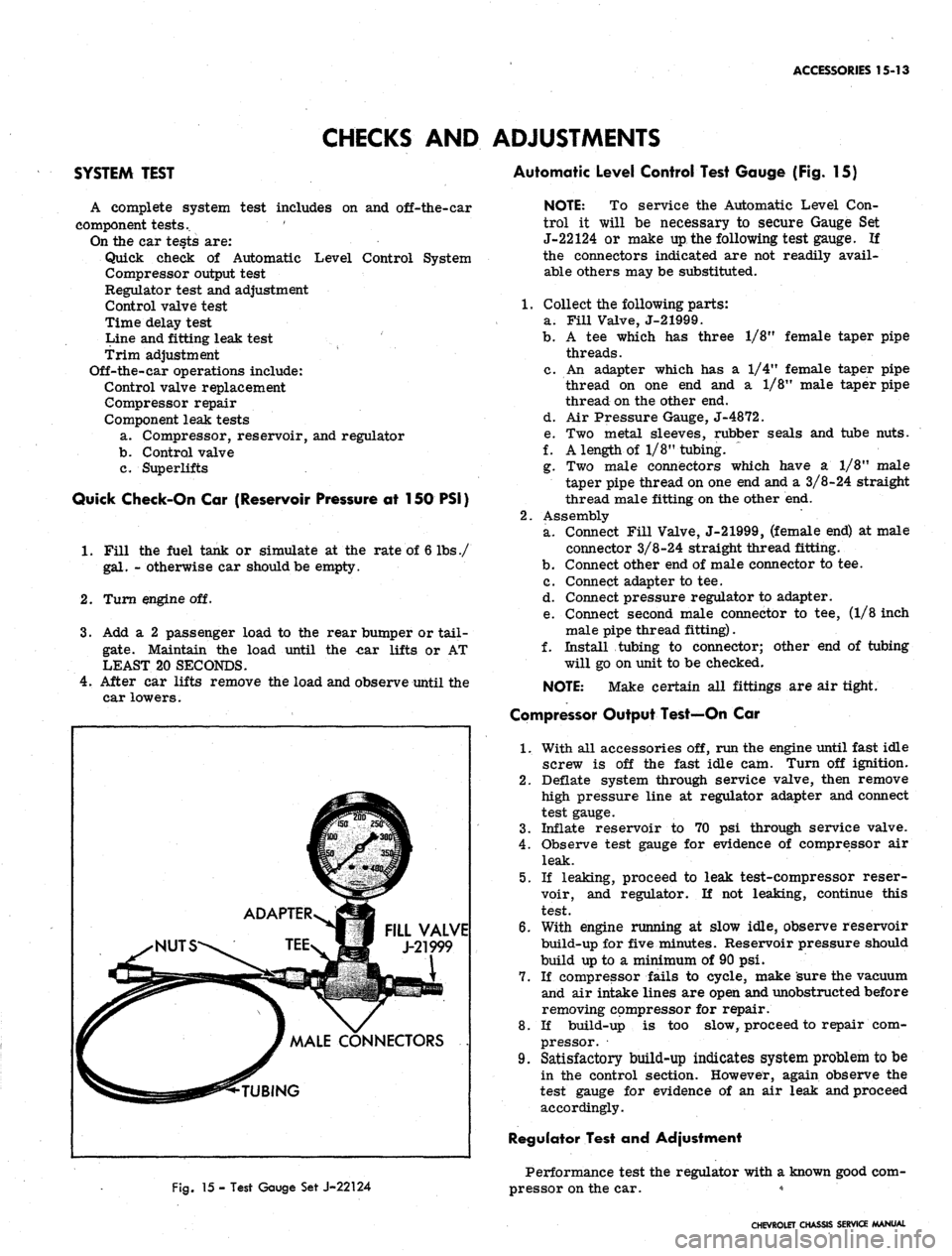
Automatic Level Control Test Gauge (Fig. 15)
A complete system test includes on and off-the-car
component tests.. '
On the car tests are:
Quick check of Automatic Level Control System
Compressor output test
Regulator test and adjustment
Control valve test
Time delay test
Line and fitting leak test
Trim adjustment
Off-the-car operations include:
Control valve replacement
Compressor repair
Component leak tests
a. Compressor, reservoir, and regulator
b.
Control valve
c. Superlifts
Quick Check-On Car (Reservoir Pressure at 150 PSI)
1.
Fill the fuel tank or simulate at the rate of 6 lbs./
gal.
- otherwise car should be empty.
2.
Turn engine off.
3.
Add a 2 passenger load to the rear bumper or tail-
gate.
Maintain the load until the -car lifts or AT
LEAST 20 SECONDS.
4.
After car lifts remove the load and observe until the
car lowers.
FILL VALVE
J-21999
CONNECTORS
Fig.
15 - Test Gauge Set J-22124
NOTE: To service the Automatic Level Con-
trol it will be necessary to secure Gauge Set
J-22124 or make up the following test gauge. If
the connectors indicated are not readily avail-
able others may be substituted.
1.
Collect the following parts:
a. Fill Valve, J-21999.
b.
A tee which has three 1/8M female taper pipe
threads.
c. An adapter which has a 1/4" female taper pipe
thread on one end and a 1/8" male taper pipe
thread on the other end.
d. Air Pressure Gauge, J-4872.
e. Two metal sleeves, rubber seals and tube nuts.
f. A length of 1/8" tubing. ~
g. Two male connectors which have a 1/8" male
taper pipe thread on one end and a 3/8-24 straight
thread male fitting on the other end.
2.
Assembly
a. Connect Fill Valve, J-21999, (female end) at male
connector 3/8-24 straight thread fitting.
b.
Connect other end of male connector to tee.
c. Connect adapter to tee.
d. Connect pressure regulator to adapter.
e. Connect second male connector to tee, (1/8 inch
male pipe thread fitting).
f. Install tubing to connector; other end of tubing
will go on unit to be checked.
NOTE:
Make certain all fittings are air tight.
Compressor Output Test—On Car
1.
With all accessories off, run the engine until fast idle
screw is off the fast idle cam. Turn off ignition.
2.
Deflate system through service valve, then remove
high pressure line at regulator adapter and connect
test gauge.
3.
Inflate reservoir to 70 psi through service valve.
4.
Observe test gauge for evidence of compressor air
leak.
5.
If leaking, proceed to leak test-compressor reser-
voir, and regulator. If not leaking, continue this
test.
6. With engine running at slow idle, observe reservoir
build-up for five minutes. Reservoir pressure should
build up to a minimum of 90 psi.
7.
If compressor fails to cycle, make sure the vacuum
and air intake lines are open and unobstructed before
removing compressor for repair.
8. If build-up is too slow, proceed to repair com-
pressor.
9. Satisfactory build-up indicates system problem to be
in the control section. However, again observe the
test gauge for evidence of an air leak and proceed
accordingly.
Regulator Test and Adjustment
Performance test the regulator with a known good com-
pressor on the car. *
CHEVROLET CHASSIS SERVICE MANUAL
Page 632 of 659

SPECIFICATIONS
5
BRAKES
SECTION
5
Type
Brake Drums
Diameter
Maximum
Out of Rou
Maximum Rebor©
id
Brake Shoes
Width Front
Rear
Length Primary
Secondary
Wheel Cylinder Diameter
Front
Rear
Chevrolet
Chevelle
Chevy
H
Camaro
Duo Servo Self Adjusting
11"
9-1/2
9-1/2
.008"
.060"
2-3/4
2
9-1/4
11-41/64
1-3/16
1
2-1/2
2
9
9-3/4
1-1/8
15/16
1-1/16
7/8
2-1/2
2
9
9-3/4
1-1/8
15/16
Corvette
Disc
2-7/32
5-31/32
1-7/8
1-3/8
TORQUE CHART
APPLICATION
Brake Pipe Distribution
and
Switch Assembly Mounting
Screws
Main Cylinder
to
Firewall
Mounting Nuts
Push
Rod
Clevis
Nut
Brake Hydraulic
Pipe
to
Main
Cylinder
and
Switch Connections
Brake Hose
to
Brake
Assembly Connection
Parking Brake Equalizer
Check
Nut
Hydraulic Brake
Pipe Connections
Rear Brake Hose
to
Rear
Brake Line "T" Connection
Caliper Half Retaining Bolts
Caliper
to
Mounting Bracket
Retaining Bolts
Chevrolet
24
lb. ft
14
lb. ft
100
lb. in.
(Front Line)
115
lb. in.
(Rear Line)
23
lb. ft
85
lb. in.
110
lb. in.
113
lb. in.
130
lb. ft
130
lb. ft
Chevelle
60
lb. in.
24
lb. ft
14
lb. ft
115
lb. in.
23
lb. ft
85
lb. in.
100
lb. in.
(Front)
120
lb. in.
(Rear)
113
lb. in.
130
lb. ft
130
lb. ft
Chevy
n
150
lb. in.
24
lb. ft
14
lb. ft
115
lb. in.
2^
lb. ft
—
100
lb. in.
65
lb. in.
130
lb. ft
130
lb. ft
Camaro
24
lb. ft
14
lb. ft
115
lb. in.
23
lb. ft
85
lb. in.
100
lb. in.
113
lb. in.
130
lb. ft
130
lb. ft
Corvette
90
lb. in.
24
lb. ft.
14
lb. ft.
115
lb. in.
23
lb. ft
70
lb. in.
100
lb. in.
113
lb. in.
130
lb. ft
130
lb. ft
CHEVROLET CHASSIS SERVICE MANUAL