1967 CHEVROLET CAMARO length
[x] Cancel search: lengthPage 151 of 659

CORVETTE BODY 1B-44
VIEW A
VIEW B
Fig.
97—Weatherstrip and Drip Moldings
1.
Headlining
2.
Roof Panel
3. Cap
4.
Drip Molding -
Side
5. Weatherstrip Assembly
- Inner Side
6. Weatherstrip Assembly
- Retaining Screw
7. Weatherstrip Assembly
- Retaining Screw Special
8. Weatherstrip Assembly
- Outer
9. Weatherstrip Assembly - Inner Forward
10.
Drip Molding - Forward
11.
Retainer - Weatherstrip Assembly,
Outer
Installation
1.
Wipe roof panel with a Xylol solvent such as 3M
Adhesive cleaner or equivalent, should be used to
remove or smooth but excess old cement. Apply
solvent and allow to soak before rubbing.
2.
Where possible, install new cover at room tempera-
ture (approximately 72 s) to permit easier fitting and
removing of wrinkles from the cover assembly.
3.
Determine center line of roof panel by marking
center points on front of hard top and back window
opening. Fold cover lengthwise. Lay cover on roof
panel. Determine overhang (approximately 1").
4.
Apply nitrile non-staining vinyl trim adhesive (such
as 3M Vinyl Trim Adhesive) to the ropf panel ad-
jacent to center line of fabric roof cover. *
5V Application of nitrile vinyl trim cement should be as
thin as possible. An excessive amount of cement may
result in trapped solvents (blisters) between fabric
cover and roof panel. A mohair roller should be used
for thin adhesive application.
NOTE:
If nitrile non-staining cement is not
available, neoprene type non-staining weather-
strip cement (3M weatherstrip cement or
equivalent) may be used.
6. Apply cement to entire fabric roof cover.
NOTE:
Allow approximately 15 minutes for
7.
cement to dry.
Fold vinyl cover back to contact adhesive on roof
panel. Vinyl cover seam must be parallel to center-
line of vehicle.
8. Repeat above steps for opposite side of
roof.
9. Use suitable spatula or roller to remove wrinkles
and/or bubbles from vinyl cover.
10.
Trim excess vinyl around entire top to provide a
CHEVROLET CHASSIS SERVICE MANUAL
Page 161 of 659

SECTION 2
FRAME
INDEX
Page
General Description 2-1
Chevrolet 2-1
Cheveile '. 2-1
Repair Procedures 2-1
Page
Checking Frame Alignment 2-1
Car Preparation 2-1
Tramming Sequence 2-1
Reference Point Dimensions 2-1
GENERAL DESCRIPTION
CHEVROLET AND CHEVELLE
Frames used on Chevrolet and Cheveile lines are basi-
cally the same, consisting of full length right and left
side members joined laterally by crossmembers. Sev-
eral different frames are used in each line to meet the
various vehicle size and function requirements but the
basic shape for each line remains the same. Differences
between frames in a given line exist only in metal gauge,
part size and numbers of parts necessary to meet the
particular structural requirements of the models
involved.
CORVETTE
The Corvette frame is a rigid perimeter unit, with five
crossmembers. From the rear kick-up forward, trap-
azoidal shaped, closed side members outline and protect
the passenger compartment. At the cowl area, the side
members curve inward in a sweeping "S" shape, to pro-
vide a sturdy foundation for the engine mounts and clear-
ance for front wheel movement. From the kick-up
rearward, box-sectioned side rails provide fore and aft
support for the rear axle and suspension. Lateral sup-
port is provided by five variously shaped welded-in
crossmembers, including the front unit, which formerly
was bolted-in.
CHEVY II AND CAMARO
Underbody alignment checking procedures will be found
in the Body Service Manual.
REPAIR PROCEDURES
CHECKING FRAME ALIGNMENT
Vehicles involved in an accident of any nature which
might result in a "swayed" or "sprung" frame should
always be checked for proper frame alingment in addi-
tion to steering geometry and wheel alignment.
CAR PREPARATION
Preparing the car for the frame alignment check in-
volves the following:
1.
Place the car on level surface.
2.
The weight of the car should be supported at the
wheel locations.
3.
A visual damage inspection should be made to elim-
inate needless measuring. Obviously damaged or
misaligned areas can often be located by sight.
TRAMMING SEQUENCE
When checking a frame for alignment in case of dam-
age,
the first step is horizontal "X" checking with a
tram from similar given points on opposite side of the
frame.
Frame alignment checks on all models should be made
with the tram points set at the center of each locating
point indicated and the cross bar level to insure
accuracy.
When "X" checking any section of the frame, the
measurements should agree within 3/16". If they do not,
it means that corrections will have to be made.
If a tram gauge is not available, the "plumb bob"
method of checking may be used. To assure any degree
of accuracy when using this method, the vehicle should
be on a level floor.
By using this method, it is only necessary to have a
#
piece of cord attached to an ordinary surveyor's plumb
bob.
When measuring the distance between two points,
the free end of the cord should be placed on the reference
point allowing the plumb bob to hang on the floor. A check
mark should be made on the floor just under the tip of
the plumb bob. This operation should be repeated at all
reference points. With these points located on the floor,
they may easily be measured with a rule.
The second step is checking the vertical dimensions
from the datum plane to the points to be trammed. With
the proper settings the tram bar will be on a plane
parallel to that of the frame. The exception to this would '
be when one of the reference locations is included in the
misaligned area; then the parallel plane between the
frame and the tram bar may not prevail. After com-
pletion of the repairs, the tram gauge should be set at
the specified dimension to check the accuracy of the re-
pair operation.
ALIGNMENT REFERENCE POINT DIMENSIONS
Dimensions to holes are measured to dead center of
the holes and flush to the adjacent surface metal.
CHEVROLET CHASSIS SERVICE MANUAL
Page 170 of 659

FRONT SUSPENSION 3-6
Fig.
8 - Caster and Camber Adjustments - Chevy
To adjust for caster and camber, loosen the upper sup-
port shaft to crossmember nuts, add or subtract shims as
required and retighten nuts.
NOTE:
Caster and camber can be adjusted in
one operation.
Caster and camber specifications will be found in the
last section of this book.
Chevrolet and Chevy II
The caster angle is adjusted by turning the two niits at
the front of the lower control arm strut rod (figs. 7 and
8).
Shortening this rod will increase caster. Lengthen-
ing will decrease caster.
Camber angle is adjusted by loosening the lower con-
trol arm pivot bolt and rotating the cam located on this
pivot. This eccentric cam action will move lower control
arm in or out, thereby varying camber.
Steering Axis Inclination Adjustment
"Camber" is the outward tilt of the wheel and "steering
axis inclination" is the inward tilt of the knuckle. Cam-
ber cannot be changed without changing steering axis
inclination. Correct specifications willbe found at the
end of this section. If, with the camber correctly ad-
justed, the steering axis inclination does not fall within
the specified limits the knuckle is bent and should be
replaced.
If a new knuckle is installed, caster, camber and toe-in
must be readjusted.
Toe-In Adjustment
Toe-in, the inward pointing of both front wheels, is
checked with the wheels in the straight ahead position. It
is the difference of the distance measured between the
extreme front and the distance measured between the ex-
treme rear of both front wheels. Correct toe-in specifi-
cations will be found at the end of this section.
NOTE:
Toe-in must be adjusted after caster
and camber adjustment.
A. If the equipment being used measures the toe-in of
each wheel individually:
1.
Set the steering gear on the high point, mark 12
o'clock position on the steering shaft and position
the steering wheel for straight ahead driving.
2.
Loosen the clamp bolt at each end of each tie rod
and adjust to the total toe-in as given in the speci-
fications at the end of this book.
B.
If a tram gauge is being used, proceed as follows:
1.
Set the front wheels in the straight ahead position.
2.
Loosen the clamp bolts on one tie rod and adjust
for the proper toe-in as given in the specifications
at the end of this book.
3.
Loosen the clamp bolts on the other tie rod. Turn
both rods the same amount and in the same direc-
tion to place the steering gear on its high point and
position the steering wheel in its straight ahead
position.
C.
After the adjustment has been made:
1.
a. Chevrolet—Position inner tie rod clamp bosses
forward to 90° down to avoid stabilizer link bolt
interference.
b.
Chevelle—Position the tie rod clamp bosses
down to 45?° forward to avoid interference.
c. Chevy II--Position the outer tie rod clamp
bosses forward and not more than 45° up or
down from horizontal to avoid interference.
Inner clamps forward and vertical.
d. Corvette--Position inner tie rod clamps with
bolt horizontal and down. Position outer clamps
with bolt vertical and to the rear.
e. Camaro—Position inner tie rod clamps with
open end of clamp and slot in line. Position
relative to ground unimportant. Position outer
clamps with bolt top and 30° either side of ver-
tical. Position relative to slot unimportant.
RIDING HEIGHT AND COIL SPRING SAG
The following check will quickly determine whether or
CHEVROLET CHASSIS SERVICE MANUAL
Page 194 of 659

REAR SUSPENSION AND DRIVE LINE
4-4
PROPELLER SHAFT
CARRIER FRONT SUPPORT
CAMBER CAM CONTROL ARM
Fig. 5—Corvette Rear Suspension and Driveline Components
rubber mounted to the frame at three points, with the .
strut rods, drive shafts and torque control arms forming
the three links at each wheel, and a transversely mounted
multi-leaf spring (fig. 5).
The bbx section trailing torque control arms are
mounted at the forward end into frame side member
openings through pivot bolts and rubber bushings, and
extend rearward to connect to the leaf spring. The
wheel spindles and spindle supports are attached to the
torque arms through four bolts pressed into the arm.
Rear wheel toe-in angle is adjusted through the use of
variable thickness shims inserted between the torque
arm and the frame side member web at the forward
pivoting joint.
The rear wheel spindles are driven through double
"U"
jointed, tubular driveshafts which are flange mount-
ed to a splined spindle flange at their outboard end and
bolted to the differential side gear yokes at their in-
board end. Wheel spindle support houses the inner and
outer tapered roller bearings, two to each wheel. Bear-
ing adjustment is made through the use of a spacer and
variable thickness shims between the bearings.
The spindle supports also incorporate integrally
forged, fork-shaped mounting brackets to accept the
outer ends of the rubber-bushed strut rods. The strut
rods are mounted laterally from the spindle support to
a bracket bolted to the lower surface of the axle car-
rier. The strut rod connection at this point is with an
eccentric cam arrangement and provides for rear wheel
camber adjustment.
The direct, double-acting shock absorbers are at-
tached at the upper eye to a frame bracket and at the
lower eye to the strut rod mounting shaft which incor-
porates a threaded stud for. the shock absorber lower
eye.
The transversely mounted multi-leaf spring is clamp
bolted at the center section to a lower mounting surface
on the differential carrier cover. The outer ends of the
main leaf are provided with a hole through which the
spring is link bolted to the rear of the torque control
arms.
The spring assembly is provided with full length
liners.
An optionally available stabilizer shaft attaches to the
upper rear section of the torque arms, and stretches
rearward where it is connected to the frame by two
rubber-bushed mounting brackets.
MAINTENANCE AND ADJUSTMENTS
Periodic maintenance and adjustments are not required
for the rear suspension components. The suspension
system should be checked for shock absorber action,
condition of suspension bushings, tightness of suspension
attaching bolts and an overall visual inspection of com-
ponents for defects.
CHEVROLET CHASSIS SERVICE MANUAL
Page 227 of 659

REAR SUSPENSION AND DRIVE LINE 4-37
9. Connect spring end link bolts as outlined under
Spring--Installation, in this section.
10.
Remove filler plug, located on right side of cover,
and fill -with hypoid lubricant to level of filler hole.
11.
Lower vehicle and road test for leaks, noise and
general performance.
POSITRACTION DIFFERENTIAL UNIT
The optionally available Positraction differential unit
is installed in the conventional carrier to replace the
standard differential unit.
Service procedures for the Positraction equipped axle
are the same as on a conventional axle except for the.
operations listed below.
On the Vehicle Check
If vehicle is equipped with a manual transmission, shift
transmission into neutral.
1.
Raise rear of vehicle until wheels are off the ground,
remove one wheel and tire assembly.
2.
Attach Adapter J-5748 to axle shaft flange and install
a
1/2-13
bolt into adapter (fig. 97).
3.
With wheel and tire assembly still on vehicle held
firmly to prevent turning, measure torque required
Fig.
97—Measuring Positraction Rotating Torque
to rotate opposite axle shaft with a 0-150# torque
wrench attached to J-5748. Torque should be 70
ft.
lbs. minimum new, and no less than 40 ft. lbs. if
used.
PROPELLER SHAFT AND UNIVERSAL JOINTS
INDEX
Page
Page
General Description 4-37
Component Parts Replacement. 4-38
Propeller Shaft (Dana) 4-38
Removal 4-38
Repairs 4-38
Installation 4-39
Propeller Shaft (Saginaw) 4-40
Removal 4-40
Repairs 4-40
Installation 4-41
GENERAL DESCRIPTION
The one-piece, exposed-type, tubular propeller shaft is
used on all models. The cardon-type universal joints are
of the extended-life design and do not require periodic
maintenance. A splined front yoke on the front end of the
propeller shaft extends into a splined coupling on the
transmission output shaft. This slip joint permits slight
lengthening and shortening of the propeller shaft to com-
pensate for up and down movement of the rear axle
assembly.
A light duty (fig. 98) and a heavy duty (fig. 99) version
of the tubular propeller shaft is used. The heavy-duty
shaft incorporates a damper, as part of the sleeve yoke,
at the transmission end of the shaft. This damper is not
serviced separately—the sleeve and damper (fig. 100)
must be replaced as an assembly.
Two different methods are used to retain the trunnions
Fig.
98—Light-Duty Propeller Shaft Cross-Section (Dana Design)
CHEVROLET CHASSIS SERVICE MANUAL
Page 229 of 659

REAR SUSPENSION AND DRIVE LINE 4-39
Fig.
103—Removing Bearing Caps
these joints are disassembled, repack bearings
and lubricate reservoir at end of trunnions with
high-melting point wheel bearing lubricant and
replace the dust seals.
1.
Remove bearing lock rings from trunnion yoke.
2.
Support trunnion yoke on a piece of 1-1/4" I.D. pipe
on an arbor bed.
NOTE:
Due to length of the propeller shaft it
may be more convenient to use a bench vise,
for removal and installation, instead of an arbor
press.
In this case, proceed with disassembly
and assembly procedure as with an arbor press.
3.
Using a suitable socket or rod, press trunnion down
far enough to drive bearing cup from yoke (fig. 103).
4.
Remove dust seals from trunnion, clean and inspect
bearing rollers and trunnion. Relubricate bearings
with a lithium base chassis lubricant.
NOTE:
In addition to packing the bearings,
make sure that the lubricant reservoir at the
end of each trunnion is completely filled with
lubricant. In filling these reservoirs, pack lu-
bricant into the hole so as to fill from the
bottom. This will prevent air pockets and ensure
an adequate supply of lubricant.
5. Place new dust seals on trunnions - cavity of seal
toward end of trunnion - then position Tool J-21548
over end of trunnion and into cavity portion of seal.
Press seal onto trunnion until tool bottoms against
trunnion (fig. 104). .
NOTE:
Installation of seal is critical to proper
sealing - use specified tool during installation to
prevent seal distortion and to assure proper
seating of seal on trunnion.
6. Partially install one bearing cup into yoke. Place
trunnion in yoke and into bearing cup. Install other
bearing cup and press both bearing cups into yoke
(fig. 105) being careful to keep trunnion aligned in
bearing cups.
7. Press bearing cups far enough to install lock rings,
and install lock rings.
Installation
1.
Inspect yoke seal in the transmission and replace, if
necessary, as described in the transmission section.
2.
Insert propeller shaft front yoke into transmission.
NOTE:
On Corvette models, install front yoke
into transmission then position propeller shaft
between yoke and companion flange; install "U"
bolts to front yoke.
3.
Align propeller shaft with companion flange, using
reference marks established in "Removal" pro-
cedure, connect the rear universal joint by installing
"U"
bolt clamps over bearing trunnions - torque
nuts to specifications.
Fig.
104—"U" Joint Trunnion Seal installation
Fig.
105—Installing Bearing Cup and Trunnion
CHEVROLET CHASSIS SERVICE MANUAL
Page 240 of 659

BRAKES 5-7
LATCH PLATE
DIE BLOCK
TUBE
UPSET FLARE PUNCH
RAM GUIDE
STOP PLATE
Fig.
13—Flaring Operation--Position ing Tubing
2.
Remove the tubing from the die block and deburr
the inside and outside edges.
3.
Install compression couplings on tubing and dip end
of tubing to be flared in hydraulic fluid. This lubri-
cation results in better formation of the flare.
4.
Place on-half of the die blocks in the tool body with
the counterbored ends toward the ram guide. Now
lay the tubing in the block with approximately 1/2"
protruding beyond the end.
Fit the other half of the block into the tool body,
close the latch plate and tighten the nuts "finger
tight".
5. Select the correct size upset flare punch. One end
of this punch is counterbored or hollowed out to
gauge the amount of tubing necessary to form a
double lap flare. Slip the punch into the tool body
with the gauge end toward the die blocks. Install the
ram; then tap lightly until the punch meets the die
, blocks and they are forced securely against the
stop plate (fig. 13).
6. Using the supplied wrench, draw the latch plate
nut down tight to prevent the tube from slipping.
Tightening the nuts alternately (beginning with the
nut at the closed hole in the plate) will prevent
distortion of the plate. Remove the punch and the
ram. Now reverse the punch and put it back into the
tool body. Install the ram and tap it lightly until
the face of the upset flare punch contacts the face
of the die blocks (fig. 14). This completes the
first operation. Remove the ram and the punch.
7. To complete the flare, insert the pointed finish
flare punch and the ram into the tool body. Tap
the ram until a good seat is formed (fig. 15).
NOTE:
The seat should be inspected at inter-
vals during the finishing operation to avoid
over-seating.
LATCH
DIE BLOCK
TUBE
UPSET FLARE PUNCH
RAM GUIDE
RAM
1ST OPERATION
UPSET FLARE
PUNCH
2ND OPERATION
FINISH FLARE
PUNCH
Fig.
15—Flaring Operation—First and Second Flare
BRAKE ADJUSTMENT
Service Brake
Although the brakes are self-adjusting, a preliminary
or initial adjustment may be necessary after the brakes
have been relined or replaced, or whenever the length
of the adjusting screw has been changed. The final
adjustment is made by using the self-adjusting feature.
1.
With brake drum off, disengage the actuator from
the star wheel and rotate the star wheel by spinning
or turning with a small screw driver.
2.
Recommended
a. Use special Tool J-21177; Drum-to-Brake Shoe
Clearance Gauge, to check the diameter of the
brake drum inner surface (fig. 16).
Fig.
14—Flaring Operation—First Flare
Fig.
16—Using Drum-to-Brake Shoe Clearance
Gauge Tool J-21177
CHEVROLET CHASSIS SERVICE MANUAL
Page 252 of 659
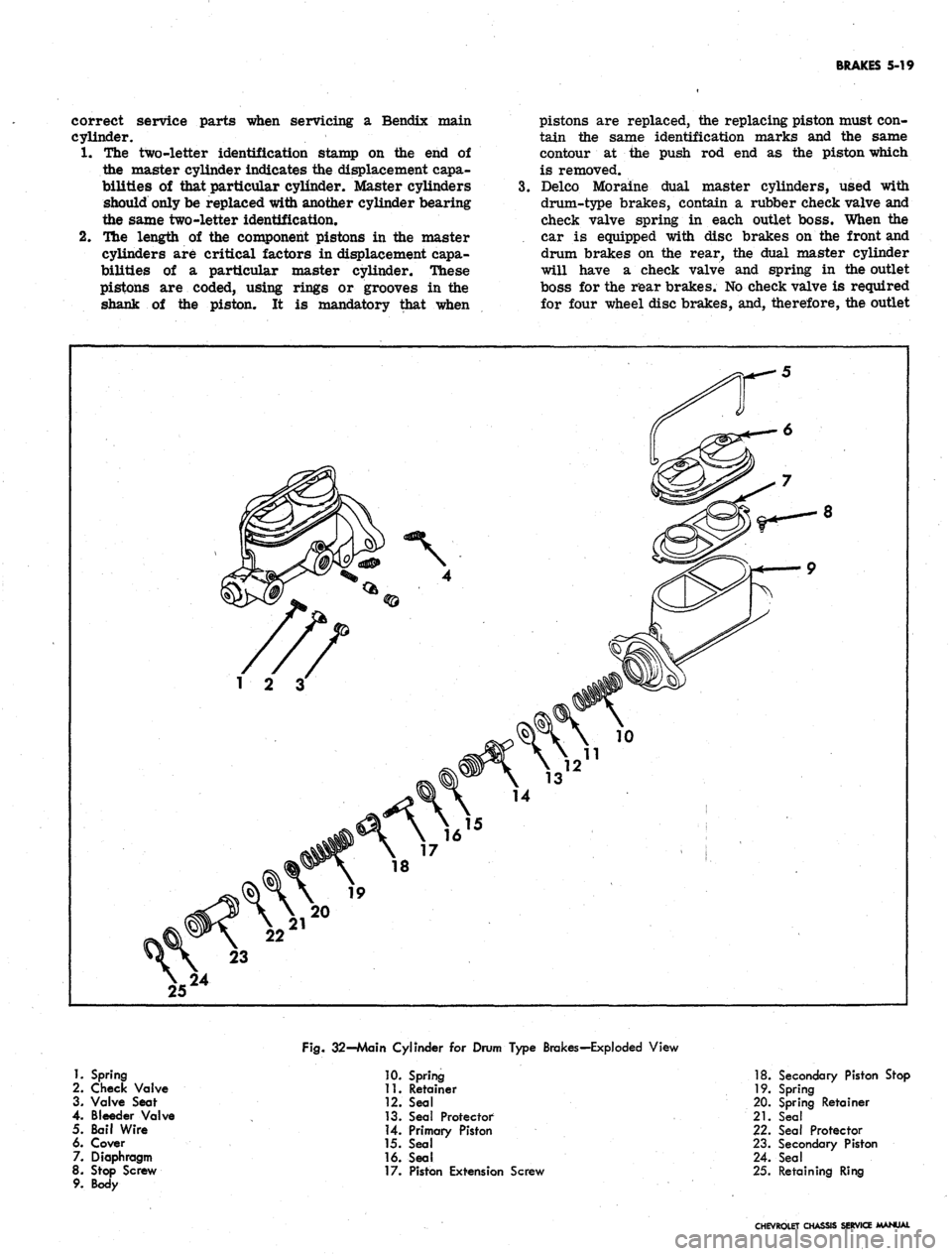
BRAKES 5-19
correct service parts when servicing a Bendix main
cylinder.
1.
The two-letter identification stamp on the end of
the master cylinder indicates the displacement capa-
bilities of that particular cylinder. Master cylinders
should only be replaced with another cylinder bearing
the same two-letter identification.
2.
The length of the component pistons in the master
cylinders are critical factors in displacement capa-
bilities of a particular master cylinder. These
pistons are coded, using rings or grooves in the
shank of the piston. It is mandatory that when
pistons are replaced, the replacing piston must con-
tain the same identification marks and the same
contour at the push rod end as the piston which
is removed.
Delco Moraine dual master cylinders, used with
drum-type brakes, contain a rubber check valve and
check valve spring in each outlet boss. When the
car is equipped with disc brakes on the front and
drum brakes on the rear, the dual master cylinder
will have a check valve and spring in the outlet
boss for the rear brakes. No check valve is required
for four wheel disc brakes, and, therefore, the outlet
1.
Spring
2.
Check Valve
3. Valve Seat
4.
Bleeder Valve
5. Bail Wire
6. Cover
7. Diaphragm
8. Stop Screw
9. Body
Fig.
32-Main Cylinder for Drum Type Brakes-Exploded View
10.
Spring
11.
Retainer
12.
Seal
13.
Seal Protector
14.
Primary Piston
15.
Seal
16.
Seal
17.
Piston Extension Screw
18.
Secondary Piston Stop
19.
Spring
20.
Spring Retainer
21.
Seal
22.
Seal Protector
23.
Secondary Piston
24.
Seal
25.
Retaining Ring
CHEVROLET CHASSIS SERVICE MANUAL