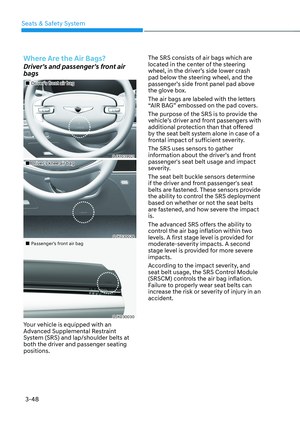
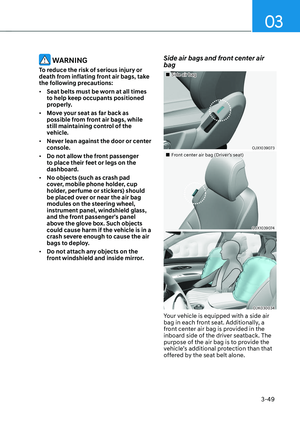
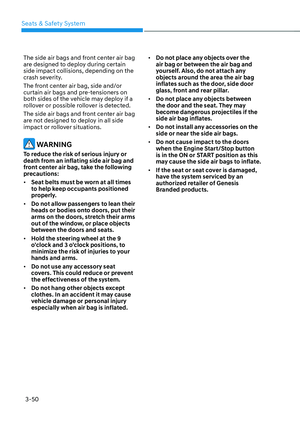
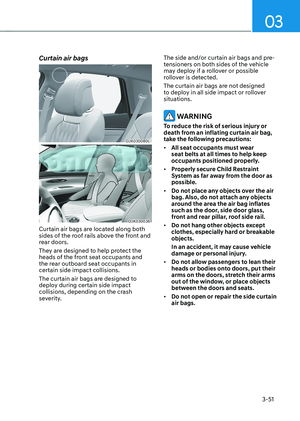
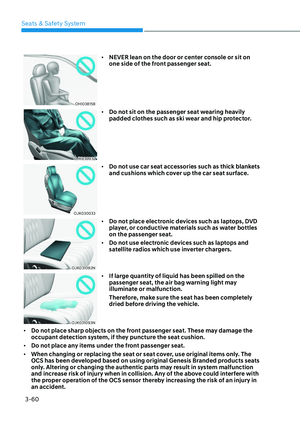
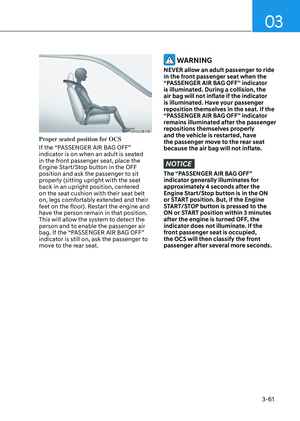
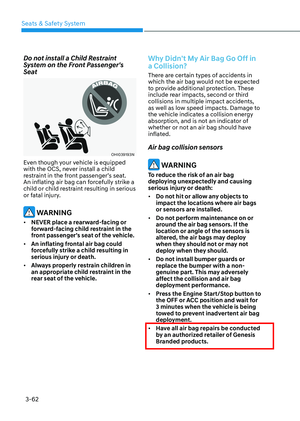
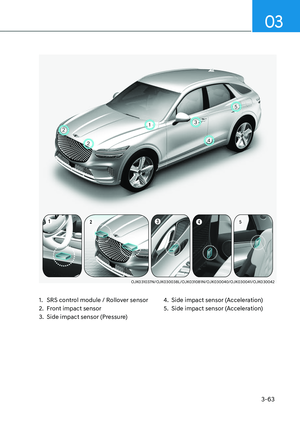
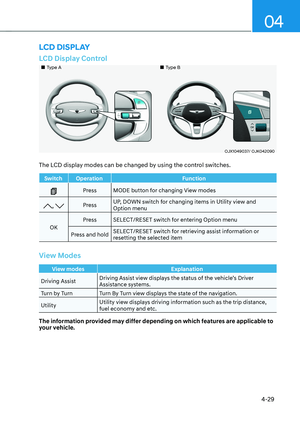
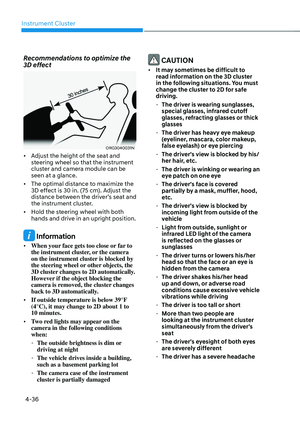
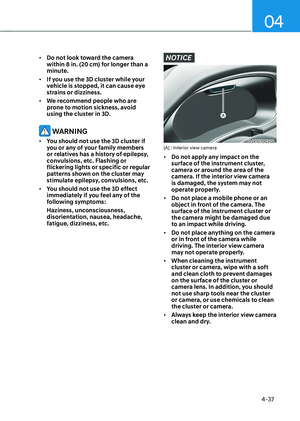
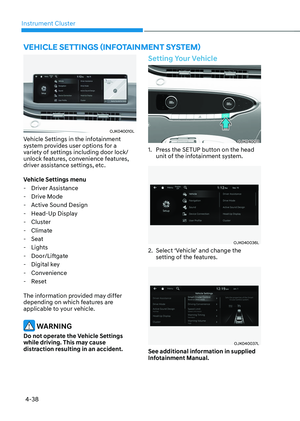
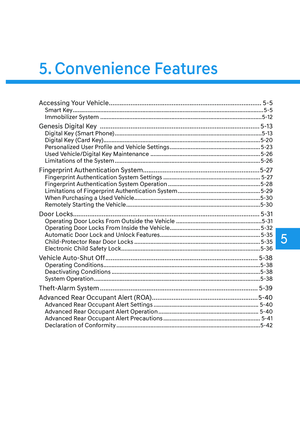
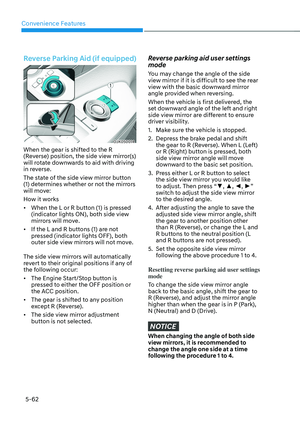
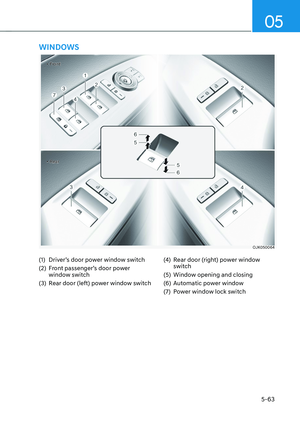
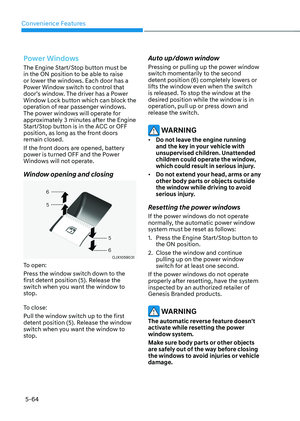
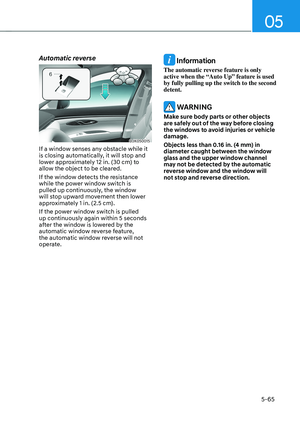
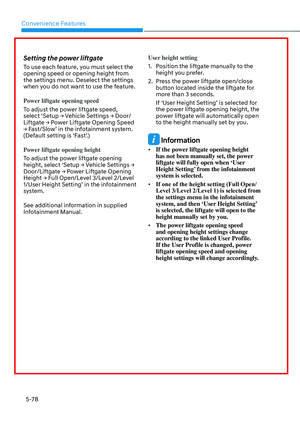
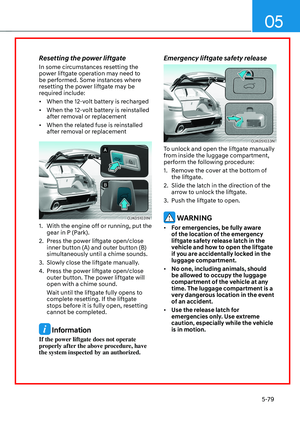
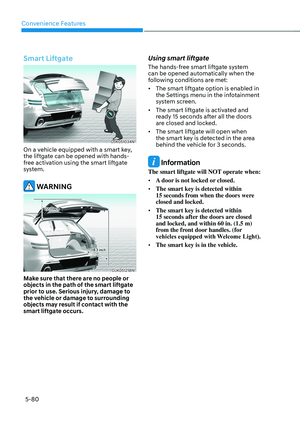
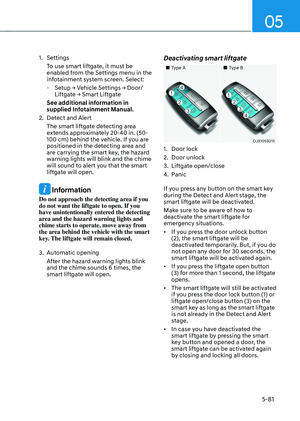
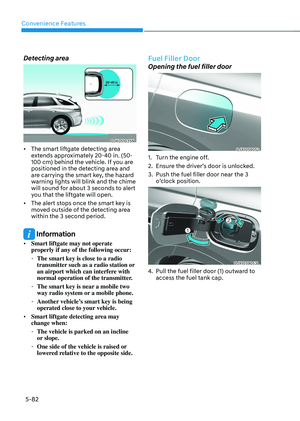
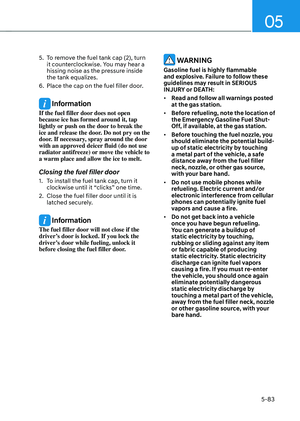
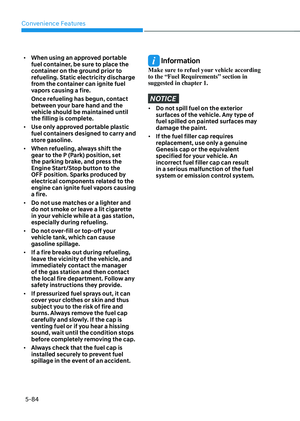
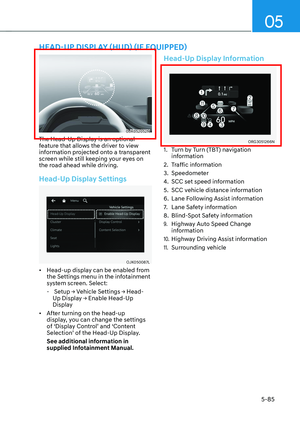
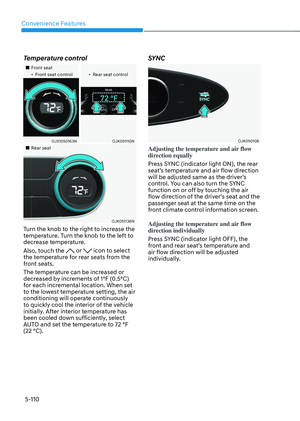
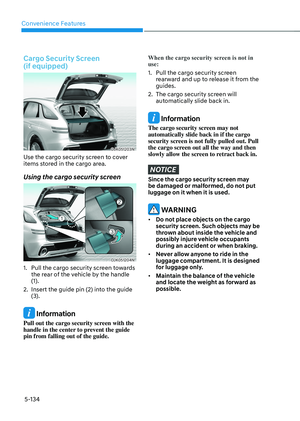
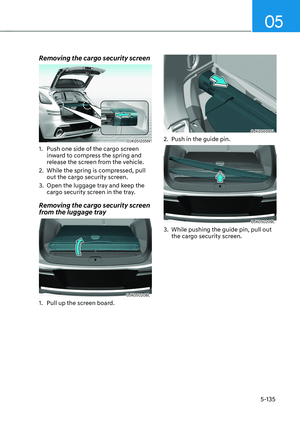
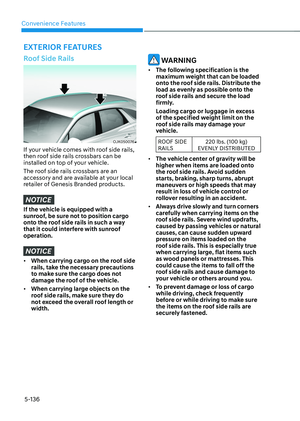
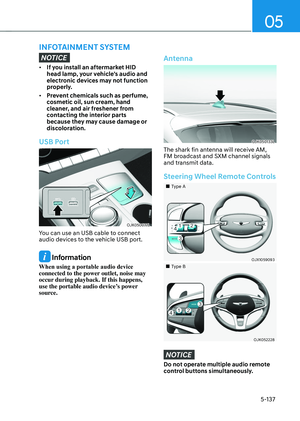
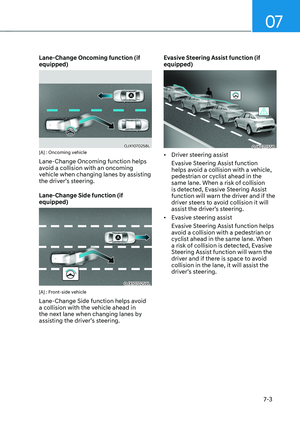
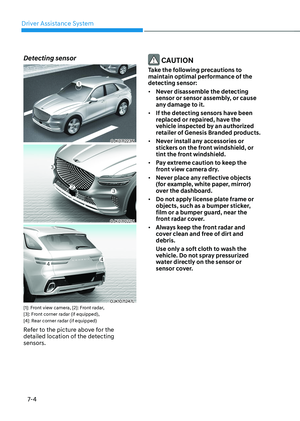
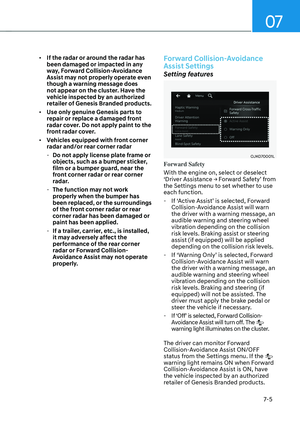
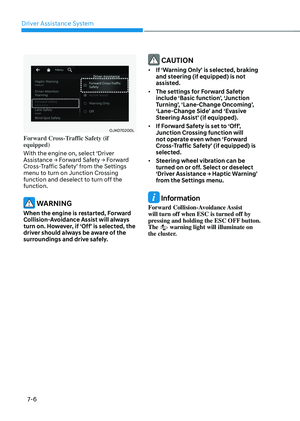
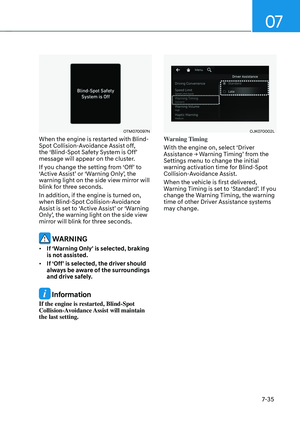
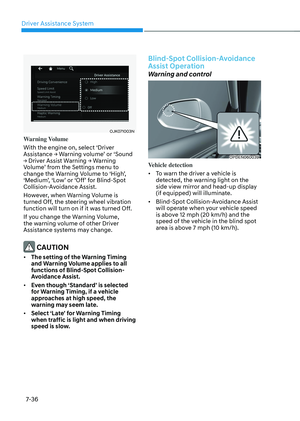
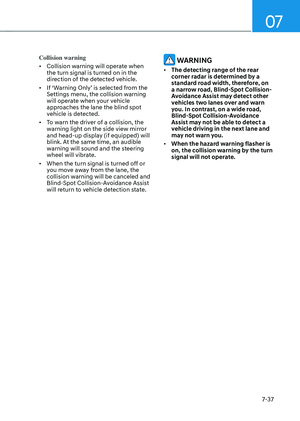
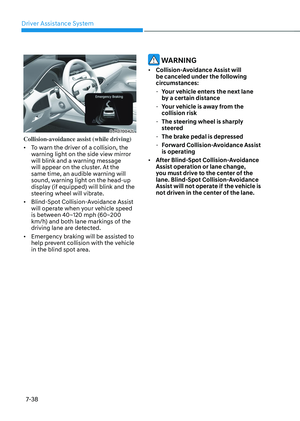
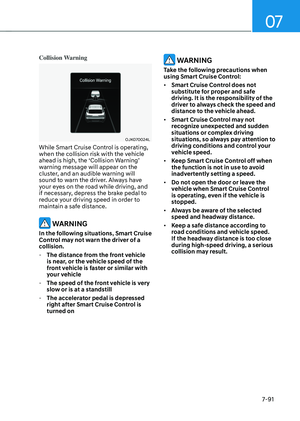
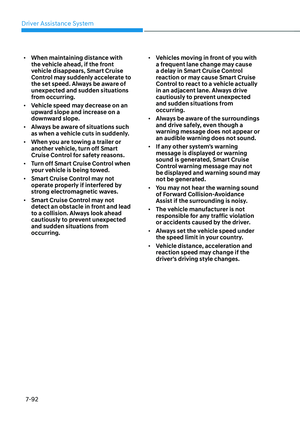
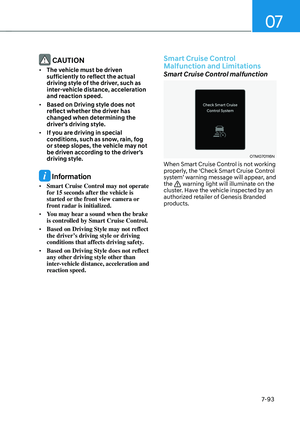
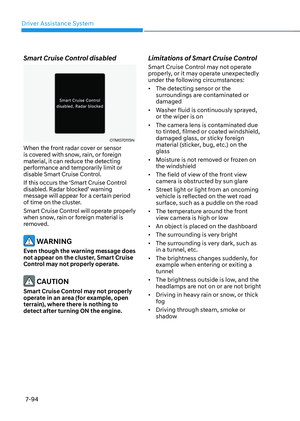
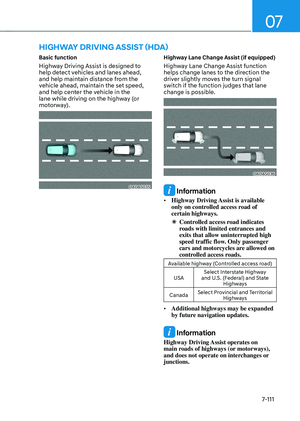
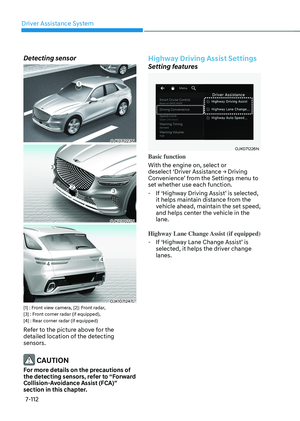
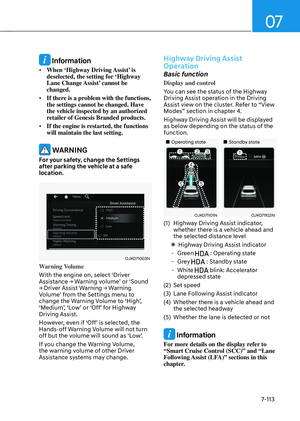
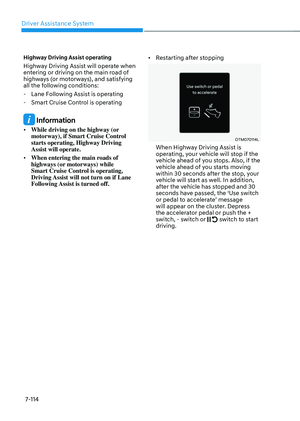
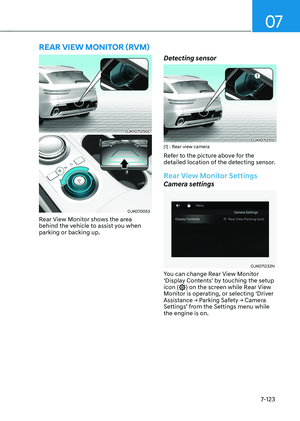
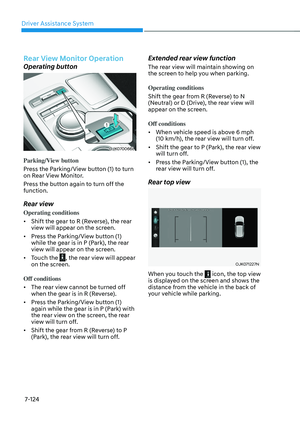
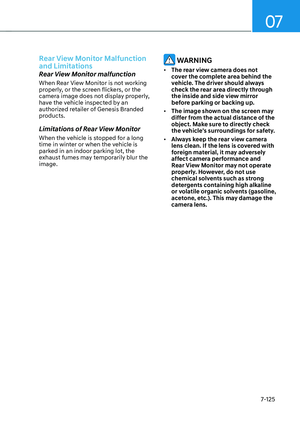
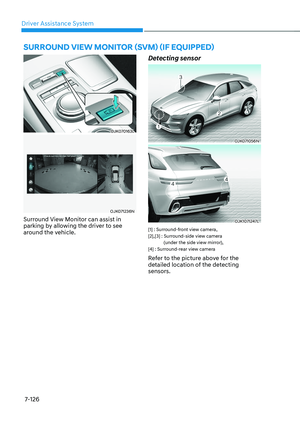
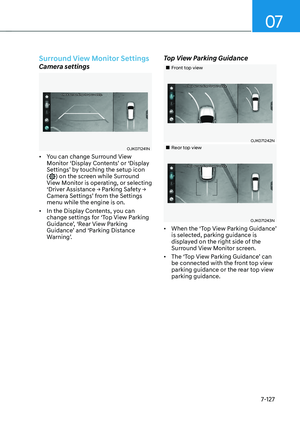
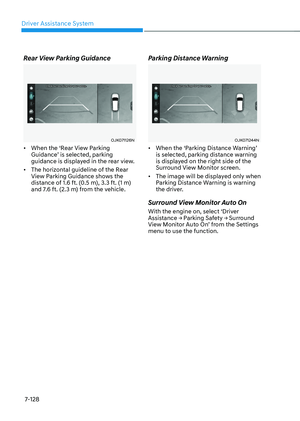
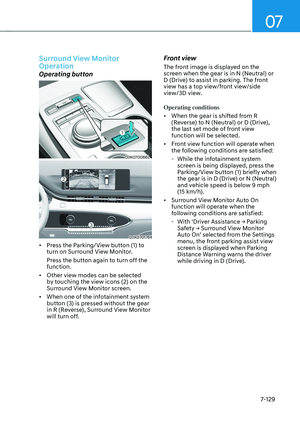
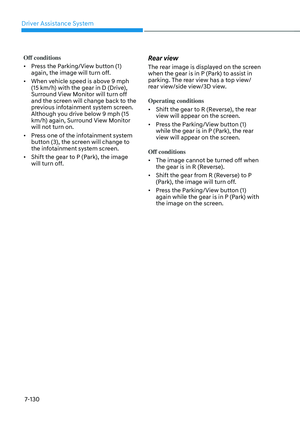
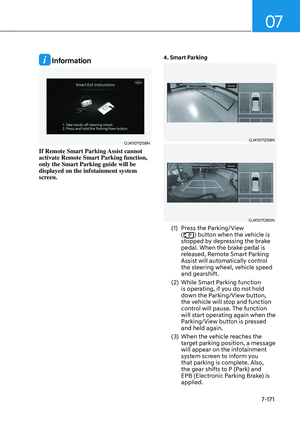
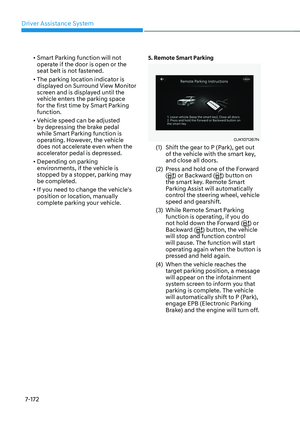
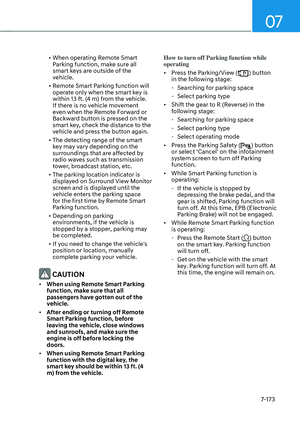
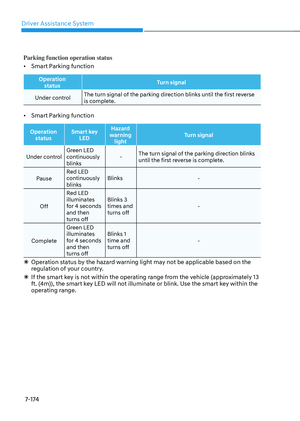
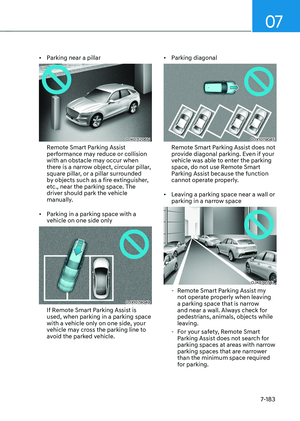
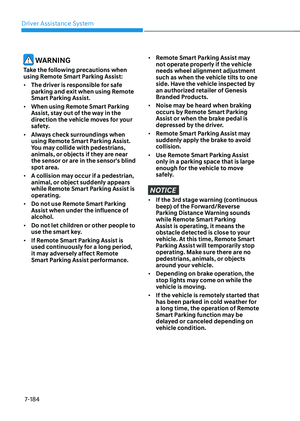
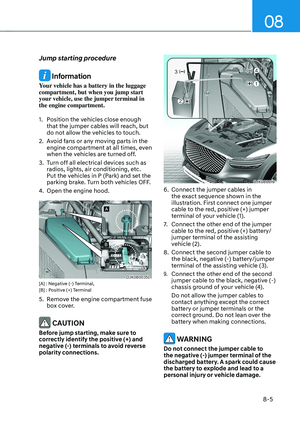
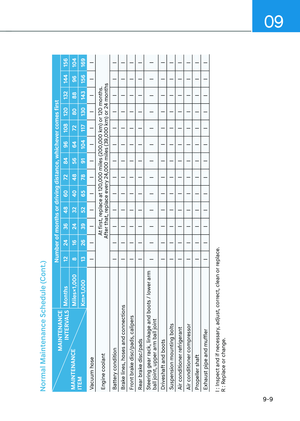
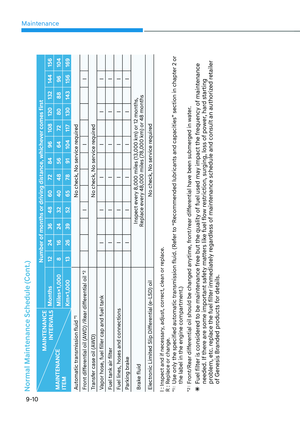
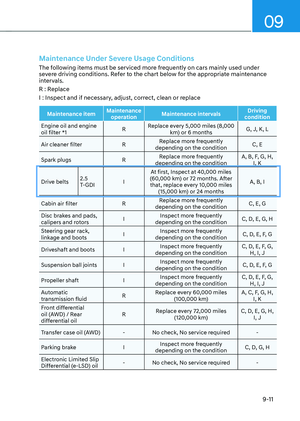
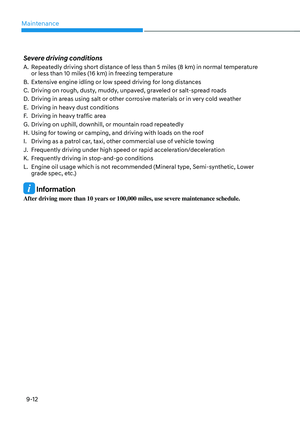
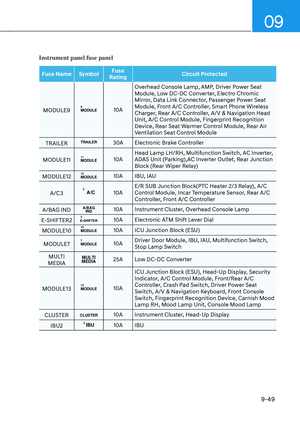
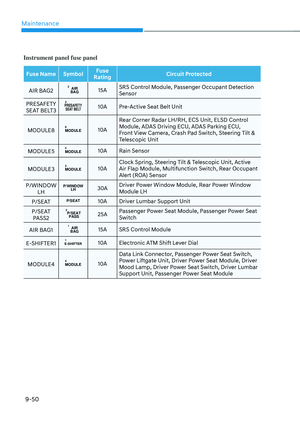
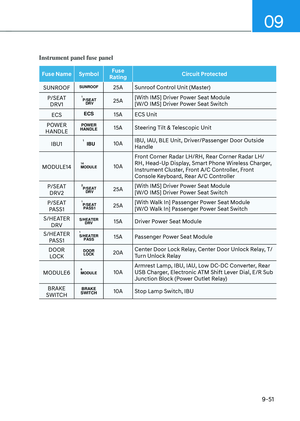
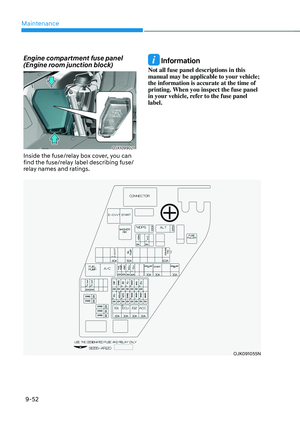
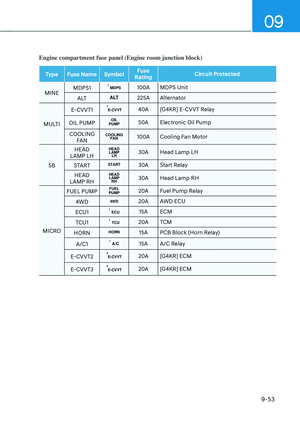
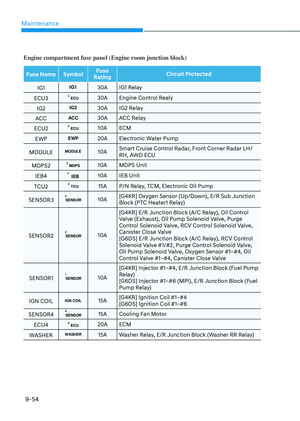
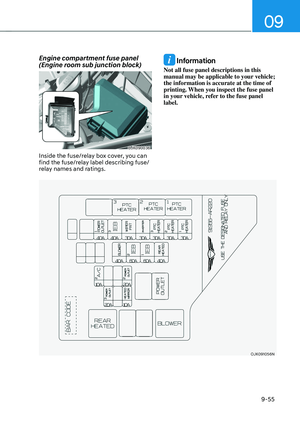
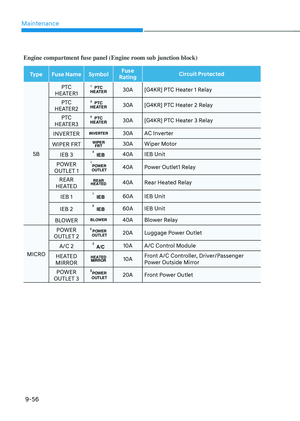
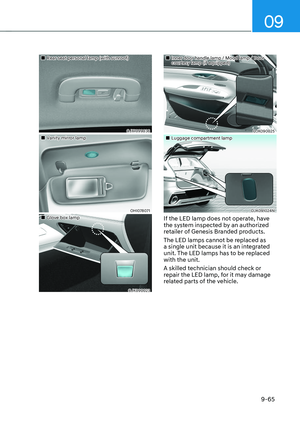
Page 489 of 637

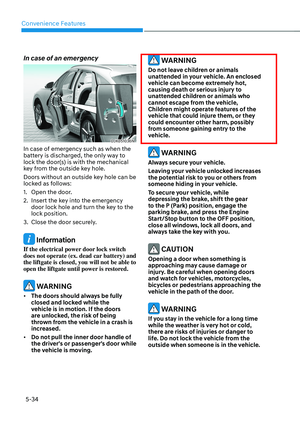
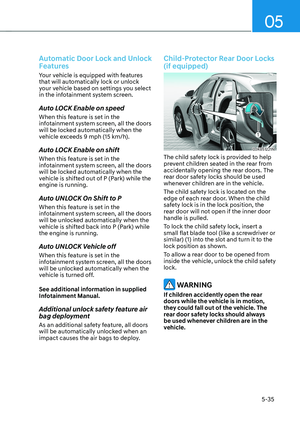
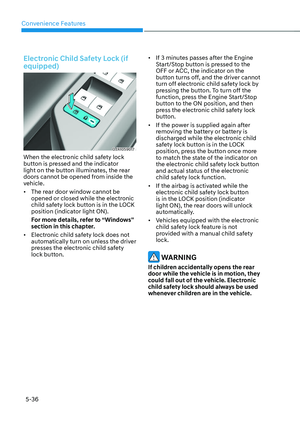
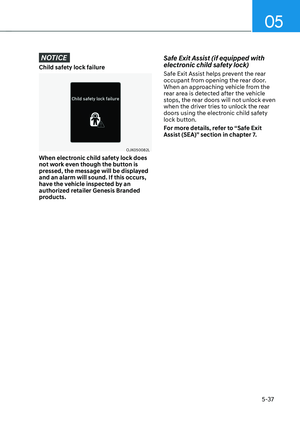
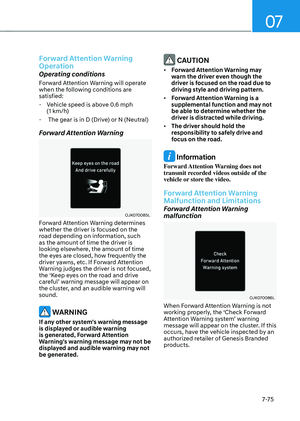
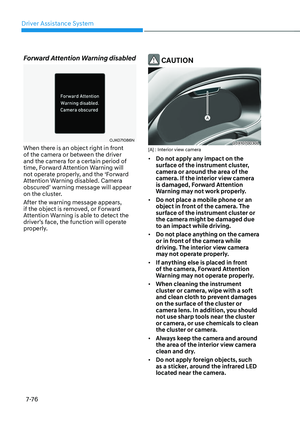
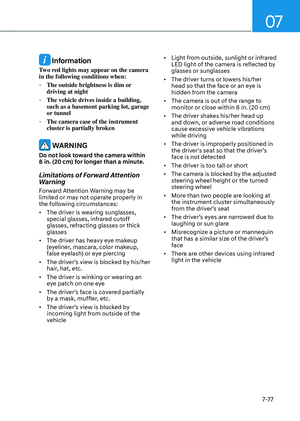
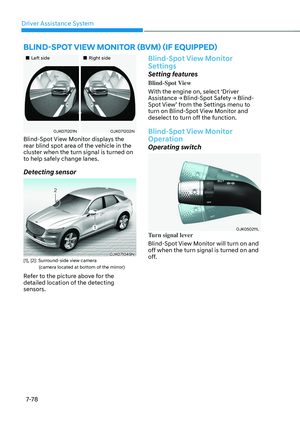
Driver Assistance System
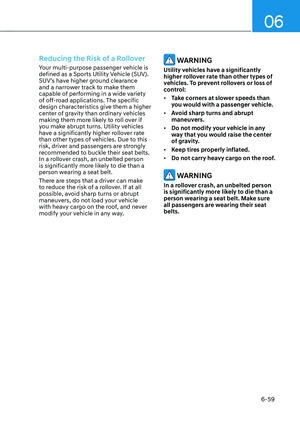
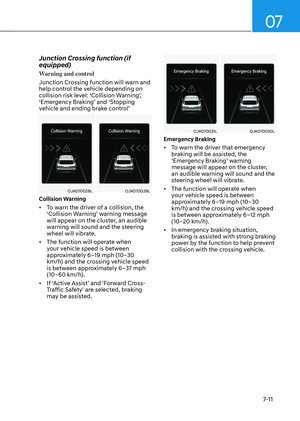
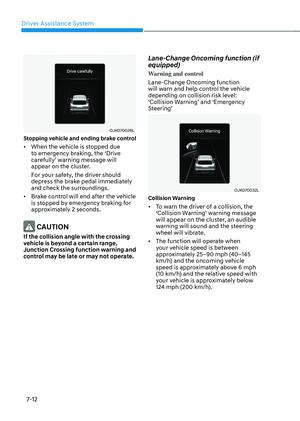
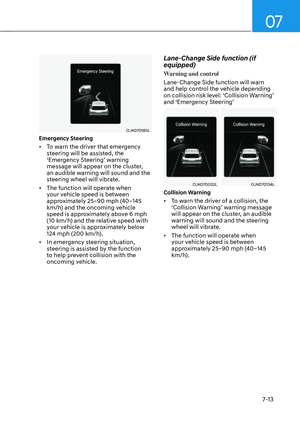
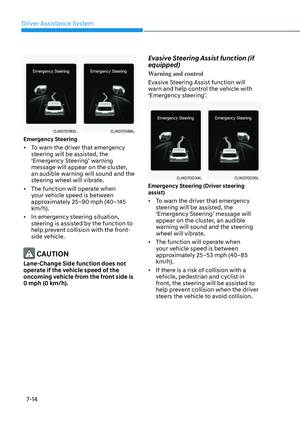
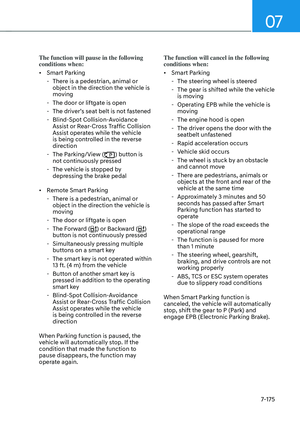
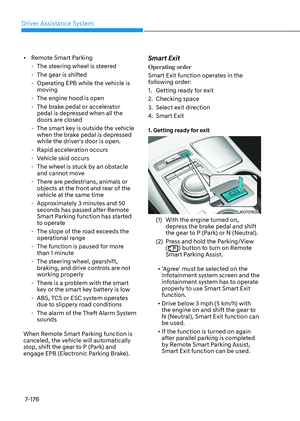
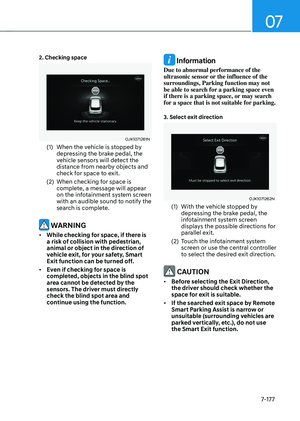
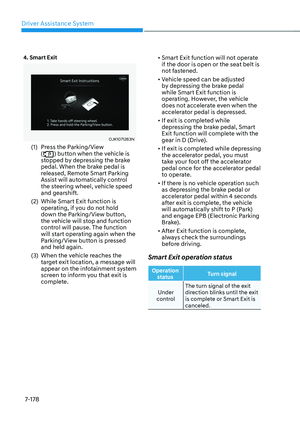
7-138
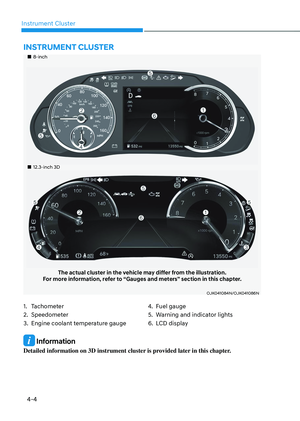
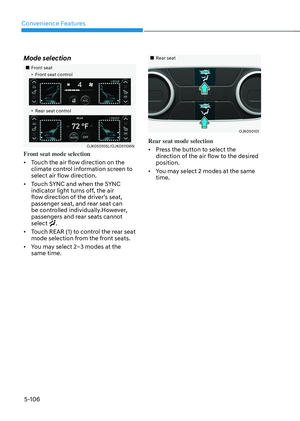
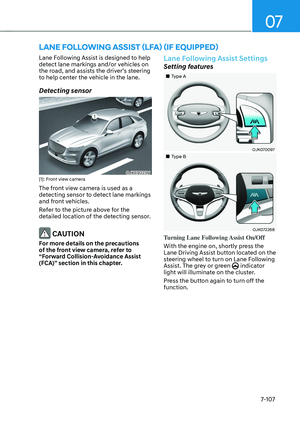
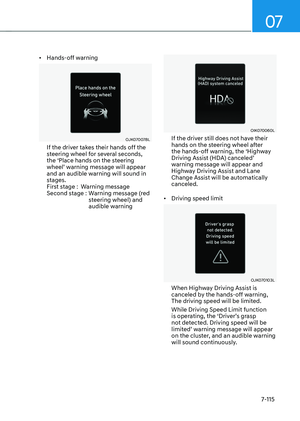
Rear Cross-Traffic Collision-
Avoidance Assist Malfunction
and Limitations
Rear Cross-Traffic Collision-
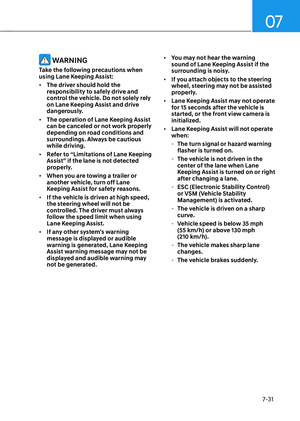
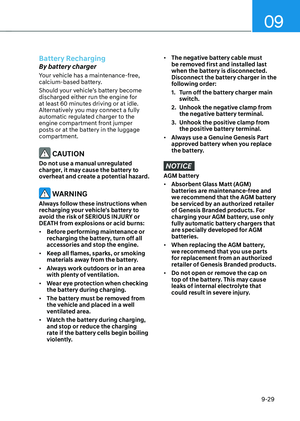
Avoidance Assist malfunction
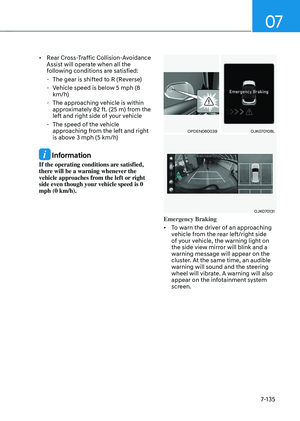
OTM070125NOTM070125N
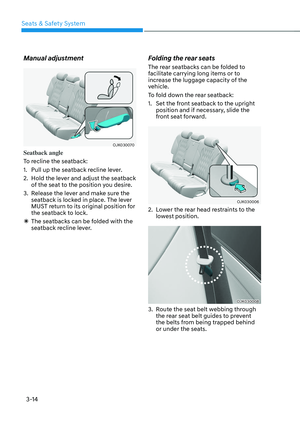
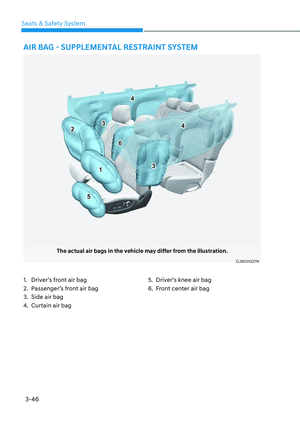
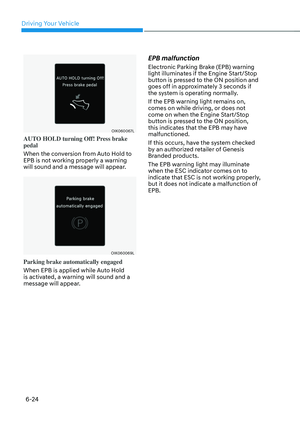
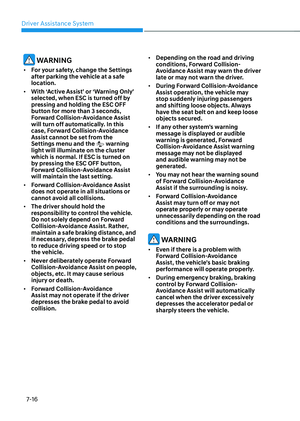
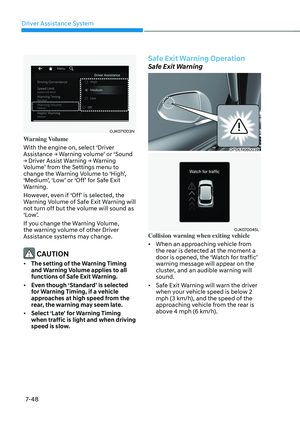
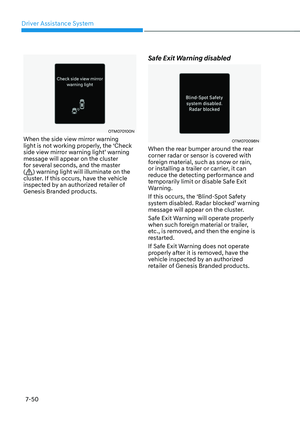
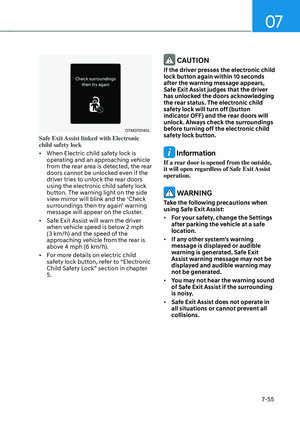
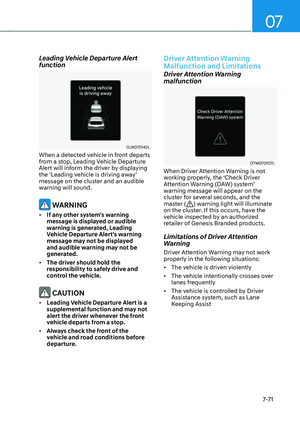
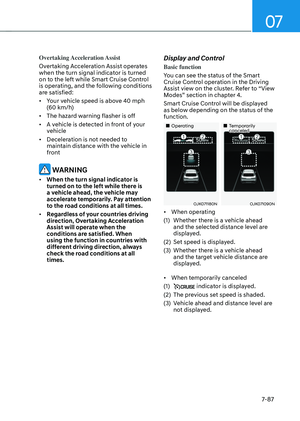
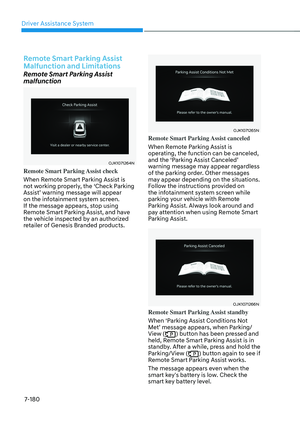
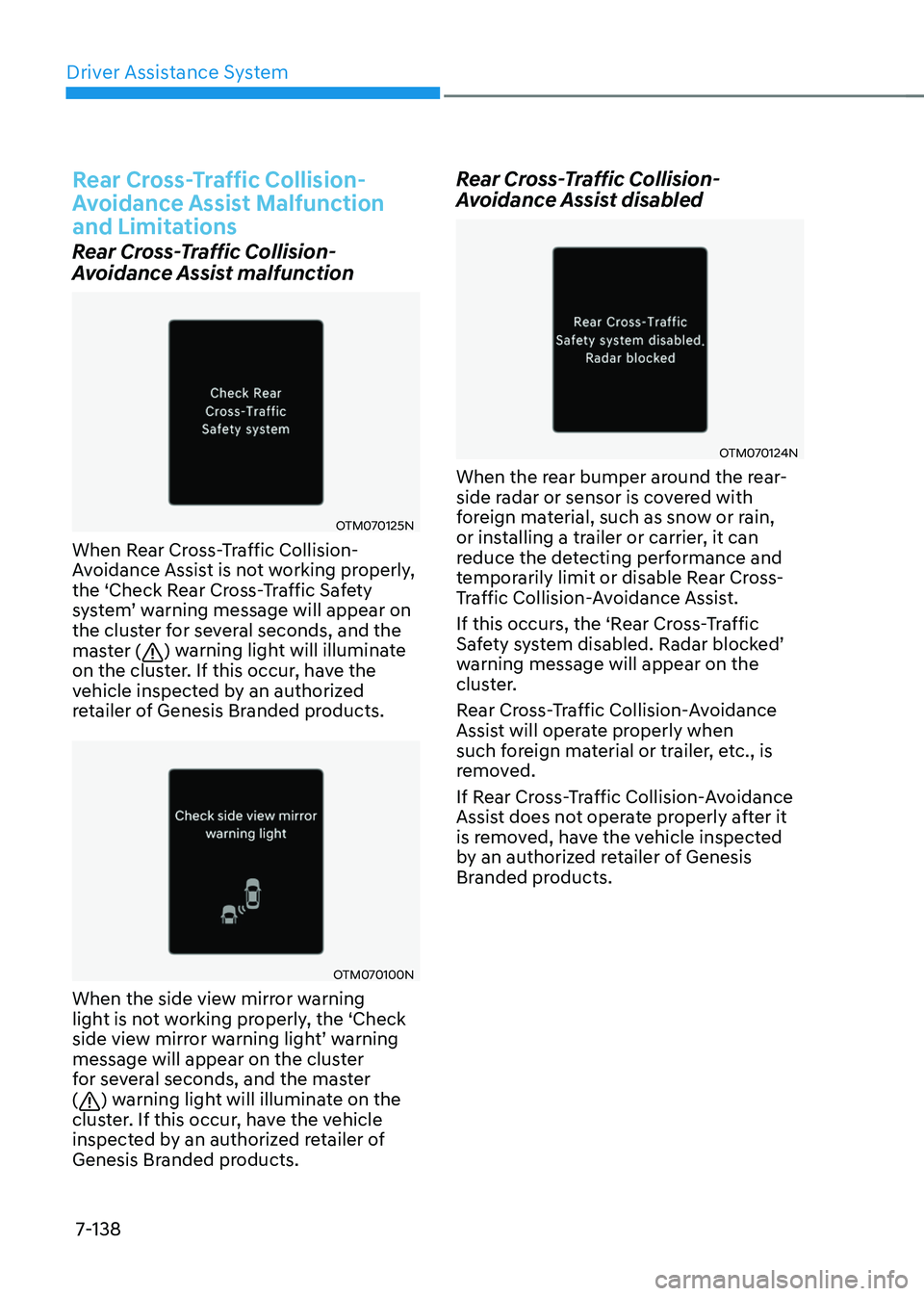
When Rear Cross-Traffic Collision-
Avoidance Assist is not working properly,
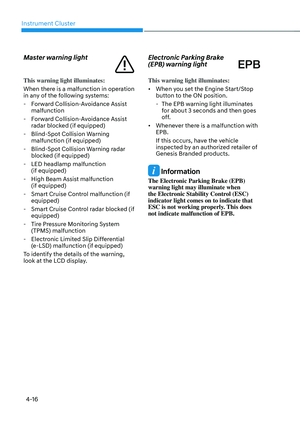
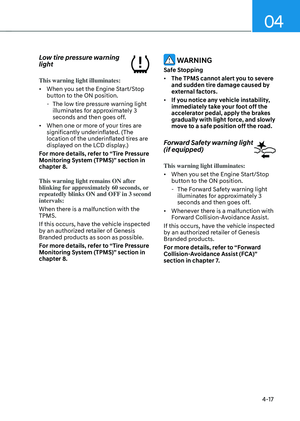
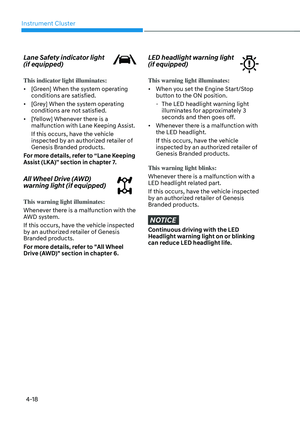
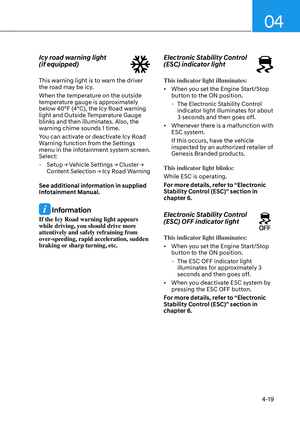
the ‘Check Rear Cross-Traffic Safety
system’ warning message will appear on
the cluster for several seconds, and the
master (
) warning light will illuminate
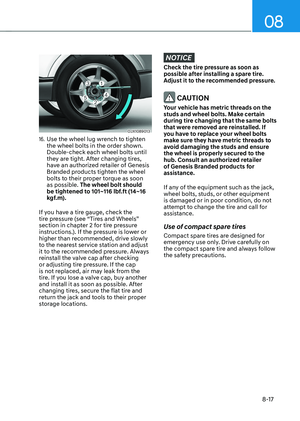
on the cluster. If this occur, have the
vehicle inspected by an authorized
retailer of Genesis Branded products.
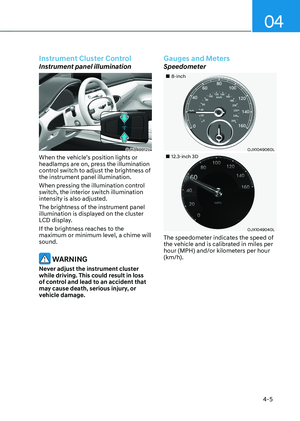
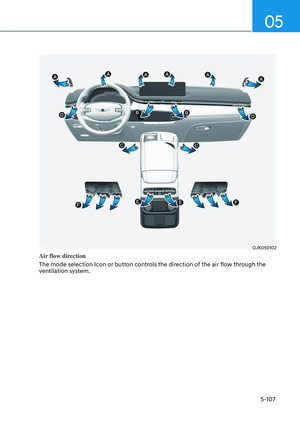
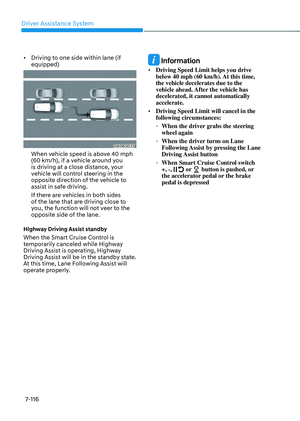
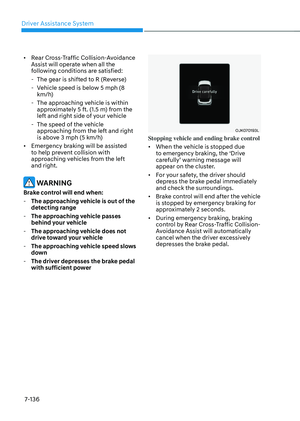
OTM070100NOTM070100N
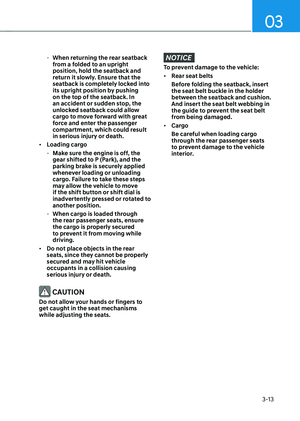
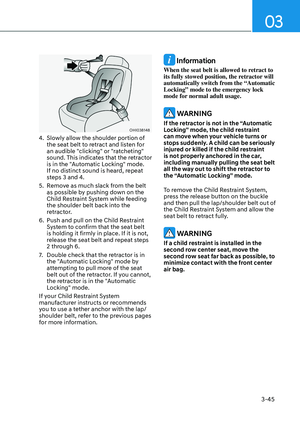
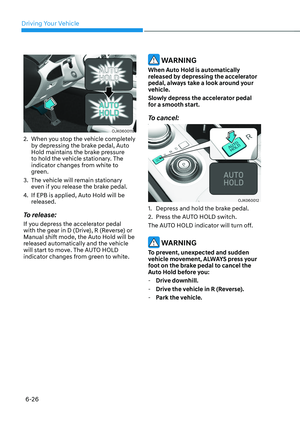
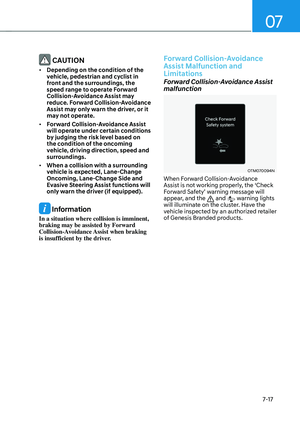
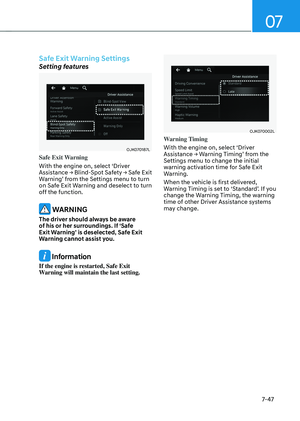
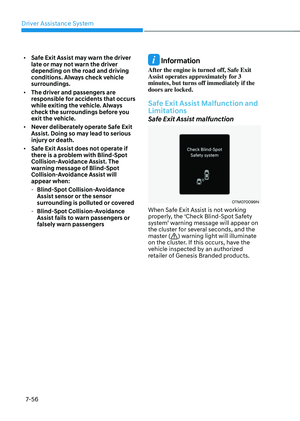
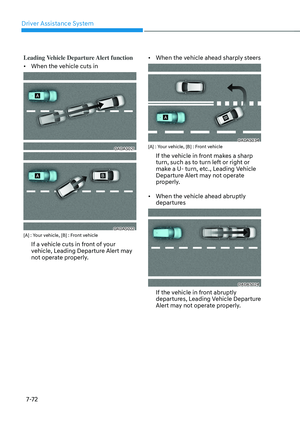
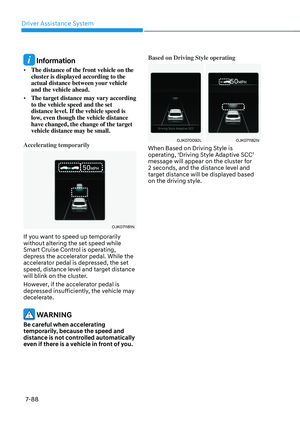
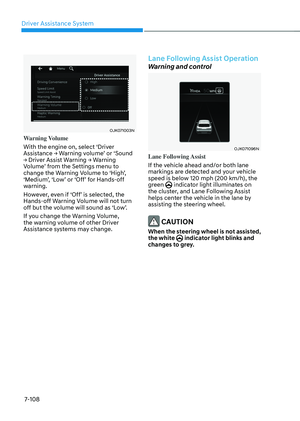
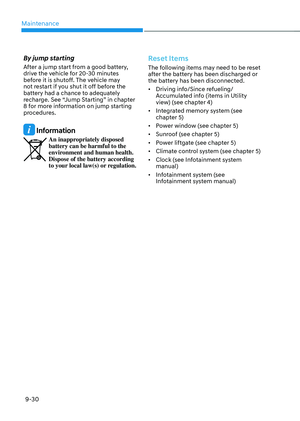
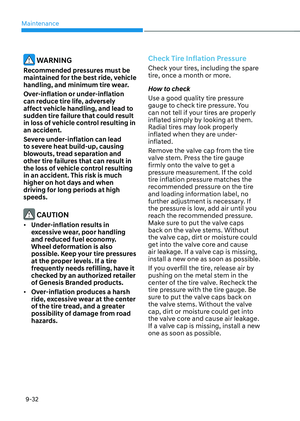
When the side view mirror warning
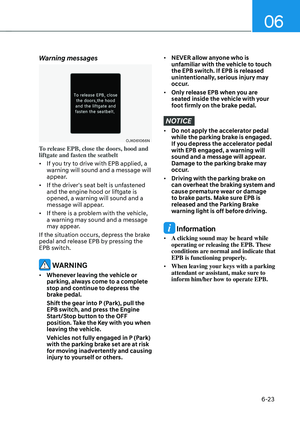
light is not working properly, the ‘Check
side view mirror warning light’ warning
message will appear on the cluster
for several seconds, and the master
(
) warning light will illuminate on the
cluster. If this occur, have the vehicle
inspected by an authorized retailer of
Genesis Branded products.
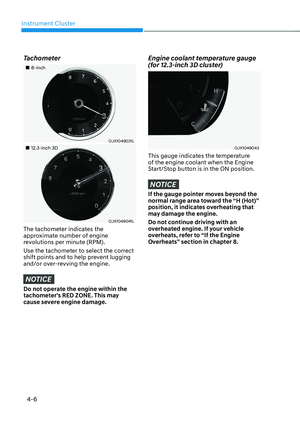
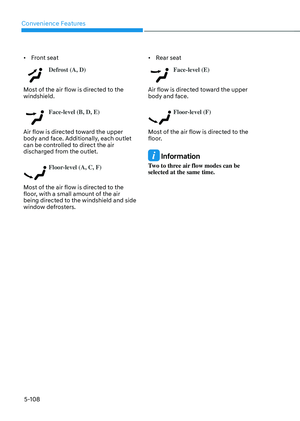
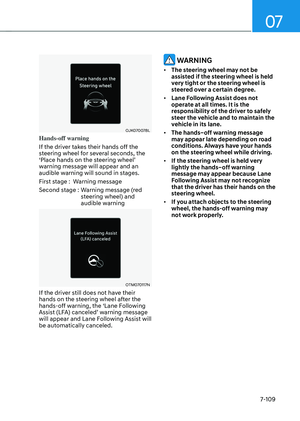
Rear Cross-Traffic Collision-
Avoidance Assist disabled
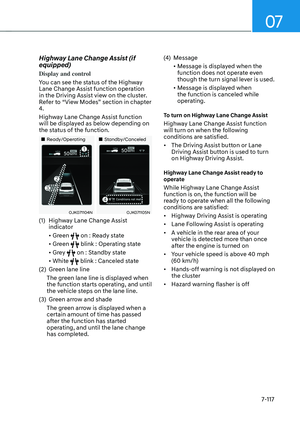
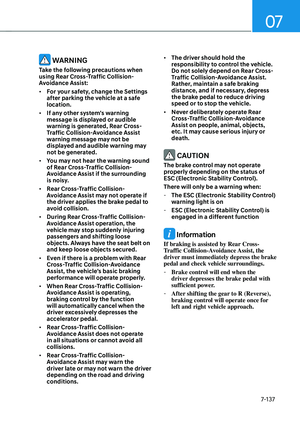
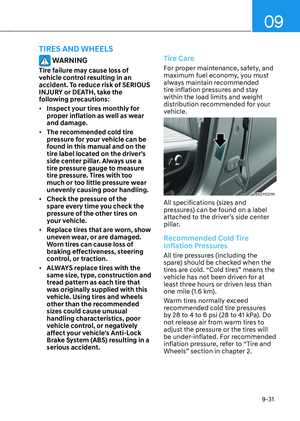
OTM070124NOTM070124N
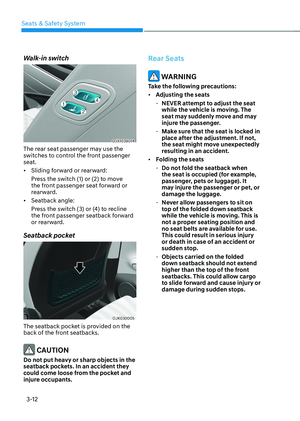
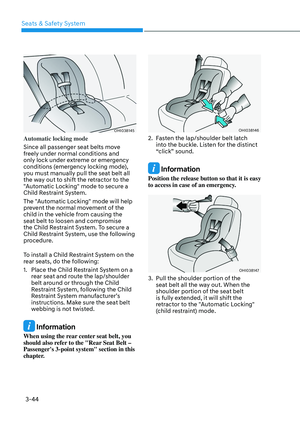
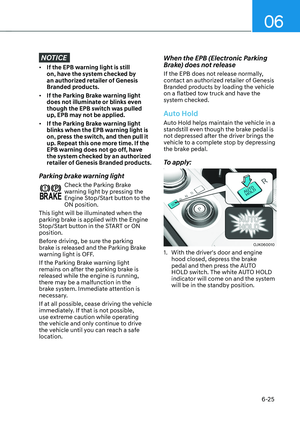
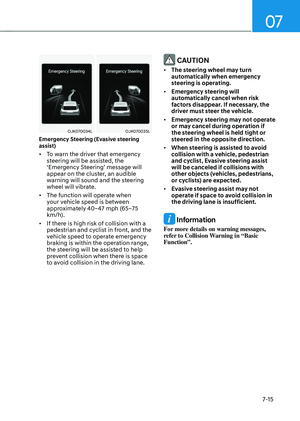
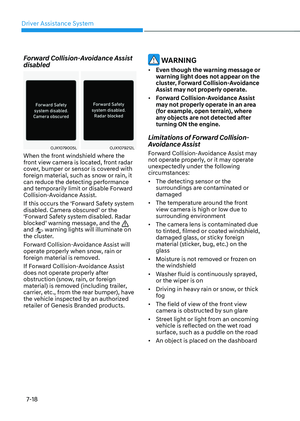
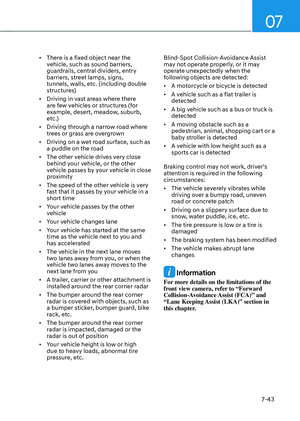
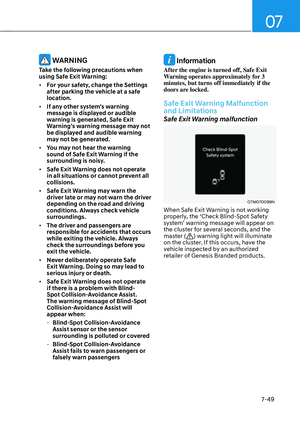
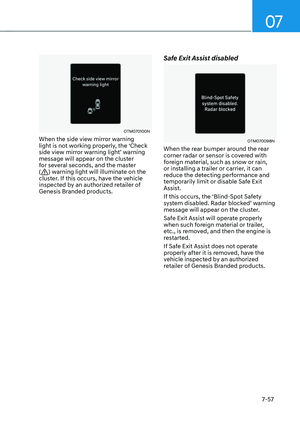
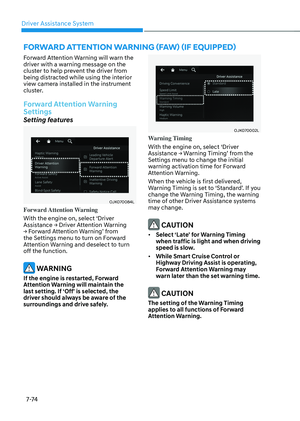
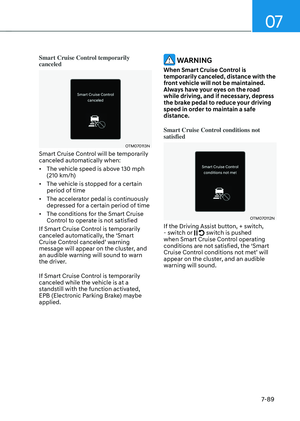
When the rear bumper around the rear-
side radar or sensor is covered with
foreign material, such as snow or rain,
or installing a trailer or carrier, it can
reduce the detecting performance and
temporarily limit or disable Rear Cross-
Traffic Collision-Avoidance Assist.
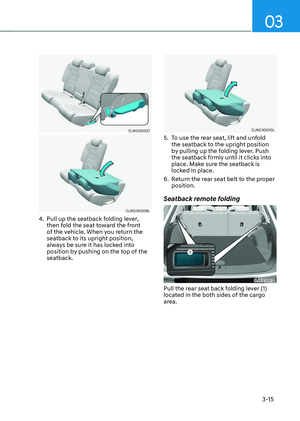
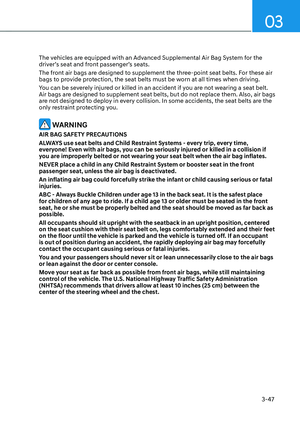
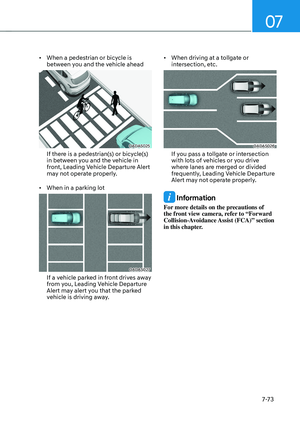
If this occurs, the ‘Rear Cross-Traffic
Safety system disabled. Radar blocked’
warning message will appear on the
cluster.
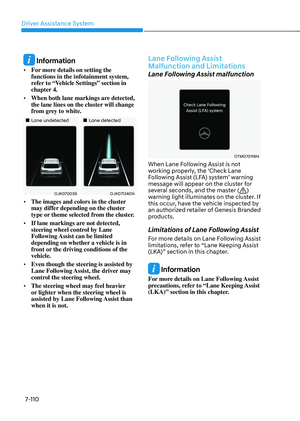
Rear Cross-Traffic Collision-Avoidance
Assist will operate properly when
such foreign material or trailer, etc., is
removed.
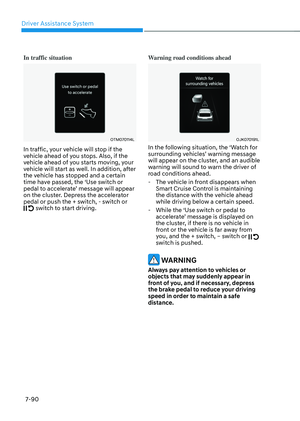
If Rear Cross-Traffic Collision-Avoidance
Assist does not operate properly after it
is removed, have the vehicle inspected
by an authorized retailer of Genesis
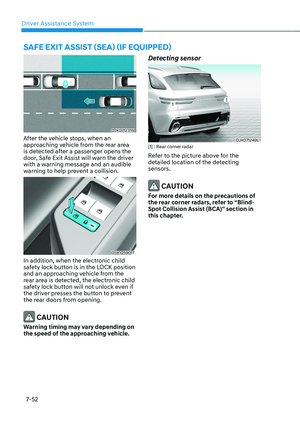
Branded products.
Page 490 of 637

07
7-139
WARNING
• Even though the warning message
does not appear on the cluster, Rear
Cross-Traffic Collision-Avoidance
Assist may not operate properly.
• Rear Cross-Traffic Collision-
Avoidance Assist may not operate
properly in an area (for example,
open terrain), where any objects are
not detected after turning ON the
engine.
CAUTION
Turn off Rear Cross-Traffic Collision-
Avoidance Assist to install or remove a
trailer, carrier, or another attachment.
Turn on Rear Cross-Traffic Collision-
Avoidance Assist when finished.
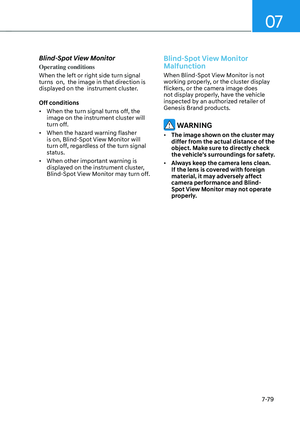
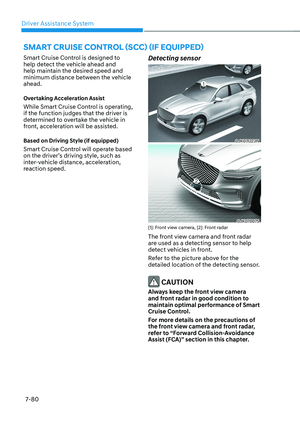
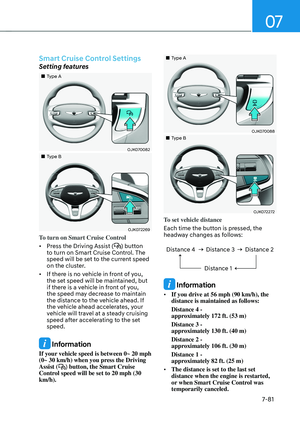
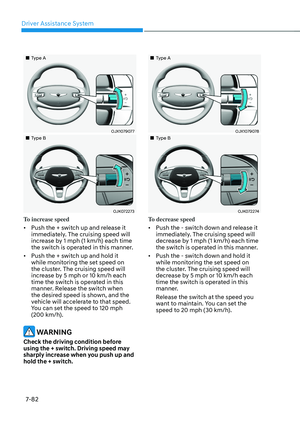
Limitations of Rear Cross-Traffic
Collision-Avoidance Assist
Rear Cross-Traffic Collision-Avoidance
Assist may not operate properly, or it
may operate unexpectedly under the
following circumstances:
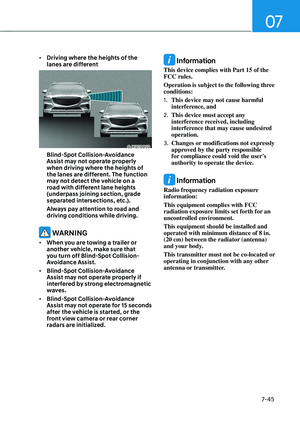
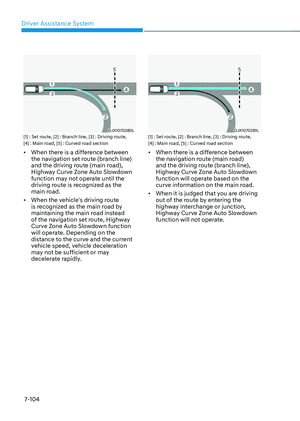
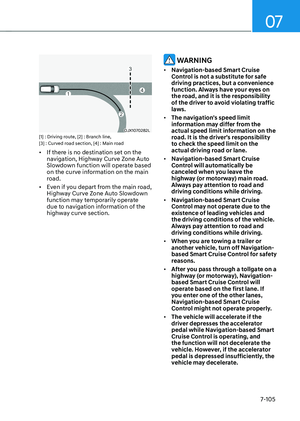
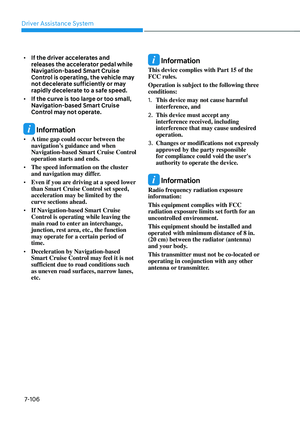
• Departing from where trees or grass
are overgrown
• Departing from where roads are wet
• Speed of the approaching vehicle is
fast or slow
Braking control may not work, driver’s
attention is required in the following
circumstances:
• The vehicle severely vibrates while
driving over a bumpy road, uneven
road or concrete patch
• Driving on a slippery surface due to
snow, water puddle, ice, etc.
• The tire pressure is low or a tire is
damaged
• The braking system has been modified
• Remote Smart Parking Assist is
operating (if equipped)
Information
For more details on the limitations of the
rear corner radar, refer to “Blind-Spot
Collision-Avoidance Assist (BCA)” section
in this chapter.
WARNING
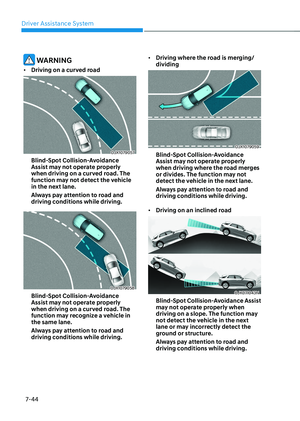
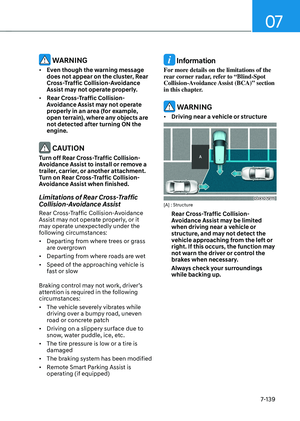
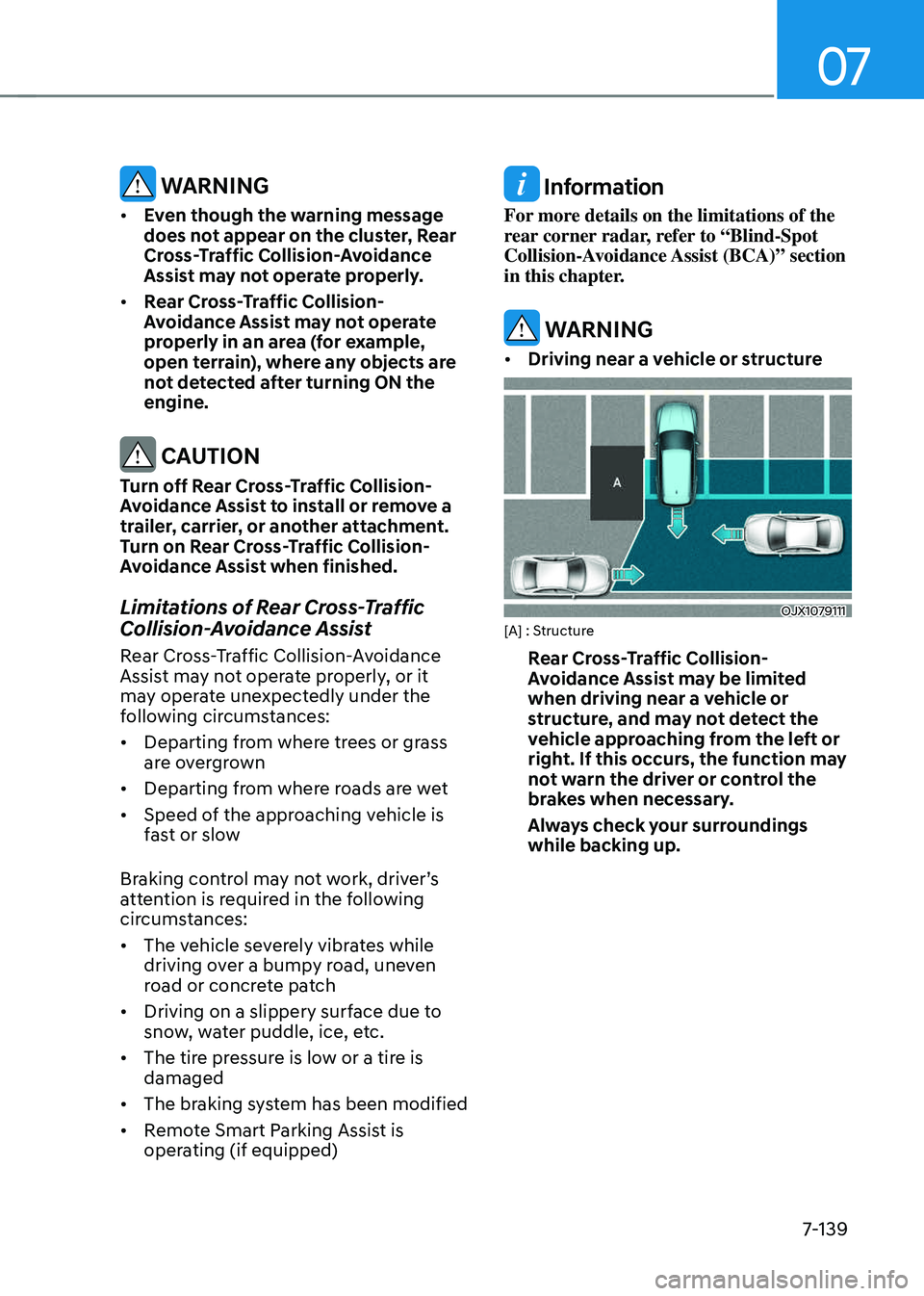
• Driving near a vehicle or structure
OJX1079111OJX1079111[A] : Structure
Rear Cross-Traffic Collision-
Avoidance Assist may be limited
when driving near a vehicle or
structure, and may not detect the
vehicle approaching from the left or
right. If this occurs, the function may
not warn the driver or control the
brakes when necessary.
Always check your surroundings
while backing up.
Page 491 of 637
Driver Assistance System
7-140
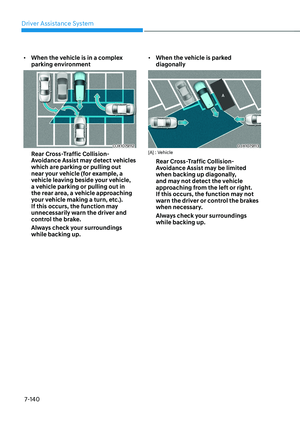
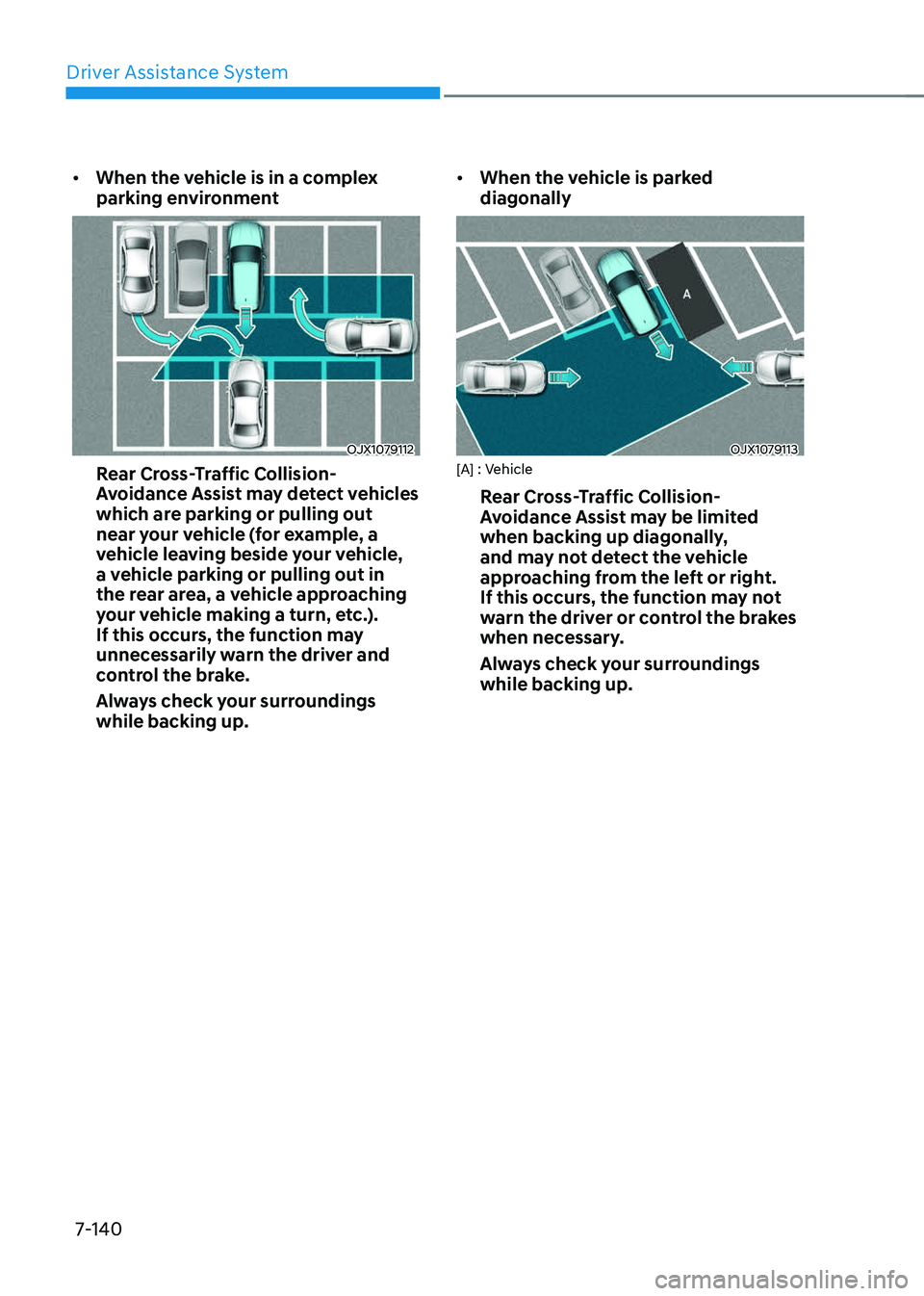
• When the vehicle is in a complex
parking environment
OJX1079112OJX1079112
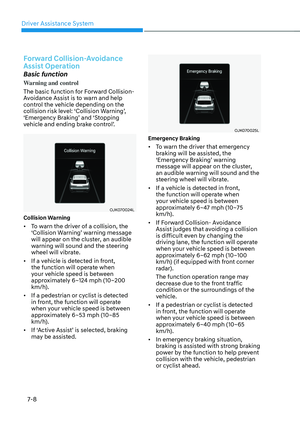
Rear Cross-Traffic Collision-
Avoidance Assist may detect vehicles
which are parking or pulling out
near your vehicle (for example, a
vehicle leaving beside your vehicle,
a vehicle parking or pulling out in
the rear area, a vehicle approaching
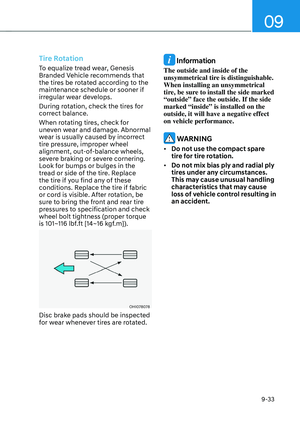
your vehicle making a turn, etc.).
If this occurs, the function may
unnecessarily warn the driver and
control the brake.
Always check your surroundings
while backing up.
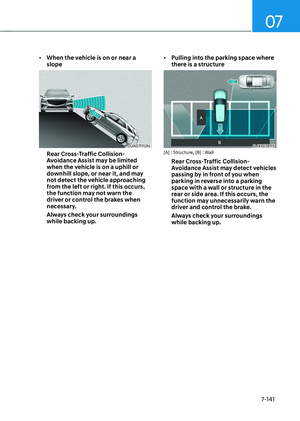
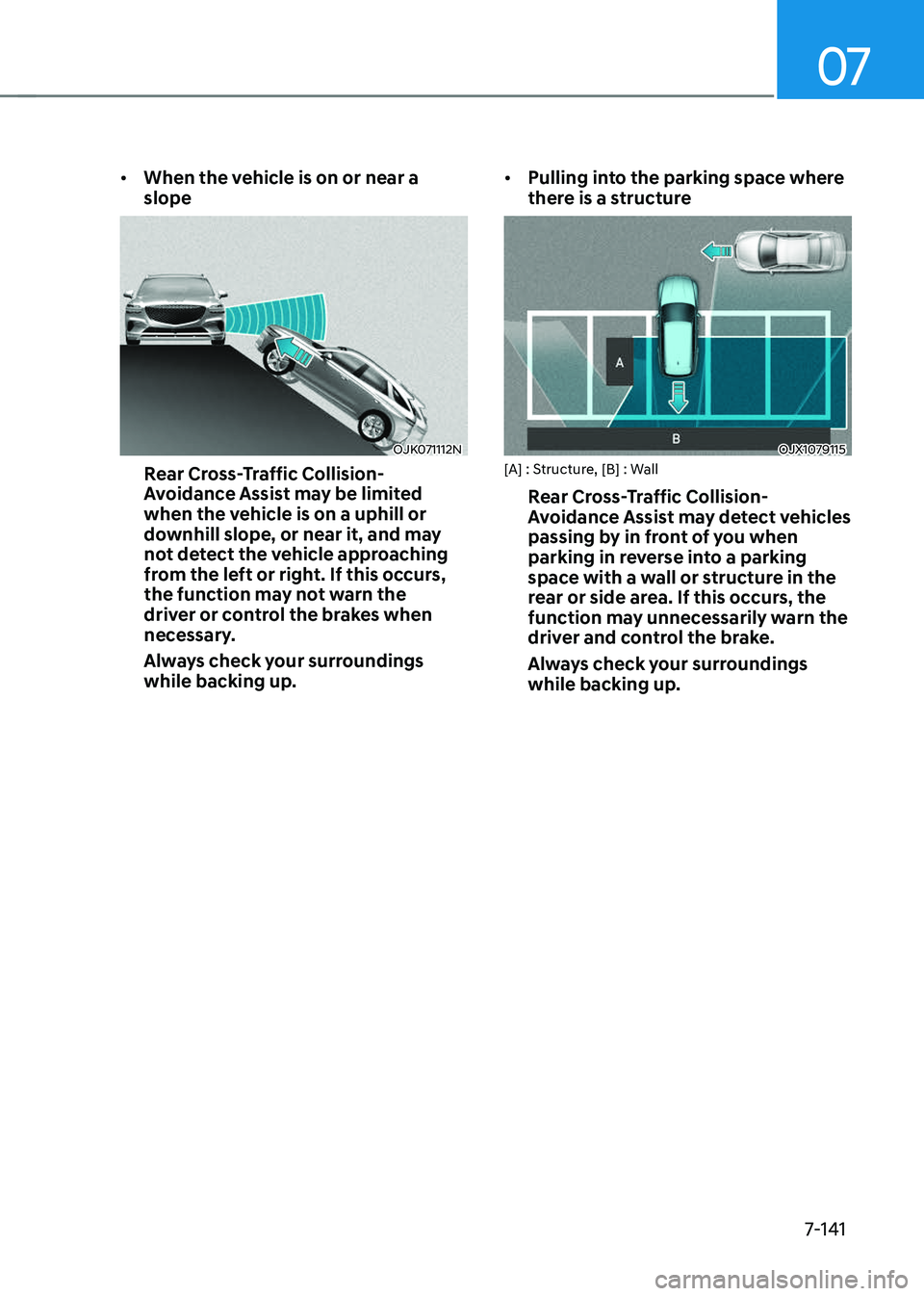
• When the vehicle is parked
diagonally
OJX1079113OJX1079113[A] : Vehicle
Rear Cross-Traffic Collision-
Avoidance Assist may be limited
when backing up diagonally,
and may not detect the vehicle
approaching from the left or right.
If this occurs, the function may not
warn the driver or control the brakes
when necessary.
Always check your surroundings
while backing up.
Page 492 of 637
07
7-141
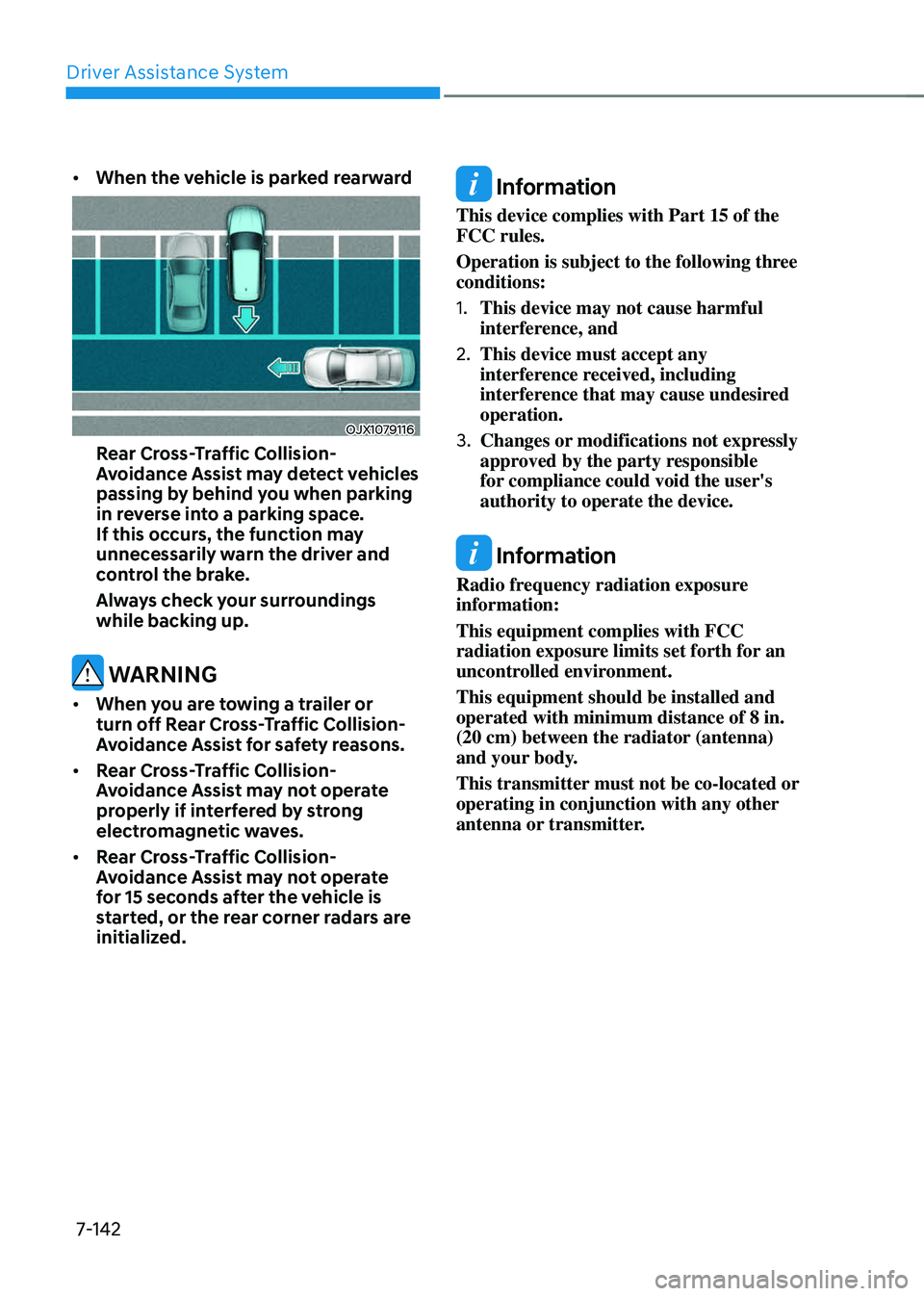
• When the vehicle is on or near a
slope
OJK071112NOJK071112N
Rear Cross-Traffic Collision-
Avoidance Assist may be limited
when the vehicle is on a uphill or
downhill slope, or near it, and may
not detect the vehicle approaching
from the left or right. If this occurs,
the function may not warn the
driver or control the brakes when
necessary.
Always check your surroundings
while backing up.
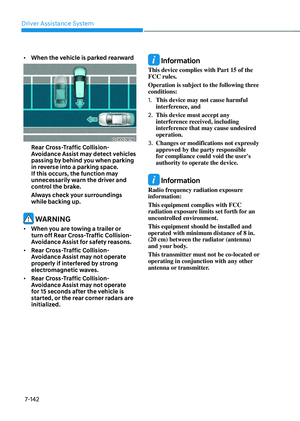
• Pulling into the parking space where
there is a structure
OJX1079115OJX1079115[A] : Structure, [B] : Wall
Rear Cross-Traffic Collision-
Avoidance Assist may detect vehicles
passing by in front of you when
parking in reverse into a parking
space with a wall or structure in the
rear or side area. If this occurs, the
function may unnecessarily warn the
driver and control the brake.
Always check your surroundings
while backing up.
Page 493 of 637

Driver Assistance System
7-142
• When the vehicle is parked rearward
OJX1079116OJX1079116
Rear Cross-Traffic Collision-
Avoidance Assist may detect vehicles
passing by behind you when parking
in reverse into a parking space.
If this occurs, the function may
unnecessarily warn the driver and
control the brake.
Always check your surroundings
while backing up.
WARNING
• When you are towing a trailer or
turn off Rear Cross-Traffic Collision-
Avoidance Assist for safety reasons.
• Rear Cross-Traffic Collision-
Avoidance Assist may not operate
properly if interfered by strong
electromagnetic waves.
• Rear Cross-Traffic Collision-
Avoidance Assist may not operate
for 15 seconds after the vehicle is
started, or the rear corner radars are
initialized.
Information
This device complies with Part 15 of the
FCC rules.
Operation is subject to the following three
conditions:
1. This device may not cause harmful
interference, and
2. This device must accept any
interference received, including
interference that may cause undesired
operation.
3. Changes or modifications not expressly
approved by the party responsible
for compliance could void the user's
authority to operate the device.
Information
Radio frequency radiation exposure
information:
This equipment complies with FCC
radiation exposure limits set forth for an
uncontrolled environment.
This equipment should be installed and
operated with minimum distance of 8 in.
(20 cm) between the radiator (antenna)
and your body.
This transmitter must not be co-located or
operating in conjunction with any other
antenna or transmitter.
Page 494 of 637
07
7-143
Reverse Parking Distance Warning can
help warn the driver if an obstacle is
detected within a certain distance when
the vehicle is moving in reverse at low
speeds.
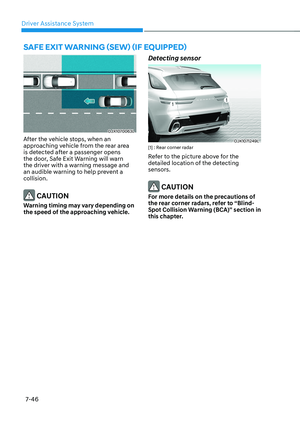
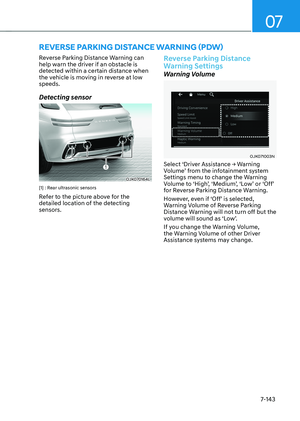
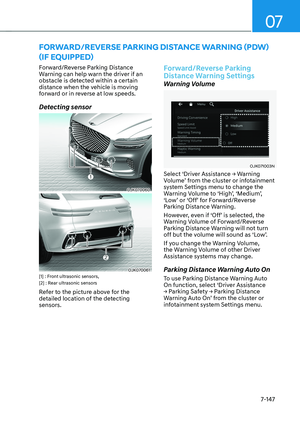
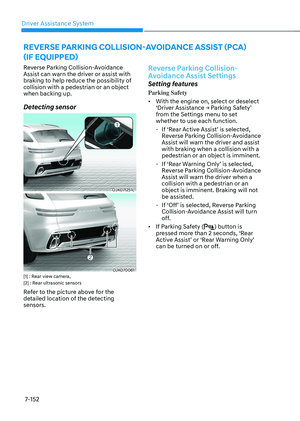
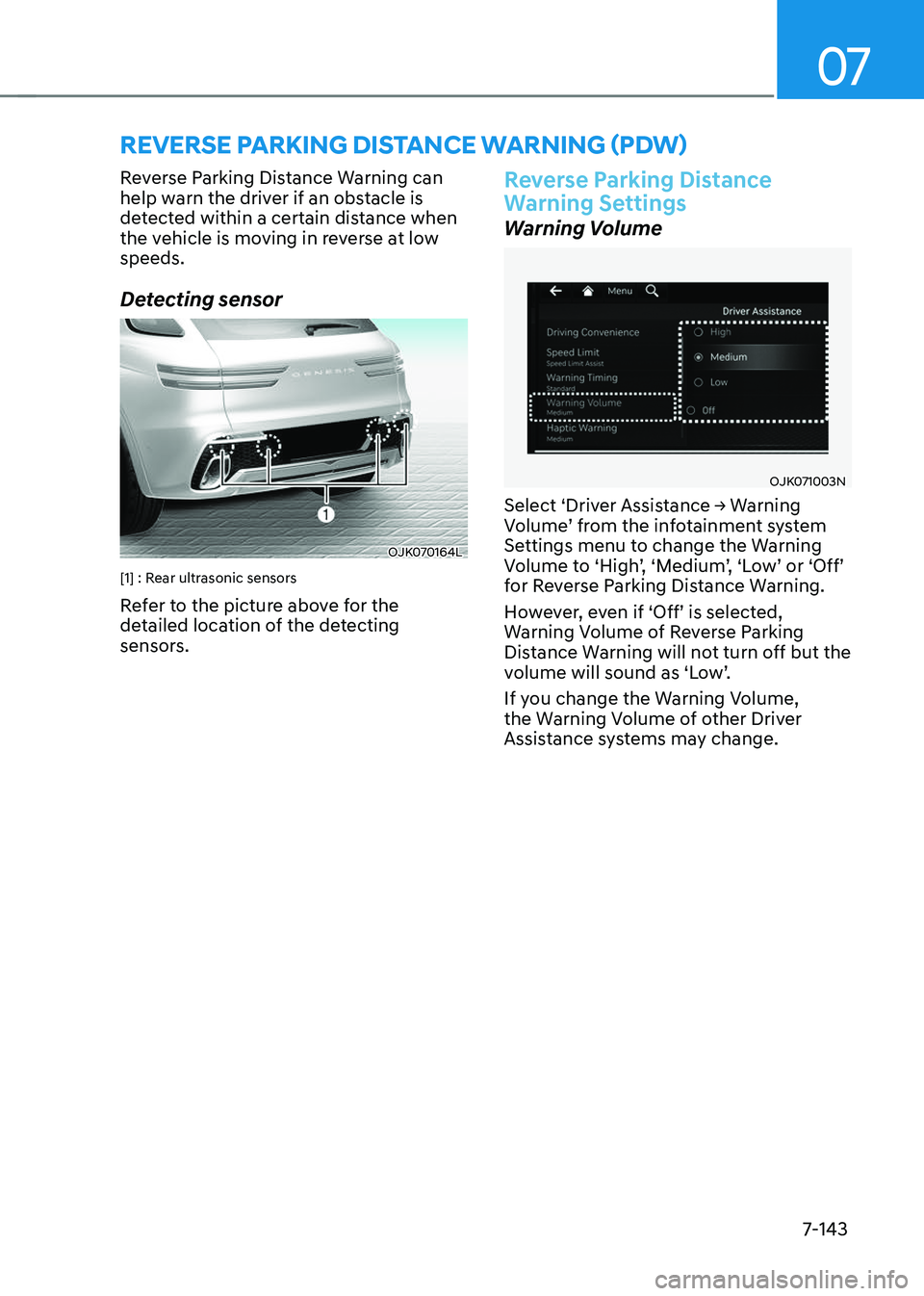
Detecting sensor
OJK070164LOJK070164L
[1] : Rear ultrasonic sensors
Refer to the picture above for the
detailed location of the detecting
sensors.
Reverse Parking Distance
Warning Settings
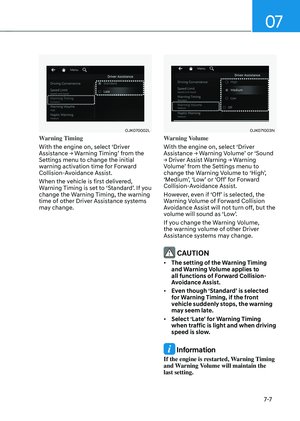
Warning Volume
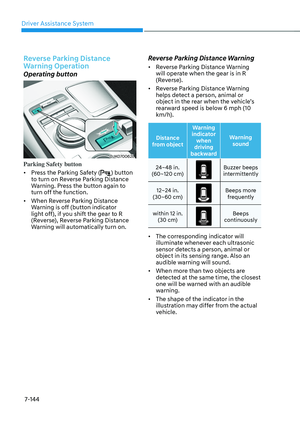
OJK071003NOJK071003N
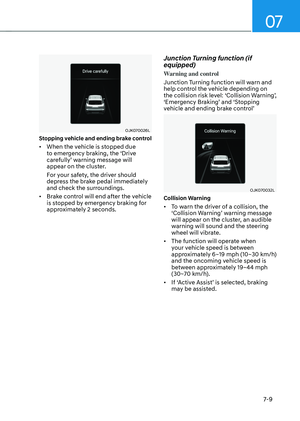
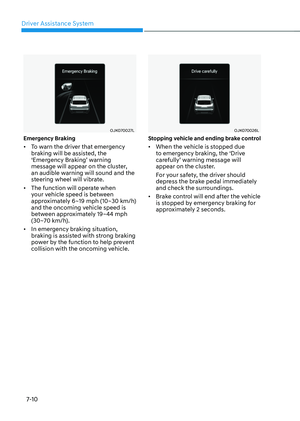
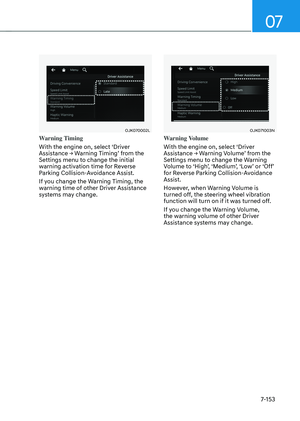
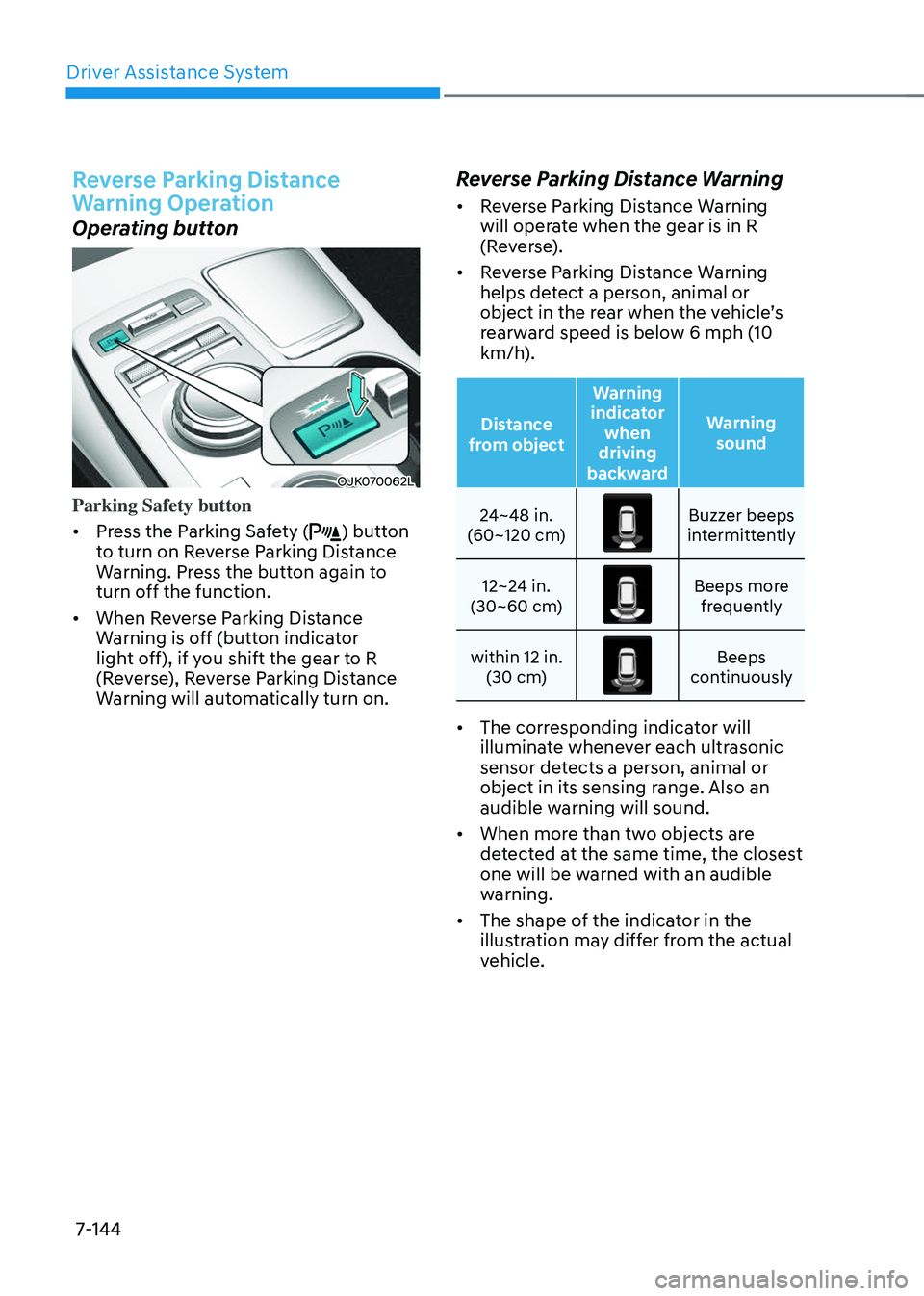
Select ‘Driver Assistance → Warning
Volume’ from the infotainment system
Settings menu to change the Warning
Volume to ‘High’, ‘Medium’, ‘Low’ or ‘Off’
for Reverse Parking Distance Warning.
However, even if ‘Off’ is selected,
Warning Volume of Reverse Parking
Distance Warning will not turn off but the
volume will sound as ‘Low’.
If you change the Warning Volume,
the Warning Volume of other Driver
Assistance systems may change.
REVERSE PARKING DISTANCE WARNING (PDW)
Page 495 of 637

Driver Assistance System
7-144
Reverse Parking Distance
Warning Operation
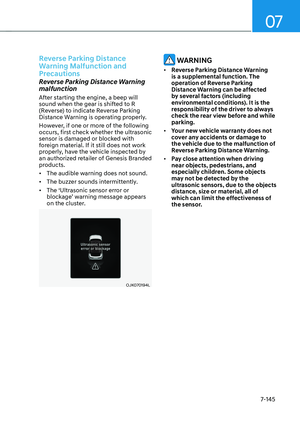
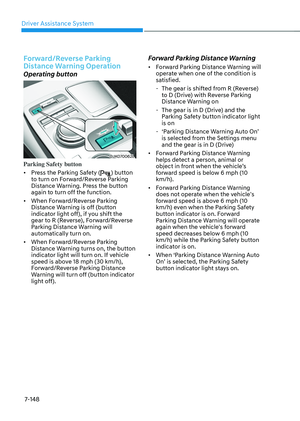
Operating button
OJK070062LOJK070062L
Parking Safety button
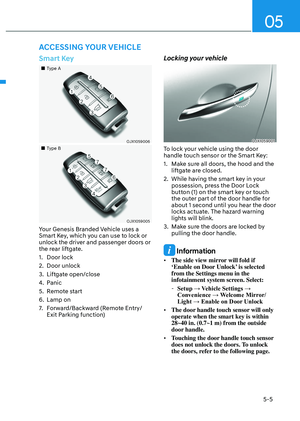
• Press the Parking Safety () button
to turn on Reverse Parking Distance
Warning. Press the button again to
turn off the function.
• When Reverse Parking Distance
Warning is off (button indicator
light off), if you shift the gear to R
(Reverse), Reverse Parking Distance
Warning will automatically turn on.
Reverse Parking Distance Warning
• Reverse Parking Distance Warning
will operate when the gear is in R
(Reverse).
• Reverse Parking Distance Warning
helps detect a person, animal or
object in the rear when the vehicle’s
rearward speed is below 6 mph (10
km/h).
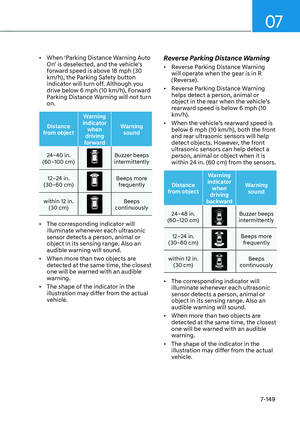
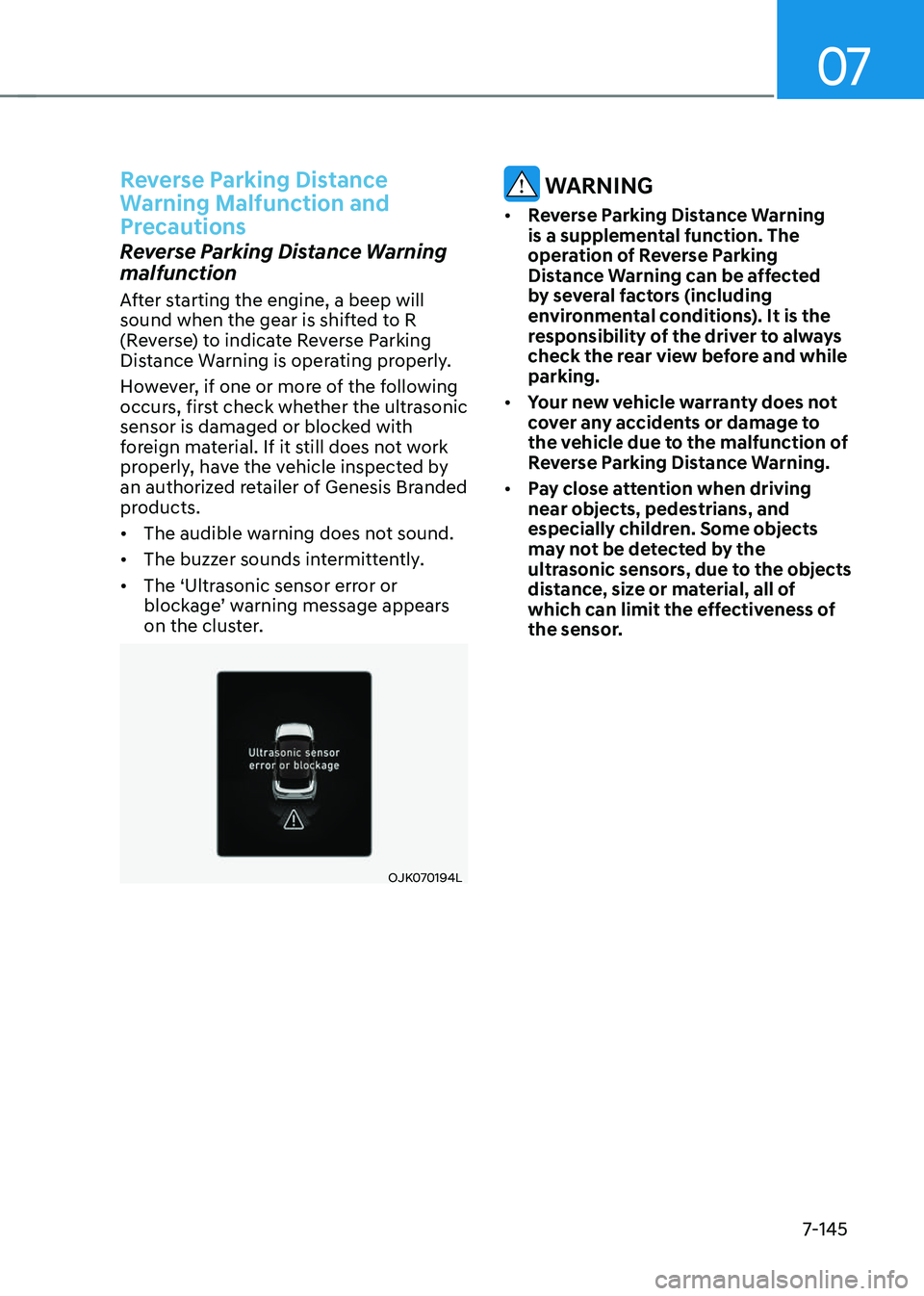
Distance
from object Warning
indicator when
driving
backward Warning
sound
24~48 in.
(60~120 cm)
Buzzer beeps intermittently
12~24 in.
(30~60 cm)
Beeps more frequently
within 12 in. (30 cm)
Beeps continuously
• The corresponding indicator will
illuminate whenever each ultrasonic
sensor detects a person, animal or
object in its sensing range. Also an
audible warning will sound.
• When more than two objects are
detected at the same time, the closest
one will be warned with an audible
warning.
• The shape of the indicator in the
illustration may differ from the actual
vehicle.
Page 496 of 637

07
7-145
Reverse Parking Distance
Warning Malfunction and
Precautions
Reverse Parking Distance Warning
malfunction
After starting the engine, a beep will
sound when the gear is shifted to R
(Reverse) to indicate Reverse Parking
Distance Warning is operating properly.
However, if one or more of the following
occurs, first check whether the ultrasonic
sensor is damaged or blocked with
foreign material. If it still does not work
properly, have the vehicle inspected by
an authorized retailer of Genesis Branded
products.
• The audible warning does not sound.
• The buzzer sounds intermittently.
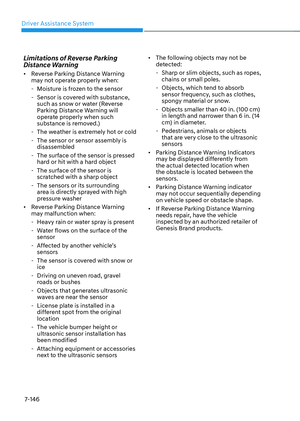
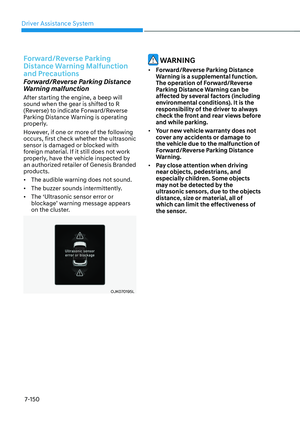
• The ‘Ultrasonic sensor error or
blockage’ warning message appears
on the cluster.
OJK070194LOJK070194L
WARNING
• Reverse Parking Distance Warning
is a supplemental function. The
operation of Reverse Parking
Distance Warning can be affected
by several factors (including
environmental conditions). It is the
responsibility of the driver to always
check the rear view before and while
parking.
• Your new vehicle warranty does not
cover any accidents or damage to
the vehicle due to the malfunction of
Reverse Parking Distance Warning.
• Pay close attention when driving
near objects, pedestrians, and
especially children. Some objects
may not be detected by the
ultrasonic sensors, due to the objects
distance, size or material, all of
which can limit the effectiveness of
the sensor.