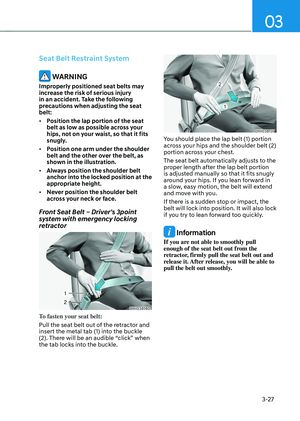
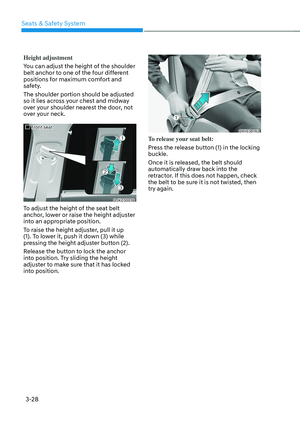
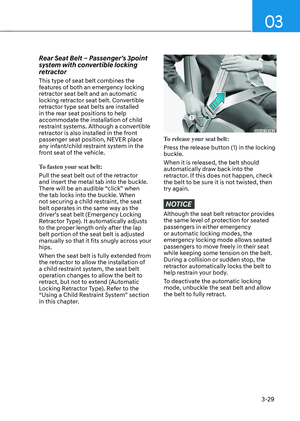
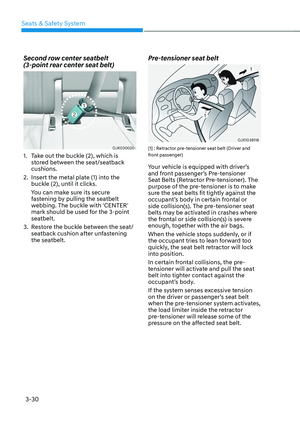
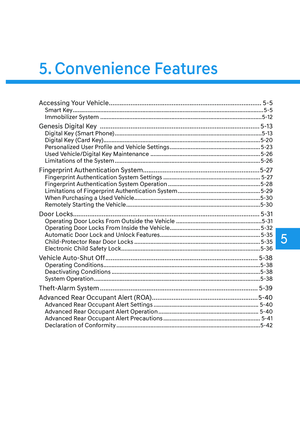
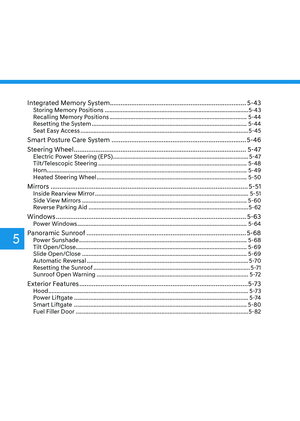
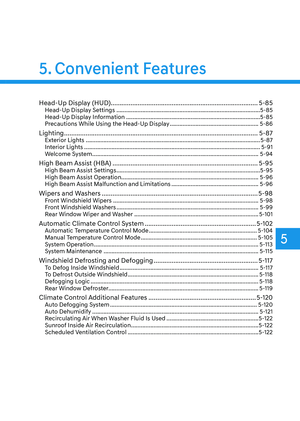
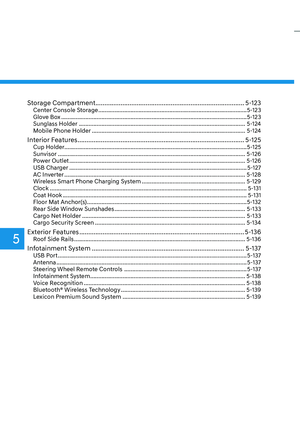
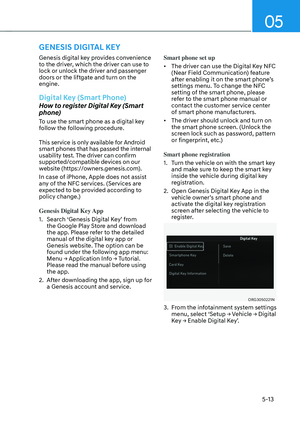
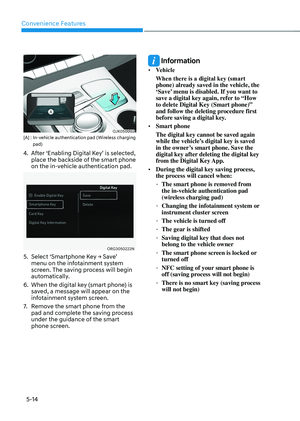
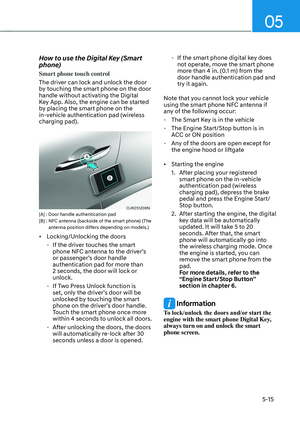
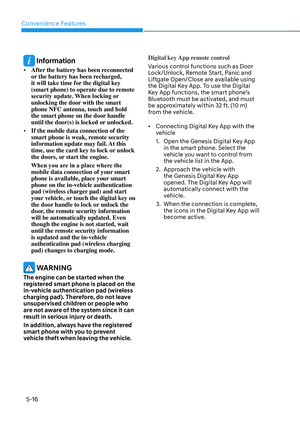
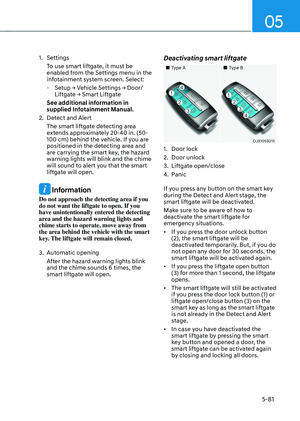
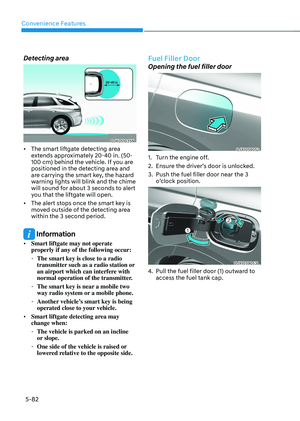
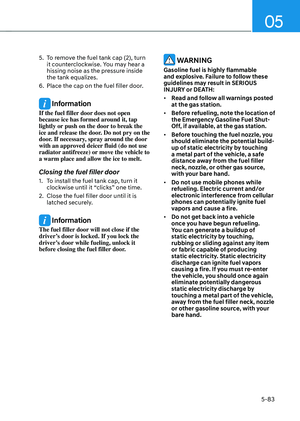
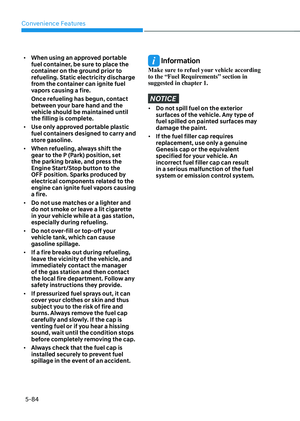
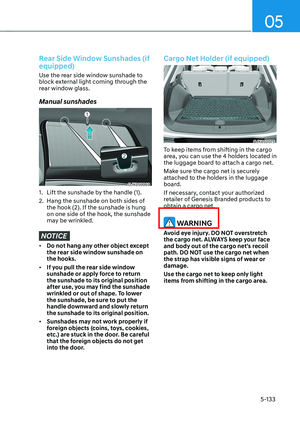
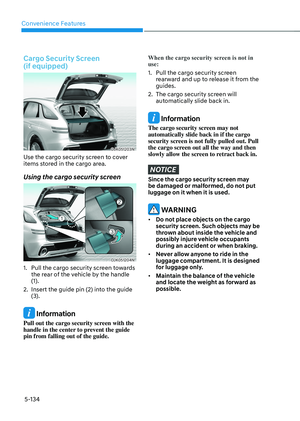
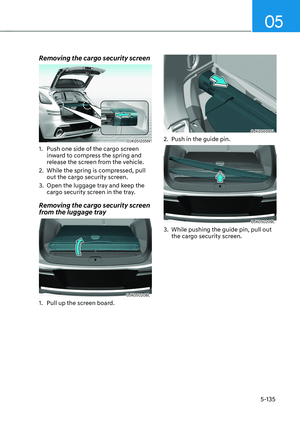
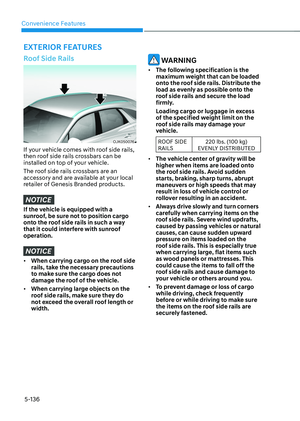
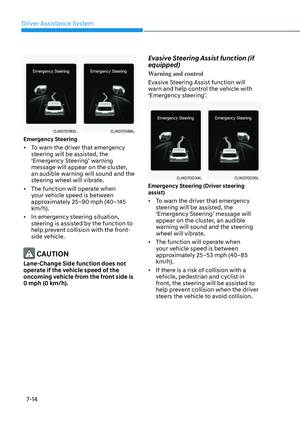
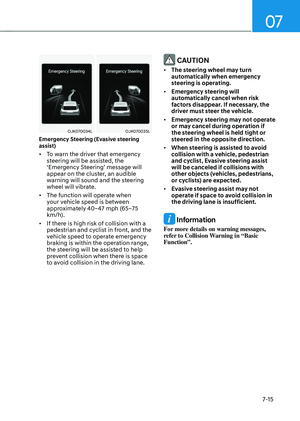
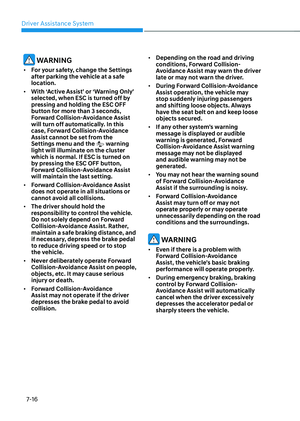
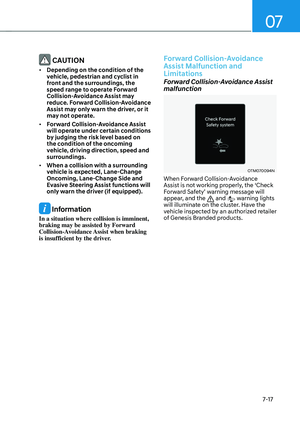
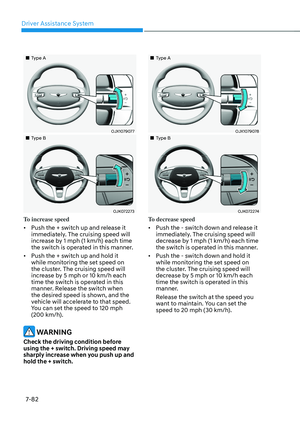
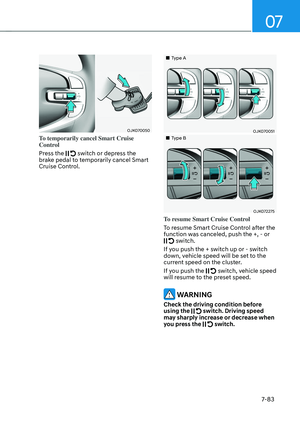
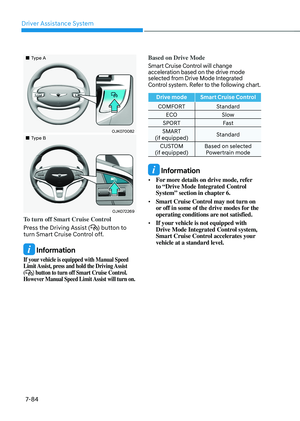
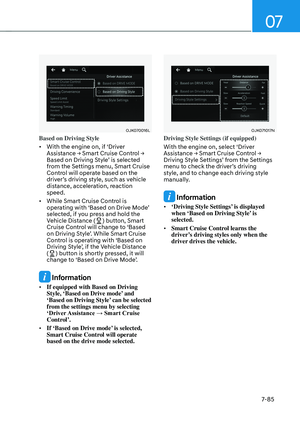
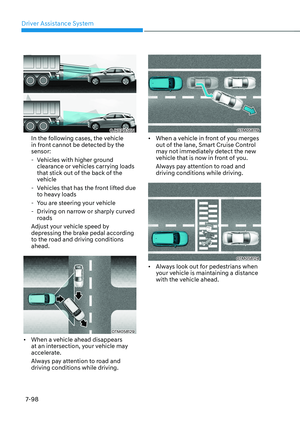
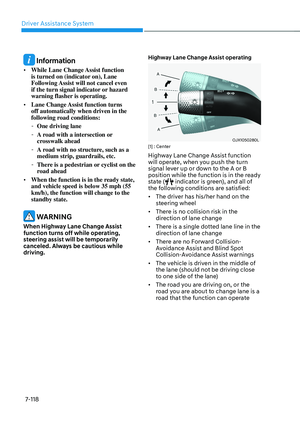
Page 9 of 637

Introduction
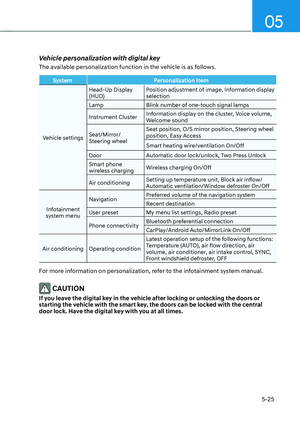
1-4
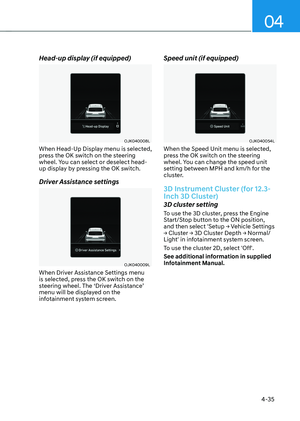
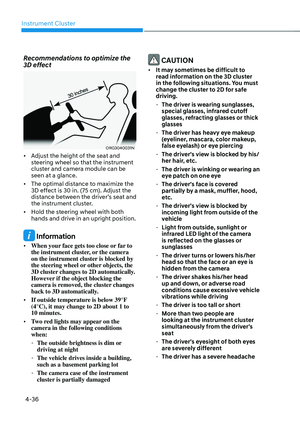
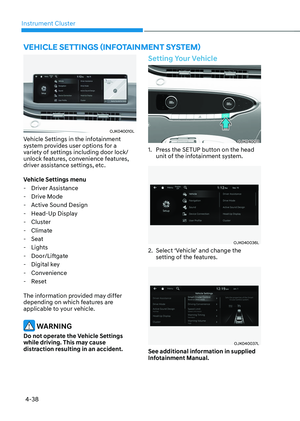
We want to help you get the greatest possible driving pleasure from your vehicle. Your
Owner’s Manual can assist you in many ways. To gain an overview of the contents
of your Owner’s Manual, use the Table of Contents in the front of the manual. The
first page of each Chapter includes a detailed Table of Contents of the topics in that
Chapter.
To quickly locate information about your vehicle, use the Index in the back of the
manual. It is an alphabetical list of what is in this manual and the page number where it
can be found.
For your convenience, we have incorporated tabs on the right-hand page edges.
These tabs are coded with the Chapter titles to assist you with navigating through the
manual.
SAFETY MESSAGES
Your safety, and the safety of others, is very important. This Owner’s Manual provides
you with many safety precautions and operating procedures. This information alerts
you to potential hazards that may hurt you or others, as well as damage to your vehicle.
Safety messages found on vehicle labels and in this manual describe these hazards
and what to do to avoid or reduce the risks.
Warnings and instructions contained in this manual are for your safety. Failure to follow
safety warnings and instructions can lead to serious injury or death.
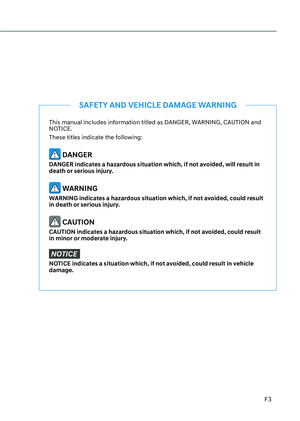
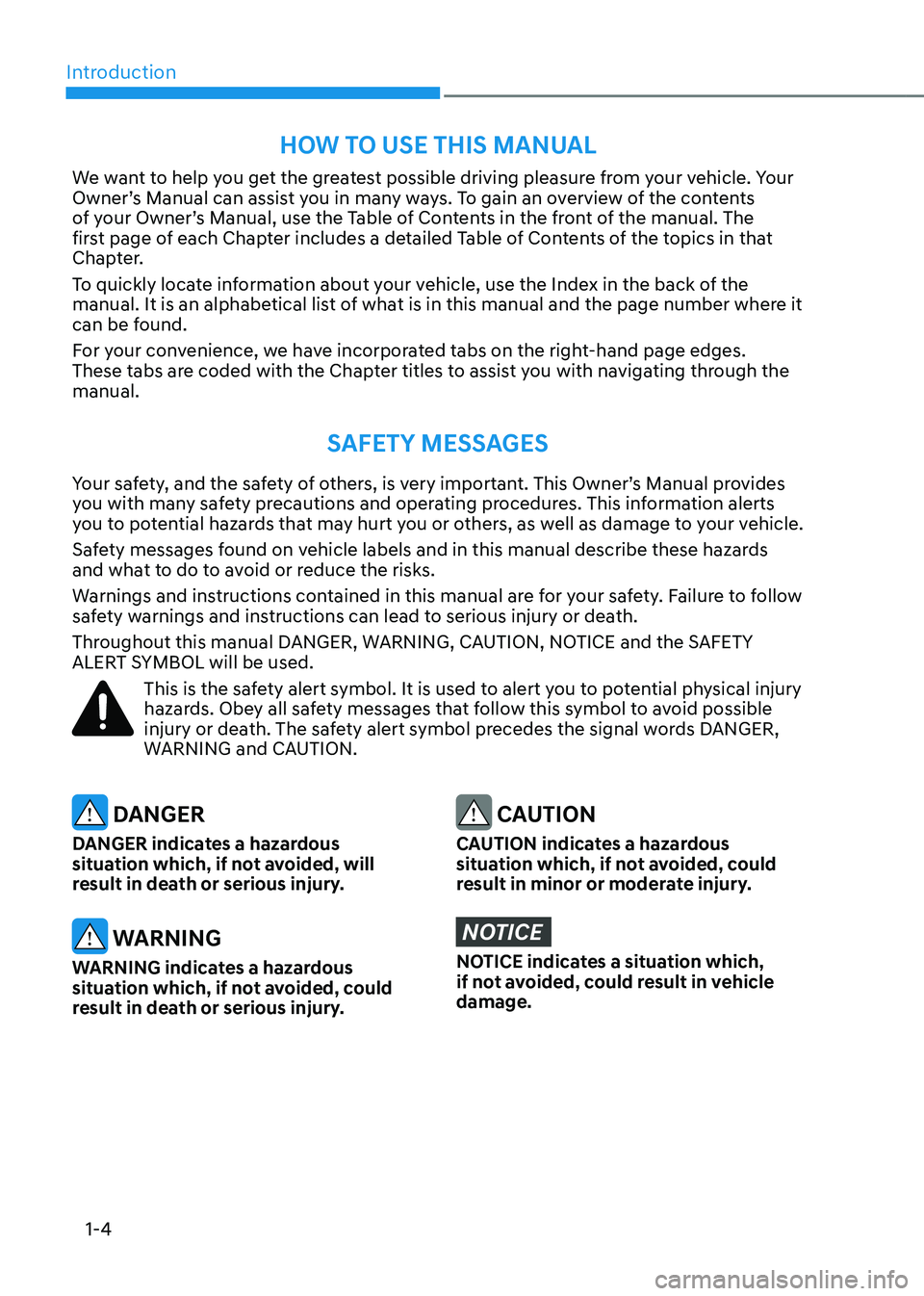
Throughout this manual DANGER, WARNING, CAUTION, NOTICE and the SAFETY
ALERT SYMBOL will be used.
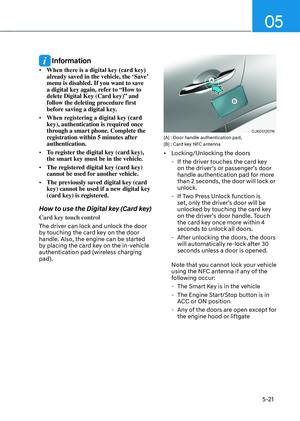
This is the safety alert symbol. It is used to alert you to potential physical injury hazards. Obey all safety messages that follow this symbol to avoid possible
injury or death. The safety alert symbol precedes the signal words DANGER,
WARNING and CAUTION.
DANGER
DANGER indicates a hazardous
situation which, if not avoided, will
result in death or serious injury.
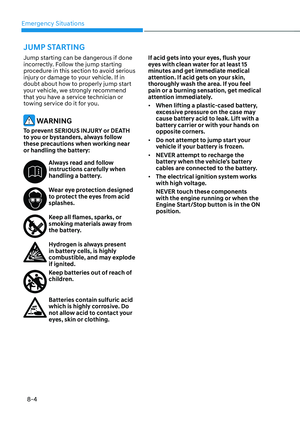
WARNING
WARNING indicates a hazardous
situation which, if not avoided, could
result in death or serious injury.
CAUTION
CAUTION indicates a hazardous
situation which, if not avoided, could
result in minor or moderate injury.
NOTICE
NOTICE indicates a situation which,
if not avoided, could result in vehicle
damage.
HOW TO USE THIS MANUAL
Page 10 of 637

01
1-5
Your new vehicle is designed to obtain maximum performance with UNLEADED FUEL,
as well as minimize exhaust emissions and spark plug fouling.
For the optimal vehicle performance, we recommend you use unleaded gasoline which
has an octane number ((R+M)/2) of 91 (Research Octane Number 95) or higher.
NOTICE
Using unleaded gasoline that is lower than octane number ((R+M)/2) of 91
(Research Octane Number 95) could result in loss of engine power and increase fuel
consumption.
NOTICE
To prevent damage to the engine and engine components, never add any fuel
system cleaning agents to the fuel tank other than what has been specified.
Consult an authorized retailer of Genesis Branded products for additional
information.
WARNING
• Do not “top off” after the nozzle automatically shuts off when refueling.
• Always check that the fuel cap is installed securely to prevent fuel spillage in the
event of an accident.
Gasoline containing alcohol and methanol
Gasohol, a mixture of gasoline and ethanol (also known as grain alcohol) are being
marketed along with or instead of leaded or unleaded gasoline. For example, “E15” is
a gasohol comprised of 15% ethanol and 85% gasoline. Do not use gasohol containing
more than 15% ethanol, and do not use gasoline or gasohol containing any methanol.
Either of these fuels may cause drivability problems and damage to the fuel system,
engine control system and emission control system.
Discontinue using gasohol of any kind if drivability problems occur. “E85” fuel is
an alternative fuel comprised of 85 percent ethanol and 15 percent gasoline, and is
manufactured exclusively for use in Flexible Fuel Vehicles. “E85” is not compatible
with your vehicle. Use of “E85” may result in poor engine performance and damage
to your vehicle’s engine and fuel system. Genesis Branded Vehicle recommends that
customers do not use fuel with an ethanol content exceeding 15 percent.
NOTICE
To prevent damage to your vehicle’s engine and fuel system:
• Never use gasohol which contains methanol.
• Never use gasohol containing more than 15% ethanol.
• Never use leaded fuel or leaded gasohol.
• Never use “E85” fuel.
Your New Vehicle Limited Warranty does not cover damage to the fuel system or any
performance problems caused by the use of “E85” fuel.
FUEL REQUIREMENTS
Page 11 of 637

Introduction
1-6
Using Fuel Additives (except Detergent Fuel Additives)
Using fuel additives such as:
-Silicone fuel additive
-Ferrocene (iron-based) fuel additive
-Other metallic-based fuel additives
may result in cylinder misfire, poor acceleration, engine stalling, damage to the
catalyst, or abnormal corrosion, and may cause damage to the engine resulting in a
reduction in the overall life of the powertrain.
The Malfunction Indicator Lamp (MIL) may illuminate.
NOTICE
Damage to the fuel system or performance problem caused by the use of these fuels
or fuel additives may not be covered by your New Vehicle Limited Warranty.
Gasoline containing MMT
Some gasoline contains harmful manganese-based fuel additives such as MMT
(Methylcyclopentadienyl Manganese Tricarbonyl).
Genesis Branded Vehicle does not recommend the use of gasoline containing MMT.
This type of fuel can reduce vehicle performance and affect your emission control
system.
The malfunction indicator lamp on the cluster may come on.
Detergent Fuel Additives
Genesis Branded Vehicle recommends that you use good quality gasolines treated
with detergent additives such as TOP TIER Detergent Gasoline, which help prevent
deposit formation in the engine. These gasolines will help the engine run cleaner and
enhance performance of the Emission Control System. For more information on TOP
TIER Detergent Gasoline, please go to the website ( www.toptiergas.com).
For customers who do not use TOP Tier Detergent Gasoline regularly, and have
problems starting or the engine does not run smoothly, detergent-based fuel additives
that you can purchase separately may be added to the gasoline. If TOP TIER Detergent
Gasoline is not available, one bottle of additive added to the fuel tank at every 8,000
miles or 12 months is recommended.
Additives are available from your authorized retailer of Genesis Branded products
along with information on how to use them. Do not mix other additives.
Operation in foreign countries
If you are going to drive your vehicle in another country, be sure to:
• Observe all regulations regarding registration and insurance.
• Determine that acceptable fuel is available.
Page 12 of 637

01
1 -7
VEHICLE MODIFICATIONS
• This vehicle should not be modified. Modification of your vehicle could affect its
performance, safety or durability and may even violate governmental safety and
emissions regulations.
• In addition, damage or performance problems resulting from any modification may
not be covered under warranty.
• If you use unauthorized electronic devices, it may cause the vehicle to operate
abnormally, wire damage, battery discharge and fire. For your safety, do not use
unauthorized electronic devices.
NOTICE
Some warning sounds (including welcome/good-bye sound, etc.) are generated
from the interior speakers or amplifiers. If necessary, we recommend you to
purchase Genesis Part to replace an interior speaker or amplifier. Any unauthorized
product may cause a malfunction of the interior speakers or amplifiers.
VEHICLE BREAK-IN PROCESS
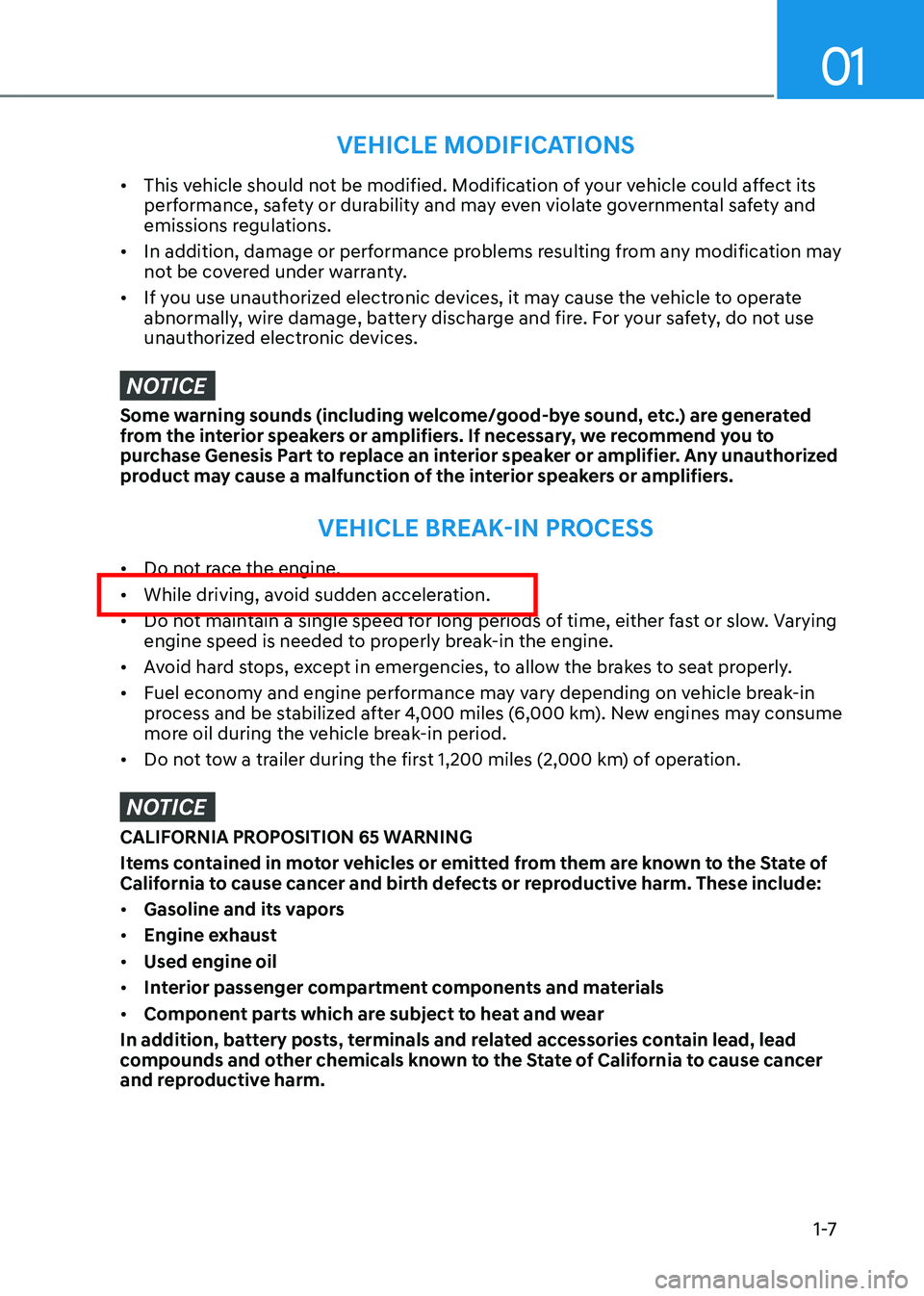
• Do not race the engine.
• While driving, avoid sudden acceleration.
• Do not maintain a single speed for long periods of time, either fast or slow. Varying
engine speed is needed to properly break-in the engine.
• Avoid hard stops, except in emergencies, to allow the brakes to seat properly.
• Fuel economy and engine performance may vary depending on vehicle break-in
process and be stabilized after 4,000 miles (6,000 km). New engines may consume
more oil during the vehicle break-in period.
• Do not tow a trailer during the first 1,200 miles (2,000 km) of operation.
NOTICE
CALIFORNIA PROPOSITION 65 WARNING
Items contained in motor vehicles or emitted from them are known to the State of
California to cause cancer and birth defects or reproductive harm. These include:
• Gasoline and its vapors
• Engine exhaust
• Used engine oil
• Interior passenger compartment components and materials
• Component parts which are subject to heat and wear
In addition, battery posts, terminals and related accessories contain lead, lead
compounds and other chemicals known to the State of California to cause cancer
and reproductive harm.
Page 13 of 637

Introduction
1-8
VEHICLE DATA COLLECTION AND EVENT DATA RECORDERS
This vehicle is equipped with an event data recorder (EDR). The main purpose of
an EDR is to record, in certain crash or near crash-like situations, such as an air bag
deployment or hitting a road obstacle, data that will assist in understanding how a
vehicle’s systems performed. The EDR is designed to record data related to vehicle
dynamics and safety systems for a short period of time, typically 30 seconds or less.
The EDR in this vehicle is designed to record such data as:
• How various systems in your vehicle were operating;
• Whether or not the driver and passenger safety belts were buckled/fastened;
• How far (if at all) the driver was depressing the accelerator and/or brake pedal; and,
• How fast the vehicle was traveling.
These data can help provide a better understanding of the circumstances in which
crashes and injuries occur. NOTE: EDR data are recorded by your vehicle only if a non-
trivial crash situation occurs; no data are recorded by the EDR under normal driving
conditions and no personal data (for example, name, gender, age, and crash location)
are recorded. However, other parties, such as law enforcement, could combine the
EDR data with the type of personally identifying data routinely acquired during a crash
investigation.
To read data recorded by an EDR, special equipment is required, and access to the
vehicle or the EDR is needed. In addition to the vehicle manufacturer, other parties,
such as law enforcement, that have the special equipment, can read the information if
they have access to the vehicle or the EDR.
Page 14 of 637

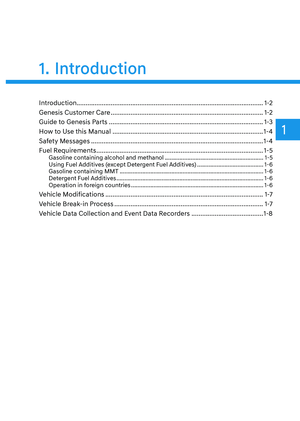
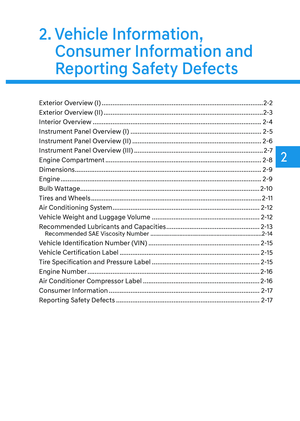
2. Vehicle Information,
Consumer Information and
Reporting Safety Defects
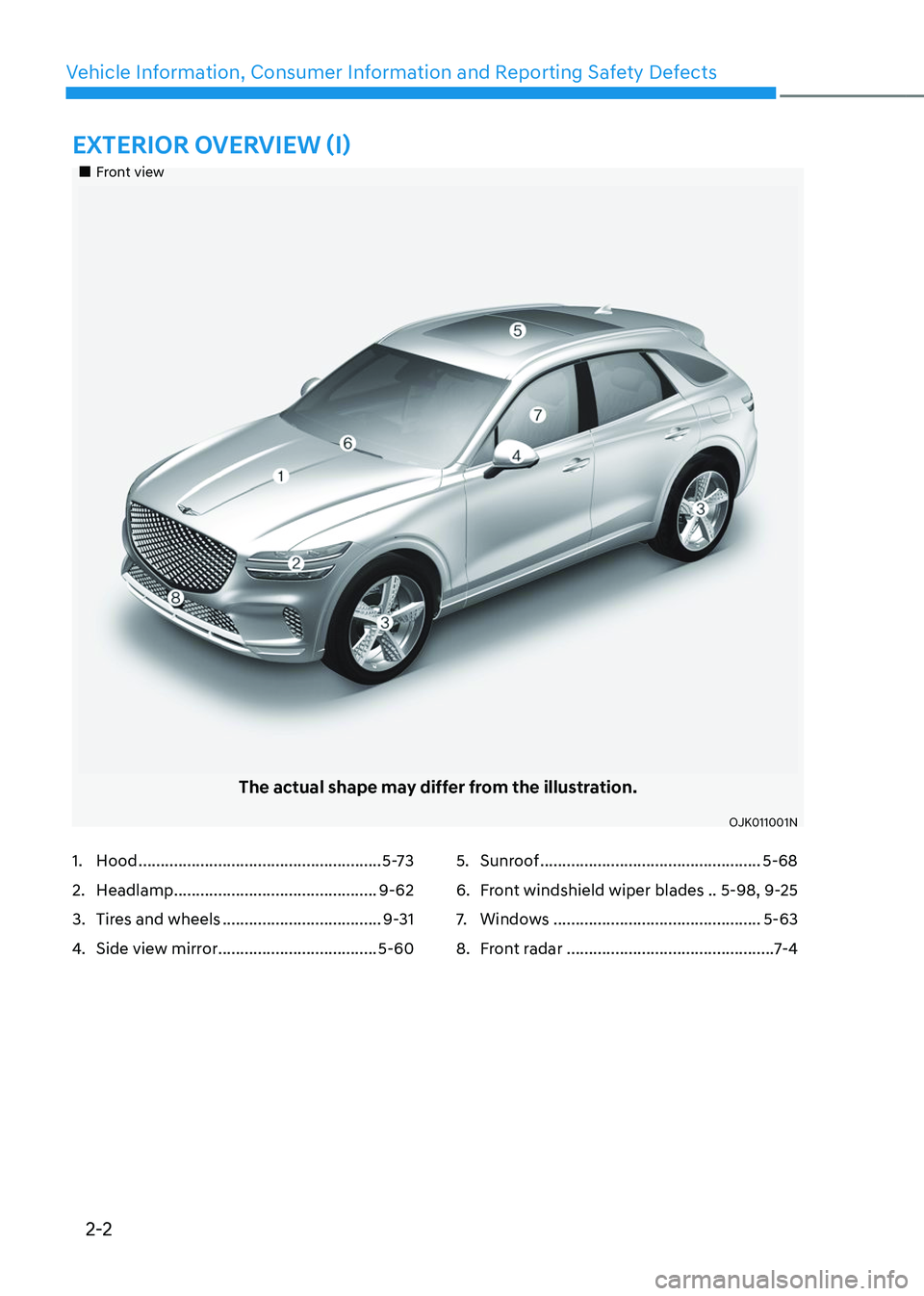
Exterior Overview (I) ........................................................................\
..................2-2
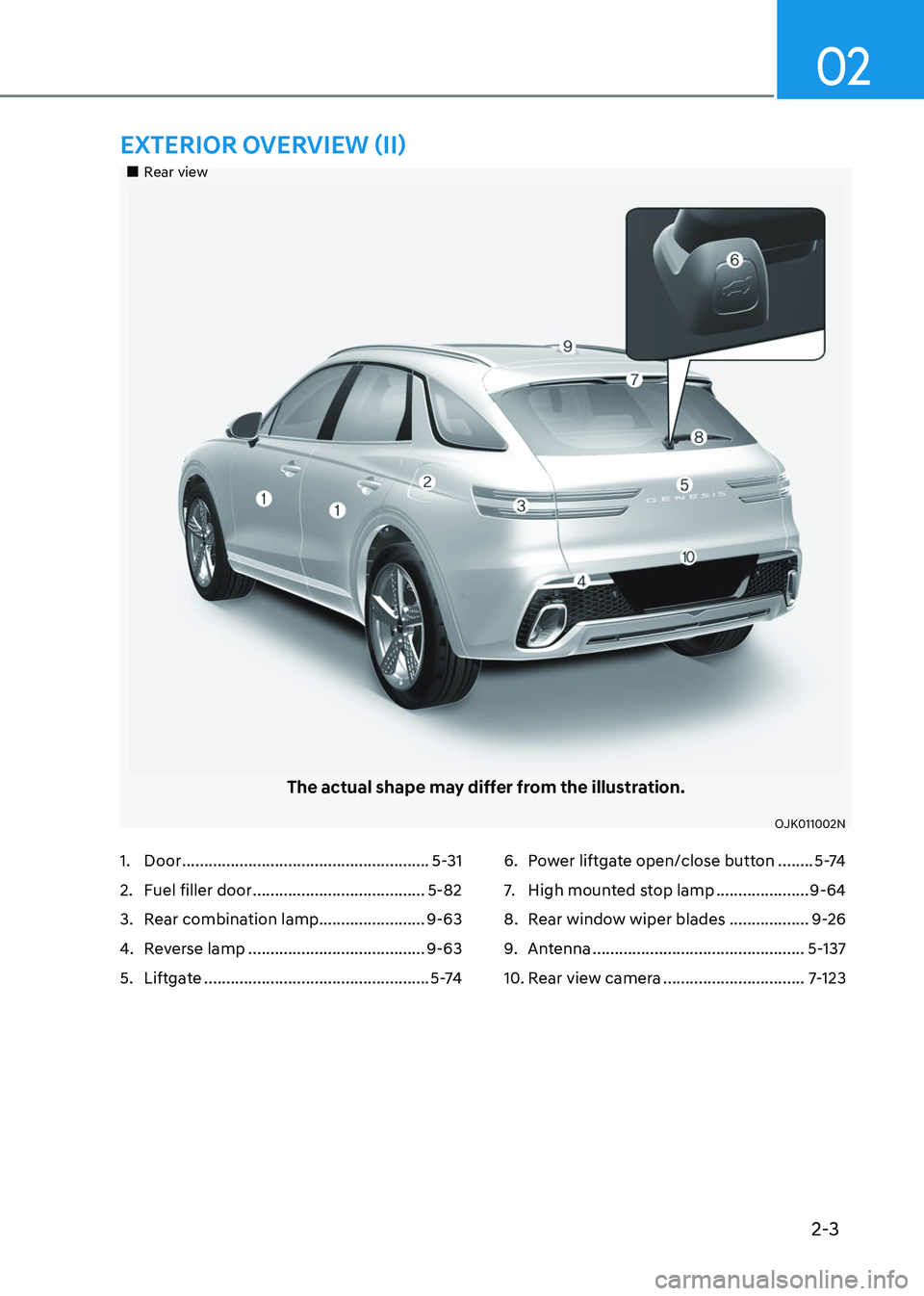
Exterior Overview (II)
........................................................................\
.................2-3
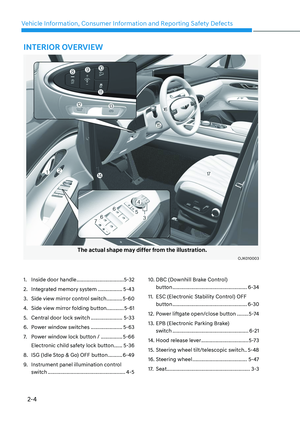
Interior Overview
........................................................................\
......................2-4
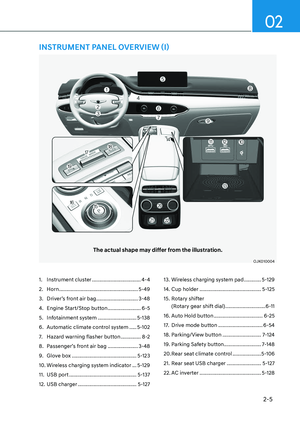
Instrument Panel Overview (I)
........................................................................\
.2-5
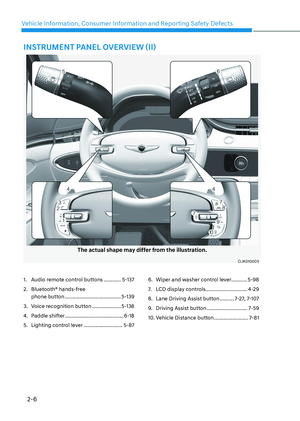
Instrument Panel Overview (II)
........................................................................\
2-6
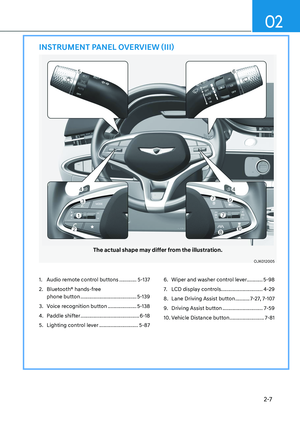
Instrument Panel Overview (III)
........................................................................\
2-7
Engine Compartment
........................................................................\
...............2-8
Dimensions
........................................................................\
................................2-9
Engine
........................................................................\
........................................2-9
Bulb Wattage
........................................................................\
............................2-10
Tires and Wheels
........................................................................\
.......................2-11
Air Conditioning System
........................................................................\
..........2-12
Vehicle Weight and Luggage Volume
............................................................2-12
Recommended Lubricants and Capacities
....................................................2-13Recommended SAE Viscosity Number .....................................................................2-14
Vehicle Identification Number (VIN) ..............................................................2-15
Vehicle Certification Label
........................................................................\
......2-15
Tire Specification and Pressure Label
............................................................2-15
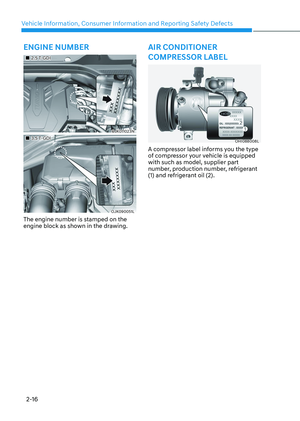
Engine Number
........................................................................\
........................2-16
Air Conditioner Compressor Label
.................................................................2-16
Consumer Information
........................................................................\
............2-17
Reporting Safety Defects
........................................................................\
........2-17
Vehicle Information, Consumer Information and Reporting Safety Defects
2
Page 15 of 637