2022 TOYOTA YARIS CROSS interior lights
[x] Cancel search: interior lightsPage 6 of 618

4
CV Owner's Manual_Europe_M52N20_en
TABLE OF CONTENTS
5-1. Using the air conditioning
system and defogger
Manual air conditioning system
.......................................... 312
Automatic air conditioning sys-
tem .................................... 316
Heated steering wheel/seat
heaters.............................. 322
5-2. Using the interior lights
Interior lights list .................. 324
5-3. Using the storage features
List of storage features ....... 326
Luggage compartment features
.......................................... 329
5-4. Other interior features
Other interior features ......... 333
6-1. Maintenance and care
Cleaning and protecting the
vehicle exterior ................. 342
Cleaning and protecting the
vehicle interior .................. 345
6-2. Maintenance
Maintenance requirements . 348
6-3. Do-it-yourself maintenance
Do-it-yourself service precau-
tions .................................. 350
Hood ................................... 351
Positioning a floor jack ........ 353
Engine compartment........... 354
Tires .................................... 363
Tire inflation pressure ......... 373
Wheels ................................ 374
Air conditioning filter ........... 376
Wireless remote control/elec-
tronic key battery .............. 378
Checking and replacing fuses
.......................................... 381
Light bulbs .......................... 386
7-1. Essential information
Emergency flashers ............ 394
If your vehicle has to be stopped
in an emergency ............... 394
If the vehicle is submerged or
water on the road is rising 395
5Interior features
6Maintenance and care
7When trouble arises
Page 23 of 618
21
CV Owner's Manual_Europe_M52N20_en
Pictorial index
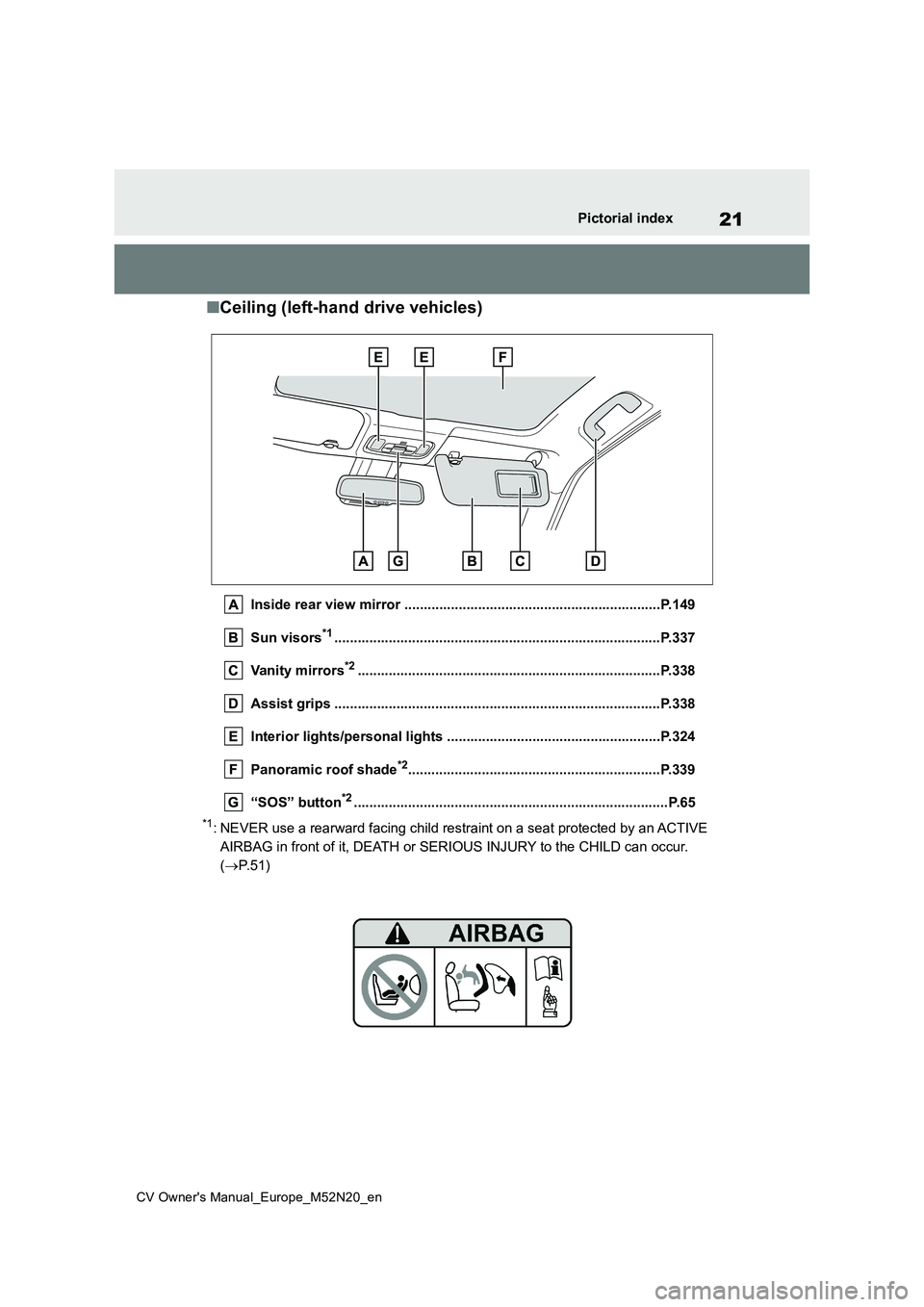
■Ceiling (left-hand drive vehicles)
Inside rear view mirror ..................................................................P.149
Sun visors*1............................................................... .....................P.337
Vanity mirrors*2............................................................... ...............P.338
Assist grips ................................................... .................................P.338
Interior lights/personal lights ................................ .......................P.324
Panoramic roof shade*2............................................................... ..P.339
“SOS” button*2............................................................... ..................P.65
*1: NEVER use a rearward facing child restraint on a seat protected by an ACTIVE
AIRBAG in front of it, DEATH or SERIOUS INJURY to the CHILD can occur.
( P.51)
Page 31 of 618
29
CV Owner's Manual_Europe_M52N20_en
Pictorial index
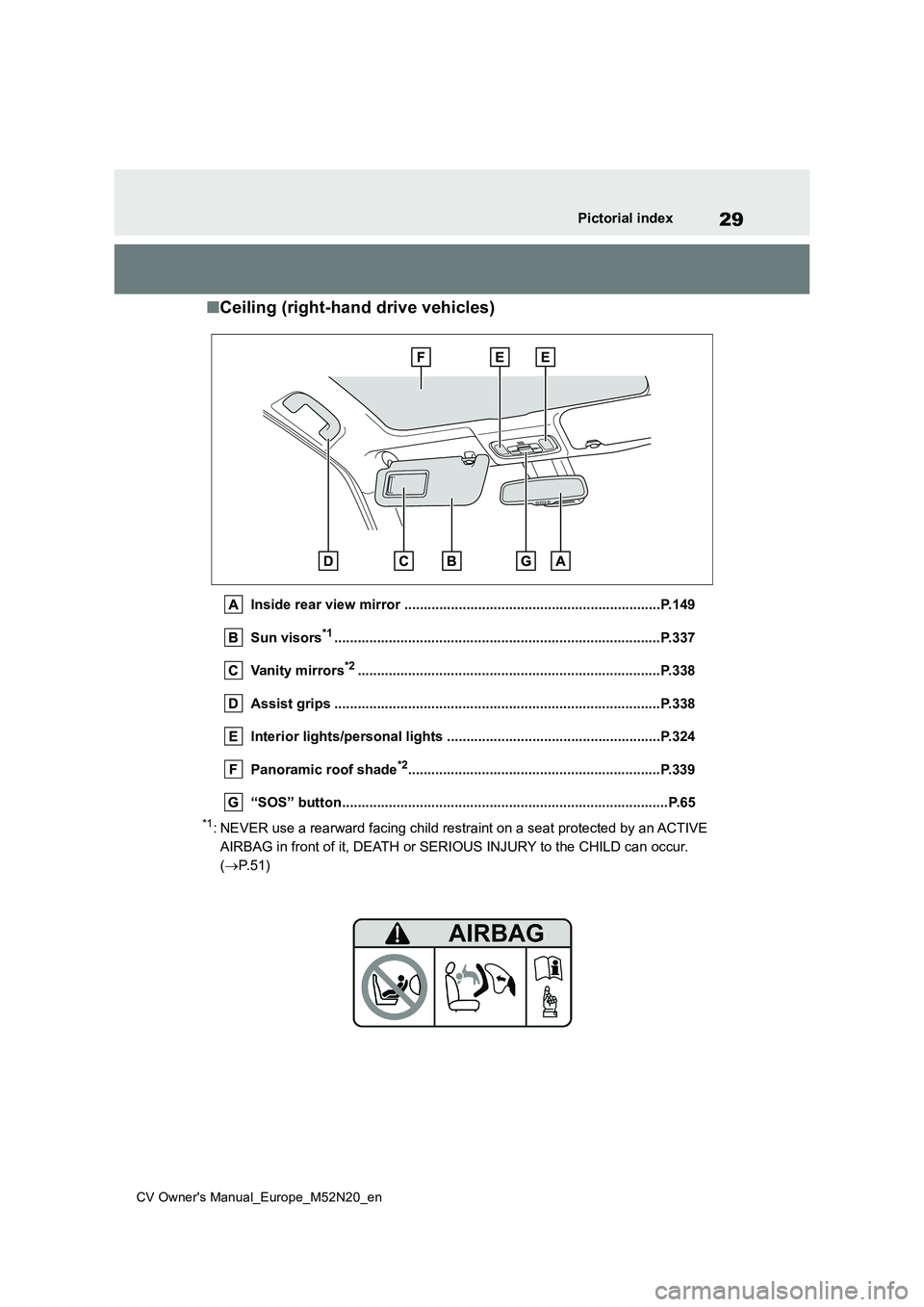
■Ceiling (right-hand drive vehicles)
Inside rear view mirror ..................................................................P.149
Sun visors*1............................................................... .....................P.337
Vanity mirrors*2............................................................... ...............P.338
Assist grips ................................................... .................................P.338
Interior lights/personal lights ................................ .......................P.324
Panoramic roof shade*2............................................................... ..P.339
“SOS” button................................................... .................................P.65
*1: NEVER use a rearward facing child restraint on a seat protected by an ACTIVE
AIRBAG in front of it, DEATH or SERIOUS INJURY to the CHILD can occur.
( P.51)
Page 42 of 618

40
CV Owner's Manual_Europe_M52N20_en
1-1. For safe use
“PASSENGER AIR BAG” indicator
Airbag sensor assembly
The main SRS airbag system components are shown above. The SRS air-
bag system is controlled by the airbag sensor assembly. As the airbags
deploy, a chemical reaction in the inflators quickly fills the airbags with non-
toxic gas to help restrain the motion of the occupants.
■If the SRS airbags deploy (inflate)
●Slight abrasions, burns, bruising etc., may be sustained from SRS airbags,
due to the extremely high speed deployment (inflation) by hot gases.
●A loud noise and white powder will be emitted.
●Parts of the airbag module (steering wheel hub, airbag cover and inflator) as well as the front seats, parts of the
front and rear pillars, and roof side rails, may be hot for several minutes.
The airbag itself may also be hot.
●The windshield may crack.
●The brakes and stop lights will be con- trolled automatically. ( P.301)
●The interior lights will turn on automat- ically. ( P.325)
●The emergency flashers will turn on automatically. ( P.394)
●Fuel supply to the engine will be stopped. ( P.402)
●Vehicles with eCall: If any of the fol-
lowing situations occur, the system is
designed to send an emergency call* to the eCall control center, notifying them of the vehicle’s location (without
needing to push the “SOS” button) and an agent will attempt to speak with the occupants to ascertain the
level of emergency and assistance required. If the occupants are unable to communicate, the agent automati-
cally treats the call as an emergency and helps to dispatch the necessary emergency services. ( P.65)
• An SRS airbag is deployed. • A seat belt pretensioner is activated.
• The vehicle is involved in a severe rear-end collision.*: In some cases, the call cannot be
made. ( P. 6 6 )
■SRS airbag deployment conditions (SRS front airbags)
●The SRS front airbags will deploy in the event of an impact that exceeds
the set threshold level (the level of force corresponding to an approxi-mately 20 - 30 km/h [12 - 18 mph]
frontal collision with a fixed wall that does not move or deform).
However, this threshold velocity will be considerably higher in the following situ-ations:
• If the vehicle strikes an object, such as a parked vehicle or sign pole, which can move or deform on impact
• If the vehicle is involved in an under- ride collision, such as a collision in which the front of the vehicle “under-
rides”, or goes under, the bed of a truck
●Depending on the type of collision, it is possible that only the seat belt pretensioners will activate.
■SRS airbag deployment conditions
(SRS side and curtain shield air- bags and SRS front seat center air-bags)
●The SRS side and curtain shield air-bags and SRS front seat center air-
bags will deploy in the event of an impact that exceeds the set threshold level (the level of force corresponding
to the impact force produced by an approximately 1500 kg [3300 lb.] vehi-cle colliding with the vehicle cabin
Page 313 of 618
5
311
CV Owner's Manual_Europe_M52N20_en
5
Interior features
Interior features
5-1. Using the air conditioning
system and defogger
Manual air conditioning system
....................................... 312
Automatic air conditioning sys-
tem ................................. 316
Heated steering wheel/seat
heaters ........................... 322
5-2. Using the interior lights
Interior lights list................ 324
5-3. Using the storage features
List of storage features ..... 326
Luggage compartment features
....................................... 329
5-4. Other interior features
Other interior features....... 333
Page 326 of 618
324
CV Owner's Manual_Europe_M52N20_en
5-2. Using the interior lights
5-2.Using the interior lights
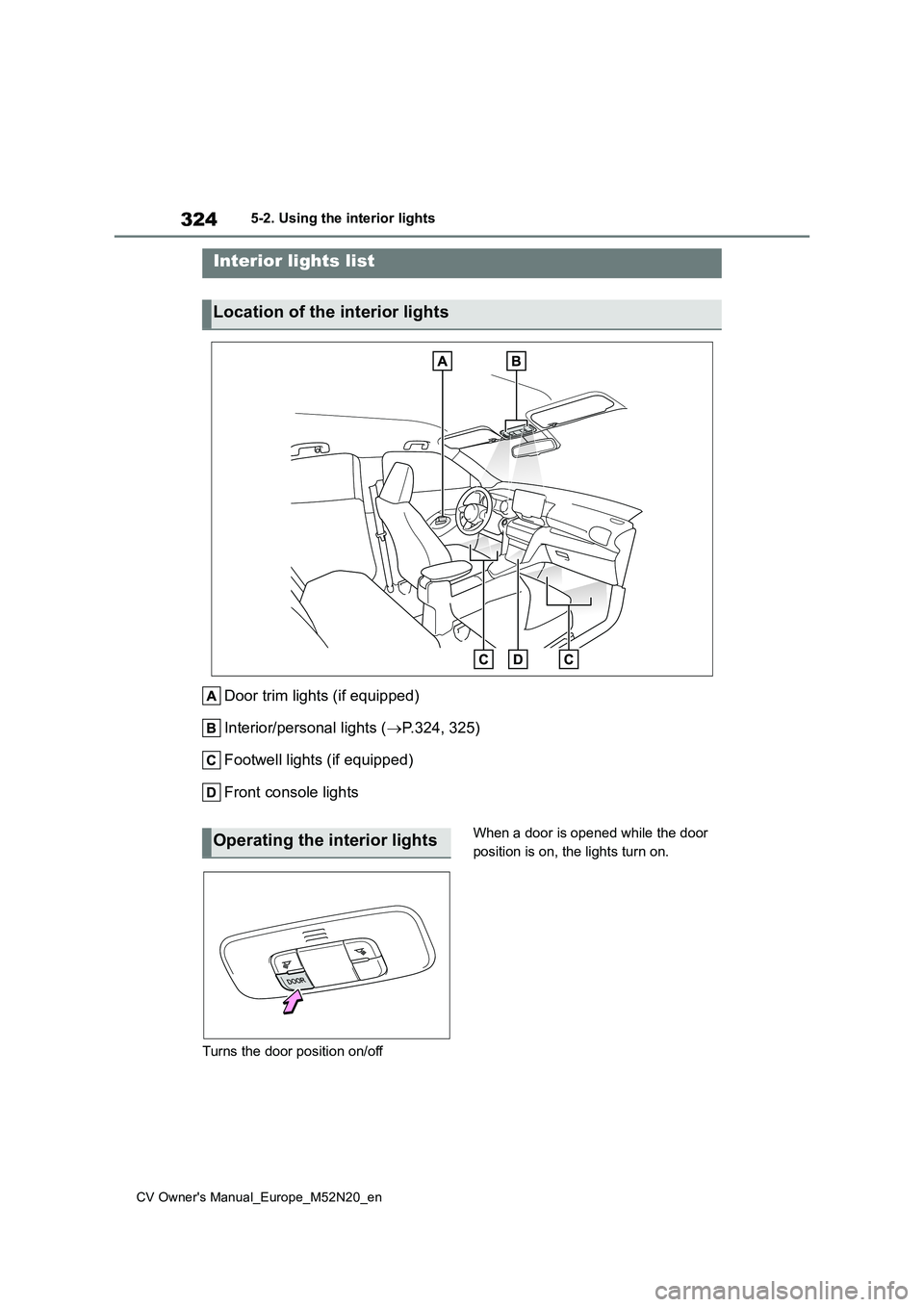
Door trim lights (if equipped)
Interior/personal lights ( P.324, 325)
Footwell lights (if equipped)
Front console lights
Turns the door position on/off
When a door is opened while the door
position is on, the lights turn on.
Interior lights list
Location of the interior lights
Operating the interior lights
Page 327 of 618
325
5
CV Owner's Manual_Europe_M52N20_en
5-2. Using the interior lights
Interior features
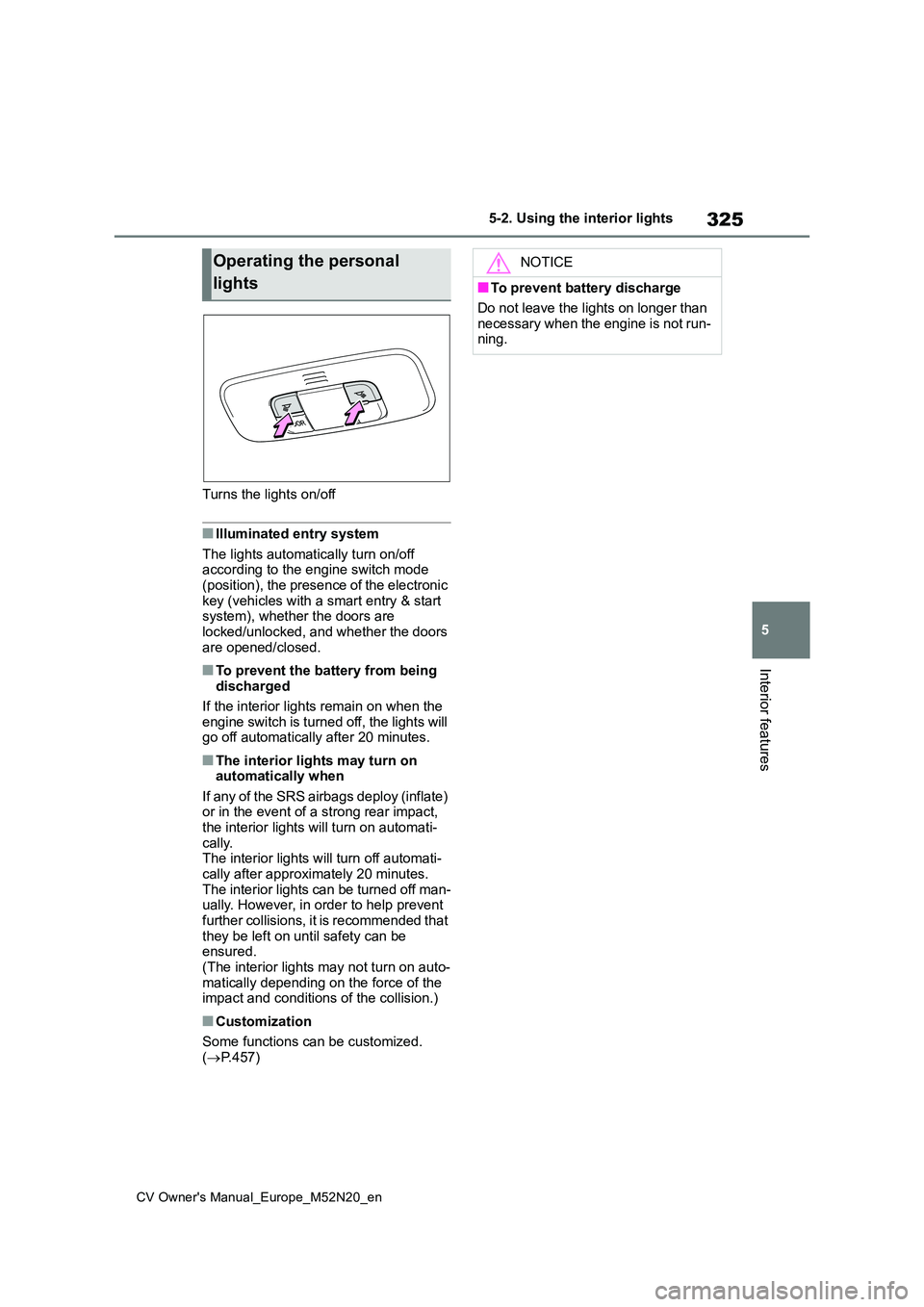
Turns the lights on/off
■Illuminated entry system
The lights automatically turn on/off according to the engine switch mode (position), the presence of the electronic
key (vehicles with a smart entry & start system), whether the doors are locked/unlocked, and whether the doors
are opened/closed.
■To prevent the battery from being discharged
If the interior lights remain on when the
engine switch is turned off, the lights will go off automatically after 20 minutes.
■The interior lights may turn on automatically when
If any of the SRS airbags deploy (inflate) or in the event of a strong rear impact, the interior lights will turn on automati-
cally. The interior lights will turn off automati-cally after approximately 20 minutes.
The interior lights can be turned off man- ually. However, in order to help prevent further collisions, it is recommended that
they be left on until safety can be ensured.(The interior lights may not turn on auto-
matically depending on the force of the impact and conditions of the collision.)
■Customization
Some functions can be customized.
( P.457)
Operating the personal
lights
NOTICE
■To prevent battery discharge
Do not leave the lights on longer than
necessary when the engine is not run- ning.
Page 337 of 618
335
5
CV Owner's Manual_Europe_M52N20_en
5-4. Other interior features
Interior features
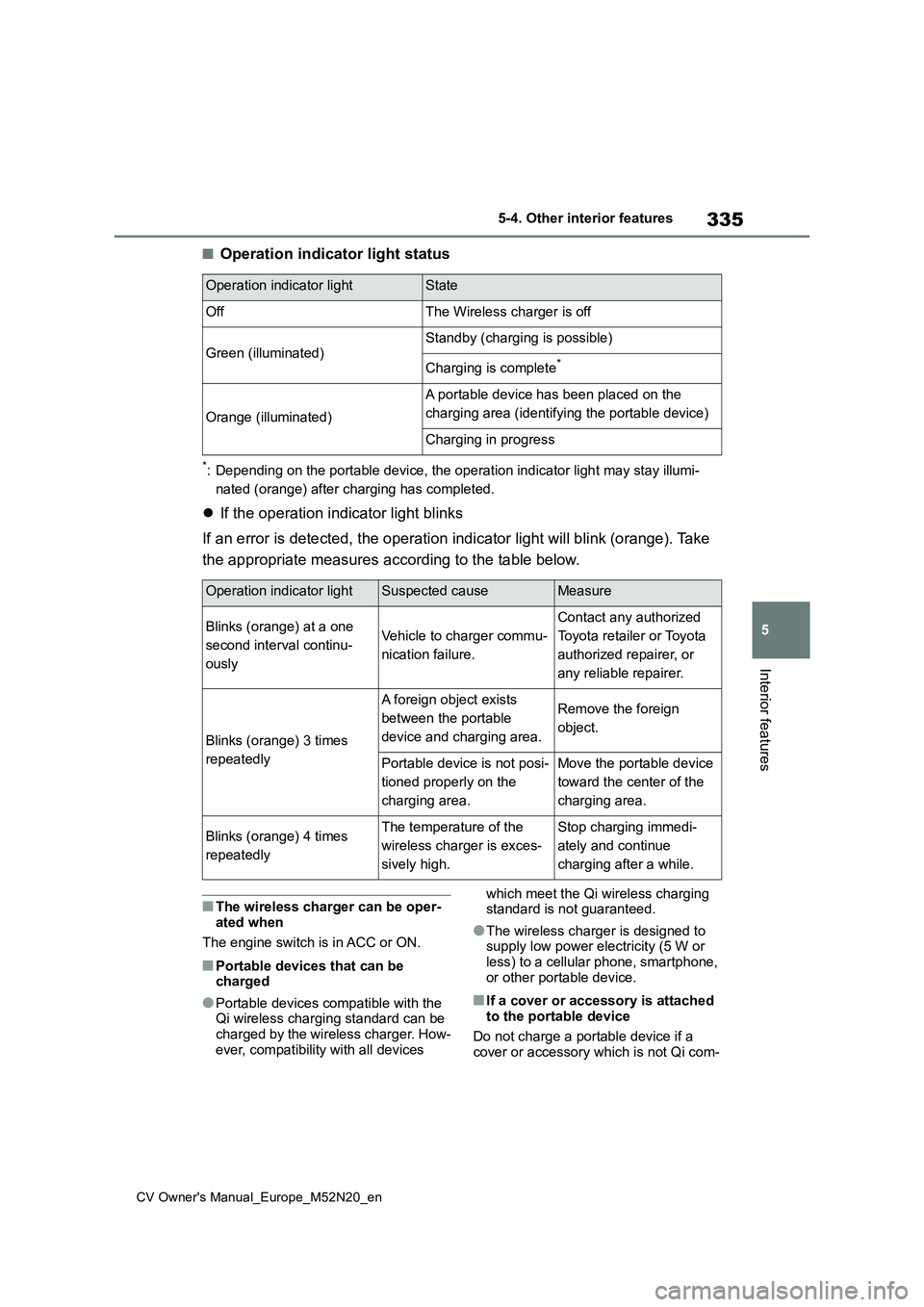
■Operation indicator light status
*: Depending on the portable device, the operation indicator light may stay illumi-
nated (orange) after charging has completed.
If the operation indicator light blinks
If an error is detected, the operation indicator light will bli nk (orange). Take
the appropriate measures according to the table below.
■The wireless charger can be oper- ated when
The engine switch is in ACC or ON.
■Portable devices that can be charged
●Portable devices compatible with the Qi wireless charging standard can be charged by the wireless charger. How-
ever, compatibility with all devices
which meet the Qi wireless charging standard is not guaranteed.
●The wireless charger is designed to supply low power electricity (5 W or
less) to a cellular phone, smartphone, or other portable device.
■If a cover or accessory is attached to the portable device
Do not charge a portable device if a cover or accessory which is not Qi com-
Operation indicator lightState
OffThe Wireless charger is off
Green (illuminated)Standby (charging is possible)
Charging is complete*
Orange (illuminated)
A portable device has been placed on the
charging area (identifying the portable device)
Charging in progress
Operation indicator lightSuspected causeMeasure
Blinks (orange) at a one
second interval continu-
ously
Vehicle to charger commu-
nication failure.
Contact any authorized
Toyota retailer or Toyota
authorized repairer, or
any reliable repairer.
Blinks (orange) 3 times
repeatedly
A foreign object exists
between the portable
device and charging area.
Remove the foreign
object.
Portable device is not posi-
tioned properly on the
charging area.
Move the portable device
toward the center of the
charging area.
Blinks (orange) 4 times
repeatedly
The temperature of the
wireless charger is exces-
sively high.
Stop charging immedi-
ately and continue
charging after a while.