2019 MERCEDES-BENZ SPRINTER warning
[x] Cancel search: warningPage 264 of 354
Make sure
toobser vethefo llowing fur ther rela‐
te d subject:
R Notes on tire pressure (/ page 234)
Rest arting the tire pressure monitor
Requ irements:
R The recommended tire pressure is cor rectly
set forth ere spective operating condition on
each of the wheels (/ page 234).
R Re
start the tire pressure monitoring sys‐
te m in the following situations:
- The tire pressure has changed.
- The wheels or tires ha vebeen changed or
newly ins talled.
On-board computer: 4 Service 5
Tires #
Scroll down in the menu.
The Use Current Pressures as New Refer-
ence Values message appears in the multi‐
function displa y. #
Con firm the message toinitiate a restart.
The Tire Press. Monitor Restarted message
appears in the multifunction displa y.
Cur rent wa rning messages are dele ted and
th e0077 yellow warning lamp goes out.
Af teryo u ha vedriven for a few minutes, the
sy stem checks whe ther the cur rent tire pres‐
su res are within the specified range. The cur‐
re nt tire pressures are then accep ted as ref‐
erence values and monitored.
Make sure toobser vethefo llowing fur ther rela‐
te d subject:
R Notes on tire pressure (/ page 234) Ra
dio-equipment appr oval of the tire pres‐
sure monitoring sy stem
Ra dio equipment appr oval numbers Countr
yRadio equipment appr oval
number
Canada IC: 4008C- TSSRE4A
Ope ration is subject tothefo llow‐
ing two conditions:
(1) this device may not cause
harmful inter fere nce, and
(2) this device must acce ptany
inter fere nce received, including
inter fere nce that may cause
undesired operation.
Mexic oM odel:TSSRE4A & TSSSG4G6,
IFETEL: RLVHUTS17-0806
US AF CC ID:YGOTSSRE4A
This device complies wi th Part15
of the FCC Rules. Operation is
subject tothefo llowing two con‐
ditions: (1) this device may not
cause harmful inter fere nce, and
(2) this device must acce ptany
inter fere nce received, including
inter fere nce that may cause
undesired operation.
WA RNING: Any changes or modi fi‐
cation not expressly appr ovedby
th e party responsible for compli‐
ance could void the user's author‐
ity tooperate this equipment. Loading the
vehicle Ti
re and Loading Information placard &
WARNING Risk of an accident when driv‐
ing wi than ove rloaded tire
Overloaded tires may overheat and bur stas a
consequence. Overloaded tires can also
impair thesteering and handling characteris‐
tics and lead tobrake failure. #
Obser vethe load rating of the tires. #
The load rating mu stbe at least half the
gross axleweight rating of theve hicle.
Mercedes-Benz recommends you use
th e load-bearing index, which is given in
th eve hicle documents. 240
Wheels and tires
Page 268 of 354
tire's ability
tocome toast andstill on a wet pa ve‐
ment under controlled conditions on a specified
U. S. go vernment test sur face made from asphalt
and concr ete.
Te mp erature grade &
WARNING Risk of accident from tire
ove rheating and tire failure
The temp erature grade forth is tire is es tab‐
lished for a tire that is properly inflated and
not overloaded. Excessive speed, underinfla‐
tion, or excessive loading, either separately or
in combination, can cause excessive heat
build-up and possible tire failure. #
Obser vethere commended tire pres‐
sures and regular lych eck the tire pres‐
sure of all tires including the spare
wheel. #
Adjust the tire pressure as necessar y.The
temp erature grades are A (highest grade), B
and C. These relate toa tire's resis tance toheat
and its ability torelease heat on a specified test
wheel in laboratory tests under contro lled condi‐
tions. Sus tained high temp eratures can cause the
material of the tire todegenerate and reduce tire
life. In addition, excessively high temp eratures
can lead tosudden tire failure. Grade C refers to
a per form ance which all passenger vehicle tires
must exhibit, according totheU. S. Depa rtment
of Transpor tation's requ irements. Information on DOT and TIN (Tire Identifica‐
tion Number) U.
S. tire regulations indicate that every tire man‐
ufacturer or retreader mu stimprint a TIN in or on
th e side wall of each tire produced. %
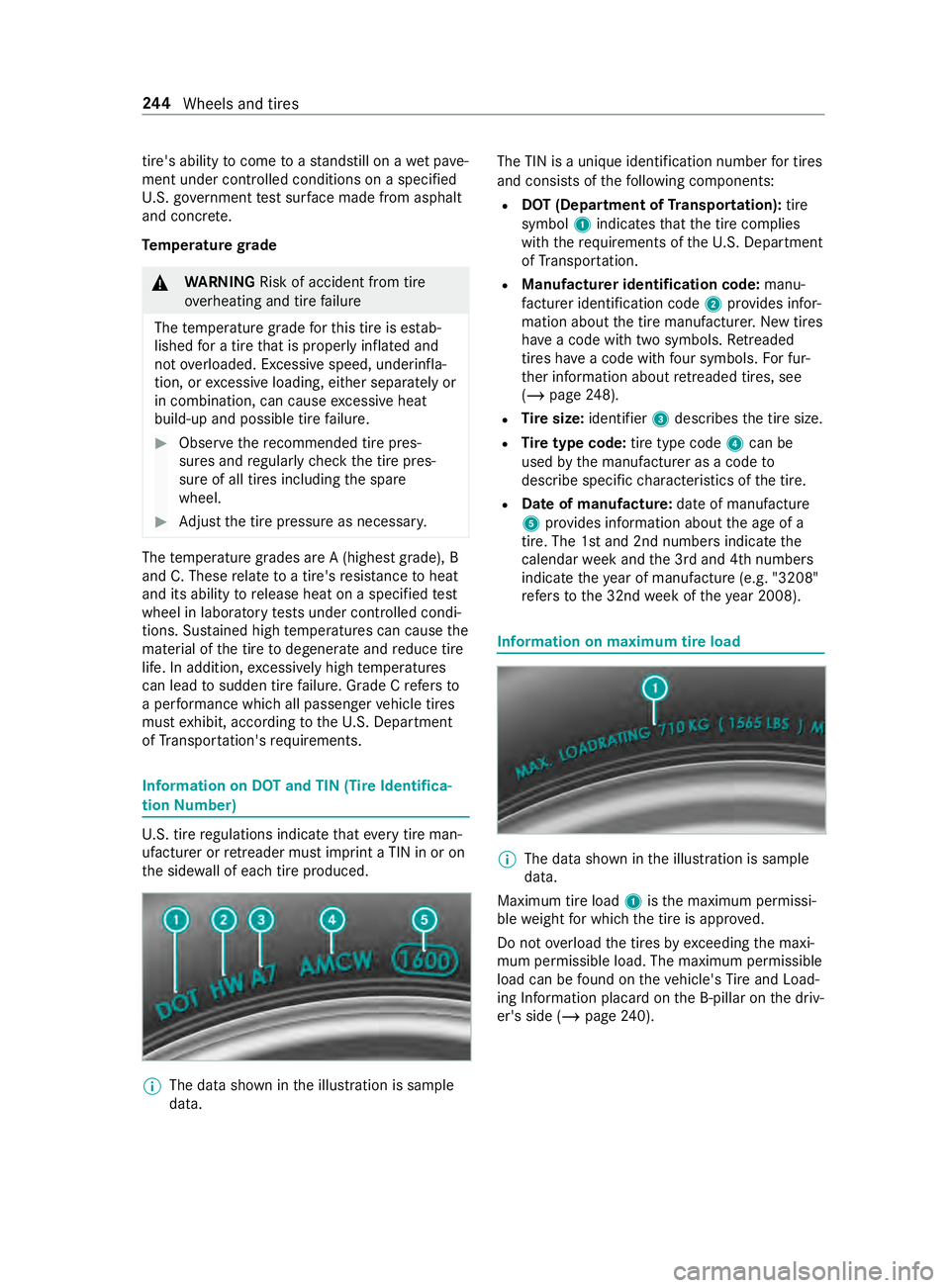
The data shown in
the illustration is sample
data. The TIN is a unique identification number
for tires
and consists of thefo llowing components:
R DOT (Department of Transportation): tire
symbol 1indicates that the tire complies
with therequ irements of theU. S. Depa rtment
of Transpor tation.
R Manufacturer identi fication code: manu‐
fa cturer identification code 2prov ides infor‐
mation about the tire manufacturer. New tires
ha ve a code with two symbols. Retreaded
tires ha vea code with four symbols. For fur‐
th er information about retreaded tires, see
(/ page 248).
R Tire size: identifier 3describes the tire size.
R Tire type code: tire type code 4can be
used bythe manufacturer as a code to
describe specific characteristics of the tire.
R Date of manu factu re:da te of manufacture
5 prov ides information about the age of a
tire. The 1st and 2nd numbers indicate the
calendar week and the 3rd and 4th numbers
indicate theye ar of manufacture (e.g. "3208"
re fers to the 32nd week of theye ar 2008). Information on maximum tire load
%
The data shown in
the illustration is sample
data.
Maximum tire load 1isthe maximum permissi‐
ble weight for which the tire is appr oved.
Do not overload the tires by exceeding the maxi‐
mum permissible load. The maximum permissible
load can be found on theve hicle's Tire and Load‐
ing In form ation placard on the B-pillar on the driv‐
er's side (/ page240). 244
Wheels and tires
Page 269 of 354
Information on maximum tire pressu
re%
The data shown in
the illustration is sample
data.
Maximum permitted tire pressure 1, which is
permitted forth e tires must not be exceeded.
Exception: when using the 225/ 75R16C
12 1/120R (122L) tires as a spa rewheel on the
re ar axle of Super Sin gle ve hicles with a dis tance
limit of 62 mi (100 km) and speed limit of 34 mph
(55 km/h). Information on tire
characteristics %
The data shown in
the illustration is sample
data.
This information describes the type of tire cord
and the number of la yers in side wall1 and
under tire tread 2. Ti
re size designation, load-bearing capacity,
speed rating and load index &
WARNING Risk of inju rythro ugh exceed‐
ing the specified tire load rating or the
permissible speed rating
Exceeding the specified tire load rating or the
permissible speed rating may lead totire
dama geand tothe tires bur sting. #
Therefore, only use tire types and sizes
appr ovedfo ryo ur vehicle model. #
Obser vethe tire load rating and speed
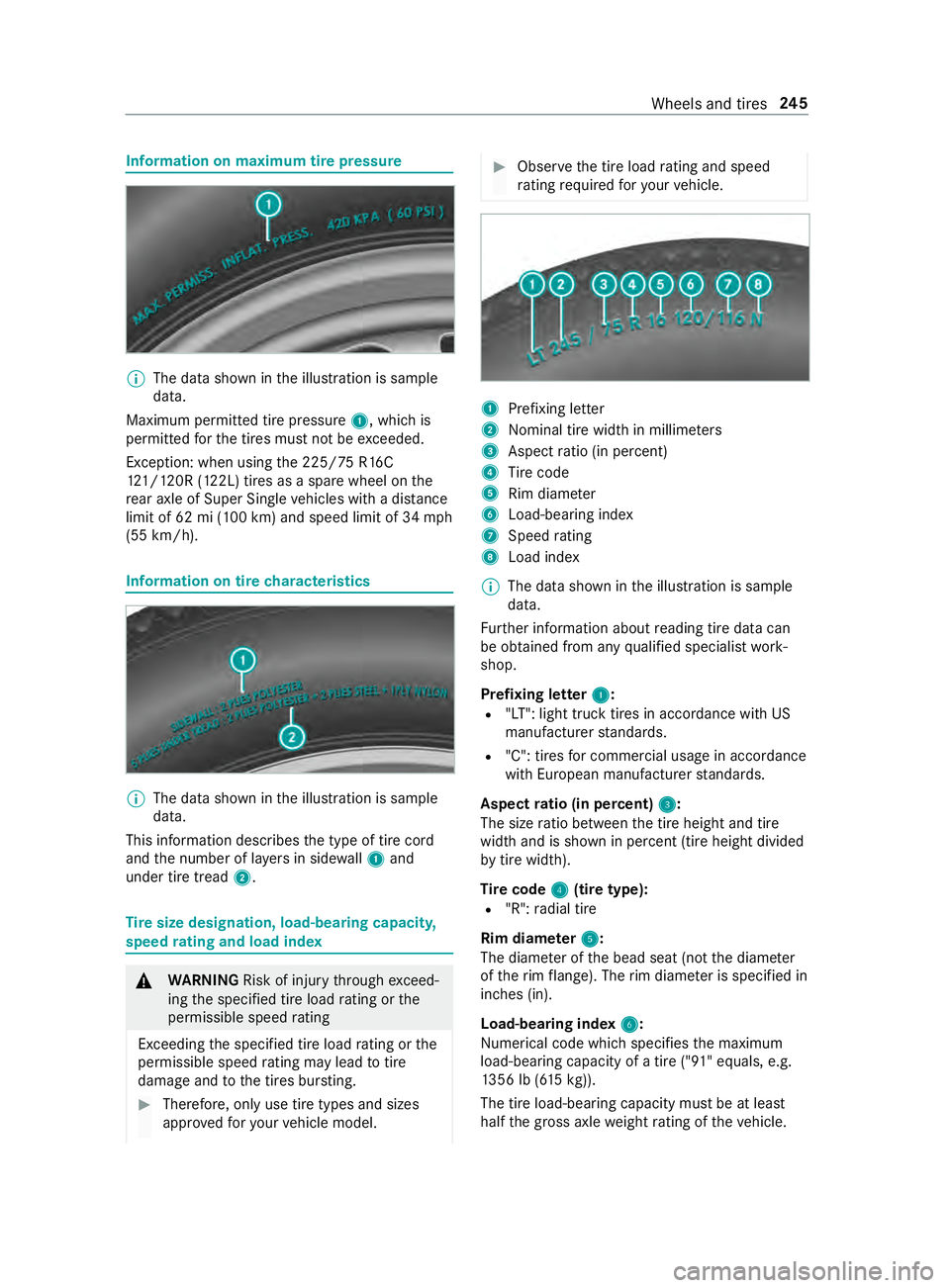
ra ting requ ired foryo ur vehicle. 1
Prefixing letter
2 Nominal tire width in millime ters
3 Aspect ratio (in pe rcent)
4 Tire code
5 Rim diame ter
6 Load-bearing index
7 Speed rating
8 Load ind ex
% The data shown in
the illustration is sample
data.
Fu rther information about reading tire data can
be obtained from any qualified specialist work‐
shop.
Prefixing letter 1 1:
R "LT": light truck tires in accordance with US
manufacturer standards.
R "C": tires for commercial usage in accordance
with European manufacturer standards.
Aspect ratio (in percent) 3 3:
The size ratio between the tire height and tire
width and is shown in percent (tire height divided
by tire width).
Ti re code 4 4(tire type):
R "R": radial tire
Rim diam eter 5
5:
The diame ter of the bead seat (not the diame ter
of therim flange). The rim diame ter is specified in
inches (in).
Load-bearing index 6
6:
Numerical code which specifies the maximum
load-bearing capacity of a tire ("91" equals, e.g.
13 56 lb (6 15kg)).
The tire load-bearing capacity must be at least
half the gross axle weight rating of theve hicle. Wheels and tires
245
Page 272 of 354
Maximum permissible pa
yload weight: nomi‐
nal load and luggage load plus 150 lbs (68 kg)
multiplied bythe number of seats in theve hicle. Changing a wheel
Note
s on selecting, installing and replacing
tires Yo
u can ask for information rega rding permit ted
wheel/tire combinations at a qualified specialist
wo rkshop. &
WARNING Risk of accident due toincor‐
re ct sizes of wheels and tires
If wheels and tires of the wrong size are used,
th e wheel brakes or wheel suspension com‐
ponents may be damaged. #
Alwaysre place wheels and tires with
ones that fulfill the specifications of the
original part.
Fo r wheels, pay attention tothefo llowing:
R Designation
R Type
R Perm issible wheel load
R Wheel of fset
Fo r tires, pay attention tothefo llowing:
R Designation
R Manufacturer
R Type
R Load-bearing index
R Speed rating &
WARNING Risk of inju rythro ugh exceed‐
ing the specified tire load rating or the
permissible speed rating
Exceeding the specified tire load rating or the
permissible speed rating may lead totire
dama geand tothe tires bur sting. #
Therefore, only use tire types and sizes
appr ovedfo ryo ur vehicle model. #
Obser vethe tire load rating and speed
ra ting requ ired foryo ur vehicle. *
NO
TEVehicle and tire damage thro ugh
tire types and sizes that ha venot been
appr oved Fo
r saf etyre asons, only use tires, wheels and
accesso ries which ha vebeen specially
appr ovedby Mercedes-Benz foryo ur vehicle.
These tires ha vebeen specially adap tedfor
use with the cont rol sy stems, such as ABS or
ESP ®
.
Otherwise, cer tain properties, such as han‐
dling characteristics, vehicle noise and con‐
sum ption could be adversely af fected. Fur‐
th ermore, other tire size could result in the
tires rubbing against the body and axle com‐
ponents when loaded. This could result in
damage tothe tire or theve hicle. #
Only use tires, wheels and accessories
th at ha vebeen checked and recommen‐
ded byMercedes-Benz. *
NO
TEDriving sa fety put at risk by retrea‐
ded tires Re
treaded tires are not checked or recom‐
mended byMercedes-Benz, as pr evious dam‐
age is not alw ays de tected du ring there tread
process.
Driving sa fety cannot, therefore, be guaran‐
te ed. #
Do not use used tires when their pr evi‐
ous usage is unknown. *
NO
TEDama getoelectronic component
parts thro ugh the use of tire-ins talling
to ols Ve
hicles with a tire pressure monitoring
sy stem: there are electronic component
parts in the wheel. Tire -ins talling tools should
not be applied in the area of theva lve.
Otherwise, the electronic component parts
could be damaged. #
Always ha vetires changed at a qualified
specialist workshop. Ac
cesso ries that are not appr ovedfo ryo ur vehi‐
cle byMercedes-Benz, or are not being used cor‐
re ctly, can impair ope rating sa fety. 248
Wheels and tires
Page 273 of 354

Before pu
rchasing and using non-appr oved
accesso ries, visit a qualified specialist workshop
and inquire about:
R Suitability
R Legal stipulations
R Factory recommendations
Obser vethefo llowing points when selecting,
ins talling and replacing tires:
R Use only tires and wheels of the same type,
design (winter tires, all-season tire) and
make.
R Only ins tall wheels of the same size and tread
design on one axle (left and right).
It is only permissible toins tall a dif fere nt
wheel size tothis in theeve nt of a flat tire in
order todrive tothe specialist workshop.
R Only ins tall tires of the cor rect size onto the
wheels.
R Ve
hicles with a tire pressure monitoring
sy stem: all ins talled wheels must be equip‐
ped with functioning sensors forth e tire pres‐
sure monitoring sy stem.
R Attemp eratures below 50 °F (10 °C), use
winter tires or all-season tire mar ked M+S for
all wheels.
Wi nter tires bearing the004D snowflake sym‐
bol in addition tothe M+S marking pr ovide
th e best possible grip in wintry road condi‐
tions.
R Only use tires with the same tread.
R Obser vethe maximum permissible speed for
th e ins talled tires.
If th is is below theve hicle's maximum speed,
th is must be indicated in an appropriate label
in the driver's field of vision.
R Break in new tires at moderate speeds forthe
fi rs t 60 miles (100 km).
R Replace the tires af ter six years at the latest,
re ga rdless of wear.
Fo r more information on wheels and tires, con‐
ta ct a qualified specialist workshop.
% Ve
hicles with twin tires:
Fo rve hicles with twin tires with a GVW of
11 ,030 lbs or 12,125 lbs, only use tires with
th e dimension LT215/85 R16 whi chhave
been appr ovedfo rth is vehicle bythe manu‐
fa cturer. It is not permissible touse tires with
dif fere nt dimensions; doing so may lead to age
neral ope rating pe rmit being rende red
in va lid.
% Ve
hicles with single tires:
Fo rve hicles with single tires with a GVW less
th an or equal to9480 lbs, only use tires with
th e dimension LT245/75 R16 whi chhave
been appr ovedfo rth is vehicle bythe manu‐
fa cturer. It is not permissible touse tires with
dif fere nt dimensions; doing so may lead to a
ge neral ope rating pe rmit being rende red
in va lid.
% Ve
hicles with Super Single tires:
Fo rve hicles with single tires with a GVW of
11 ,030 lbs, only use tires with the dimen‐
sions 225/ 75R16C (FA) and 285/65 R16C
(RA) which ha vebeen appr ovedfo rth is vehi‐
cle bythe manufacturer. It is not permissible
to use tires with dif fere nt dimensions; doing
so may lead toage neral ope rating pe rmit
being rende red in valid.
Be sure toalso obse rveth efo llowing fur ther rela‐
te d subjects:
R Notes on tire pressure (/ page 234)
R Tire and Loading In form ation placard
(/ page 240)
R Tire size designation, load-beari ng capacity,
speed rating and load ind ex (/page 245)
R Tire pressure table
R Notes on the emer gency spa rewheel
(/ page 255) Note
s onrotating wheels &
WARNING Risk of inju rythro ugh dif fer‐
ent wheel sizes
Inter changing the front and rear wheels if the
wheels or tires ha vediffere nt dimensions may
se verely impair the driving characteristics.
The wheel brakes or wheel suspension com‐
ponents may also be damaged. #
Rotate front and rear wheels only if the
wheels and tires are of the same dimen‐
sions. On
vehicles that ha vethe same size front and
re ar wheels, rotate the wheels according tothe
inter vals in the tire manufacturer's warranty book
in your vehicle documents. If this is not available,
ro tate the tires every3,000 (5,000) to
6,000 miles (10,000 km), depending on the Wheels and tires
249
Page 275 of 354

Preparing
theve hicle for a wheel change Re
quirements:
R The tire-change tool kit is available.
R The vehicle is not on a slope.
R The vehicle is on solid, non-slippery and le vel
ground. #
Appl yth e parking brake. #
Movethe front wheels tothest ra ight-ahead
position. #
Vehicles with automatic transmission:
shift the transmission toposition 005D. #
Switch off the engine. #
Make sure that the engine cann otbe star ted. #
Take theve hicle tool kit from thefo ot we ll on
th e front passsenger side (/ page 229).Ve
hicles with rear wheel drive #
Take the jack and the tire-change tool kit out
of thestow age compartment (/ page 250).#
If necessar y,remo vethe hub cab. #
Assemble the lug wrench extension using the
middle rod and thero d with the lar gest diam‐
et er from theth re e-piece jack pump le ver. #
Starting with the middle rod, slide the lug
wrench extension as far as it will go onto the
lug wrench. #
Using the lug wrench, loosen the wheel nuts
or bolts on the wheel you wish tochange by
about one full turn. Do not unscr ewthe wheel
nuts or bolts comple tely. #
Raise theve hicle (/ page 251). Ra
ising theve hicle when changing a wheel &
WARNING Risk of inju ryfrom jack tip‐
ping
If yo u park a vehicle with air suspension, the
air suspension may remain activated for up to
one hour, even when the ignition is switched
off. If youth en raise theve hicle with the jac k,
th e air suspension will attem pttoadjust the
ve hicle le vel.
The jack may tip. #
Press the Service button on the air sus‐
pension remo tecontrol before raising
th eve hicle.
This pr events au tomatic readjustment
of theve hicle le vel and pr events it from
being raised or lo wered manually. &
WARNING Risk of inju ryfrom incor rect
positioning of the jack
If yo u do not position the jack cor rectly at the
appropriate jacking point of theve hicle, the
jack could tip wi th theve hicle raised. #
Only position the jack at the appropriate
jacking point of theve hicle. The base of
th e jack must be positioned vertically
under the jacking point of theve hicle. &
WARNING Risk of inju ryfrom vehicle tip‐
ping
On slopes, the jack could tip with theve hicle
ra ised. #
Neverch ange a wheel on a slope. #
Consult a qualified specialist workshop. *
NO
TEVehicle damage from the jack If
yo u do not position the jack cor rectly at the
appropriate jack support point of theve hicle,
th e jack could tip over with theve hicle raised. #
The jack is designed exclusively for
jacking up theve hicle at the jack sup‐
port points. Re
quirements:
R There are no persons in theve hicle.
R The vehicle is prepared forch anging a wheel
(/ page 251). Wheels and tires
251
Page 277 of 354
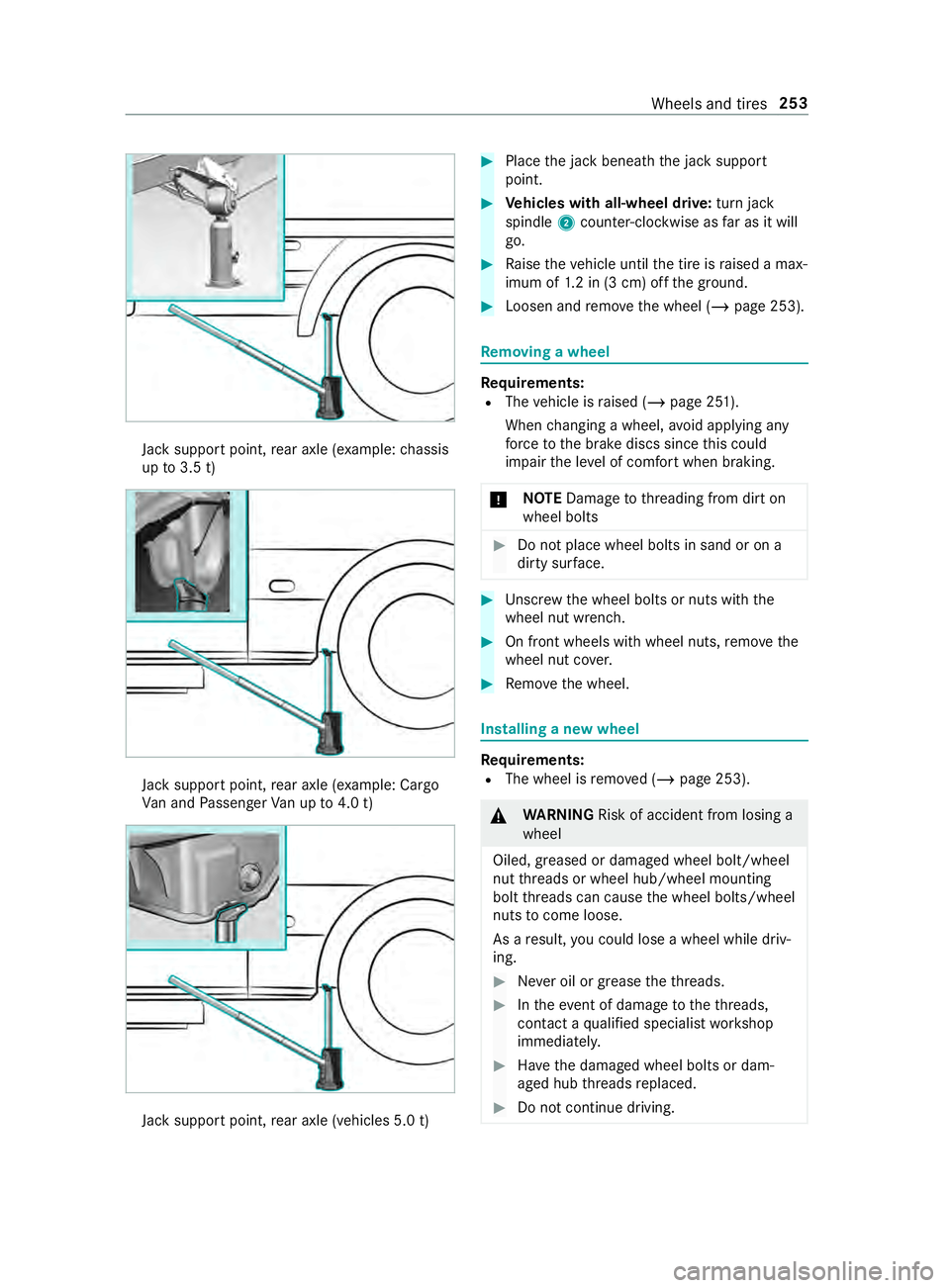
Jack support point,
rear axle (e xamp le:chassis
up to3.5 t) Jack
support point, rear axle (e xamp le: Cargo
Va n and Passenger Van up to4.0 t) Jack
support point, rear axle (vehicles 5.0 t) #
Place the jack beneath the jack support
point. #
Vehicles with all-wheel drive: turn jack
spindle 2counter-clockwise as far as it will
go. #
Raise theve hicle until the tire is raised a max‐
imum of 1.2 in (3 cm) off the ground. #
Loosen and remo vethe wheel (/ page 253). Re
moving a wheel Re
quirements:
R The vehicle is raised (/ page 251).
When changing a wheel, avoid applying any
fo rc eto the brake discs since this could
impair the le vel of com fort when braking.
* NO
TEDama getothre ading from dirt on
wheel bolts #
Do not place wheel bolts in sand or on a
dirty sur face. #
Unscr ewthe wheel bolts or nuts with the
wheel nut wrench. #
On front wheels with wheel nuts, remo vethe
wheel nut co ver. #
Remo vethe wheel. Installing a new wheel
Re
quirements:
R The wheel is remo ved (/ page 253). &
WARNING Risk of accident from losing a
wheel
Oiled, greased or damaged wheel bolt/wheel
nut thre ads or wheel hub/wheel mounting
bolt thre ads can cause the wheel bolts/wheel
nuts tocome loose.
As a result, you could lose a wheel while driv‐
ing. #
Never oil or grease theth re ads. #
Intheeve nt of damage totheth re ads,
con tact a qualified specialist workshop
immediatel y. #
Have the damaged wheel bolts or dam‐
aged hub thre ads replaced. #
Do not continue driving. Wheels and tires
253
Page 278 of 354
&
WARNING Risk of inju ryfrom tightening
wheel bolts and nuts
If yo u tighten the wheel bolts or wheel nuts
when theve hicle is raised, the jack could tip. #
Only tighten wheel bolts or wheel nuts
when theve hicle is on the ground. #
Obser vethe information on thech oice of
tires (/ page248). #
For saf etyre asons, only use wheel bolts or
wheel nuts which ha vebeen appr ovedby
Mercedes-Benz and forth e wheel in question.
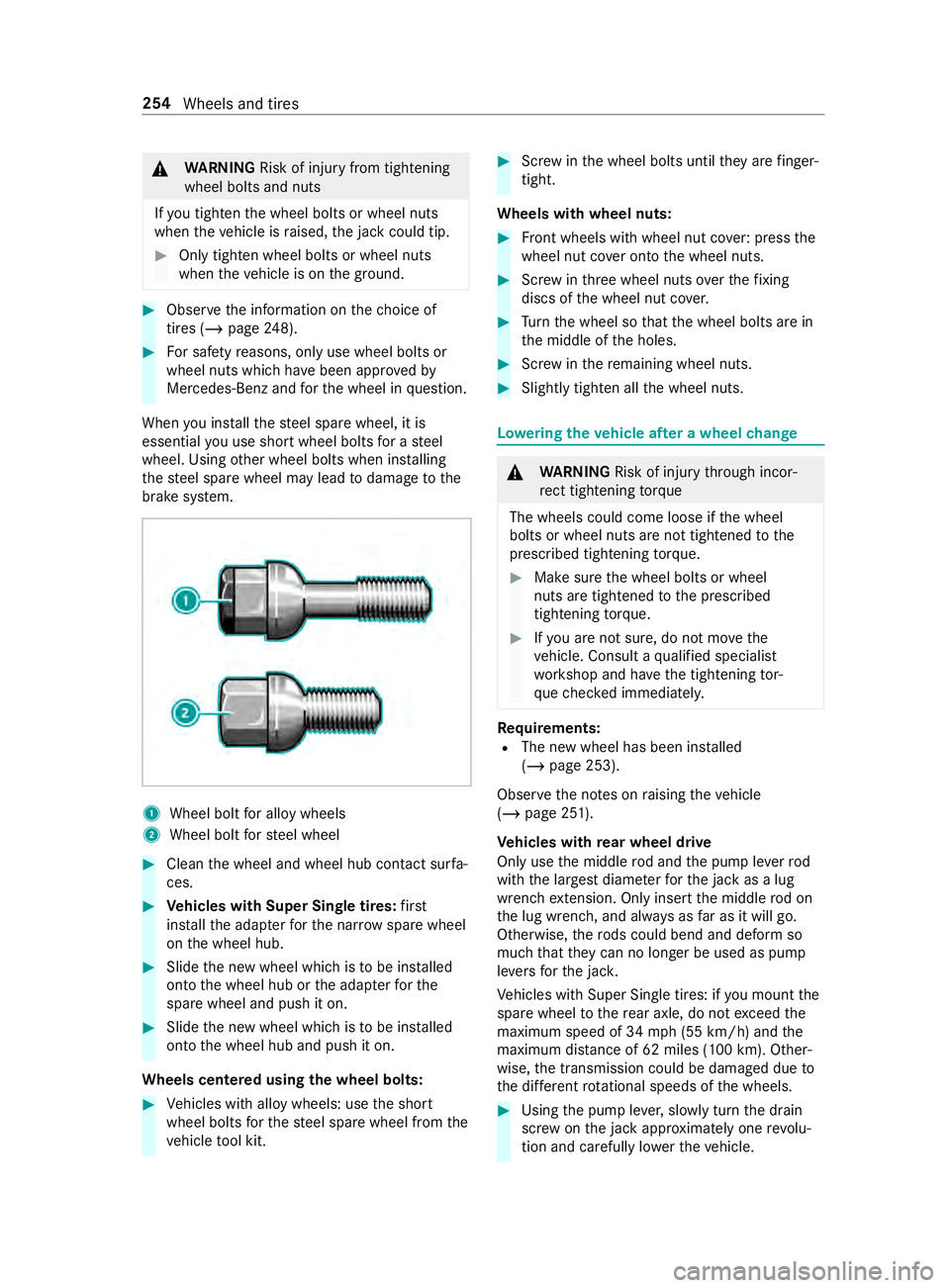
When you ins tallth esteel spare wheel, it is
essential you use short wheel bolts for a steel
wheel. Using other wheel bolts when ins talling
th esteel spare wheel may lead todamage tothe
brake sy stem. 1
Wheel bolt for alloy wheels
2 Wheel bolt forst eel wheel #
Clean the wheel and wheel hub contact sur fa‐
ces. #
Vehicles with Super Single tires: first
ins tallth e adap terfo rth e nar row spare wheel
on the wheel hub. #
Slide the new wheel which is tobe ins talled
onto the wheel hub or the adap terfo rthe
spare wheel and push it on. #
Slide the new wheel which is tobe ins talled
onto the wheel hub and push it on.
Wheels centered using the wheel bolts: #
Vehicles with alloy wheels: use the short
wheel bolts forth esteel spare wheel from the
ve hicle tool kit. #
Screw inthe wheel bolts until they are finger-
tight.
Wheels with wheel nuts: #
Front wheels with wheel nut co ver:press the
wheel nut co ver onto the wheel nuts. #
Screw inthre e wheel nuts overth efixing
discs of the wheel nut co ver. #
Turn the wheel so that the wheel bolts are in
th e middle of the holes. #
Screw inthere maining wheel nuts. #
Slightly tighten all the wheel nuts. Lo
weri ngtheve hicle af ter a wheel change &
WARNING Risk of inju rythro ugh incor‐
re ct tigh tening torque
The wheels could come loose if the wheel
bolts or wheel nuts are not tightened tothe
prescribed tightening torque. #
Makesure the wheel bolts or wheel
nuts are tightened tothe prescribed
tightening torque. #
Ifyo u are not sure, do not mo vethe
ve hicle. Consult a qualified specialist
wo rkshop and ha vethe tightening tor‐
qu ech ecked immediately. Re
quirements:
R The new wheel has been ins talled
(/ page 253).
Obser vethe no tes on raising theve hicle
(/ page 251).
Ve hicles with rear wheel drive
Only use the middle rod and the pump le verrod
with the largest diame terfo rth e jack as a lug
wrench extension. Only inse rtthe middle rod on
th e lug wrench, and alw ays as far as it will go.
Otherwise, thero ds could bend and deform so
much that they can no longer be used as pu mp
le ve rs forth e jac k.
Ve hicles with Super Single tires: if you mount the
spare wheel tothere ar axle, do not exceed the
maximum speed of 34 mph (55 km/h) and the
maximum dis tance of 62 miles (100 km). Other‐
wise, the transmission could be damaged due to
th e dif fere nt rotational speeds of the wheels. #
Using the pump le ver,slowly turn the drain
scr ew onthe jack appr oximately one revo lu‐
tion and carefully lo werth eve hicle. 254
Wheels and tires