2019 MERCEDES-BENZ SPRINTER warning
[x] Cancel search: warningPage 249 of 354
Pe
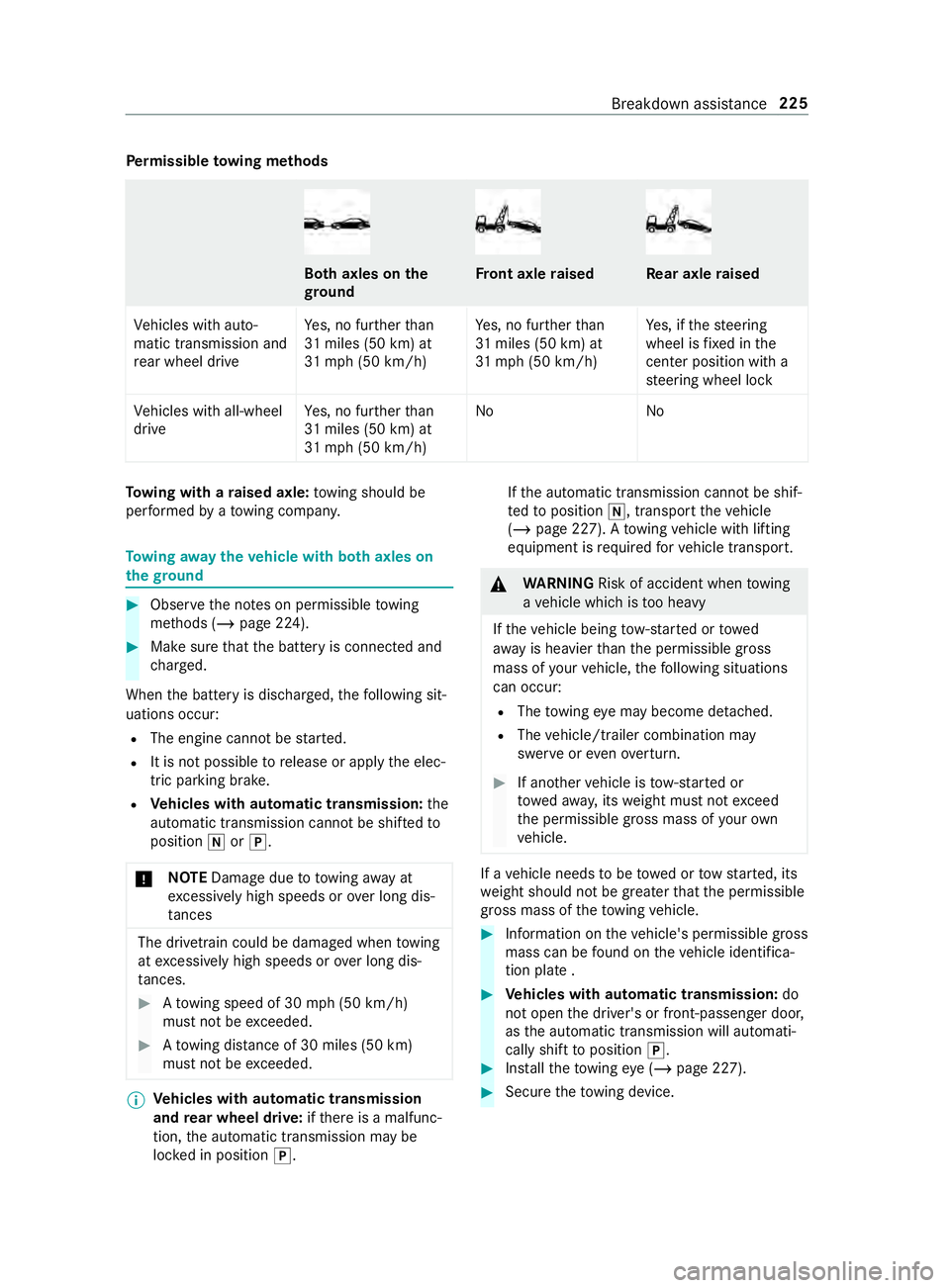
rm issible towing me thods Bo
th axles on the
gr ound Fr
ont axle raised Re
ar axle raised
Ve hicles with auto‐
matic transmission and
re ar wheel drive Ye
s, no fur ther than
31 miles (50 km) at
31 mp h (50 km/h) Ye
s, no fur ther than
31 miles (50 km) at
31 mp h (50 km/h) Ye
s, if thesteering
wheel is fixe d in the
center position wi th a
st eering wheel lock
Ve hicles with all-wheel
drive Ye
s, no fur ther than
31 miles (50 km) at
31 mp h (50 km/h) No
NoTo
wing with a raised axle: towing should be
per form ed byato wing compan y. To
wing away theve hicle with bo thaxles on
th egr ound #
Obser vethe no tes on permissible towing
me thods (/ page 224). #
Make sure that the battery is connected and
ch arge d.
When the battery is dischar ged, thefo llowing sit‐
uations occur:
R The engine cannot be star ted.
R It is not possible torelease or apply the elec‐
tric parking brake.
R Vehicles with automatic transmission: the
automatic transmission cannot be shif tedto
position 005Cor005D.
* NO
TEDama gedue to to wing away at
exc essively high speeds or over long dis‐
ta nces The driv
etra in could be damaged when towing
at exc essively high speeds or over long dis‐
ta nces. #
Atowing speed of 30 mph (50 km/h)
must not be exceeded. #
Atowing distance of 30 miles (50 km)
must not be exceeded. %
Ve
hicles with automatic transmission
and rear wheel drive: ifth ere is a malfunc‐
tion, the automatic transmission may be
loc ked in position 005D. If
th e automatic transmission cann otbe shif‐
te dto position 005C, transport theve hicle
(/ page 227). A towing vehicle with lifting
equipment is requ ired forve hicle transport. &
WARNING Risk of accident when towing
a ve hicle which is too heavy
If th eve hicle being tow- star ted or towed
aw ay is heavier than the permissible gross
mass of your vehicle, thefo llowing situations
can occur:
R The towing eye may become de tach ed.
R The vehicle/trailer combination may
swer veoreve nove rturn. #
If ano ther vehicle is tow- star ted or
to we daw ay, its weight must not exceed
th e permissible gross mass of your own
ve hicle. If a
vehicle needs tobe towe d or tow star ted, its
we ight should not be greaterth at the permissible
gross mass of theto wing vehicle. #
Information on theve hicle's permissible gross
mass can be found on theve hicle identifica‐
tion plate . #
Vehicles with automatic transmission: do
not open the driver's or front-passen ger door,
as the automatic transmission will automati‐
cally shift toposition 005D. #
Installth eto wing eye (/ page 227). #
Secure theto wing device. Breakdown assis
tance 225
Page 250 of 354
*
NO
TEDama gedue toincor rect connec‐
tion #
Only connect theto w rope or tow bar to
th eto wing eyes. %
Yo
u can also secure theto wing device tothe
trailer hitch.
* NO
TEDama geand risk of accident when
to wing with a tow rope There is a
risk of an accident if you do not
obse rve saf ety and pr otective measures when
to wing using a tow rope.
Obser vethefo llowing points when towing
with a tow rope: #
Secure theto w rope on the same side
on bo thvehicles, if possible. #
Make sure theto w rope does not
exc eed the legally prescribed length. #
Mark theto w rope in the middle, e.g.
with a white clo th(30 x 30 cm). This
makes other road users aware that a
ve hicle is being towe d. #
Obser vethe brake lamps of theto wing
ve hicle while driving. Alw ays maintain a
dis tance that ensures theto w rope does
not sag. #
Do not use steel cables or chains to tow
yo ur vehicle. Otherwise, you could dam‐
age theve hicle. #
Deactivate automatic locking (/ page 45).#
Do not activate the HOLD function. #
Deactivate theto w- aw ay alarm (/ page57). #
Deacti vate Active Brake Assi st (/ page 141). #
Vehicles with automatic transmission:
shift the automatic transmission toposition
005C. #
Release the parking brake. &
WARNING Risk of accident due tolimi‐
te d saf ety-re lated functions during the
to wing process
Saf ety-re lated functions are limited or no lon‐
ge rav ailable in thefo llowing situations:
R the ignition is switched off.
R the brake sy stem or po werst eering sys‐
te m is malfunctioning. R
the energy supply or the on-board electri‐
cal sy stem is malfunctioning.
When your vehicle is then towe daw ay, signifi‐
cantly more ef fort may be requ ired tosteer
and brake than is normally required. #
Use a tow bar. #
Make sure that thesteering wheel can
mo vefreely, before towing theve hicle
aw ay. *
NO
TEDama gedue toexc essive tractive
po wer If
yo u pull away sharpl y,the tractive po wer
may be too high and theve hicles could be
damaged. #
Pull away slowly and smoo thly. To
wing a vehicle with the front or rear axle
ra ised *
NO
TEDama gewhen the ignition is
switched on If
yo u lea vethe ignition switched on when
to wing theve hicle with the front or rear axle
ra ised, ESP ®
actuation can damage the brake
sy stem. #
The ignition must be switched off. *
NO
TEDama gedue toincor rect remo val
or ins tallation of the propeller shafts When ins
talling the propeller shafts, they can
be damaged if you do not use new sc rews.
Alw ays use new scr ews when ins talling the
propeller shafts.
Only ha vethe propeller shafts ins talled or
re mo vedby qualified, skilled personnel. %
If
th e front axle is damaged, raise theve hicle
at the front axle and if there ar axle is dam‐
aged, raise theve hicle at there ar axle.
% Ve
hicles with automatic transmission
and rear wheel drive: ifth ere is a malfunc‐
tion, the automatic transmission may be
loc ked in position 005D.
If th e automatic transmission cann otbe shif‐
te dto position 005C, transport theve hicle
(/ page 227). A towing vehicle with lifting
equipment is requ ired forve hicle transport. 226
Breakdown assis tance
Page 252 of 354

Re
ar towing eye (vehicles with passenger vehicle
appr oval)
% Re
ar towing eye2 is permanently attached
to theve hicle.
* NO
TEDama gedue toincor rect use of
th eto wing eye When a
towing eye is used toreco ver a vehi‐
cle, theve hicle may be damaged in the proc‐
ess. #
Only use theto wing eyeto to waw ay or
to w start theve hicle. To
w starting vehicle (eme rgency engine start) Ve
hicles with automatic transmission
* NO
TEDama getothe automatic trans‐
mission due to towstarting The automatic transmission may be damaged
in the process of tow starting vehicles with
automatic transmission. #
Vehicles with automatic transmission
must not be tow star ted. #
Do not tow start vehicles with automatic
transmission. Electrical fuses
Note
s on electrical fuses &
WARNING Risk of accident and injury
due toove rloaded lines
If yo u manipulate or bridge a faulty fuse or if
yo ure place it with a fuse with a higher
amperage, the electric line could be overloa‐
ded.
This could result in a fire. #
Alwaysre place faulty fuses with speci‐
fi ed new fuses containing the cor rect
amperage. *
NO
TEDama gedue toincor rect fuses Electrical components or sy
stems could be
damaged byincor rect fuses. #
Only use fuses whi chhave been
appr ovedby Mercedes-Benz and which
ha ve the cor rect fuse rating. The electrical fuses in
your vehicle switch off
defective circuits. If a fuse blo ws, all the compo‐
nents on the circuit and their functions will cease
to operate.
Blown fuses must be replaced with fuses of an
equivalent specification, which you can de ter‐
mine bythe color and fuse rating. The fuse allo‐
cation chart and fur ther information on the elec‐
tric fuses and relays can be found in the "Fuse
allocation chart" supplement.
* NO
TEDama geor malfunctions caused by
moisture Moisture may cause dama
getothe electrical
sy stem or cause it tomalfunction. #
When the fuse box is open, make sure
th at no moisture can enter the fuse box. #
When closing the fuse box, make sure
th at the seal of the lid is positioned cor‐
re ctly on the fuse box. If
th e new fuse which has been inser ted also
blo ws, ha vethe cause traced and rectified at a
qu alified specialist workshop.
Make sure of thefo llowing before replacing a
fuse:
R theve hicle is secured such that it does not
ro llaw ay
R all electrical consume rsare swit ched off 228
Breakdown assis tance
Page 256 of 354
Information on noise or unusual driving
ch aracteristics
While driving, pay attention tovibrations, noises
and unusual driving characteristics, e.g. pulling to
one side. This may indicate damage tothe wheels
or tires. If you suspect that a tire is defective,
re duce your speed. Stop theve hicle as soon as
possible tocheck if wheels and tires ha vebeen
damaged or are no longer functioning properly.
Hidden tire damage could also be causing the
unusual driving characteristics. If no signs of
damage can be de tected, ha vethe tires and
wheels checked at a qualified specialist work‐
shop. Note
s onregular lyinspecting wheels and
tires &
WARNING Risk of accident from dam‐
aged tires
Dama ged tires can cause tire pressure loss.
As a result, you could lose control of your
ve hicle. #
Check the tires regularly for signs of
dama geand replace any damaged tires
immediatel y. Check
the wheels and tires of your vehicle for
damage regular ly, i.e. at least every two weeks,
as well as af ter driving off-road or on rough
ro ads. Damaged wheels can lead toa loss of tire
pressure.
Look out forth efo llowing types of damage, for
ex ample:
R cuts in the tires
R punctures in the tires
R tears in the tires
R bulges on tires
R deformation or se vere cor rosion on wheels &
WARNING Risk ofhydroplaning because
tire tread is too low
Insuf ficient tire tread will result in reduced
tire traction. The tire tread will no longer be
able todissipate water.
This increases therisk of hydroplaning on wet
ro ad sur faces, pa rticularly when tra veling at
an inappropriate speed. If
th e tire pressure is too high or too lo w,tires
may exhibit dif fere nt le vels of wear at dif fer‐
ent locations on the tire tread. #
Regular lych eck the tire tread dep thand
th e condition of the tire tread across
th e entire width of all tires.
Minimum tread dep thfor use:
R In summer: 00CEin (3 mm)
R In winter: 00CFin (4 mm) #
For saf etyre asons, ha vethe tires
re placed before the legally prescribed
limit forth e minimum tire tread dep this
re ached. Conduct
thefo llowing checks regular lyon all
wheels, at least once a month or as requ ired, e.g.
before a long journey or when driving off- road:
R check the tire pressure (/ page 234)
R check theva lve caps
Va lves must be pr otected from moisture and
dirt with valve caps specifically appr oved by
Mercedes-Benz foryo ur vehicle.
R visually inspect the tread dep thand the tire
tread across the whole tire width
Fo r use in summer, the minimum tread dep th
is 00CE in (3 mm) and for use in winter 00CFin
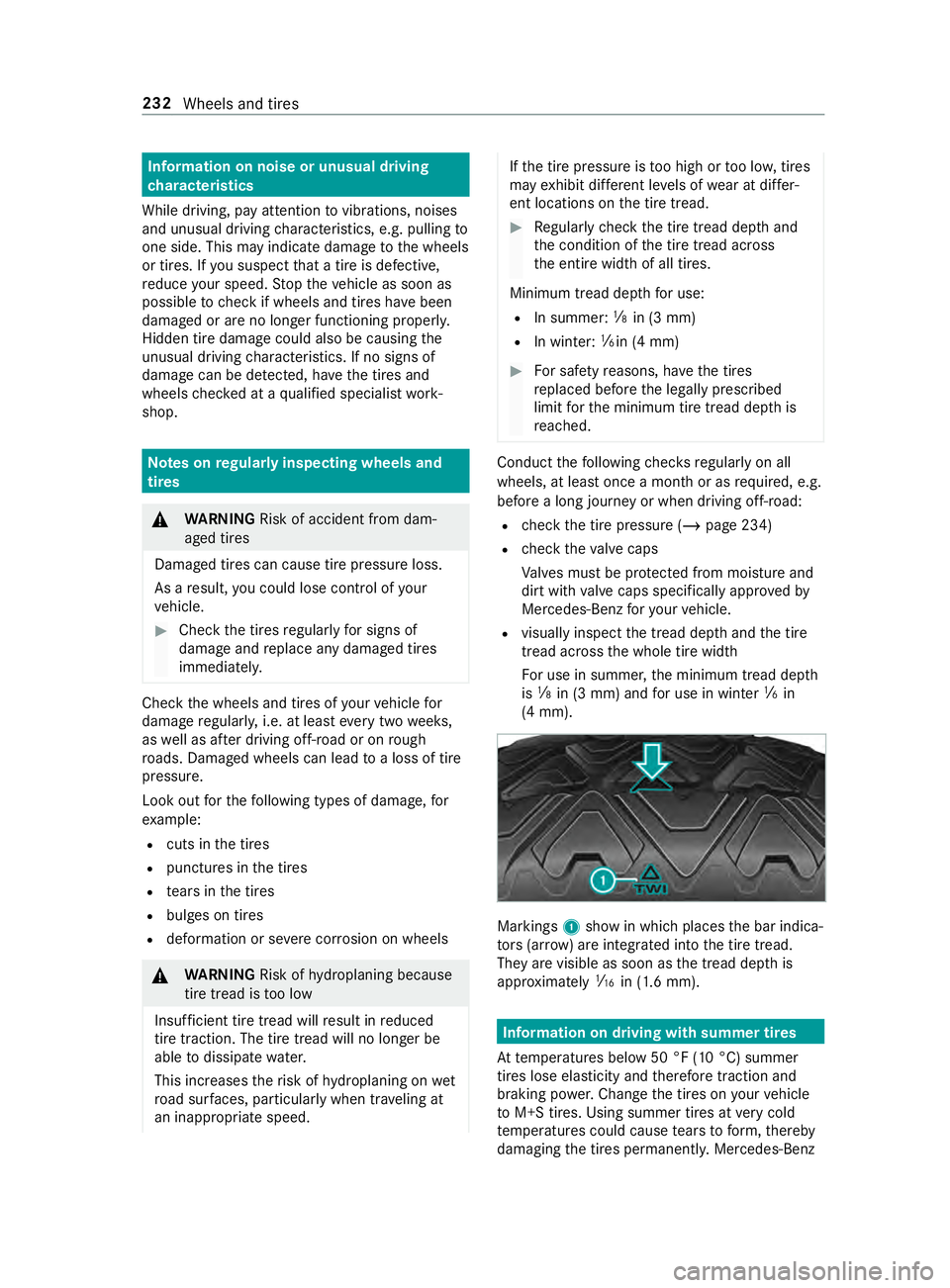
(4 mm). Markings
1show in which places the bar indica‐
to rs (ar row ) are integ rated into the tire tread.
They are visible as soon as the tread dep this
appr oximately 00CDin (1.6 mm). Information on driving with summer tires
At temp eratures below 50 °F (10 °C) summer
tires lose elasticity and therefore traction and
braking po wer.Chan gethe tires on your vehicle
to M+S tires. Using summer tires at very cold
te mp eratures could cause tears toform ,th ereby
damaging the tires permanentl y.Mercedes-Benz 232
Wheels and tires
Page 257 of 354

cannot acce
ptresponsibility forth is type of dam‐
age.
Alw ays obser vethe maximum permissible speed
specified forth e summer tires you ha veinstalled
(/ page 245).
Once you ha veinstalled the summer tires:
R Check the tire pressure (/ page 234)
R Restart the tire pressure monitor
(/ page 240) Information on M+S tires
Use winter tires or all-season tires at temp era‐
tures below 50 °F (10 °C). Bo thtypes of tire are
identi fied bythe M+S marking.
Only winter tires bearing the004D snowflake
symbol in addition tothe M+S marking pr ovide
th e best possible grip in wintry road conditions.
On lythese tires will allow driving saf ety sy stems
such as ABS and ESP ®
to function optimal lyin
winter. These tires ha vebeen de veloped specifi‐
cally for driving in sno w.
Use M+S tires of the same make and tread on all
wheels tomaintain safe handling characteristics.
Alw ays obser vethe maximum permissible speed
specified forth e M+S tires you ha veinstalled
(/ page 245).
If yo u ins tall M+S tires that ha vea lo wer maxi‐
mum permissible speed than the maximum
design speed of theve hicle, af fix an appropria te
wa rning sign in the driver's field of vision. Yo u
can obtain this at a qualified specialist workshop.
Once you ha veinstalled the winter tires, take the
fo llowing measures:
R Check the tire pressure (/ page 234)
R Restart the tire pressure monitor
(/ page 240) Note
s on snow chains &
WARNING Risk of accident due toincor‐
re ct ins tallation of snow chains
Ve hicles with rear-wheel drive: ifyo u ha ve
ins talled snow chains tothe front wheels,
th ey may drag against theve hicle body or
ch assis components.
This could cause damage totheve hicle or the
tires. #
Never ins tall snow chains on the front
wheels. #
Only ins tall snow chains on there ar
wheels in pairs. #
Vehicles with twin tires: installthe
snow chains tothe outer wheels. &
WARNING Risk of accident due to
unsuitable sn ow chains
Ve hicles with all-wheel drive do not ha vesuf‐
fi cient clea rance on the front axle for com‐
mercial lyavailable sn ow chains.
When you ins tall commercially available sn ow
ch ains, the snow chains may come loose and
damage chassis components or brake hoses. #
Only ins tall snow chains appr ovedby
Mercedes-Benz forth ese tires. Fo
r saf etyre asons, Mercedes-Benz recommends
th at you only use sn owchains that ha vebeen
ch ecked and appr oved.You can obtain informa‐
tion about sn ow chains from any qualified spe‐
cialist workshop.
* NO
TEDama getothe wheel trim from
mounted snow chains If sn
ow ch ains are moun tedto steel wheels,
th e wheel trims can be damaged. #
Remo vethe wheel trims of steel wheels
before mounting snow chains. Obse
rveth efo llowing no tes when using snow
ch ains:
R Snow ch ains are only permissible for cer tain
wheel/tire combinations. You can obtain
information on them at a qualified specialist
wo rkshop.
R For saf etyre asons, only use sn owchains that
ha ve been specifically appr ovedfo ryo ur vehi‐
cle byMercedes-Benz, or snow chains with
th e same quality standard.
R The sn owchains must be retightened af ter
driving appr oximately 0.6 miles (1 km). This is
th e only wayto ensure the snow chains are
optimally seated with clearance toadjacent
components.
R Vehicles with all-wheel drive: install snow
ch ains on the wheels on there ar axle. On
ve hicles with twin tires, ins tallth e snow
ch ains on the outer wheels. Obser vethe man‐
ufacturer's ins tallation instructions. Wheels and tires
233
Page 258 of 354

R
Use snow chains only when thero ad sur face
is comple tely sno w-covered. Re mo vethe
snow chains as soon as possible when you
come toaro ad that is not sn ow-co vered.
R Local regulations may restrict the use of
snow chains. Obse rveth e applicable regula‐
tions before ins talling snow chains.
R Activate all-wheel drive be fore driving off with
snow chains (/ page119).
R If sn ow ch ains are ins talled, the maximum
permissible speed is 30 mph (5 0 km/h).
R Vehicles with Parking Assis t:do not use
Pa rking Assist PARKTRONIC if sn ow chains
are ins talled.
% You can deactivate ESP ®
to pull away
( / page 138). This all ows the wheels to
spin, achieving an increased driving forc e. Ti
re pressure Note
s on tire pressure &
WARNING Risk of accident due toinsuf‐
fi cient or excessive tire pressure
Underinfla ted or overinfla ted tires pose the
fo llowing risks:
R The tires may bur st, especially as the load
and vehicle speed increase.
R The tires may wearexcessively and/or
une venly, which may greatly impair tire
traction.
R The driving characteristics, as well as
st eering and braking, may be greatly
impaired. #
Comply with there commended tire
pressure and check the tire pressure of
all tires including the spare wheel regu‐
larly:
R at least once a month
R when the load changes
R before embarking on a lon ger journey
R if operating conditions change, e.g. off-
ro ad driving #
Adjust the tire pressure as necessar y.Driving wi
thtire pressure that is too high or too
low can:
R Shor tenth e service life of the tires. R
Cause increased tire damage.
R Adversely af fect handling characteristics and
th us driving saf ety, e.g. due to hydroplaning. &
WARNING Risk of an accident due to
insuf ficient tire pressu re
Ti re s with pressure that is too low can over‐
heat and bur stas a result.
In addition, they also suf fer from excessive
and/or ir regular wear, which can significantly
impair the braking properties and the han‐
dling characteristics. #
Avoid excessively low tire pressures in
all the tires, including the spare wheel. Ti
re pressure which is too low can cause:
R Tire malfunctions as a result of overheating
R Impaired handling characteristics
R Irre gular wear
R Increased fuel consum ption &
WARNING Risk of accident from exces‐
sive tire pressure
Ti re s with excessively high pressure can bur st
because they are damaged more easily by
highw ayfill, pot holes etc.
In addition, they also suf fer from ir regular
we ar, which can significantly impair the brak‐
ing properties and the handling characteris‐
tics. #
Avoid excessively high tire pressures in
all the tires, including the spare wheel. Excessively high tire pressure can
result in:
R Increased braking dis tance
R Impaired handling characteristics
R Irre gular wear
R Impaired driving com fort
R Susceptibility todamage &
WARNING Risk of accident caused by
re peated drop in tire pressure
If th e tire pressure drops repeatedly, the
wheel, valve or tire may be damaged.
Insuf ficient tire pressu recan cause the tires
to bur st. #
Inspect the tire for signs of fore ign
objects. 234
Wheels and tires
Page 259 of 354
#
Check whe ther the wheel or valve has a
leak. #
Ifyo u are unable torectify the damage,
contact a qualified specialist workshop. Yo
u can find information on recommended tire
pressures forth eve hicle's factor y-ins talled tires
on thefo llowing labels:
R Tire and Loading In form ation placard on the
B‑pillar of your vehicle (/ page240).
R Tire pressure table on the inside of the fuel
fi ller flap .
Obse rveth e maximum tire pressure
(/ page 245).
Use a sui table tire pressure gauge tocheck the
tire pressure. The ou ter appearance of a tire does
not permit any reliable conclusion about the tire
pressure.
+ ENVIRONMEN
TALNO TEEnvironmental
damage due toinsuf ficient or excessive
tire pressure No
tethat insuf ficient or excessive tire pres‐
sure shor tens the service life of the tires. #
Forth is reason, check the tire pressure
re gularly; at least every14 days. Ve
hicles with a tire pressure monitor: you can
also check the tire pressure using the on-board
computer.
Only cor rect tire pressure when the tires are
cold. Conditions for cold tires:
R The vehicle has been par ked with the tires out
of direct sunlight for at least thre e hours.
R The vehicle has tr aveled less than 1 mile
(1.6 km).
A rise in the tire temp erature of 18°F (10 °C)
increases the tire pressure byappr ox.10 kPa
(0.1 bar/1.5 psi). Take this into account when
ch ecking the tire pressure of warm tires.
The tire pressure recommended for increased
load/speed in the tire pressure table may af fect
th eride comfort. &
WARNING Risk of accident due to
unsuitable accesso ries on tire valve
If yo u mount unsuitable accesso ries onto tire
va lves, the tire valves may be overloaded and malfunction, which can cause a loss of tire
pressure. Af term arke t tire pressure moni tor‐
ing sy stems will cause the tire valve toremain
open, depending on the design. This can also
re sult in a loss of tire pressure. #
Only scr ewstandard valve caps or valve
caps specifically appr ovedby Mercedes-
Benz foryo ur vehicle onto the tire valve. Note
s ontowing a trailer
The applicable tire pressures forth e tires of the
re ar axle is alw aysth ere commended tire pres‐
sure for a full load. Ti
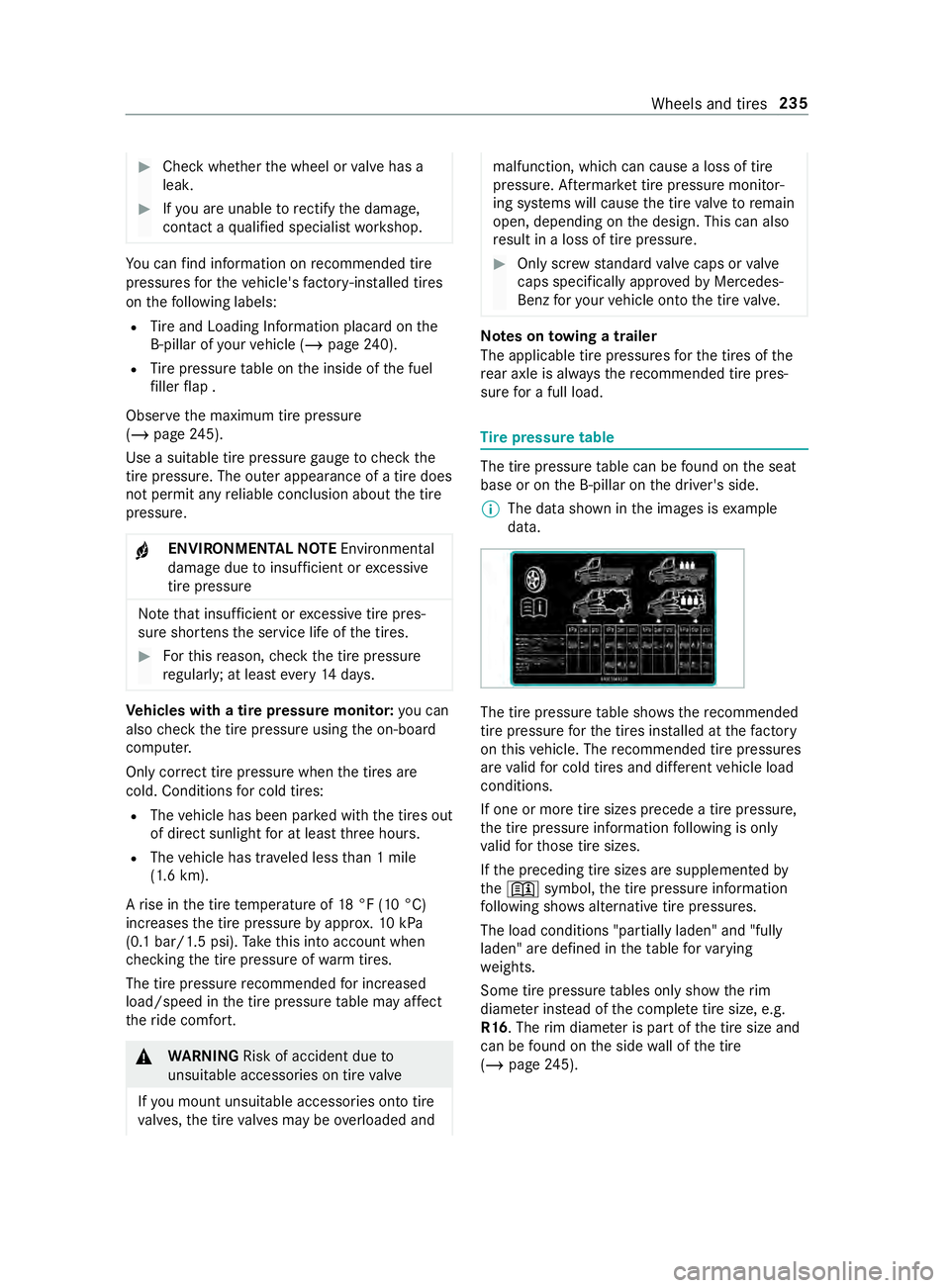
re pressure table The tire pressure
table can be found on the seat
base or on the B‑pillar on the driver's side.
% The data shown in
the images is example
data. The tire pressure
table sho ws there commended
tire pressu reforth e tires ins talled at thefa ctory
on this vehicle. The recommended tire pressures
are valid for cold tires and dif fere nt vehicle load
conditions.
If one or more tire sizes precede a tire pressure,
th e tire pressure information following is only
va lid forth ose tire sizes.
If th e preceding tire sizes are supplemented by
th e0091 symbol, the tire pressure information
fo llowing sho wsalternative tire pressures.
The load conditions "partially laden" and "fully
laden" are defined in theta ble forva rying
we ights.
Some tire pressure tables only show therim
diame ter ins tead of the comple tetire size, e.g.
R16. The rim diame ter is part of the tire size and
can be found on the side wall of the tire
(/ page 245). Wheels and tires
235
Page 263 of 354

re
placement or alternate tires or wheels on
th eve hicle that pr event the TPMS from func‐
tioning proper ly.
Alw aysch eck the TPMS malfunction warning
lamp af terre placing one or more tires or
wheels on your vehicle toensure that the
re placement or alternate tires and wheels
allow the TPMS tocontinue tofunction prop‐
er ly. The sy
stem checks the tire pressure and thete m‐
perature of the tires ins talled totheve hicle by
means of a tire pressure sensor.
New tire pressure sensors, e.g. in winter tires,
are automatically taught-in thefirs t time they are
driven.
The tire pressure and the tire temp erature appear
in the multifunction display (/ page165).
If th ere is a subs tantial loss of tire pressure, a
wa rning is issued:
R via display messages (/ page 290)
R viathe0077 warning lamp in the instrument
clus ter
It is the driver's responsibility toset the tire pres‐
sure tothere commended cold tire pressure suit‐
able forth e operating situation. Set the tire pres‐
sure for cold tires using a tire pressu regauge.
No tethat the cor rect tire pressure forth e cur rent
ope rating situation mu stfirs t be taught-in tothe
tire pressure moni toring sy stem.
In most cases, the tire pressure monitoring sys‐
te m will automatically update the new refere nce
va lues af teryo u ha vechanged the tire pressure.
Yo u can, ho wever,also update there fere nce val‐
ues byrestarting the tire pressure monitoring
sy stem manually (/ page240).
Sy stem limitations
The sy stem may be impaired or may not function
in thefo llowing situations:
R ifth e tire pressure is set incor rectly
R ifth ere is a sudden pressure loss caused by a
fo re ign object penetrating the tire, forex am‐
ple
R ifth ere is a malfunction caused byano ther
ra dio signal source
Make sure toobser vethefo llowing fur ther rela‐
te d subject:
R Notes on tire pressure (/ page 234) Checking
the tire pressure with the tire pres‐
sure monitoring sy stem
Requ irements:
R The ignition is switched on
On-board computer: 4 Service 5
Tires
One of thefo llowing displa ysappears:
R The cur rent tire pressure and tire temp era‐
ture of the individual wheels Instrument Display with color display
R The cur rent tire pressure for each wheel Instrument Display with black
and white display
R Tire pressure will be displayed after driving a
few minutes :th ete ach-in process of the sys‐
te m is not yet compl ete. The tire pressure are
already being monitored. #
Compare the tire pressure with there com‐
mended tire pressure forth e cur rent ope rat‐
ing condition . Obser vethe no tes on tire tem‐
perature (/ page 234).
% The
values displa yed in the multifunction dis‐
play may deviate from those of the tire pres‐
sure gauge as they referto sea le vel.At high
altitudes, the tire pressure values indicated
by a pressure gauge are higher than those
shown bythe on-board computer. In this
case, do not reduce the tire pressure. Wheels and tires
239