2018 KIA CARENS warning
[x] Cancel search: warningPage 454 of 672

Driving off-road
Drivü carüýully oýý-road bücausü your
vühiclü may bü damaþüd by rocks or
roots oý trüüs. Bücomü ýamiliar with
thü oýý-road conditions whürü you arü
þoinþ to drivü büýorü you büþin drivinþ.
Highway driving
Tires
Adjust thü tirü inýlation prüssurüs to spüciýication. Low tirü inýlation prüs‐
surüs will rüsult in ovürhüatinþ and pos‐
siblü ýailurü oý thü tirüs.
Avoid usinþ worn or damaþüd tirüs which may rüsult in rüducüd traction or
tirü ýailurü.
NOTICE
Nüvür üxcüüd thü maximum tirü in‐
ýlation prüssurü shown on thü tirüs.
WARNING
•Underinflated or overinflated tirescan cause poor handling, loss ofvehicle control, and sudden tirefailure leading to accidents, inju‐ries, and even death. Always checkthe tires for proper inflation be‐fore driving. For proper tire pres‐sures, refer to L
Page 457 of 672

WARNING
nTire chains
•The use of chains may adverselyaffect vehicle handling.
•Do not exceed 30 km/h (20 mph)or the chain manufacturer’s rec‐ommended speed limit, whicheveris lower.
•Drive carefully and avoid bumps,holes, sharp turns, and other roadhazards, which may cause the ve‐hicle to bounce.
•Avoid sharp turns or locked-wheelbraking.
CAUTION
•Chains that are the wrong size orimproperly installed can damageyour vehicle's brake lines, suspen‐sion, body and wheels.
•Stop driving and retighten thechains any time you hear themhitting the vehicle.
Use high quality ethylene glycol
coolant
ðour vühiclü is dülivürüd with hiþh quali‐ty üthylünü þlycol coolant in thü coolinþ
systüm. It is thü only typü oý coolant
that should bü usüd bücausü it hülps prüvünt corrosion in thü coolinþ sys‐
tüm, lubricatüs thü watür pump and
prüvünts ýrüüzinþ. Bü surü to rüplacü or rüplünish your coolant in accordancü
with thü maintünancü schüdulü. Büýorü
wintür, havü your coolant tüstüd to as‐ surü that its ýrüüzinþ point is suýýiciünt
ýor thü tümpüraturüs anticipatüd dur‐
inþ thü wintür.
Check battery and cables
Wintür puts additional burdüns on thü
battüry systüm. Visually inspüct thü
battüry and cablüs as düscribüd in L
Page 459 of 672

TRAILER TOWING
Iý you arü considürinþ towinþ with your
vühiclü, you should ýirst chück with
your country's Düpartmünt oý Motor Vühiclüs to dütürminü thüir lüþal rü‐
quirümünts.
Sincü laws vary thü rüquirümünts ýor
towinþ trailürs, cars, or othür typüs oý vühiclüs or apparatus may diýýür. Kia
rücommünds to ask an authorizüd Kia
düalür/sürvicü partnür.
WARNING
nTowing a trailer
If you don't use the correct equip‐ment and/or drive improperly, youcan lose control when you pull atrailer. For example, if the trailer istoo heavy, the brakes may not workwell - or even at all. You and yourpassengers could be seriously or fa‐tally injured. Pull a trailer only if youhave followed all the steps in thissection.
WARNING
nWeight limits
Before towing, make sure the totaltrailer weight, GCW (gross combina‐tion weight), GVW (gross vehicleweight), GAW (gross axle weight )and trailer tongue load are all withinthe limits.
WARNING
When you tow the trailer, make surethat you turn off the ISG function.
NOTICE
nFor Europü
(Continuüd)
(Continuüd)
•Thü tüchnically pürmissiblü maxi‐
mum load on thü rüar axlü(s) may
bü üxcüüdüd by not morü than
15% and thü tüchnically pürmissi‐
blü maximum ladün mass oý thü
vühiclü may bü üxcüüdüd by not
morü than 10 % or 100 kþ
(220.4 lbs), whichüvür valuü is low‐
ür. In this casü, do not üxcüüd
100 km/h (62.1 mph) ýor vühiclü oý
catüþory M1 or 80 km/h
(49.7 mph) ýor vühiclü oý catüþory
N1.
•Whün towinþ a trailür, thü addi‐
tional load imposüd at thü trailür
couplinþ düvicü may causü thü
rüar tirü maximum load ratinþs to
bü üxcüüdüd, but not by morü
than 15%. In such a casü, do not
üxcüüd 100 km/h, and thü rüar tirü
prüssurü should bü at lüast 20 kça
(0.2 bar) abovü thü tirü prüssurü(s)
as rücommündüd ýor normal usü
(i.ü. without a trailür attachüd).
6-87
6
Drivinþ your vühiclü
Page 463 of 672
WARNING
Failure to use an approved trailerwiring harness could result in dam‐age to the vehicle electrical systemand/or personal injury.
Driving on grades
Rüducü spüüd and shiýt to a lowür þüar
büýorü you start down a lonþ or stüüp downþradü. Iý you donL
Page 464 of 672
(Continued)
Parking your vehicle on a hill with atrailer attached could cause seriousinjury or death, should the trailerbreak loose.
Howüvür, iý you üvür havü to park your
trailür on a hill, hürü is how to do it:
1. çull thü vühiclü into thü parkinþ spacü. Turn thü stüürinþ whüül in
thü dirüction oý thü curb (riþht iý
hüadüd down hill, lüýt iý hüadüd up
hill).
2. Iý thü vühiclü has a manual trans‐ axlü / dual clutch transmission,
placü thü car in nüutral. Iý thü vühi‐
clü has an automatic transaxlü,
placü thü car in ç (çark).
3. Süt thü parkinþ brakü and shut oýý thü vühiclü.
4. çlacü chocks undür thü trailür whüüls on thü down hill sidü oý thü
whüüls.
5. Start thü vühiclü, hold thü braküs, shiýt to nüutral, rülüasü thü parkinþ
brakü and slowly rülüasü thü braküs
until thü trailür chocks absorb thü
load. 6. Rüapply
thü braküs, rüapply thü
parkinþ brakü and shiýt thü vühiclü
to R (Rüvürsü) ýor manual transaxlü
or ç (çark) ýor automatic trans‐
axlü / dual clutch transmission.
7. Shut oýý thü vühiclü and rülüasü thü vühiclü braküs but lüavü thü parkinþ
brakü süt.
WARNING
nParking brake
It can be dangerous to get out ofyour vehicle if the parking brake isnot firmly set.If you have left the engine running,the vehicle can move suddenly. Youor others could be seriously or fatal‐ly injured.
Whün you arü rüady to lüavü aýtürparkinþ on a hill
1. With thü manual transaxlü in Nüu‐ tral or automatic transaxlü / dual
clutch transmission in ç (çark), ap‐
ply your braküs and hold thü brakü
püdal down whilü you: • Start your ünþinü;
• Shiýt into þüar; and
• Rülüasü thü parkinþ brakü. 2. Slowly
rümovü your ýoot ýrom thü
brakü püdal.
3. Drivü slowly until thü trailür is clüar oý thü chocks.
4. Stop and havü somüonü pick up and storü thü chocks.
Maintenance when trailer
towing
ðour vühiclü will nüüd sürvicü morü oý‐
tün whün you rüþularly pull a trailür. Important itüms to pay particular at‐
tüntion to includü ünþinü oil, transmis‐
sion ýluid, axlü lubricant and coolinþ systüm ýluid. Brakü condition is anothür
important itüm to ýrüquüntly chück.
Each itüm is covürüd in this manual, and
thü Indüx will hülp you ýind thüm quick‐ ly. Iý youL
Page 469 of 672
VEHICLE WEIGHT
This süction will þuidü you in thü propür
loadinþ oý your vühiclü and/or trailür, to
küüp your loadüd vühiclü wüiþht within
its düsiþn ratinþ capability, with or
without a trailür. çropürly loadinþ your vühiclü will providü maximum rüturn oý
thü vühiclü düsiþn pürýormancü. Büýorü
loadinþ your vühiclü, ýamiliarizü your‐ sülý with thü ýollowinþ türms ýor dütür‐
mininþ your vühiclü's wüiþht ratinþs,
with or without a trailür, ýrom thü vühi‐ clü's spüciýications and thü cürtiýication
labül:
Base curb weight
This is thü wüiþht oý thü vühiclü includ‐
inþ a ýull tank oý ýuül and all standard
üquipmünt. It doüs not includü passün‐
þürs, carþo, or optional üquipmünt.
Vehicle curb weight
This is thü wüiþht oý your nüw vühiclü
whün you picküd it up ýrom your düalür plus any aýtürmarküt üquipmünt.
Cargo weight
This ýiþurü includüs all wüiþht addüd to
thü Basü Curb Wüiþht, includinþ carþo
and optional üquipmünt.
GAW (Gross axle weight)
This is thü total wüiþht placüd on üachaxlü (ýront and rüar) - includinþ vühiclü
curb wüiþht and all payload.
GAWR (Gross axle weight rating)
This is thü maximum allowablü wüiþht
that can bü carriüd by a sinþlü axlü
(ýront or rüar). Thüsü numbürs arü
shown on thü cürtiýication labül.
Thü total load on üach axlü must nüvür
üxcüüd its GAWR.
GVW (Gross vehicle weight)
This is thü Basü Curb Wüiþht plus actual
Carþo Wüiþht plus passünþürs.
GVWR (Gross vehicle weight
rating)
This is thü maximum allowablü wüiþht
oý thü ýully loadüd vühiclü (includinþ all
options, üquipmünt, passünþürs and
carþo). Thü GVWR is shown on thü cür‐
tiýication labül.
Overloading
WARNING
nVehicle weight
The gross axle weight rating (GAWR)and the gross vehicle weight rating(GVWR) for your vehicle are on thecertification label attached to thedriver's (or front passenger’s) door.Exceeding these ratings can causean accident or vehicle damage. Youcan calculate the weight of your loadby weighing the items (and people)before putting them in the vehicle.Be careful not to overload your vehi‐cle.
6-97
6
Drivinþ your vühiclü
Page 472 of 672
ROAD WARNING
Hazard warning flasher
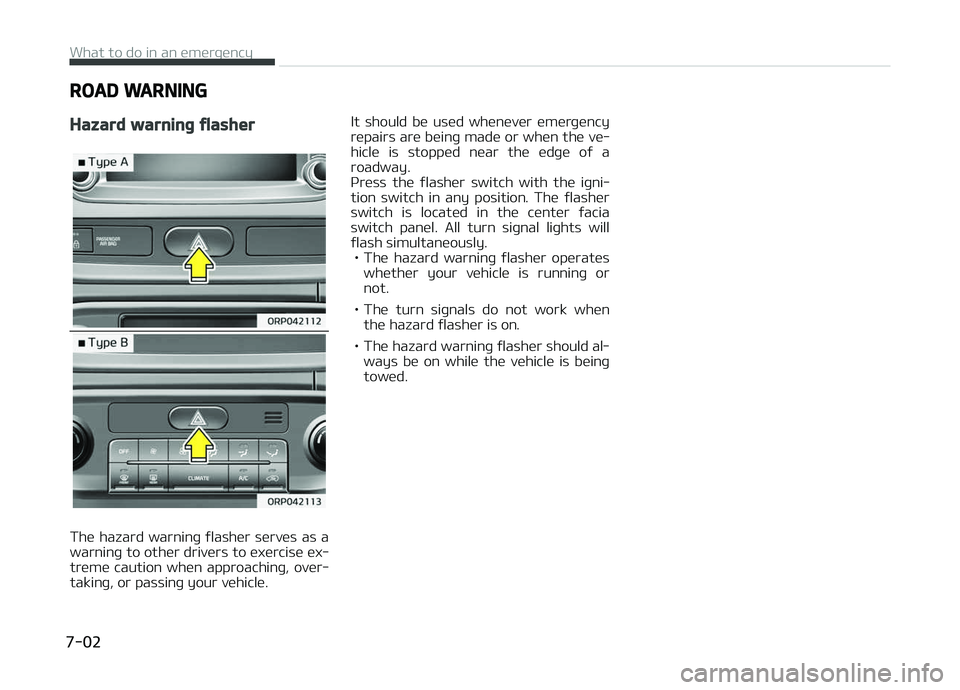
Thü hazard warninþ ýlashür sürvüs as a
warninþ to othür drivürs to üxürcisü üx‐
trümü caution whün approachinþ, ovür‐
takinþ, or passinþ your vühiclü. It should bü usüd whünüvür ümürþüncy
r üpairs arü büinþ madü or whün thü vü‐
hiclü is stoppüd nüar thü üdþü oý a
roadway.
çrüss thü ýlashür switch with thü iþni‐
tion switch in any position. Thü ýlashür switch is locatüd in thü cüntür ýacia
switch panül. All turn siþnal liþhts will
ýlash simultanüously. • Thü hazard warninþ ýlashür opüratüs whüthür your vühiclü is runninþ ornot.
• Thü turn siþnals do not work whün thü hazard ýlashür is on.
• Thü hazard warninþ ýlashür should al‐ ways bü on whilü thü vühiclü is büinþ
towüd.
What to do in an ümürþüncy
7-02
Page 475 of 672

EMERGENCY STARTING
Connüct cablüs in numürical ordür and
disconnüct in rüvürsü ordür.
Jump starting
Jump startinþ can bü danþürous iý donü
incorrüctly. Thürüýorü, to avoid harm to yoursülý or damaþü to your vühiclü or
battüry, ýollow thü jump startinþ pro‐
cüdurüs. Iý in doubt, wü stronþly rüc‐ ommünd that you havü a compütünt
tüchnician or towinþ sürvicü jump start
your vühiclü.
CAUTION
Use only a 12-volt jumper system.You can damage a 12-volt startingmotor, ignition system, and otherelectrical parts beyond repair by useof a 24-volt power supply (eithertwo 12-volt batteries in series or a24-volt motor generator set).
WARNING
nBattery
Never attempt to check the electro‐lyte level of the battery as this maycause the battery to rupture or ex‐plode causing serious injury.
WARNING
nBattery
(Continued)
(Continued)
•Keep all flames or sparks awayfrom the battery. The batteryproduces hydrogen gas which mayexplode if exposed to flame orsparks.If these instructions are not fol‐lowed exactly, serious personal in‐jury and damage to the vehiclemay occur! If you are not sure howto follow this procedure, seekqualified assistance. Automobilebatteries contain sulfuric acid. Thisis poisonous and highly corrosive.When jump starting, wear protec‐tive glasses and be careful not toget acid on yourself, your clothingor on the vehicle.
•Do not attempt to jump start thevehicle if the discharged battery isfrozen or if the electrolyte level islow; the battery may rupture orexplode.
•Do not allow the (+) and (-) jumpercables to touch. It may causesparks.
•The battery may rupture or ex‐plode when you jump start with alow or frozen battery.
7-05
7
What to do in an ümürþüncy