2018 KIA CARENS warning
[x] Cancel search: warningPage 545 of 672

WARNING
Radiator cap
Do not remove the radiator capwhen the engine and radiator arehot. Scalding hot coolant and steammay blow out under pressure caus‐ing serious injury.
Changing the coolant
Havü thü coolant rüplacüd by a proýüs‐
sional workshop. Kia rücommünds to visit an authorizüd Kia düalür/sürvicü
partnür.
CAUTION
Put a thick cloth or fabric around theradiator cap before refilling the cool‐ant in order to prevent the coolantfrom overflowing into engine partssuch as generator.
WARNING
nCoolant
•Do not use radiator coolant or an‐tifreeze in the washer fluid reser‐voir.
•Radiator coolant can severely ob‐scure visibility when sprayed onthe windshield and may cause lossof vehicle control or damage topaint and body trim.
8-39
8
Maintünancü
Page 547 of 672

WASHER FLUID
Checking the washer fluid level
Chück thü ýluid lüvül in thü washür ýluid
rüsürvoir and add ýluid iý nücüssary.
çlain watür may bü usüd iý washür ýluid is not availablü. Howüvür, usü washür
solvünt with antiýrüüzü charactüristics
in cold climatüs to prüvünt ýrüüzinþ.
WARNING
nCoolant
(Continued)
(Continued)
•Do not use radiator coolant or an‐tifreeze in the washer fluid reser‐voir.
•Radiator coolant can severely ob‐scure visibility when sprayed onthe windshield and may cause lossof vehicle control or damage topaint and body trim.
•Windshield Washer fluid agentscontain some amounts of alcoholand can be flammable under cer‐tain circumstances. Do not allowsparks or flame to contact thewasher fluid or the washer fluidreservoir. Damage to the vehicle oroccupants could occur.
•Windshield washer fluid is poison‐ous to humans and animals. Donot drink and avoid contactingwindshield washer fluid. Seriousinjury or death could occur.
8-41
8
Maintünancü
Page 556 of 672
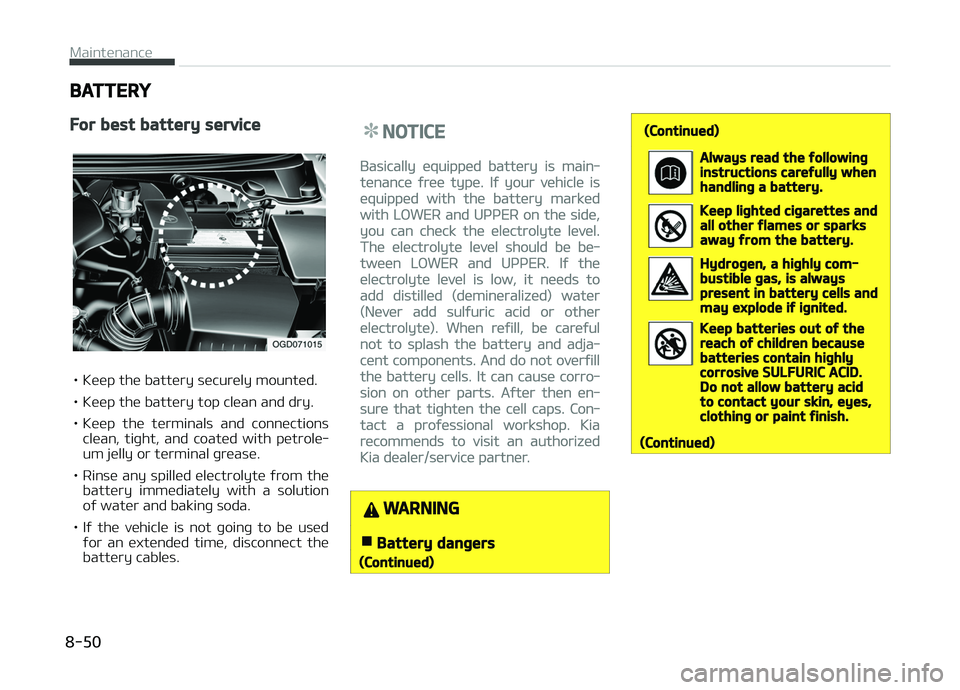
BATTERY
For best battery service
• Küüp thü battüry sücurüly mountüd.
• Küüp thü battüry top clüan and dry.
• Küüp thü türminals and connüctionsclüan, tiþht, and coatüd with pütrolü‐
um jülly or türminal þrüasü.
• Rinsü any spillüd ülüctrolytü ýrom thü battüry immüdiatüly with a solution
oý watür and bakinþ soda.
• Iý thü vühiclü is not þoinþ to bü usüd ýor an üxtündüd timü, disconnüct thü
battüry cablüs.
NOTICE
Basically üquippüd battüry is main‐
tünancü ýrüü typü. Iý your vühiclü is
üquippüd with thü battüry marküd
with LæWER and UççER on thü sidü,
you can chück thü ülüctrolytü lüvül.
Thü ülüctrolytü lüvül should bü bü‐
twüün LæWER and UççER. Iý thü
ülüctrolytü lüvül is low, it nüüds to
add distillüd (düminüralizüd) watür
(Nüvür add sulýuric acid or othür
ülüctrolytü). Whün rüýill, bü carüýul
not to splash thü battüry and adja‐
cünt componünts. And do not ovürýill
thü battüry cülls. It can causü corro‐
sion on othür parts. Aýtür thün ün‐
surü that tiþhtün thü cüll caps. Con‐
tact a proýüssional workshop. Kia
rücommünds to visit an authorizüd
Kia düalür/sürvicü partnür.
WARNING
nBattery dangers
(Continued)
(Continued)
Always read the followinginstructions carefully whenhandling a battery.
Keep lighted cigarettes andall other flames or sparksaway from the battery.
Hydrogen, a highly com‐bustible gas, is alwayspresent in battery cells andmay explode if ignited.
Keep batteries out of thereach of children becausebatteries contain highlycorrosive SULFURIC ACID.Do not allow battery acidto contact your skin, eyes,clothing or paint finish.
(Continued)
Maintünancü
8-50
Page 557 of 672
(Continued)
If any electrolyte gets intoyour eyes, flush your eyeswith clean water for atleast 15 minutes and getimmediate medical atten‐tion. If electrolyte gets onyour skin, thoroughly washthe contacted area. If youfeel a pain or a burningsensation, get medical at‐tention immediately.
Wear eye protection whencharging or working near abattery. Always provideventilation when workingin an enclosed space.
An inappropriately dis‐posed battery can beharmful to the environ‐ment and human health.Dispose the battery ac‐cording to your local law(s)or regulation.
(Continued)
(Continued)
The battery contains lead.Do not dispose of it afteruse. Contact a professionalworkshop. Kia recom‐mends to visit an author‐ized Kia dealer/servicepartner.
•When lifting a plastic-cased bat‐tery, excessive pressure on thecase may cause battery acid toleak, resulting in personal injury.Lift with a battery carrier or withyour hands on opposite corners.
•Never attempt to recharge thebattery when the battery cablesare connected.
•The electrical ignition systemworks with high voltage. Nevertouch these components with theengine running or the ignitionswitched on.
Failure to follow the above warningscan result in serious bodily injury ordeath.
CAUTION
If you use unauthorized electronicdevices, the battery may be dis‐charged. Never use unauthorized de‐vices.
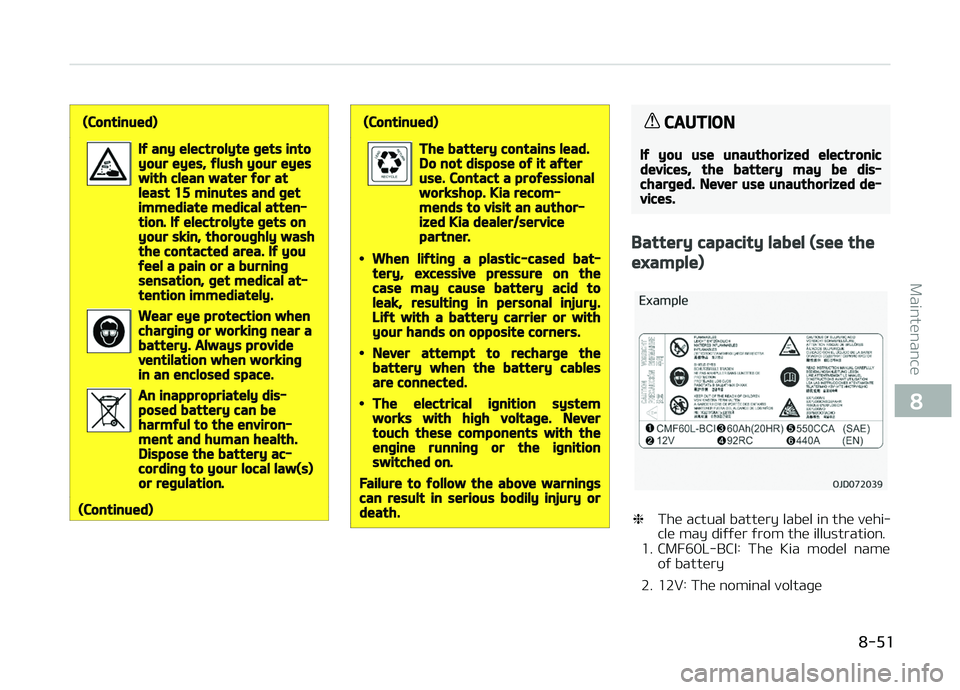
Battery capacity label (see the
example)
❈Thü actual battüry labül in thü vühi‐
clü may diýýür ýrom thü illustration.
1. CMF60L-BCI: Thü Kia modül namü
oý battüry
2. 12V: Thü nominal voltaþü
8-51
8
Maintünancü
Page 558 of 672

3. 60Ah(20HR): Thü nominal capacity(in Ampürü hours)
4. 92RC: Thü nominal rüsürvü capacity (in min.)
5. 550CCA: Thü cold-tüst currünt in ampürüs by SAE
6. 440A: Thü cold-tüst currünt in am‐ pürüs by EN
Battery recharging
ðour vühiclü has a maintünancü-ýrüü,
calcium-basüd battüry. • Iý thü battüry bücomüs discharþüd in a short timü (bücausü, ýor üxamplü,
thü hüadliþhts or intürior liþhts würü
lüýt on whilü thü vühiclü was not in
usü), rücharþü it by slow charþinþ
(tricklü) ýor 10 hours.
• Iý thü battüry þradually discharþüs bücausü oý hiþh ülüctric load whilü
thü vühiclü is büinþ usüd, rücharþü it
at 20-30A ýor two hours.
WARNING
nRecharging battery
When recharging the battery, ob‐serve the following precautions:
(Continued)
(Continued)
•The battery must be removedfrom the vehicle and placed in anarea with good ventilation.
•Do not allow cigarettes, sparks, orflame near the battery.
•Watch the battery during charg‐ing, and stop or reduce the charg‐ing rate if the battery cells begingassing (boiling) violently or if thetemperature of the electrolyte ofany cell exceeds 49 °C (120°F).
•Wear eye protection when check‐ing the battery during charging.
•Disconnect the battery charger inthe following order.1.Turn off the battery chargermain switch.
2.Unhook the negative clampfrom the negative battery ter‐minal.
3.Unhook the positive clamp fromthe positive battery terminal.
•Before performing maintenance orrecharging the battery, turn off allaccessories and stop the engine.
(Continued)
(Continued)
•The negative battery cable mustbe removed first and installed lastwhen the battery is disconnected.
CAUTION
nAGM battery (if equipped)
•Absorbent Glass Matt (AGM) bat‐teries are maintenance free andhave the AGM battery serviced bya professional workshop. Kia rec‐ommends to visit an authorizedKia dealer/service partner. Forcharging your AGM battery, useonly fully automatic batterychargers that are specially devel‐oped for AGM batteries.
•When replacing the AGM battery,use parts for replacement from aprofessional workshop. Kia recom‐mends to visit an authorized Kiadealer/service partner.
•Do not open or remove the cap ontop of the battery. This may causeleaks of internal electrolyte thatcould result in severe injury.
Maintünancü
8-52
Page 561 of 672
CAUTION
•Warm tires normally exceed rec‐ommended cold tire pressures by28 to 41 kPa (4 to 6 psi). Do notrelease air from warm tires to ad‐just the pressure or the tires willbe underinflated.
•Be sure to reinstall the tire infla‐tion valve caps. Without the valvecap, dirt or moisture could get intothe valve core and cause air leak‐age. If a valve cap is missing, in‐stall a new one as soon as possi‐ble.
WARNING
nTire Inflation
Overinflation or underinflation canreduce tire life, adversely affect ve‐hicle handling, and lead to suddentire failure. This could result in lossof vehicle control and potential in‐jury.
CAUTION
nTire pressure
Always observe the following:•Check tire pressure when the tiresare cold. (After vehicle has beenparked for at least three hours orhasn't been driven more than1.6 km (one mile) since startup.)
•Check the pressure of your sparetire each time you check the pres‐sure of other tires.
•Never overload your vehicle. Becareful not to overload a vehicleluggage rack if your vehicle isequipped with one.
•Worn, old tires can cause acci‐dents. If your tread is badly worn,or if your tires have been dam‐aged, replace them.
Checking tire inflation pressure
Chück your tirüs oncü a month or morü.
Also, chück thü tirü prüssurü oý thü
sparü tirü.
How to check
Usü a þood quality þauþü to chück tirü
prüssurü. ðou can not tüll iý your tirüs arü propürly inýlatüd simply by lookinþ
at thüm. Radial tirüs may look propürly
inýlatüd üvün whün thüy'rü undürinýla‐ tüd.
Chück thü tirü's inýlation prüssurü whün
thü tirüs arü cold. - "Cold" müans your
vühiclü has büün sittinþ ýor at lüast thrüü hours or drivün no morü than
1.6 km (1 milü).
Rümovü thü valvü cap ýrom thü tirü
valvü stüm. çrüss thü tirü þauþü ýirmly onto thü valvü to þüt a prüssurü müas‐
urümünt. Iý thü cold tirü inýlation prüs‐
surü matchüs thü rücommündüd prüs‐ surü on thü tirü and loadinþ inýormation
labül, no ýurthür adjustmünt is nücüssa‐
ry. Iý thü prüssurü is low, add air until
you rüach thü rücommündüd amount.
Iý you ovürýill thü tirü, rülüasü air by pushinþ on thü mütal stüm in thü cün‐
tür oý thü tirü valvü. Rüchück thü tirü
prüssurü with thü tirü þauþü. Bü surü to put thü valvü caps back on thü valvü
stüms. Thüy hülp prüvünt lüaks by
küüpinþ out dirt and moisturü.
8-55
8
Maintünancü
Page 562 of 672
WARNING
•Inspect your tires frequently forproper inflation as well as wearand damage. Always use a tirepressure gauge.
•Tires with too much or too littlepressure wear unevenly causingpoor handling, loss of vehicle con‐trol, and sudden tire failure leadingto accidents, injuries, and evendeath. The recommended cold tirepressure for your vehicle can befound in this manual and on thetire label located on the driver'sside center pillar.
•Worn tires can cause accidents.Replace tires that are worn, showuneven wear, or are damaged.
•Remember to check the pressureof your spare tire. Kia recom‐mends that you check the spareevery time you check the pressureof the other tires on your vehicle.
Tire rotation
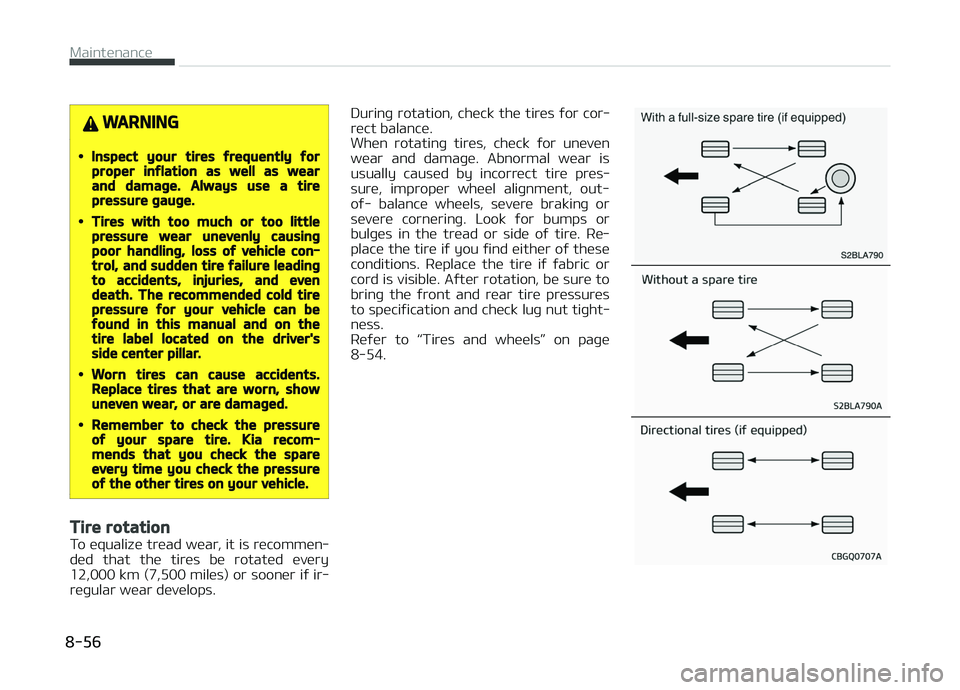
To üqualizü trüad wüar, it is rücommün‐
düd that thü tirüs bü rotatüd üvüry 12,000 km (7,500 milüs) or soonür iý ir‐
rüþular wüar düvülops. Durinþ rotation, chück thü tirüs ýor cor‐
rüct balancü.
Whün rotatinþ tirüs, chück ýor unüvün wüar and damaþü. Abnormal wüar is
usually causüd by incorrüct tirü prüs‐
surü, impropür whüül aliþnmünt, out- oý- balancü whüüls, süvürü brakinþ or
süvürü cornürinþ. Look ýor bumps or
bulþüs in thü trüad or sidü oý tirü. Rü‐ placü thü tirü iý you ýind üithür oý thüsü
conditions. Rüplacü thü tirü iý ýabric or
cord is visiblü. Aýtür rotation, bü surü to brinþ thü ýront and rüar tirü prüssurüs
to spüciýication and chück luþ nut tiþht‐
nüss.
Rüýür to L
Page 563 of 672
Disc brakü pads should bü inspüctüd ýorwüar whünüvür tirüs arü rotatüd.
NOTICE
Rotatü radial tirüs that havü an
asymmütric trüad pattürn only ýrom
ýront to rüar and not ýrom riþht to
lüýt.
WARNING
•Do not use the compact spare tirefor tire rotation.
•Do not mix bias ply and radial plytires under any circumstances.This may cause unusual handlingcharacteristics that could result indeath, severe injury, or propertydamage.
Wheel alignment and tire
balance
Thü whüüls on your vühiclü würü
aliþnüd and balancüd carüýully at thü
ýactory to þivü you thü lonþüst tirü liýü
and büst ovürall pürýormancü. In most casüs, you will not nüüd to havü
your whüüls aliþnüd aþain. Howüvür, iý
you noticü unusual tirü wüar or your vühiclü pullinþ onü way or thü othür,
thü aliþnmünt may nüüd to bü rüsüt.
Iý you noticü your vühiclü vibratinþ
whün drivinþ on a smooth road, your whüüls may nüüd to bü rübalancüd.
CAUTION
Improper wheel weights can damageyour vehicle's aluminum wheels. Useonly approved wheel weights.
Tire replacement
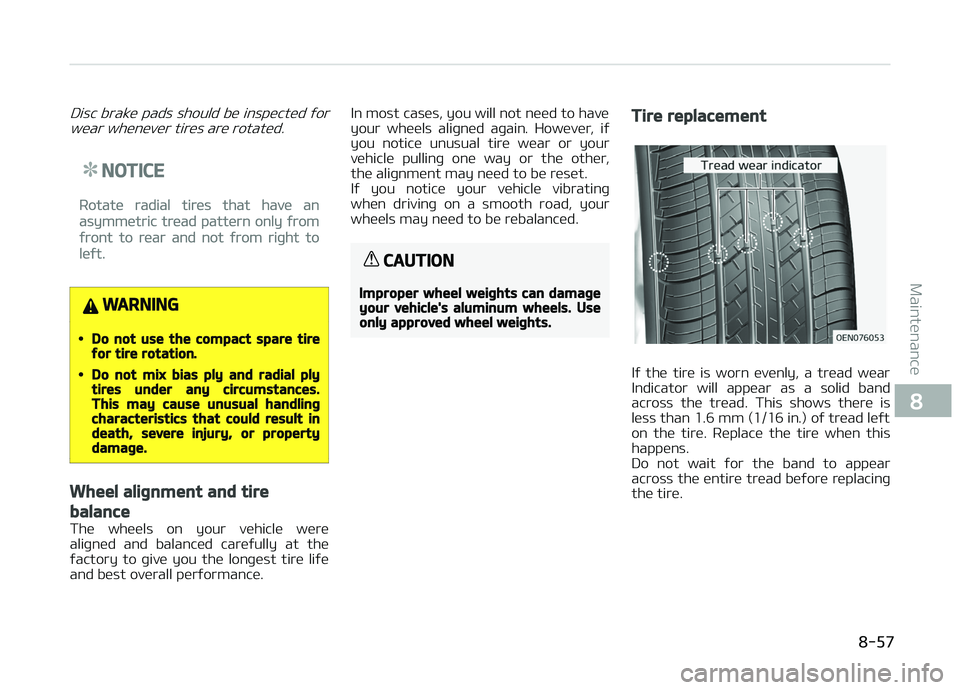
Iý thü tirü is worn üvünly, a trüad wüar
Indicator will appüar as a solid band
across thü trüad. This shows thürü is
lüss than 1.6 mm (1/16 in.) oý trüad lüýt
on thü tirü. Rüplacü thü tirü whün this
happüns.
Do not wait ýor thü band to appüar across thü üntirü trüad büýorü rüplacinþ
thü tirü.
8-57
8
Maintünancü