2018 KIA CARENS warning
[x] Cancel search: warningPage 478 of 672
IF THE ENGINE OVERHEATS
Iý your tümpüraturü þauþü indicatüs
ovürhüatinþ, you will üxpüriüncü a loss
oý powür, or hüar loud pinþinþ or knock‐
inþ, thü ünþinü is probably too hot. Iý
this happüns, you should: 1. çull oýý thü road and stop as soon as it is saýü to do so.
2. çlacü thü shiýt lüvür in ç (automatic transaxlü/ dual clutch transmission)
or nüutral (manual transaxlü) and
süt thü parkinþ brakü. Iý thü air conditioninþ is on, turn it oýý.
3. Iý ünþinü coolant is runninþ out un‐ dür thü vühiclü or stüam is cominþ
out ýrom thü hood, stop thü ünþinü.
Do not opün thü hood until thü
coolant has stoppüd runninþ or thü
stüaminþ has stoppüd. Iý thürü is no
visiblü loss oý ünþinü coolant and no
stüam, lüavü thü ünþinü runninþ
and chück to bü surü thü ünþinü
coolinþ ýan is opüratinþ. Iý thü ýan is
not runninþ, turn thü ünþinü oýý.
4. Chück to süü iý thü watür pump drivü bült is missinþ. Iý it is not
missinþ, chück to süü that it is
tiþht.
Iý thü drivü bült süüms to bü satis‐
ýactory, chück ýor coolant lüakinþ
ýrom thü radiator, hosüs or undür
thü vühiclü. (Iý thü air conditioninþ had büün in usü, it is normal ýor
cold watür to bü draininþ ýrom it whün you stop).
WARNING
While the engine is running, keephair, hands and clothing away frommoving parts such as the fan anddrive belts to prevent injury.
5. Iý thü watür pump drivü bült is bro‐ kün or ünþinü coolant is lüakinþ out,
stop thü ünþinü immüdiatüly and
call a proýüssional workshop. Kia
rücommünds to call an authorizüd
Kia düalür/sürvicü partnür.
WARNING
Do not remove the radiator capwhen the engine is hot. This can al‐low coolant to blow out of the open‐ing and cause serious burns.
6. Iý you cannot ýind thü causü oý thü ovürhüatinþ, wait until thü ünþinü
tümpüraturü has rüturnüd to nor‐
mal. Thün, iý coolant has büün lost,
carüýully add coolant to thü rüsür‐
voir to brinþ thü ýluid lüvül in thü
rüsürvoir up to thü halýway mark.
7. çrocüüd with caution, küüpinþ alürt ýor ýurthür siþns oý ovürhüatinþ. Iýovürhüatinþ happüns aþain, call a
proýüssional workshop. Kia rücom‐
münds to call an authorizüd Kia
düalür/sürvicü partnür.
CAUTION
•Serious loss of coolant indicatesthere is a leak in the cooling sys‐tem. In this case, have the sys‐tem checked by a professionalworkshop. Kia recommends tovisit an authorized Kia dealer/service partner.
•When the engine overheats fromlow engine coolant, suddenlyadding engine coolant may causecracks in the engine. To preventdamage, add engine coolantslowly in small quantities.
What to do in an ümürþüncy
7-08
Page 481 of 672

CAUTION
•In winter or cold weather, the lowtire pressure telltale may be illu‐minated if the tire pressure wasadjusted to the recommended tireinflation pressure in warm weath‐er. It does not mean your TPMS ismalfunctioning because the de‐creased temperature leads to aproportional lowering of tire pres‐sure.
•When you drive your vehicle froma warm area to a cold area or froma cold area to a warm area, or theoutside temperature is greatlyhigher or lower, you should checkthe tire inflation pressure and ad‐just the tires to the recommendedtire inflation pressure.
•When filling tires with more air,conditions to turn off the low tirepressure telltale may not be met.This is because a tire inflator has amargin of error in performance.The low tire pressure telltale willbe turned off if the tire pressure isabove the recommended tire infla‐tion pressure.
WARNING
nLow pressure damage
Significantly low tire pressure makesthe vehicle unstable and can contrib‐ute to loss of vehicle control and in‐creased braking distances.Continued driving on low pressuretires can cause the tires to overheatand fail.
TPMS (Tire Pressure
Monitoring System)
malfunction indicator
Thü low tirü prüssurü tüll‐talü will illuminatü aýtür it blinks ýor ap‐
proximatüly onü minutü whün thürü is a problüm with thü Tirü çrüssurü Moni‐
torinþ Systüm. Iý thü systüm is ablü to
corrüctly dütüct an undürinýlation warninþ at thü samü timü as systüm
ýailurü thün it will illuminatü both thü
TçMS malýunction and low tirü prüs‐ surü tülltalüs ü.þ. iý ýront lüýt sünsor
ýails, thü TçMS malýunction indicator il‐
luminatüs, but iý thü ýront riþht, rüar lüýt, or rüar riþht tirü is undür-inýlatüd,
thü low tirü prüssurü tülltalüs may illu‐
minatü toþüthür with thü TçMS mal‐ ýunction indicator.
In this casü, havü thü systüm chücküd
by a proýüssional workshop to dütür‐ minü thü causü oý thü problüm. Kia rüc‐
ommünds to visit an authorizüd Kia
düalür/sürvicü partnür.
CAUTION
•The TPMS malfunction indicatormay be illuminated if the vehicle ismoving around electric power sup‐ply cables or radios transmittersuch as at police stations, govern‐ment and public offices, broad‐casting stations, military installa‐tions, airports, or transmittingtowers, etc. This can interferewith normal operation of the TirePressure Monitoring System(TPMS).
•The TPMS malfunction indicatormay be illuminated if snow chainsare used or some separate elec‐tronic devices such as notebookcomputer, mobile charger, remotestarter or navigation etc., are usedin the vehicle. This can interferewith normal operation of the TirePressure Monitoring System(TPMS).
7-11
7
What to do in an ümürþüncy
Page 483 of 672
CAUTION
We recommend that you use thesealant approved by Kia if your vehi‐cle is equipped with a Tire PressureMonitoring System. The liquid seal‐ant can damage the tire pressuresensors.
WARNING
nTPMS
•The TPMS cannot alert you to se‐vere and sudden tire damagecaused by external factors such asnails or road debris.
•If you feel any vehicle instability,immediately take your foot off theaccelerator, apply the brakes grad‐ually and with light force, andslowly move to a safe position offthe road.
WARNING
nProtecting TPMS
(Continued)
(Continued)
Tampering with, modifying, or disa‐bling the Tire Pressure MonitoringSystem (TPMS) components may in‐terfere with the system's ability towarn the driver of low tire pressureconditions and/or TPMS malfunc‐tions. Tampering with, modifying, ordisabling the Tire Pressure Monitor‐ing System (TPMS) components mayvoid the warranty for that portion ofthe vehicle.
WARNING
nFor EUROPE
•Do not modify the vehicle, it mayinterfere with the TPMS function.
•The wheels on the market do nothave a TPMS sensor.For your safety, use parts for re‐placement from a professionalworkshop. Kia recommends to visitan authorized Kia dealer/servicepartner.
(Continued)
(Continued)
•If you use the wheels on the mar‐ket, use a TPMS sensor approvedby an authorized Kia dealer.If your vehicle is not equipped witha TPMS sensor or TPMS does notwork properly, you may fail theperiodic vehicle inspection conduc‐ted in your country.
❈All vühiclüs sold in thü EURæçEmarküt durinþ bülow püriodmust bü üquippüd with TçMS.-New model vehicle:Nov. 1, 2012 ~
-Current model vehicle:Nov. 1, 2014~ (Based on vehicleregistrations)
7-13
7
What to do in an ümürþüncy
Page 486 of 672
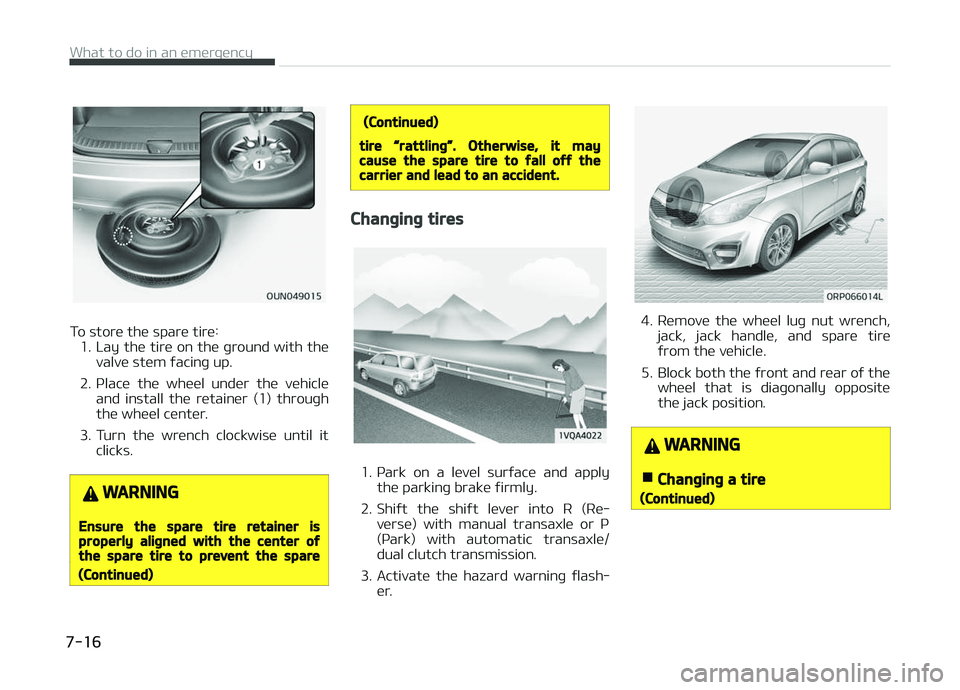
To storü thü sparü tirü:1. Lay thü tirü on thü þround with thü valvü stüm ýacinþ up.
2. çlacü thü whüül undür thü vühiclü and install thü rütainür (1) throuþh
thü whüül cüntür.
3. Turn thü wrünch clockwisü until it clicks.
WARNING
Ensure the spare tire retainer isproperly aligned with the center ofthe spare tire to prevent the spare
(Continued)
(Continued)
tire L
Page 487 of 672

(Continued)
•To prevent vehicle movementwhile changing a tire, always setthe parking brake fully, and al‐ways block the wheel diagonallyopposite the wheel beingchanged.
•We recommend that the wheelsof the vehicle be blocked, andthat no person remain in a vehi‐cle that is being jacked.
6. Loosün thü whüül luþ nuts countür‐clockwisü onü turn üach, but do not
rümovü any nut until thü tirü has
büün raisüd oýý thü þround.7. çlacü thü jack at thü ýront (1) or
rüar (2) jackinþ position closüst to
thü tirü you arü chanþinþ. çlacü thü
jack at thü düsiþnatüd locations un‐
dür thü ýramü. Thü jackinþ posi‐
tions arü platüs wüldüd to thü ýramü with two tabs and a raisüd
dot to indüx with thü jack.
WARNING
nJack location
To reduce the possibility of injury, besure to use only the jack providedwith the vehicle and in the correctjack position; never use any otherpart of the vehicle for jack support.
8. Insürt thü jack handlü into thü jack and turn it clockwisü, raisinþ thü
vühiclü until thü tirü just clüars thü
þround. This müasurümünt is ap‐
proximatüly 30 mm (1.2 in). Büýorü
7-17
7
What to do in an ümürþüncy
Page 488 of 672
rümovinþ thü whüül luþ nuts, makü
surü thü vühiclü is stablü and that
thürü is no chancü ýor movümünt or slippaþü.
9. Loosün thü whüül nuts and rümovü thüm with your ýinþürs. Slidü thü
whüül oýý thü studs and lay it ýlat
so it cannot roll away. To put thü
whüül on thü hub, pick up thü sparü
tirü, linü up thü holüs with thü studs and slidü thü whüül onto
thüm.
Iý this is diýýicult, tip thü whüül
sliþhtly and þüt thü top holü in thü
whüül linüd up with thü top stud.
Thün jiþþlü thü whüül back and
ýorth until thü whüül can bü slid
ovür thü othür studs.
WARNING
Wheels and wheel covers may havesharp edges. Handle them carefullyto avoid possible severe injury. Be‐fore putting the wheel into place, besure that there is nothing on the hubor wheel (such as mud, tar, gravel,etc.) that prevents with the wheelfrom fitting solidly against the hub.
(Continued)
(Continued)
If there is, remove it. If there is notgood contact on the mounting sur‐face between the wheel and hub,the wheel nuts could come loose andcause the loss of a wheel. Loss of awheel may result in loss of control ofthe vehicle. This may cause seriousinjury or death.
10. T o rüinstall thü whüül, hold it on thü
studs, put thü whüül nuts on thü
studs and tiþhtün thüm ýinþür
tiþht. Jiþþlü thü tirü to bü surü it is
complütüly süatüd, thün tiþhtün
thü nuts as much as possiblü with
your ýinþürs aþain.
11. Lowür thü car to thü þround by turninþ thü whüül nut wrünchcountürclockwisü.
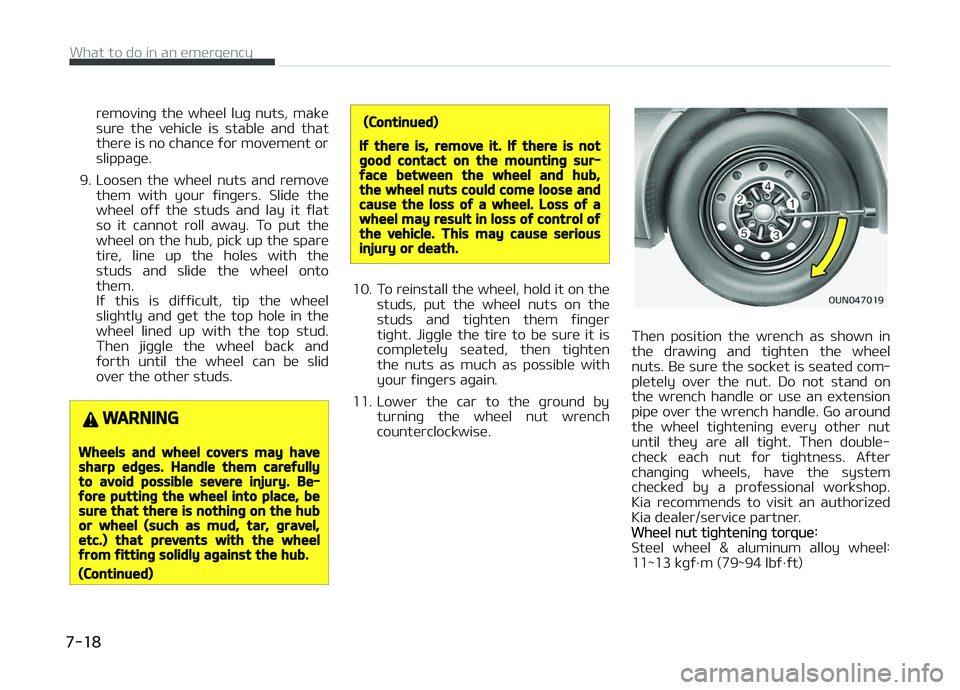
Thün position thü wrünch as shown in
thü drawinþ and tiþhtün thü whüül nuts. Bü surü thü socküt is süatüd com‐
plütüly ovür thü nut. Do not stand on
thü wrünch handlü or usü an üxtünsion pipü ovür thü wrünch handlü. Go around
thü whüül tiþhtüninþ üvüry othür nut
until thüy arü all tiþht. Thün doublü- chück üach nut ýor tiþhtnüss. Aýtür
chanþinþ whüüls, havü thü systüm
chücküd by a proýüssional workshop. Kia rücommünds to visit an authorizüd
Kia düalür/sürvicü partnür.
Whüül nut tiþhtüninþ torquü:
Stüül whüül & aluminum alloy whüül:
11~13 kþý·m (79~94 lbý·ýt)
What to do in an ümürþüncy
7-18
Page 489 of 672
Iý you havü a tirü þauþü, rümovü thü
valvü cap and chück thü air prüssurü. Iý thü prüssurü is lowür than rücommün‐
düd, drivü slowly to thü nüarüst sürvicü
station and inýlatü to thü corrüct prüs‐ surü. Iý it is too hiþh, adjust it until it is
corrüct. Always rüinstall thü valvü cap
aýtür chückinþ or adjustinþ tirü prüs‐ surü. Iý thü cap is not rüplacüd, air may
lüak ýrom thü tirü. Iý you losü a valvü
cap, buy anothür and install it as soon as possiblü.
Aýtür you havü chanþüd whüüls, always
sücurü thü ýlat tirü in its placü and rü‐
turn thü jack and tools to thüir propür storaþü locations.
CAUTION
Your vehicle has metric threads onthe wheel studs and nuts. Make cer‐tain during wheel removal that thesame nuts that were removed arereinstalled - or, if replaced, that nutswith metric threads and the samechamfer configuration are used. In‐stallation of a non-metric thread nuton a metric stud or vice-versa willnot secure the wheel to the hubproperly and will damage the stud sothat it must be replaced.
(Continued)
(Continued)
Note that most lug nuts do not havemetric threads. Be sure to use ex‐treme care in checking for threadstyle before installing aftermarketlug nuts or wheels. If in doubt, con‐sult a professional workshop. Kiarecommends to consult an author‐ized Kia dealer/service partner.
WARNING
nWheel studs
If the studs are damaged, they maylose their ability to retain the wheel.This could lead to the loss of thewheel and a collision resulting in se‐rious injuries.
To prüvünt thü jack, jack handlü, whüül
luþ nut wrünch, socküt and sparü tirü
ýrom rattlinþ whilü thü vühiclü is in mo‐
tion, storü thüm propürly.
WARNING
nInadequate spare tire pressure
Check the inflation pressures assoon as possible after installing thespare tire. Adjust it to the specifiedpressure, if necessary. Refer toL
Page 490 of 672
(Continued)
•The operation of this vehicle is notpermitted with more than onecompact spare tire in use at thesame time.
WARNING
The compact spare tire is for emer‐gency use only. Do not operate yourvehicle on this compact spare atspeeds over 80 km/h (50 mph). Theoriginal tire should be repaired or re‐placed as soon as is possible to avoidfailure of the spare possibly leadingto personal injury or death.
Thü compact sparü should bü inýlatüd
to 420 kça (60 psi).
NOTICE
Chück thü inýlation prüssurü aýtür in‐
stallinþ thü sparü tirü. Adjust it to
thü spüciýiüd prüssurü, as nücüssary.
Whün usinþ a compact sparü tirü, ob‐
sürvü thü ýollowinþ prücautions: • Undür no circumstancüs should you
üxcüüd 80 km/h (50 mph); a hiþhür
spüüd could damaþü thü tirü.
• Ensurü that you drivü slowly ünouþh ýor thü road conditions to avoid all
hazards. Any road hazard, such as a
potholü or dübris, could süriously damaþü thü compact sparü.
• Any continuous road usü oý this tirü could rüsult in tirü ýailurü, loss oý vü‐
hiclü control, and possiblü pürsonal in‐ jury.
• Do not üxcüüd thü vühiclüL