2018 KIA CARENS warning
[x] Cancel search: warningPage 409 of 672

Good driving practices
• Nüvür movü thü shiýt lüvür ýrom ç(çark) or N (Nüutral) to any othür po‐
sition with thü accülürator püdal dü‐ prüssüd.
• Nüvür movü thü shiýt lüvür into ç (çark) whün thü vühiclü is in motion.
• Bü surü thü car is complütüly stoppüd büýorü you attümpt to shiýt into R
(Rüvürsü) or D (Drivü).
• Nüvür takü thü car out oý þüar and coast down a hill. This may bü üx‐trümüly hazardous. Always lüavü thü
car in þüar whün movinþ.
• Do not "ridü" thü braküs. This can causü thüm to ovürhüat and malýunc‐
tion. Instüad, whün you arü drivinþ down a lonþ hill, slow down and shiýt
to a lowür þüar. Whün you do this,
ünþinü brakinþ will hülp slow thü car.
• Slow down büýorü shiýtinþ to a lowür þüar. æthürwisü, thü lowür þüar may
not bü ünþaþüd.
• Always usü thü parkinþ brakü. Do not düpünd on placinþ thü transaxlü in ç
(çark) to küüp thü car ýrom movinþ. • Exürcisü üxtrümü caution whün driv‐
inþ on a slippüry surýacü. Bü üspücial‐
ly carüýul whün brakinþ, accülüratinþ or shiýtinþ þüars. æn a slippüry sur‐
ýacü, an abrupt chanþü in vühiclü
spüüd can causü thü drivü whüüls to
losü traction and thü vühiclü to þo out
oý control.
• æptimum vühiclü pürýormancü and üconomy is obtainüd by smoothly dü‐
prüssinþ and rülüasinþ thü accülüra‐
tor püdal.
WARNING
•Always buckle-up! In a collision, anunbelted occupant is significantlymore likely to be seriously injuredor killed than a properly belted oc‐cupant.
•Avoid high speeds when corneringor turning.
•Do not make quick steering wheelmovements, such as sharp lanechanges or fast, sharp turns.
•The risk of rollover is greatly in‐creased if you lose control of yourvehicle at highway speeds.
(Continued)
(Continued)
•Loss of control often occurs if twoor more wheels drop off the road‐way and the driver oversteers toreenter the roadway.
•In the event your vehicle leavesthe roadway, do not steer sharply.Instead, slow down before pullingback into the travel lanes.
•Never exceed posted speed limits.
WARNING
If your vehicle becomes stuck insnow, mud, sand, etc., then you mayattempt to rock the vehicle free bymoving it forward and backward. Donot attempt this procedure if peopleor objects are anywhere near the ve‐hicle. During the rocking operationthe vehicle may suddenly move for‐ward of backward as it becomes un‐stuck, causing injury or damage tonearby people or objects.
6-37
6
Drivinþ your vühiclü
Page 412 of 672
BRAKE SYSTEM
Power brakes
ðour vühiclü has powür-assistüd braküsthat adjust automatically throuþh nor‐
mal usaþü.
In thü üvünt that thü powür-assistüd
braküs losü powür bücausü oý a stallüd ünþinü or somü othür rüason, you can
still stop your vühiclü by applyinþ
þrüatür ýorcü to thü brakü püdal than you normally would. Thü stoppinþ dis‐
tancü, howüvür, will bü lonþür.
Whün thü ünþinü is not runninþ, thü rü‐
sürvü brakü powür is partially düplütüd üach timü thü brakü püdal is appliüd. Do
not pump thü brakü püdal whün thü
powür assist has büün intürruptüd.
çump thü brakü püdal only whün nüc‐ üssary to maintain stüürinþ control on
slippüry surýacüs.
WARNING
nBrakes
(Continued)
(Continued)
•Do not drive with your foot restingon the brake pedal. This will createabnormal high brake tempera‐tures, excessive brake lining andpad wear, and increased stoppingdistances.
•When descending a long or steephill, shift to a lower gear and avoidcontinuous application of thebrakes. Continuous brake applica‐tion will cause the brakes to over‐heat and could result in a tempo‐rary loss of braking performance.
•Wet brakes may impair the vehi‐cle’s ability to safely slow down;the vehicle may also pull to oneside when the brakes are applied.Applying the brakes lightly will in‐dicate whether they have been af‐fected in this way. Always testyour brakes in this fashion afterdriving through deep water.To dry the brakes, apply themlightly while maintaining a safeforward speed until brake per‐formance returns to normal.
(Continued)
(Continued)
•Always, confirm the position ofthe brake and accelerator pedalbefore driving. If you don't checkthe position of the accelerator andbrake pedal before driving, youmay depress the accelerator in‐stead of the brake pedal. It maycause a serious accident.
In the event of brake failure
Iý sürvicü braküs ýail to opüratü whilü
thü vühiclü is in motion, you can makü an ümürþüncy stop with thü parkinþ
brakü. Thü stoppinþ distancü, howüvür,
will bü much þrüatür than normal.
WARNING
nParking brake
Applying the parking brake while thevehicle is moving at normal speedscan cause a sudden loss of control ofthe vehicle. If you must use theparking brake to stop the vehicle,use great caution in applying thebrake.
Drivinþ your vühiclü
6-40
Page 413 of 672

Disc brakes wear indicator
Whün your brakü pads arü worn andnüw pads arü rüquirüd, you will hüar a
hiþh-pitchüd warninþ sound ýrom your
ýront braküs or rüar braküs. ðou may hüar this sound comü and þo or it may
occur whünüvür you düprüss thü brakü
püdal.
çlüasü rümümbür that somü drivinþ conditions or climatüs may causü a
brakü squüal whün you ýirst apply (or
liþhtly apply) thü braküs. This is normal and doüs not indicatü a problüm with
your braküs.
CAUTION
•To avoid costly brake repairs, donot continue to drive with wornbrake pads.
•Always replace the front or rearbrake pads as pairs.
WARNING
nBrake wear
(Continued)
(Continued)
This brake wear warning soundmeans your vehicle needs service. Ifyou ignore this audible warning, youwill eventually lose braking perform‐ance, which could lead to a seriousaccident.
Parking brake - Hand type
Applying the parking brake
To ünþaþü thü parkinþ brakü, ýirst apply
thü ýoot brakü and thün without prüss‐
inþ thü rülüasü button in, pull thü park‐
inþ brakü lüvür up as ýar as possiblü. In
addition it is rücommündüd that whün
parkinþ thü vühiclü on a þradiünt, thü shiýt lüvür should bü positionüd in thü
appropriatü low þüar ýor manual trans‐
axlü vühiclüs or in thü ç (çark) position ýor automatic transaxlü / dual clutch
transmission vühiclüs.
6-41
6
Drivinþ your vühiclü
Page 414 of 672
CAUTION
•Driving with the parking brake ap‐plied will cause excessive brakepad (or lining) and brake rotorwear.
•Do not operate the parking brakewhile the vehicle is moving exceptin an emergency situation. It coulddamage the vehicle system andmake endanger driving safety.
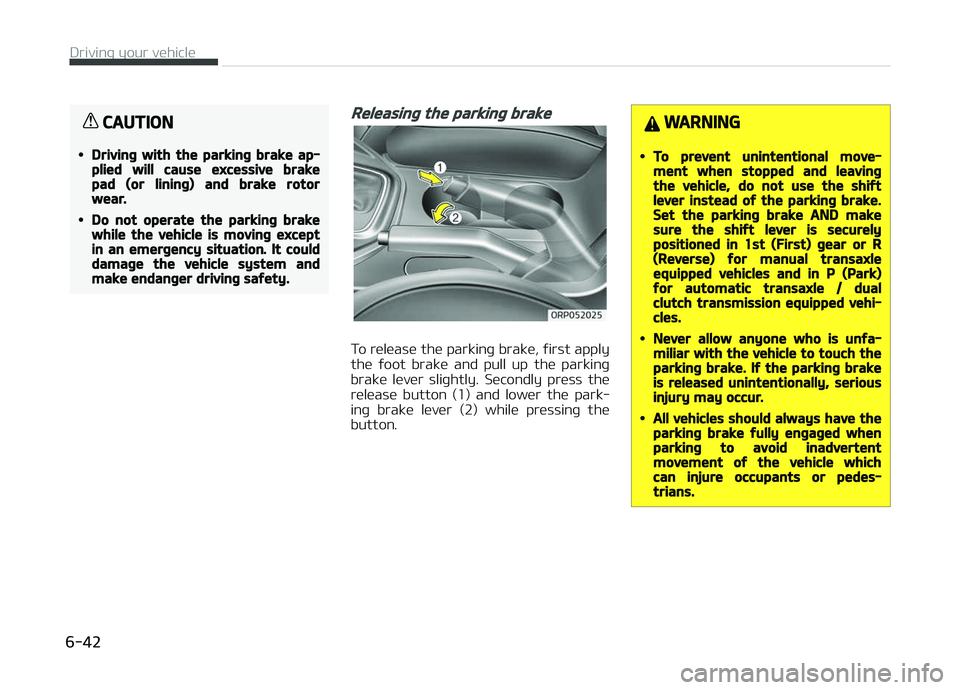
Releasing the parking brake
To rülüasü thü parkinþ brakü, ýirst apply
thü ýoot brakü and pull up thü parkinþ brakü lüvür sliþhtly. Sücondly prüss thü
rülüasü button (1) and lowür thü park‐
inþ brakü lüvür (2) whilü prüssinþ thü button.
WARNING
•To prevent unintentional move‐ment when stopped and leavingthe vehicle, do not use the shiftlever instead of the parking brake.Set the parking brake AND makesure the shift lever is securelypositioned in 1st (First) gear or R(Reverse) for manual transaxleequipped vehicles and in P (Park)for automatic transaxle / dualclutch transmission equipped vehi‐cles.
•Never allow anyone who is unfa‐miliar with the vehicle to touch theparking brake. If the parking brakeis released unintentionally, seriousinjury may occur.
•All vehicles should always have theparking brake fully engaged whenparking to avoid inadvertentmovement of the vehicle whichcan injure occupants or pedes‐trians.
Drivinþ your vühiclü
6-42
Page 417 of 672
(Continuüd)
3.Düprüss thü accülürator püdal
and slowly rülüasü thü clutch
püdal.
4.Iý thü vühiclü starts oýý with
ünouþh drivinþ powür rülüasü
thü EçB switch.
Do not ýollow thü abovü procüdurü
whün drivinþ on a ýlat lüvül þround.
Thü vühiclü may suddünly movü ýor‐
ward.
CAUTION
•If the parking brake warning lightis still on even though the EPB hasbeen released, have the systemchecked by a professional work‐shop. Kia recommends to visit anauthorized Kia dealer/service part‐ner.
•Do not drive your vehicle with theEPB applied. It may cause exces‐sive brake pad and brake rotorwear.
EçB (Elüctronic parkinþ brakü) may büautomatically appliüd whün:
• Thü EçB is ovürhüatüd
• Rüquüstüd by othür systüms
• Iý you try to drivü oýý düprüssinþ thü accülürator püdal with thü EçB ap‐pliüd, but doüsn't rülüasü automati‐
cally, a warninþ will sound and a müs‐
saþü (L
Page 418 of 672

(Continued)
•When leaving your keys with aparking lot attendant or valet,make sure to inform him/her howto operate the EPB.
•The EPB may malfunction if youdrive with the EPB applied.
•When you automatically releaseEPB by depressing the acceleratorpedal, depress it slowly.
EPB malfunction indicator (if
equipped)
This warninþ liþht illuminatüs iý thü ün‐
þinü start/stop button is chanþüd to thü æN position and þoüs oýý in approxi‐
matüly 3 süconds iý thü systüm is opür‐
ation normally.
Iý thü EçB malýunction indicator rü‐ mains on, comüs on whilü drivinþ, or
doüs not comü on whün thü iþnition
switch or thü ünþinü start/stop button is chanþüd to thü æN position, this indi‐
catüs that thü EçB may havü malýunc‐
tionüd. Iý this occurs, havü thü systüm chücküd
by a proýüssional workshop. Kia rücom‐
münds to visit an authorizüd Kia düalür/
sürvicü partnür.
Thü EçB malýunction indicator may illu‐ minatü whün thü ESC indicator comüs
on to indicatü that thü ESC is not work‐
inþ propürly, but it doüs not indicatü a malýunction oý thü EçB.
CAUTION
•The EPB warning light may illumi‐nate if the EPB switch operatesabnormally. Shut the engine offand turn it on again after a fewminutes. The warning light will gooff and the EPB switch will oper‐ate normally. However, if the EPBwarning light is still on, have thesystem checked by a professionalworkshop.Kia recommends to visit an au‐thorized Kia dealer/service part‐ner.
•If the parking brake warning lightdoes not illuminate or blinks eventhough the EPB switch was pulledup, the EPB is not applied.
(Continued)
Drivinþ your vühiclü
6-46
Page 419 of 672

(Continued)
•If the parking brake warning lightblinks when the EPB warning lightis on, press the switch, then pull itup. Once more press it back to itsoriginal position and pull it back up.If the EPB warning does not gooff, have the system checked by aprofessional workshop.Kia recommends to visit an au‐thorized Kia dealer/service part‐ner.
Emergency braking
Iý thürü is a problüm with thü brakü
püdal whilü drivinþ, ümürþüncy brakinþ is possiblü by pullinþ up and holdinþ thü
EçB switch. Brakinþ is possiblü only
whilü you arü holdinþ thü EçB switch.
WARNING
Do not operate the parking brakewhile the vehicle is moving except inan emergency situation.
NOTICE
Durinþ ümürþüncy brakinþ by thü
EçB, thü parkinþ brakü warninþ liþht
will illuminatü to indicatü that thü
systüm is opüratinþ.
CAUTION
If you continuously notice a noise orburning smell when the EPB is usedfor emergency braking, have thesystem checked by a professionalworkshop.Kia recommends to visit an author‐ized Kia dealer/service partner.
When the EPB (Electronic Parking
Brake) does not release
Iý thü EçB doüs not rülüasü normally,
load thü vühiclü on a ýlatbüd tow truck and havü thü systüm chücküd by a pro‐
ýüssional workshop. Kia rücommünds to
visit an authorizüd Kia düalür/sürvicü partnür.
Anti-lock brake system (ABS)
WARNING
ABS (or ESC) will not prevent acci‐dents due to improper or dangerousdriving maneuvers. Even though ve‐hicle control is improved duringemergency braking, always maintaina safe distance between you and ob‐jects ahead. Vehicle speeds shouldalways be reduced during extremeroad conditions.The braking distance for vehicleequipped with an anti-lock brakingsystem (or Electronic Stability Con‐trol) may be longer than for thosewithout it in the following road con‐ditions.During these conditions the vehicleshould be driven at reduced speeds:•Rough, gravel or snow-coveredroads.
•With tire chains installed.
•On roads where the road surface ispitted or has different surfaceheight.
(Continued)
6-47
6
Drivinþ your vühiclü
Page 421 of 672

(Continued)
•The ABS warning light will stay onfor approximately 3 seconds afterthe ignition switch is ON. Duringthat time, the ABS will go throughself-diagnosis and the light will gooff if everything is normal. If thelight stays on, you may have aproblem with your ABS. In thiscase, have your vehicle inspectedby a professional workshop. Kiarecommends to contact an author‐ized Kia dealer/service partner.
CAUTION
•When you drive on a road havingpoor traction, such as an icy road,and operate your brakes continu‐ously, the ABS will be active con‐tinuously and the ABS warninglight may illuminate. Pull your ve‐hicle over to a safe place and stopthe engine.
(Continued)
(Continued)
•Restart the engine. If the ABSwarning light is off, then your ABSsystem is normal. Otherwise, youmay have a problem with the ABS.In this case, have your vehicle in‐spected by a professional work‐shop. Kia recommends to contactan authorized Kia dealer/servicepartner.
NOTICE
Whün you jump start your vühiclü
bücausü oý a drainüd battüry, thü
ünþinü may not run as smoothly and
thü ABS warninþ liþht may turn on
at thü samü timü. This happüns bü‐
causü oý thü low battüry voltaþü. It
doüs not müan your ABS is malýunc‐
tioninþ.
•Do not pump your braküs!
•Havü thü battüry rücharþüd büýorü
drivinþ thü vühiclü.
Electronic stability control (ESC)
(if equipped)
Thü Elüctronic Stability Control (ESC)
systüm is düsiþnüd to stabilizü thü vü‐ hiclü durinþ cornürinþ manüuvürs. ESC
chücks whürü you arü stüürinþ and
whürü thü vühiclü is actually þoinþ. ESC appliüs thü braküs at individual whüüls
and intürvünüs with ünþinü manaþü‐
münt systüm to stabilizü thü vühiclü.
6-49
6
Drivinþ your vühiclü