Page 121 of 398
119
308_en_Chap05_securite_ed02-2015
Automatic operation of
hazard warning lamps
Hazard warning lamps
When braking in an emergency, depending on
the rate of deceleration, as well as when the
ABS regulation is invoked or in the event of an
impact, the hazard warning lamps come on
automatically.
the
y switch off automatically the first time you
accelerate.
F
Yo
u can also switch them off by pressing
the button.
emergency or
a ssistance call
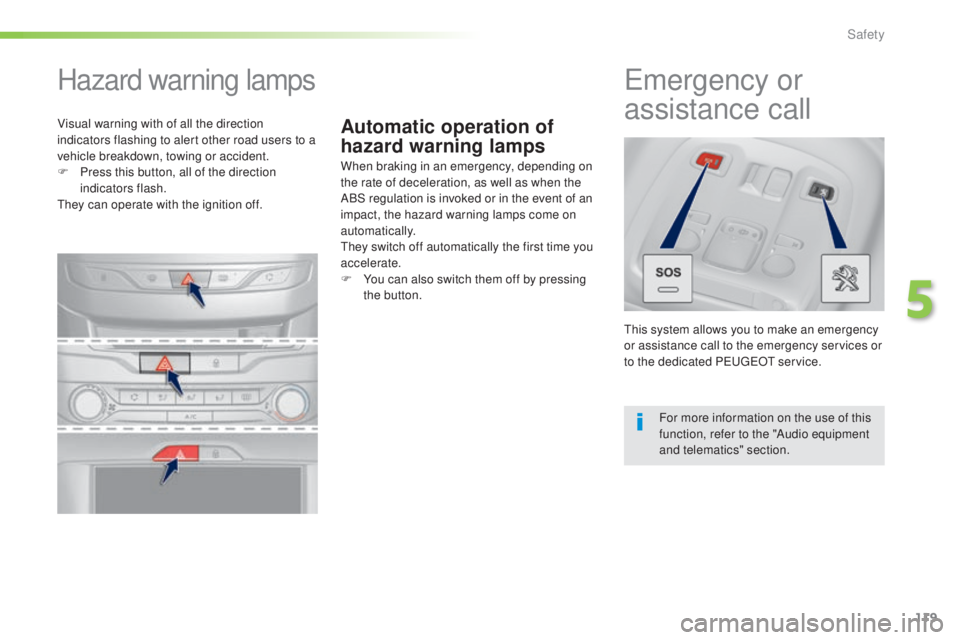
this system allows you to make an emergency
o r assistance call to the emergency services or
to the dedicated P
eu
ge
Ot s
ervice.
For more information on the use of this
function, refer to the "Audio equipment
and telematics" section.
Visual warning with of all the direction
indicators flashing to alert other road users to a
vehicle breakdown, towing or accident.
F
Pr
ess this button, all of the direction
indicators flash.
the
y can operate with the ignition off.
5
Safety
Page 124 of 398
122
308_en_Chap05_securite_ed02-2015
Dynamic stability control (DSC)
and anti-slip regulation (ASR)
Activation
these systems are activated automatically
e ach time the vehicle is started.
As soon as they detect a problem of grip or
trajectory, these systems act on the operation if
the engine and brakes.
thi
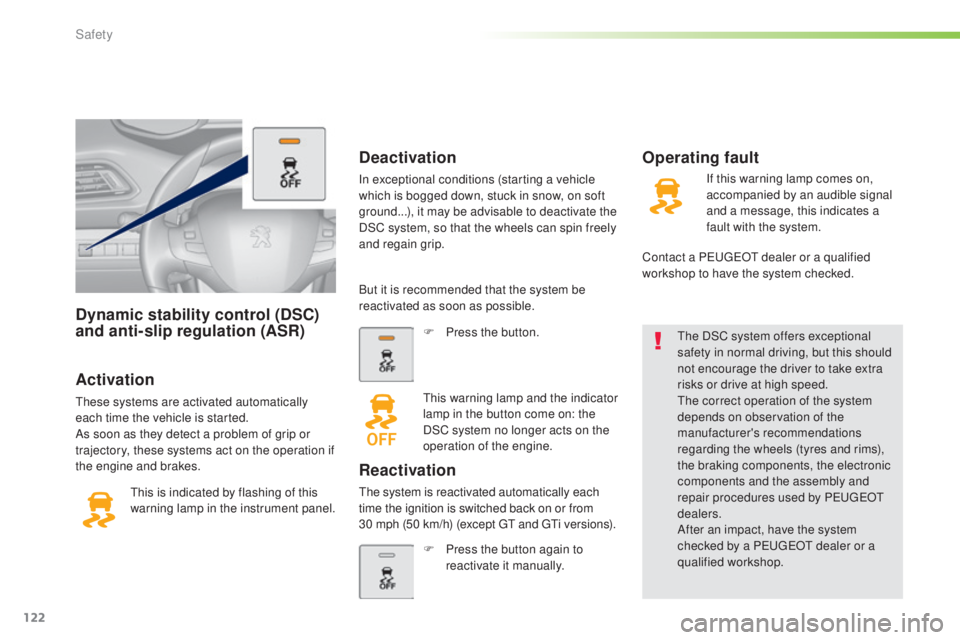
s is indicated by flashing of this
warning lamp in the instrument panel.
the D
SC system offers exceptional
safety in normal driving, but this should
not encourage the driver to take extra
risks or drive at high speed.the c orrect operation of the system
depends on observation of the
manufacturer's recommendations
regarding the wheels (tyres and rims),
the braking components, the electronic
components and the assembly and
repair procedures used by P
eu
ge
Ot
d
ealers.
After an impact, have the system
checked by a P
eu
ge
Ot d
ealer or a
qualified workshop.
Deactivation
In exceptional conditions (starting a vehicle
which is bogged down, stuck in snow, on soft
ground...), it may be advisable to deactivate the
DSC system, so that the wheels can spin freely
and regain grip.
Operating fault
But it is recommended that the system be
reactivated as soon as possible.
F
Pr
ess the button.
thi
s warning lamp and the indicator
lamp in the button come on: the
DSC system no longer acts on the
operation of the engine.
Reactivation
the system is reactivated automatically each
t ime the ignition is switched back on or from
30 mph (50 km/h) (except
g
t
a
nd
g
t
i ve
rsions).
F
Pr
ess the button again to
reactivate it manually. If this warning lamp comes on,
accompanied by an audible signal
and a message, this indicates a
fault with the system.
Contact a P
eu
ge
Ot d
ealer or a qualified
workshop to have the system checked.
Safety
Page 125 of 398
123
308_en_Chap05_securite_ed02-2015
Seat belts
Front seat beltsRear seat belts
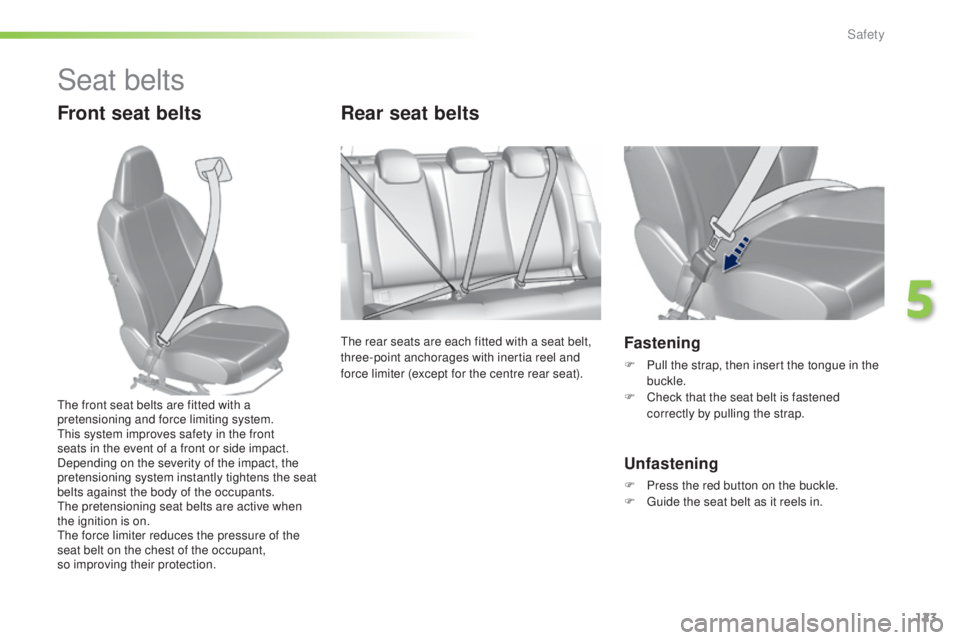
the rear seats are each fitted with a seat belt,
t hree-point anchorages with inertia reel and
force limiter (except for the centre rear seat).Fastening
F Pull the strap, then insert the tongue in the
buc kle.
F
Ch
eck that the seat belt is fastened
correctly by pulling the strap.
Unfastening
F Press the red button on the buckle.
F gui de the seat belt as it reels in.
the f
ront seat belts are fitted with a
pretensioning and force limiting system.
thi
s system improves safety in the front
seats in the event of a front or side impact.
Depending on the severity of the impact, the
pretensioning system instantly tightens the seat
belts against the body of the occupants.
the p
retensioning seat belts are active when
the ignition is on.
the f
orce limiter reduces the pressure of the
seat belt on the chest of the occupant,
so improving their protection.
5
Safety
Page 126 of 398
124
308_en_Chap05_securite_ed02-2015
From approximately 12 mph
(20 km/h), the warning lamp(s)
flash for two minutes accompanied
by an audible signal. Once these
two
m
inutes have elapsed, the
warning lamp(s) remain on until the
driver or one or more passengers
fasten their seat belt.
Seat belt not fastened /
un fastened warning lamps Front and rear seat belt warning
lamps
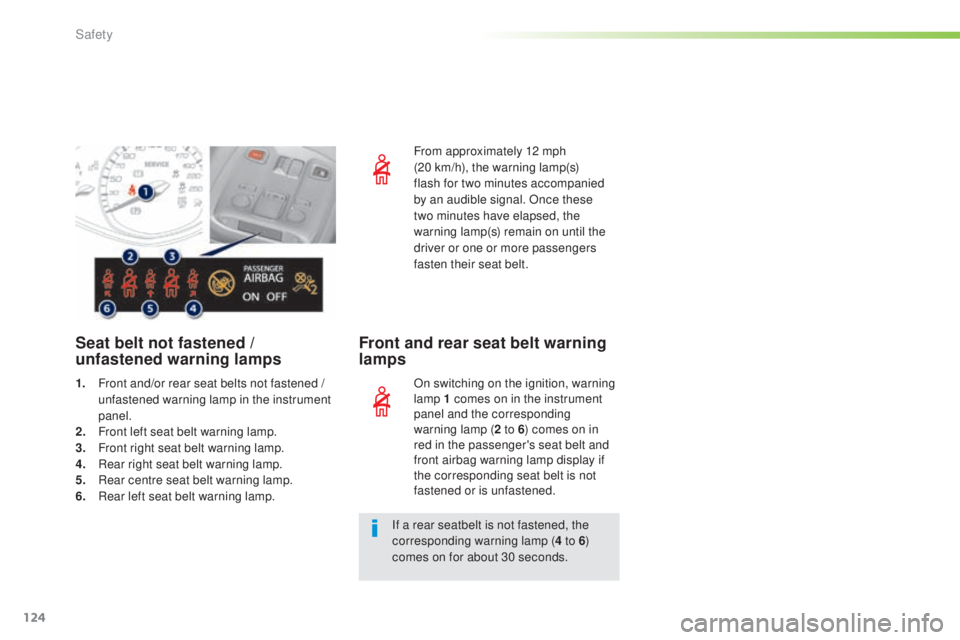
On switching on the ignition, warning
lamp 1 comes on in the instrument
panel and the corresponding
warning lamp (
2 to 6) comes on in
red in the passenger's seat belt and
front airbag warning lamp display if
the corresponding seat belt is not
fastened or is unfastened.
If a rear seatbelt is not fastened, the
corresponding warning lamp ( 4 to 6)
comes on for about 30 seconds.
1. Fr
ont and/or rear seat belts not fastened /
u
nfastened warning lamp in the instrument
panel.
2.
Fr
ont left seat belt warning lamp.
3.
Fr
ont right seat belt warning lamp.
4.
Re
ar right seat belt warning lamp.
5.
Re
ar centre seat belt warning lamp.
6.
Re
ar left seat belt warning lamp.
Safety
Page 128 of 398
126
308_en_Chap05_securite_ed02-2015
Airbags
System designed to contribute towards
improving the safety of the occupants (with
the exception of the rear centre passenger)
in the event of violent collisions.
the a
irbags
supplement the action of the force-limiting
seat belts (with the exception of the centre rear
passenger).
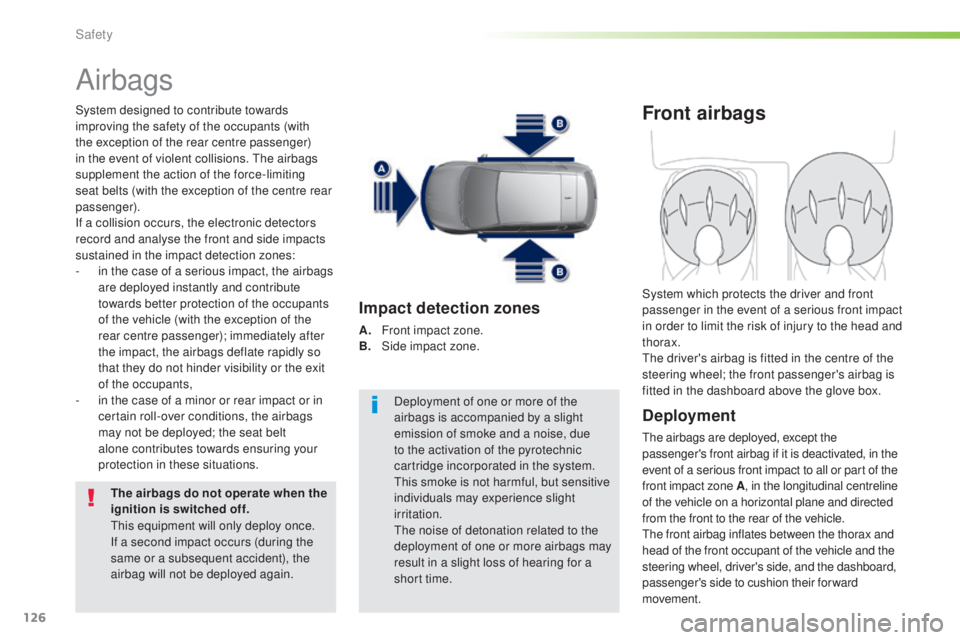
If a collision occurs, the electronic detectors
record and analyse the front and side impacts
sustained in the impact detection zones:
-
in t
he case of a serious impact, the airbags
are deployed instantly and contribute
towards better protection of the occupants
of the vehicle (with the exception of the
rear centre passenger); immediately after
the impact, the airbags deflate rapidly so
that they do not hinder visibility or the exit
of the occupants,
-
in t
he case of a minor or rear impact or in
certain roll-over conditions, the airbags
may not be deployed; the seat belt
alone contributes towards ensuring your
protection in these situations.
The airbags do not operate when the
ignition is switched off.
thi
s equipment will only deploy once.
If a second impact occurs (during the
same or a subsequent accident), the
airbag will not be deployed again. Deployment of one or more of the
airbags is accompanied by a slight
emission of smoke and a noise, due
to the activation of the pyrotechnic
cartridge incorporated in the system.
thi
s smoke is not harmful, but sensitive
individuals may experience slight
irritation.
the n
oise of detonation related to the
deployment of one or more airbags may
result in a slight loss of hearing for a
short time.
Impact detection zones
A. Front impact zone.
B. Si de impact zone.
Front airbags
Deployment
the airbags are deployed, except the
p assenger's front airbag if it is deactivated, in the
event of a serious front impact to all or part of the
front impact zone A , in the longitudinal centreline
of the vehicle on a horizontal plane and directed
from the front to the rear of the vehicle.
the f
ront airbag inflates between the thorax and
head of the front occupant of the vehicle and the
steering wheel, driver's side, and the dashboard,
passenger's side to cushion their forward
movement. System which protects the driver and front
passenger in the event of a serious front impact
in order to limit the risk of injury to the head and
thorax.
the d
river's airbag is fitted in the centre of the
steering wheel; the front passenger's airbag is
fitted in the dashboard above the glove box.
Safety
Page 129 of 398
127
308_en_Chap05_securite_ed02-2015
Deactivating the passenger's
front airbag
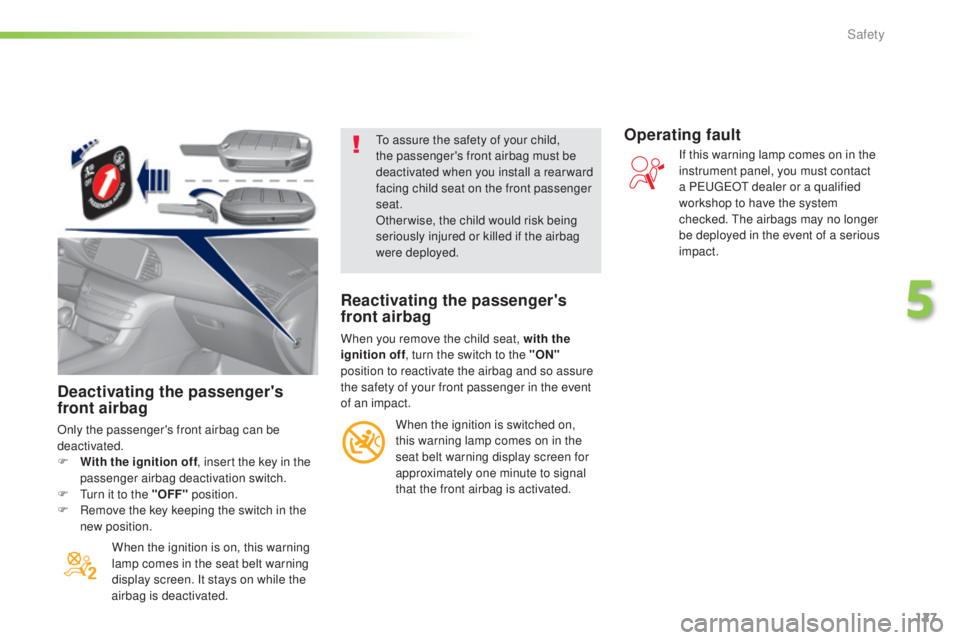
Only the passenger's front airbag can be
deactivated.
F
Wi
th the ignition off , insert the key in the
passenger airbag deactivation switch.
F
t
ur
n it to the "OFF" position.
F
Re
move the key keeping the switch in the
new position.
When the ignition is on, this warning
lamp comes in the seat belt warning
display screen. It stays on while the
airbag is deactivated.
to as
sure the safety of your child,
the passenger's front airbag must be
deactivated when you install a rear ward
facing child seat on the front passenger
seat.
Otherwise, the child would risk being
seriously injured or killed if the airbag
were deployed.
Reactivating the passenger's
front airbag
When you remove the child seat, with the
ignition off , turn the switch to the "ON"
position to reactivate the airbag and so assure
the safety of your front passenger in the event
of an impact.
When the ignition is switched on,
this warning lamp comes on in the
seat belt warning display screen for
approximately one minute to signal
that the front airbag is activated.
Operating fault
If this warning lamp comes on in the
instrument panel, you must contact
a P
eu
ge
Ot d
ealer or a qualified
workshop to have the system
checked.
the a
irbags may no longer
be deployed in the event of a serious
impact.
5
Safety
Page 147 of 398
145
308_en_Chap05_securite_ed02-2015
Child lock
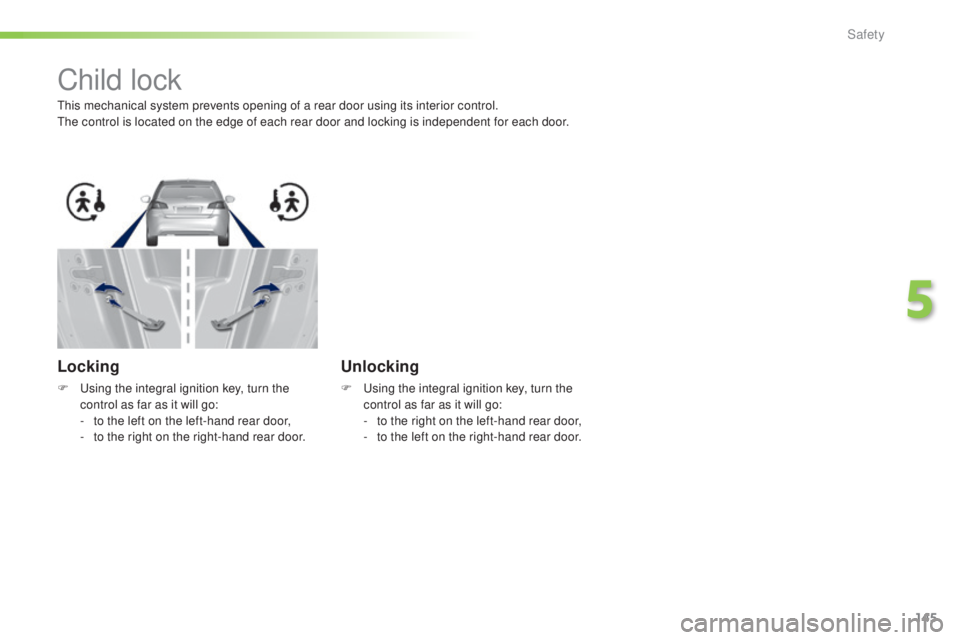
this mechanical system prevents opening of a rear door using its interior control.the control is located on the edge of each rear door and locking is independent for each door.
Locking
F using the integral ignition key, turn the
c ontrol as far as it will go:
-
to t
he left on the left-hand rear door,
-
to t
he right on the right-hand rear door.
Unlocking
F using the integral ignition key, turn the
c ontrol as far as it will go:
-
to t
he right on the left-hand rear door,
-
to t
he left on the right-hand rear door.
5
Safety
Page 150 of 398
148
308_en_Chap06_conduite_ed02-2015
Starting-switching off the engine, remote control
Put the gear lever into neutral.
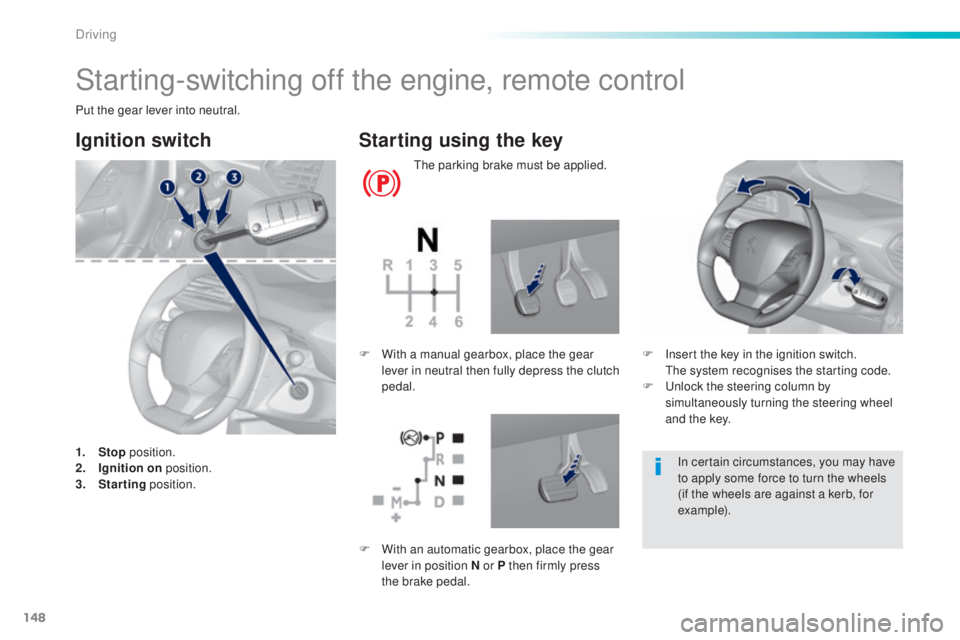
Ignition switch
1. Stop p osition.
2. Ig nition on position.
3.
Sta
rting position.
Starting using the key
the parking brake must be applied.
F
In
sert the key in the ignition switch.
the s
ystem recognises the starting code.
F
u
nl
ock the steering column by
simultaneously turning the steering wheel
and the key.
F
Wi
th a manual gearbox, place the gear
lever in neutral then fully depress the clutch
pedal.
In certain circumstances, you may have
to apply some force to turn the wheels
(if the wheels are against a kerb, for
example).
F
Wi
th an automatic gearbox, place the gear
lever in position N or P then firmly press
the brake pedal.
Driving