2016 Peugeot 308 ignition
[x] Cancel search: ignitionPage 238 of 398
236
308_en_Chap07_info-pratiques_ed02-2015
Range indicators
Once the AdBlue® tank is on reserve or after
detection of a fault with the SCR emissions
control system, when the ignition is switched
on, an indicator displays an estimate of the
distance that can be covered, the range, before
engine starting is prevented.
In the event of simultaneous system fault and
low AdBlue
® level, the shortest range figure is
the one displayed.
In the event of the risk of non-starting related to a lack of AdBlue®
the engine start prevention system
r equired by regulations is activated
automatically once the AdBlue
® tank is
e m pt y.
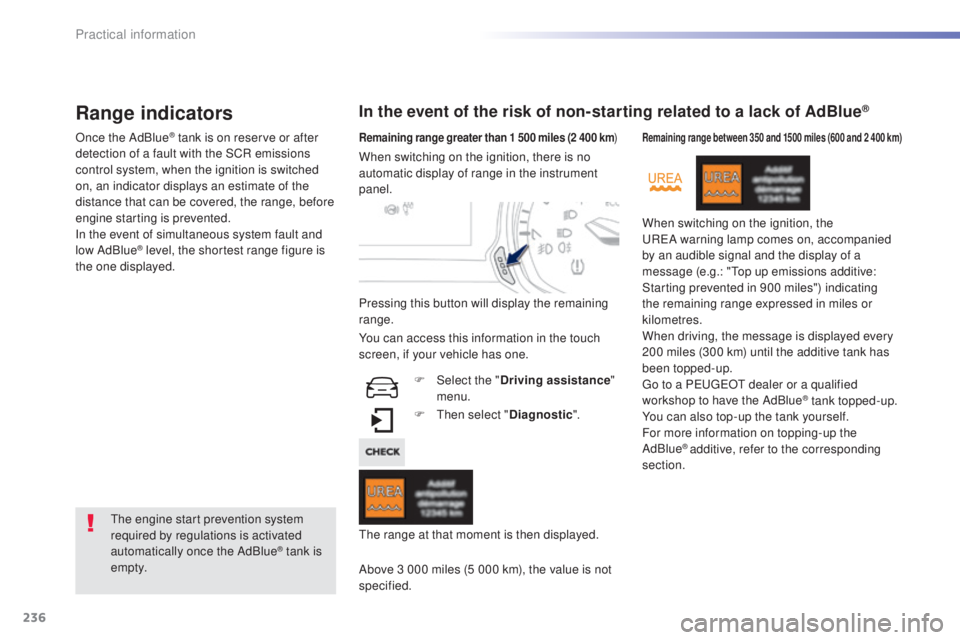
Remaining range greater than 1 500 miles (2 400 km )
Pressing this button will display the remaining
range.
F
t
hen se
lect "Diagnostic ".
Above 3 000 miles (5 000 km), the value is not
specified. When switching on the ignition, there is no
automatic display of range in the instrument
panel.
the r
ange at that moment is then displayed.
You can access this information in the touch
screen, if your vehicle has one.
F
Selec
t the "Driving assistance "
menu.
Remaining range between 350 and 1500 miles (600 and 2 400 km)
When switching on the ignition, the uReA w arning lamp comes on, accompanied
by an audible signal and the display of a
message (e.g.: "
top u
p emissions additive:
Starting prevented in 900 miles") indicating
the remaining range expressed in miles or
kilometres.
When driving, the message is displayed every
200 miles (300 km) until the additive tank has
been topped-up.
go to a Peu
ge
Ot d
ealer or a qualified
workshop to have the AdBlue
® tank topped-up.
You can also top-up the tank yourself.
For more information on topping-up the
AdBlue
® additive, refer to the corresponding
section.
Practical information
Page 239 of 398
237
308_en_Chap07_info-pratiques_ed02-2015
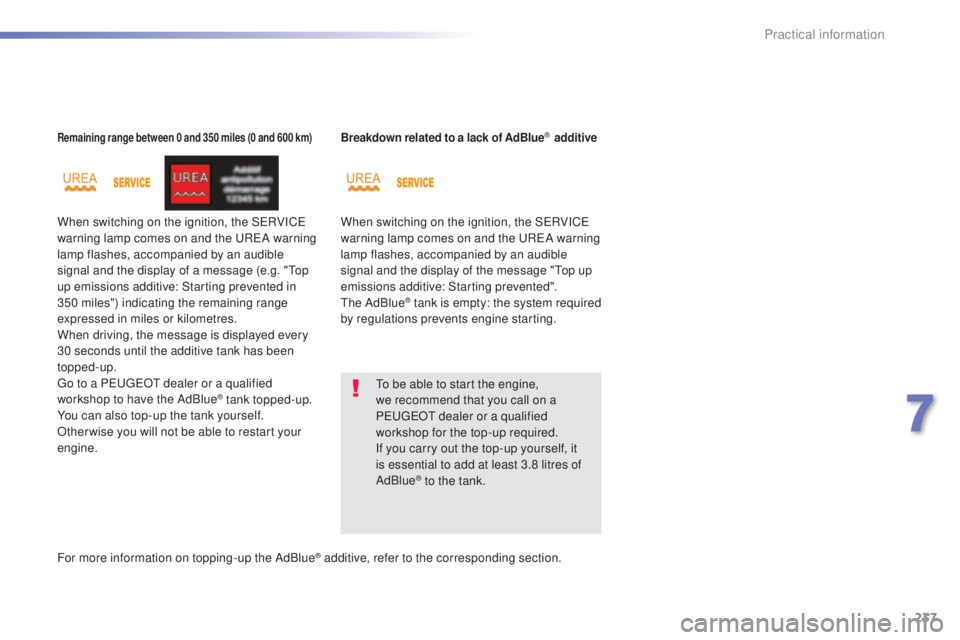
Remaining range between 0 and 350 miles (0 and 600 km)
When switching on the ignition, the SeRVICe
w arning lamp comes on and the uReA wa rning
lamp flashes, accompanied by an audible
signal and the display of a message (e.g. "
top
u
p emissions additive: Starting prevented in
350 miles") indicating the remaining range
expressed in miles or kilometres.
When driving, the message is displayed every
30 seconds until the additive tank has been
topped-up.
go to a Peu
ge
Ot d
ealer or a qualified
workshop to have the AdBlue
® tank topped-up.
You can also top-up the tank yourself.
Other wise you will not be able to restart your
engine.
Breakdown related to a lack of AdBlue® additive
When switching on the ignition, the SeRV ICe
w arning lamp comes on and the uReA wa rning
lamp flashes, accompanied by an audible
signal and the display of the message "
top u
p
emissions additive: Starting prevented".
the
AdBlue
® tank is empty: the system required
by regulations prevents engine starting.
to be a
ble to start the engine,
we recommend that you call on a
P
eu
ge
Ot d
ealer or a qualified
workshop for the top-up required.
If you carry out the top-up yourself, it
is essential to add at least 3.8 litres of
AdBlue
® to the tank.
For more information on topping-up the AdBlue
® additive, refer to the corresponding section.
7
Practical information
Page 240 of 398
238
308_en_Chap07_info-pratiques_ed02-2015
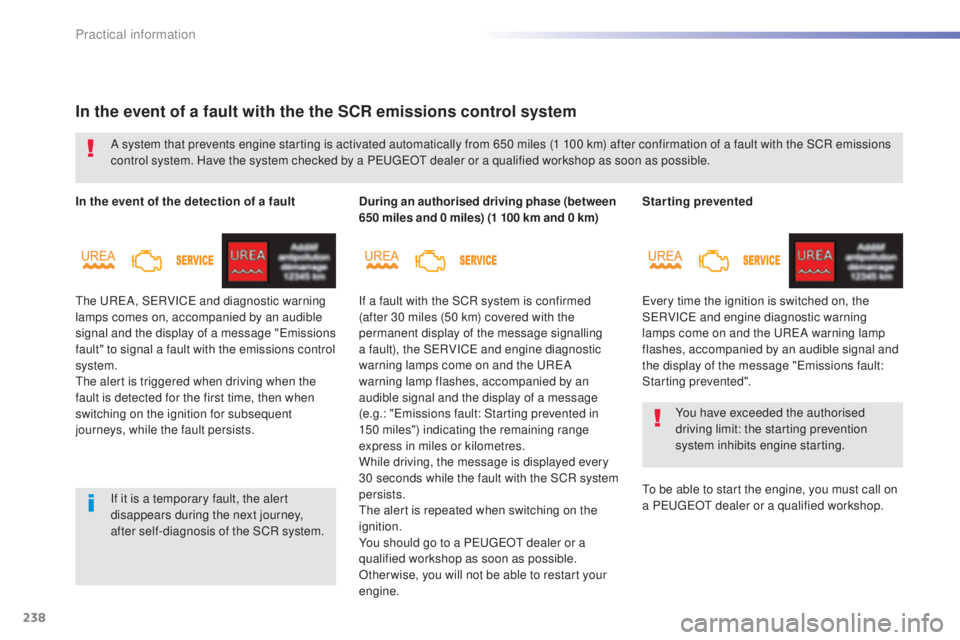
Starting prevented
eve
ry time the ignition is switched on, the
S
eRV
IC
e and
engine diagnostic warning
lamps come on and the
uReA wa
rning lamp
flashes, accompanied by an audible signal and
the display of the message "
emi
ssions fault:
Starting prevented".
You have exceeded the authorised
driving limit: the starting prevention
system inhibits engine starting.
to be a
ble to start the engine, you must call on
a P
eu
ge
Ot d
ealer or a qualified workshop.
In the event of a fault with the the SCR emissions control system
A system that prevents engine starting is activated automatically from 650 miles (1 100 km) after confirmation of a fault with the SCR emissions
co ntrol system. Have the system checked by a Peu geOt d ealer or a qualified workshop as soon as possible.
If it is a temporary fault, the alert
disappears during the next journey,
after self-diagnosis of the SCR system.
In the event of the detection of a fault
the uReA, SeRV
IC
e a
nd diagnostic warning
lamps comes on, accompanied by an audible
signal and the display of a message "
emi
ssions
fault" to signal a fault with the emissions control
system.
the a
lert is triggered when driving when the
fault is detected for the first time, then when
switching on the ignition for subsequent
journeys, while the fault persists. During an authorised driving phase (between
650 miles and 0 miles) (1 100 km and 0 km)
If a fault with the SCR system is confirmed
(after 30 miles (50 km) covered with the
permanent display of the message signalling
a fault), the S
eRV
IC
e a
nd engine diagnostic
warning lamps come on and the
uReA
war
ning lamp flashes, accompanied by an
audible signal and the display of a message
(e.g.: "
emi
ssions fault: Starting prevented in
150
m
iles") indicating the remaining range
express in miles or kilometres.
While driving, the message is displayed every
30 seconds while the fault with the SCR system
persists.
the a
lert is repeated when switching on the
ignition.
You should go to a P
eu
ge
Ot d
ealer or a
qualified workshop as soon as possible.
Other wise, you will not be able to restart your
engine.
Practical information
Page 242 of 398
240
308_en_Chap07_info-pratiques_ed02-2015
Recommendations on storage
Never store bottles of AdBlue® in your
vehicle.
AdBlue
® freezes at about -11°C and
deteriorates above 25°C. It is recommended
that bottles be stored in a cool area and
protected from direct sunlight.
under
these conditions, the additive can be
kept for at least a year.
If the additive has frozen, it can be used once it
has completely thawed out.
Procedure
Before topping-up, ensure that the vehicle is
parked on a flat and level sur face.
In wintry conditions, ensure that the
temperature of the vehicle is above -11°C.
Otherwise the AdBlue
® may be frozen and
so cannot be poured into its tank. Park your
vehicle in a warmer area for a few hours to
allow the top-up to be carried out.
F
Sw
itch off the ignition and remove the
key, or if your vehicle has one, press
the S
tARt/StOP b
utton to switch off
the
eng
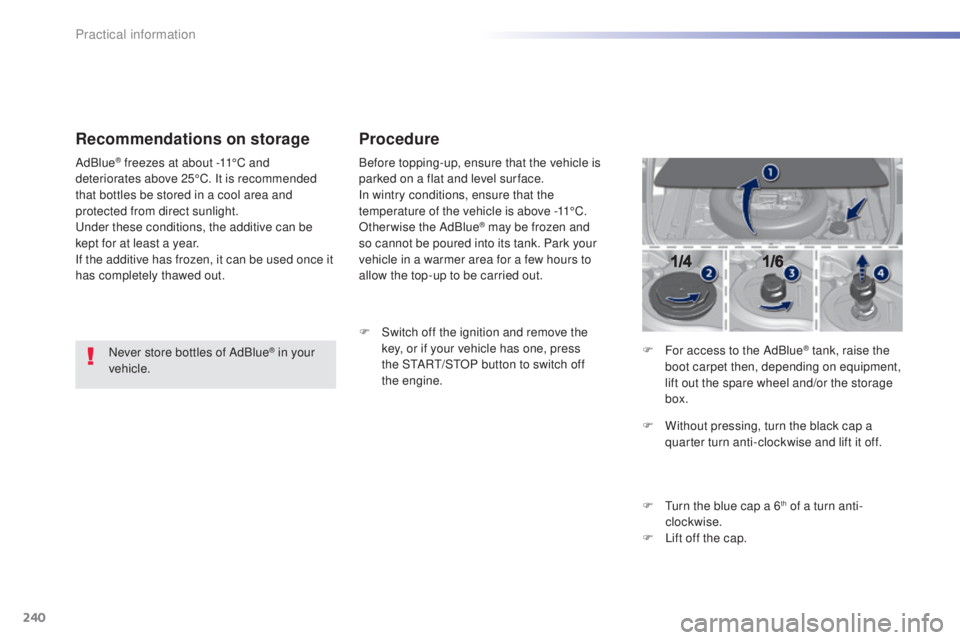
ine. F
Fo
r access to the AdBlue
® tank, raise the
boot carpet then, depending on equipment,
lift out the spare wheel and/or the storage
box.
F
Wi
thout pressing, turn the black cap a
quarter turn anti-clockwise and lift it off.
F
t
ur
n the blue cap a 6
th of a turn anti-
clockwise.
F
Li
ft off the cap.
Practical information
Page 243 of 398

241
308_en_Chap07_info-pratiques_ed02-2015
Never dispose of AdBlue® additive
bottles in the household waste. Place
them in a special container provided
this purpose or take them to your dealer.
F
Af
ter emptying the bottle, wipe away any
spillage around the tank filler using a damp
cloth. If any additive is split or splashed, wash
immediately with cold water or wipe with
a damp cloth.
If the additive has crystallised, clean it
off using a sponge and hot water.
F
Re
fit the blue cap to the tank and turn it a
6
th of a turn clockwise, to its stop.
F Re fit the black cap and turn it a quarter of
a turn clockwise without pressing.
ens
ure
that the indicator on the cap lines up with
the indicator on the support.
F
De
pending on equipment, return the spare
wheel and/or the storage box to the bottom
of the boot.
F
Re
fit the boot carpet and close the tailgate. Important: when topping
-up after
running out of additive , signalled
by the message "
top u
p emissions
additive: Starting prevented", you
must wait for about 5 minutes before
switching on the ignition, without
opening the driver's door, unlocking
the vehicle, introducing the key
into the ignition switch, or placing
the key of the "Keyless Entr y and
Star ting" system inside the vehicle .
Switch on the ignition, then wait for
10
se
conds before starting the engine.
F
Ob
tain a bottle of AdBlue
®. After first
checking the use-by date, read carefully
the instructions on use on the label before
pouring the contents of the bottle into your
vehicle's AdBlue
® tank.
Freezing of the AdBlue
® additive
the
AdBlue
® additive freezes at
temperatures below around -11°C.
the S
CR system includes a heater
for the AdBlue
® tank, allowing you to
continue driving in very cold conditions.
7
Practical information
Page 248 of 398
246
308_en_Chap08_en-cas-de-panne_ed02-2015
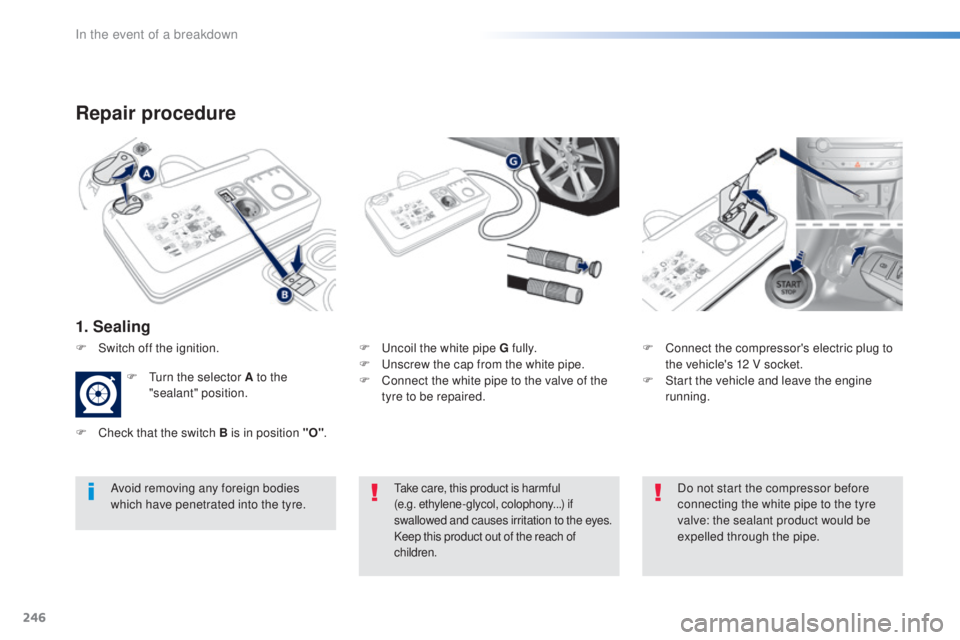
Repair procedure
1. Sealing
F uncoil the white pipe G fully.
F uns crew the cap from the white pipe.
F
Co
nnect the white pipe to the valve of the
tyre to be repaired. F Co
nnect the compressor's electric plug to
the vehicle's 12 V socket.
F
St
art the vehicle and leave the engine
running.
take care, this product is harmful
( e.g. e thylene-glycol, colophony...) if
swallowed and causes irritation to the eyes.
Keep this product out of the reach of
children.Avoid removing any foreign bodies
which have penetrated into the tyre. Do not start the compressor before
connecting the white pipe to the tyre
valve: the sealant product would be
expelled through the pipe.
F
Swi
tch off the ignition.
F
t
ur
n the selector A to the
"sealant" position.
F
Ch
eck that the switch B is in position "O"
.
In the event of a breakdown
Page 254 of 398

252
308_en_Chap08_en-cas-de-panne_ed02-2015
F Remove the bolt cover from each of
t
he bolts using the tool 3 (according to
equipment).
F
Fi
t the security socket 4 on the
wheelbrace
1
to slacken the security bolt
(if
f
itted).
F
Sl
acken the other bolts using the
wheelbrace 1 o n l y. F Po
sition the foot of the jack on the ground,
ensuring that it is directly below the
vehicle's jacking point A or B , the one
closest to the wheel to be changed.
Removing a wheel
Parking the vehicle
Immobilise the vehicle where it does not
block traffic: the ground must be level,
stable and not slippery.
Apply the parking brake unless it has
been programmed to automatic mode,
switch off the ignition and engage first
gear to block the wheels.
Check that the braking warning lamp
and the P warning lamp in the parking
brake control lever come on.
the o
ccupants must get out of the
vehicle and wait where they are safe.
Never go underneath a vehicle raised
using a jack; use an axle stand.
Do not use:
-
th
e jack for any other purpose than
lifting the vehicle,
-
a ja
ck other than the one supplied
by the manufacturer.
In the event of a breakdown
Page 268 of 398
266
308_en_Chap08_en-cas-de-panne_ed02-2015
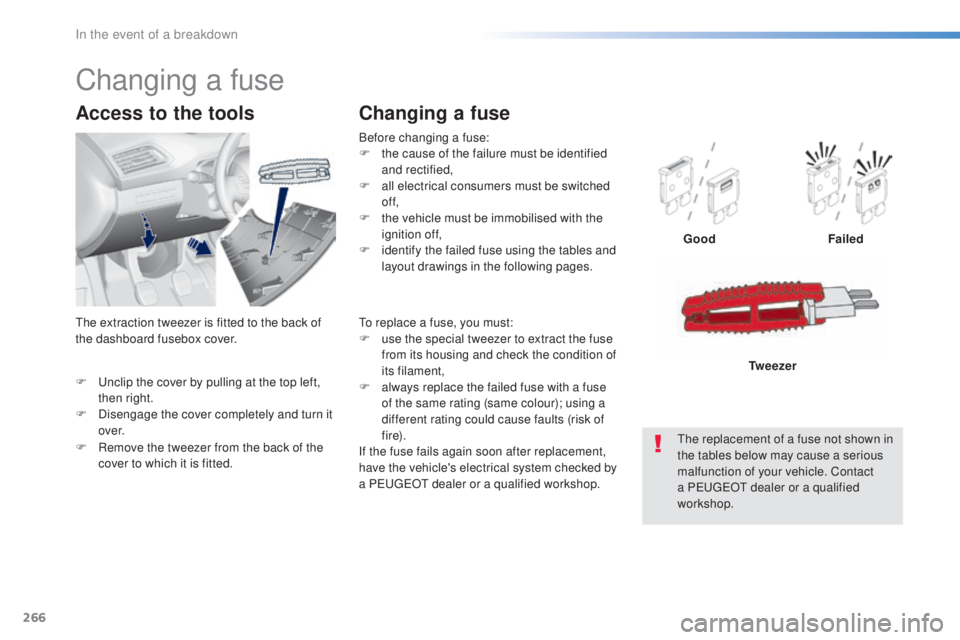
F unclip the cover by pulling at the top left,
t hen right.
F
Di
sengage the cover completely and turn it
ove r.
Access to the tools
Before changing a fuse:
F th e cause of the failure must be identified
and rectified,
F
al
l electrical consumers must be switched
of f,
F
th
e vehicle must be immobilised with the
ignition off,
F
id
entify the failed fuse using the tables and
layout drawings in the following pages.
Changing a fuse
Good Failed
the r
eplacement of a fuse not shown in
the tables below may cause a serious
malfunction of your vehicle. Contact
a P
eu
ge
Ot d
ealer or a qualified
workshop. Tw e e z e r
Changing a fuse
to replace a fuse, you must:
F us e the special tweezer to extract the fuse
from its housing and check the condition of
its filament,
F
al
ways replace the failed fuse with a fuse
of the same rating (same colour); using a
different rating could cause faults (risk of
f i r e).
If the fuse fails again soon after replacement,
have the vehicle's electrical system checked by
a P
eu
ge
Ot d
ealer or a qualified workshop.
F
Re
move the tweezer from the back of the
cover to which it is fitted.the e
xtraction tweezer is fitted to the back of
the dashboard fusebox cover.
In the event of a breakdown