Page 7 of 398
5
308_en_Chap00b_vue-ensemble_ed02-2015
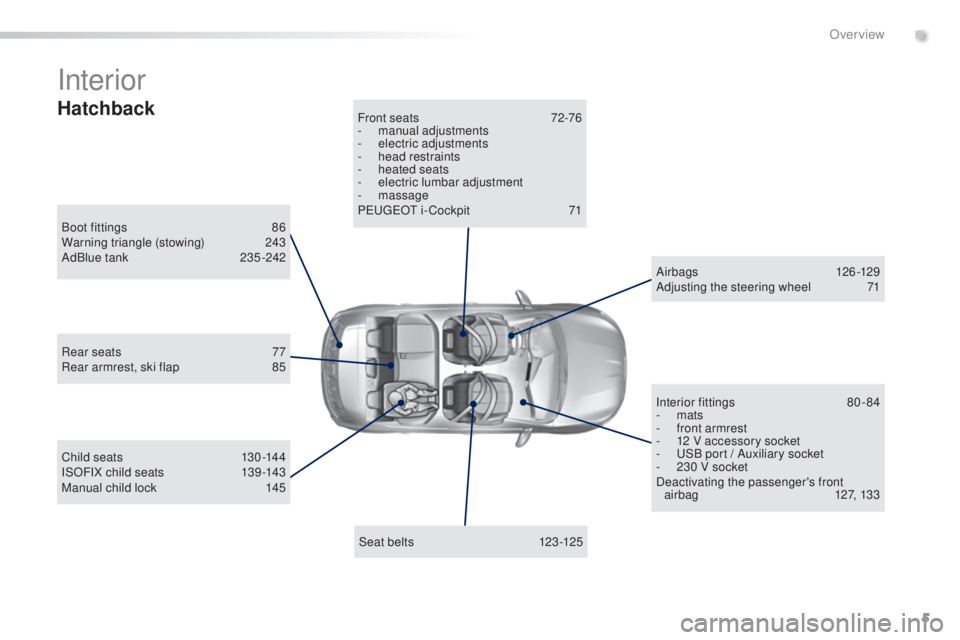
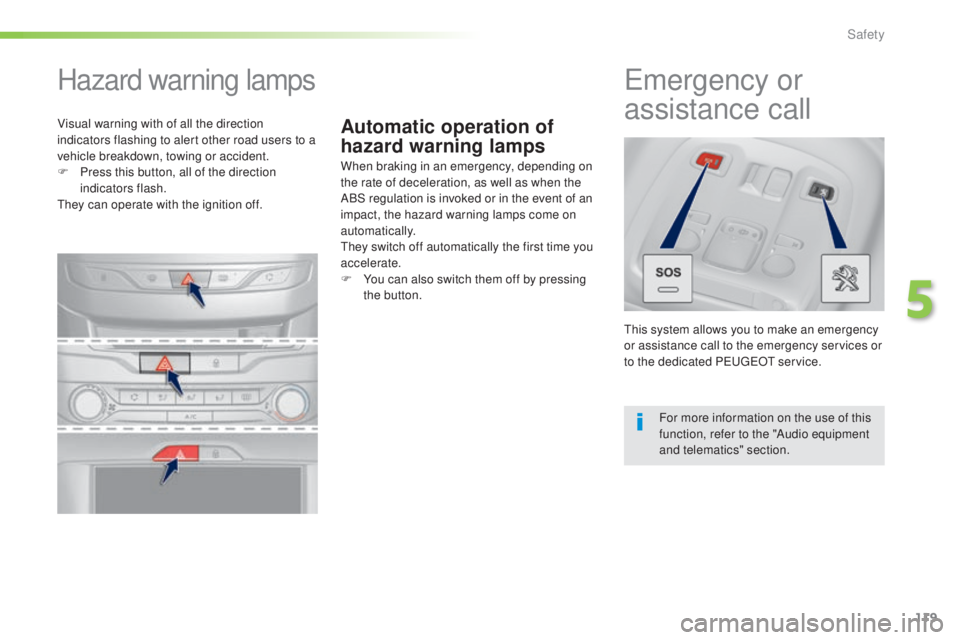
Interior
Boot fittings 86
W arning triangle (stowing) 24 3
AdBlue tank
23
5 -242
Seat belts
123
-125
Front seats
72
-76
-
man
ual adjustments
-
ele
ctric adjustments
-
he
ad restraints
-
heat
ed seats
-
el
ectric lumbar adjustment
-
m
assage
P
eu
ge
Ot i
- Cockpit
71
C
hild seats
13
0 -144
ISOFIX child seats
13
9 -143
Manual child lock
145 A
ir bags
12
6 -129
Adjusting the steering wheel
71
I
nterior fittings
80
-84
-
m
ats
-
fr
ont armrest
-
12 V a
ccessory socket
-
u
SB p
ort / Auxiliary socket
-
23
0 V socket
Deactivating the passenger's front airbag
12
7, 133
Rear seats
77
R
ear armrest, ski flap
85
Hatchback
.
Over view
Page 8 of 398
6
308_en_Chap00b_vue-ensemble_ed02-2015
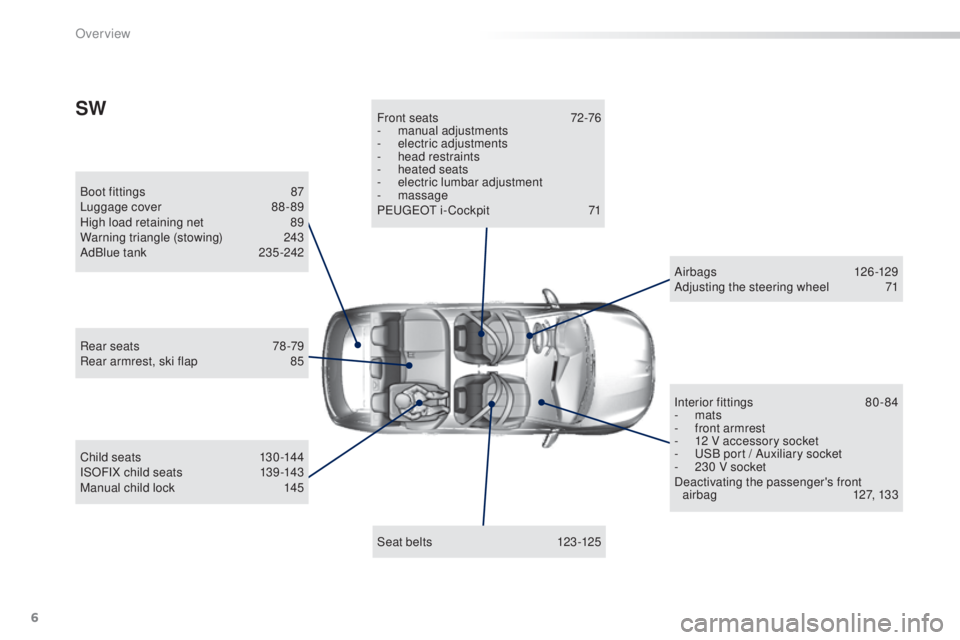
Boot fittings 87
Lu ggage cover 88 - 89
High load retaining net
89
W
arning triangle (stowing)
24
3
AdBlue tank
23
5 -242
Seat belts
123
-125
Front seats
72
-76
-
man
ual adjustments
-
ele
ctric adjustments
-
he
ad restraints
-
heat
ed seats
- el ectric lumbar adjustment
- m assage
P
eu
ge
Ot i
- Cockpit
71
C
hild seats
13
0 -144
ISOFIX child seats
13
9 -143
Manual child lock
145 A
ir bags
12
6 -129
Adjusting the steering wheel
71
I
nterior fittings
80
-84
-
m
ats
-
fr
ont armrest
-
12 V a
ccessory socket
-
u
SB p
ort / Auxiliary socket
-
23
0 V socket
Deactivating the passenger's front airbag
12
7, 133
Rear seats
78
-79
Rear armrest, ski flap
85
SW
Over view
Page 88 of 398
86
308_en_Chap03_ergonomie-et-confort_ed02-2015
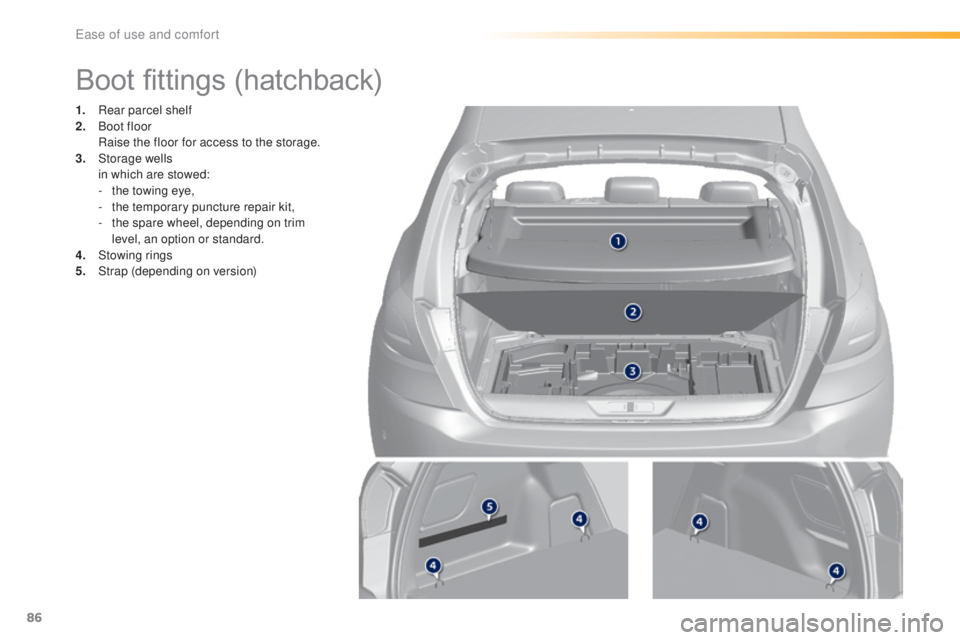
Boot fittings (hatchback)
1. Rear parcel shelf
2. Boot floor
Ra
ise the floor for access to the storage.
3.
Sto
rage wells
in w
hich are stowed:
-
th
e towing eye,
-
th
e temporary puncture repair kit,
-
th
e spare wheel, depending on trim
level, an option or standard.
4.
St
owing rings
5.
St
rap (depending on version)
ease of use and comfort
Page 89 of 398
87
308_en_Chap03_ergonomie-et-confort_ed02-2015
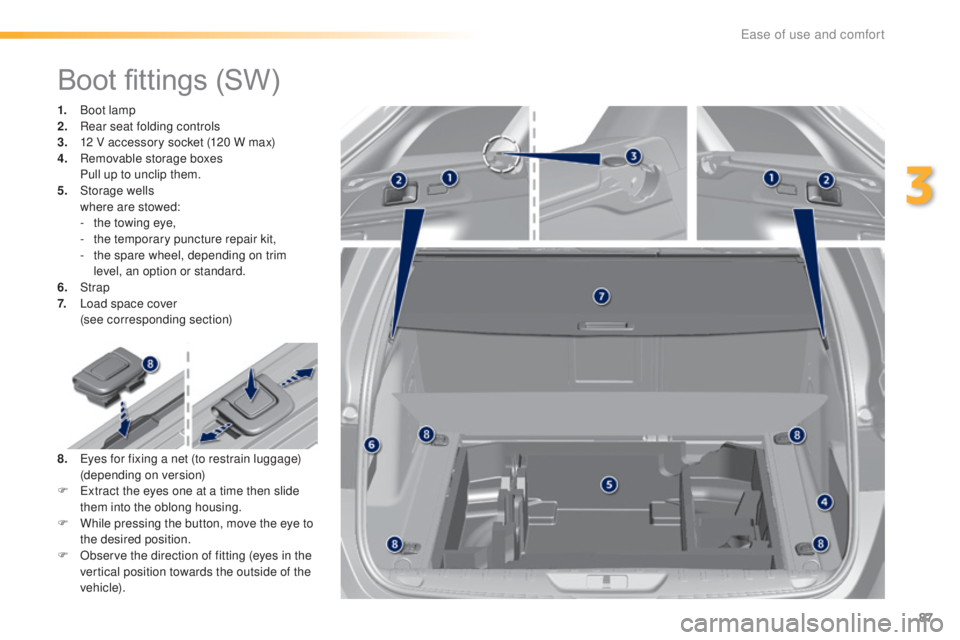
Boot fittings (SW)
1. Boot lamp
2. Rea r seat folding controls
3.
12 V a
ccessory socket (120 W max)
4.
Re
movable storage boxes
Pu
ll up to unclip them.
5.
Sto
rage wells
wh
ere are stowed:
-
th
e towing eye,
-
th
e temporary puncture repair kit,
-
th
e spare wheel, depending on trim
level, an option or standard.
6.
St
rap
7.
Lo
ad space cover
(se
e corresponding section)
8.
eyes f
or fixing a net (to restrain luggage)
(d
epending on version)
F
e
xt
ract the eyes one at a time then slide
them into the oblong housing.
F
Wh
ile pressing the button, move the eye to
the desired position.
F
Ob
serve the direction of fitting (eyes in the
vertical position towards the outside of the
vehicle).
3
ease of use and comfort
Page 93 of 398
91
308_en_Chap03_ergonomie-et-confort_ed02-2015
In order for these systems to be fully effective, follow the operation and maintenance
guidelines below:
F
t
o ob
tain an even air distribution, take care not to obstruct the exterior air intake grilles
located at the base of the windscreen, the nozzles, the vents and the air outlets, as well
as the air extractor located in the boot.
F
Do n
ot cover the sunshine sensor, located on the dashboard; this is used for regulation
of the air conditioning system.
F
Op
erate the air conditioning system for at least 5 to 10 minutes, once or twice a month
to keep it in per fect working order.
F
e
ns
ure that the passenger compartment filter is in good condition and have the filter
elements replaced regularly.
We r
ecommend the use of a combined passenger compartment filter.
tha
nks to its
special active additive, it contributes to the purification of the air breathed by the
occupants and the cleanliness of the passenger compartment (reduction of allergic
symptoms, bad odours and greasy deposits).
F
t
o en
sure correct operation of the air conditioning system, you are also advised to have
it checked regularly as recommended in the warranty and maintenance record.
F
If t
he system does not produce cold air, switch it off and contact a P
eu
ge
Ot d
ealer or
a qualified workshop.
Recommendations for ventilation and air conditioning
If after an extended stop in sunshine,
the interior temperature is very high, first
ventilate the passenger compartment for
a few moments.
Put the air flow control at a setting high
enough to quickly change the air in the
passenger compartment.
the a
ir conditioning system does not
contain chlorine and does not present
any danger to the ozone layer.
the c
ondensation created by the air
conditioning results in a discharge
of water under the vehicle which is
perfectly normal.
When towing the maximum load on a steep gradient in high temperatures, switching off the
air conditioning increases the available engine power and so improves the towing ability.
Stop & Start
the heating and air conditioning
s ystems only work when the engine
is running.
to ma
intain a comfortable
temperature in the passenger
compartment, you can temporarily
deactivate the Stop & Start system (see
the corresponding section).
3
ease of use and comfort
Page 121 of 398
119
308_en_Chap05_securite_ed02-2015
Automatic operation of
hazard warning lamps
Hazard warning lamps
When braking in an emergency, depending on
the rate of deceleration, as well as when the
ABS regulation is invoked or in the event of an
impact, the hazard warning lamps come on
automatically.
the
y switch off automatically the first time you
accelerate.
F
Yo
u can also switch them off by pressing
the button.
emergency or
a ssistance call
this system allows you to make an emergency
o r assistance call to the emergency services or
to the dedicated P
eu
ge
Ot s
ervice.
For more information on the use of this
function, refer to the "Audio equipment
and telematics" section.
Visual warning with of all the direction
indicators flashing to alert other road users to a
vehicle breakdown, towing or accident.
F
Pr
ess this button, all of the direction
indicators flash.
the
y can operate with the ignition off.
5
Safety
Page 149 of 398
147
308_en_Chap06_conduite_ed02-2015
When towing
Distribution of loads
F Distribute the load in the trailer so that the
heaviest items are as close as possible to
the axle and the nose weight approaches
the maximum permitted without
exceeding
it
.
Air density decreases with altitude, thus
reducing engine performance. Above
1
0
00
m
etres, the maximum towed load must
be reduced by 10
% f
or every 1
0
00 metres of
altitude.
Side wind
F take into account the increased sensitivity
t o side wind.
Cooling
towing a trailer on a slope increases the
t emperature of the coolant.
As the fan is electrically controlled, its cooling
capacity is not dependent on the engine speed.
F
t
o lo
wer the engine speed, reduce your
speed.
the m
aximum towed load on a long incline
depends on the gradient and the ambient
temperature.
In all cases, keep a check on the coolant
temperature.
F
If t
he warning lamp and the
STOP warning lamp come on,
stop the vehicle and switch off
the engine as soon as possible.
Braking
towing a trailer increases the braking distance.to av oid overheating of the brakes, the use of
engine braking is recommended.
Ty r e s
F Check the tyre pressures of the towing
v ehicle and of the trailer, observing the
recommended pressures.
Lighting
F Check the electrical lighting and signalling
o n the trailer and the hadlamp beam height
of your vehicle.
For more information on adjusting the
headlamp beam height, refer to the
corresponding section.
For more information on weights (and
the towed loads which apply to your
vehicle) refer to the corresponding
section.
the r
ear parking sensors will be
deactivated automatically if a genuine
P
eu
ge
Ot t
owbar is used.
6
Driving
Page 157 of 398
155
308_en_Chap06_conduite_ed02-2015
electric parking brake
Never leave a child alone inside the
vehicle with the ignition on, as they
could release the parking brake.
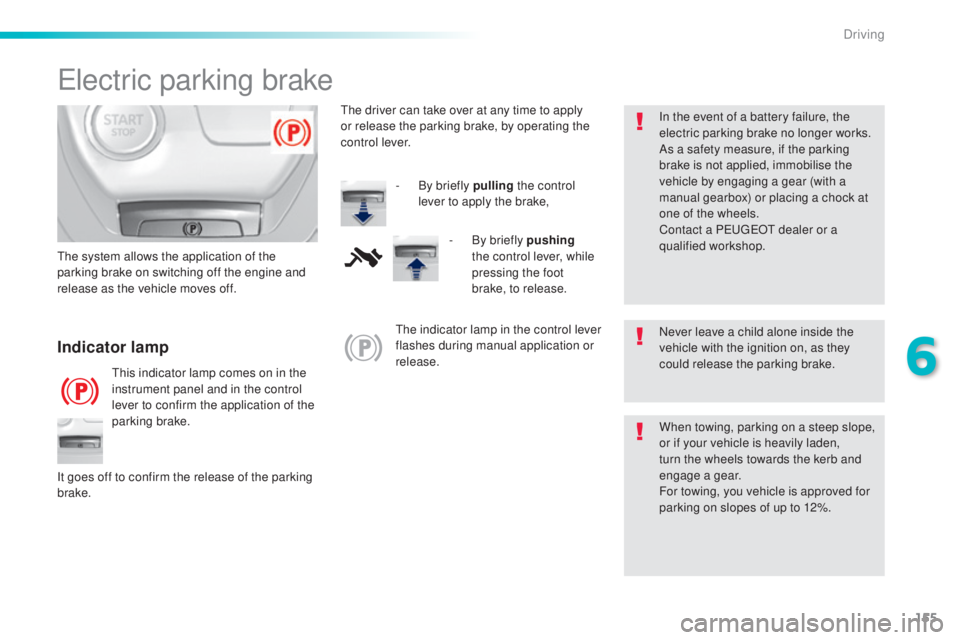
Indicator lamp
this indicator lamp comes on in the
i nstrument panel and in the control
lever to confirm the application of the
parking brake.
the s
ystem allows the application of the
parking brake on switching off the engine and
release as the vehicle moves off.
When towing, parking on a steep slope,
or if your vehicle is heavily laden,
turn the wheels towards the kerb and
engage a gear.
For towing, you vehicle is approved for
parking on slopes of up to 12%.
It goes off to confirm the release of the parking
brake.
the i
ndicator lamp in the control lever
flashes during manual application or
release. In the event of a battery failure, the
electric parking brake no longer works.
As a safety measure, if the parking
brake is not applied, immobilise the
vehicle by engaging a gear (with a
manual gearbox) or placing a chock at
one of the wheels.
Contact a P
eu
ge
Ot d
ealer or a
qualified workshop.
the d
river can take over at any time to apply
or release the parking brake, by operating the
control lever.
-
By b
riefly pulling
the control
lever to apply the brake,
-
By b
riefly pushing
the control lever, while
pressing the foot
brake, to release.
6
Driving