Page 161 of 398
159
308_en_Chap06_conduite_ed02-2015
Emergency braking
In the event of a failure of the main service
brake or in an exceptional situation (e.g. driver
taken ill, under instruction, etc) a continuous
pull on the control lever will brake the vehicle.
Braking takes place while the control lever is
being pulled. It is interrupted if the control lever
is released.
the A
BS and DSC systems provide stability of
the vehicle during emergency braking.
If the emergency braking malfunctions, the
message "Parking brake control faulty" will be
displayed.
the em
ergency braking should only be
used in an exceptional situation.
Repeat this procedure to reactivate automatic
operation.
Reactivation of automatic operation is
confirmed by the indicator lamp in the
instrument panel going off.
Deactivating automatic operation
In some situations, such as very cold weather
or towing (caravan, recovery), it may be
necessary to deactivate automatic operation of
the system.
F
St
art the engine.
F
Ap
ply the parking brake with the control
lever, if it is released.
F
t
ak
e your foot off the brake pedal.
F
Pu
sh and hold the control lever in the
release direction for at least 10 seconds
and no more than 15 seconds.
F
Re
lease the control lever.
F
Pr
ess and hold the brake pedal.
F
Pu
ll the control lever in the apply direction
for 2 seconds.
Deactivation of the automatic functions
is confirmed by illumination of this
indicator lamp in the instrument panel.
F
Re
lease the control lever and the brake
pedal. From this point the parking brake can only
be applied and released manually using the
control lever.
If a failure of the ABS and DSC systems,
signalled by the illumination of one or both
warning lamps in the instrument panel, then
stability of the vehicle is no longer guaranteed.
In this event, stability must be assured by the
driver by repeating alternate “pull-release”
actions on the control lever until the vehicle is
immobilised.
6
Driving
Page 181 of 398
179
308_en_Chap06_conduite_ed02-2015
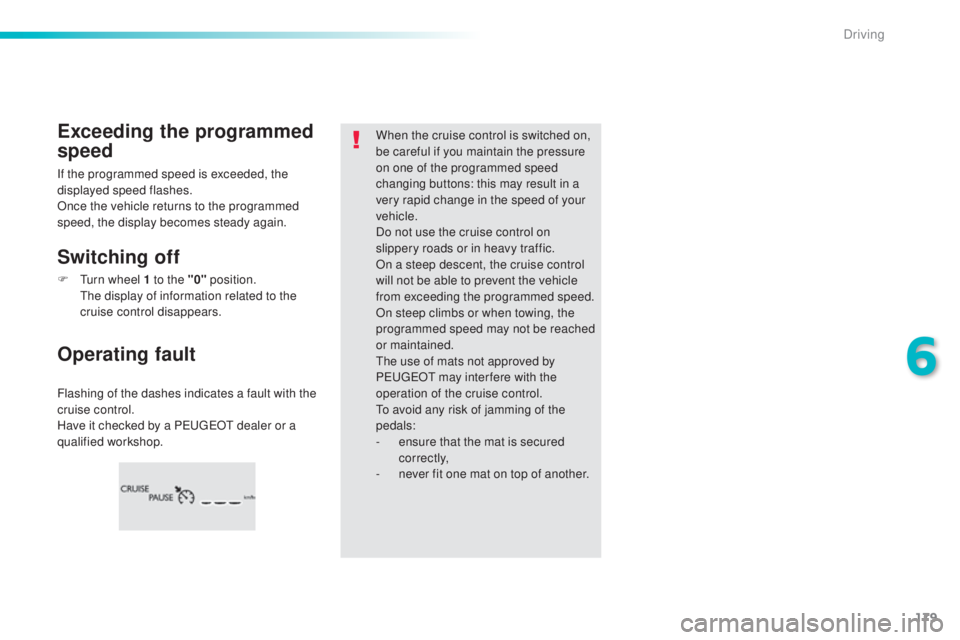
Flashing of the dashes indicates a fault with the
cruise control.
Have it checked by a P
eu
ge
Ot d
ealer or a
qualified workshop.
Operating fault Exceeding the programmed
speed
Switching off
When the cruise control is switched on,
be careful if you maintain the pressure
on one of the programmed speed
changing buttons: this may result in a
very rapid change in the speed of your
vehicle.
Do not use the cruise control on
slippery roads or in heavy traffic.
On a steep descent, the cruise control
will not be able to prevent the vehicle
from exceeding the programmed speed.
On steep climbs or when towing, the
programmed speed may not be reached
or maintained.
the u
se of mats not approved by
P
eu
ge
Ot m
ay inter fere with the
operation of the cruise control.
to av
oid any risk of jamming of the
pedals:
-
en
sure that the mat is secured
c o r r e c t l y,
-
ne
ver fit one mat on top of another.
If the programmed speed is exceeded, the
displayed speed flashes.
Once the vehicle returns to the programmed
speed, the display becomes steady again.
F
t
ur
n wheel 1 to the "0" position.
the d
isplay of information related to the
cruise control disappears.
6
Driving
Page 188 of 398
186
308_en_Chap06_conduite_ed02-2015
In the event of a fault with the active cruise
control, you are alerted by an audible signal
and display of the message message "Driving
aid functions fault".
Have the system checked by a P
eu
ge
Ot
d
ealer or a qualified workshop. When the cruise control is working, take
care if making a maintained press on
one of the cruise control programmed
speed modification buttons: this can
lead to a very quick change in the
speed of your vehicle.
Do not use the active cruise control on
slippery sur faces or in heavy traffic.
When descending a steep hill, the
cruise control may not be able to
prevent the vehicle from exceeding the
programmed speed.
When ascending a steep hill or when
towing, it might not be possible to attain
or maintain the programmed speed.
Operating fault
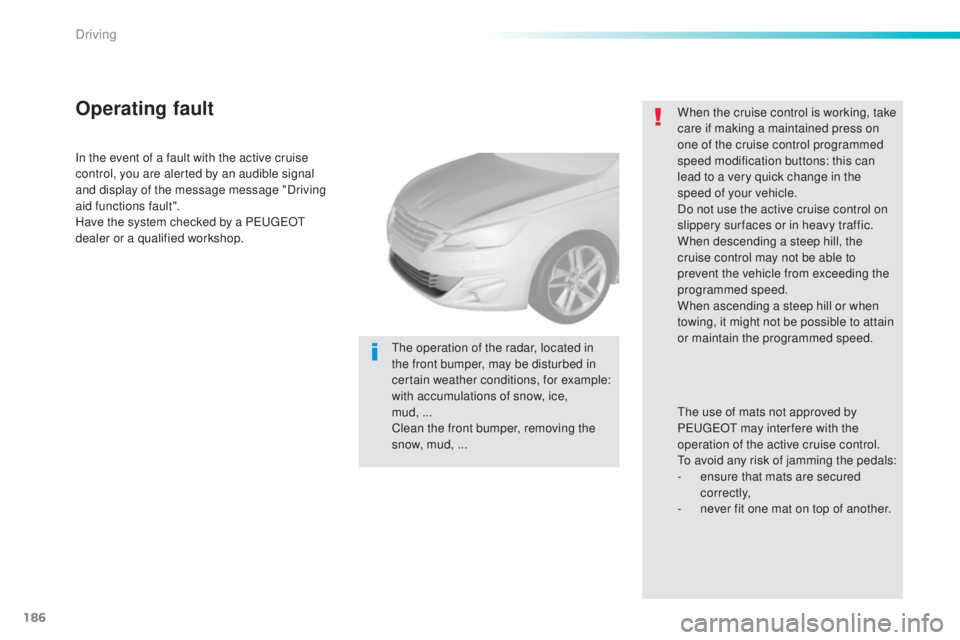
the operation of the radar, located in
t he front bumper, may be disturbed in
certain weather conditions, for example:
with accumulations of snow, ice,
mud,
...
C
lean the front bumper, removing the
snow, mud, ...
the u
se of mats not approved by
P
eu
ge
Ot m
ay inter fere with the
operation of the active cruise control.
to av
oid any risk of jamming the pedals:
-
en
sure that mats are secured
c o r r e c t l y,
-
ne
ver fit one mat on top of another.
Driving
Page 199 of 398
197
308_en_Chap06_conduite_ed02-2015
F to deactivate the system, press
t his button again; its indicator lamp
goes off as well as the associated
indicator in the instrument panel
(depending on version). -
th
is warning lamp
flashes for a few
seconds then goes off,
Operating fault
the system is automatically deactivated
w hen towing with a towbar approved by
P
e u
g e
Ot.
H
igh pressure jet wash
When washing your vehicle, direct the
lance at least 30 cm away from the
sensors.
the s
tate of the system remains in memory on
switching off the ignition. -
th
is symbol changes to alert
mode, its warning lamp flashes
for a few moments, then goes off.
Have it checked by a Peu geOt d ealer or a
qualified workshop.
the s
ystem may suffer temporary
interference in certain weather
conditions (rain, hail...).
In particular, driving on a wet sur face
or moving from a dry area to a wet area
can cause false alerts (for example, the
presence of a fog of water droplets in
the blind spot angle is interpreted as a
vehicle).
In bad or wintry weather, ensure that
the sensors are not covered by mud,
ice or snow.
tak
e care not to cover the warning zone
in the door mirrors or the detection
zones on the front and rear bumpers
with adhesive labels or other objects;
they may hamper the correct operation
of the system.
Depending on version:
6
Driving
Page 210 of 398
208
308_en_Chap06_conduite_ed02-2015
the system is deactivated by pressing the
c ontrol.
the s
ystem is deactivated automatically:
-
on s
witching off the ignition,
-
if t
he engine stalls,
-
if n
o manoeuvre is started within 5 minutes
of selection of the type of manoeuvre,
-
af
ter a prolonged stop of the vehicle during
a manoeuvre,
-
if t
he road wheel anti-slip regulation (ASR)
is triggered,
-
if t
he speed of the vehicle exceeds the
stated limit,
-
wh
en the driver interrupts movement of the
steering wheel,
-
af
ter 4 manoeuvre cycles,
-
on
opening the driver's door,
-
if o
ne of the front wheels encounters an
obstacle.
the o
peration indicator lamp goes off in the
instrument panel and a message is displayed
accompanied by an audible signal.
the d
river should then take back control of the
vehicle's steering.
Deactivation
If the system is deactivated during a
manoeuvre, the drive should reactivate it to
repeat the measurement.
the s
ystem is switched off automatically:
-
wh
en towing a trailer,
-
if t
he driver's door is opened,
-
if t
he speed of the vehicle is above 42 mph
(70 km/h).
to sw
itch the system of for a prolonged period,
contact a P
eu
ge
Ot d
ealer or a qualified
workshop.
-
th
is warning lamp comes on
in the instrument panel and a
message appears, accompanied
by an audible signal,
Operating faults
In the event of a fault, the symbol
for the button changes to alert
mode and the warning lamp flashes
for a few moments then goes off.
Contact a P
eu
ge
Ot d
ealer or a qualified
workshop.
Switching off
In bad weather or in winter, ensure that
the sensors are not covered by road
dirt, ice or snow.
In the event of a fault, have the system
checked by a P
eu
ge
Ot d
ealer or a
qualified workshop.
-
th
is symbol changes to alert
mode, its warning lamp flashes
for a few moments, then goes off. If the lateral distance between your vehicle
and the space is too great, the system may
not be able to measure the space.
Anything projecting beyond the envelope
of the vehicle (long or wide load) is not
taken into account by the Park Assist
system during a manoeuvre.
Depending on version:
Driving
Page 219 of 398
217
308_en_Chap07_info-pratiques_ed02-2015
Very cold climate screen
Before fitting or removing the screen,
ensure that the engine is off and the cooling
fan has stopped. It is recommended that
the screen be fitted and removed by a
P
eu
ge
Ot d
ealer or a qualified workshop.
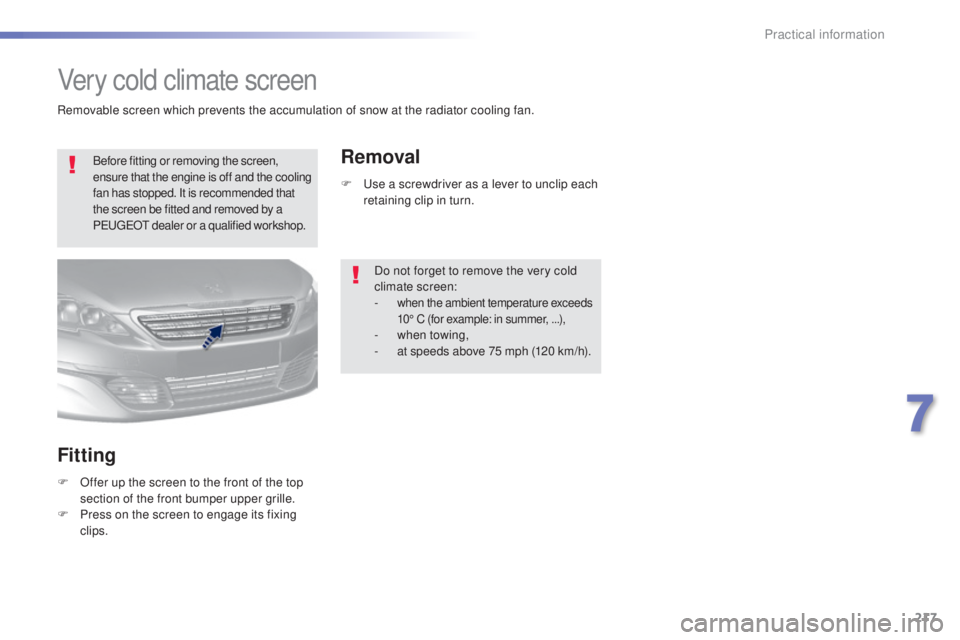
Fitting
F Offer up the screen to the front of the top
section of the front bumper upper grille.
F
Pr
ess on the screen to engage its fixing
clips.
Removal
F use a screwdriver as a lever to unclip each
r etaining clip in turn.
Do not forget to remove the very cold
climate screen:
-
when the ambient temperature exceeds
10° C (for example: in summer, . ..),
- when towing,
- at s peeds above 75 mph (120 km/h).
Removable screen which prevents the accumulation of snow at the radiator cooling fan.
7
Practical information
Page 220 of 398
218
308_en_Chap07_info-pratiques_ed02-2015
towing a trailer
We recommend the use of genuine
PeugeOt t owbars and their harnesses
that have been tested and approved
from the design stage of your vehicle,
and that the fitting of the towbar is
entrusted to a P
eu
ge
Ot d
ealer or a
qualified workshop.
If the towbar is not fitted by a
P
eu
ge
Ot d
ealer, it must still be
fitted in accordance with the vehicle
manufacturer's instructions.
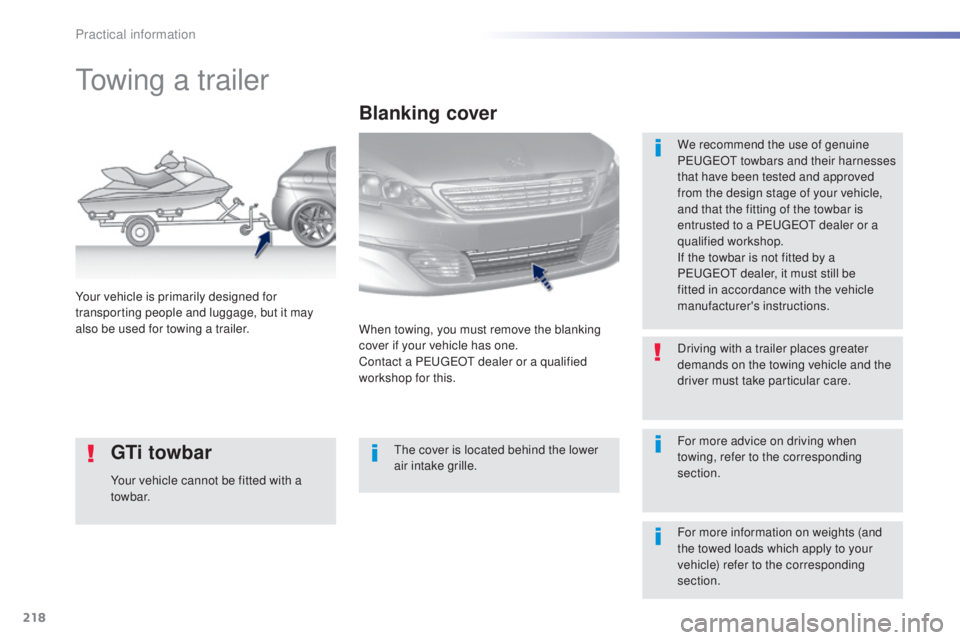
Your vehicle is primarily designed for
transporting people and luggage, but it may
also be used for towing a trailer.
Blanking cover
When towing, you must remove the blanking
cover if your vehicle has one.
Contact a P
eu
ge
Ot d
ealer or a qualified
workshop for this. Driving with a trailer places greater
demands on the towing vehicle and the
driver must take particular care.
the c
over is located behind the lower
air intake grille.
For more information on weights (and
the towed loads which apply to your
vehicle) refer to the corresponding
section.
GTi towbar
Your vehicle cannot be fitted with a
towbar. For more advice on driving when
towing, refer to the corresponding
section.
Practical information
Page 245 of 398
243
308_en_Chap08_en-cas-de-panne_ed02-2015
Warning triangle (stowing)
Before leaving your vehicle to set up
and install the triangle, switch on the
hazard warning lamps and put on your
high visibility vest.
thi
s safety equipment should be used in
addition to the hazard warning lamps.
Its presence in the vehicle is mandatory.
Placing the triangle in the
road
Refer to the manufacturer's instructions on
unfolding and installing supplied with the
triangle. F
Pl
ace the triangle behind the vehicle, as
required by the legislation in force in your
c o unt r y.
the t
riangle is available as an
accessory; contact a P
eu
ge
Ot d
ealer
or a qualified workshop.
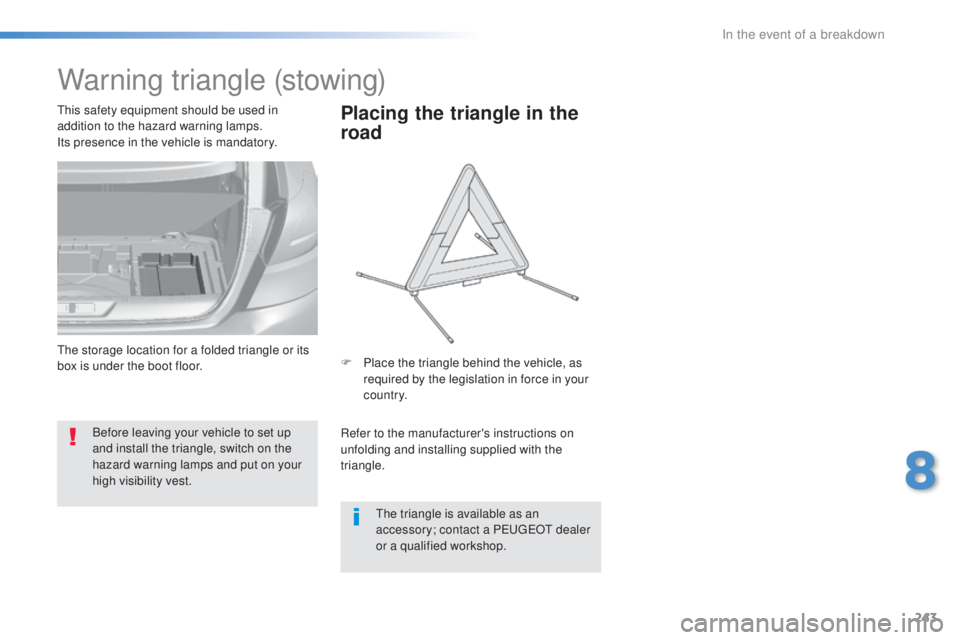
the s
torage location for a folded triangle or its
box is under the boot floor.
8
In the event of a breakdown