2016 NISSAN NOTE light
[x] Cancel search: lightPage 2432 of 3641
![NISSAN NOTE 2016 Service Repair Manual MWI-74
< ECU DIAGNOSIS INFORMATION >[TYPE B]
COMBINATION METER
ECU DIAGNOSIS INFORMATION
COMBINATION METER
Reference ValueINFOID:0000000012432613
VALUES ON THE DIAGNOSIS TOOL
Monitor Item Display cont](/manual-img/5/57363/w960_57363-2431.png "NISSAN NOTE 2016 Service Repair Manual MWI-74
< ECU DIAGNOSIS INFORMATION >[TYPE B]
COMBINATION METER
ECU DIAGNOSIS INFORMATION
COMBINATION METER
Reference ValueINFOID:0000000012432613
VALUES ON THE DIAGNOSIS TOOL
Monitor Item Display cont")
MWI-74
< ECU DIAGNOSIS INFORMATION >[TYPE B]
COMBINATION METER
ECU DIAGNOSIS INFORMATION
COMBINATION METER
Reference ValueINFOID:0000000012432613
VALUES ON THE DIAGNOSIS TOOL
Monitor Item Display contentData monitor
Condition Reference value in normal operation
SPEED METER
[mph or km/h] Speed meter
operation
While driving
Vehicle speed matches speed meter
SPEED OUTPUT
[mph or km/h] Vehicle speed While driving The speed output signal value via CAN
communication is approx. value of ve-
hicle speed.
ODO OUTPUT
[mph or km/h] ODO meter op-
eration
Driving
Distance driven
TACHO METER
[rpm] Ta c h o m e t e r
operation
Engine running The tacho meter is approx. value of en-
gine speed via CAN communication.
FUEL METER
[L] Fuel level Ignition ON Fuel level is approx. value of fuel
gauge.
W TEMP METER
[ ° F] or [ °C] Engine coolant
temperature
Engine running Input value of engine coolant tempera-
ture signal via CAN communication.
ABS W/L ABS warning
lampWhen ABS warning lamp is ON
On
When ABS warning lamp is OFF Off
VDC/TCS IND VDC indicator
lampWhen VDC indicator lamp is ON
On
When VDC indicator lamp is OFF OFF
SLIP IND Slip indicator
lampWhen SLIP indicator lamp is ON
On
When SLIP indicator lamp is OFF Off
BRAKE W/L Brake warning
lamp When Brake warning lamp is ON
On
*
When Brake warning lamp is OFF Off
DOOR W/L Door open
warning lampWhen Door warning lamp is ON
On
When Door warning lamp is OFF Off
HI-BEAM IND HI-Beam indi-
cator lampWhen High-beam indicator lamp is ON
On
When High-beam indicator lamp is OFF Off
TURN IND Turn signal in-
dicatorWhen Turn signal indicator lamp is ON
On
When Turn signal indicator lamp is OFF Off
LIGHT IND Light indicatorWhen Tail lamp indicator lamp is ON
On
When Tail lamp indicator lamp is OFF Off
FR FOG IND Front fog lamp
indicatorFront fog lamp indicator lamp ON
On
Front fog lamp indicator lamp OFF Off
OIL W/L Engine oil pres-
sure warning
light When engine oil pressure warning lamp is
ON
On
When engine oil pressure warning lamp is
OFF Off
MIL MIL warning
lampWhen Malfunction indi
cator lamp (MIL) is
ON On
When Malfunction indi cator lamp (MIL) is
OFF Off
Revision: August 2015
2016 Versa Note
cardiagn.com
Page 2435 of 3641
![NISSAN NOTE 2016 Service Repair Manual MWI
COMBINATION METERMWI-77
< ECU DIAGNOSIS INFORMATION > [TYPE B]
C
D
E
F
G H
I
J
K L
M B A
O P
*1:For Canada
Fail-safeINFOID:0000000012432614
The combination meter activates the fail-safe contro l i](/manual-img/5/57363/w960_57363-2434.png "NISSAN NOTE 2016 Service Repair Manual MWI
COMBINATION METERMWI-77
< ECU DIAGNOSIS INFORMATION > [TYPE B]
C
D
E
F
G H
I
J
K L
M B A
O P
*1:For Canada
Fail-safeINFOID:0000000012432614
The combination meter activates the fail-safe contro l i")
MWI
COMBINATION METERMWI-77
< ECU DIAGNOSIS INFORMATION > [TYPE B]
C
D
E
F
G H
I
J
K L
M B A
O P
*1:For Canada
Fail-safeINFOID:0000000012432614
The combination meter activates the fail-safe contro l if CAN communication with each unit is malfunctioning.
DTC IndexINFOID:0000000012432615
Function Specifications
Speedometer Reset to zero by suspending communication.
Tachometer
Illumination control When suspending communication, changes to nighttime mode.
Shift position indicator When suspending communication, not indicate.
Information display Trip com-
puterCurrent fuel consump-
tion
• When reception time of an abnormal signal is 2 seconds or
less, the last received datum is used for calculation to indi-
cate the result.
• When reception time of an abnormal signal is more than two seconds, the last result calculated during normal condition is
indicated.
Average fuel consump-
tion
Distance to empty
Odo/trip meter An indicated value is maintained at communications blackout.
Buzzer The buzzer turns OFF by suspending communication.
Warning lamp/indicator lamp ABS warning lamp
The lamp turns ON by suspending communication.
Slip indicator lamp
Malfunction indicator lamp (MIL)
VDC OFF indicator lamp
EPS warning lamp
Brake warning lamp
High beam indicator lamp
The lamp turns OFF by suspending communication.
Turn signal indicator lamp
Door warning lamp
Light indicator lamp
Engine oil pressure warning lamp
High water temperature warning
lamp
Key warning lamp
O/D OFF indicator lamp
Shift P warning lamp
Engine start operation indicator lamp
Display contents of CONSULT
Diagnostic item is detected when... Refer to
CAN COMM CIRCUIT
[U1000] When combination meter is not transmitting or receiving CAN communication signal for
2 seconds or more.
MWI-93
CONTROL UNIT (CAN)
[U1010]When detecting error during the initial diagnosis of the CAN controller of combination
meter.
MWI-94
VEHICLE SPEED
[B2205]The abnormal vehicle speed signal is input from the ABS actuator and electric unit (con-
trol unit) for 2 seconds or more.
MWI-95
ENGINE SPEED
[B2267]If ECM continuously transmits abnormal engine speed signals for 2 seconds or more.
MWI-96
WATER TEMP
[B2268]If ECM continuously transmits abnormal engine coolant temperature signals for 60 sec-
onds or more.
MWI-97
Revision: August 2015
2016 Versa Note
cardiagn.com
Page 2466 of 3641
![NISSAN NOTE 2016 Service Repair Manual MWI-108
< SYMPTOM DIAGNOSIS >[TYPE B]
THE OIL PRESSURE WARNING LAMP DOES NOT TURN ON
THE OIL PRESSURE WARNING
LAMP DOES NOT TURN ON
DescriptionINFOID:0000000012432649
The engine oil pressure warning](/manual-img/5/57363/w960_57363-2465.png "NISSAN NOTE 2016 Service Repair Manual MWI-108
< SYMPTOM DIAGNOSIS >[TYPE B]
THE OIL PRESSURE WARNING LAMP DOES NOT TURN ON
THE OIL PRESSURE WARNING
LAMP DOES NOT TURN ON
DescriptionINFOID:0000000012432649
The engine oil pressure warning")
MWI-108
< SYMPTOM DIAGNOSIS >[TYPE B]
THE OIL PRESSURE WARNING LAMP DOES NOT TURN ON
THE OIL PRESSURE WARNING
LAMP DOES NOT TURN ON
DescriptionINFOID:0000000012432649
The engine oil pressure warning lamp stays off when the ignition switch is turned ON.
Diagnosis ProcedureINFOID:0000000012432650
1.CHECK COMBINATION METER ENGIN E OIL PRESSURE WARNING LIGHT
1. Select METER/M&A on CONSULT.
2. Observe OIL W/L DATA MONITOR while operating the ignition switch.
Is the inspection result normal?
YES >> Inspection End.
NO >> Replace combination meter. Refer to MWI-115, "
Removal and Installation".
ComponentCondition CONSULT
Engine oil pressure warning light Ignition ON
ON
Ignition OFF OFF
Revision: August 2015 2016 Versa Note
cardiagn.com
Page 2467 of 3641
![NISSAN NOTE 2016 Service Repair Manual MWI
THE OIL PRESSURE WARNING LAMP DOES NOT TURN OFFMWI-109
< SYMPTOM DIAGNOSIS > [TYPE B]
C
D
E
F
G H
I
J
K L
M B A
O P
THE OIL PRESSURE WARNING LAMP DOES NOT TURN OFF
DescriptionINFOID:0000000012432](/manual-img/5/57363/w960_57363-2466.png "NISSAN NOTE 2016 Service Repair Manual MWI
THE OIL PRESSURE WARNING LAMP DOES NOT TURN OFFMWI-109
< SYMPTOM DIAGNOSIS > [TYPE B]
C
D
E
F
G H
I
J
K L
M B A
O P
THE OIL PRESSURE WARNING LAMP DOES NOT TURN OFF
DescriptionINFOID:0000000012432")
MWI
THE OIL PRESSURE WARNING LAMP DOES NOT TURN OFFMWI-109
< SYMPTOM DIAGNOSIS > [TYPE B]
C
D
E
F
G H
I
J
K L
M B A
O P
THE OIL PRESSURE WARNING LAMP DOES NOT TURN OFF
DescriptionINFOID:0000000012432651
The engine oil pressure warning lamp remains on while the engine is running (normal oil pressure).
Diagnosis ProcedureINFOID:0000000012432652
1.CHECK COMBINATION METER INPUT SIGNAL
1. Start the engine and select METER/M&A on CONSULT.
2. Observe OIL W/L DATA MONITOR and the operation of the engine oil pressure warning lamp on the com- bination meter.
Is the inspection result normal?
YES >> Replace combination meter. Refer to MWI-115, "Removal and Installation".
NO >> Perform ECM self-diagnosis. Refer to EC-60, "
CONSULT Function".
ComponentConditionCONSULT
Engine oil pressure warning light Engine runningOFF
Revision: August 2015 2016 Versa Note
cardiagn.com
Page 2482 of 3641
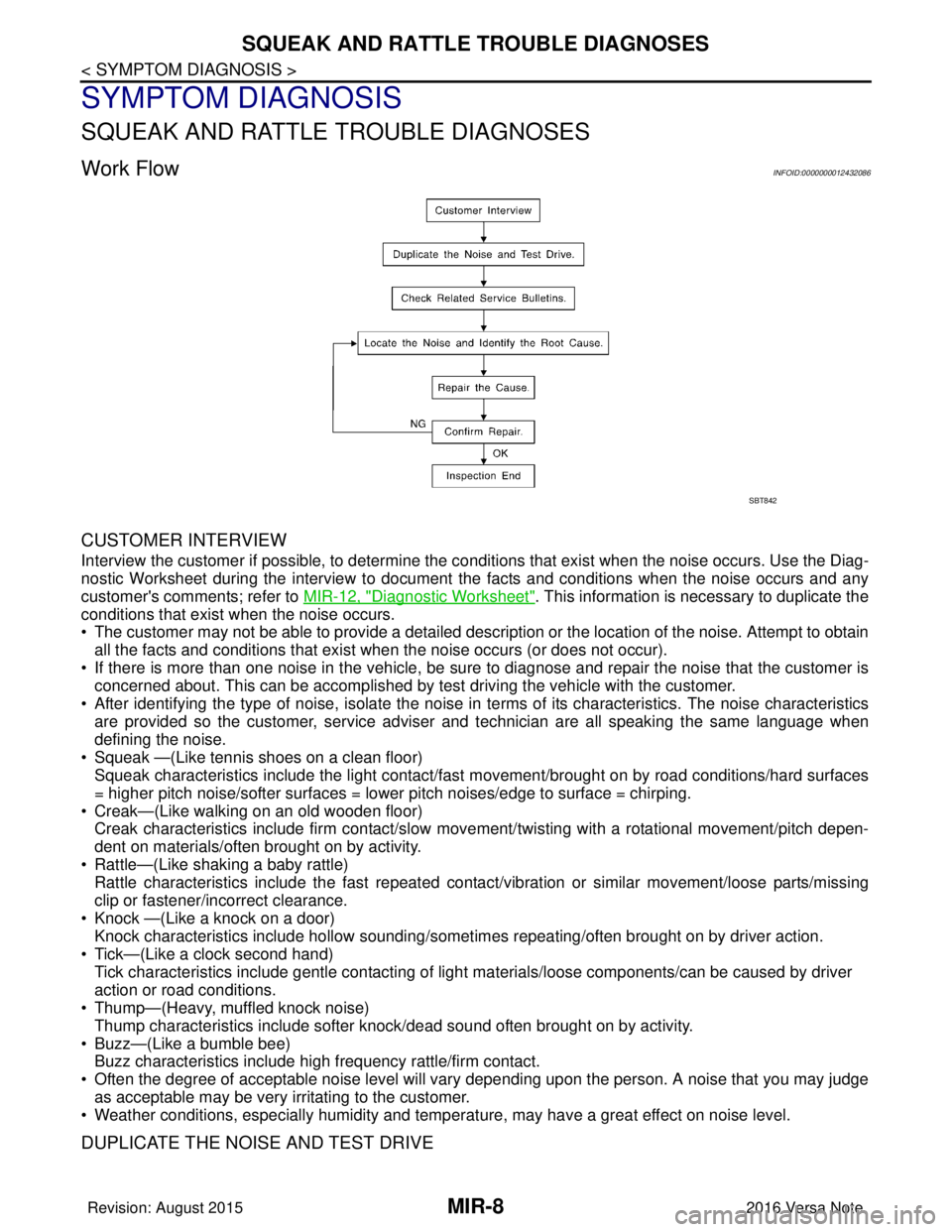
MIR-8
< SYMPTOM DIAGNOSIS >
SQUEAK AND RATTLE TROUBLE DIAGNOSES
SYMPTOM DIAGNOSIS
SQUEAK AND RATTLE TROUBLE DIAGNOSES
Work FlowINFOID:0000000012432086
CUSTOMER INTERVIEW
Interview the customer if possible, to determine the conditions that exist when the noise occurs. Use the Diag-
nostic Worksheet during the interview to document the facts and conditions when the noise occurs and any
customer's comments; refer to MIR-12, "
Diagnostic Worksheet". This information is necessary to duplicate the
conditions that exist when the noise occurs.
• The customer may not be able to provide a detailed description or the location of the noise. Attempt to obtain
all the facts and conditions that exist w hen the noise occurs (or does not occur).
• If there is more than one noise in the vehicle, be sure to diagnose and repair the noise that the customer is
concerned about. This can be accomplished by test driving the vehicle with the customer.
• After identifying the type of noise, isolate the noise in terms of its characteristics. The noise characteristics
are provided so the customer, service adviser and technician are all speaking the same language when
defining the noise.
• Squeak —(Like tennis shoes on a clean floor) Squeak characteristics include the light contact/fast movement/brought on by road conditions/hard surfaces
= higher pitch noise/softer surfaces = lower pitch noises/edge to surface = chirping.
• Creak—(Like walking on an old wooden floor) Creak characteristics include firm contact/slow mo vement/twisting with a rotational movement/pitch depen-
dent on materials/often brought on by activity.
• Rattle—(Like shaking a baby rattle) Rattle characteristics include the fast repeated contac t/vibration or similar movement/loose parts/missing
clip or fastener/incorrect clearance.
• Knock —(Like a knock on a door) Knock characteristics include hollow sounding/someti mes repeating/often brought on by driver action.
• Tick—(Like a clock second hand) Tick characteristics include gentle contacting of light materials/loose components/can be caused by driver
action or road conditions.
• Thump—(Heavy, muffled knock noise)
Thump characteristics include softer k nock/dead sound often brought on by activity.
• Buzz—(Like a bumble bee) Buzz characteristics include hi gh frequency rattle/firm contact.
• Often the degree of acceptable noise level will vary depending upon the person. A noise that you may judge as acceptable may be very irritating to the customer.
• Weather conditions, especially humidity and temperat ure, may have a great effect on noise level.
DUPLICATE THE NOISE AND TEST DRIVE
SBT842
Revision: August 2015 2016 Versa Note
cardiagn.com
Page 2484 of 3641

MIR-10
< SYMPTOM DIAGNOSIS >
SQUEAK AND RATTLE TROUBLE DIAGNOSES
INSTRUMENT PANEL
Most incidents are caused by contact and movement between:
1. Cluster lid A and the instrument panel
2. Acrylic lens and combination meter housing
3. Instrument panel to front pillar finisher
4. Instrument panel to windshield
5. Instrument panel pins
6. Wiring harnesses behind the combination meter
7. A/C defroster duct and duct joint
These incidents can usually be located by tapping or moving the components to duplicate the noise or by
pressing on the components while driving to stop the noise. Most of these incidents can be repaired by apply-
ing felt cloth tape or silicone spray (in hard to reach areas). Urethane pads can be used to insulate wiring har-
ness.
CAUTION:
Do not use silicone spray to isolate a squeak or rattle. If you saturate the ar ea with silicone, you will
not be able to recheck the repair.
CENTER CONSOLE
Components to pay attention to include:
1. Shift selector assembly cover to finisher
2. A/C control unit and cluster lid C
3. Wiring harnesses behind audio and A/C control unit
The instrument panel repair and isolation pr ocedures also apply to the center console.
DOORS
Pay attention to the:
1. Finisher and inner panel making a slapping noise
2. Inside handle escutcheon to door finisher
3. Wiring harnesses tapping
4. Door striker out of alignment causing a popping noise on starts and stops
Tapping or moving the components or pressing on them wh ile driving to duplicate the conditions can isolate
many of these incidents. You can usually insulate the areas with felt cloth tape or insulator foam blocks from
the NISSAN Squeak and Rattle Kit (J-50397) to repair the noise.
TRUNK
Trunk noises are often caused by a loose jack or loose items put into the trunk by the owner.
In addition look for:
1. Trunk lid bumpers out of adjustment
2. Trunk lid striker out of adjustment
3. The trunk lid torsion bars knocking together
4. A loose license plate or bracket
Most of these incidents can be repaired by adjusting, se curing or insulating the item(s) or component(s) caus-
ing the noise.
SUNROOF/HEADLINING
Noises in the sunroof/headlining area c an often be traced to one of the following:
1. Sunroof lid, rail, linkage or seals making a rattle or light knocking noise
2. Sun visor shaft shaking in the holder
3. Front or rear windshield touching headlining and squeaking
Again, pressing on the components to stop the noise while duplicating the conditions can isolate most of these
incidents. Repairs usually consist of insulating with felt cloth tape.
OVERHEAD CONSOLE (FRONT AND REAR)
Overhead console noises are often caused by the c onsole panel clips not being engaged correctly. Most of
these incidents are repaired by pushing up on the c onsole at the clip locations until the clips engage.
In addition look for:
Revision: August 2015 2016 Versa Note
cardiagn.com
Page 2497 of 3641
PB-4
< PERIODIC MAINTENANCE >
PARKING BRAKE SYSTEM
PERIODIC MAINTENANCE
PARKING BRAKE SYSTEM
Inspection and AdjustmentINFOID:0000000012430688
INSPECTION
Parking Brake Control Stroke
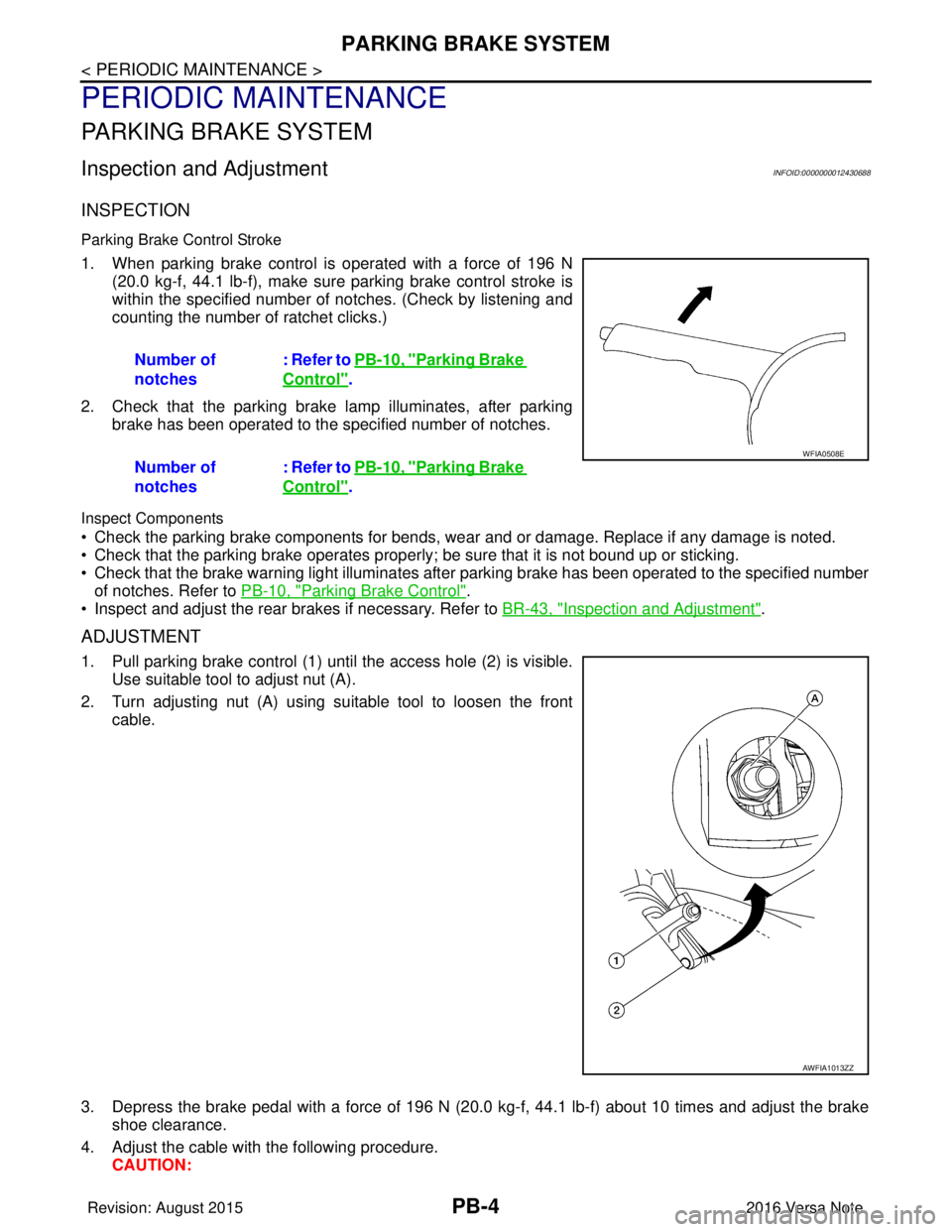
1. When parking brake control is operated with a force of 196 N(20.0 kg-f, 44.1 lb-f), make sure parking brake control stroke is
within the specified number of notches. (Check by listening and
counting the number of ratchet clicks.)
2. Check that the parking brake lamp illuminates, after parking brake has been operated to the specified number of notches.
Inspect Components
• Check the parking brake components for bends, wear and or damage. Replace if any damage is noted.
• Check that the parking brake operates properly ; be sure that it is not bound up or sticking.
• Check that the brake warning light illuminates afte r parking brake has been operated to the specified number
of notches. Refer to PB-10, "
Parking Brake Control".
• Inspect and adjust the rear brakes if necessary. Refer to BR-43, "
Inspection and Adjustment".
ADJUSTMENT
1. Pull parking brake control (1) until the access hole (2) is visible.
Use suitable tool to adjust nut (A).
2. Turn adjusting nut (A) using suitable tool to loosen the front cable.
3. Depress the brake pedal with a force of 196 N (20. 0 kg-f, 44.1 lb-f) about 10 times and adjust the brake
shoe clearance.
4. Adjust the cable with the following procedure. CAUTION:Number of
notches
: Refer to PB-10, "
Parking Brake
Control".
Number of
notches : Refer to PB-10, "
Parking Brake
Control".
WFIA0508E
AWFIA1013ZZ
Revision: August 2015
2016 Versa Note
cardiagn.com
Page 2503 of 3641
PB-10
< SERVICE DATA AND SPECIFICATIONS (SDS)
SERVICE DATA AND SPECIFICATIONS (SDS)
SERVICE DATA AND SPECIFICATIONS (SDS)
SERVICE DATA AND SPECIFICATIONS (SDS)
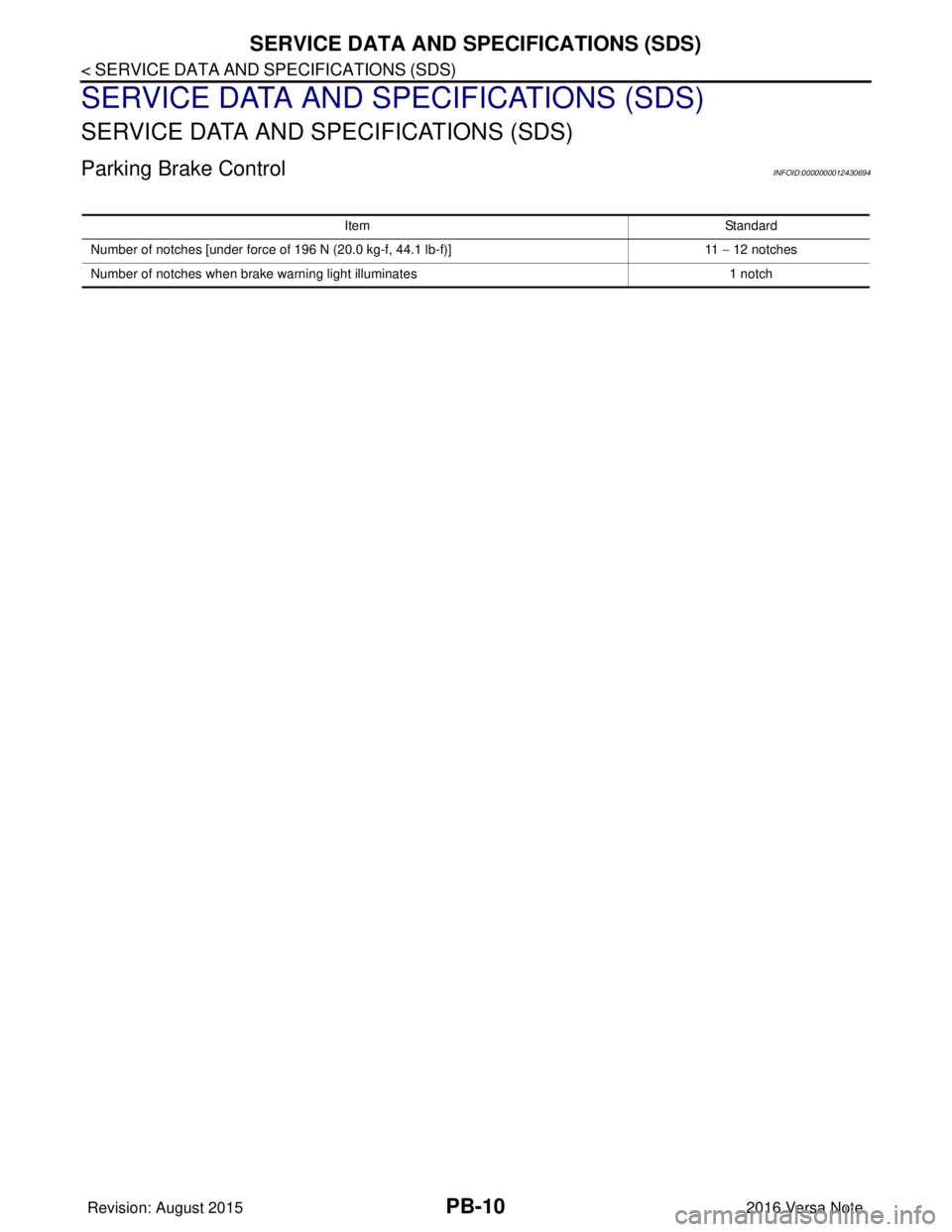
Parking Brake ControlINFOID:0000000012430694
ItemStandard
Number of notches [under force of 196 N (20.0 kg-f, 44.1 lb-f)] 11 − 12 notches
Number of notches when brake warning light illuminates 1 notch
Revision: August 20152016 Versa Note
cardiagn.com