2016 BMW M4 lock
[x] Cancel search: lockPage 45 of 228

Closing without the anti-trap
mechanism
WARNING
Operating the windows can lead to parts
of the body or objects becoming trapped. Dan‐
ger of injury or damage to property. When
opening and closing, make sure that the area
of movement of the windows is free.◀
If an external danger or ice does not allow you to close the windows normally, proceed as fol‐
lows:1.Pull the switch past the resistance point
and hold it there.
The anti-trap mechanism is restricted and
the window opens slightly when the clos‐
ing force exceeds a certain value.2.Pull the switch past the resistance point
again within approximately four seconds
and hold it there.
The window closes without the anti-trap
mechanism.
Roller sunblinds
Roller sunblind for rear window
General If the roller sunblinds for the rear window can
no longer be moved after a number of opera‐
tions in immediate succession, the system is
blocked for a limited time to prevent overheat‐
ing. Allow the system to cool down.
The roller sunblind for the rear window cannot
be operated in low interior temperatures.
Retracting or extending the roller sunblind for rear window
Press the button.
Glass Roof, electrical
General The Glass Roof and the sun blind can be oper‐
ated separately or together with the same
switch.
Notes
WARNING
Operating the Glass Roof can lead to
parts of the body becoming trapped. Danger of
injury. When opening and closing, make sure
that the area of movement of the Glass Roof is
free.◀
WARNING
Unsupervised children or animals in the
vehicle can set the vehicle in motion and en‐
danger themselves or other road users, for ex‐
ample by the following actions:
▷Pressing the start/stop button.▷Releasing the parking brake.▷Opening and closing doors or windows.▷Setting the selector lever to neutral.▷Operating vehicle equipment.
Risk of accident or injury. Do not leave children
or animals unsupervised in the vehicle. When
leaving the vehicle, take the remote control
with you and lock it.◀
Seite 45Opening and closingControls45
Online Edition for Part no. 01 40 2 964 013 - VI/15
Page 49 of 228
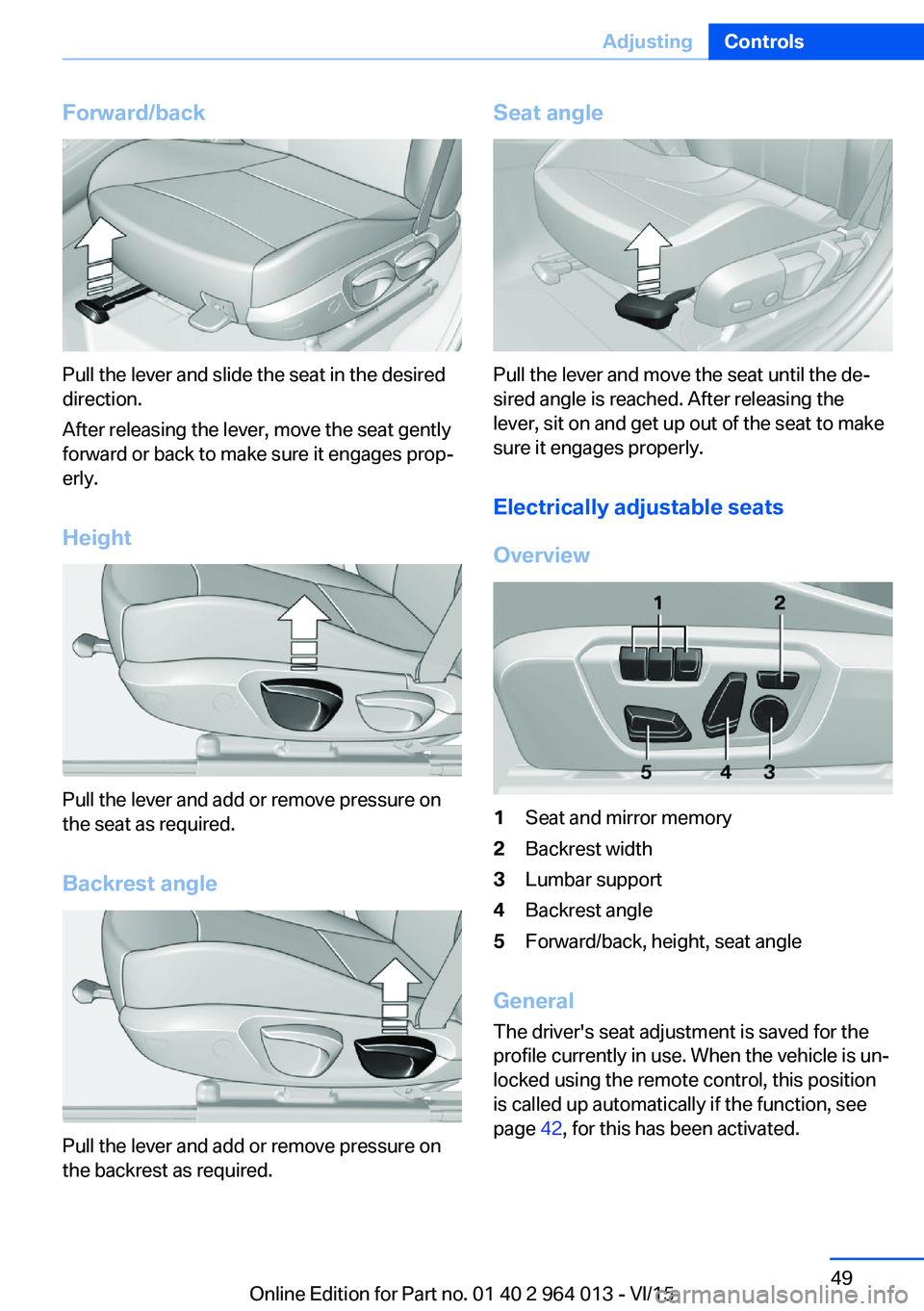
Forward/back
Pull the lever and slide the seat in the desired
direction.
After releasing the lever, move the seat gently
forward or back to make sure it engages prop‐
erly.
Height
Pull the lever and add or remove pressure on
the seat as required.
Backrest angle
Pull the lever and add or remove pressure on
the backrest as required.
Seat angle
Pull the lever and move the seat until the de‐
sired angle is reached. After releasing the
lever, sit on and get up out of the seat to make
sure it engages properly.
Electrically adjustable seats
Overview
1Seat and mirror memory2Backrest width3Lumbar support4Backrest angle5Forward/back, height, seat angle
General The driver's seat adjustment is saved for the
profile currently in use. When the vehicle is un‐
locked using the remote control, this position is called up automatically if the function, see
page 42, for this has been activated.
Seite 49AdjustingControls49
Online Edition for Part no. 01 40 2 964 013 - VI/15
Page 51 of 228

Switch offPress and hold down the button.
LEDs go out.
Entering in the back
Notes WARNING
Danger of trapping when moving the
seats. Danger of injury or damage to property.
Before making the setting, make sure that the
movement area of the seat is clear.◀
WARNING
The backrest can unexpectedly move
during the journey when it is unlocked. You
could lose control of the vehicle. Danger of in‐
jury. Fold back and lock the backrests before
every journey.◀
Manual longitudinal adjustment Comfort entry
The comfort entry contains a memory function
for the longitudinal and backrest adjustment.1.Pull the lever until it stops.2.Fold the backrest forwards.3.Slide the seat forwards.
Original position
1.Push seat back to the starting position.2.Fold back backrest to lock the seat.Electric longitudinal adjustment
Comfort entry
The comfort entry contains a memory function
for the longitudinal and backrest adjustment.1.Pull the lever until it stops.2.Fold the backrest forwards.3.Changing the entrance area:▷Press and hold down the button
until the seat has moved into the
desired position. Releasing stops the
movement.▷Press the button briefly. Seat au‐
tomatically moves into the end
position. Pressing the switch again
stops the movement.
Original position
1.Move seat in original position:▷Hold down the button until the
seat is moved to its original posi‐
tion. Releasing stops the movement.▷Press the button briefly. The seat
moves into its original position.
Pressing the switch again stops the
movement.2.Fold back backrest.Seite 51AdjustingControls51
Online Edition for Part no. 01 40 2 964 013 - VI/15
Page 52 of 228
Seat beltsNumber of seat belts
Your vehicle has been fitted with four seat
belts for the safety of you and your passen‐
gers. However, they can only offer protection
when adjusted correctly.
General Before a journey, always make sure that all oc‐
cupants have fastened their seat belts.
To protect vehicle occupants, belt interlock is
triggered early. When it is applied, guide the
belt slowly from the bracket.
The airbags are a complementary safety fea‐
ture and not a substitute for the seat belts.
The belt anchorage is suitable for adults of any
stature as long as the seat is correctly adjus‐
ted.
Notes WARNING
Using a seat belt to restrain more than
one person nullifies the protective effect of the
seatbelt. Danger of injury or life. Only restrain one person with each seat belt. Do not place
infants and children on your lap, but instead re‐
strain them with the child restraint systems
provided, and secure them accordingly.◀
WARNING
The protective effect of the seat belts
can be restricted or they can be rendered inef‐
fective if put on incorrectly. If a seat belt is not
worn correctly, additional injuries can be
caused, for example in the event of an accident
or braking and evasive manoeuvres. Danger of
injury or life. Make sure that all vehicle occu‐
pants have fastened their seat belts cor‐
rectly.◀WARNING
Seat belts are designed to bear upon the
bony structure of the body and should be worn
low across the front of the pelvis, or the pelvis,
chest and shoulders, as applicable. Wearing
the lap section of the belt across the abdomi‐
nal area must be avoided.
Seat belts should be adjusted as firmly as pos‐
sible, consistent with comfort, to provide the
protection for which they have been designed.
A slack belt will greatly reduce the protection
afforded to the wearer.
Care should be taken to avoid contamination of
the seat belt strap by polishes, oils and chemi‐
cals and particularly battery acid. Cleaning may
safely be carried out using mild soap and wa‐
ter. The seat belt strap should be replaced if
webbing becomes frayed, contaminated or
damaged. Seat belts should not be worn with
seat belt straps twisted. Each seat belt assem‐
bly must only be used by one occupant; it is il‐
legal to carry an infant or a child on the occu‐
pant's lap.
It is essential to replace the entire assembly af‐
ter it has been worn in a severe impact even if
damage to the assembly is not obvious.◀
WARNING
No modifications or additions should be
made by the user that will either prevent the
seat belt adjusting devices from operating to
remove slack, or prevent the seat belt assem‐
bly from being adjusted to remove slack.◀
Correct seat belt use▷Place the seat belt tightly over the pelvis
and shoulder as close as possible to the
body and without twisting.▷Make sure that it is positioned low at the
hip in the area of the pelvis. The seat belt
must not press on the midriff.▷The seat belt must not pass across the
neck. It should not be pulled or jammed
across sharp edges or breakable objects.Seite 52ControlsAdjusting52
Online Edition for Part no. 01 40 2 964 013 - VI/15
Page 53 of 228

▷Avoid bulky clothing.▷Regularly pull the seat belt in the upper-
body area taut.
Adjustment for automatic retracting
seat belts
▷Draw the buckle tongue attached to the
seat belt across the body and press it into
the buckle catch until a ‘click’ is heard.▷Adjustment of the belt length is very im‐
portant. To adjust the lap belt and check
whether the buckle has locked correctly,
pull upwards on the shoulder strap until the
lap belt fits tightly.▷The length of the diagonal shoulder strap
adjusts itself automatically to allow free‐
dom of movement.▷To release the seat belt, press the button
on the buckle catch unit.
Fastening the seat belt
The seat belt buckle must be heard to engage.
Automatically tension seat belt
If the belt is fastened, the belt strap is automat‐
ically fastened once when driving off.
Unfastening the seat belt
1.Hold onto the belt.2.Press the red button on the belt buckle.3.Guide the belt back up to the reel mecha‐
nism.Seat belt reminder for driver’s and
front seat passenger seat
A Check Control message is displayed.
Check whether the seat belt has been
fastened correctly.
The seat belt reminder is activated when the
seat belt on the driver's side is not fastened.
On some national versions, the seat belt re‐
minder is also activated above approximately
10 km/h, 6 mph if the front passenger's seat
belt is not fastened and if heavy objects are lo‐
cated on the seat.
Not for Australia/New Zealand: Seat
belt reminder for rear seats
The indicator light in the instrument
cluster is illuminated after the engine
starts.▷Green: seat belt fastened on the corre‐
sponding rear seat.▷Red: seat belt not fastened on the corre‐
sponding rear seat.
The seat belt reminder will also be activated if
a rear seat belt is unfastened during the jour‐
ney.
Damaged seat belts WARNING
The protective effect of the seat belts
can be restricted or nullified in the following
situations:
▷Belts are damaged, contaminated or have
been modified in another way.▷Belt buckle is damaged or heavily contami‐
nated.▷Belt tensioners or belt retractors have
been modified.
Seat belts can be damaged in an accident
without the damage necessarily being appa‐
rent. Danger of injury or life. Do not modify seat
belts, belt buckles, belt tensioners, belt retrac‐
tors and belt anchor points; also, keep them
Seite 53AdjustingControls53
Online Edition for Part no. 01 40 2 964 013 - VI/15
Page 55 of 228

Saving1.Switch on ignition.2.Set desired position.3.Press button briefly. LED in button
is illuminated.4.Press the desired button 1 or 2 while the
LED is lit. LED turns off.
If SET button was pressed inadvertently:
Press the button again.
LED turns off.
Recalling
General
There are two possibilities of calling up the
memory function:
▷Comfort function, see page 55.▷Safety function, see page 55.
Convenience function
1.Open the driver's door.2.Switch ignition off if necessary.3.Briefly press button 1 or 2 as desired.
The relevant seat adjustment is done automat‐
ically.
The process is cancelled if a seat adjustment
switch or one of the buttons is pressed.
Safety function
1.Close the driver’s door or switch the igni‐
tion on.2.Keep button 1 or 2 pressed as desired until
the adjustment procedure has been con‐
cluded.
Calling up has been disabled
After a short time, calling up saved seat posi‐
tions is disabled to prevent the battery from
being discharged.
To reactivate calling up:
▷Open and close a door or the boot lid.▷Press a button on the remote control.▷Press the start/stop button.
Mirrors
Exterior mirrors
General Depending on the equipment, the mirror set‐
ting is saved for the profile currently in use.
When the vehicle is unlocked using the remote
control, this position is called up automatically
if the setting for this has been enabled.
Note WARNING
Objects reflected in the mirrors are
closer than they appear. The distance to road
users behind the vehicle could be incorrectly
estimated, for example when changing lane.
Danger of accidents. Look over your shoulder
to estimate the distance from following traf‐
fic.◀
Overview
1Adjusting 562Left/right, automatic parking function3Folding in and out 56Seite 55AdjustingControls55
Online Edition for Part no. 01 40 2 964 013 - VI/15
Page 57 of 228
Steering wheel
Note WARNING
Steering wheel adjustment during the
journey can lead to unexpected steering wheel
movements. You could lose control of the vehi‐
cle. Danger of accidents. Only adjust the steer‐
ing wheel when the vehicle is at a standstill.◀
Electric steering wheel lock With manual gearbox: The steering wheel
locks automatically when the driver's door is
opened.
Switch on ignition to unlock.
WARNING
If steering wheel lock is activated, the ve‐
hicle cannot be steered. Danger of accidents.
Switch on the ignition prior to moving the vehi‐
cle.◀
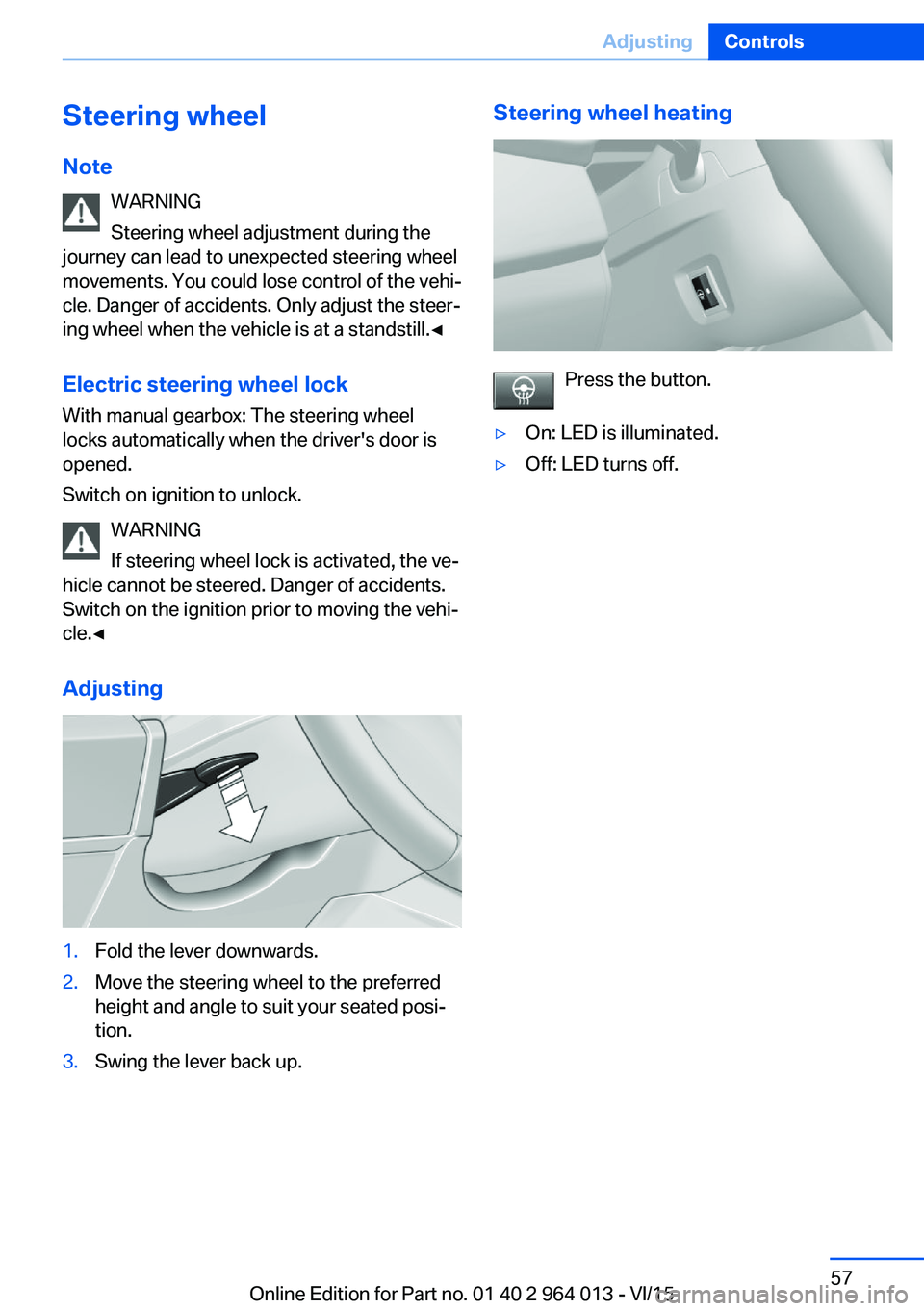
Adjusting1.Fold the lever downwards.2.Move the steering wheel to the preferred
height and angle to suit your seated posi‐
tion.3.Swing the lever back up.Steering wheel heating
Press the button.
▷On: LED is illuminated.▷Off: LED turns off.Seite 57AdjustingControls57
Online Edition for Part no. 01 40 2 964 013 - VI/15
Page 58 of 228

Carrying children in safetyVehicle equipmentThis chapter describes all standard, national
and special equipment provided in the model
series. Equipment not available in the vehicle is
therefore also described, for example the se‐lected special equipment or national version.
This also applies to safety-relevant functions
and systems. Comply with the relevant na‐
tional regulations when using the correspond‐
ing functions and systems.
Important considerations
Note
WARNING
Unsupervised children or animals in the
vehicle can set the vehicle in motion and en‐
danger themselves or other road users, for ex‐
ample by the following actions:▷Pressing the start/stop button.▷Releasing the parking brake.▷Opening and closing doors or windows.▷Setting the selector lever to neutral.▷Operating vehicle equipment.
Risk of accident or injury. Do not leave children
or animals unsupervised in the vehicle. When
leaving the vehicle, take the remote control
with you and lock it.◀
Not for Australia/New Zealand: Suitable seats
Information about which child seats can be
used on the seats in question, if the child seatsare attached with a seat belt — according to
ECE-R 16 standard: GroupWeight of childApproximate
ageFront pas‐
senger's seatRear seats,
outer – b)Rear seat,
middle0Up to 10 kgUp
to 9 monthsUUX0+Up to 13 kgUp
to 18 monthsUUXI9 – 18 kgUp to 4 yearsUUXII15 – 25 kgUp to 7 yearsUUXSeite 58ControlsCarrying children in safety58
Online Edition for Part no. 01 40 2 964 013 - VI/15