2016 BMW M4 lock
[x] Cancel search: lockPage 154 of 228
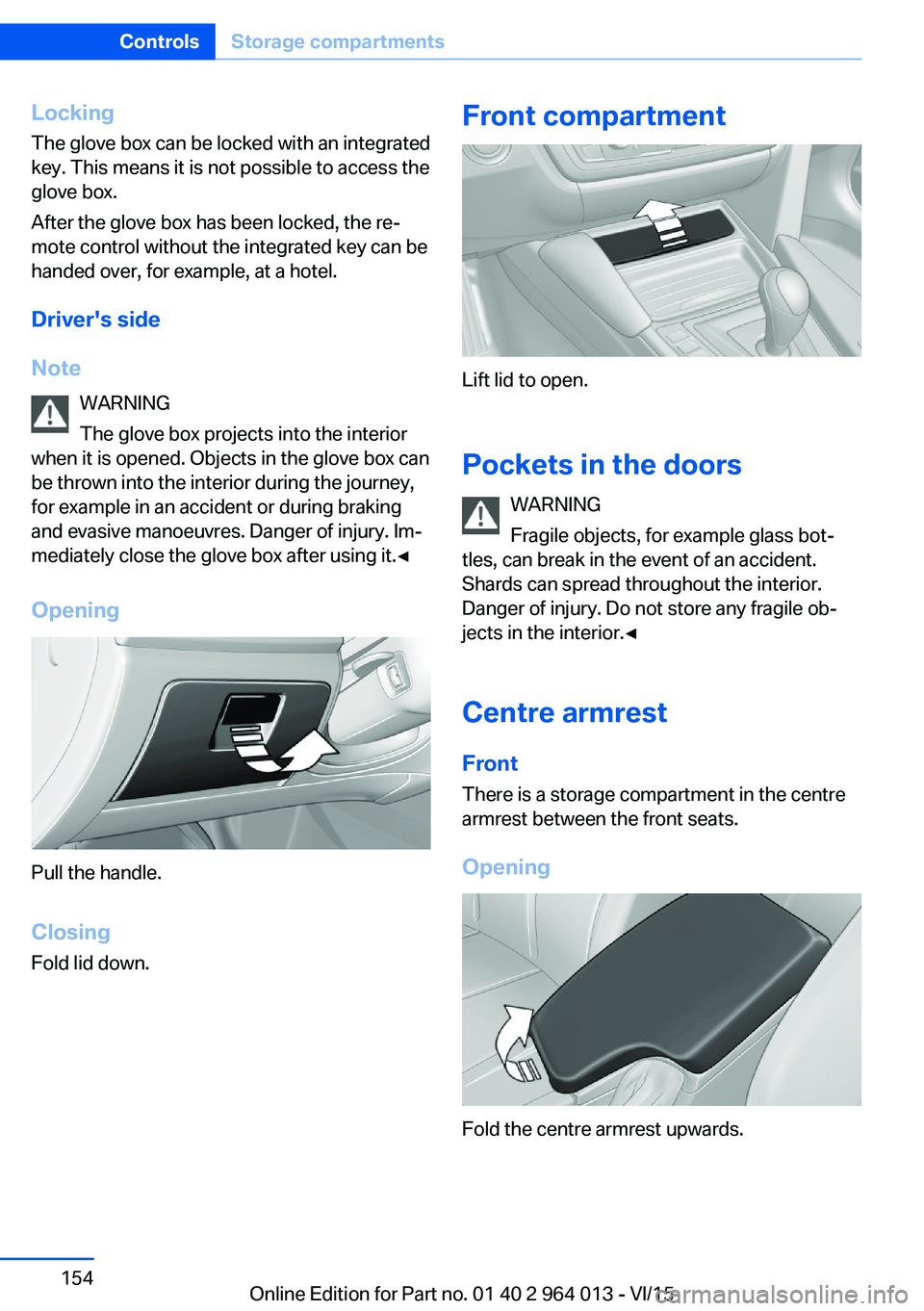
LockingThe glove box can be locked with an integrated
key. This means it is not possible to access the
glove box.
After the glove box has been locked, the re‐
mote control without the integrated key can be
handed over, for example, at a hotel.
Driver's side
Note WARNING
The glove box projects into the interior
when it is opened. Objects in the glove box can
be thrown into the interior during the journey,
for example in an accident or during braking
and evasive manoeuvres. Danger of injury. Im‐
mediately close the glove box after using it.◀
Opening
Pull the handle.
ClosingFold lid down.
Front compartment
Lift lid to open.
Pockets in the doors WARNING
Fragile objects, for example glass bot‐
tles, can break in the event of an accident.
Shards can spread throughout the interior.
Danger of injury. Do not store any fragile ob‐
jects in the interior.◀
Centre armrest
Front There is a storage compartment in the centre
armrest between the front seats.
Opening
Fold the centre armrest upwards.
Seite 154ControlsStorage compartments154
Online Edition for Part no. 01 40 2 964 013 - VI/15
Page 155 of 228
SlidingCentre armrest can be slid in the longitudinal
direction. It engages into the end positions.
Connection for external audio device An external audio device, for ex‐
ample an MP3 player, can be
connected through the AUX-IN
port or the USB audio interface
in the centre armrest.
Storage compartment
between the rear seats
A storage compartment is located between the
rear seats.
Cupholder
Note WARNING
Unsuitable containers in the cupholder
and hot drinks can damage the cupholders,
and increase the risk of injury in an accident.
Danger of injury or damage to property. Use
light, lockable containers that are shatterproof.
Do not transport hot drinks. Do not force ob‐
jects into the cupholder.◀
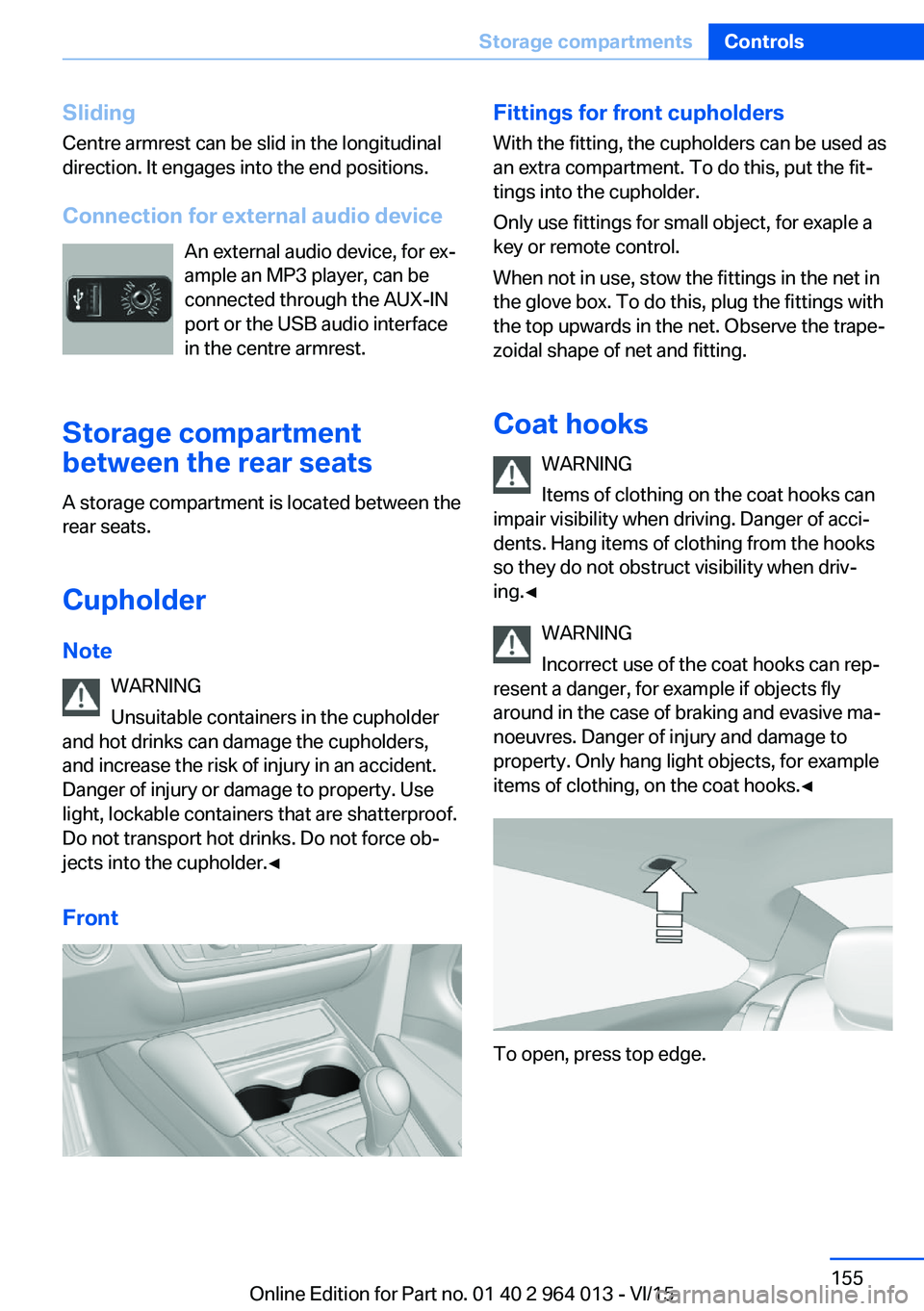
FrontFittings for front cupholders
With the fitting, the cupholders can be used as
an extra compartment. To do this, put the fit‐
tings into the cupholder.
Only use fittings for small object, for exaple a
key or remote control.
When not in use, stow the fittings in the net in
the glove box. To do this, plug the fittings with
the top upwards in the net. Observe the trape‐
zoidal shape of net and fitting.
Coat hooks WARNING
Items of clothing on the coat hooks can
impair visibility when driving. Danger of acci‐
dents. Hang items of clothing from the hooks
so they do not obstruct visibility when driv‐
ing.◀
WARNING
Incorrect use of the coat hooks can rep‐
resent a danger, for example if objects fly
around in the case of braking and evasive ma‐
noeuvres. Danger of injury and damage to
property. Only hang light objects, for example items of clothing, on the coat hooks.◀
To open, press top edge.
Seite 155Storage compartmentsControls155
Online Edition for Part no. 01 40 2 964 013 - VI/15
Page 164 of 228
Applying the brakes fully is the most effective
way of braking in situations in which this is
necessary.
The vehicle can be steered. Any obstacles can
be avoided with steering wheel movements
that are as calm as possible.
A pulsing of the brake pedal shows that ABS is
regulating.
In certain braking situations, the perforated
brake disks can cause functional noise. How‐
ever, this has no effect on the efficiency and
operational safety of the brakes.
Objects in the range of movement of
the pedals and in the footwell
WARNING
Objects in the driver's footwell can re‐
strict the pedal travel, or block a pedal that has
been pressed. Danger of accidents. Stow
items in the vehicle so that they are secure and
cannot get into the driver's footwell. Only use
floor mats that have been categorised as ap‐
propriate for the vehicle and that can be fas‐
tened accordingly. Do not use any loose floor
mats, and do not place several floor mats on
top of one another. Make sure that there is suf‐
ficient space for the pedals. Ensure that the
floor mats are securely reattached after having
been removed, for example for cleaning.◀
Wet roads
In damp weather, if road grit has been spread
or there is heavy rain, apply the brakes lightly
every few kilometres/miles.
In doing so, do not obstruct other road users.
The resulting heat dries the brake discs and
pads.
The braking force will be available immediately
if needed.Downhill gradients
WARNING
Even slight, continuous pressure on the
brake pedal can cause overheating, brake pad
wear or even brake system failure. Danger of
accidents. Avoid excessive loads on the
brake.◀
WARNING
When idling or with the engine switched
off, safety-relevant functions are restricted or
no longer available, for example the braking ef‐
fect of the engine or power assistance for the
braking force and steering. Danger of acci‐
dents. Do not drive at idle speed or with the
engine switched off.◀
When driving on long or steep downhill
stretches, use the gear in which the least brak‐
ing is required. Otherwise the brake system
can overheat and braking action is reduced.
Manual gearbox:
The braking effect can be additionally in‐
creased by shifting down, even into first gear, if
applicable.
M double clutch transmission:
The braking action of the engine can be boos‐
ted further by shifting down in sequential
mode, see page 75.
Corrosion of the brake disc Corrosion of the brake discs and contamina‐
tion of the brake pads increase with the
following circumstances:▷Low mileage.▷Extended periods when the vehicle is not
used.▷Infrequent use of the brakes.
Corrosion occurs when the minimum pressure
that must be exerted by the pads during brake
applications to clean the discs is not reached.
Seite 164Driving hintsDriving precautions164
Online Edition for Part no. 01 40 2 964 013 - VI/15
Page 172 of 228
RefuellingVehicle equipmentThis chapter describes all standard, national
and special equipment provided in the model
series. Equipment not available in the vehicle is
therefore also described, for example the se‐
lected special equipment or national version.
This also applies to safety-relevant functions
and systems. Comply with the relevant na‐
tional regulations when using the correspond‐
ing functions and systems.
Notes Before refuelling, observe notes on fuel quality,
see page 174.
ATTENTION
If the range drops below 50 km, approx.
30 miles, the engine could not be supplied
anymore with sufficient fuel. Engine functions
are not ensured anymore. Danger of damage
to property. Refuel in good time.◀
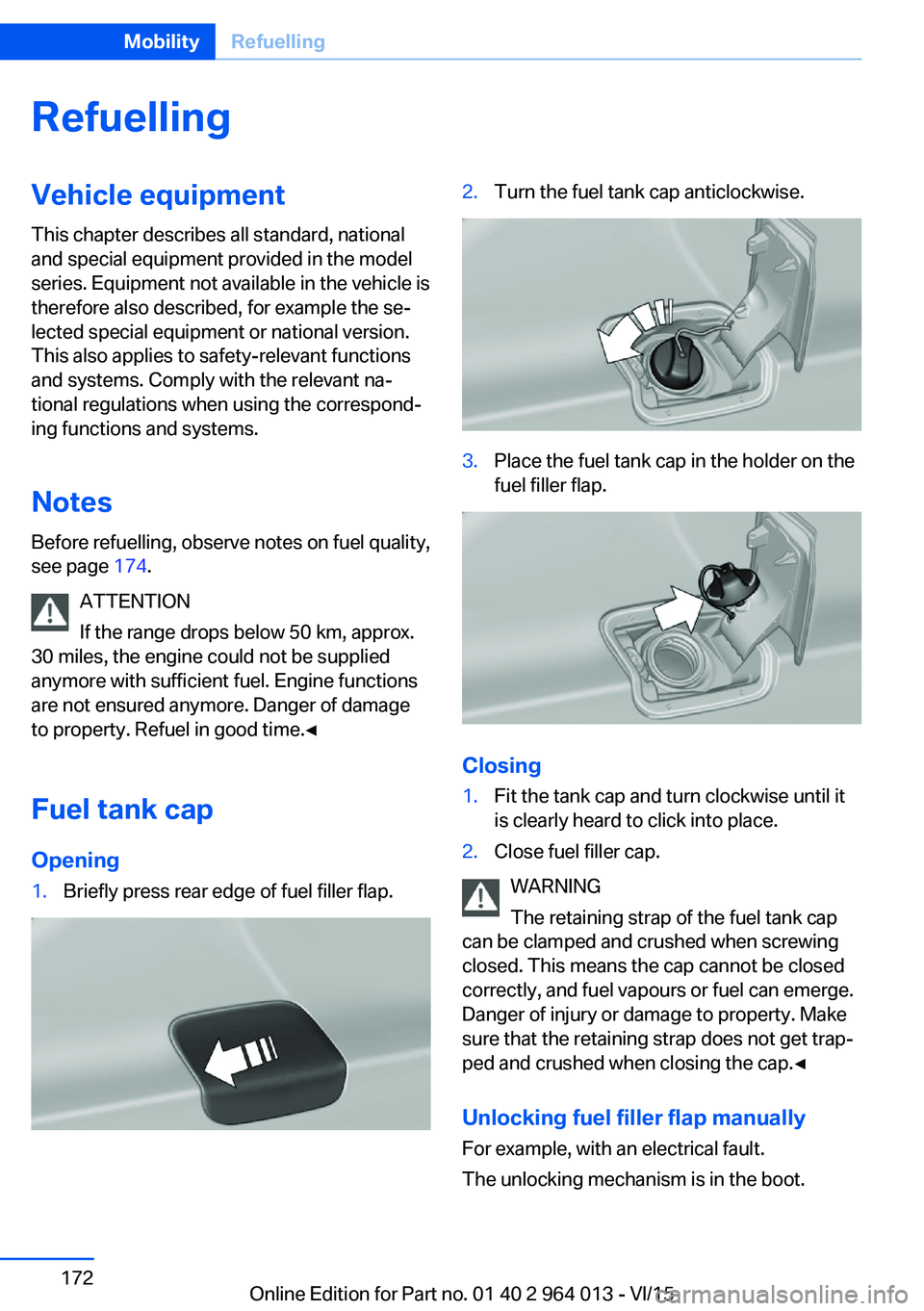
Fuel tank cap Opening1.Briefly press rear edge of fuel filler flap.2.Turn the fuel tank cap anticlockwise.3.Place the fuel tank cap in the holder on the
fuel filler flap.
Closing
1.Fit the tank cap and turn clockwise until it
is clearly heard to click into place.2.Close fuel filler cap.
WARNING
The retaining strap of the fuel tank cap
can be clamped and crushed when screwing
closed. This means the cap cannot be closed
correctly, and fuel vapours or fuel can emerge.
Danger of injury or damage to property. Make
sure that the retaining strap does not get trap‐
ped and crushed when closing the cap.◀
Unlocking fuel filler flap manually
For example, with an electrical fault.
The unlocking mechanism is in the boot.
Seite 172MobilityRefuelling172
Online Edition for Part no. 01 40 2 964 013 - VI/15
Page 173 of 228
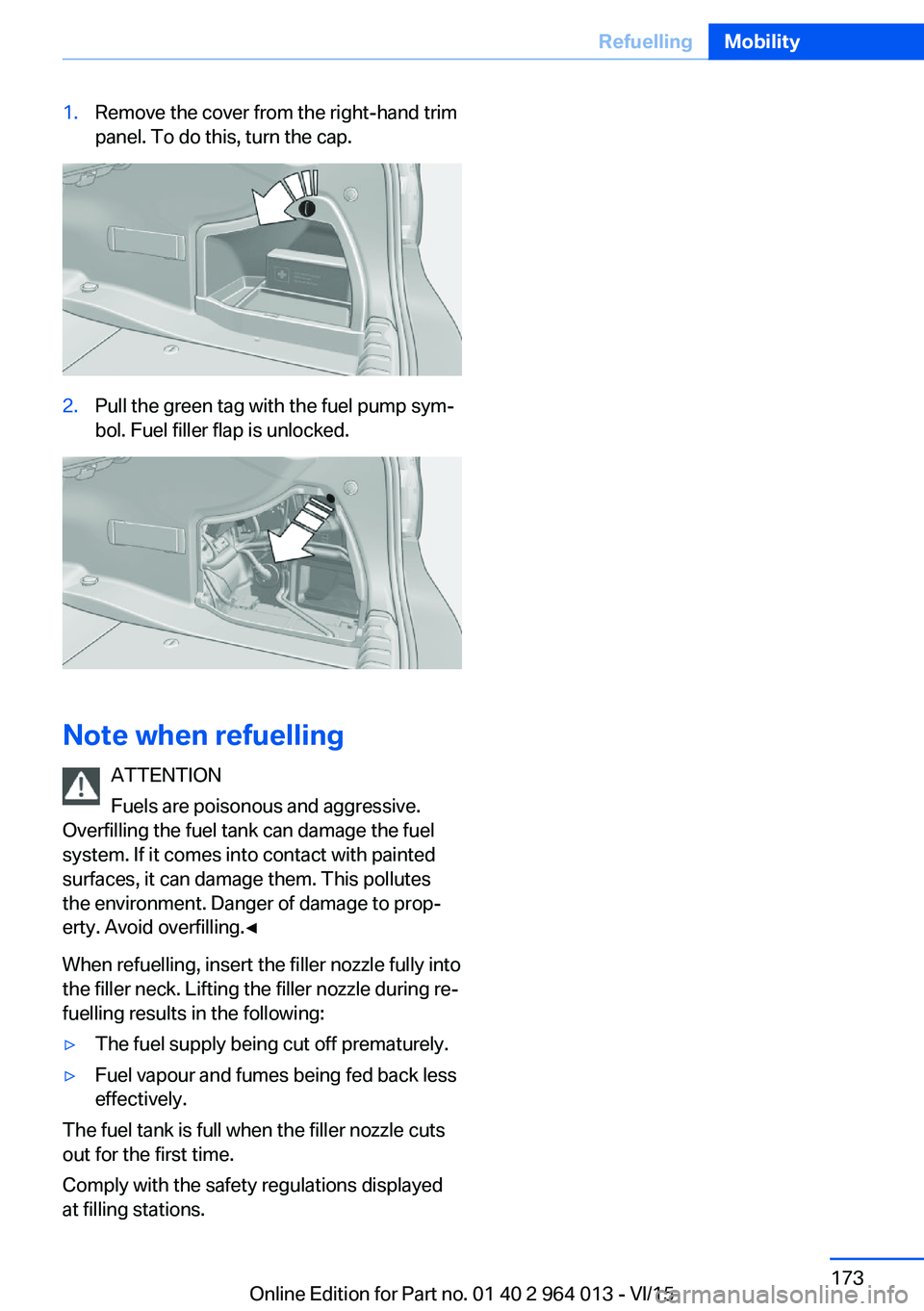
1.Remove the cover from the right-hand trim
panel. To do this, turn the cap.2.Pull the green tag with the fuel pump sym‐
bol. Fuel filler flap is unlocked.
Note when refuelling
ATTENTION
Fuels are poisonous and aggressive.
Overfilling the fuel tank can damage the fuel
system. If it comes into contact with painted
surfaces, it can damage them. This pollutes
the environment. Danger of damage to prop‐
erty. Avoid overfilling.◀
When refuelling, insert the filler nozzle fully into
the filler neck. Lifting the filler nozzle during re‐
fuelling results in the following:
▷The fuel supply being cut off prematurely.▷Fuel vapour and fumes being fed back less
effectively.
The fuel tank is full when the filler nozzle cuts
out for the first time.
Comply with the safety regulations displayed
at filling stations.
Seite 173RefuellingMobility173
Online Edition for Part no. 01 40 2 964 013 - VI/15
Page 178 of 228
ted speed for the tyres fitted must be dis‐
played in the driver's field of view. The sticker
is available from a Service Partner or a qualified
specialist workshop.
If winter tyres are fitted, observe and comply
with the respectively permitted maximum
speed.
Interchanging front and rear wheels
The manufacturer of your vehicle advises
against interchanging the front and rear
wheels. This could impair vehicle handling
Such a change is not permitted in vehicles with
different tyre or rim dimensions on the front
and rear axles.
Tyre storage
Store wheels and tyres in a cool, dry and pref‐
erably dark place when not in use.
Protect tyres against contamination from oil,
grease and fuel.
Do not exceed the maximum tyre pressure in‐
dicated on the tyre's side wall.
Remedying flat tyres Safety measures▷Park the vehicle on a solid surface and as
far away from moving traffic as possible.▷Switch on hazard warning lights.▷Protect the vehicle against rolling, by ap‐
plying the parking brake.▷Engage the steering wheel lock in the
straight ahead position of the wheels.▷Allow all vehicle occupants get out of the
vehicle and guide them out of the danger
area, for example behind the crash barrier.▷Set up warning triangle an appropriate dis‐
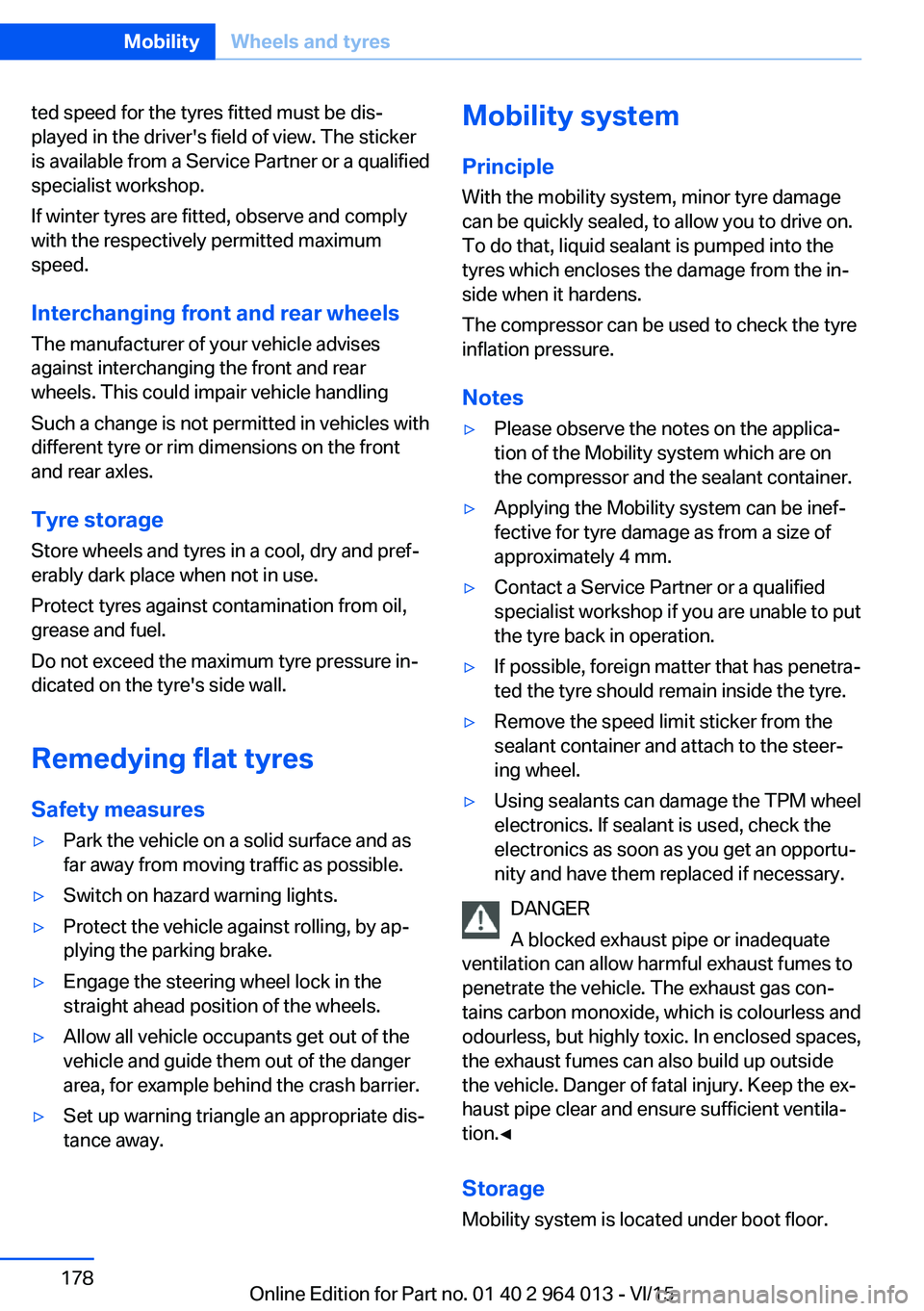
tance away.Mobility system
Principle With the mobility system, minor tyre damage
can be quickly sealed, to allow you to drive on.
To do that, liquid sealant is pumped into the
tyres which encloses the damage from the in‐ side when it hardens.
The compressor can be used to check the tyre
inflation pressure.
Notes▷Please observe the notes on the applica‐
tion of the Mobility system which are on
the compressor and the sealant container.▷Applying the Mobility system can be inef‐
fective for tyre damage as from a size of
approximately 4 mm.▷Contact a Service Partner or a qualified
specialist workshop if you are unable to put
the tyre back in operation.▷If possible, foreign matter that has penetra‐
ted the tyre should remain inside the tyre.▷Remove the speed limit sticker from the
sealant container and attach to the steer‐
ing wheel.▷Using sealants can damage the TPM wheel
electronics. If sealant is used, check the
electronics as soon as you get an opportu‐
nity and have them replaced if necessary.
DANGER
A blocked exhaust pipe or inadequate
ventilation can allow harmful exhaust fumes to
penetrate the vehicle. The exhaust gas con‐
tains carbon monoxide, which is colourless and
odourless, but highly toxic. In enclosed spaces,
the exhaust fumes can also build up outside
the vehicle. Danger of fatal injury. Keep the ex‐
haust pipe clear and ensure sufficient ventila‐
tion.◀
Storage
Mobility system is located under boot floor.
Seite 178MobilityWheels and tyres178
Online Edition for Part no. 01 40 2 964 013 - VI/15
Page 183 of 228

Bonnet
Notes WARNING
Incorrectly performed work in the engine
compartment can damage components and
lead to a safety risk. Danger of accident or damage to property. Have work in the engine
compartment carried out by a Service Partner
or a qualified specialist workshop.◀
WARNING
The engine compartment contains mov‐
ing components. Certain components can also
move in the engine compartment when the ve‐
hicle is switched off, for example the radiator
fan. Danger of injury. Do not reach into the area
of moving parts. Keep articles of clothing and
hair away from moving parts.◀
ATTENTION
When wipers are folded away from the
windscreen, they can be trapped when the
bonnet is opened. Danger of damage to prop‐
erty. Before opening the bonnet, make sure
that the wipers with wiper blades fitted are in
contact with the windscreen.◀
WARNING
The bonnet has projecting parts on the
inside, for example locking hooks. Danger of
injury. When the bonnet is open, watch out for
projecting parts and keep these areas clear.◀
ATTENTION
When closing, the bonnet must audibly
click into place. Additional pushing can dam‐
age the bonnet. Danger of damage to property.
Open and close the bonnet once more. Avoid
additional pushing.◀WARNING
If the bonnet is not correctly locked, it
can come open during the journey and impair
visibility. Danger of accidents. Stop immedi‐
ately and close the bonnet correctly.◀
WARNING
Parts of the body can become trapped
when opening and closing the bonnet. Danger
of injury. When opening and closing, make
sure that the area of movement of the bonnet
is free.◀
Opening bonnet1.Pull lever, arrow 1.
Bonnet is released.2.After releasing the lever, pull lever again,
arrow 2.
Bonnet is opened.
Indicator and warning lamps With the bonnet unlocked, a Check Control
message is shown.
Seite 183Engine compartmentMobility183
Online Edition for Part no. 01 40 2 964 013 - VI/15
Page 187 of 228
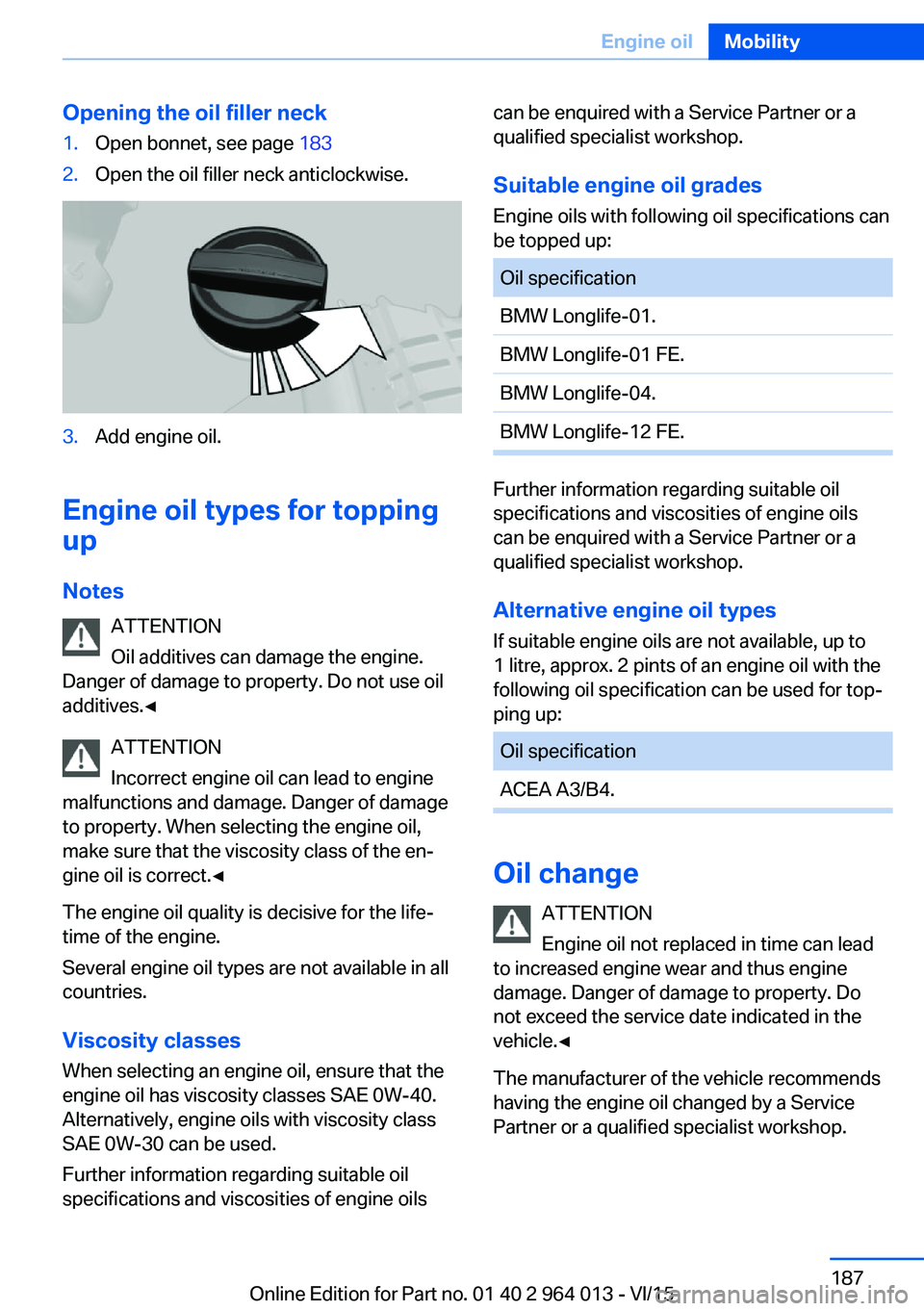
Opening the oil filler neck1.Open bonnet, see page 1832.Open the oil filler neck anticlockwise.3.Add engine oil.
Engine oil types for topping
up
Notes ATTENTION
Oil additives can damage the engine.
Danger of damage to property. Do not use oil
additives.◀
ATTENTION
Incorrect engine oil can lead to engine
malfunctions and damage. Danger of damage
to property. When selecting the engine oil,
make sure that the viscosity class of the en‐
gine oil is correct.◀
The engine oil quality is decisive for the life‐
time of the engine.
Several engine oil types are not available in all
countries.
Viscosity classes When selecting an engine oil, ensure that the
engine oil has viscosity classes SAE 0W-40.
Alternatively, engine oils with viscosity class
SAE 0W-30 can be used.
Further information regarding suitable oil
specifications and viscosities of engine oils
can be enquired with a Service Partner or a
qualified specialist workshop.
Suitable engine oil grades
Engine oils with following oil specifications can
be topped up:Oil specificationBMW Longlife-01.BMW Longlife-01 FE.BMW Longlife-04.BMW Longlife-12 FE.
Further information regarding suitable oil
specifications and viscosities of engine oils
can be enquired with a Service Partner or a
qualified specialist workshop.
Alternative engine oil types If suitable engine oils are not available, up to
1 litre, approx. 2 pints of an engine oil with the
following oil specification can be used for top‐
ping up:
Oil specificationACEA A3/B4.
Oil change
ATTENTION
Engine oil not replaced in time can lead
to increased engine wear and thus engine
damage. Danger of damage to property. Do
not exceed the service date indicated in the
vehicle.◀
The manufacturer of the vehicle recommends
having the engine oil changed by a Service
Partner or a qualified specialist workshop.
Seite 187Engine oilMobility187
Online Edition for Part no. 01 40 2 964 013 - VI/15