2016 AUDI RS7 SPORTBACK ECO mode
[x] Cancel search: ECO modePage 103 of 282

Automatic transmission tiptronic
Introduction
The automat ic transmission is controlled e lec
tron ically. The transmission upshifts or down
shifts automatically depending on wh ich drive
p rogram is selected.
When a
moderate driving style is used , the
transmission selects the most economical driving
mode.
It will then change up early and delay the
downshifts to give bette r fu el economy .
The transm iss ion switches to a sporty mode after
a kick-down or when the driver uses a
sporty
driving style
character ized by quick accelerator
pedal movements, heavy acceleration, frequent
changes in speed and traveling at the maximum
speed.
If desired, the dr iver can also select the gears
manually (tiptronic mode) ¢page 105.
In the tiptron ic transmission, power is transfer
red by a torque converte r.
Selector lever positions
Fig. 113 Display in the instrument cluster : selector lever
position
The selector lever position engaged appears next
to the selector lever as well as in the instrument
cluster display .
P -Park
In th is selector lever pos ition the transm iss ion is
mechanically locked . Engage P only when the ve
hicle is
completely stopped¢.&. in Driving the
automatic transmission on page 103.
Automatic transmission
T o shift in or out of position P, you must first
press and hold the brake pedal and then press
the release button in the selector lever handle
while moving the selector lever to or from P . You
can shift out of this position only with the igni
tion on .
R - Reverse
Select R only when the vehicle is at a full stop
and the engine is running at idle speed¢ & in
Driving the automatic transmission on
page 103.
Before you move the selector lever to R, press
both the button in the hand le of the selector lev
er
and the brake pedal at the same time.
When the ignition is on, the backup lights illumi
nate when the selector lever is moved into R .
N -Neutral
The transmission is in neutra l in this position .
Shift to this position for standing with the brakes
applied
¢ & in Driving the automatic transmis
sion on page 103 .
When the vehicle is stat ionary or at speeds be low
1 mph (2 km/h) , you must always apply the foot
brake before and whi le moving the lever out of N.
DIS -Normal position for driving forward
In the D/S position, the transmission can be op
erated either in the normal mode Dor in the
sport mode S. To select the sport mode S, pull
the selec tor lever back briefly. Pulling the leve r
back again will select the normal mode D . The in
strument cluster display shows the selected driv
ing mode.
In the normal mode D, the transmission auto
matically selects the suitable gear ratio. It de
pends on engine load, vehicle speed and drivin g
style.
Select the sport mode S fo r spo rty driving. The
vehicle makes full use of the engine 's powe r.
Shifting may become noticeable when accelerat
ing.
When the vehicle is stat ionary or at speeds below
1 mph (2 km/h), you must always apply the foot ..,.
101
Page 104 of 282

Automatic transmission
brake before and while moving the lever to D/S
out of N.
A WARNING
Read and follow all WARNINGS r=':> & in Driv
ing the automatic transmission on
page 103.
(D Note
Coasting downhill with the transmission in N
and the engine not running will result in dam
age to the automatic transmission and possi
bly the catalytic converter.
{!) Tips
- Audi drive select: you can adjust the sporty
shift characteristics in the
Dynamic driv ing
mode .Swill appear in the instrument clus
ter display instead of D .
- If you accidentally select
N while driving,
take your foot off the accelerator pedal im
mediately and wa it for the engine to slow
down to idle before selecting D/S .
- If there is a power failure, the selector lever
will not move out of the P posit ion . The
emergency release can be used if this hap
pens
r=':> poge 106.
Automatic Shift Lock (ASL)
.
The Automatic Shift Lock safeguards you against
occidentally shifting into o forward or the re
verse gear and causing the vehicle to move unin
tentionally.
F ig. 114 Shift gate : selecto r lever lock posit io ns and re
l ease bu tton high light ed
The selector lever lock is released as follows:
102
.,. Turn the ignition on .
.,. Step on the brake pedal.
At the some t ime
press and hold the release button on the gear
selector knob
c::> fig. 114 with your thumb until
you have moved the selector lever to the de sired position .
Automatic selector lever lock
The sel ector lever is locked in the P and N posi
tions when the ignition is turned on . You must
press the br ake pedal and the release button to
select another position. As a reminder to the driver, the following warn ing appears in the in
strument cluster display when the selector is in P
and N:
When stationary apply brake pedal while select
ing gear
The Automatic Shift Lock only functions when the
vehicle is sta tionary or at speeds below 1 mph
(2 km/h) .
At speeds above about 1 mph (2 km/h) the Auto
matic Shift Lock is automatically deactivated in
the N position.
A t ime delay element prevents the selector lever
from locking when it is moved through the N po
sition (going from R to D/S). The locking element
will lock the selector lever if the lever is left in N
(Neutral) for more than approximately 2 second,
without the brake pedal being pressed .
Release button
The release button on the selector lever prevents
the lever from being accidentally shifted into cer
tain positions . Depending on the direction of the
shift, the selector lever locks at different posi
tions . The positions are highlighted in the illus
tration
<=:> fig . 114.
Page 148 of 282

Airbag syste m
A WARNING
Objects between you and the airbag will in
cr ease the risk of inju ry in a cras h by interfer
ing w ith the way the airbag unfol ds or by be
ing pushed into you as the a irbag inflates.
- Never hold th ings in your hands or on your
lap when the vehicle is in use.
- Never transport items on or in the area of
the front passenger seat . Objects could
move into the area of the front airbags du r
ing bra king or other sudden maneuve rs and
become dangerous projectiles that can
ca use serious pe rsonal injury if the a irbags
inflate.
- Never pl ace or attach accessor ies or o ther
objects (such as cup ho lders, te lephone
brackets, large, heavy o r bulky objects) on
the doors, over or near the area marked "AIRBAG" on the steering wheel, instru
ment pane l, seat backrests or between
those areas and yourself. These objects
could cause injury in a crash, especially
when the airbags inflate.
- Never recline the front passenger's seat to transport objec ts. Items can also move into
t h e a rea of the side airbag o r the front a ir
bag during braking or in a s udden maneu
ver. Objects near the airbags can become
projectiles and cause in ju ry, particularly
when the seat is reclined.
- Never pl ace or transport o bje cts on the
front passenge r seat . Objects on the front
passenge r seat co uld cause the capac itive
sensor in the seat to signal to airbag system
that the seat is occupied by a person when it
in fact is not, or that the person on the seat
is heavier than he or she actually is. The
change in elect ric capac itance because of
s u ch objects can cause the passenger front
airbag to be turned on when it shou ld be
off, or ca n cause the a irbag to wo rk i n a way
that is diffe rent from the way it would have
wor ked witho ut objects on the seat.
- Alway s m ake sure th at the re is nothing on
t h e fron t passenger seat that w ill cause the
capacit ive passenger detection system in
the seat to signa l to the Airbag System that
146
the seat is occup ied by a person when it is
not, or to signal that it is occupied by some
one who is heavier than the person actually
sitt ing on the seat . The presence of an ob
ject could ca use the passenger front airbag
to be turned on when it should be off, or
could cause the airbag to work in a way that is diffe rent from the w ay it would have
wo rked withou t the object on the seat.
A WARNING
-
The fine dus t created when airbags deploy c an
cause breathing prob lems for peo ple with a
h istory of asthma or othe r breath ing cond i
tions.
- To reduce the r is k of breathing p roblems,
those with asthma o r other respiratory con
ditions shou ld get fresh a ir right away by
getting out of the vehicle or opening win
dows or doors .
- If you are in a co llision in which airbags de
ploy, wash yo ur hands and face with m ild
soap and water before eating.
- Be ca refu l not to get the dust into your eyes,
or into any cuts or scratches.
- If the residue sho uld get into your eyes,
flush them w ith wate r.
Monitoring the
Advanced Airbag System
t~ (USA models) !!I: (Canada models)
Airbag monitoring indicator light
Two separate indicators monitor the function of
the Advanced Airbag System: the airbag moni
toring indicator light and the
PASSENGER AIR
BAG OFF
light.
The Advanced A irbag System as well as t he side
airbags and side curta in airbags w ith ejection
mitigation features (including the electronic con
tro l unit, senso rs and system w iring) are all
monito red cont inuo usly to make sure that they
a re functioning properly whenever the ignition is
o n. Every time you tu rn o n the ign ition, the air
bag sys tem indi cato r li ght
II (USA models) a
(Canada mode ls) will come on for a few seconds
(function check). .,.
Page 149 of 282
The system must be inspected when the indicato r light
II (USA models ) !E,I
( Canada models):
- does not come on when the ignitio n is switched
on,
- does not go out a few seconds after you have
switched on the ign ition, or
- comes on while driving.
I f an airbag system malf unct io n is de tected, the
indicator light wi ll first start flashing to catch the
driver's attention and then stay on co nti nuo usly
to se rve as a constant reminder to have the sys
tem i nspected immed iate ly.
If a malfunction occ urs that turns the front air
bag on the passenger si de
off, the PASSENGER
AIR BAG OFF
light will come on and stay on
whenever the ignit io n is on.
A WARNING
An airbag system that is not funct io ning prop
erly cannot provide supp lemen tal p rotec tion
in a front al c rash .
- If the air bag indicato r ligh t
c:;, page 17
come s whe n the vehicle is be ing use d, have
th e sys te m in sp ecte d im med iate ly by yo ur
au thoriz ed Au di deale r.
It is po ss ible that
th e air bag wi ll inf late w hen it is not sup
posed to, or will not i nfla te w hen it s hou ld .
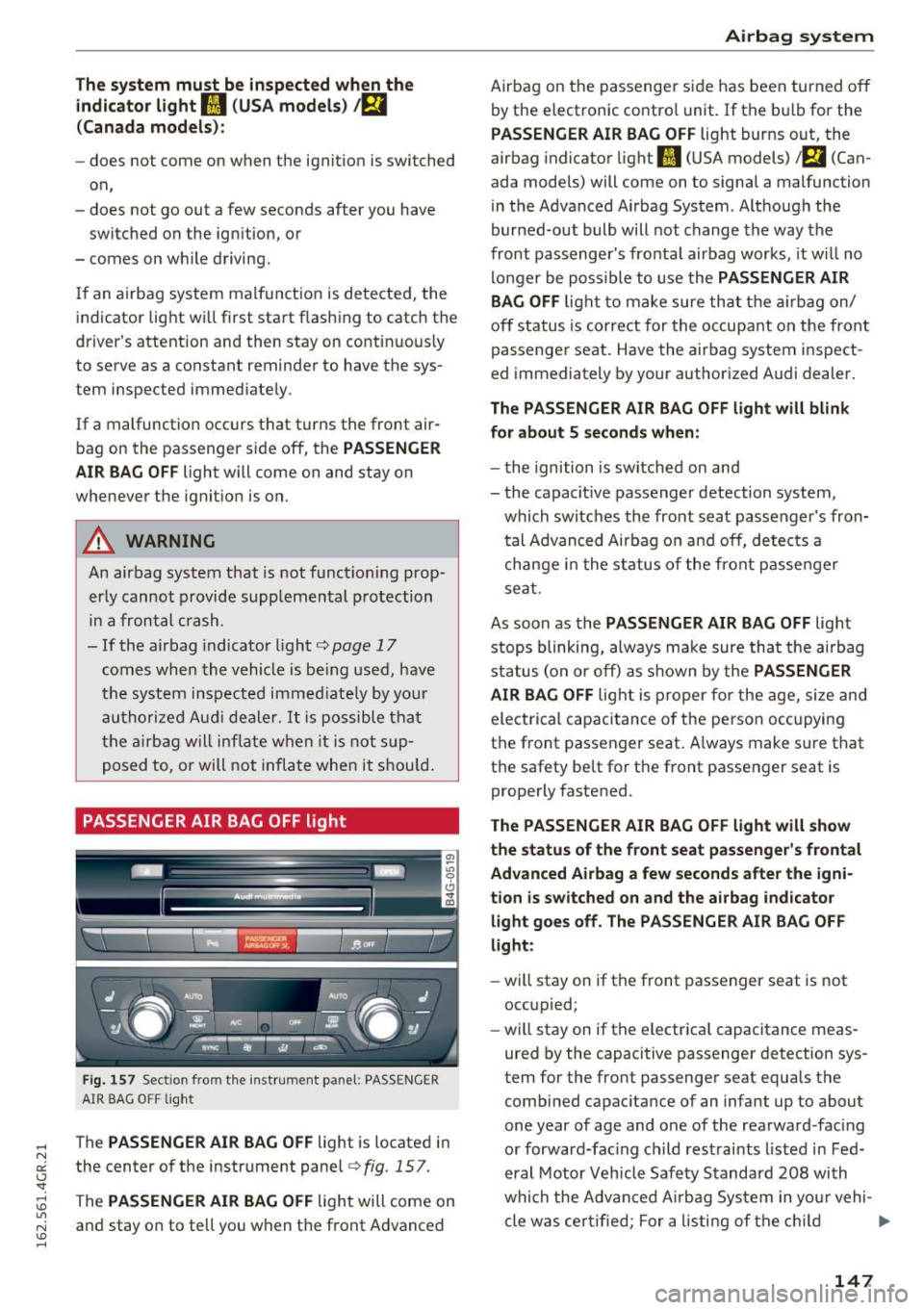
PASSENGER AIR BAG OFF light
Fi g. 157 Sect ion from t he inst rum ent pa ne l: PASSENGER
AIR BAG OFF lig ht
The PASSENGER AIR BAG OFF light is located i n
the center o f the instr ument panel
c:;, fig . 157.
The PASSENGER AIR BAG OFF light will come on
and stay on to te ll you when the front Advanced
Airbag system
Airba g on the pas senge r si de has been turned o ff
by the electronic contro l unit. If t he bulb for the
PASSENGER AIR BAG OFF light burns out, the
airbag indicato r light
II (US A models) a (Can
ada models) will come on to signal a malfunction
i n the Advanced Airbag System . Alt hough the
bur ned-out bulb will not change the way the
front passenge r's fronta l airbag work s, it w ill no
lo nger be poss ible to use the
PASSENGER AIR
BAG OFF
lig ht to ma ke sure th at th e air bag on/
of f st atus is corre ct for the occup ant on the fron t
p assenge r seat. Have the air bag system i nsp ect
ed immediately by your author ized Audi dealer.
The PASSENGER AIR BAG OFF light will blink
for about 5 seconds when:
- th e ignition is switche d on an d
- the capacit ive passenger detection system,
which switc hes the front sea t passe nger' s fron
t al A dva nced Airbag o n an d off, de tec ts a
ch ange in the st atu s of the fr ont passe nger
se at.
As soon as the
PASSENGER AIR BAG OFF light
s top s blinking , always m ake sure th at the air bag
s tatu s (o n or off) as shown by the
PASSENGER
AIR BAG OFF
lig ht is pr oper for the age, siz e and
ele ctrica l capaci tance o f the pe rso n occu pying
t h e front passenger seat. A lwa ys make s ure t hat
t h e safety be lt fo r th e front passen ger seat is
prope rly faste ned .
The PASSENGER AIR BAG OFF light will show
the status of the front seat passenger 's frontal
Advanced Airbag a few seconds after the igni·
tion is switched on and the airbag indicator light goes off. The PASSENGER AIR BAG OFF
light:
- will stay on if t he front passenger seat is not
occ upied;
- wi ll stay on if t he e lectrica l capacitance meas
ured by the capacitive passenger detection sys
tem for the front passenger seat equa ls the
combined ca pac ita nce of an infa nt up to ab out
one year of age and one of the rearwa rd -facing
or fo rwar d-fac ing ch ild rest raints l isted in Fe d
e ral Motor V ehicl e Safe ty S tandard 20 8 wi th
whi ch th e A dvanc ed Airbag Sys tem i n yo ur vehi-
cle w as ce rtifie d; For a listin g of t he c hild .,.
147
Page 152 of 282
Airbag system
(D Tips
If the capacitive passenger detection system
determines that the front passenger seat is
empty, the frontal airbag on the passenger
side will be turned off, and the
PASSENGER
AIR BAG OFF
light will stay on.
Repair , care and disposal of the airbags
Parts of the airbag system are installed at many
different places on your Audi. Installing, remov
ing, servicing or repairing a part in an area of the
vehicle can damage a part of an airbag system
and prevent that system from working properly
in a collision.
There are some important things you have to
know to make sure that the effectiveness of the
system will not be impaired and that discarded
components do not cause injury or pollute the
environment.
A WARNING
-Improper care, servicing and repair proce
dures can increase the risk of personal injury
and death by preventing an airbag from de
ploying when needed or deploying an airbag
unexpectedly:
- Never cover, obstruct, or change the steer ing wheel horn pad or airbag cover or the in
strument panel or modify them in any way.
- Never attach any objects such as cup holders or telephone mountings to the surfaces cov
ering the airbag units.
- For cleaning the horn pad or instrument
panel, use only a soft, dry cloth or one mois
tened with plain water. Solvents or cleaners could damage the airbag cover or change
the stiffness or strength of the material so
that the airbag cannot deploy and protect
properly.
- Never repair, adjust, or change any parts of the airbag system.
- All work on the steering wheel, instrument
panel, front seats or electrical system (in
cluding the installation of audio equipment,
cellular telephones and CB radios, etc.)
must be performed by a qualified technician
150
who has the training and special equipment necessary.
- For any work on the airbag system, we
strongly recommend that you see your au
thorized Audi dealer or qualified workshop.
- Never modify the front bumper or parts of
the vehicle body.
- Always make sure that the side airbag can
inflate without interference:
- Never install seat covers or replacement
upholstery over the front seatbacks that
have not been specifically approved by
Audi.
- Never use additional seat cushions that
cover the areas where the side airbags in
flate.
- Damage to the original seat covers or to
the seam in the area of the side airbag
module must always be repaired immedi
ately by an authorized Audi dealer.
- The airbag system can deploy only once. Af
ter an airbag has been deployed, it must be
replaced with new replacement parts de
signed and approved especially for your
Audi model version. Replacement of com plete airbag systems or airbag components
must be performed by qualified workshops
only . Make sure that any airbag service ac
tion is entered in your Audi Warranty
&
Maintenance booklet under AIRBAG RE
PLACEMENT RECORD.
- For safety reasons in severe accidents, the
alternator and starter are separated from
the vehicle battery with a pyrotechnic circuit
interrupter.
- Work on the pyrotechnic circuit interrupt
er must only be performed by a qualified
technicians who have the experience, in
formation and special tools necessary to perform the work safely.
- If the vehicle or the circuit interrupter is
scrapped, all applicable safety precautions must be followed.
~
Page 163 of 282

Advanced front airbag system and children
Your vehicle is equipped with a front "Advanced
Airbag System" in compliance with United States
F edera l Motor Vehicle Safety Standard ( FMVSS)
208, as well as Canada Motor Vehicle Safety
Standard (CMVSS) 208 as applicable at the time
your veh icle was manufactured.
The Advanced Airbag system in your vehicle has
been certified to meet the "low-risk" require
ments for 3- and 6-year old children on the pas
senger side and small adults on the driver side.
The low risk deployment criteria are intended to
reduce the risk of injury through interaction with
the airbag that can occur, for example, by being
too close to the steering wheel and instrument
panel when the airbag inflates. In addition, the
system has been certified to comply with the
"s uppress ion " req uirements of the Safety Stand
ard, to turn off the front airbag for infants up to
12 months who are restrained on the front pas
senger seat in child restraints that are listed in
the Standard.
E ven though your vehicle is equipped with an Ad ·
vanced Airbag system, all children, especially
those 12 years and younger, should always ride
in the back seat properly restrained for their age
and size. The airbag on the passenger side makes
the front seat a potentially dangerous place for a
child to r ide. The front seat is not the safest place
for a child in a forward-facing child safety seat .
It
can be a very dangerous place for an infant or a
la rger child in a rearward-facing seat.
The vehicle's Advanced A irbag System has a ca
pac itive passenger detect io n system in the front
passenger seat cush ion that can detect the pres
ence of a baby or a child in a child restraint sys
tem on this seat .
The capacit ive passenger detection system regis
ters the changes that result in an electrical field
when a child, a child restraint, and a baby blanket
are on the front passenge r seat. The change in
the measured capacitance due to the presence of
a child, a child restraint, and a baby blanket on
the front passenger seat is related to the child restraint system resting on the seat. The meas
ured capacitance of a child restraint system var-
Child safety
ies depending on the type of system and specific
make and mode l.
T he elect rical capacitance of the various types,
makes, and models of child restra ints specified
by the U.S .National Highway Traff ic Safety Ad
ministration (NHTSA) in the relevant safety
standard are stored in the Advanced Airbag Sys
tem control unit together with the capacitances
typ ical of infants and a 1-year old child. When a
child restraint is used on the front passenger
seat w it h a typical 1 year-old infant, the Ad
vanced Airbag System compares the capacitance measured by the capacitive passenge r detection
system with the data stored in the electronic con
t rol unit.
Child restraints and Advanced front airbag
system
Regardless of the ch ild restraint that you use,
make sure that it has been certified to meet Safe
ty Standards and has been cert ified by its manu
facturer for use w ith an airbag . Always be sure
that the child restraint is properly installed at
one of the rear seating positions. If in exception
al circumstances you must use it on the front
passenger seat, carefully read all of the informa
tion on child safety and Advanced Airbags and heed all of the applicable WARNINGS . Make cer
tain that the chi ld and child restraint are correct
ly recognized by the capac itive passenger detec
t ion system in the front passenger seat, that the
front passenger a irbag is turned off, and that the
airbag status is always correctly s ignaled by the
PASSENGER AIR BAG OFF light .
Many types and models of child restra ints have
been available over the years, new models are in
troduced regularly incorporating new and im
proved designs and older models are taken out of
production. Child restra ints are no t standardized.
Child restraints of the same type typically have
different weights and sizes and different "foot
prints", the size and shape of the bottom of the
chi ld restraint that sits on the seat, when they
are installed on a vehicle seat. These differences
make it virtually impossib le to certify compliance
with the requirements for advanced a irbags w ith
each and every child restra int that has ever been ..,.
161
Page 183 of 282

In extreme cases, EDL automatically switches off
to keep the brake on the braked wheel from over
heating. The vehicle is still working correctly. EDL
will switch on again automatically when condi
tions have returned to normal.
Steering recommendation
The ESC helps to stabilize the vehicle by changing
the steering torque .
I n vehicles with dynamic steering*, ESC also
helps to stabilize the steering in critical situa
tions.
Selective wheel torque control
Selective wheel torque control is used when driv
ing on curves. The front wheel on the inside of
the curve or both wheels on the inside of the
curve are braked selectively as needed. This al
lows more precise driving in curves.
Automatic post-collision braking system
The "Automatic post-collision brak ing system"
can help to reduce the risk of sliding and of other
coll isions after an accident.
If the airbag control
module detects a collision above a certain vehicle
speed, the vehicle is braked by the ESC.
The vehicle does not brake automatically if:
- the driver presses the accelerator pedal, or
- the braking force generated by the pressed
brake pedal is greater than the brak ing force
that would be initiated by the system, or
- the ESC, the brake system or the vehicle electri
cal system are not function ing .
Switching on /off
Intelligent Technology
A WARNING
-- The ESC and its integrated systems cannot
overcome the limits posed by natural physi
cal laws. This is especia lly important on slip
pery or wet roads. If the systems begin act
ing to stabilize your vehicle, you should im
mediately alter your speed to match the
road and traffic conditions. Do not let the
increased safety provided tempt you into
taking r isks. This cou ld increase your risk of
a collision .
- Please note the risk of a collision increases
when driving fast, especially through curves
and on slippery or wet roads, and when dr iv
ing too close to objects ahead. The ESC and
its integrated systems cannot always pre
vent collisions -there is still a risk of acci
dents!
- Press the accelerator pedal carefully when
accelerating on even, slippery surfaces such
as ice and snow. The dr ive wheels can spin
even when these control systems are instal
led and this can affect driving stability and
i n crease the risk of a collision .
(j) Tips
-ABS and ASR only function correctly when
all four wheels are equipped with identical
tires. Different tire sizes can lead to a reduc
tion in engine power.
- You may hear noises when the systems de
scribed are working.
£SC turns on automatically when you start the engine.
Fig. 175 Center console: OFF~ button
The ESC is designed to function in levels. Depend
ing on the level that is se lected, the stabilization
function of the ESC is limited or switched off. The amount of stabilization control will differ de
pending on the level.
The following examples are unusual situations
where it may make sense to switch sport mode on in order to allow the wheels to spin:
- Rocking the vehicle to free it when it is stuck ..,.
181
Page 184 of 282

Intelligent Technology
- Driving in deep snow or on loose ground
ESC levels
- Driv ing with snow chains
Sport mode on ESC/ASR off Sport mode off or
ESC/ASRon
Beha vior
The ESC and ASR stabiliza- The stabiliza tion function is The f ull stabilization tune-
tion f unctions are limited not available ¢
,&. ESC and
tion of the ESC and ASR is
¢
&. . ASR are switched off . avai
lab le aga in .
Op eration Press the I B OFF I button Press and hold the !B OFFI Press the IB OFFI button
briefly . button longer than 3 sec- again.
onds.
I n d ica to r II turns on. II and lit turn on. II turns off or II and II
light s turn off .
Driver me s- Stabili zation cont rol (E SC): S tabilization control (E SC ):
Stabili zation cont rol
s age s Sport Warning ! Redu ced Off Wa
rning! Reduced sta - (ESC ): on
st abilit y
A WARNING
You should only switch sport mode on or
switch ESC/ ASR off if your driving abilities
and road conditions permit.
bility
- The stabilization function is limited when
sport mode is sw itched on. The driving
wheels co uld spin and the vehicle could
swerve , espec ially on s lick o r slippery road
s u rfaces.
- The re is no vehicle stab ilizat ion when ESC/
ASR a re swi tched off .
(D Tips
-ESC/ASR cannot be switched off or sport
mode cannot be switched on if the cru ise
control system* or the adaptive cruise con
tro l* is switched on .
- If the rear spoiler system malfunct ions,
sport mode may not switch on or it may switch off ag ain automatically .
Braking
What affects braking efficiency?
New brake pads
During the first 250 miles (400 km), new brake
pads do not possess the ir full braking effect, they
have to be "broken in" first¢&, . The b reak-in pe
riod can be considerably longe r fo r vehicles with
182
ceramic brake rotors* . You can compensate for
this slightly reduced braking power by pushing harder on the brake pedal. Avoid heavy braking
l oads during the break-in per iod.
Op erating c ondition s and dri ving habits
The brak es on today 's automobiles are still sub
ject to wear, depending large ly on operating con
dit ions and driving habits ¢&, . On vehicles that
are either driven mostly in stop-and-go city traf
fic or are driven hard, the brake pads shou ld be
checked by your authorized Audi dealer more of
ten than specified in the
Warr ant y & Maint e
nance booklet .
Failure to have your brake pads
i nspected ca n result in red uced b rake perfo rm
ance.
On steep slopes, you should use the brak ing ef
fect of the engine . Th is way, you prevent unnec
essa ry wea r on the brake system. If you must use
you r brakes, do not ho ld the brakes down contin
u ous ly. P ump the brakes at intervals.
Operating noi se
Noises may occur when brak ing depending on the
speed, braking force and outside conditions such as temperature and h umid ity.
Due to the nature of the mater ials used in ceram
i c brake rotors*, no ises may become more appa-
rent at low speeds. ..,.