2014 SUBARU TRIBECA lock
[x] Cancel search: lockPage 267 of 426
7-20Starting and operating
NOTE
When you depress the brake pedalsuddenly, the brake pedal might wig-gle. This is a normal operation phe-nomenon, and it is not a malfunction.
Brake assist is a driver assistance system.It assists the brake power when the drivercannot depress the brake pedal stronglyand the brake power is insufficient.
Brake assist generates the brake poweraccording to the speed at which the driverdepresses the brake pedal.
&Disc brake pad wear warning
indicators
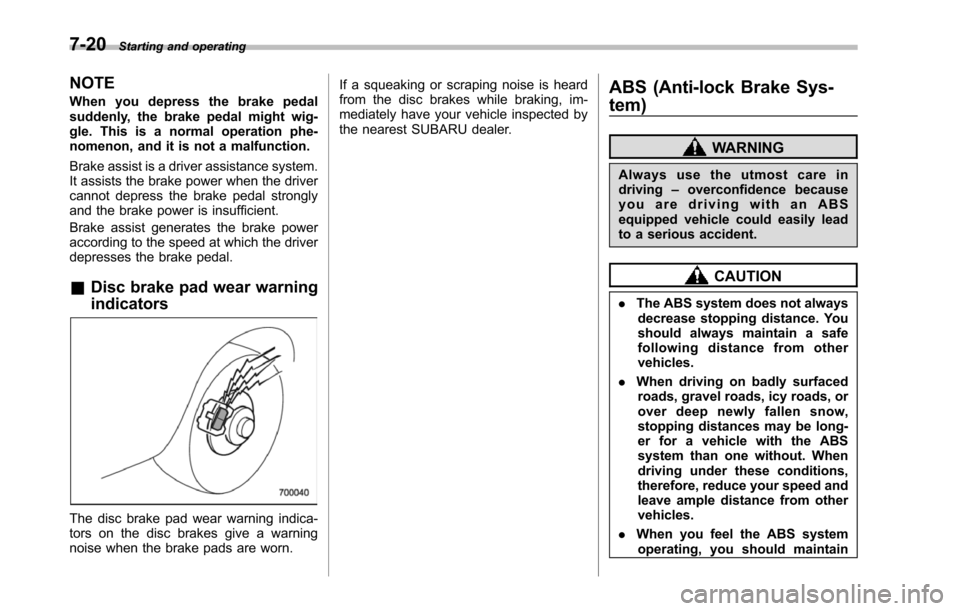
The disc brake pad wear warning indica-tors on the disc brakes give a warningnoise when the brake pads are worn.
If a squeaking or scraping noise is heardfrom the disc brakes while braking, im-mediately have your vehicle inspected bythe nearest SUBARU dealer.
ABS (Anti-lock Brake Sys-
tem)
WARNING
Always use the utmost care indriving–overconfidence becauseyou are driving with an ABSequipped vehicle could easily leadto a serious accident.
CAUTION
.The ABSsystem does not alwaysdecrease stopping distance. Youshould always maintain a safefollowing distance from othervehicles.
.When driving on badly surfacedroads, gravel roads, icy roads, orover deep newly fallen snow,stopping distances may be long-er for a vehicle with the ABSsystem than one without. Whendriving under these conditions,therefore, reduce your speed andleave ample distance from othervehicles.
.When you feel the ABS systemoperating, you should maintain
Page 268 of 426
constant brake pedal pressure.Do not pump the brake pedalsince doing so may defeat theoperation of the ABS system.
The ABS system prevents the lock-up ofwheels which may occur during suddenbraking or braking on slippery road sur-faces. This helps prevent the loss ofsteering control and directional stabilitycaused by wheel lock-up.
When the ABS system is operating, youmay hear a chattering noise or feel a slightvibration in the brake pedal. This is normalwhen the ABS operates.
The ABS system will not operate when thevehicle speed is below approximately 6mph (10 km/h).
&ABS system self-check
You may feel a slight shock in the brakepedal and hear the operating sound ofABS from the engine compartment justafter the vehicle is started. This is causedby an automatic functional test of the ABSsystem being carried out and does notindicate any abnormal condition.
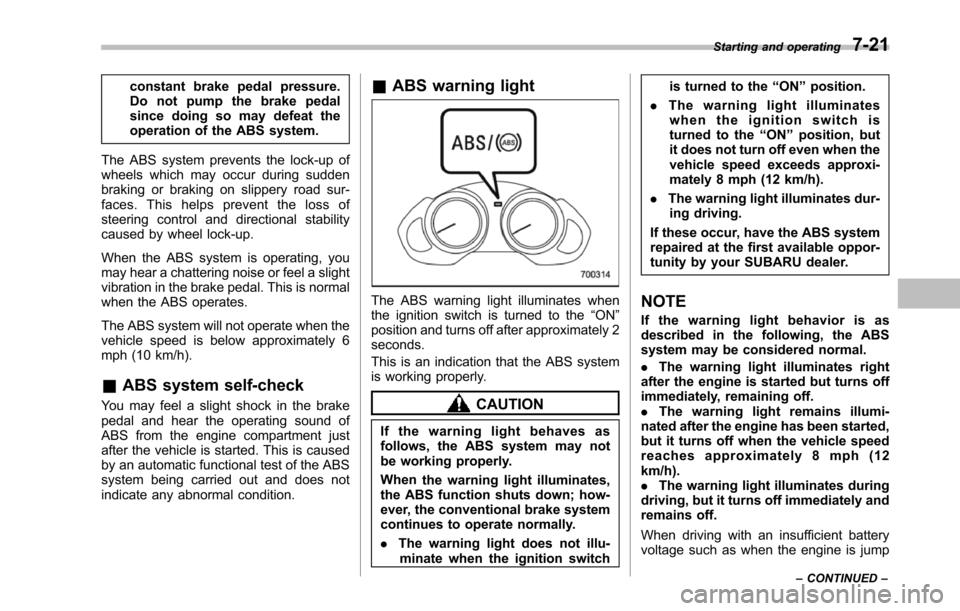
&ABS warning light
The ABS warning light illuminates whenthe ignition switch is turned to the“ON”position and turns off after approximately 2seconds.
This is an indication that the ABS systemis working properly.
CAUTION
If the warning light behaves asfollows, the ABS system may notbe working properly.
Whenthe warning light illuminates,the ABS function shuts down; how-ever, the conventional brake systemcontinues to operate normally.
.The warning light does not illu-minatewhen the ignition switch
is turned to the“ON”position.
.The warning light illuminateswhen the ignition switch isturned to the“ON”position, butit does not turn off even when thevehicle speed exceeds approxi-mately 8 mph (12 km/h).
.The warning light illuminates dur-ing driving.
If these occur, have the ABS systemrepaired at the first available oppor-tunity by your SUBARU dealer.
NOTE
If the warning light behavior is asdescribed in the following, the ABSsystem may be considered normal.
.The warning light illuminates rightafterthe engine is started but turns offimmediately, remaining off..The warning light remains illumi-nated after the engine has been started,but it turns off when the vehicle speedreaches approximately 8 mph (12km/h)..The warning light illuminates duringdriving, but it turns off immediately andremains off.
When driving with an insufficient batteryvoltage suchas when the engine is jump
Starting and operating7-21
–CONTINUED–
Page 269 of 426
7-22Starting and operating
started, the ABS warning light may illumi-nate. This is due to the low battery voltageand does not indicate a malfunction.When the battery becomes fully charged,the light will turn off.
Electronic Brake Force Dis-
tribution (EBD) system
The EBD system maximizes the effective-ness of the brakes by allowing the rearbrakes to supply a greater proportion ofthe braking force. It functions by adjustingthe distribution of braking force to the rearwheels in accordance with the vehicle’sloading condition and speed.
The EBD system is an integral part of theABS system anduses some of the ABSsystem’s components to perform its func-tion of optimizing the distribution of brak-ing force. If any of the ABS componentsused by the EBD system malfunction, theEBD system also stops working.
Whenthe EBD system is operating, youmay hear a chattering noise or feel a slightvibration in the brake pedal. This is normaland does not indicate a malfunction.
&Steps to take if EBD system
malfunctions
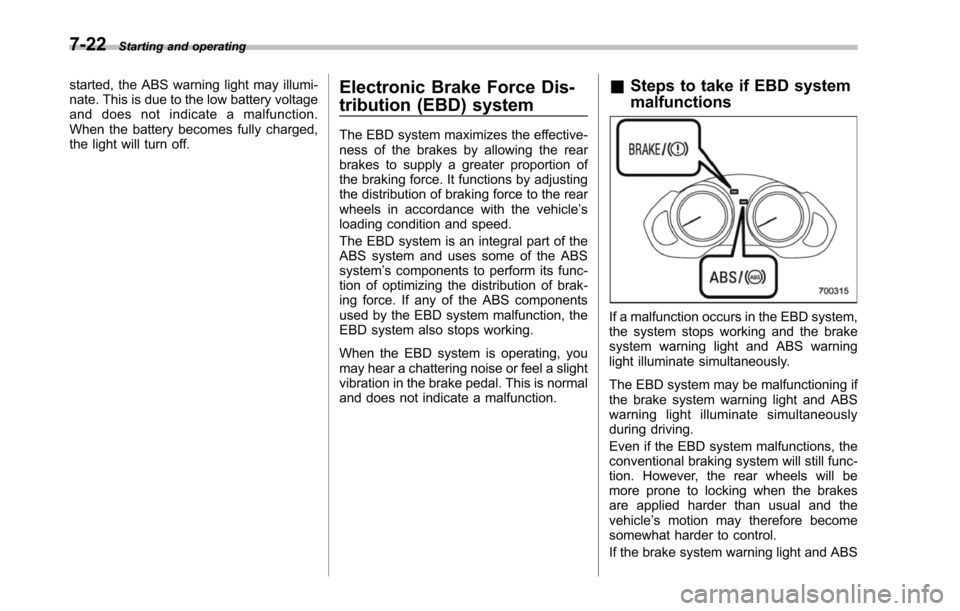
If a malfunction occurs in the EBD system,the system stops working and the brakesystem warning light and ABS warninglightilluminate simultaneously.
The EBD system may be malfunctioning ifthebrake system warning light and ABSwarning light illuminate simultaneouslyduring driving.
Even if the EBD system malfunctions, theconventional braking system will still func-tion. However, the rear wheels will bemore prone to locking when the brakesare applied harder than usual and thevehicle’s motion may therefore becomesomewhat harder to control.
If the brake system warning light and ABS
Page 273 of 426
7-26Starting and operating
Tr a c t i o n C on t r o l s y s t e m O F F i nd i c a t o rlight (Latin America-spec. models)
Traction Control system OFF switch
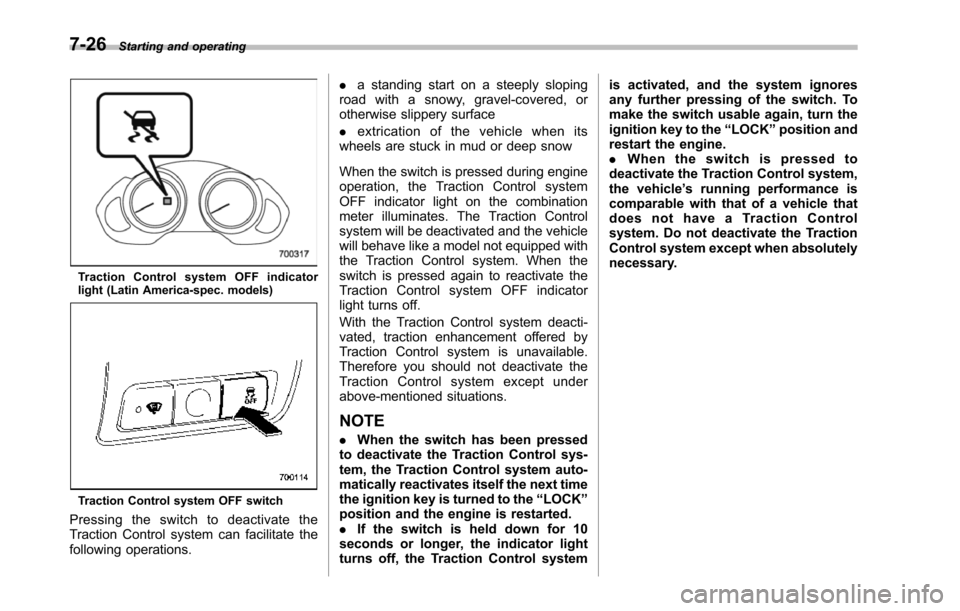
Pressing the switch to deactivate theTraction Control system can facilitate thefollowing operations.
.a standing start on a steeply slopingroad with a snowy, gravel-covered, orotherwise slippery surface
.extrication of the vehicle when itswheels are stuck in mud or deep snow
When the switch is pressed during engineoperation, the Traction Control systemOFF indicator light on the combinationmeter illuminates. The Traction Controlsystem willbe deactivated and the vehiclewill behave like a model not equipped withthe Traction Control system. When theswitch is pressed again to reactivate theTraction Control system OFF indicatorlight turns off.
With the Traction Control system deacti-vated, traction enhancement offered byTraction Control system is unavailable.Therefore you should not deactivate theTraction Control system except underabove-mentioned situations.
NOTE
.When the switch has been pressedto deactivate the Traction Control sys-tem, the Traction Control system auto-matically reactivates itself the next timethe ignition key is turned to the“LOCK”position and the engine is restarted..If the switch is held down for 10seconds or longer, the indicator lightturns off,the Traction Control system
is activated, and the system ignoresany further pressing of the switch. Tomake the switch usable again, turn theignition key to the“LOCK”position andrestart the engine..When the switch is pressed todeactivate the Traction Control system,the vehicle’s running performance iscomparable with that of a vehicle thatdoes not have a Traction Controlsystem. Do not deactivate the TractionControl system except when absolutelynecessary.
Page 277 of 426
7-30Starting and operating
to the“Acc”or“LOCK”position, andthen turn it again to the“ON”position.
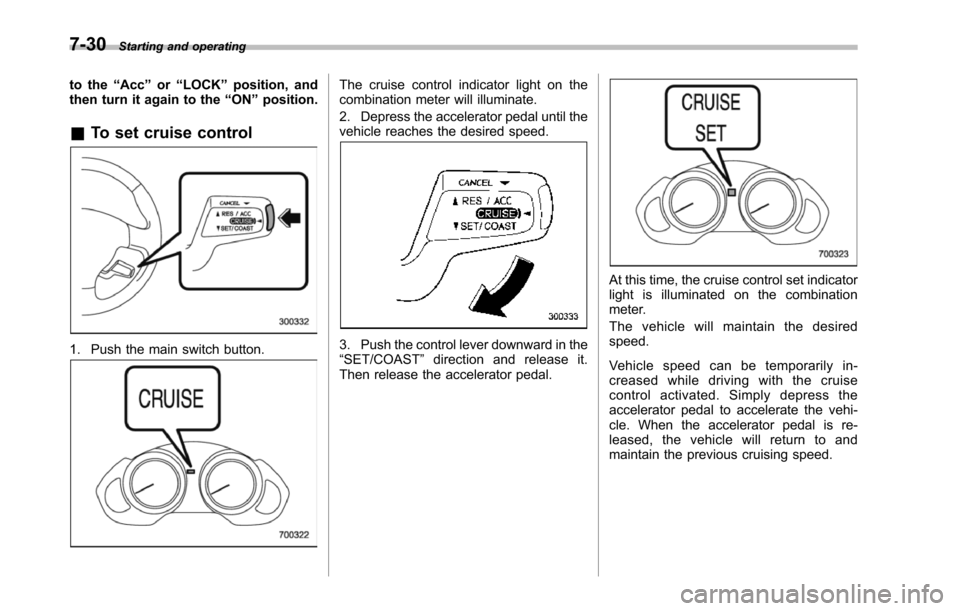
&To set cruise control
1. Push the main switch button.
The cruise control indicator light on thecombination meter will illuminate.
2. Depress the accelerator pedal until thevehicle reaches the desired speed.
3. Push the control lever downward in the“SET/COAST”direction and release it.Then release the accelerator pedal.
At this time, the cruise control set indicatorlight is illuminated on the combinationmeter.
The vehicle will maintain the desiredspeed.
Vehicle speed can be temporarily in-creased while driving with the cruisecontrol activated. Simply depress theaccelerator pedal to accelerate the vehi-cle. When the accelerator pedal is re-leased, the vehicle will return to andmaintain the previous cruising speed.
Page 278 of 426
&To temporarily cancel the
cruise control
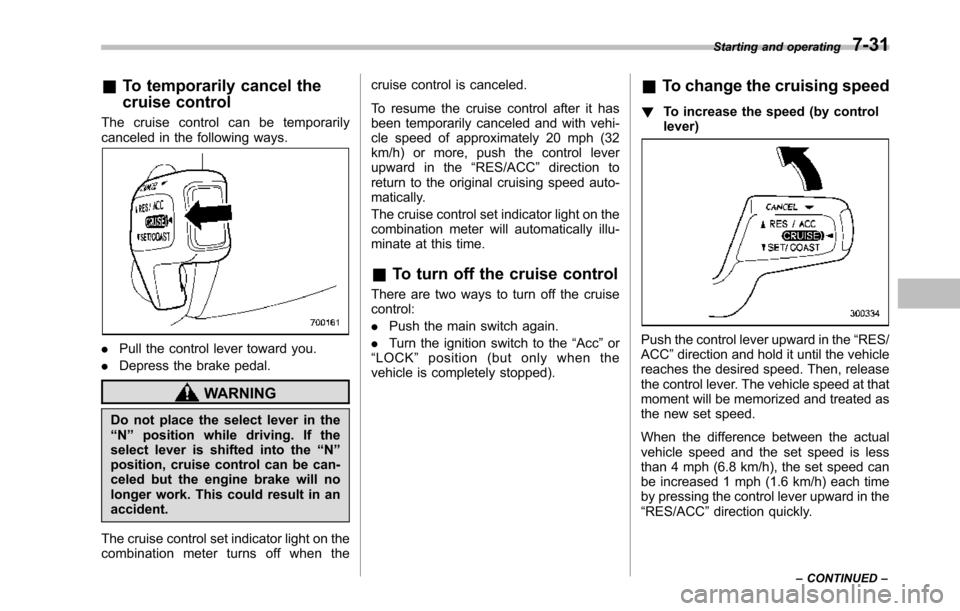
The cruise control can be temporarilycanceled in the following ways.
.Pull the control lever toward you.
.Depressthe brake pedal.
WARNING
Do not place the select lever in the“N”position while driving. If theselect lever is shifted into the“N”position, cruise control can be can-celed but the engine brake will nolonger work. This could result in anaccident.
The cruise control set indicator light on thecombination meter turns off when the
cruise control is canceled.
To resume the cruise control after it hasbeen temporarily canceled and with vehi-cle speed of approximately 20 mph (32km/h) or more, push the control leverupward in the“RES/ACC”direction toreturn to the original cruising speed auto-matically.
The cruise control set indicator light on thecombination meter will automatically illu-minate at this time.
&To turn off the cruise control
There are two ways to turn off the cruisecontrol:
.Push the main switch again.
.Turn the ignition switch to the“Acc”or“LOCK”position (but only when thevehicle is completely stopped).
&To change the cruising speed
!To increase the speed (by controllever)
Push the control lever upward in the“RES/ACC”direction and hold it until the vehiclereaches the desired speed. Then, releasethe control lever. The vehicle speed at thatmoment will be memorized and treated asthe new set speed.
When the difference between the actualvehicle speed and the set speed is lessthan 4 mph (6.8 km/h), the set speed canbe increased 1 mph (1.6 km/h) each timeby pressing the control lever upward in the“RES/ACC”direction quickly.
Starting and operating7-31
–CONTINUED–
Page 285 of 426
8-6Driving tips
On-road and off-road driving
WARNING
.In a rollover crash, an unbeltedperson is significantly morelikely to die than a person wear-ing a seatbelt. You the driver andall your passengers should fas-ten the seatbelts before startingto drive in order to minimize thechance of serious injury or death.
.Do not make sharp turns andquick maneuvers unless abso-lutely unavoidable. Such actionsare dangerous as you may losecontrol, possibly resulting in arolloverwhich could cause deathor serious injury.
.Always maintain a safe drivingspeed according to the road andweather conditions in order toavoid havingan accident on asharp turn, during sudden brak-ing or under other similar condi-tions.
.Whenever strong crosswinds arepresent, slow down sufficientlyto maintain control of your vehi-cle. Remember that your vehicle,with its higher profile and center
of gravity, is more likely to beaffected by crosswinds than or-dinary passenger cars.
.Always use the utmost care indriving–overconfidence be-cause you are driving an All-Wheel Drive model could easilylead to a serious accident.
Yo u r v e h i c l e i s c l a s s i f i e d a s a u t i l i t yvehicle. Utilityvehicles feature a higherground clearance which enables them tobe used for wide applications including off-road driving. But please keep in mind thatyour vehicle is neither a conventional off-road vehicle nor an all-terrain vehicle. Ahighercenter of gravity in relation to thetread width as compared with ordinarypassenger cars makes vehicles of thistype more likely to roll over. In reality, utilityvehicles have a significantly higher roll-over rate thanother types of vehicles. Thehigh ground clearance of this vehicle is areal advantage, giving you a better view ofthe road and allowing you to anticipateproblems earlier. However, remember thatyour utility vehicleis not designed for high-speed cornering comparable to ordinarypassenger cars and that your vehiclecould roll over if you make a sharp turnat high speed. If you do take yourSUBARU off-road, certain common sense
precautions such as those in the followinglist should be taken.
.Make certain that you and all of yourpassengers are wearing seatbelts.
.Carry some emergency equipment,such as a towing rope or chain, a shovel,wheel blocks, first aid kit and cell phone orcitizens band radio.
.Drive carefully. Do not take unneces-sary risks by driving in dangerous areas orover rough terrain.
.Slow down and employ extra caution atall times. When driving off-road, you willnot have the benefit of marked trafficlanes, banked curves, traffic signs andthe like.
.Do not drive across steep slopes.Instead, drive either straight up or straightdown the slopes. A vehicle can muchmore easily tip over sideways than it canend over end. Avoid driving straight up ordown slopes that are too steep.
.Avoid sharp turning maneuvers, espe-cially at higher speeds.
.Do not grip the inside or spokes of thesteering wheel. A bad bump could jerk thewheel andinjure your hands. Instead drivewith your fingers and thumbs on theoutside of the rim.
.If driving through water, such as whencrossing shallow streams, first check the
Page 287 of 426
8-8Driving tips
Winter driving
&Operation during cold
weather
Carry some emergency equipment, suchas a window scraper, a bag of sand,flares, a small shovel and jumper cables.
Check the battery and cables. Coldtemperatures reduce battery capacity.The battery must be in good condition toprovide enough power for cold winterstarts.
Use an engine oil of proper grade andviscosity for cold weather. Heavy summeroil will cause harder starting.
Keep the door locks from freezing bysquirting them with deicer or glycerin.
Forcing a frozen door open may damageor separate the rubber weather stripsaround the door. If the door is frozen,use hot water to melt the ice, and after-wards thoroughly wipe the water away.
Use a windshield washer fluid that con-tains an antifreeze solution. Do not useengine antifreeze or other substitutesbecause they may damage the paint ofthe vehicle.
SUBARU Windshield Washer Fluid con-tains 58.5% methyl alcohol and 41.5%surfactant, by volume. Its freezing tem-perature varies according to how much itis diluted, as indicated in the followingtable.
Washer Fluid Con-centrationFreezing Temperature
30% 10.48F(!128C)
50%!48F(!208C)
100%!498F(!458C)
In order to prevent freezing of washerfluid, check the freezing temperatures inthe table above when adjusting the fluidconcentration to the outside temperature.
If you fill the reservoir tank with a fluid witha different concentration from the oneused previously, purge the old fluid fromthe piping between the reservoir tank and
washer nozzles by operating the washerfor a certain period of time. Otherwise, ifthe concentration of the fluid remaining inthe piping is too low for the outsidetemperature, it may freeze and block thenozzles.
CAUTION
.Adjust the washer fluid concen-tration appropriately for the out-side temperature. If the concen-tration is inappropriate, sprayedwasher fluid may freeze on thewindshield and obstruct yourview, and the fluid may freeze inthe reservoir tank.
.State or local regulations onvolatile organic compounds mayrestrict the use of methanol, acommon windshield washer anti-freeze additive. Washer fluidscontaining non-methanol anti-freeze agents should be usedonly if they provide cold weatherprotection without damagingyour vehicle’s paint, wiper bladesor washer system.
!Before driving your vehicle
Before entering the vehicle, remove anysnow or ice from your shoes because that