2014 SUBARU TRIBECA lock
[x] Cancel search: lockPage 289 of 426
8-10Driving tips
vior can cause the wheels to lock, possiblyleading to loss of vehicle control.
An anti-lock brake system (ABS) en-hances your vehicle’sbrakingperfor-mance on snowy and icy roads. Forinformation about braking on slipperysurfaces, refer to“ABS (Anti-lock BrakeSystem)”F7-20 and“Vehicle DynamicsControl system”F7-23.
!Wiper operation when snowing
Before driving in cold weather, make surethe wiper blades are not frozen to thewindshield or rear window. If the wiperblades are frozen to the windshield or rearwindow, use the defroster with the airflowcontrol button in the“”position and thetemperature control dial set for maximumwarmth until the wiper blades are com-pletely thawed out. The wiper deicer ishelpful to thaw the windshield wiperblades. To thaw out the rear wiper blade,use the rear window defogger.
When driving in snow, if frozen snow startsto stick on the surface of the windshielddespite wiper operation, use the defrosterwith the airflow control button in“”andthe temperature control dial set for max-imum warmth. After the windshield getswarmed enoughto melt the frozen snowon it, wash it away using the windshieldwasher.
Snow stuck on the wiper arm prevents thewiper from working effectively. If snow isstuck on the wiper arm, pull off the road toa safe place, then remove it. If you stopthe vehicle at road side, use the hazardwarning flasher to alert other drivers.
We recommend use of non-freezing typewiper blades (winter blades) during theseasons in which you could have snowand freezing temperatures. Blades of thistype givesuperior wiping performance insnowy conditions. Be sure to use bladesthat are suitable for your vehicle.
CAUTION
During high-speed driving, non-freezing type wiper blades may notperformas well as standard wiperblades. If this happens, reduce thevehicle speed.
NOTE
When the season requiring non-freez-ing type wiper blades is over, replacethem with standard wiper blades.
&Corrosion protection
Refer to“Corrosion protection”F10-4.
&Snow tires
WARNING
.When replacing original tires withwinter (snow) tires, make sureyou use only tires of the samesize, circumference, speed sym-bol and load index as the originaltires listed on the tire placard.Using tires of other sizes orconstructions may affect speed-ometer/odometer calibration andclearance between the body andtires. It also may be dangerousand lead to loss of vehicle con-trol.
.You must install four winter tiresthat are of the same size, circum-ferences,construction, manufac-turer, brand (tread pattern), de-gree of wear, speed symbol andload index. Mixing tires of othersizes, circumferences or con-structions may result in severemechanical damage to the drivetrain of your vehicle and mayaffect ride, handling, braking andspeedometer/odometer calibra-tion. It also may be dangerousand lead to loss of vehicle con-trol.
Page 298 of 426
has safety chains and that eachchain will hold the trailer’s max-imum gross weight. Towing trai-lers without safety chains couldcreate a traffic safety hazard ifthe trailer separates from thehitch due to coupling damage orhitch ball damage.
.Be sure to check the hitch pinand safety pin for positive lock-ing placement before towing atrailer. If the ball mount comes offthe hitch receiver, the trailercould get loose and create atraffic safety hazard.
.Use only the ball mount suppliedwith this hitch. Use the hitch onlyas a weight carrying hitch. Do notuse with any type of weightdistributing hitch.
The maximum gross trailer weight andmaximum gross tongue weight are indi-cated in the following table.
Maximumgross trailerweight
Maximumgross tongueweight
Vehicle with-out cooling kit2,000 lbs(906 kg)200 lbs(90 kg)
Vehicle withcooling kit3,500 lbs(1,587 kg)350 lbs(158 kg)
When you tow a trailer, follow the instruc-tions in“Trailer towing”F8-21.
&Connecting a trailer
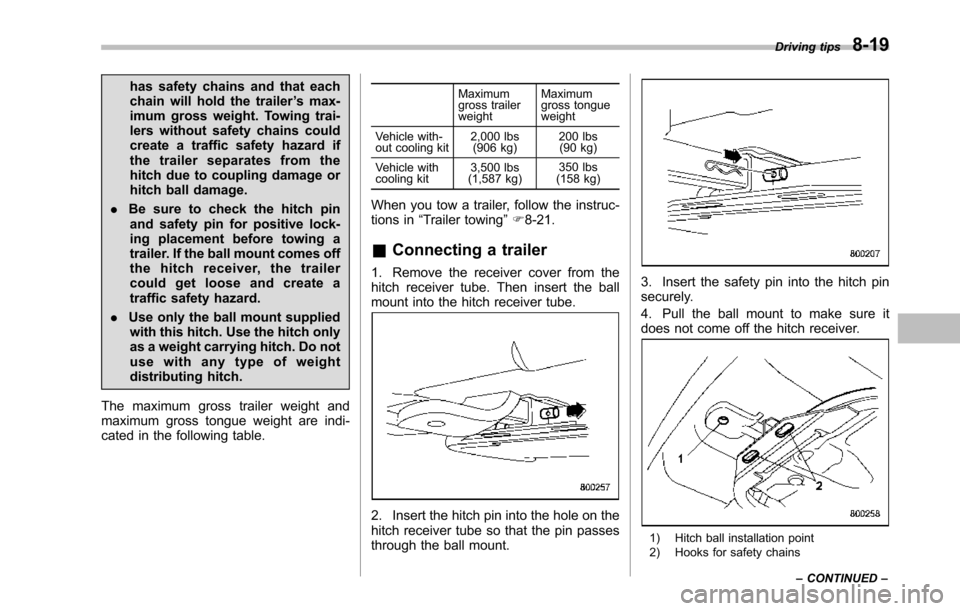
1. Remove the receiver cover from thehitch receiver tube. Then insert the ballmount into the hitch receiver tube.
2. Insert the hitch pin into the hole on thehitch receiver tube so that the pin passesthrough the ball mount.
3. Insert the safety pin into the hitch pinsecurely.
4. Pull the ball mount to make sure itdoes not come off the hitch receiver.
1) Hitch ball installation point2) Hooks for safety chains
Driving tips8-19
–CONTINUED–
Page 307 of 426
8-28Driving tips
zone in the“D”position than in themanual mode position.
.Avoid using the accelerator pedal tostay stationary on an uphill slope insteadof using the parking brake or foot brake.That may cause the transmission fluid tooverheat.
!Parking on a grade
Always block the wheels under bothvehicle and trailer when parking. Applythe parking brake firmly. You should notpark on a hill or slope. But if parking on ahill or slope cannot be avoided, youshould take the following steps.
1. Apply the brakes and hold the pedaldown.
2. Have someone place wheel blocksunder both the vehicle and trailer wheels.
3. When the wheel blocks are in place,release the regular brakes slowly until theblocks absorb theload.
4. Apply the regular brakes and thenapply the parking brake; slowly releasethe regular brakes.
5. Shift into“P”and shut off the engine.
Page 308 of 426
If you park your vehicle in an emergency......... 9-2
Spare tire............................................................. 9-2Removing the spare tire...................................... 9-3Re-storage of spare tire....................................... 9-4
Temporary spare tire........................................... 9-5
Flat tires............................................................... 9-6Changing a flat tire.............................................. 9-6Tire pressure monitoring system (TPMS) ............ 9-10
Jump starting..................................................... 9-11How to jump start............................................... 9-12
Engine overheating........................................... 9-14If steam is coming from the enginecompartment................................................... 9-14If no steam is coming from the enginecompartment................................................... 9-14
Towing................................................................ 9-14Towing and tie-down hooks................................ 9-15Using a flat-bed truck......................................... 9-17Towing with all wheels on the ground................. 9-17
Reargate–if the rear gate cannot beunlocked.......................................................... 9-18
Maintenance tools............................................. 9-19Jack and jack handle......................................... 9-19
In case of emergency
9
Page 310 of 426
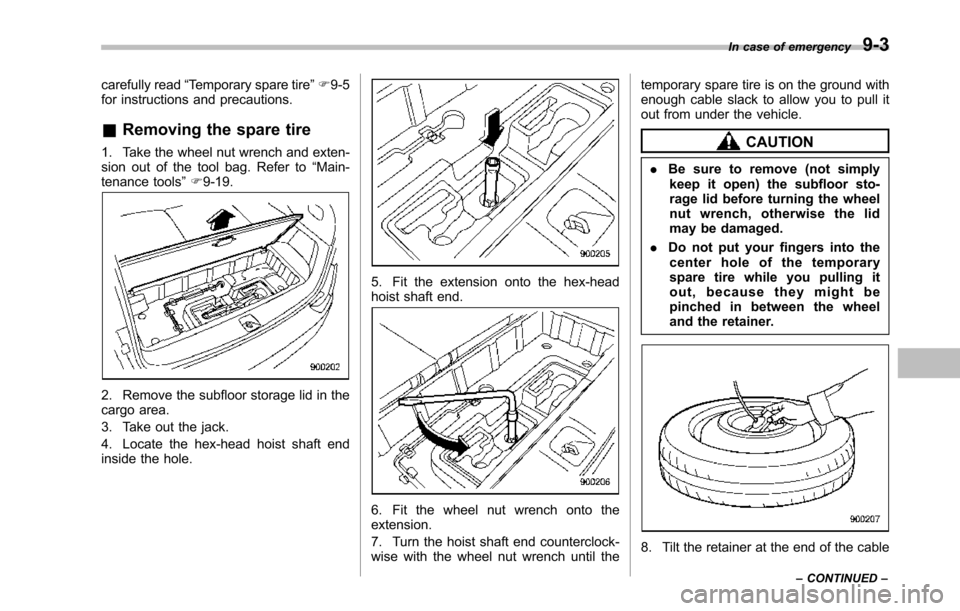
carefully read“Temporary spare tire”F9-5for instructions and precautions.
&Removing the spare tire
1. Take the wheel nut wrench and exten-sion out of the tool bag. Refer to“Main-tenance tools”F9-19.
2. Remove the subfloor storage lid in thecargo area.
3. Take out the jack.
4. Locate the hex-head hoist shaft endinside the hole.
5. Fit the extension onto the hex-headhoist shaft end.
6. Fit the wheel nut wrench onto theextension.
7. Turn the hoist shaft end counterclock-wise with the wheel nut wrench until the
temporary spare tire is on the ground withenough cable slack to allow you to pull itout from under the vehicle.
CAUTION
.Be sure to remove (not simplykeep it open) the subfloor sto-ragelid before turning the wheelnut wrench, otherwise the lidmay be damaged.
.Do not put your fingers into thecenter hole of the temporaryspare tire while you pulling itout, because they might bepinched in between the wheelandthe retainer.
8. Tilt the retainer at the end of the cable
In case of emergency9-3
–CONTINUED–
Page 311 of 426
9-4In case of emergency
and pull it through the center of thetemporary spare tire.
9. After the temporary spare tire isremoved from the cable, the cable mustbe wound up completely by turning thehoist nut shaft clockwise until you hear aclicking sound. Also visually inspect thecable to make certain that there is nolonger any slack present.
WARNING
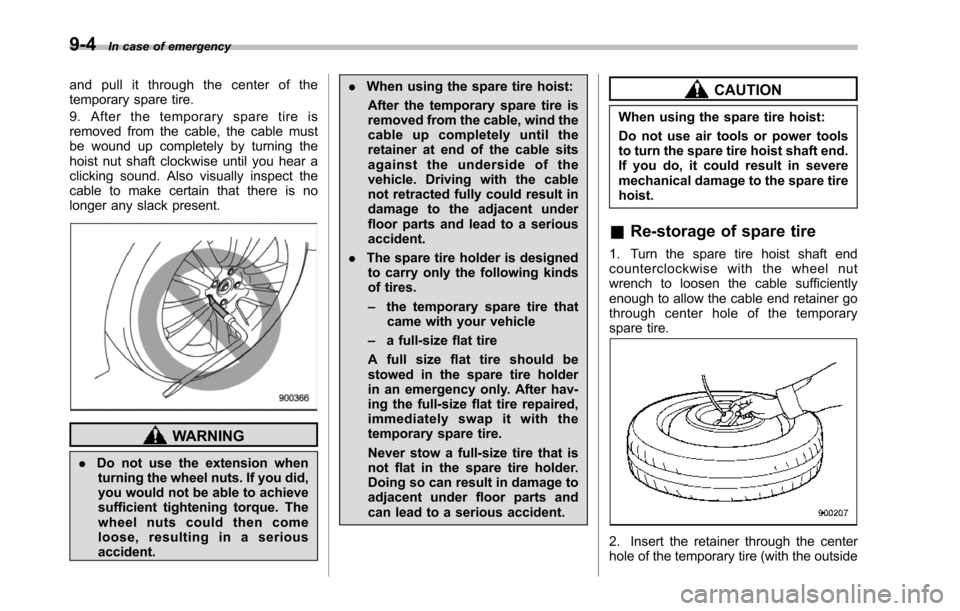
.Do not use the extension whenturning the wheel nuts. If you did,you would not be able to achievesufficient tightening torque. Thewheel nuts could then comeloose, resulting in a seriousaccident.
.When using the spare tire hoist:
After the temporary spare tire isremoved from the cable, wind thecable up completely until theretainer at end of the cable sitsagainst the underside of thevehicle. Driving with the cablenot retracted fully could result indamage to the adjacent underfloor partsand lead to a seriousaccident.
.The spare tire holder is designedto carry only the following kindsof tires.
–the temporaryspare tire thatcame with your vehicle
–a full-size flat tire
A full size flat tire should bestowed in the spare tire holderin an emergency only. After hav-ing the full-sizeflat tire repaired,immediately swap it with thetemporary spare tire.
Never stow a full-size tire that isnot flat in the spare tire holder.Doing so can result in damage toadjacent under floor parts andcan lead to a serious accident.
CAUTION
When using the spare tire hoist:
Do not use air tools or power toolsto turn the spare tire hoist shaft end.If you do, it could result in severemechanical damage to the spare tirehoist.
&Re-storage of spare tire
1. Turn the spare tire hoist shaft endcounterclockwise with the wheel nutwrench to loosen the cable sufficientlyenough to allow the cable end retainer gothrough center hole of the temporaryspare tire.
2. Insert the retainer through the centerhole of the temporary tire (with the outside
Page 312 of 426

of the tire facing up).
3. Turn the hoist shaft end clockwise withthe wheel nut wrench to wind the cable upcompletely until you hear a few clickingsounds.Confirm that the temporary sparetire holding cable has been wound upcompletely by shaking the temporary tire.
CAUTION
If the temporary spare tire is notstored securely, it could damageadjacent areas of the vehicle andmake an abnormal noise.
4. Place the wheel nut wrench andextension back into the tool bag and storethe jackand tool bag in their storagelocations.
5. Fit the lid of the cargo area.
CAUTION
.When stowing a flat tire in thespare tire holder, turn the hoistshaft end only slowly. If it isturned quickly, the wheel disc ofthe flat tire could be damaged.
.Afull-sizeflattireshouldbestowed in the spare tire holderin an emergency only. After hav-ingthe flat tire repaired, immedi-ately swap it with the temporaryspare tire.
.Remember that the tread width ofa flat tire is wider than that of thetemporary spare tire. When car-rying a flat tire stowed in thespare tire holder, make sure thetiredoes not touch any obsta-cles.
Temporary spare tire
WARNING
.Never tow a trailer when thetemporary spare tire is used.The temporary spare tire is notdesigned to sustain the towingload. Use of the temporary sparetire when towing can result infailure of the spare tire and/orless stability of the vehicle andmay lead to an accident.
.When a spare tire is mounted or awheel rim is replaced without theoriginal pressure sensor/trans-mitter being transferred, the lowtire pressure warning light willilluminate steadily after blinkingfor approximately one minute.This indicates the tire pressuremonitoring system (TPMS) is un-able to monitor all four roadwheels. Contact your SUBARUdealer as soon as possible fortire and sensor replacement and/or system resetting.
In case of emergency9-5
–CONTINUED–
Page 314 of 426
.Always turn off the engine beforeraising the flat tire off the groundusing the jack. Never swing orpush the vehicle supported withthe jack. The jack can come outof the jacking point due to a joltand this can result in a severeaccident.
1. Park on a hard, level surface, when-ever possible, then stop the engine.
2. Set the parking brake securely andshift in the“P”(Park) position.
3. Turn on the hazard warning flasherandhave everyone get out of the vehicle.
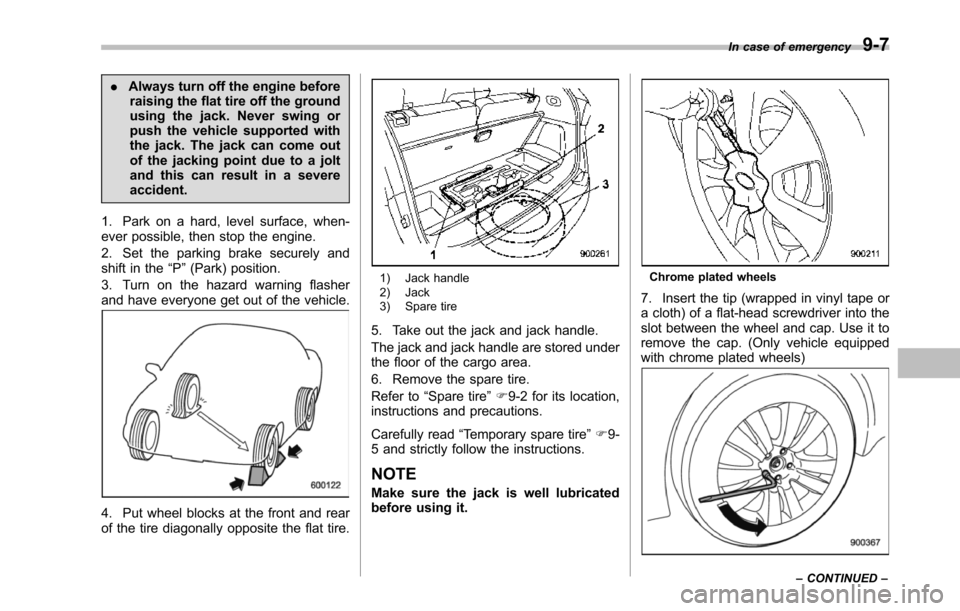
4. Put wheel blocks at the front and rearof the tire diagonally opposite the flat tire.
1) Jack handle2) Jack3) Spare tire
5. Take out the jack and jack handle.
The jack and jack handle are stored underthe floor of the cargo area.
6. Remove the spare tire.
Refer to“Spare tire”F9-2 for its location,instructions andprecautions.
Carefully read“Temporary spare tire”F9-5 and strictly follow the instructions.
NOTE
Make sure the jack is well lubricatedbefore using it.
Chrome plated wheels
7. Insert the tip (wrapped in vinyl tape ora cloth) of a flat-head screwdriver into theslot between the wheel and cap. Use it toremove the cap. (Only vehicle equippedwith chrome plated wheels)
In case of emergency9-7
–CONTINUED–