2014 SUBARU TRIBECA tires
[x] Cancel search: tiresPage 13 of 426
8
&Car phone/cell phone and
driving
CAUTION
Do not use a car phone/cell phonewhile driving; it may distract yourattention from driving and can leadto an accident. If you use a carphone/cell phone, pull off the roadand park in a safe place beforeusing your phone. In some States/Provinces, only hands-free phonesmay legally be used while driving.
&Modification of your vehicle
CAUTION
Your vehicle should not be modifiedother than with genuine SUBARUparts and accessories. Other typesof modifications could affect itsperformance, safety or durability,and may even violate governmentalregulations. In addition, damage orperformance problems resultingfrom modification may not be cov-ered under warranties.
&Driving a vehicle equipped
with a navigation system
WARNING
Do not allow the monitor to distractyour attention from driving. Also, donot operate the controls of thenavigation system while driving.The loss of attention to drivingcould lead to an accident. If youwish to operate the controls of thenavigation system, first take thevehicle off the road and stop it in asafe place.
&Driving with pets
Unrestrained pets can interfere with yourdriving and distract your attention fromdriving. In a collision or sudden stop,unrestrained pets or cages can be thrownaround inside the vehicle and hurt you oryour passengers. Besides, the pets canbe hurt under these situations. It is also fortheir own safety that pets should beproperly restrained in your vehicle. Re-strain a pet with a special travelingharnesswhich can be secured to the rearseat with a seatbelt or use a pet carrierwhich can be secured to the rear seat byrouting a seatbelt through the carrier’s
handle. Never restrain pets or pet carriersin the front passenger’s seat. For furtherinformation, consult your veterinarian,local animal protection society or petshop.
&Tire pressures
WARNING
Driving at high speeds with exces-sively low tirepressures can causethe tires to deform severely and torapidly become hot. A sharp in-crease in temperature could causetread separation, and destruction ofthe tires. The resulting loss ofvehicle control could lead to anaccident.
Check and, if necessary, adjust thepressure of each tire (including the spare)at least once a month and before any longjourney.
Check the tire pressure when the tires arecold. Use a pressure gauge to adjust thetire pressures to the values shown on thetire placard. For detailed information, referto“Tires and wheels”F11-21.
Page 17 of 426
12
Illustrated index
&Exterior
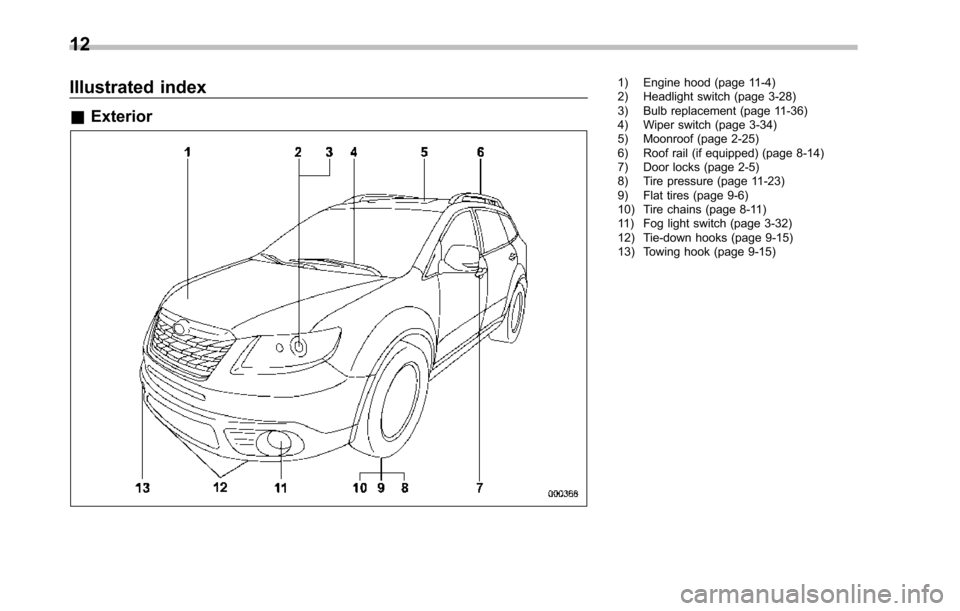
1) Engine hood (page 11-4)2) Headlight switch (page 3-28)3) Bulb replacement (page 11-36)4) Wiper switch (page 3-34)5) Moonroof (page 2-25)6) Roof rail (if equipped) (page 8-14)7) Door locks (page 2-5)8) Tire pressure (page 11-23)9) Flat tires (page 9-6)10) Tire chains (page 8-11)11) Fog light switch (page 3-32)12) Tie-down hooks (page 9-15)13) Towing hook (page 9-15)
Page 59 of 426

1-28Seat, seatbelt and SRS airbags
viceable parts. For required ser-vicing of front seatbelt retractorsequipped with seatbelt preten-sioners, see your nearestSUBARU dealer.
.When discarding front seatbeltretractor assemblies or scrap-ping the entire vehicle due tocollision damage or for otherreasons, consult your SUBARUdealer.
&System monitors
A diagnostic system continually monitorsthe readiness of the seatbelt pretensionerwhile the vehicle is being driven. Theseatbeltpretensioners share the controlmodule with the airbag system. Therefore,if any malfunction occurs in a seatbeltpretensioner, the SRS airbag systemwarning light will illuminate. For details,refer to“SRS airbag system monitors”F1-71.
&System servicing
WARNING
.When discarding a seatbelt re-tractor assembly or scrappingthe entire vehicle damaged by a
collision, consult your SUBARUdealer.
.Tampering with or disconnectingthe system’s wiring could resultin accidental activation of theseatbelt pretensioner and/or air-bag or could make the systeminoperative, which may result inserious injury. Do not use elec-trical test equipment on anycircuit related to the seatbeltpretensioner and airbag sys-tems. For required servicing ofthe seatbelt pretensioner, seeyour nearest SUBARU dealer.
CAUTION
The front sub sensors are locatedon both sides of the radiator panel,and the airbag control module in-cludingthe impact sensors is lo-cated under the center console. Ifyou need service or repair in thoseareas or near the front seatbeltretractors, we recommend that youhave an authorized SUBARU dealerperform the work.
NOTE
If the front part of the vehicle isdamaged in an accident to the extentthat the seatbelt pretensioner does notoperate, contact your SUBARU dealeras soon as possible.
&Precautions against vehicle
modification
Always consult your SUBARU dealer ifyou want to install any accessory parts toyour vehicle.
CAUTION
Do not perform any of the followingmodifications. Such modificationscan interfere with proper operationof the seatbelt pretensioners.
.Attachment of any equipment(bush bar, winches, snow plow,skid plate, etc.)other than genu-ine SUBARU accessory parts tothe front end.
.Modification of the suspensionsystem or front end structure.
.Installation of a tire of differentsize and construction from thetires specified on the vehicleplacard attached to the doorpillar or specified for individual
Page 97 of 426
1-66Seat, seatbelt and SRS airbags
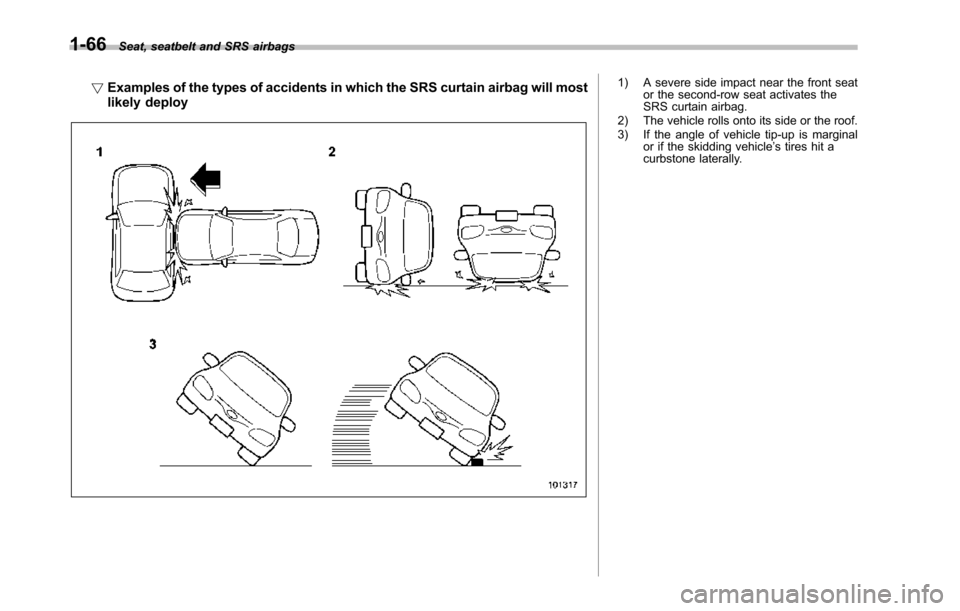
!Examples of the types of accidents in which the SRS curtain airbag will mostlikely deploy
1) A severe side impact near the front seator the second-row seat activates theSRS curtain airbag.2) The vehicle rolls onto its side or the roof.3) If the angle of vehicle tip-up is marginalor if the skidding vehicle’s tires hit acurbstone laterally.
Page 104 of 426
or wiring of the SRS airbag system.
This includes following modifica-tions.
.Installation of custom steeringwheels
.Attachment of additional trimmaterials to the dashboard
.Installation of custom seats
.Replacement of seat fabric orleather
.Installation of additional fabric orleather on the front seat
.Attachment of a hands-free mi-crophone or any other accessoryto a front pillar, a center pillar, arear pillar, the windshield, a sidewindow, an assist grip, or anyother cabin surface that would benear a deploying SRS curtainairbag.
.Installation of additional electri-cal/electronic equipment such asa mobile two-way radio on ornear the SRS airbag systemcomponents and/or wiring is notadvisable. This could interferewith proper operation of theSRS airbag system.
CAUTION
Do not perform any of the followingmodifications. Such modificationscan interfere with proper operationof the SRS airbag system.
.Attachment of any equipment(bush bar, winches, snow plow,skid plate, etc.) other than genu-ine SUBARU accessory parts.
.Modificationof the suspensionsystem or front end structure.
.Installation of a tire of differentsize and construction from thetires specified on the vehicleplacardattached to the driver’sdoor pillar or specified for indivi-dual vehicle models in this Own-er’s Manual.
.Attachment of any equipment(side steps or side sill protectors,etc.) other than genuine SUBARUaccessory parts to the side body.
Always consult your SUBARU dealer ifyou want to install any accessory parts onyour vehicle.
Seat, seatbelt and SRS airbags1-73
Page 147 of 426
3-14Instruments and controls
vehicle speed and stop the vehicle at thenearest safe place.
Park the vehicle for several minutes. Afterthe light turns off, you can start driving.
If the light does not turn off, contact thenearest SUBARU dealer for service.
NOTE
.If the tire pressures are not correctand/or the tires are not all the samesize and brand, the rear differential willbe heavily loaded when the vehicle isdriven, resultingin an abnormally highoiltemperature..The rear differential oil will deterio-rate if its temperature increases en-ough for the rear differential oil tem-perature warning light to illuminate. It isadvisable to have the rear differentialoil replaced as soon as possible.
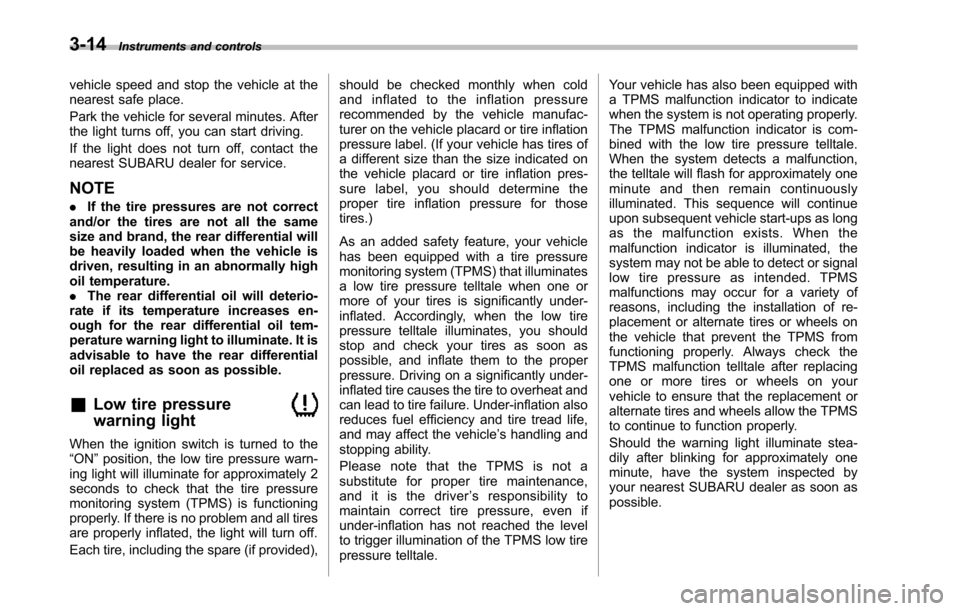
&Low tire pressure
warning light
When the ignition switch is turned to the“ON”position, the low tire pressure warn-ing light will illuminate for approximately 2seconds to check that the tire pressuremonitoring system (TPMS) is functioningproperly. If there is no problem and all tiresare properly inflated, the light will turn off.
Each tire, including the spare (if provided),
should be checked monthly when coldand inflated to the inflation pressurerecommended by the vehicle manufac-turer on the vehicle placard or tire inflationpressure label. (If your vehicle has tires ofa different size than the size indicated onthe vehicle placard or tire inflation pres-sure label, you should determine theproper tire inflation pressure for thosetires.)
As an added safety feature, your vehiclehas been equipped with a tire pressuremonitoring system (TPMS) that illuminatesa low tire pressure telltale when one ormore of your tires is significantly under-inflated. Accordingly, when the low tirepressure telltale illuminates, you shouldstop and check your tires as soon aspossible, and inflatethem to the properpressure.Driving on a significantly under-inflated tire causes the tire to overheat andcan lead to tire failure. Under-inflation alsoreduces fuel efficiency and tire tread life,and may affect the vehicle’s handling andstopping ability.
Please note that the TPMS is not asubstitute for proper tire maintenance,and it is the driver’sresponsibilitytomaintain correct tire pressure, even ifunder-inflation has not reached the levelto trigger illumination of the TPMS low tirepressure telltale.
Your vehicle has also been equipped witha TPMS malfunction indicator to indicatewhen the system is not operating properly.The TPMS malfunction indicator is com-bined with the low tire pressure telltale.When the system detects a malfunction,the telltale will flash for approximately oneminute and then remain continuouslyilluminated. This sequence will continueupon subsequent vehicle start-ups as longas the malfunction exists. When themalfunction indicator is illuminated, thesystem may not be able to detect or signallow tire pressure as intended. TPMSmalfunctions may occur for a variety ofreasons, including the installation of re-placement or alternate tires or wheels onthe vehicle that prevent the TPMS fromfunctioning properly. Always check theTPMS malfunction telltale after replacingone or more tires or wheels on yourvehicle to ensure that the replacement oralternate tires and wheels allow the TPMSto continue to function properly.
Should the warning light illuminate stea-dily after blinking for approximately oneminute, have the system inspected byyour nearest SUBARU dealer as soon aspossible.
Page 148 of 426

WARNING
If this light does not illuminatebriefly after the ignition switch isturned ON or the light illuminatessteadily after blinking for approxi-mately one minute, you should haveyour Tire Pressure Monitoring Sys-tem checked at a SUBARU dealer assoon as possible.
If this light illuminates while driving,never brake suddenly and keepdriving straight ahead while gradu-ally reducing speed. Then slowlypull off the road to a safe place.Otherwise an accident involvingserious vehicle damage and seriouspersonal injury could occur.
If this light still illuminates whiledriving after adjusting the tire pres-sure, a tire may have significantdamage and a fast leak that causesthe tire to lose air rapidly. If you havea flat tire, replace it with a spare tireas soon as possible.
When a spare tire is mounted or awheel rim is replaced without theoriginal pressure sensor/transmitterbeing transferred, the Low tire pres-sure warning light will illuminatesteadily after blinking for approxi-mately one minute. This indicates
that the TPMS is unable to monitorall four road wheels. Contact yourSUBARU dealer as soon as possiblefor tire and sensor replacement and/or system resetting. If the lightilluminates steadily after blinkingfor approximately one minute,promptly contact a SUBARU dealerto have the system inspected.
CAUTION
The tire pressure monitoring systemis NOT a substitute for manuallychecking tire pressure. The tirepressureshould be checked peri-odically (at least monthly) using atire gauge. After any change to tirepressure(s), the tire pressure mon-itoring system will not re-check tireinflationpressures until the vehicleis first driven more than 20 mph (32km/h). Therefore, after adjusting thetire pressures, increase the vehiclespeed to at least 20 mph (32 km/h) tostart the TPMS re-checking of thetire inflation pressures. If the tirepressures are now above the severelow pressure threshold, the low tirepressure warning light should turnoff a few minutes later. Therefore, besure to install the specified size for
the front and rear tires.
&ABS warning light
CAUTION
If the warning light behaves asfollows, the ABS system may notwork properly.
When the warning light illuminates,the ABS function shuts down; how-ever, the conventional brake systemcontinues to operate normally.
.The warning light does not illu-minate when the ignition switchis turned to the“ON”position.
.The warning light illuminateswhen the ignition switch isturned to the“ON”position, butit does not turn off even when thevehicle speed exceeds approxi-mately 8 mph (12 km/h).
.The warning light illuminates dur-ing driving.
If any of these conditions occur,have the ABS system repaired atthe first available opportunity byyour SUBARU dealer.
The ABS warning light illuminates to-
Instruments and controls3-15
–CONTINUED–
Page 151 of 426
3-18Instruments and controls
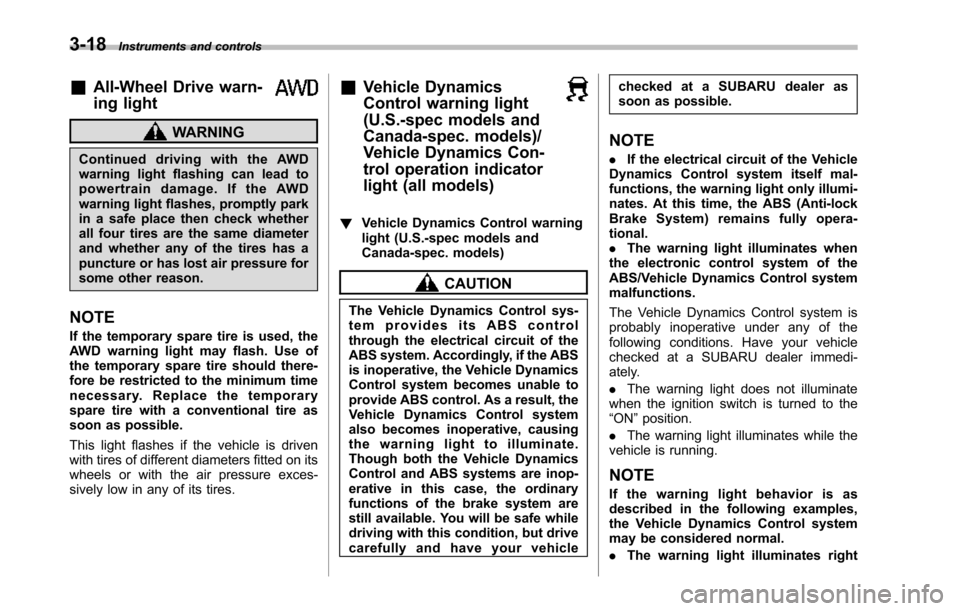
&All-Wheel Drive warn-
ing light
WARNING
Continued driving with the AWDwarning light flashing can lead topowertrain damage. If the AWDwarninglight flashes, promptly parkin a safe place then check whetherall four tires are the same diameterand whether any of the tires has apuncture or has lost air pressure forsome other reason.
NOTE
If the temporary spare tire is used, theAWD warning light may flash. Use ofthe temporary spare tire should there-fore be restricted to the minimum timenecessary. Replace the temporarysparetire with a conventional tire assoon as possible.
This light flashes if the vehicle is drivenwith tires of different diameters fitted on itswheelsor with the air pressure exces-sively low in any of its tires.
&Vehicle Dynamics
Control warning light
(U.S.-spec models and
Canada-spec. models)/
Vehicle Dynamics Con-
trol operation indicator
light (all models)
!Vehicle Dynamics Control warninglight (U.S.-spec models andCanada-spec. models)
CAUTION
The Vehicle Dynamics Control sys-tem provides its ABS controlthrough the electrical circuit of theABS system. Accordingly, if the ABSis inoperative, the Vehicle DynamicsControl system becomes unable toprovide ABS control. As a result, theVehicle Dynamics Control systemalso becomes inoperative, causingthe warning light to illuminate.Though both the Vehicle DynamicsControl and ABS systems are inop-erative in this case, the ordinaryfunctions of the brake system arestill available. You will be safe whiledriving with this condition, but drivecarefully and have your vehicle
checked at a SUBARU dealer assoon as possible.
NOTE
.If the electrical circuit of the VehicleDynamics Control system itself mal-functions, the warning light only illumi-nates. At this time, the ABS (Anti-lockBrake System) remains fully opera-tional..The warning light illuminates whenthe electronic control system of theABS/Vehicle Dynamics Control systemmalfunctions.
The Vehicle Dynamics Control system isprobably inoperative under any of thefollowing conditions. Have your vehiclecheckedat a SUBARU dealer immedi-ately.
.The warning light does not illuminatewhen the ignition switch is turned to the“ON”position.
.The warning light illuminates while thevehicle is running.
NOTE
If the warning light behavior is asdescribed in the following examples,the Vehicle Dynamics Control systemmay be considered normal.
.The warning light illuminates right